
Chapter 16 Breasts and Axillae an imprint of

Chapter 16 Breasts and Axillae . an imprint of Elsevier Inc. Copyright © 2015 by Mosby,

"I may not have gone where I intended to go, but I think I have ended up where I intended to be. " ---Douglas Adams Copyright © 2015 by Mosby, an imprint of Elsevier Inc.
Breasts and Axillae The breast examination is typically performed: Ø Ø When the patient has a specific breast complaint As part of an overall annual well person examination Examination of the breasts includes: Ø Ø Examination of the axillae Relevant lymph node chains Copyright © 2015 by Mosby, an imprint of Elsevier Inc. 3
Breasts and Axillae (Cont. ) Major focus of the examination in adults is identification of breast masses, skin, or vascular changes that could indicate malignancy. In children, it is important for Tanner staging and as part of the evaluation with hormonal concerns. Copyright © 2015 by Mosby, an imprint of Elsevier Inc. 4
Females Inspect with patient seated. Compare breasts Inspect both areolae and nipples Copyright © 2015 by Mosby, an imprint of Elsevier Inc. 5
Females (Cont. ) Reinspect breasts with the patient in the following positions: Arms extended over head or flexed behind the neck Ø Hands pressed on hips with shoulder rolled forward Ø Seated and leaning over Ø Recumbent position Ø Copyright © 2015 by Mosby, an imprint of Elsevier Inc. 6
Females (Cont. ) Perform a chest wall sweep. Perform bimanual digital palpation. Palpate for lymph nodes in the axilla, down the arm to the elbow, and in the supraclavicular and infraclavicular areas. Palpate breast tissue with patient supine, using light, medium, and deep pressure. Depress the nipple into the well behind the areola. Copyright © 2015 by Mosby, an imprint of Elsevier Inc. 7
Males Palpate breasts and over areolae for lumps or nodules. Palpate for lymph nodes in the axilla, down the arm to the elbow, and in the supraclavicular and infraclavicular areas. Copyright © 2015 by Mosby, an imprint of Elsevier Inc. 8
Breasts Glandular tissue Ø Lactiferous ducts drain milk from each lobe onto nipple surface. Fibrous tissue Ø Ø Provides breast support Suspensory ligaments (Cooper ligaments) • Extend from the connective tissue layer through the breast and attach to the underlying muscle fascia providing further support Copyright © 2015 by Mosby, an imprint of Elsevier Inc. 9
Breasts (Cont. ) Five segments (for examination purposes): four quadrants and tail Upper outer quadrant: greatest amount of glandular tissue Ø Upper inner quadrant Ø Lower outer quadrant Ø Tail of Spence Ø Copyright © 2015 by Mosby, an imprint of Elsevier Inc. 10
Breasts (Cont. ) Lymphatic network Ø Ø Deep lymphatics drain mammary lobules Complex of axillary lymph nodes Nipple Ø Sebaceous glands (Montgomery tubercles) on areola Copyright © 2015 by Mosby, an imprint of Elsevier Inc. 11
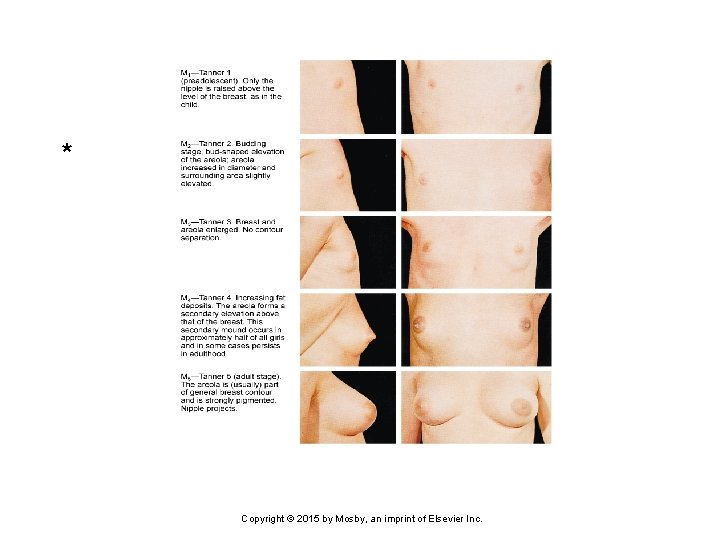
Children and Adolescents Breast development Latent phase in children and preadolescence Thelarche (breast development) early sign of puberty in adolescent girls Ø Tanner’s five stages of developing sexual maturity Ø Ø Copyright © 2015 by Mosby, an imprint of Elsevier Inc. 12
* Copyright © 2015 by Mosby, an imprint of Elsevier Inc.

Pregnant Women Areolae: increases in size and number due to placental hormones Ø pigment increases Ø become more erect Ø Vascularization increases. Milk is produced 2 -4 days after delivery Copyright © 2015 by Mosby, an imprint of Elsevier Inc. 14
History of Present Illness Breast mass or lump Breast discomfort Nipple discharge Copyright © 2015 by Mosby, an imprint of Elsevier Inc. 15
History of Present Illness (Cont. ) Breast enlargement in men History of hyperthyroidism, testicular tumor, Klinefelter syndrome Ø Medications Ø Treatment for prostate cancer: androgens or Gn. RH analogues Ø Illicit and/or recreational drugs: anabolic steroids, marijuana Ø Copyright © 2015 by Mosby, an imprint of Elsevier Inc. 16
History (Cont. ) Changes in breast characteristics Risk factors for breast cancer Mammogram and other breast imaging history Family history First day of last menstrual period Pregnancy and lactation Menopause Breast self-examination (BSE) Copyright © 2015 by Mosby, an imprint of Elsevier Inc. 17
Inspection/ Palpation Peau-d’orange is edema on or around the nipple and is from blocked lymph nodes Nipple and areola—The 5 D’s Ø Ø Ø Discharge Depression or inversion Discoloration Dermatologic changes Deviation Copyright © 2015 by Mosby, an imprint of Elsevier Inc. 18
Inspection/Palpation Inspect breasts in varied positions. Seated with arms extended over head or flexed behind neck Ø Hands pressed on hips with shoulder rolled forward Ø Seated and leaning forward from waist Ø Supine with arms above head with towel under shoulder Ø Copyright © 2015 by Mosby, an imprint of Elsevier Inc. 19
Palpation Document masses found. Nipples Discharge Tail of Spence Ø Both axillae Copyright © 2015 by Mosby, an imprint of Elsevier Inc. 20
Palpation (Cont. ) Males Expect to feel a thin layer of fatty tissue overlying muscle. Ø Gynecomastia Ø Have patient hang arms at sides Ø Copyright © 2015 by Mosby, an imprint of Elsevier Inc. 21
Infants Breasts of many well newborns, male and female, are enlarged for a relatively brief time. Ø Result of passively transferred maternal estrogen Copyright © 2015 by Mosby, an imprint of Elsevier Inc. 22
Adolescents Breast tissue is based on Tanner stages Gynecomastia Ø Unusual and unexpected Copyright © 2015 by Mosby, an imprint of Elsevier Inc. 23
Pregnant Women Inspection Ø Ø Increase in size Tenderness and tingling Enlarged erect nipples Vascular spiders and striae Palpation Ø Ø Colostrum Coarse nodularity of breast tissue Dilated subcutaneous veins Engorgement Copyright © 2015 by Mosby, an imprint of Elsevier Inc. 24
Abnormalities (Breasts) Paget disease Ø Mastitis Ø Inflammation and infection of the breast tissue Fibrocystic changes Ø Surface manifestation of underlying ductal cancer Benign fluid-filled cyst formation caused by ductal enlargement Galactorrhea Ø Lactation not associated with childbearing Copyright © 2015 by Mosby, an imprint of Elsevier Inc. 25
Abnormalities (Breast Lumps) Malignant breast tumors Ductal cancer arises from the epithelial lining of ducts Ø Lobular cancer originates in the glandular tissue of the lobules Ø Fibroadenoma Ø Benign tumors composed of stromal and epithelial elements that represent a hyperplastic or proliferative process in a single terminal ductal unit Copyright © 2015 by Mosby, an imprint of Elsevier Inc. 26
Abnormalities (Children) Premature thelarche Ø Ø Ø Breast enlargement in girls before onset of puberty Cause unknown Breasts continue to enlarge slowly throughout childhood until full development reached during adolescence Copyright © 2015 by Mosby, an imprint of Elsevier Inc. 27

Breast Self Exam http: //www. breasthealthinfo. com Copyright © 2015 by Mosby, an imprint of Elsevier Inc.
- Slides: 28