
Chapter 16 Auditing Information Technology What is auditing
- Slides: 37
Chapter 16 Auditing Information Technology What is auditing through the computer? l It is the process of reviewing and evaluating the internal controls in an electronic data processing system. l What is auditing with the computer? l It is the utilization of the computer by an auditor to perform some audit work that otherwise would have to be done manually. l 2001 Prentice Hall Business Publishing, Accounting Information Systems, 8/E, Bodnar/Hopwood 16 - 1
Structure of Financial Statement Audit The primary objective and responsibility of the external auditor is to attest to the fairness of a firm’s financial reports. l The external auditor serves the firm’s stockholders, the government, and the general public. l The internal auditor serves a firm’s management. l 2001 Prentice Hall Business Publishing, Accounting Information Systems, 8/E, Bodnar/Hopwood 16 - 2
Structure of Financial Statement Audit Various types of professional certifications are applicable to auditing. l What are these? l CPA (certified public accountant) l CISA (certified information systems auditor) l CIA (certified internal auditor) l Audits are almost universally divided into two components. l 2001 Prentice Hall Business Publishing, Accounting Information Systems, 8/E, Bodnar/Hopwood 16 - 3
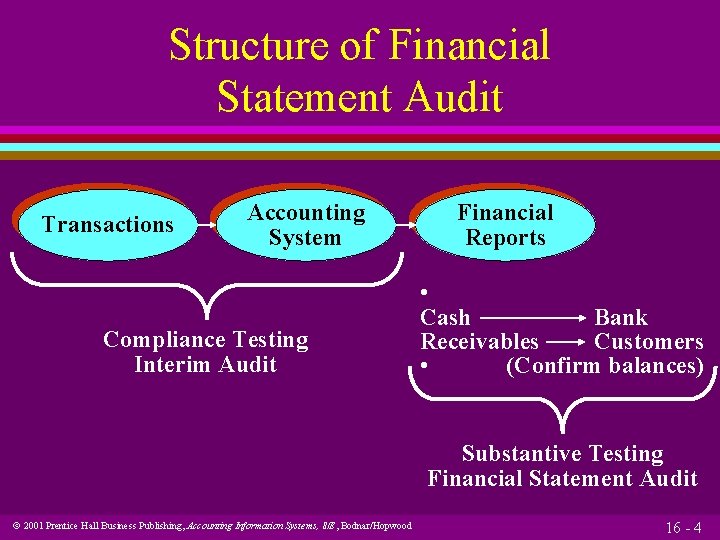
Structure of Financial Statement Audit Transactions Accounting System Compliance Testing Interim Audit Financial Reports • Cash Bank Receivables Customers • (Confirm balances) Substantive Testing Financial Statement Audit 2001 Prentice Hall Business Publishing, Accounting Information Systems, 8/E, Bodnar/Hopwood 16 - 4
Auditing Around the Computer An accounting system is comprised of input, processing, and output. l In the around-the-computer approach, the processing portion is ignored. l Auditing through the computer may be defined as l the verification of controls in a computerized system. l Auditing with the computer is the process of using information technology in auditing. 2001 Prentice Hall Business Publishing, Accounting Information Systems, 8/E, Bodnar/Hopwood 16 - 5
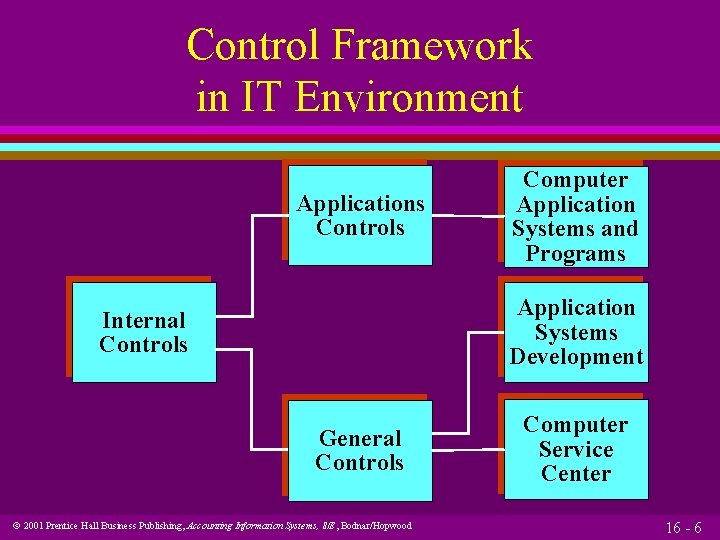
Control Framework in IT Environment Applications Controls Computer Application Systems and Programs Application Systems Development Internal Controls General Controls 2001 Prentice Hall Business Publishing, Accounting Information Systems, 8/E, Bodnar/Hopwood Computer Service Center 16 - 6
Auditing with the Computer l 1 2 What are some of the potential benefits of using information systems technology in an audit? Computer-generated working papers are generally more legible and consistent. Time may be saved by eliminating manual footing, cross footing, and other routine calculations. 2001 Prentice Hall Business Publishing, Accounting Information Systems, 8/E, Bodnar/Hopwood 16 - 7
Auditing with the Computer 3 4 5 Calculations, comparisons, and other data manipulations are more accurately performed. Analytical review calculations may be more efficiently performed. Project information may be more easily generated analyzed. 2001 Prentice Hall Business Publishing, Accounting Information Systems, 8/E, Bodnar/Hopwood 16 - 8
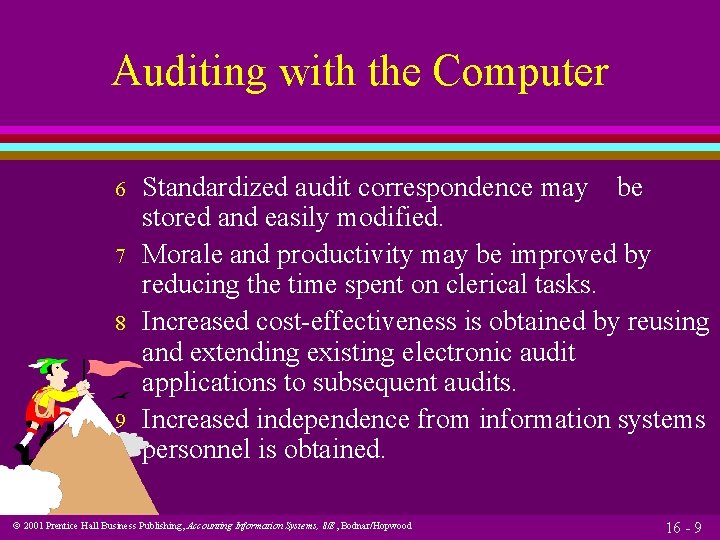
Auditing with the Computer 6 7 8 9 Standardized audit correspondence may be stored and easily modified. Morale and productivity may be improved by reducing the time spent on clerical tasks. Increased cost-effectiveness is obtained by reusing and extending existing electronic audit applications to subsequent audits. Increased independence from information systems personnel is obtained. 2001 Prentice Hall Business Publishing, Accounting Information Systems, 8/E, Bodnar/Hopwood 16 - 9
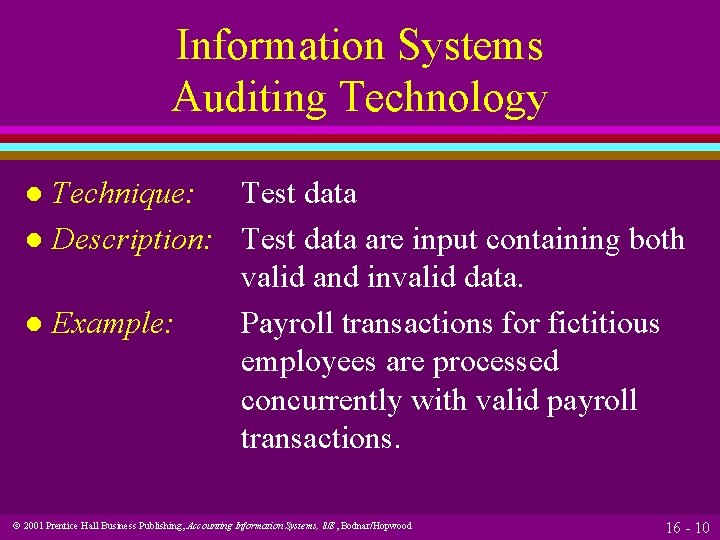
Information Systems Auditing Technology Technique: Test data l Description: Test data are input containing both valid and invalid data. l Example: Payroll transactions for fictitious employees are processed concurrently with valid payroll transactions. l 2001 Prentice Hall Business Publishing, Accounting Information Systems, 8/E, Bodnar/Hopwood 16 - 10
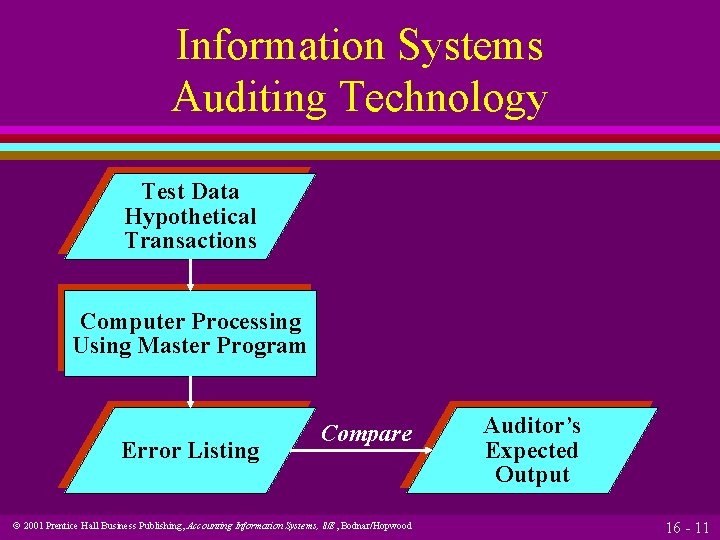
Information Systems Auditing Technology Test Data Hypothetical Transactions Computer Processing Using Master Program Error Listing Compare 2001 Prentice Hall Business Publishing, Accounting Information Systems, 8/E, Bodnar/Hopwood Auditor’s Expected Output 16 - 11
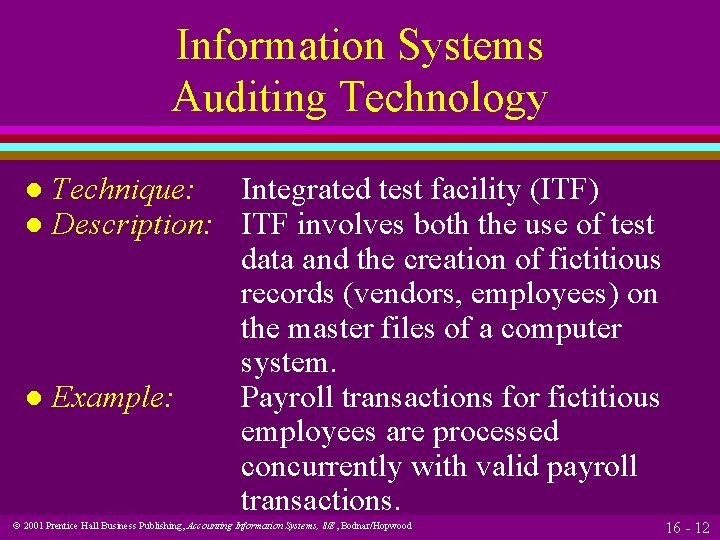
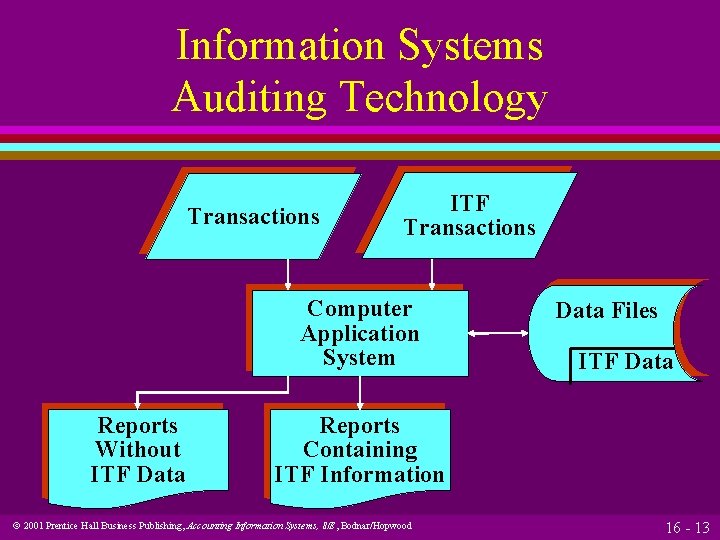
Information Systems Auditing Technology Technique: Integrated test facility (ITF) Description: ITF involves both the use of test data and the creation of fictitious records (vendors, employees) on the master files of a computer system. l Example: Payroll transactions for fictitious employees are processed concurrently with valid payroll transactions. l l 2001 Prentice Hall Business Publishing, Accounting Information Systems, 8/E, Bodnar/Hopwood 16 - 12
Information Systems Auditing Technology Transactions ITF Transactions Computer Application System Reports Without ITF Data Files ITF Data Reports Containing ITF Information 2001 Prentice Hall Business Publishing, Accounting Information Systems, 8/E, Bodnar/Hopwood 16 - 13
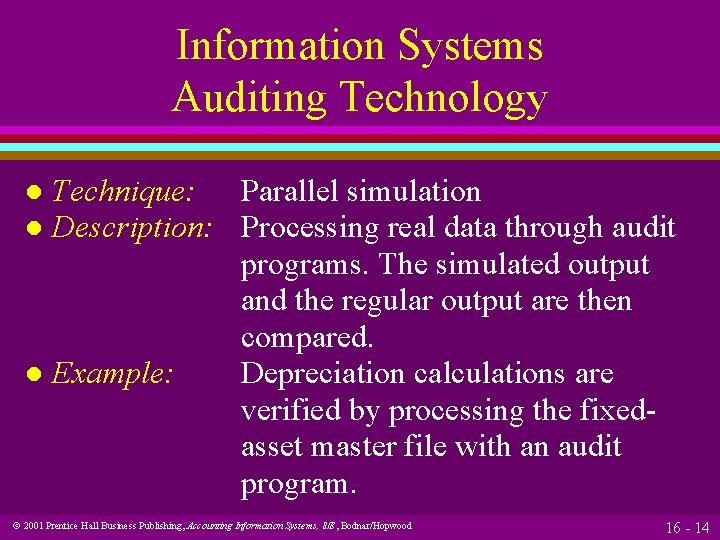
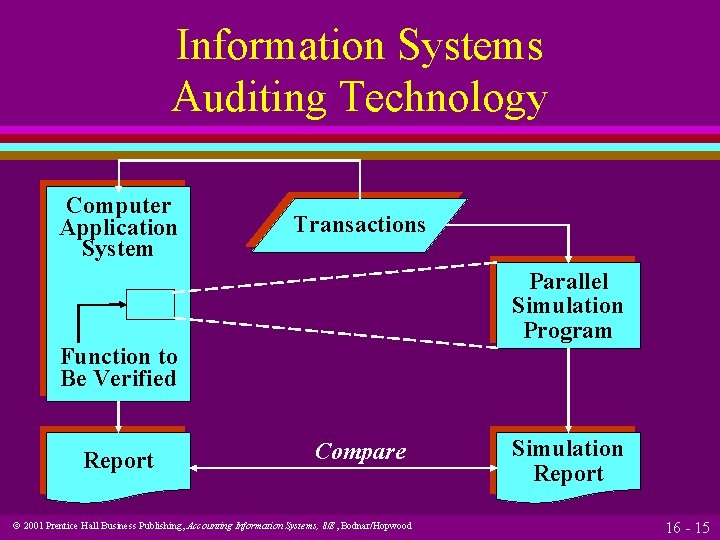
Information Systems Auditing Technology Technique: Parallel simulation Description: Processing real data through audit programs. The simulated output and the regular output are then compared. l Example: Depreciation calculations are verified by processing the fixedasset master file with an audit program. l l 2001 Prentice Hall Business Publishing, Accounting Information Systems, 8/E, Bodnar/Hopwood 16 - 14
Information Systems Auditing Technology Computer Application System Transactions Parallel Simulation Program Function to Be Verified Report Compare 2001 Prentice Hall Business Publishing, Accounting Information Systems, 8/E, Bodnar/Hopwood Simulation Report 16 - 15
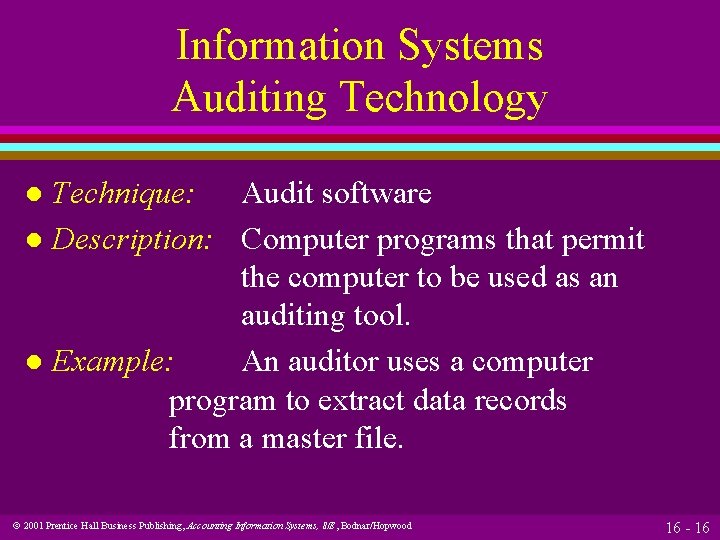
Information Systems Auditing Technology Technique: Audit software l Description: Computer programs that permit the computer to be used as an auditing tool. l Example: An auditor uses a computer program to extract data records from a master file. l 2001 Prentice Hall Business Publishing, Accounting Information Systems, 8/E, Bodnar/Hopwood 16 - 16
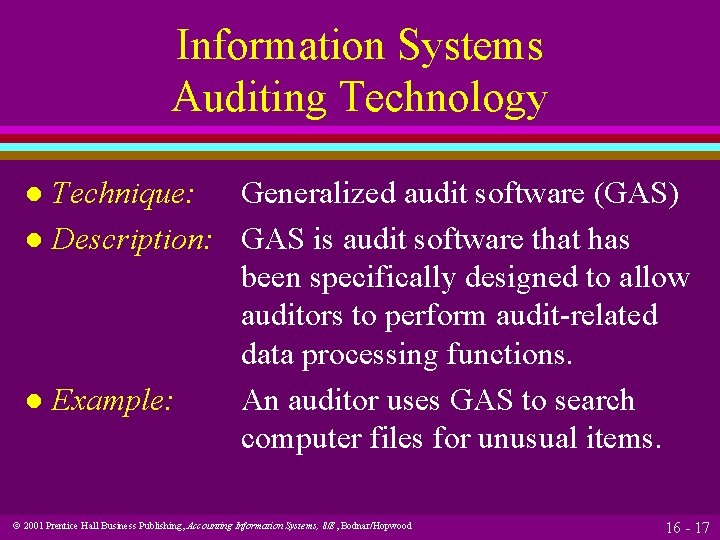
Information Systems Auditing Technology Technique: Generalized audit software (GAS) l Description: GAS is audit software that has been specifically designed to allow auditors to perform audit-related data processing functions. l Example: An auditor uses GAS to search computer files for unusual items. l 2001 Prentice Hall Business Publishing, Accounting Information Systems, 8/E, Bodnar/Hopwood 16 - 17
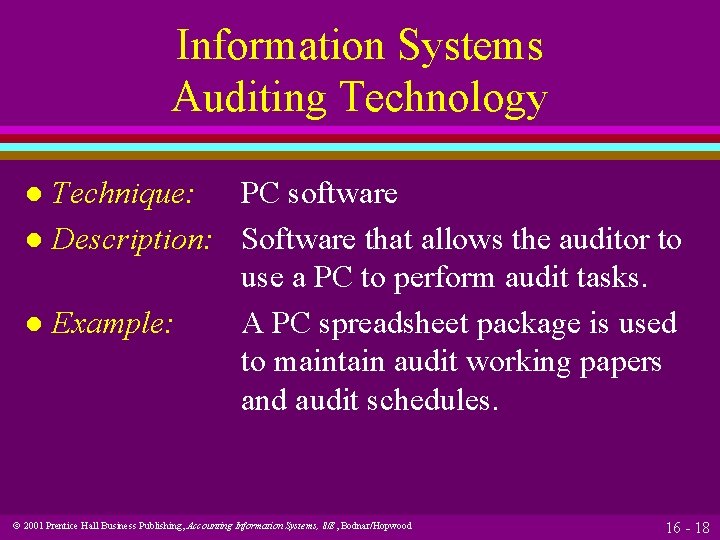
Information Systems Auditing Technology Technique: PC software l Description: Software that allows the auditor to use a PC to perform audit tasks. l Example: A PC spreadsheet package is used to maintain audit working papers and audit schedules. l 2001 Prentice Hall Business Publishing, Accounting Information Systems, 8/E, Bodnar/Hopwood 16 - 18
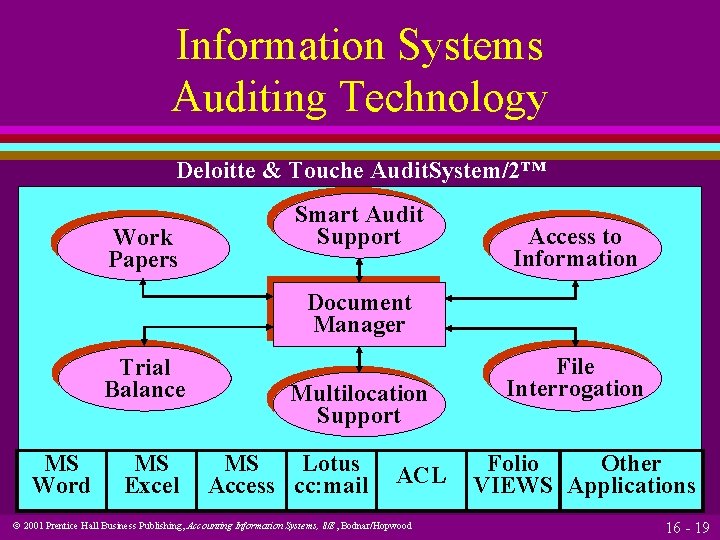
Information Systems Auditing Technology Deloitte & Touche Audit. System/2™ Work Papers Smart Audit Support Access to Information Document Manager Trial Balance MS Word MS Excel Multilocation Support MS Lotus Access cc: mail ACL 2001 Prentice Hall Business Publishing, Accounting Information Systems, 8/E, Bodnar/Hopwood File Interrogation Folio Other VIEWS Applications 16 - 19
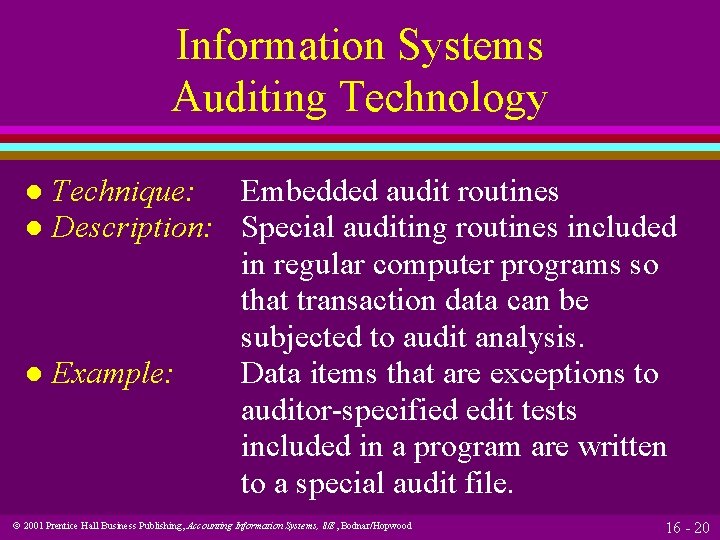
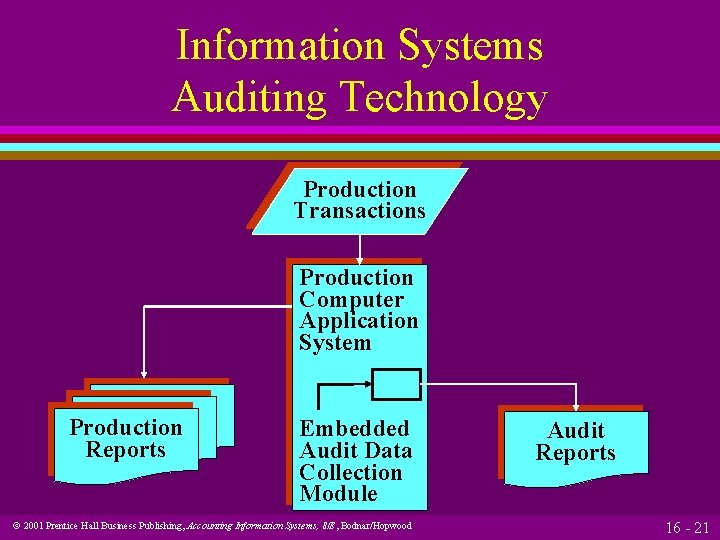
Information Systems Auditing Technology Technique: Embedded audit routines Description: Special auditing routines included in regular computer programs so that transaction data can be subjected to audit analysis. l Example: Data items that are exceptions to auditor-specified edit tests included in a program are written to a special audit file. l l 2001 Prentice Hall Business Publishing, Accounting Information Systems, 8/E, Bodnar/Hopwood 16 - 20
Information Systems Auditing Technology Production Transactions Production Computer Application System Production Reports Embedded Audit Data Collection Module 2001 Prentice Hall Business Publishing, Accounting Information Systems, 8/E, Bodnar/Hopwood Audit Reports 16 - 21
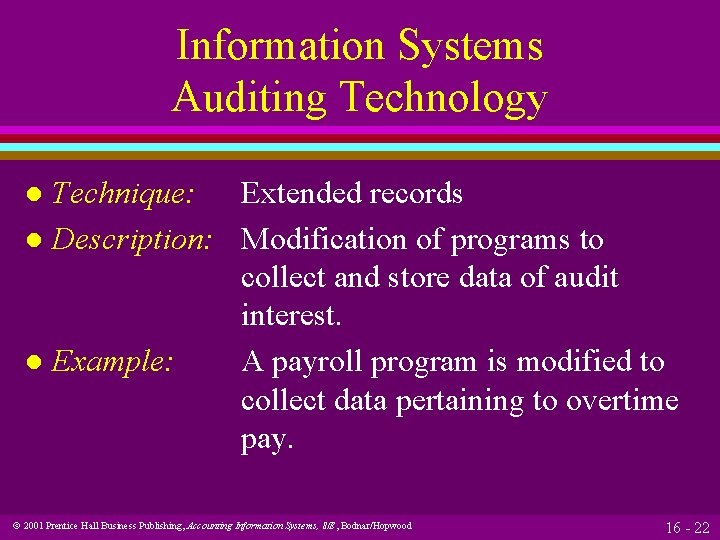
Information Systems Auditing Technology Technique: Extended records l Description: Modification of programs to collect and store data of audit interest. l Example: A payroll program is modified to collect data pertaining to overtime pay. l 2001 Prentice Hall Business Publishing, Accounting Information Systems, 8/E, Bodnar/Hopwood 16 - 22
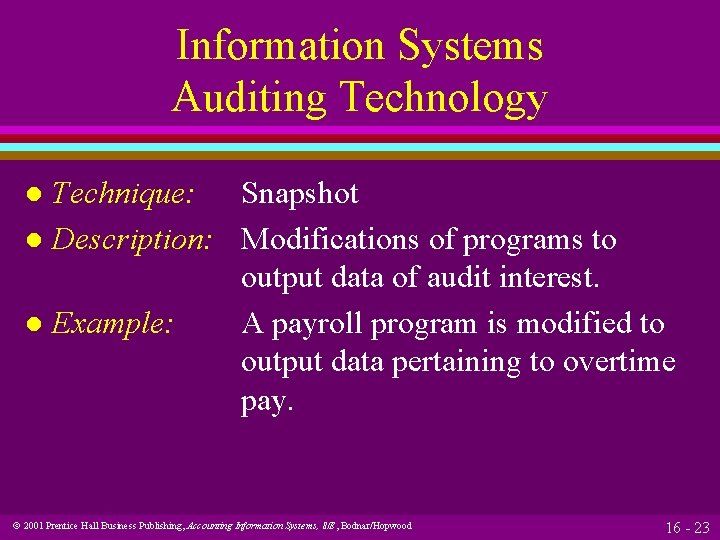
Information Systems Auditing Technology Technique: Snapshot l Description: Modifications of programs to output data of audit interest. l Example: A payroll program is modified to output data pertaining to overtime pay. l 2001 Prentice Hall Business Publishing, Accounting Information Systems, 8/E, Bodnar/Hopwood 16 - 23
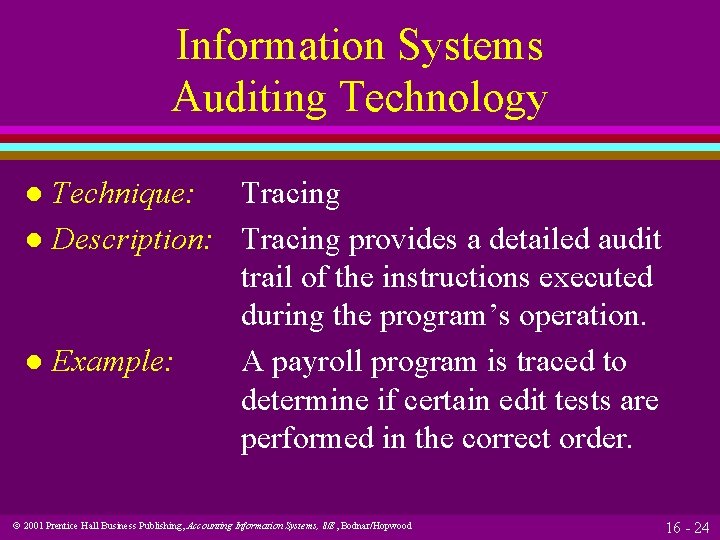
Information Systems Auditing Technology Technique: Tracing l Description: Tracing provides a detailed audit trail of the instructions executed during the program’s operation. l Example: A payroll program is traced to determine if certain edit tests are performed in the correct order. l 2001 Prentice Hall Business Publishing, Accounting Information Systems, 8/E, Bodnar/Hopwood 16 - 24
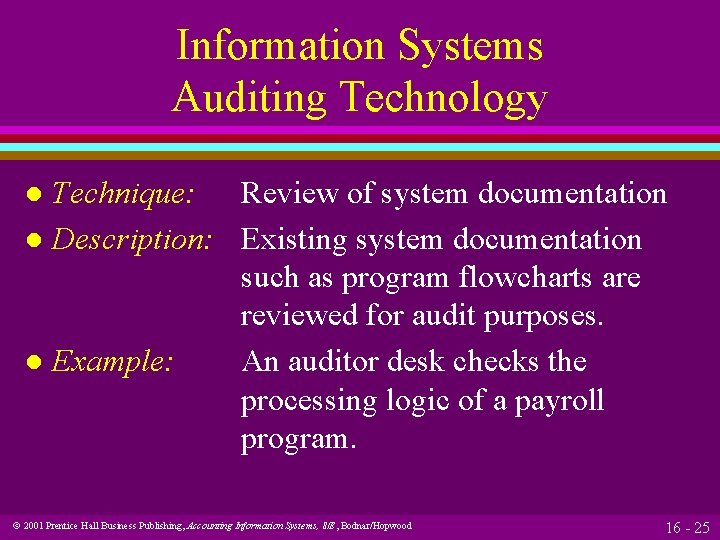
Information Systems Auditing Technology Technique: Review of system documentation l Description: Existing system documentation such as program flowcharts are reviewed for audit purposes. l Example: An auditor desk checks the processing logic of a payroll program. l 2001 Prentice Hall Business Publishing, Accounting Information Systems, 8/E, Bodnar/Hopwood 16 - 25
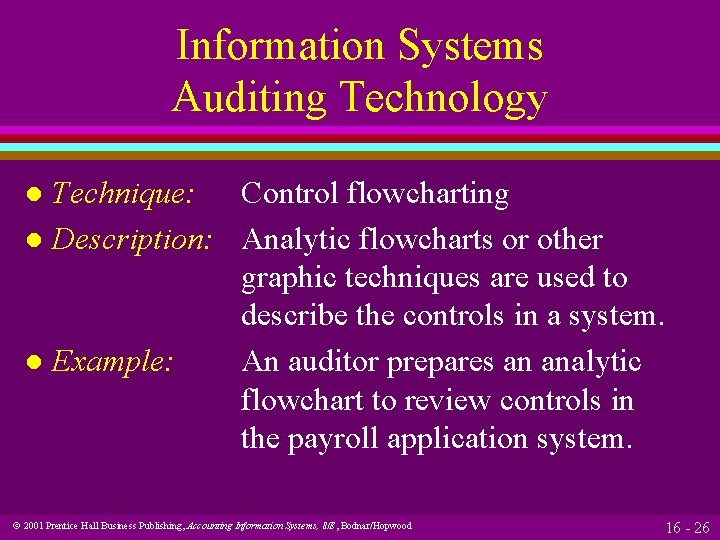
Information Systems Auditing Technology Technique: Control flowcharting l Description: Analytic flowcharts or other graphic techniques are used to describe the controls in a system. l Example: An auditor prepares an analytic flowchart to review controls in the payroll application system. l 2001 Prentice Hall Business Publishing, Accounting Information Systems, 8/E, Bodnar/Hopwood 16 - 26
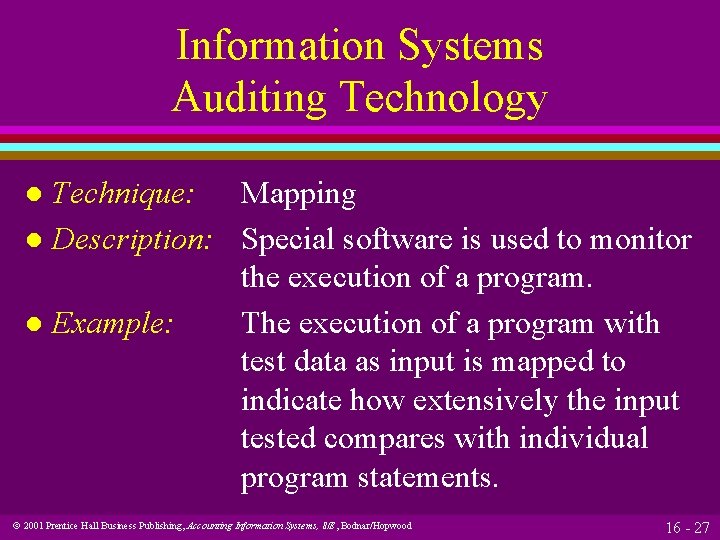
Information Systems Auditing Technology Technique: Mapping l Description: Special software is used to monitor the execution of a program. l Example: The execution of a program with test data as input is mapped to indicate how extensively the input tested compares with individual program statements. l 2001 Prentice Hall Business Publishing, Accounting Information Systems, 8/E, Bodnar/Hopwood 16 - 27
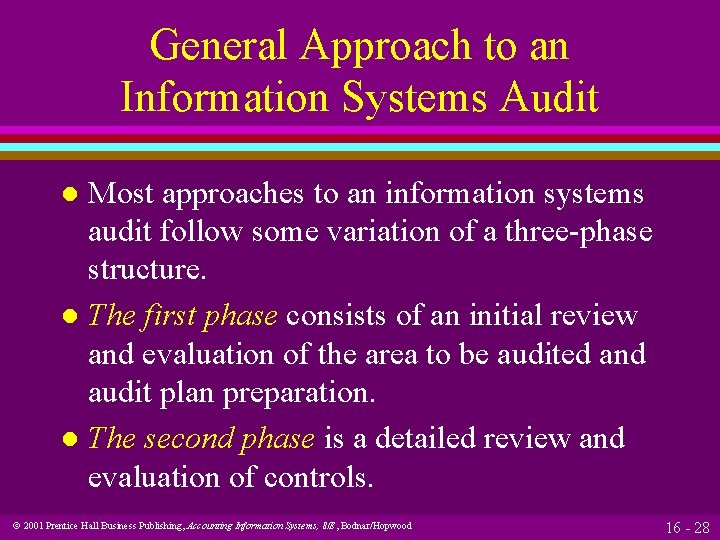
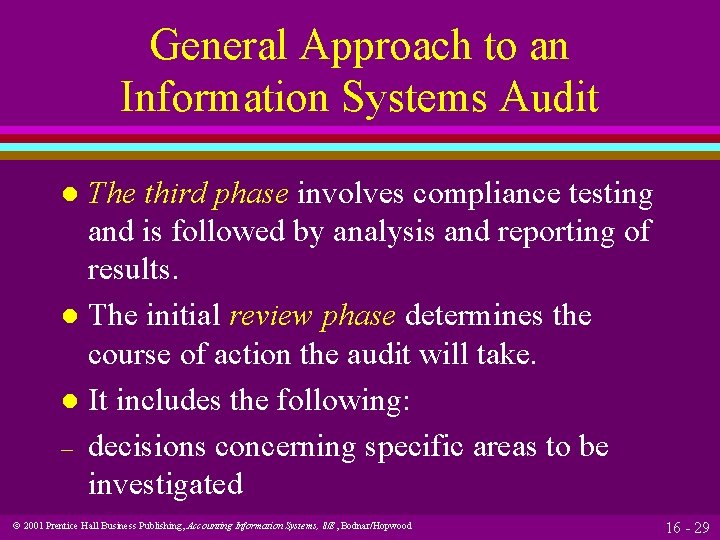
General Approach to an Information Systems Audit Most approaches to an information systems audit follow some variation of a three-phase structure. l The first phase consists of an initial review and evaluation of the area to be audited and audit plan preparation. l The second phase is a detailed review and evaluation of controls. l 2001 Prentice Hall Business Publishing, Accounting Information Systems, 8/E, Bodnar/Hopwood 16 - 28
General Approach to an Information Systems Audit The third phase involves compliance testing and is followed by analysis and reporting of results. l The initial review phase determines the course of action the audit will take. l It includes the following: – decisions concerning specific areas to be investigated l 2001 Prentice Hall Business Publishing, Accounting Information Systems, 8/E, Bodnar/Hopwood 16 - 29
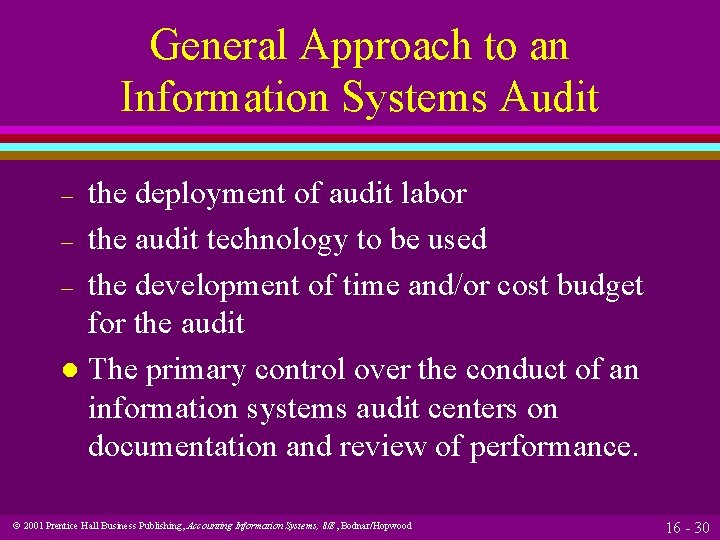
General Approach to an Information Systems Audit the deployment of audit labor – the audit technology to be used – the development of time and/or cost budget for the audit l The primary control over the conduct of an information systems audit centers on documentation and review of performance. – 2001 Prentice Hall Business Publishing, Accounting Information Systems, 8/E, Bodnar/Hopwood 16 - 30
General Approach to an Information Systems Audit What is an audit program? l It is a detailed list of the audit procedures to be applied on a particular audit. l Standardized audit programs for particular audit areas have been developed and are common in all types of auditing. l 2001 Prentice Hall Business Publishing, Accounting Information Systems, 8/E, Bodnar/Hopwood 16 - 31
General Approach to an Information Systems Audit In the second general phase of the audit, effort is focused on fact-finding in the area(s) selected for audit. l Documentation of the application area is reviewed. l Data concerning the operation of the system are reviewed. l 2001 Prentice Hall Business Publishing, Accounting Information Systems, 8/E, Bodnar/Hopwood 16 - 32
General Approach to an Information Systems Audit l In the third phase of the audit, compliance tests are undertaken to provide reasonable assurance that internal controls exist and operate as prescribed. 2001 Prentice Hall Business Publishing, Accounting Information Systems, 8/E, Bodnar/Hopwood 16 - 33
Information Systems Application Audits Application controls are divided into three general areas. l What are these areas? 1 Input 2 Processing 3 Output l 2001 Prentice Hall Business Publishing, Accounting Information Systems, 8/E, Bodnar/Hopwood 16 - 34
Application Systems Development Audits There are three general areas of audit concern in the systems development process. l They are: 1 Systems development standards 2 Project management 3 Program change control l What are systems development standards? l 2001 Prentice Hall Business Publishing, Accounting Information Systems, 8/E, Bodnar/Hopwood 16 - 35
Application Systems Development Audits Systems development standards are the documentation governing the design, development, and implementation of application systems. l What is project management? l It consists of project planning and project supervision. l 2001 Prentice Hall Business Publishing, Accounting Information Systems, 8/E, Bodnar/Hopwood 16 - 36
Application Systems Development Audits l l l What is the objective of program change controls? It is to prevent unauthorized and potentially fraudulent changes from being introduced into previously tested and accepted programs. Normally, an audit of the computer service center is undertaken before any application audits to ensure the general integrity of the environment in which the application will function. 2001 Prentice Hall Business Publishing, Accounting Information Systems, 8/E, Bodnar/Hopwood 16 - 37