
CHAPTER 16 AGENCY FORMATION AND TERMINATION 2010 Pearson
- Slides: 28
CHAPTER 16 AGENCY FORMATION AND TERMINATION © 2010 Pearson Education, Inc. , publishing as Prentice-Hall 1
Agency Relationships • Formed by the mutual consent of principal and agent. • Agency is a fiduciary relationship “which results from the manifestation of consent by one person to another that the other shall act in his behalf and subject to his control, and consent by the other so to act. ” © 2010 Pearson Education, Inc. , publishing as Prentice-Hall 2
Agency • Agency Law – Body of common law that governs agency. – Contract law and tort law. • Principal – The party who employs another person to act on his or her behalf. • Agent – The party who agrees to act on behalf of another. © 2010 Pearson Education, Inc. , publishing as Prentice-Hall 3
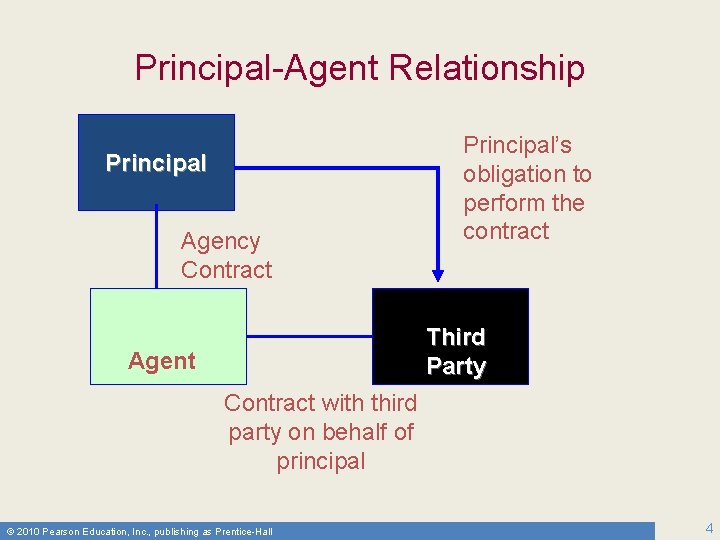
Principal-Agent Relationship Principal Agency Contract Principal’s obligation to perform the contract Third Party Agent Contract with third party on behalf of principal © 2010 Pearson Education, Inc. , publishing as Prentice-Hall 4
Who Can Initiate Agency Relationship • Any person who has the capacity to contract can appoint an agent to act on his or her behalf. • Persons who lack contractual capacity cannot appoint an agent. – E. g. , insane persons and minors. – Court may appoint guardian who may act as agent of such persons. © 2010 Pearson Education, Inc. , publishing as Prentice-Hall 5
Purpose of Agency Relationship • An agency can be created only to accomplish a lawful purpose. • Agency contracts that are created for illegal purposes or are against public policy are void and unenforceable. – E. g. , contract to hire agent to commit crime. © 2010 Pearson Education, Inc. , publishing as Prentice-Hall 6
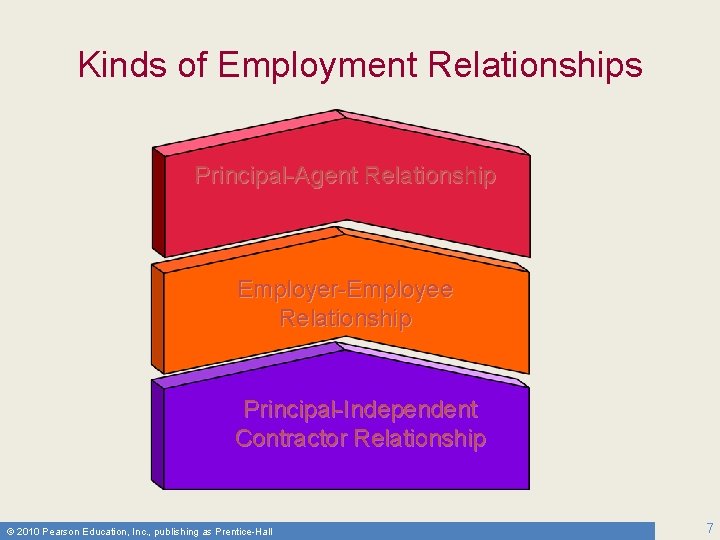
Kinds of Employment Relationships Principal-Agent Relationship Employer-Employee Relationship Principal-Independent Contractor Relationship © 2010 Pearson Education, Inc. , publishing as Prentice-Hall 7
Principal-Agent Relationship • Employer hires employee, giving employee authority to act and enter into contracts on his or her behalf. • Extent of authority governed by any express agreement between the parties and implied from the circumstances of the agency. – E. g. , president of corporation has authority to enter into major contracts; assembly line supervisor has authority to enter contracts to buy supplies to keep line running. © 2010 Pearson Education, Inc. , publishing as Prentice-Hall 8
Employer-Employee Relationship • Employer hires an employee to perform task or service. • Employee is not an agent unless he or she is specifically empowered to enter into contracts on the principal/employer’s behalf. – E. g. , assembly line worker may have no authority to enter into contracts. © 2010 Pearson Education, Inc. , publishing as Prentice-Hall 9
Principal-Independent Contractor Relationship • Principals employ persons or businesses that are not employees to perform certain tasks. – E. g. , plumbers, architects, lawyers, CPAs. • Crucial factor in determining whether employee or independent contractor is degree of control that principal has over that person. © 2010 Pearson Education, Inc. , publishing as Prentice-Hall 10
Independent Contractor and Agency Status • Principal can authorize independent contractor to enter into contracts. – E. g. , authorize attorney to enter into settlement agreement on client’s behalf. • Principal liable for authorized contracts of independent contractors. © 2010 Pearson Education, Inc. , publishing as Prentice-Hall 11
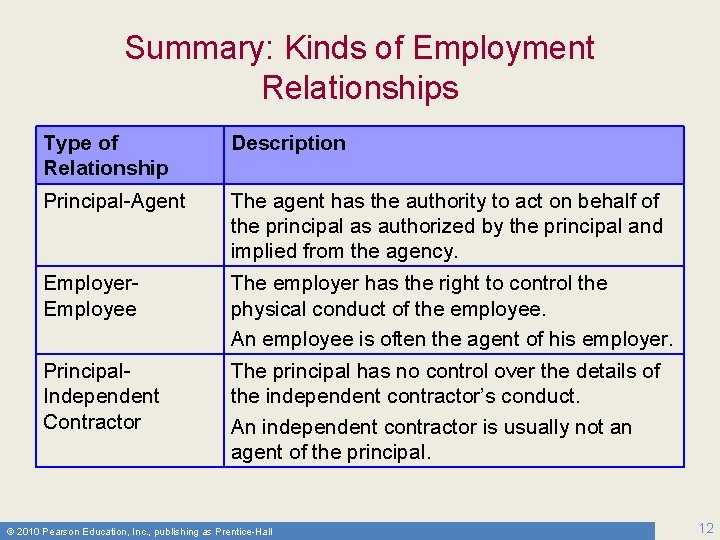
Summary: Kinds of Employment Relationships Type of Relationship Description Principal-Agent The agent has the authority to act on behalf of the principal as authorized by the principal and implied from the agency. Employer. Employee The employer has the right to control the physical conduct of the employee. An employee is often the agent of his employer. Principal. Independent Contractor The principal has no control over the details of the independent contractor’s conduct. An independent contractor is usually not an agent of the principal. © 2010 Pearson Education, Inc. , publishing as Prentice-Hall 12
Express Agency • Express agency contracts may be either oral or written, unless the Statute of Frauds stipulates that they must be written. – E. g. , agency agreement with real estate agent to be in writing. • May be exclusive agency agreement or power of attorney. © 2010 Pearson Education, Inc. , publishing as Prentice-Hall 13
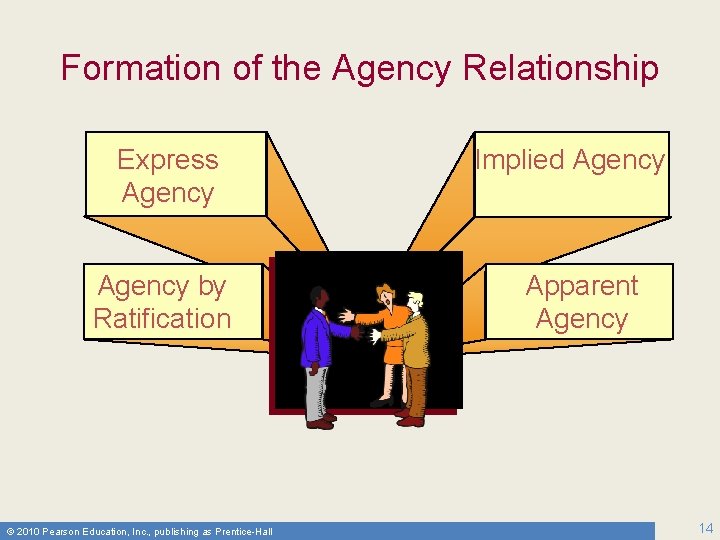
Formation of the Agency Relationship Express Agency by Ratification © 2010 Pearson Education, Inc. , publishing as Prentice-Hall Implied Agency Apparent Agency 14
Implied Agency • Agency is implied from the conduct of the parties. • Extent of agent’s authority determined from facts and circumstances of the particular situation. – Industry custom, prior dealings of parties, agent’s position, acts necessary to carry out agent’s express duties. © 2010 Pearson Education, Inc. , publishing as Prentice-Hall 15
Incidental Authority • Express agency agreement may lack certain details regarding performance. • It may be implied that agent possesses duties beyond express agency powers. – E. g. , to take reasonable actions in emergency situations. © 2010 Pearson Education, Inc. , publishing as Prentice-Hall 16
Agency by Ratification Agency that occurs when: 1. A person misrepresents himself or herself as another’s agent when in fact he or she is not, and 2. The purported principal ratifies (accepts) the unauthorized act. © 2010 Pearson Education, Inc. , publishing as Prentice-Hall 17
Apparent Agency • Agency that arises when a principal creates the appearance of an agency that in actuality does not exist. • When an apparent agency is established, the principal is estopped from denying the agency relationship. © 2010 Pearson Education, Inc. , publishing as Prentice-Hall 18
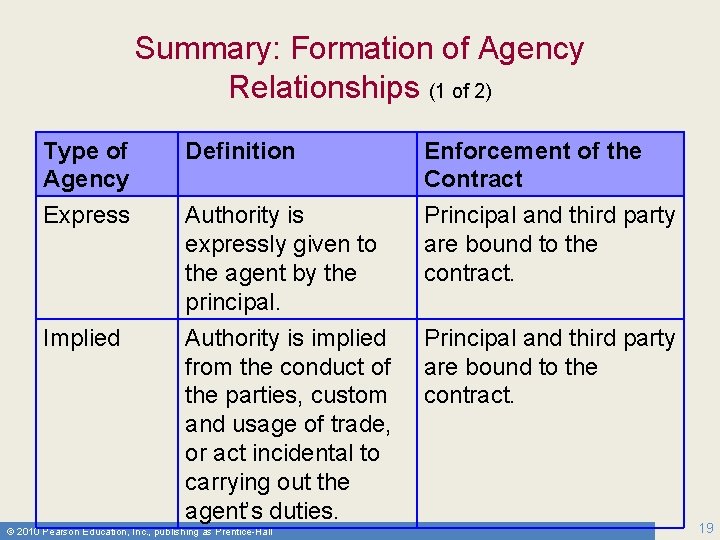
Summary: Formation of Agency Relationships (1 of 2) Type of Agency Definition Enforcement of the Contract Express Authority is expressly given to the agent by the principal. Authority is implied from the conduct of the parties, custom and usage of trade, or act incidental to carrying out the agent’s duties. Principal and third party are bound to the contract. Implied © 2010 Pearson Education, Inc. , publishing as Prentice-Hall Principal and third party are bound to the contract. 19
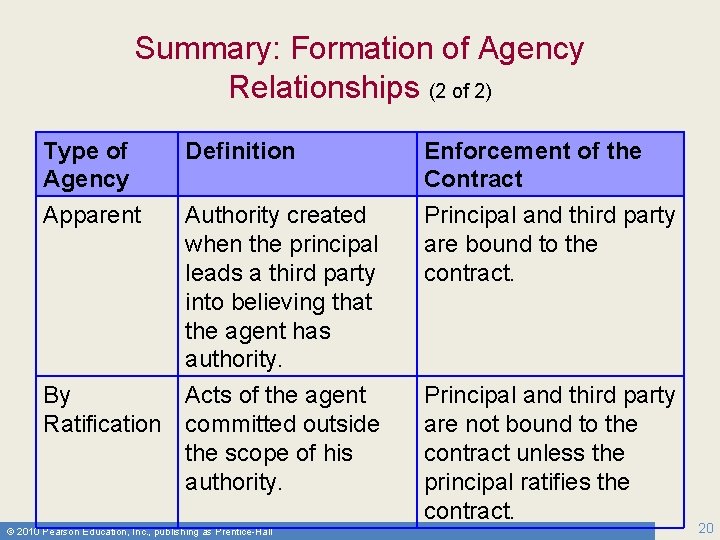
Summary: Formation of Agency Relationships (2 of 2) Type of Agency Definition Apparent Authority created when the principal leads a third party into believing that the agent has authority. By Acts of the agent Ratification committed outside the scope of his authority. © 2010 Pearson Education, Inc. , publishing as Prentice-Hall Enforcement of the Contract Principal and third party are bound to the contract. Principal and third party are not bound to the contract unless the principal ratifies the contract. 20
Principal’s Duties • Principal compensates agent for services provided, unless is gratuitous agent. • Principal indemnifies agent for authorized expenses or losses suffered because of the principal. • Principal cooperates with and assists agent in performance of agent’s duties. © 2010 Pearson Education, Inc. , publishing as Prentice-Hall 21
Agent’s Duties • Agent must perform. – Performing the lawful duties expressed in the contract. – Meeting the standards of reasonable care, skill, and diligence implicit in all contracts. • • Agent must notify principal of relevant information. Agent must maintain accurate accounting of all transactions and money received. – Money or other benefits belong to principal; held in constructive trust. © 2010 Pearson Education, Inc. , publishing as Prentice-Hall 22
Termination of Agency by Act of Parties • Parties may terminate agency by agreement or by their actions. – Mutual agreement. – Lapse of time. – Purpose achieved. – Occurrence of specified event. © 2010 Pearson Education, Inc. , publishing as Prentice-Hall 23
Notification Required • If agency terminated by agreement of parties, principal must notify third parties of termination of agency. – Parties who dealt with the agent given direct notice. – Parties who have knowledge of the agency given direct or constructive notice. E. g. , legal notice in newspaper. – Parties who have no knowledge of the agency owed no notice. • If proper notice not given, agent continues to have apparent authority. © 2010 Pearson Education, Inc. , publishing as Prentice-Hall 24
Agency Coupled with an Interest • Agency created for agent’s benefit. – E. g. , if debtor fails to pay debt, creditor/agent authorized to sell debtor’s property. • Irrevocable by principal. • Not terminated by death or incapacity of either principal or agent. • Terminates only when agent’s obligations are performed. © 2010 Pearson Education, Inc. , publishing as Prentice-Hall 25
Termination of Agency or Employment Contract • Contracts that do not specify a definite time for termination may be terminated at will by either party without liability. – Principal revokes authority. – Agent renounces authority. © 2010 Pearson Education, Inc. , publishing as Prentice-Hall 26
Wrongful Termination of Agency or Employment Contract • Termination of agency contract in violation of its terms. • Nonbreaching party may recover damages. • Critical distinction between power and right to terminate an agency. © 2010 Pearson Education, Inc. , publishing as Prentice-Hall 27
Termination by Operation of Law • • • Death of principal or agent. Insanity of principal or agent. Bankruptcy of principal. Changed circumstances. War between principal’s and agent’s countries. Impossibility • • • Loss or destruction of subject matter of agency. Loss of required qualification by agent. Change in law making agency illegal. © 2010 Pearson Education, Inc. , publishing as Prentice-Hall 28