
Chapter 16 Additives Producing Desired Characteristics in Foods
- Slides: 45
Chapter 16 Additives: Producing Desired Characteristics in Foods Images shutterstock. com
Objectives • Differentiate between intentional and incidental food additives. • State the role of the Food and Drug Administration in regulating additives. • Describe four main functions of additives. continued © Goodheart-Willcox Co. , Inc. Permission granted to reproduce for educational use only.
Objectives • Explain the secondary use of additives as processing aids. • Weigh the advantages and disadvantages of additives in the food supply. © Goodheart-Willcox Co. , Inc. Permission granted to reproduce for educational use only.
What Is a Food Additive? • Ingredients are component parts of food products that are generally recognized as safe – An ingredient list indicates what has been combined to make a food product • A food additive is a substance added to food to cause a desired positive change in the product’s characteristics continued © Goodheart-Willcox Co. , Inc. Permission granted to reproduce for educational use only.
What Is a Food Additive? • Food additives – may or may not have nutritional value – can be added at any point from the farm to the kitchen table – are regulated by the USDA and FDA – undergo extensive testing and research to confirm their safety continued © Goodheart-Willcox Co. , Inc. Permission granted to reproduce for educational use only.
What Is a Food Additive? • Additives get into foods in 2 main ways – Intentional food additives are added on purpose to give food specific characteristics – Incidental food additives get into foods unintentionally • Both intentional and incidental food additives are regulated to protect the consumer from health hazards © Goodheart-Willcox Co. , Inc. Permission granted to reproduce for educational use only.
Regulating Additive Use • Foods are constantly monitored, tested, and reevaluated for safety • U. S. Food regulations and guidelines keep up with new scientific knowledge • The 1938 Federal Food, Drug, and Cosmetic Act gave the FDA authority – to supervise the use of additives in the food supply and set the guidelines for their use continued © Goodheart-Willcox Co. , Inc. Permission granted to reproduce for educational use only.
Regulating Additive Use • The 1958 Food Additive Amendment prevents the use of an additive in foods unless the FDA is convinced it is safe – Evidence of safety must be based on scientific research – A manufacturer of a new additive is required to provide proof of safety before receiving approval for its use continued © Goodheart-Willcox Co. , Inc. Permission granted to reproduce for educational use only.
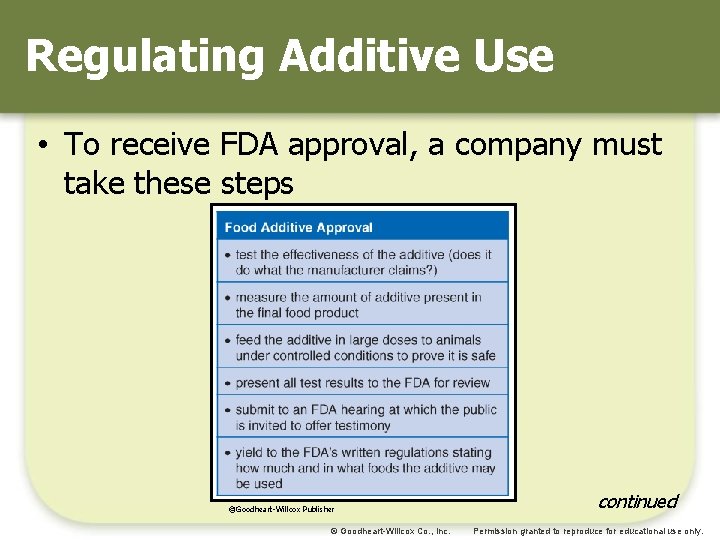
Regulating Additive Use • To receive FDA approval, a company must take these steps ©Goodheart-Willcox Publisher © Goodheart-Willcox Co. , Inc. continued Permission granted to reproduce for educational use only.
Regulating Additive Use • The FDA establishes a margin of safety for each additive – This is the zone between the concentration in which an additive is used and the level at which a hazard exists – Most foods have a margin of safety of 1/100, meaning a person would need to eat 100 servings in a short period to be at risk continued © Goodheart-Willcox Co. , Inc. Permission granted to reproduce for educational use only.
Regulating Additive Use • The law further requires that – an intentional additive must perform a useful function – an additive cannot be used to deceive the consumer or hide faulty manufacturing – an additive cannot cause a substantial loss of nutritive value in a food continued © Goodheart-Willcox Co. , Inc. Permission granted to reproduce for educational use only.
Regulating Additive Use • The law further requires that – an additive cannot be used in place of good manufacturing practices – a method must exist for analyzing the presence of the additive in food • The FDA can reject an additive if any of the requirements are not met © Goodheart-Willcox Co. , Inc. Permission granted to reproduce for educational use only.
The GRAS List • Food additives that had long been used with no known health hazards were exempt from the 1958 Food Additive Amendment – They were placed on a generally recognized as safe list, known as the GRAS list. – Manufacturers were allowed to continue use of the GRAS list additives until testing could be done continued © Goodheart-Willcox Co. , Inc. Permission granted to reproduce for educational use only.
The GRAS List • President Nixon ordered the reevaluation of the GRAS list in 1969 – Those found with a potential hazard were removed or reclassified • Additives on the GRAS list are classified based on the type of conclusion the FDA reached regarding their safety continued © Goodheart-Willcox Co. , Inc. Permission granted to reproduce for educational use only.
The GRAS List • GRAS classifications – Class 1—considered safe at present and anticipated levels of use – Class 2—safe at current usages, but further study is advised on increased levels – Class 3—permitted restricted use and further research is needed – Class 4—safer guidelines are needed – Class 5—recommended for removal continued © Goodheart-Willcox Co. , Inc. Permission granted to reproduce for educational use only.
The GRAS List • Controlled-use substances – are conditionally approved additives that do not appear on the GRAS list – must be used per specific guidelines for the type of food to which they are added – are defined in parts per million (ppm) molecules of additive as compared to molecules of other substances © Goodheart-Willcox Co. , Inc. Permission granted to reproduce for educational use only.
The Delaney Clause • The Delaney Clause – was added to the Food Additives amendment of 1958 and the Color Additives amendment of 1960 – bars approval of any food additive found to cause cancer in humans or animals • Problems with the Delaney Clause – An additive may cause cancer in animals under conditions not related to use in food continued © Goodheart-Willcox Co. , Inc. Permission granted to reproduce for educational use only.
The Delaney Clause • Problems with the Delaney Clause – New technology allows detection at parts per billion instead of parts per thousand so all foods could be found to contain at least one carcinogen • New guidelines allow use if the substance is required or cannot be avoided • Limits are set to protect public safety © Goodheart-Willcox Co. , Inc. Permission granted to reproduce for educational use only.
International Regulation • Regulations vary from country to country • Increased use of food imports created a need for international guidelines • The United Nations established both the – Food and Agricultural Organization (FAO) – World Health Organization (WHO) • FAO and WHO formed a commission to set international food standards © Goodheart-Willcox Co. , Inc. Permission granted to reproduce for educational use only.
Functions of Additives • Additives are allowed when their benefits outweigh their risks • Food additives function to – preserve product quality and/or prolong shelf life – enhance flavors and/or colors – control product consistency – improve or maintain nutritive value © Goodheart-Willcox Co. , Inc. Permission granted to reproduce for educational use only.
Preserve Product Quality • Preservatives are substances added to food to prevent or slow spoilage and maintain natural colors and flavors – They prevent spoilage caused by microbial contamination and spoilage from the oxidation of fats – Food scientists choose functional, nontoxic, flavorless, and economical additives continued © Goodheart-Willcox Co. , Inc. Permission granted to reproduce for educational use only.
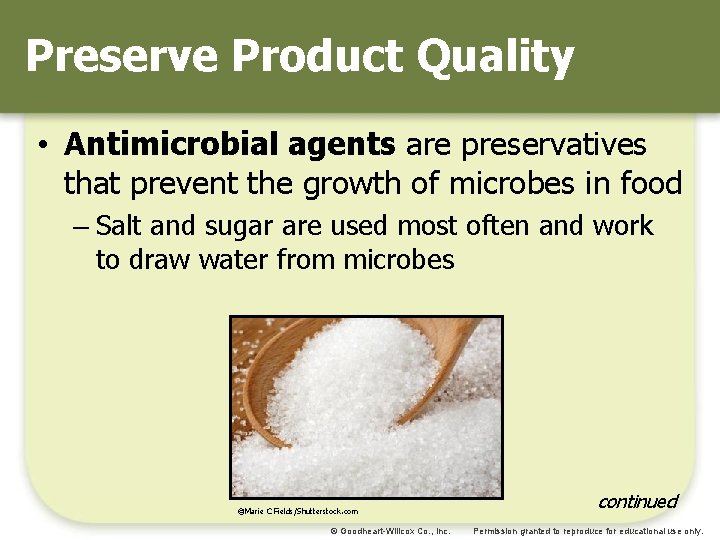
Preserve Product Quality • Antimicrobial agents are preservatives that prevent the growth of microbes in food – Salt and sugar are used most often and work to draw water from microbes ©Marie C Fields/Shutterstock. com © Goodheart-Willcox Co. , Inc. continued Permission granted to reproduce for educational use only.
Preserve Product Quality • Examples of antimicrobial agents – Nitrites prevent growth of bacteria that causes botulism in such foods as bologna, hot dogs, smoked fish, sausage, salami, and ham – Acetic, ascorbic, citric, lactic, and propionic acids prevent microbe growth by lowering p. H • The agent chosen depends on the type of food and how it is likely to spoil continued © Goodheart-Willcox Co. , Inc. Permission granted to reproduce for educational use only.
Preserve Product Quality • Antioxidants protect food from changes caused by exposure to oxygen and are added by – incorporating directly into fats and oils – combining water-soluble antioxidants with glycerol-water emulsions – spraying or dipping food in antioxidant solution – packaging food in a wrap that contains antioxidants continued © Goodheart-Willcox Co. , Inc. Permission granted to reproduce for educational use only.
Preserve Product Quality • The 3 categories of antioxidants are – GRAS list antioxidants such as citric acid, vitamin C, and vitamin E – controlled-use antioxidants such as BHA, BHT, propyl gallate, and TBHQ – sulfites, or salts containing sulfur, such as sulfur dioxide, sodium sulfite, and sodium and potassium bisulfite © Goodheart-Willcox Co. , Inc. Permission granted to reproduce for educational use only.
Enhance Sensory Characteristics • Coloring agents are of 2 types – natural versus synthetic • Natural colors – are extracted from plant, animal, and mineral sources – come from beta-carotene, spices such as turmeric, saffron, and paprika, squid ink, and ferrous gluconate continued © Goodheart-Willcox Co. , Inc. Permission granted to reproduce for educational use only.
Enhance Sensory Characteristics • Synthetic coloring agents – are used more widely than natural colors – provide the most stable colors – are easier to produce, more economical, and lacking unwanted flavors – are identified by use, shade, and number • The name FD & C Red No. 40 means the coloring agent is approved for use in food, drugs, and cosmetics continued © Goodheart-Willcox Co. , Inc. Permission granted to reproduce for educational use only.
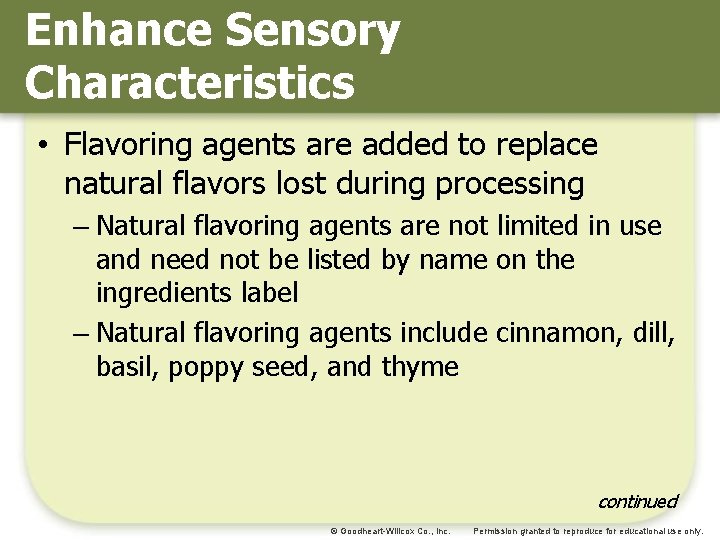
Enhance Sensory Characteristics • Flavoring agents are added to replace natural flavors lost during processing – Natural flavoring agents are not limited in use and need not be listed by name on the ingredients label – Natural flavoring agents include cinnamon, dill, basil, poppy seed, and thyme continued © Goodheart-Willcox Co. , Inc. Permission granted to reproduce for educational use only.
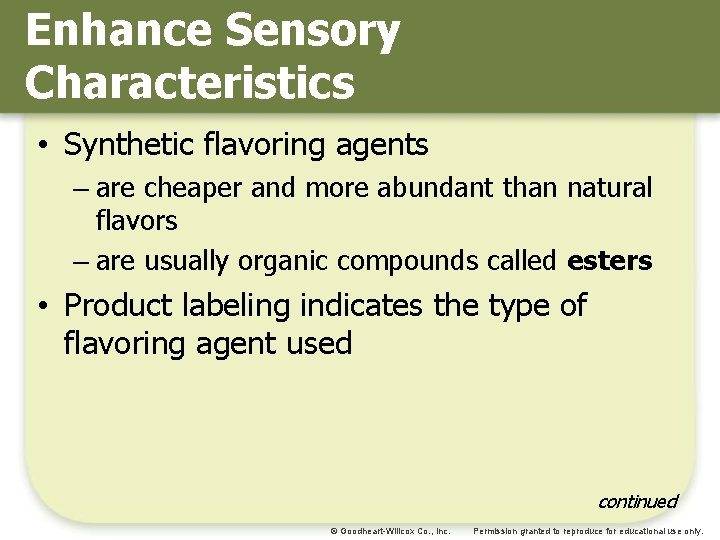
Enhance Sensory Characteristics • Synthetic flavoring agents – are cheaper and more abundant than natural flavors – are usually organic compounds called esters • Product labeling indicates the type of flavoring agent used continued © Goodheart-Willcox Co. , Inc. Permission granted to reproduce for educational use only.
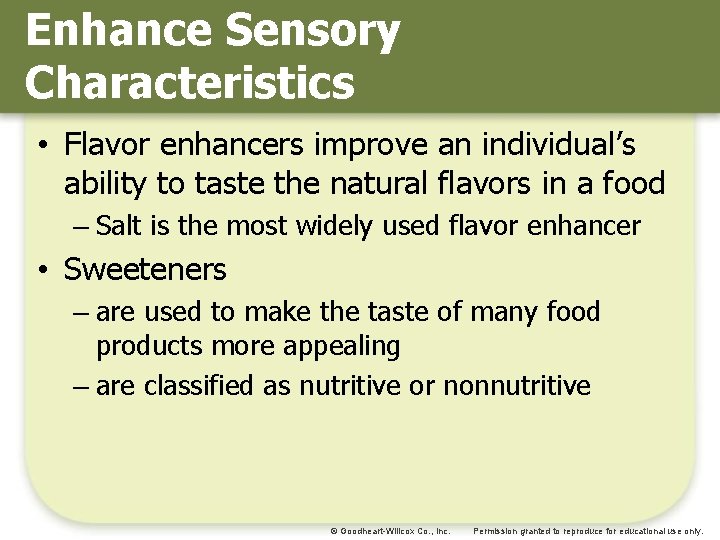
Enhance Sensory Characteristics • Flavor enhancers improve an individual’s ability to taste the natural flavors in a food – Salt is the most widely used flavor enhancer • Sweeteners – are used to make the taste of many food products more appealing – are classified as nutritive or nonnutritive © Goodheart-Willcox Co. , Inc. Permission granted to reproduce for educational use only.
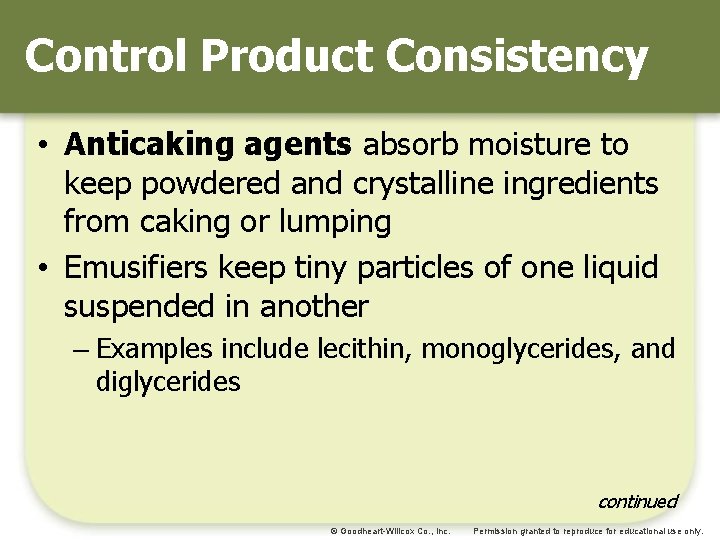
Control Product Consistency • Anticaking agents absorb moisture to keep powdered and crystalline ingredients from caking or lumping • Emusifiers keep tiny particles of one liquid suspended in another – Examples include lecithin, monoglycerides, and diglycerides continued © Goodheart-Willcox Co. , Inc. Permission granted to reproduce for educational use only.
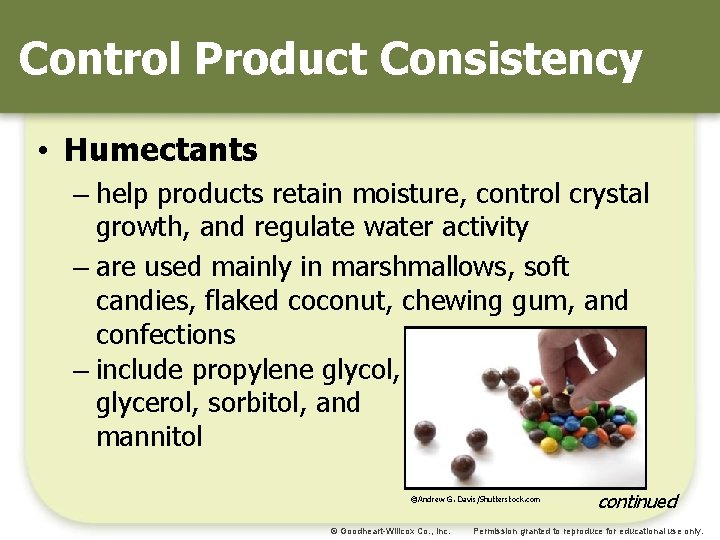
Control Product Consistency • Humectants – help products retain moisture, control crystal growth, and regulate water activity – are used mainly in marshmallows, soft candies, flaked coconut, chewing gum, and confections – include propylene glycol, glycerol, sorbitol, and mannitol ©Andrew G. Davis/Shutterstock. com © Goodheart-Willcox Co. , Inc. continued Permission granted to reproduce for educational use only.
Control Product Consistency • Leavening agents increase volume and alter texture – The 2 main types are yeast and chemical leavening agents that cause an acid-base reaction • Maturing and bleaching agents are chemicals that speed the aging process and whiten flour continued © Goodheart-Willcox Co. , Inc. Permission granted to reproduce for educational use only.
Control Product Consistency • p. H control agents are additives that alter or stabilize the p. H of a food mixture – Acids are used as preservatives, to give a tart flavor, and/or to alter texture – Bases enhance the color and flavor of some foods, can affect texture, and soften fruit skin – Buffers stabilize mixtures at a desired p. H continued © Goodheart-Willcox Co. , Inc. Permission granted to reproduce for educational use only.
Control Product Consistency • Stabilizers and thickeners – help control the consistency of food mixtures – prevent chocolate from settling out of chocolate milk – prevent ice crystals from forming in ice cream – keep flavors from evaporating from cakes and puddings © Goodheart-Willcox Co. , Inc. Permission granted to reproduce for educational use only.
Improve or Maintain Nutritional Value • Most additives are vitamins or minerals • They are added to reduce or eliminate illness due to nutrient deficiencies – Enrichment replaces nutrients lost in processing – Fortification adds nutrients to a food mixture to improve its health benefits © Goodheart-Willcox Co. , Inc. Permission granted to reproduce for educational use only.
Secondary Intentional Additives • Intentional enzymes – are added to alter flavor, texture, digestibility, or nutritional value of a food – are used as a processing aid – must meet FDA regulations – may come from plants, animal tissue, or microorganisms continued © Goodheart-Willcox Co. , Inc. Permission granted to reproduce for educational use only.
Secondary Intentional Additives • Intentional enzymes are used to – make processes safer, faster, more economical – clarify juices and canned vegetable broths – make cheese and cured and processed meats – enhance baked goods by hydrolyzing gluten © Goodheart-Willcox Co. , Inc. Permission granted to reproduce for educational use only.
Balancing Benefits and Risks • Benefits of food additives include – an expanded and varied low-cost food supply available throughout the year – a reduced risk of foodborne illness – less time required for food preparation tasks – greater variety of convenience foods – more job opportunities continued © Goodheart-Willcox Co. , Inc. Permission granted to reproduce for educational use only.
Balancing Benefits and Risks • Concerns of food additives include – unknown health hazards that may be revealed in future research – allergic reactions in certain people • The FDA operates an Adverse Reaction Monitoring System (ARMS) to monitor the safety of additives continued © Goodheart-Willcox Co. , Inc. Permission granted to reproduce for educational use only.
Balancing Benefits and Risks • Steps to reduce possible risks linked to food additives include – wash all produce before eating – choose fresh produce over processed snack foods – learn to prepare foods from scratch – read food product labels – read reports from FDA on additives © Goodheart-Willcox Co. , Inc. Permission granted to reproduce for educational use only.
Recap • Intentional additives are added on purpose but incidental food additives get into foods unintentionally • The Food and Drug Administration (FDA) regulates food additives continued © Goodheart-Willcox Co. , Inc. Permission granted to reproduce for educational use only.
Recap • Food additives function to – preserve product quality and/or prolong shelf life – enhance flavors and/or colors – control product consistency – improve or maintain nutritive value continued © Goodheart-Willcox Co. , Inc. Permission granted to reproduce for educational use only.
Recap • Intentional enzymes are added to food products to act as a processing aid • Although food additives offer benefits, their use creates concern for some – Concerns can be expressed at FDA review hearings © Goodheart-Willcox Co. , Inc. Permission granted to reproduce for educational use only.