
Chapter 16 Acids and Bases Properties of Acids
Chapter 16 Acids and Bases
Properties of Acids and Bases Acids: Taste = Touch = Litmus Paper = p. H Reactions with Metals = Section 16. 1 A Brief Review Bases: Taste = Touch = Litmus Paper = p. H Reactions with Metals = Acids and Bases
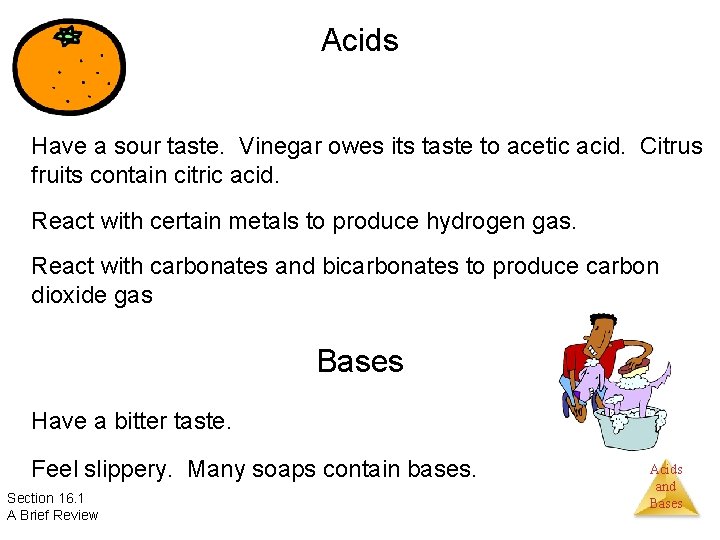
Acids Have a sour taste. Vinegar owes its taste to acetic acid. Citrus fruits contain citric acid. React with certain metals to produce hydrogen gas. React with carbonates and bicarbonates to produce carbon dioxide gas Bases Have a bitter taste. Feel slippery. Many soaps contain bases. Section 16. 1 A Brief Review Acids and Bases
Some Definitions • Arrhenius – An acid is a substance that, when dissolved in water, increases the concentration of hydrogen ions. – A base is a substance that, when dissolved in water, increases the concentration of hydroxide ions. Section 16. 1 A Brief Review Acids and Bases
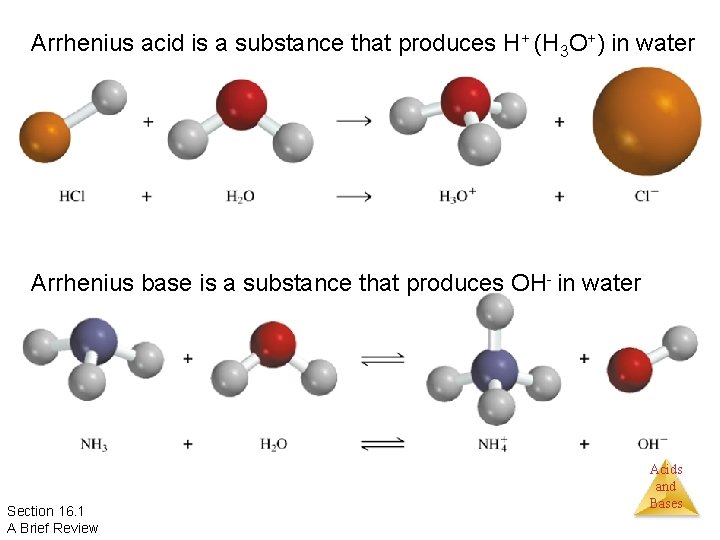
Arrhenius acid is a substance that produces H+ (H 3 O+) in water Arrhenius base is a substance that produces OH- in water Section 16. 1 A Brief Review Acids and Bases
Definitions of Acids and Bases Arrhenius (1884) defined an acid as producing a H+ ion when dissolved in water. He also defined a base as producing an OH- ion when dissolved in water. This definition was limiting because it only applied to aqueous solutions. The chemists Johannes Bronsted and Thomas Lowry (1923) proposed a more broad definition. Their definition does not require that an acid be in an aqueous solution and includes more than just protons and hydroxide ions for acids and bases. A Bronsted-Lowry acid is a proton (H+) donor. A Bronsted-Lowry base is a proton (H+) acceptor. Acids and Bases
Section 16. 2 Bronsted – Lowry Acids & Bases Acids and Bases
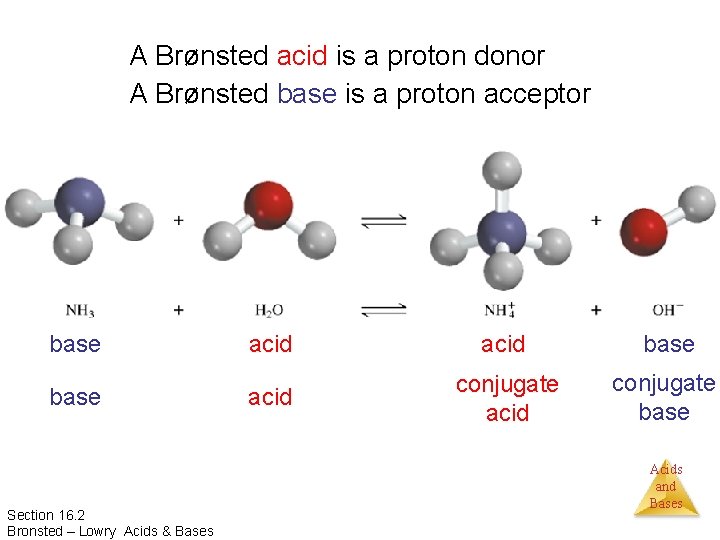
A Brønsted acid is a proton donor A Brønsted base is a proton acceptor base Section 16. 2 Bronsted – Lowry Acids & Bases acid base acid conjugate base Acids and Bases
A Brønsted-Lowry acid… …must have a removable (acidic) proton. A Brønsted-Lowry base… …must have a pair of nonbonding electrons. Section 16. 2 Bronsted – Lowry Acids & Bases Acids and Bases
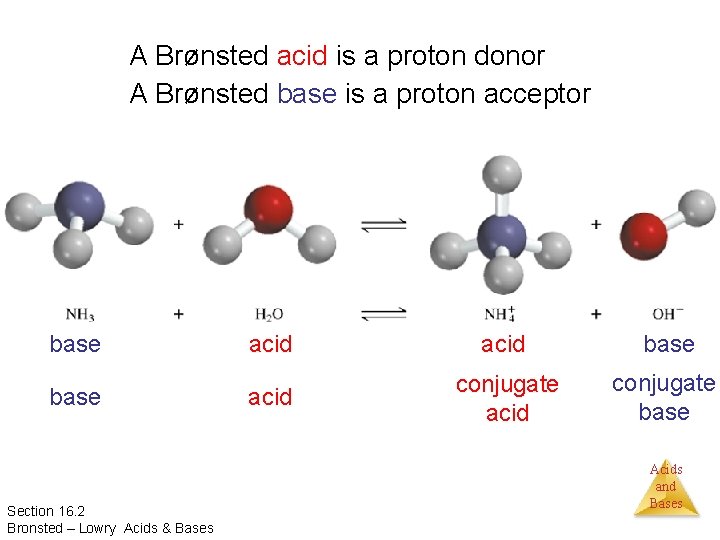
A Brønsted acid is a proton donor A Brønsted base is a proton acceptor base Section 16. 2 Bronsted – Lowry Acids & Bases acid base acid conjugate base Acids and Bases
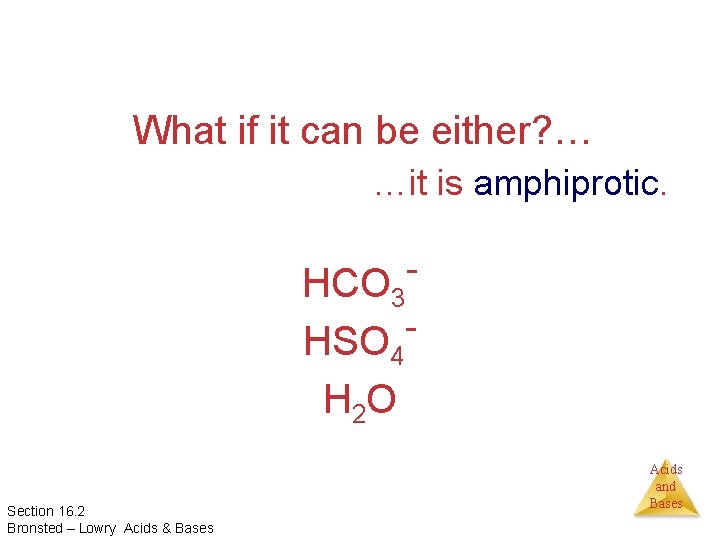
What if it can be either? … …it is amphiprotic. HCO 3 HSO 4 H 2 O Section 16. 2 Bronsted – Lowry Acids & Bases Acids and Bases
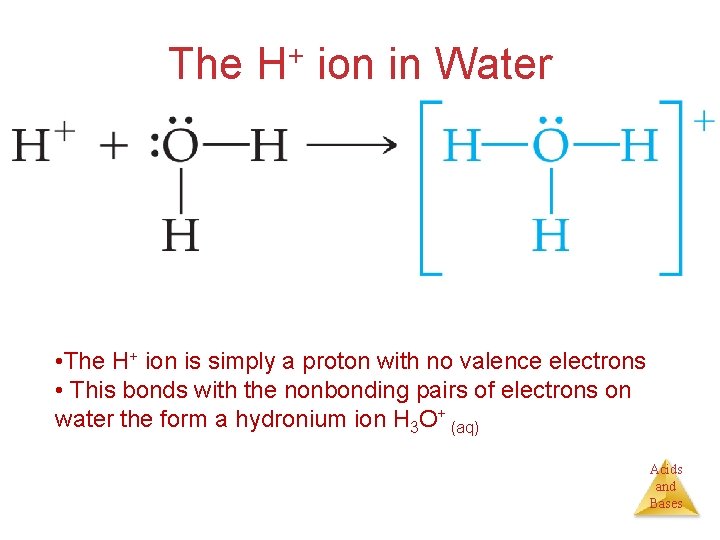
The H+ ion in Water • The H+ ion is simply a proton with no valence electrons • This bonds with the nonbonding pairs of electrons on water the form a hydronium ion H 3 O+ (aq) Acids and Bases
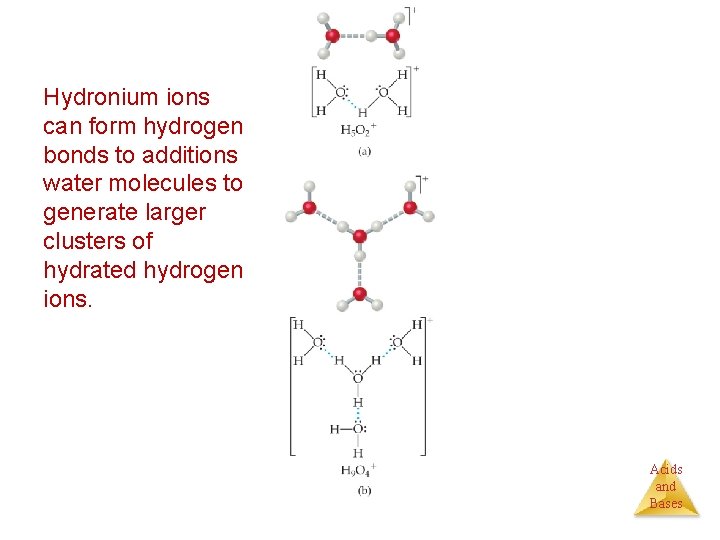
Figure 16. 01 Hydronium ions can form hydrogen bonds to additions water molecules to generate larger clusters of hydrated hydrogen ions. Acids and Bases
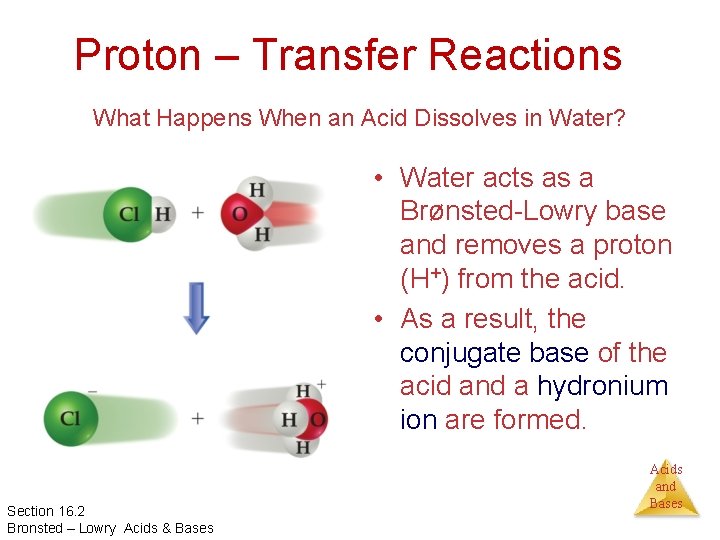
Proton – Transfer Reactions What Happens When an Acid Dissolves in Water? • Water acts as a Brønsted-Lowry base and removes a proton (H+) from the acid. • As a result, the conjugate base of the acid and a hydronium ion are formed. Section 16. 2 Bronsted – Lowry Acids & Bases Acids and Bases
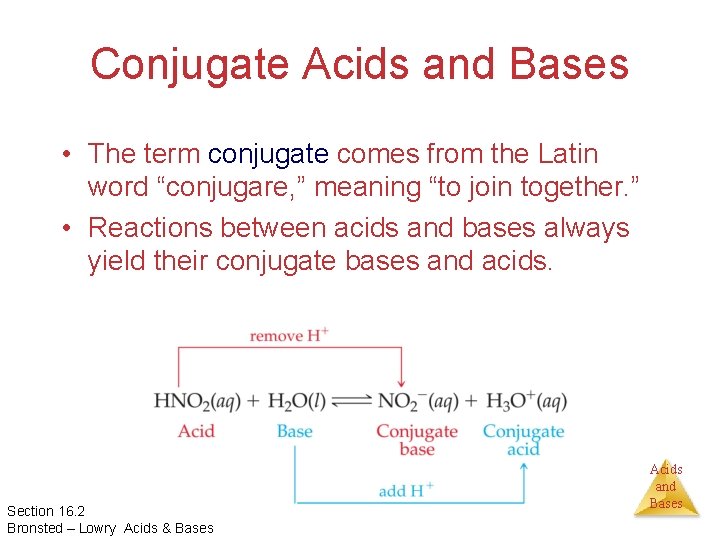
Conjugate Acids and Bases • The term conjugate comes from the Latin word “conjugare, ” meaning “to join together. ” • Reactions between acids and bases always yield their conjugate bases and acids. Section 16. 2 Bronsted – Lowry Acids & Bases Acids and Bases
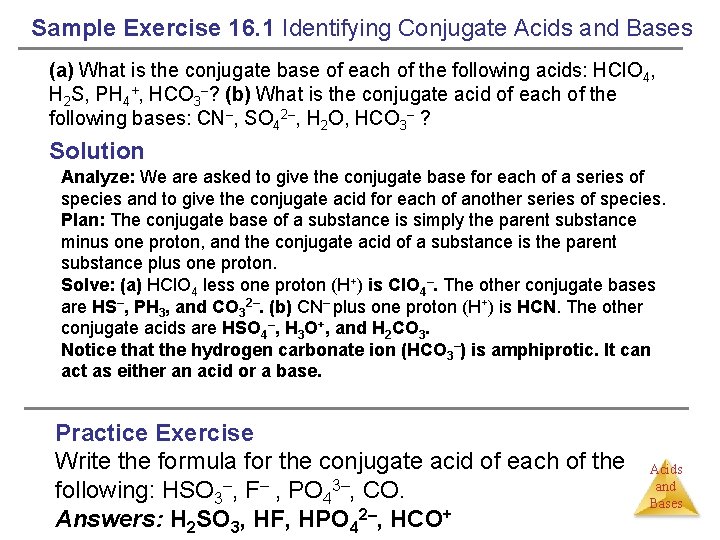
Sample Exercise 16. 1 Identifying Conjugate Acids and Bases (a) What is the conjugate base of each of the following acids: HCl. O 4, H 2 S, PH 4+, HCO 3–? (b) What is the conjugate acid of each of the following bases: CN–, SO 42–, H 2 O, HCO 3– ? Solution Analyze: We are asked to give the conjugate base for each of a series of species and to give the conjugate acid for each of another series of species. Plan: The conjugate base of a substance is simply the parent substance minus one proton, and the conjugate acid of a substance is the parent substance plus one proton. Solve: (a) HCl. O 4 less one proton (H+) is Cl. O 4–. The other conjugate bases are HS–, PH 3, and CO 32–. (b) CN– plus one proton (H+) is HCN. The other conjugate acids are HSO 4–, H 3 O+, and H 2 CO 3. Notice that the hydrogen carbonate ion (HCO 3–) is amphiprotic. It can act as either an acid or a base. Practice Exercise Write the formula for the conjugate acid of each of the following: HSO 3–, F– , PO 43–, CO. Answers: H 2 SO 3, HF, HPO 42–, HCO+ Acids and Bases
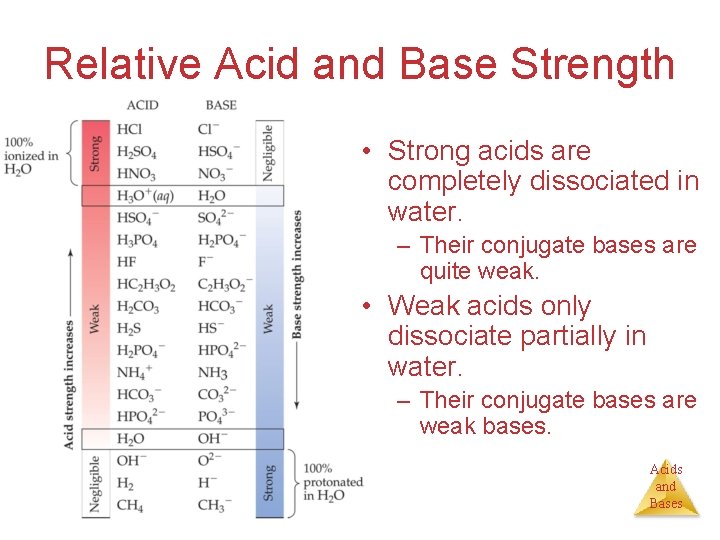
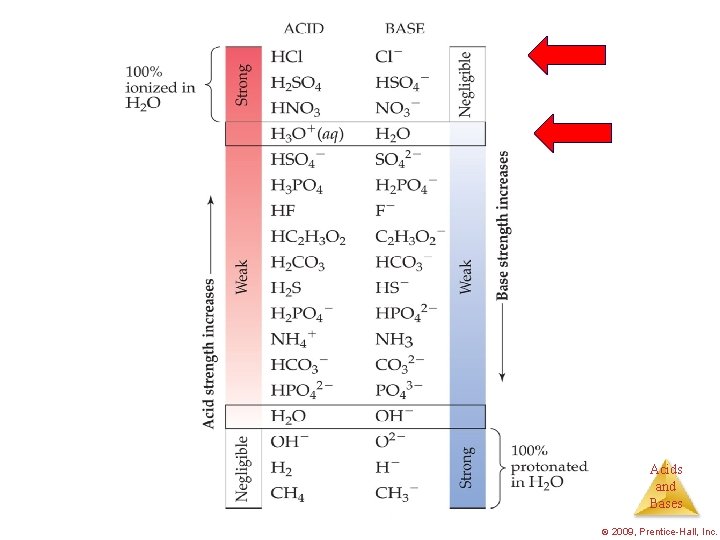
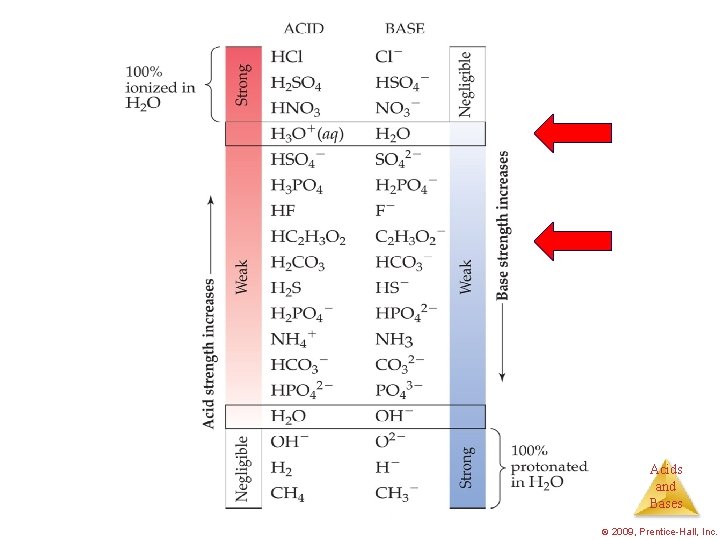
Relative Acid and Base Strength • Strong acids are completely dissociated in water. – Their conjugate bases are quite weak. • Weak acids only dissociate partially in water. – Their conjugate bases are weak bases. Acids and Bases
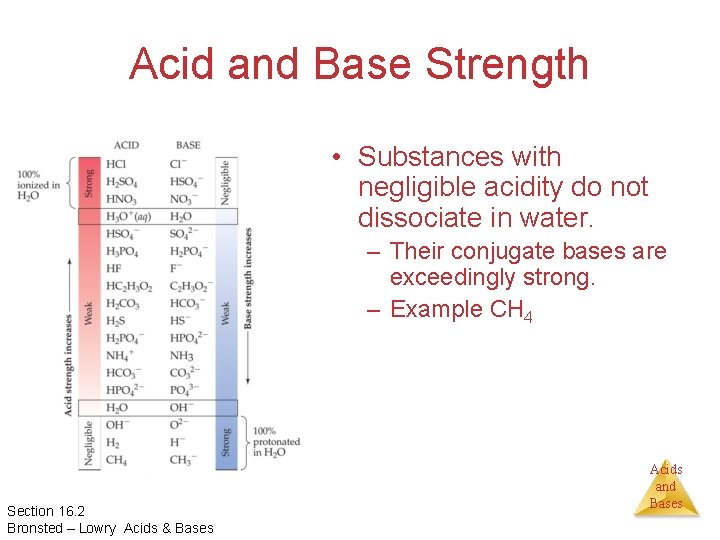
Acid and Base Strength • Substances with negligible acidity do not dissociate in water. – Their conjugate bases are exceedingly strong. – Example CH 4 Section 16. 2 Bronsted – Lowry Acids & Bases Acids and Bases
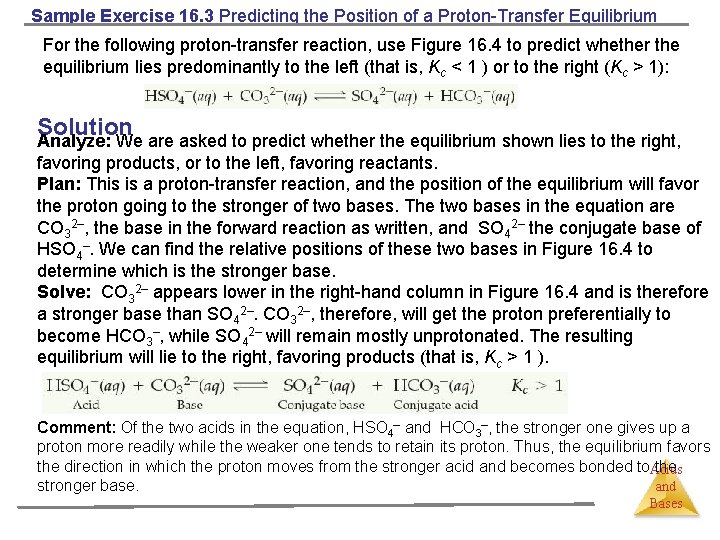
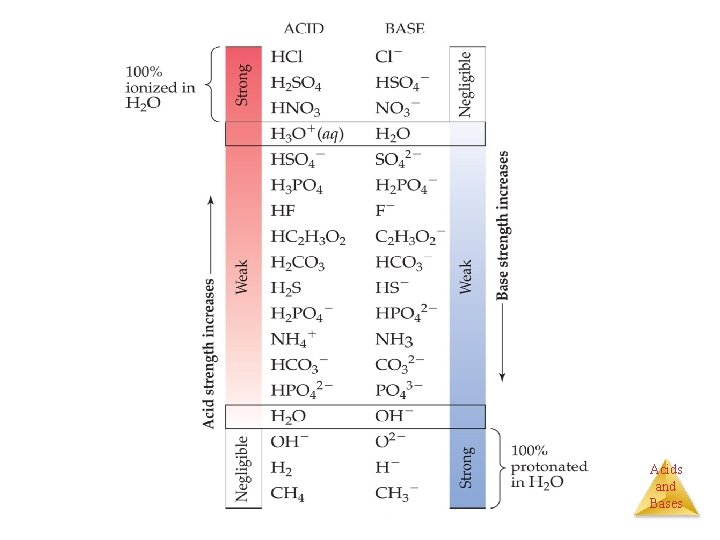
Sample Exercise 16. 3 Predicting the Position of a Proton-Transfer Equilibrium For the following proton-transfer reaction, use Figure 16. 4 to predict whether the equilibrium lies predominantly to the left (that is, Kc < 1 ) or to the right (Kc > 1): Solution Analyze: We are asked to predict whether the equilibrium shown lies to the right, favoring products, or to the left, favoring reactants. Plan: This is a proton-transfer reaction, and the position of the equilibrium will favor the proton going to the stronger of two bases. The two bases in the equation are CO 32–, the base in the forward reaction as written, and SO 42– the conjugate base of HSO 4–. We can find the relative positions of these two bases in Figure 16. 4 to determine which is the stronger base. Solve: CO 32– appears lower in the right-hand column in Figure 16. 4 and is therefore a stronger base than SO 42–. CO 32–, therefore, will get the proton preferentially to become HCO 3–, while SO 42– will remain mostly unprotonated. The resulting equilibrium will lie to the right, favoring products (that is, Kc > 1 ). Comment: Of the two acids in the equation, HSO 4– and HCO 3–, the stronger one gives up a proton more readily while the weaker one tends to retain its proton. Thus, the equilibrium favors the direction in which the proton moves from the stronger acid and becomes bonded to. Acids the stronger base. and Bases
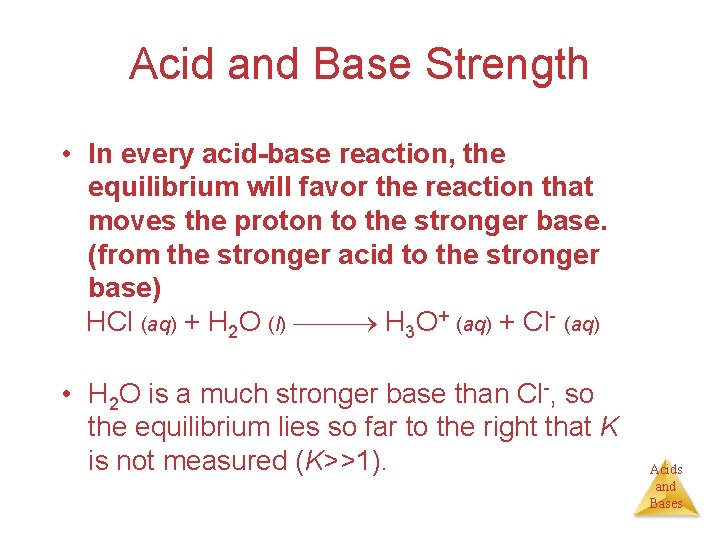
Acid and Base Strength • In every acid-base reaction, the equilibrium will favor the reaction that moves the proton to the stronger base. (from the stronger acid to the stronger base) HCl (aq) + H 2 O (l) H 3 O+ (aq) + Cl- (aq) • H 2 O is a much stronger base than Cl-, so the equilibrium lies so far to the right that K is not measured (K>>1). Acids and Bases
Acids and Bases © 2009, Prentice-Hall, Inc.
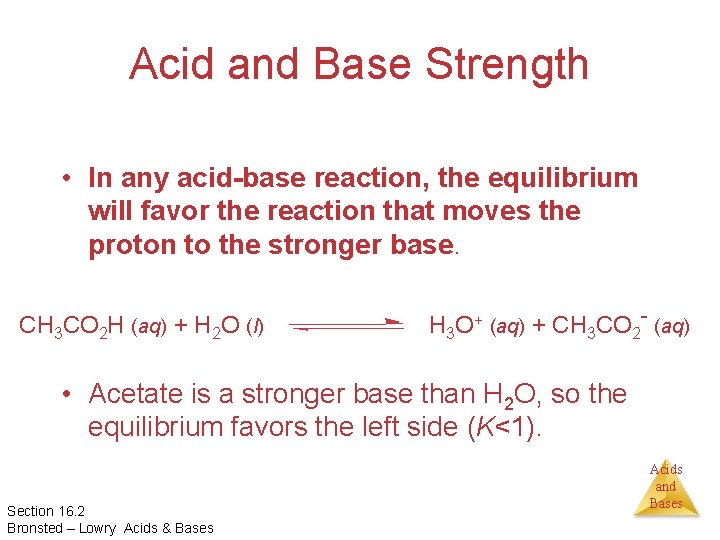
Acid and Base Strength • In any acid-base reaction, the equilibrium will favor the reaction that moves the proton to the stronger base. CH 3 CO 2 H (aq) + H 2 O (l) H 3 O+ (aq) + CH 3 CO 2 - (aq) • Acetate is a stronger base than H 2 O, so the equilibrium favors the left side (K<1). Section 16. 2 Bronsted – Lowry Acids & Bases Acids and Bases
Acids and Bases © 2009, Prentice-Hall, Inc.
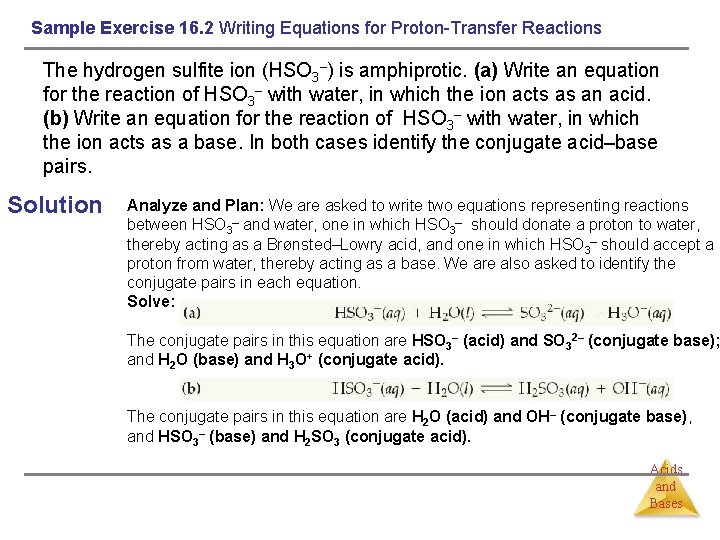
Sample Exercise 16. 2 Writing Equations for Proton-Transfer Reactions The hydrogen sulfite ion (HSO 3–) is amphiprotic. (a) Write an equation for the reaction of HSO 3– with water, in which the ion acts as an acid. (b) Write an equation for the reaction of HSO 3– with water, in which the ion acts as a base. In both cases identify the conjugate acid–base pairs. Solution Analyze and Plan: We are asked to write two equations representing reactions between HSO 3– and water, one in which HSO 3– should donate a proton to water, thereby acting as a Brønsted–Lowry acid, and one in which HSO 3– should accept a proton from water, thereby acting as a base. We are also asked to identify the conjugate pairs in each equation. Solve: The conjugate pairs in this equation are HSO 3– (acid) and SO 32– (conjugate base); and H 2 O (base) and H 3 O+ (conjugate acid). The conjugate pairs in this equation are H 2 O (acid) and OH– (conjugate base), and HSO 3– (base) and H 2 SO 3 (conjugate acid). Acids and Bases
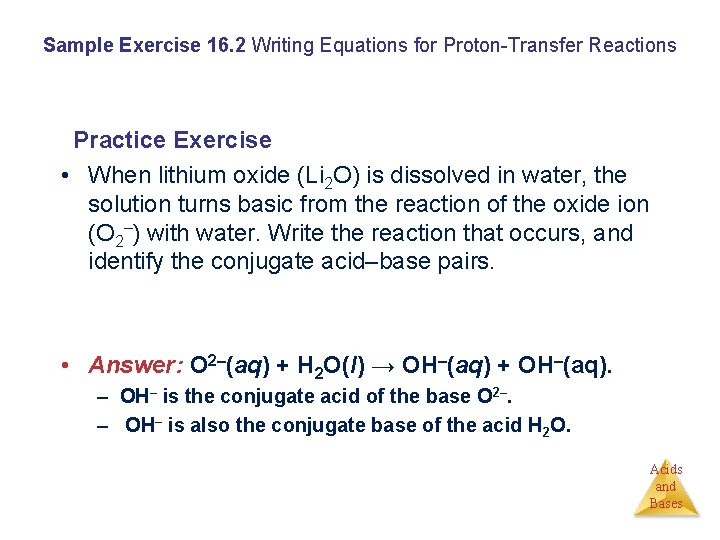
Sample Exercise 16. 2 Writing Equations for Proton-Transfer Reactions Practice Exercise • When lithium oxide (Li 2 O) is dissolved in water, the solution turns basic from the reaction of the oxide ion (O 2–) with water. Write the reaction that occurs, and identify the conjugate acid–base pairs. • Answer: O 2–(aq) + H 2 O(l) → OH–(aq) + OH–(aq). – OH– is the conjugate acid of the base O 2–. – OH– is also the conjugate base of the acid H 2 O. Acids and Bases
Acids and Bases
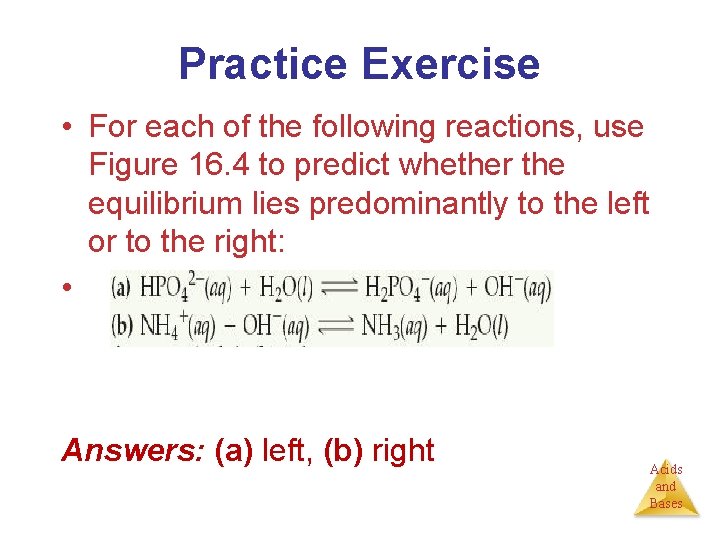
Practice Exercise • For each of the following reactions, use Figure 16. 4 to predict whether the equilibrium lies predominantly to the left or to the right: • Answers: (a) left, (b) right Acids and Bases
Section 16. 3 Autoionization of Water Acids and Bases
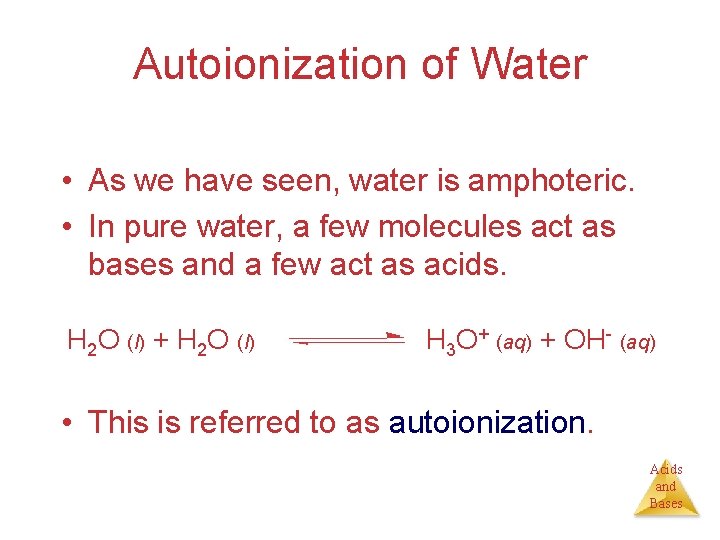
Autoionization of Water • As we have seen, water is amphoteric. • In pure water, a few molecules act as bases and a few act as acids. H 2 O (l) + H 2 O (l) H 3 O+ (aq) + OH- (aq) • This is referred to as autoionization. Acids and Bases
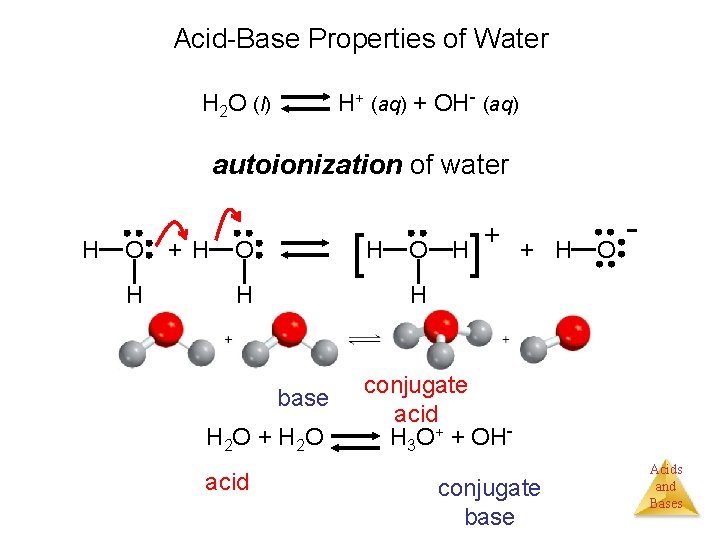
Acid-Base Properties of Water H+ (aq) + OH- (aq) H 2 O (l) autoionization of water H O H + H [H O H ] H + H O - H base H 2 O + H 2 O acid O + conjugate acid H 3 O+ + OHconjugate base Acids and Bases
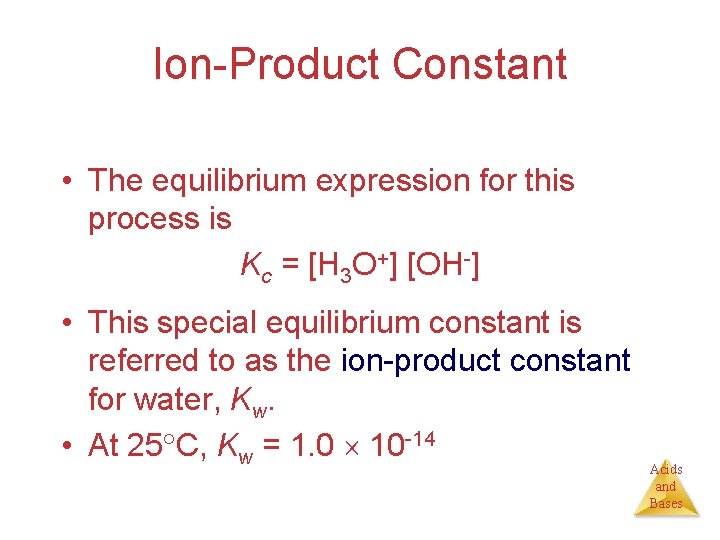
Ion-Product Constant • The equilibrium expression for this process is Kc = [H 3 O+] [OH-] • This special equilibrium constant is referred to as the ion-product constant for water, Kw. • At 25 C, Kw = 1. 0 10 -14 Acids and Bases
![Sample Exercise 16. 4 Calculating [H+] for Pure Water Calculate the values of [H+]](http://slidetodoc.com/presentation_image_h2/9a28570c5212a2a101a5bcac5c3ac484/image-32.jpg "Sample Exercise 16. 4 Calculating [H+] for Pure Water Calculate the values of [H+]")
Sample Exercise 16. 4 Calculating [H+] for Pure Water Calculate the values of [H+] and [OH-] in a neutral solution at 25 ºC. Solution Analyze: We are asked to determine the concentrations of H+ and OH– ions in a neutral solution at 25 ºC. Plan: We will use Equation 16. 16 and the fact that, by definition, [H+] = [OH–] in a neutral solution. Solve: We will represent the concentration of [H+] and [OH–] in neutral solution with x. This gives Practice Exercise Indicate whether solutions with each of the following ion concentrations are neutral, acidic, or basic: (a) [H+] = 4 × 10– 9 M ; (b) [OH-] = 1 × 10– 7 M ; (c) [OH–] = 7 × 10– 13 M. Answers: (a) basic, (b) neutral, (c) acidic Acids and Bases
![Sample Exercise 16. 5 Calculating [H+] from [OH-] Calculate the concentration of H+(aq) in](http://slidetodoc.com/presentation_image_h2/9a28570c5212a2a101a5bcac5c3ac484/image-33.jpg "Sample Exercise 16. 5 Calculating [H+] from [OH-] Calculate the concentration of H+(aq) in")
Sample Exercise 16. 5 Calculating [H+] from [OH-] Calculate the concentration of H+(aq) in (a) a solution in which [OH–] is 0. 010 M, (b) a solution in which [OH–] is 1. 8 × 10– 9 M. Solution Analyze: We are asked to calculate the hydronium ion concentration in an aqueous solution where the hydroxide concentration is known. Plan: We can use the equilibrium-constant expression for the autoionization of water and the value of Kw to solve for each unknown concentration. Solve: a) Using Equation 16. 16, we have: This solution is basic because (b) In this instance This solution is acidic because Acids and Bases
![Practice Exercise Calculate the concentration of OH–(aq) in a solution in which (a) [H+]](http://slidetodoc.com/presentation_image_h2/9a28570c5212a2a101a5bcac5c3ac484/image-34.jpg "Practice Exercise Calculate the concentration of OH–(aq) in a solution in which (a) [H+]")
Practice Exercise Calculate the concentration of OH–(aq) in a solution in which (a) [H+] = 2 × 10– 6 M; (b) [H+] = [OH–]; Answers: (a) 5 × 10– 9 M, (b) 1. 0 × 10– 7 M, Acids and Bases
Stop here sections 16. 1 -3 • Answer the following EOC questions: • Section 16. 1 & 2 – q’s 13 -27 odd • Section 16. 3 – q’s 29 -34 Acids and Bases
Section 16. 4 The p. H Scale Acids and Bases
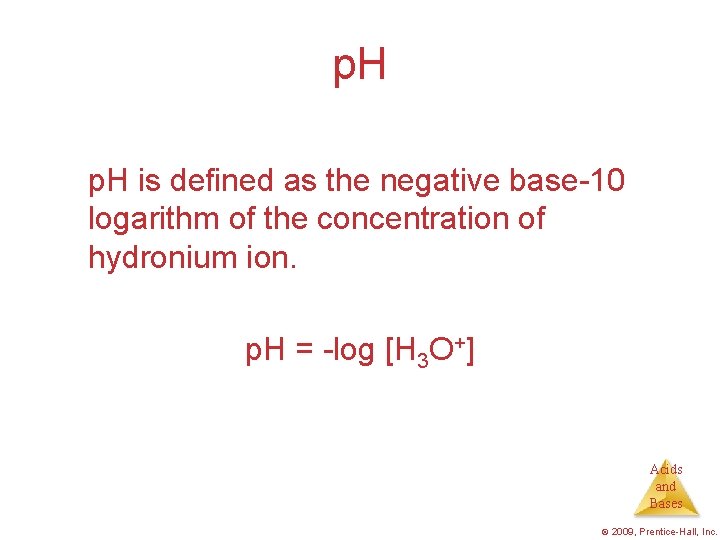
p. H is defined as the negative base-10 logarithm of the concentration of hydronium ion. p. H = -log [H 3 O+] Acids and Bases © 2009, Prentice-Hall, Inc.
![p. H • In pure water, Kw = [H 3 O+] [OH-] = 1.](http://slidetodoc.com/presentation_image_h2/9a28570c5212a2a101a5bcac5c3ac484/image-38.jpg "p. H • In pure water, Kw = [H 3 O+] [OH-] = 1.")
p. H • In pure water, Kw = [H 3 O+] [OH-] = 1. 0 10 -14 • Since in pure water [H 3 O+] = [OH-], [H 3 O+] = 1. 0 10 -14 = 1. 0 10 -7 Acids and Bases © 2009, Prentice-Hall, Inc.
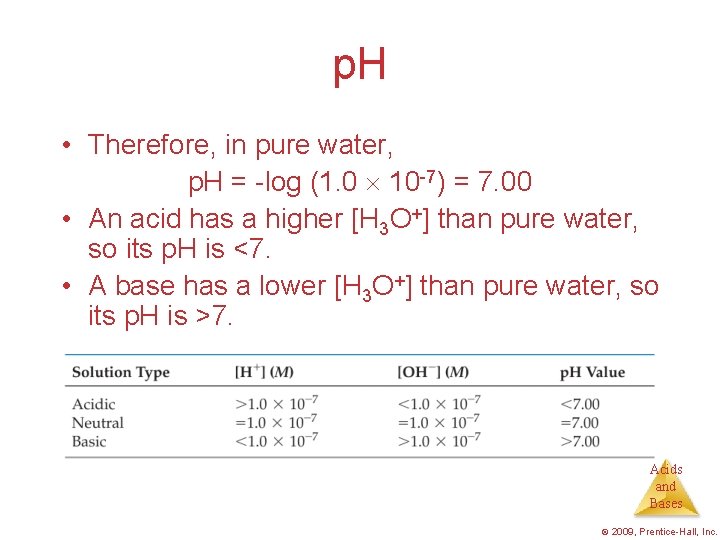
p. H • Therefore, in pure water, p. H = -log (1. 0 10 -7) = 7. 00 • An acid has a higher [H 3 O+] than pure water, so its p. H is <7. • A base has a lower [H 3 O+] than pure water, so its p. H is >7. Acids and Bases © 2009, Prentice-Hall, Inc.
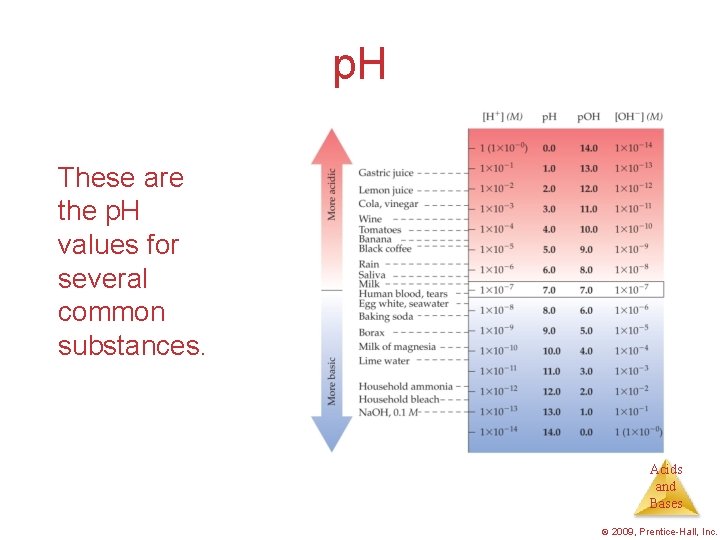
p. H These are the p. H values for several common substances. Acids and Bases © 2009, Prentice-Hall, Inc.
Other “p” Scales • The “p” in p. H tells us to take the negative base-10 logarithm of the quantity (in this case, hydronium ions). • Some similar examples are – p. OH: -log [OH-] – p. Kw: -log Kw Acids and Bases © 2009, Prentice-Hall, Inc.
![Watch This! Because [H 3 O+] [OH-] = Kw = 1. 0 10 -14,](http://slidetodoc.com/presentation_image_h2/9a28570c5212a2a101a5bcac5c3ac484/image-42.jpg "Watch This! Because [H 3 O+] [OH-] = Kw = 1. 0 10 -14,")
Watch This! Because [H 3 O+] [OH-] = Kw = 1. 0 10 -14, we know that -log [H 3 O+] + -log [OH-] = -log Kw = 14. 00 or, in other words, p. H + p. OH = p. Kw = 14. 00 Acids and Bases © 2009, Prentice-Hall, Inc.
![Sample Exercise 16. 6 Calculating p. H from [H+] Calculate the p. H values](http://slidetodoc.com/presentation_image_h2/9a28570c5212a2a101a5bcac5c3ac484/image-43.jpg "Sample Exercise 16. 6 Calculating p. H from [H+] Calculate the p. H values")
Sample Exercise 16. 6 Calculating p. H from [H+] Calculate the p. H values for the two solutions described in Sample Exercise 16. 5. Solution Analyze: We are asked to determine the p. H of aqueous solutions for which we have already calculated [H+]. Plan: We can calculate p. H using its defining equation, Equation 16. 17. Solve: (a) In the first instance we found [H+]. to be 1. 0 × 10– 12 M. Because 1. 0 × 10– 12 has two significant figures, the p. H has two decimal places, 12. 00. (b) For the second solution, [H+] = 5. 6 × 10– 6 M. Before performing the calculation, it is helpful to estimate the p. H. To do so, we note that [H+] lies between 1 × 10– 6 and 1 × 10– 5 Thus, we expect the p. H to lie between 6. 0 and 5. 0. We use Equation 16. 17 to calculate the p. H. Check: After calculating a p. H, it is useful to compare it to your prior estimate. In this case the p. H, as we predicted, falls between 6 and 5. Had the calculated p. H and the estimate not agreed, we should have reconsidered our calculation or estimate or both. Acids and Bases
![Practice Exercise (a) In a sample of lemon juice [H+] is 3. 8 ×](http://slidetodoc.com/presentation_image_h2/9a28570c5212a2a101a5bcac5c3ac484/image-44.jpg "Practice Exercise (a) In a sample of lemon juice [H+] is 3. 8 ×")
Practice Exercise (a) In a sample of lemon juice [H+] is 3. 8 × 10– 4 M. What is the p. H? (b) A commonly available window-cleaning solution has [OH–] = 1. 9 × 10– 6 M. What is the p. H? Answers: (a) 3. 42, (b) [H+] = 5. 3 × 10– 9 M, so p. H = 8. 28 Acids and Bases
![Sample Exercise 16. 7 Calculating [H+] from p. H A sample of freshly pressed](http://slidetodoc.com/presentation_image_h2/9a28570c5212a2a101a5bcac5c3ac484/image-45.jpg "Sample Exercise 16. 7 Calculating [H+] from p. H A sample of freshly pressed")
Sample Exercise 16. 7 Calculating [H+] from p. H A sample of freshly pressed apple juice has a p. H of 3. 76. Calculate [H+]. Solution Analyze: We need to calculate [H+] from p. H. Plan: We will use Equation 16. 17, p. H = –log[H+], for the calculation. Solve: From Equation 16. 17, we have To find [H+] , we need to determine the antilog of – 3. 76. Check: Because the p. H is between 3. 0 and 4. 0, we know that [H+] will be between 1 × 10– 3 and 1 × 10– 4 M. Our calculated [H+] falls within this estimated range. Acids and Bases
Practice Exercise A solution formed by dissolving an antacid tablet has a p. H of 9. 18. Calculate [H+]. Answer: [H+] = 6. 6× 10– 10 M Acids and Bases
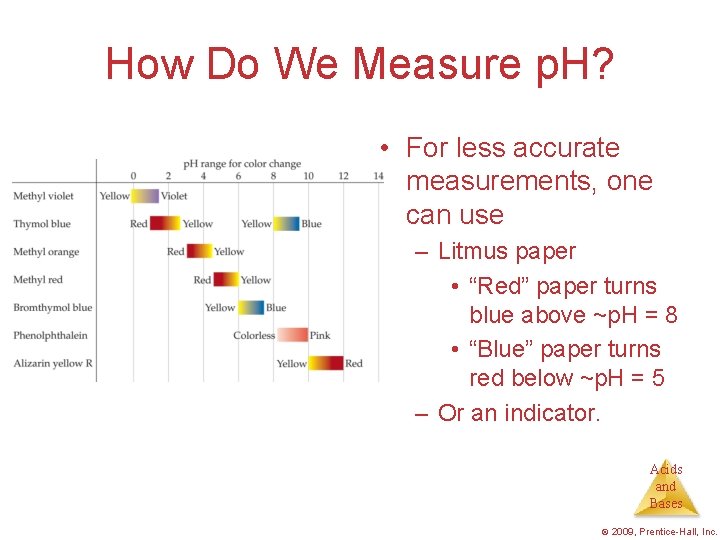
How Do We Measure p. H? • For less accurate measurements, one can use – Litmus paper • “Red” paper turns blue above ~p. H = 8 • “Blue” paper turns red below ~p. H = 5 – Or an indicator. Acids and Bases © 2009, Prentice-Hall, Inc.
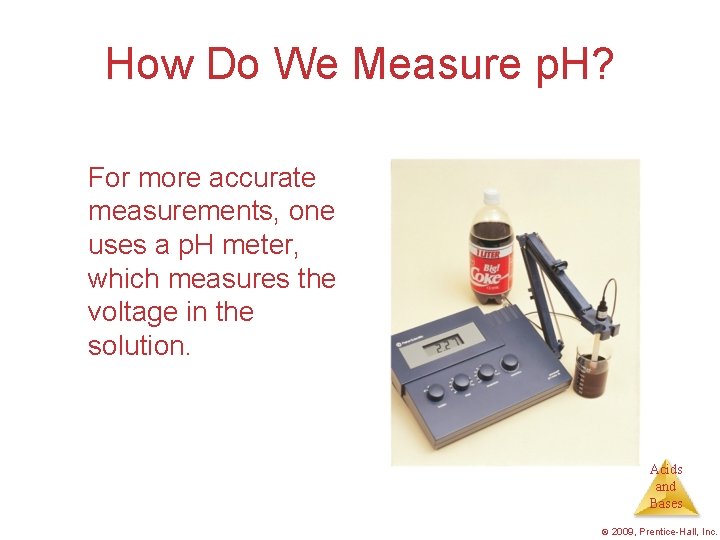
How Do We Measure p. H? For more accurate measurements, one uses a p. H meter, which measures the voltage in the solution. Acids and Bases © 2009, Prentice-Hall, Inc.
Stop here sections 16. 4 • Answer the following EOC questions: • Section 16. 4 EOC Q’S 35 -39, 41, 42 Acids and Bases
Section 16. 5, 16. 6 & 16. 7 • Strong Acids & Bases • Weak Acids • Weak Bases Acids and Bases
Strong Acids • You will recall that the seven strong acids are HCl, HBr, HI, HNO 3, H 2 SO 4, HCl. O 3, and HCl. O 4. • These are, by definition, strong electrolytes and exist totally as ions in aqueous solution. • For the monoprotic strong acids, [H 3 O+] = [acid]. Acids and Bases © 2009, Prentice-Hall, Inc.
Strong Bases • Strong bases are the soluble hydroxides, which are the alkali metal and heavier alkaline earth metal hydroxides (Ca 2+, Sr 2+, and Ba 2+). • Again, these substances dissociate completely in aqueous solution. Acids and Bases © 2009, Prentice-Hall, Inc.
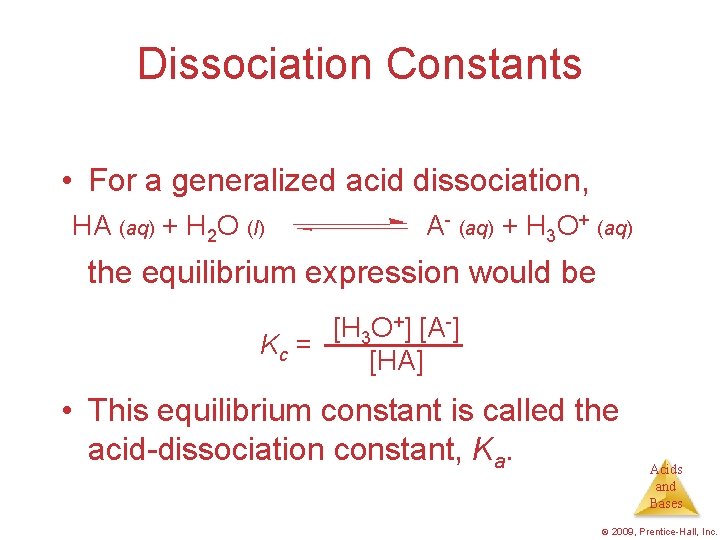
Dissociation Constants • For a generalized acid dissociation, HA (aq) + H 2 O (l) A- (aq) + H 3 O+ (aq) the equilibrium expression would be [H 3 O+] [A-] Kc = [HA] • This equilibrium constant is called the acid-dissociation constant, Ka. Acids and Bases © 2009, Prentice-Hall, Inc.
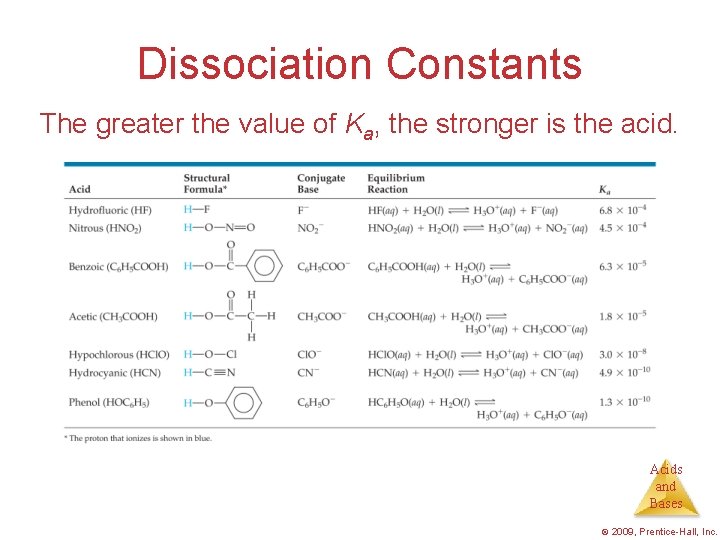
Dissociation Constants The greater the value of Ka, the stronger is the acid. Acids and Bases © 2009, Prentice-Hall, Inc.
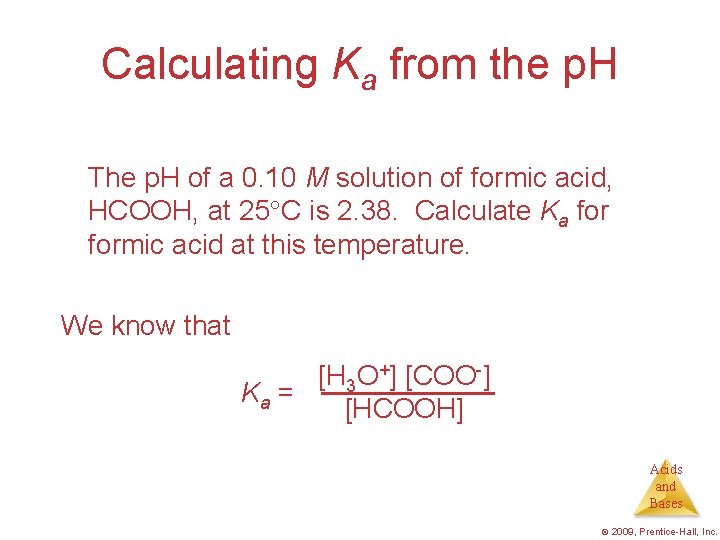
Calculating Ka from the p. H The p. H of a 0. 10 M solution of formic acid, HCOOH, at 25 C is 2. 38. Calculate Ka formic acid at this temperature. We know that [H 3 O+] [COO-] Ka = [HCOOH] Acids and Bases © 2009, Prentice-Hall, Inc.
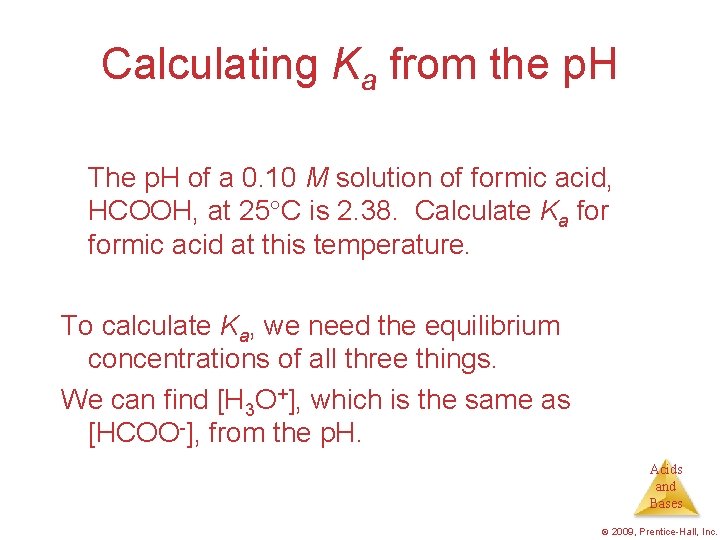
Calculating Ka from the p. H The p. H of a 0. 10 M solution of formic acid, HCOOH, at 25 C is 2. 38. Calculate Ka formic acid at this temperature. To calculate Ka, we need the equilibrium concentrations of all three things. We can find [H 3 O+], which is the same as [HCOO-], from the p. H. Acids and Bases © 2009, Prentice-Hall, Inc.
![Calculating Ka from the p. H = -log [H 3 O+] 2. 38 =](http://slidetodoc.com/presentation_image_h2/9a28570c5212a2a101a5bcac5c3ac484/image-57.jpg "Calculating Ka from the p. H = -log [H 3 O+] 2. 38 =")
Calculating Ka from the p. H = -log [H 3 O+] 2. 38 = -log [H 3 O+] -2. 38 = log [H 3 O+] 10 -2. 38 = 10 log [H 3 O+] = [H 3 O+] 4. 2 10 -3 = [H 3 O+] = [HCOO-] Acids and Bases © 2009, Prentice-Hall, Inc.
![Calculating Ka from p. H Now we can set up a table… [HCOOH], M](http://slidetodoc.com/presentation_image_h2/9a28570c5212a2a101a5bcac5c3ac484/image-58.jpg "Calculating Ka from p. H Now we can set up a table… [HCOOH], M")
Calculating Ka from p. H Now we can set up a table… [HCOOH], M [H 3 O+], M [HCOO-], M Initially 0. 10 0 0 Change - 4. 2 10 -3 + 4. 2 10 -3 0. 10 - 4. 2 10 -3 = 0. 0958 = 0. 10 4. 2 10 -3 At Equilibrium Acids and Bases © 2009, Prentice-Hall, Inc.
![Calculating Ka from p. H [4. 2 10 -3] Ka = [0. 10] =](http://slidetodoc.com/presentation_image_h2/9a28570c5212a2a101a5bcac5c3ac484/image-59.jpg "Calculating Ka from p. H [4. 2 10 -3] Ka = [0. 10] =")
Calculating Ka from p. H [4. 2 10 -3] Ka = [0. 10] = 1. 8 10 -4 Acids and Bases © 2009, Prentice-Hall, Inc.
![Calculating Percent Ionization [H 3 O+]eq • Percent Ionization = [HA] 100 initial •](http://slidetodoc.com/presentation_image_h2/9a28570c5212a2a101a5bcac5c3ac484/image-60.jpg "Calculating Percent Ionization [H 3 O+]eq • Percent Ionization = [HA] 100 initial •")
Calculating Percent Ionization [H 3 O+]eq • Percent Ionization = [HA] 100 initial • In this example [H 3 O+]eq = 4. 2 10 -3 M [HCOOH]initial = 0. 10 M 4. 2 10 -3 Percent Ionization = 100 0. 10 = 4. 2% Acids and Bases © 2009, Prentice-Hall, Inc.
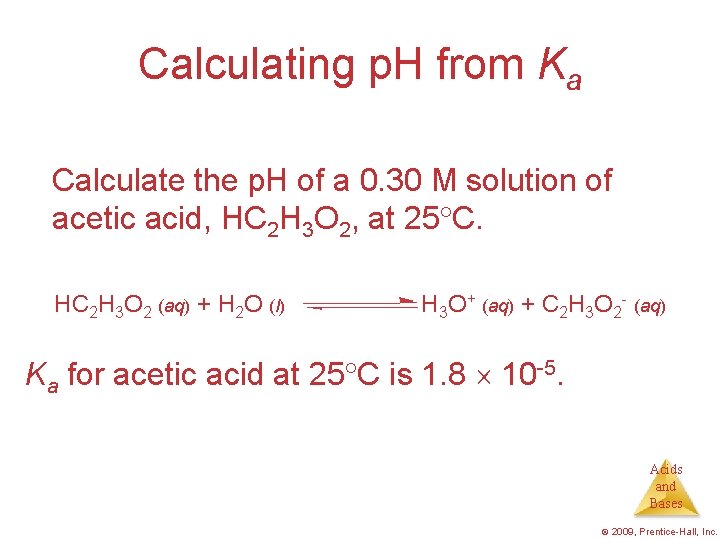
Calculating p. H from Ka Calculate the p. H of a 0. 30 M solution of acetic acid, HC 2 H 3 O 2, at 25 C. HC 2 H 3 O 2 (aq) + H 2 O (l) H 3 O+ (aq) + C 2 H 3 O 2 - (aq) Ka for acetic acid at 25 C is 1. 8 10 -5. Acids and Bases © 2009, Prentice-Hall, Inc.
![Calculating p. H from Ka The equilibrium constant expression is [H 3 O+] [C](http://slidetodoc.com/presentation_image_h2/9a28570c5212a2a101a5bcac5c3ac484/image-62.jpg "Calculating p. H from Ka The equilibrium constant expression is [H 3 O+] [C")
Calculating p. H from Ka The equilibrium constant expression is [H 3 O+] [C 2 H 3 O 2 -] Ka = [HC 2 H 3 O 2] Acids and Bases © 2009, Prentice-Hall, Inc.
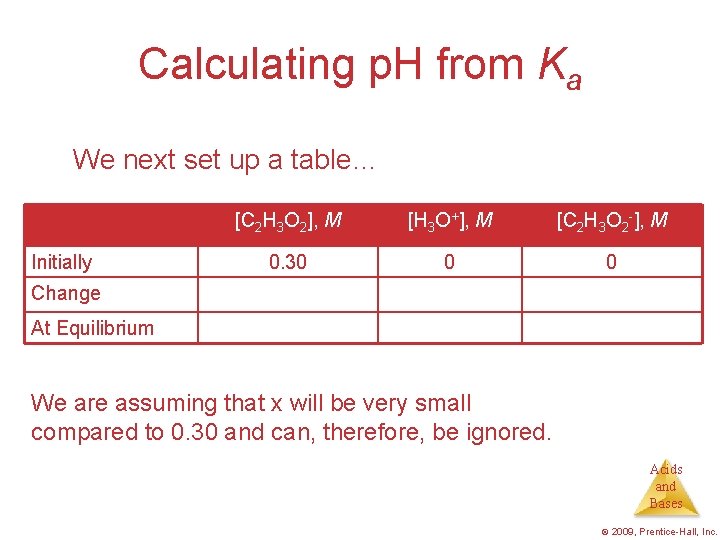
Calculating p. H from Ka We next set up a table… [C 2 H 3 O 2], M [H 3 O+], M [C 2 H 3 O 2 -], M Initially 0. 30 0 0 Change -x +x +x 0. 30 - x 0. 30 x x At Equilibrium We are assuming that x will be very small compared to 0. 30 and can, therefore, be ignored. Acids and Bases © 2009, Prentice-Hall, Inc.
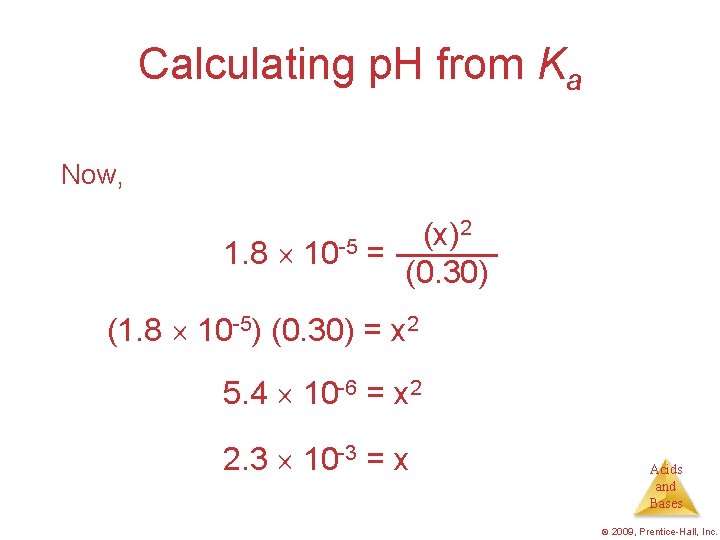
Calculating p. H from Ka Now, 2 (x) 1. 8 10 -5 = (0. 30) (1. 8 10 -5) (0. 30) = x 2 5. 4 10 -6 = x 2 2. 3 10 -3 = x Acids and Bases © 2009, Prentice-Hall, Inc.
![Calculating p. H from Ka p. H = -log [H 3 O+] p. H](http://slidetodoc.com/presentation_image_h2/9a28570c5212a2a101a5bcac5c3ac484/image-65.jpg "Calculating p. H from Ka p. H = -log [H 3 O+] p. H")
Calculating p. H from Ka p. H = -log [H 3 O+] p. H = -log (2. 3 10 -3) p. H = 2. 64 Acids and Bases © 2009, Prentice-Hall, Inc.
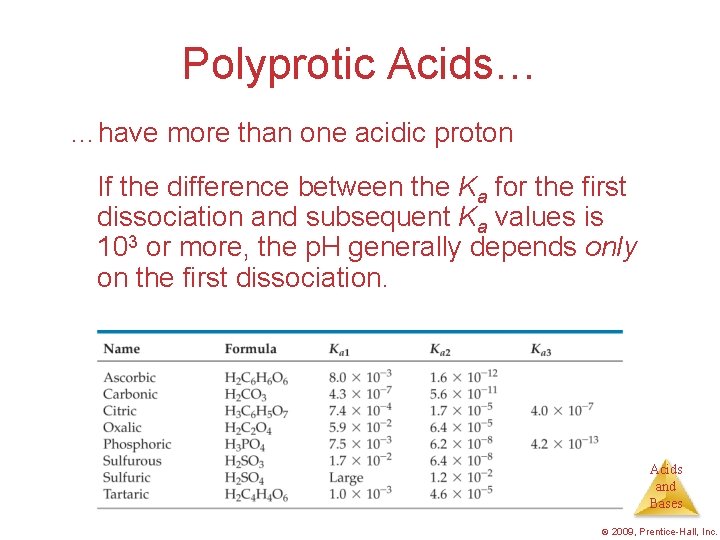
Polyprotic Acids… …have more than one acidic proton If the difference between the Ka for the first dissociation and subsequent Ka values is 103 or more, the p. H generally depends only on the first dissociation. Acids and Bases © 2009, Prentice-Hall, Inc.
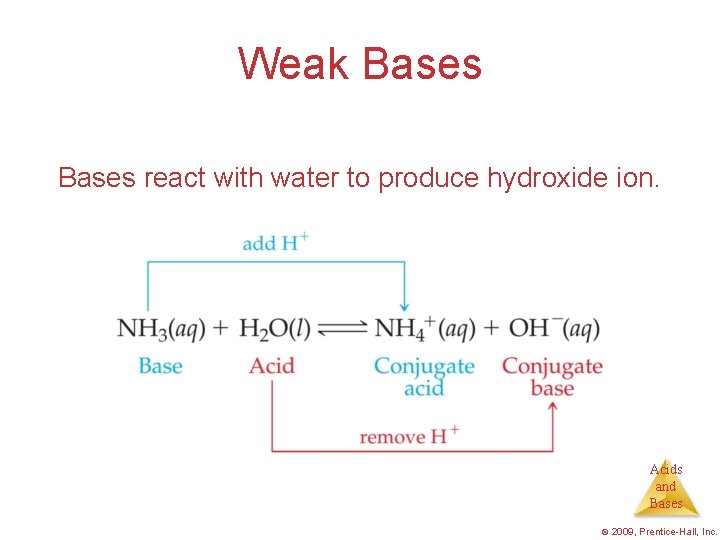
Weak Bases react with water to produce hydroxide ion. Acids and Bases © 2009, Prentice-Hall, Inc.
![Weak Bases The equilibrium constant expression for this reaction is [HB] [OH-] Kb =](http://slidetodoc.com/presentation_image_h2/9a28570c5212a2a101a5bcac5c3ac484/image-68.jpg "Weak Bases The equilibrium constant expression for this reaction is [HB] [OH-] Kb =")
Weak Bases The equilibrium constant expression for this reaction is [HB] [OH-] Kb = [B-] where Kb is the base-dissociation constant. Acids and Bases © 2009, Prentice-Hall, Inc.
![Weak Bases Kb can be used to find [OH-] and, through it, p. H.](http://slidetodoc.com/presentation_image_h2/9a28570c5212a2a101a5bcac5c3ac484/image-69.jpg "Weak Bases Kb can be used to find [OH-] and, through it, p. H.")
Weak Bases Kb can be used to find [OH-] and, through it, p. H. Acids and Bases © 2009, Prentice-Hall, Inc.
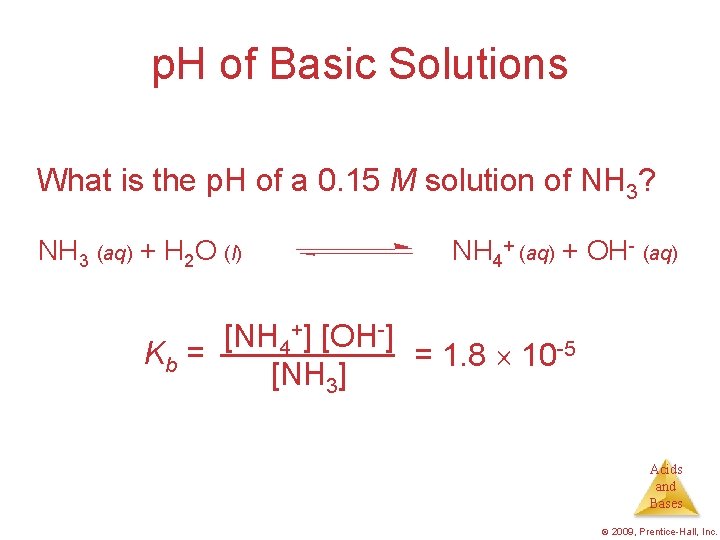
p. H of Basic Solutions What is the p. H of a 0. 15 M solution of NH 3? NH 3 (aq) + H 2 O (l) NH 4+ (aq) + OH- (aq) [NH 4+] [OH-] Kb = = 1. 8 10 -5 [NH 3] Acids and Bases © 2009, Prentice-Hall, Inc.
![p. H of Basic Solutions Tabulate the data. Initially At Equilibrium [NH 3], M](http://slidetodoc.com/presentation_image_h2/9a28570c5212a2a101a5bcac5c3ac484/image-71.jpg "p. H of Basic Solutions Tabulate the data. Initially At Equilibrium [NH 3], M")
p. H of Basic Solutions Tabulate the data. Initially At Equilibrium [NH 3], M [NH 4+], M [OH-], M 0. 15 - x 0. 15 0 x Acids and Bases © 2009, Prentice-Hall, Inc.
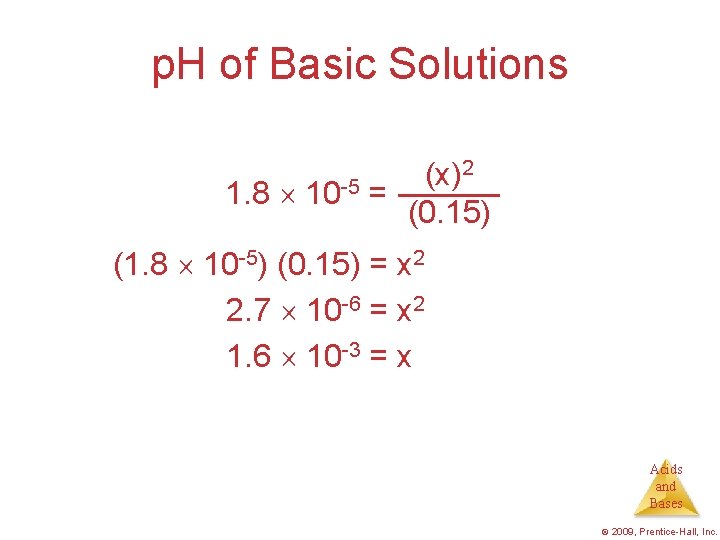
p. H of Basic Solutions 2 (x) 1. 8 10 -5 = (0. 15) (1. 8 10 -5) (0. 15) = x 2 2. 7 10 -6 = x 2 1. 6 10 -3 = x 2 Acids and Bases © 2009, Prentice-Hall, Inc.
![p. H of Basic Solutions Therefore, [OH-] = 1. 6 10 -3 M p.](http://slidetodoc.com/presentation_image_h2/9a28570c5212a2a101a5bcac5c3ac484/image-73.jpg "p. H of Basic Solutions Therefore, [OH-] = 1. 6 10 -3 M p.")
p. H of Basic Solutions Therefore, [OH-] = 1. 6 10 -3 M p. OH = -log (1. 6 10 -3) p. OH = 2. 80 p. H = 14. 00 - 2. 80 p. H = 11. 20 Acids and Bases © 2009, Prentice-Hall, Inc.
Stop Here Section 16. 5, 16. 6 & 16. 7 • Strong Acids & Bases EOC q’s 43 -49 • Weak Acids EOC q’s 51 -69 odd • Weak Bases EOC q’s 71 - 89 Acids and Bases
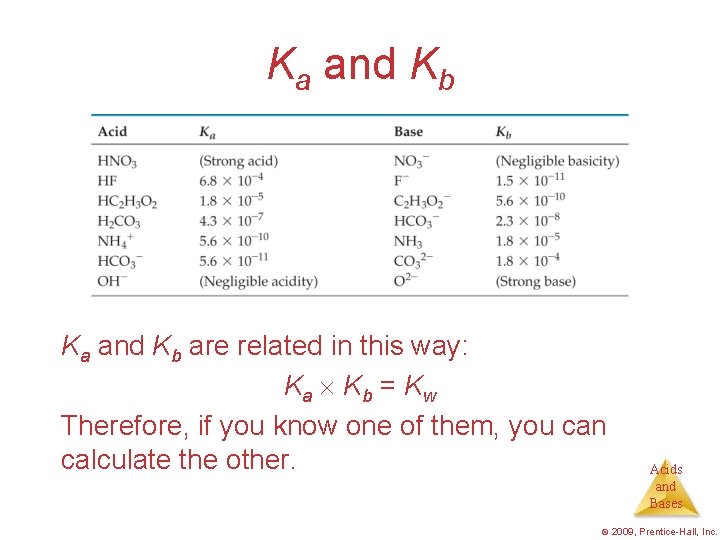
Ka and Kb are related in this way: Ka Kb = Kw Therefore, if you know one of them, you can calculate the other. Acids and Bases © 2009, Prentice-Hall, Inc.
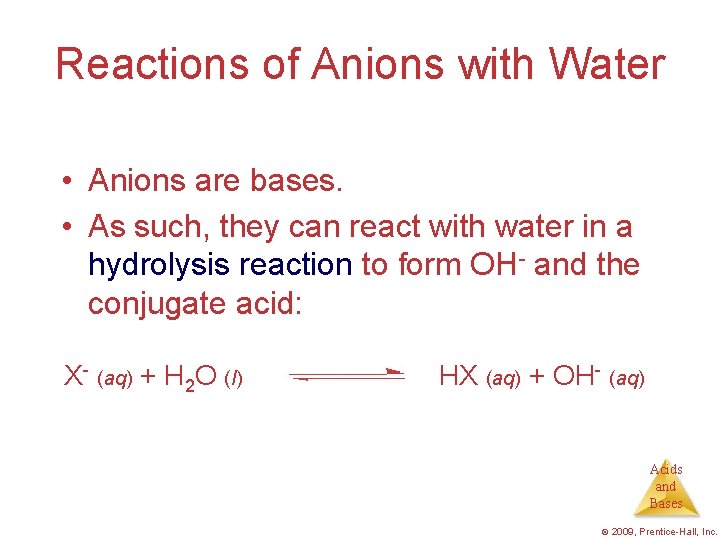
Reactions of Anions with Water • Anions are bases. • As such, they can react with water in a hydrolysis reaction to form OH- and the conjugate acid: X- (aq) + H 2 O (l) HX (aq) + OH- (aq) Acids and Bases © 2009, Prentice-Hall, Inc.
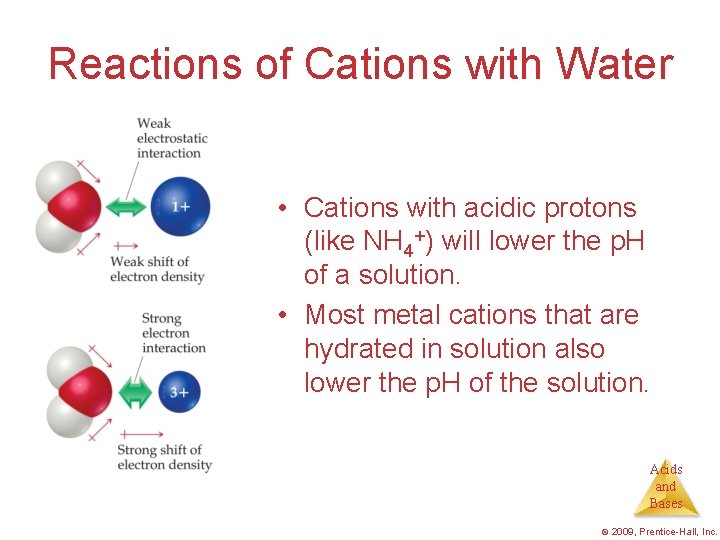
Reactions of Cations with Water • Cations with acidic protons (like NH 4+) will lower the p. H of a solution. • Most metal cations that are hydrated in solution also lower the p. H of the solution. Acids and Bases © 2009, Prentice-Hall, Inc.
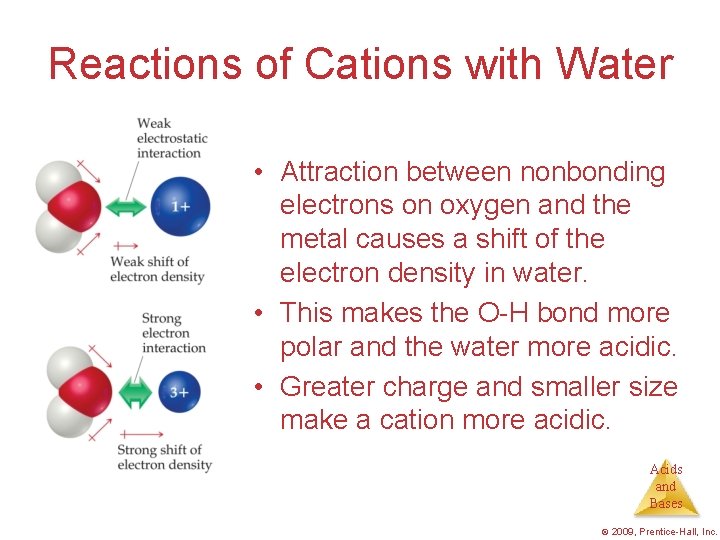
Reactions of Cations with Water • Attraction between nonbonding electrons on oxygen and the metal causes a shift of the electron density in water. • This makes the O-H bond more polar and the water more acidic. • Greater charge and smaller size make a cation more acidic. Acids and Bases © 2009, Prentice-Hall, Inc.
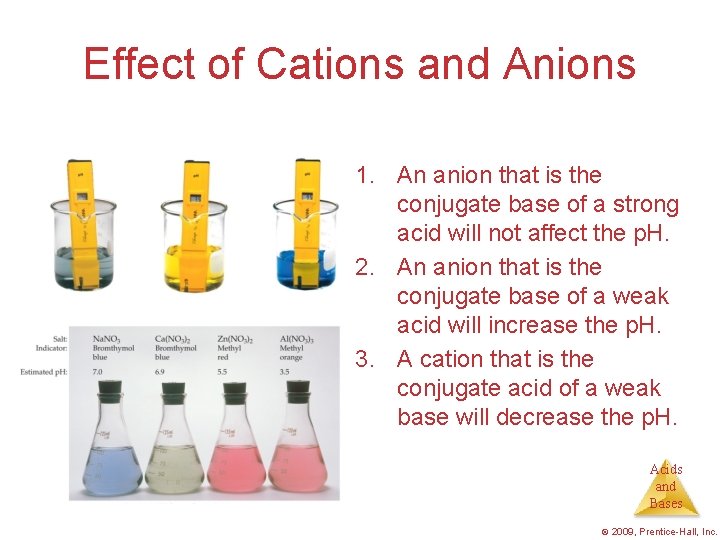
Effect of Cations and Anions 1. An anion that is the conjugate base of a strong acid will not affect the p. H. 2. An anion that is the conjugate base of a weak acid will increase the p. H. 3. A cation that is the conjugate acid of a weak base will decrease the p. H. Acids and Bases © 2009, Prentice-Hall, Inc.
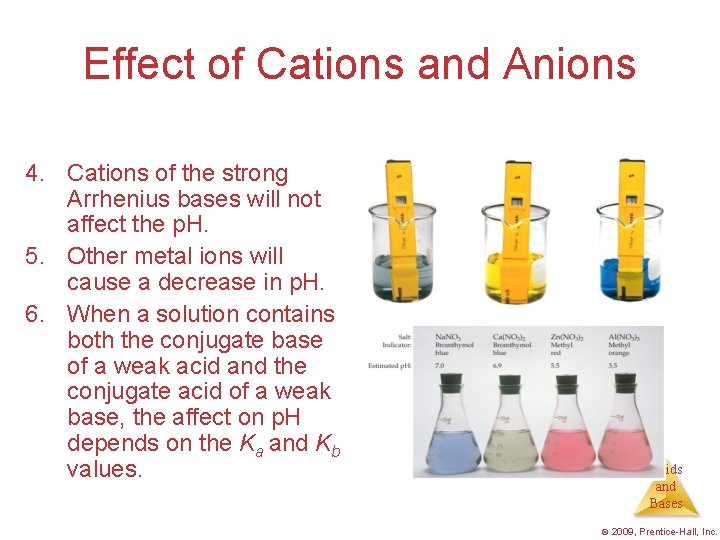
Effect of Cations and Anions 4. Cations of the strong Arrhenius bases will not affect the p. H. 5. Other metal ions will cause a decrease in p. H. 6. When a solution contains both the conjugate base of a weak acid and the conjugate acid of a weak base, the affect on p. H depends on the Ka and Kb values. Acids and Bases © 2009, Prentice-Hall, Inc.
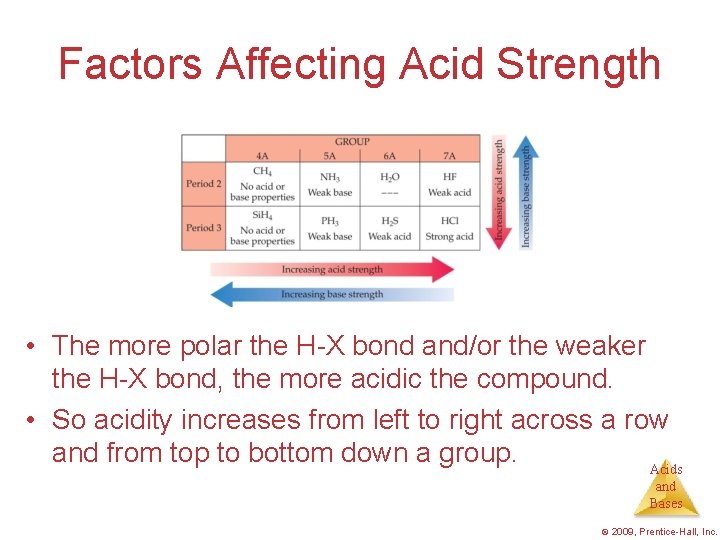
Factors Affecting Acid Strength • The more polar the H-X bond and/or the weaker the H-X bond, the more acidic the compound. • So acidity increases from left to right across a row and from top to bottom down a group. Acids and Bases © 2009, Prentice-Hall, Inc.
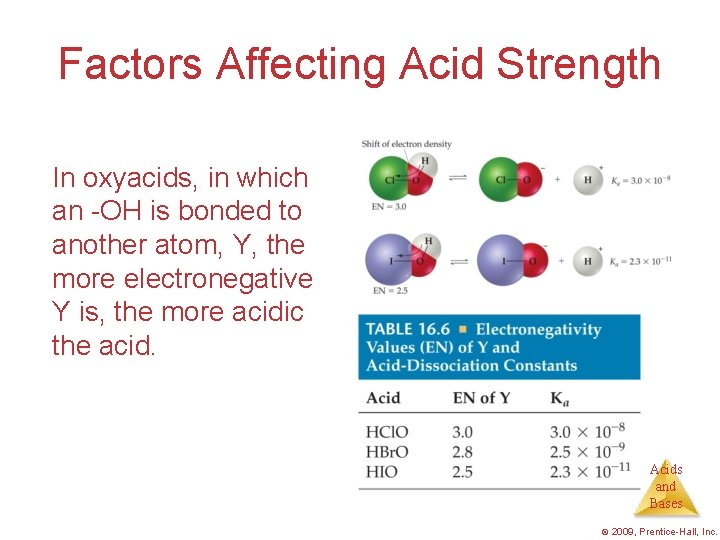
Factors Affecting Acid Strength In oxyacids, in which an -OH is bonded to another atom, Y, the more electronegative Y is, the more acidic the acid. Acids and Bases © 2009, Prentice-Hall, Inc.
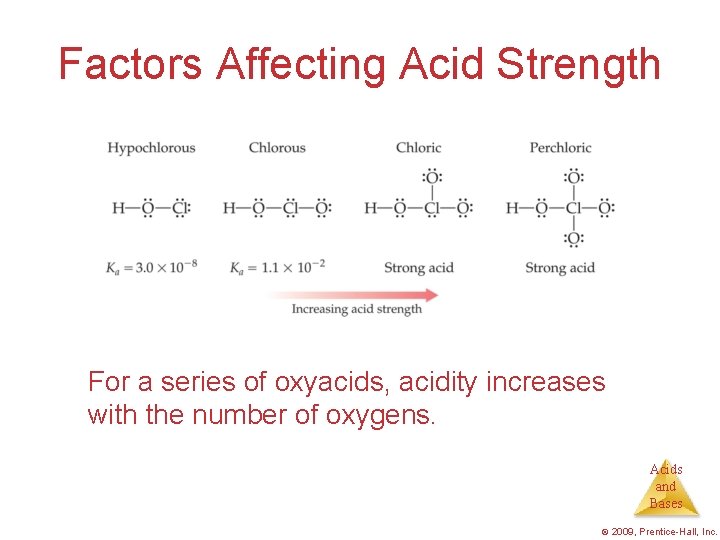
Factors Affecting Acid Strength For a series of oxyacids, acidity increases with the number of oxygens. Acids and Bases © 2009, Prentice-Hall, Inc.
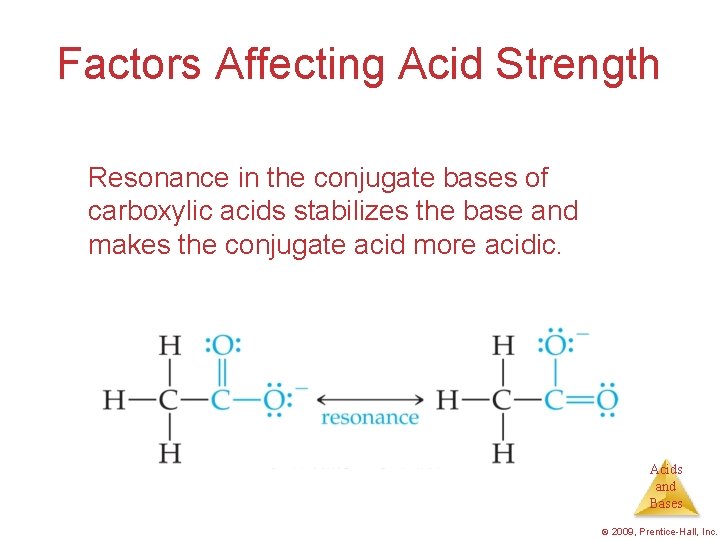
Factors Affecting Acid Strength Resonance in the conjugate bases of carboxylic acids stabilizes the base and makes the conjugate acid more acidic. Acids and Bases © 2009, Prentice-Hall, Inc.
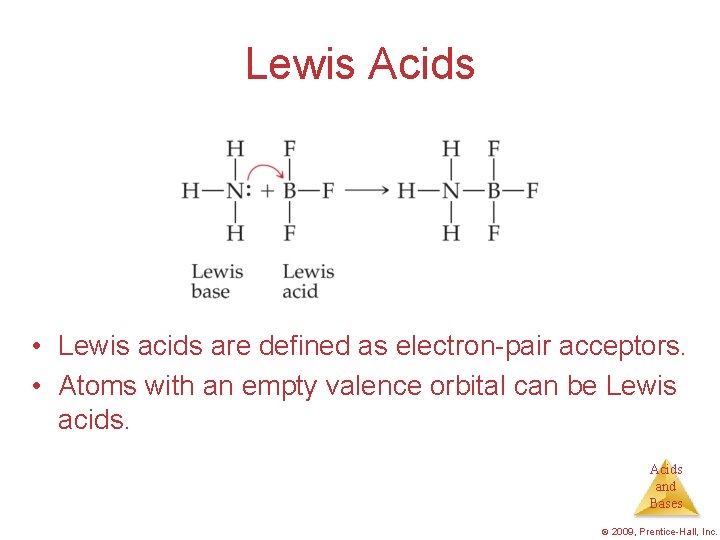
Lewis Acids • Lewis acids are defined as electron-pair acceptors. • Atoms with an empty valence orbital can be Lewis acids. Acids and Bases © 2009, Prentice-Hall, Inc.
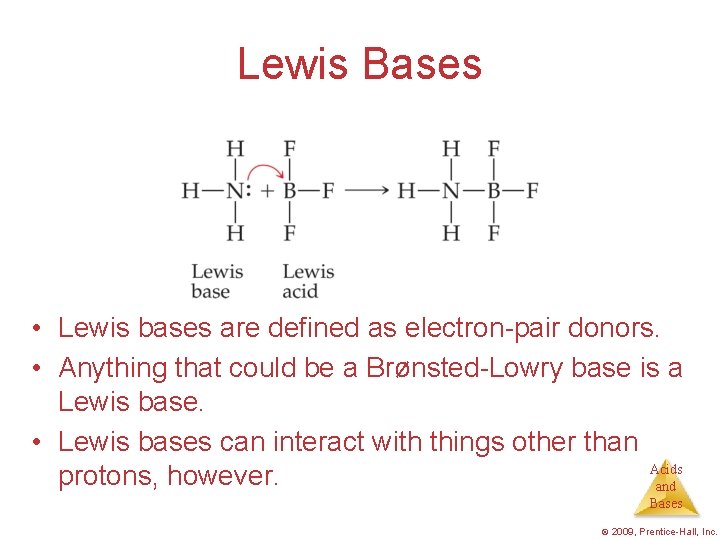
Lewis Bases • Lewis bases are defined as electron-pair donors. • Anything that could be a Brønsted-Lowry base is a Lewis base. • Lewis bases can interact with things other than Acids protons, however. and Bases © 2009, Prentice-Hall, Inc.
- Slides: 86