
Chapter 15 Work Power and Simple Machines Video
- Slides: 33
Chapter 15 Work, Power, and Simple Machines Video #57 (simple mach. For kids)
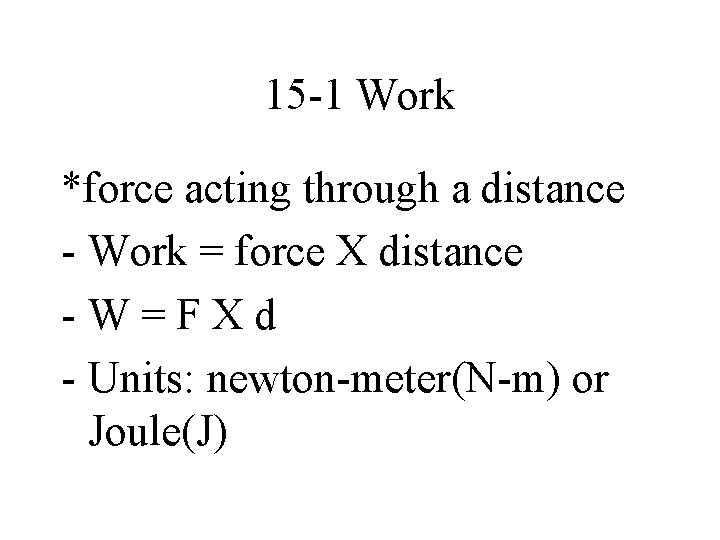
15 -1 Work *force acting through a distance - Work = force X distance -W=FXd - Units: newton-meter(N-m) or Joule(J)
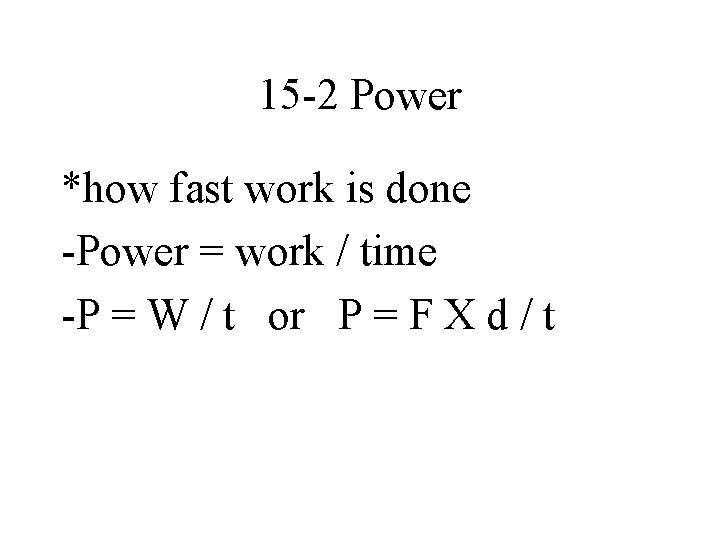
15 -2 Power *how fast work is done -Power = work / time -P = W / t or P = F X d / t
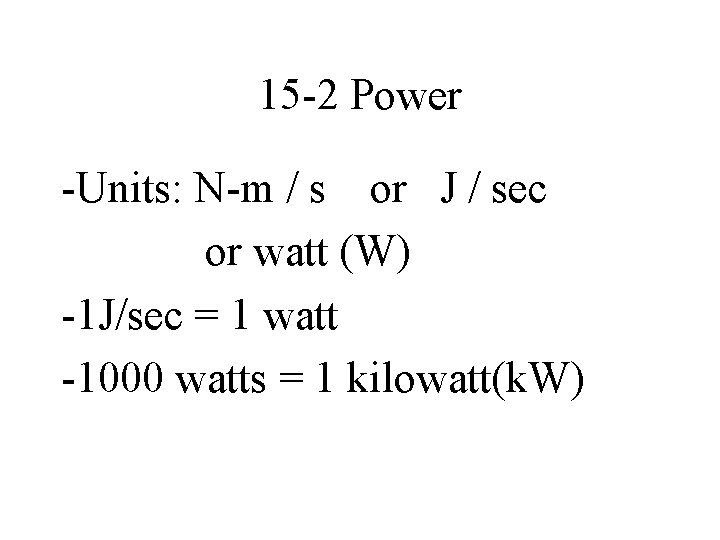
15 -2 Power -Units: N-m / s or J / sec or watt (W) -1 J/sec = 1 watt -1000 watts = 1 kilowatt(k. W)
-Horsepower *(hp) = to 750 watts (745. 56) Video #44 (Science of Golf)
15 -3 Machines *device that makes work easier Video #42 (Real World: W, E, F)
-effort and resistance -make work easier by changing size or dir of applied force *effort force(Fe): force applied to a machine
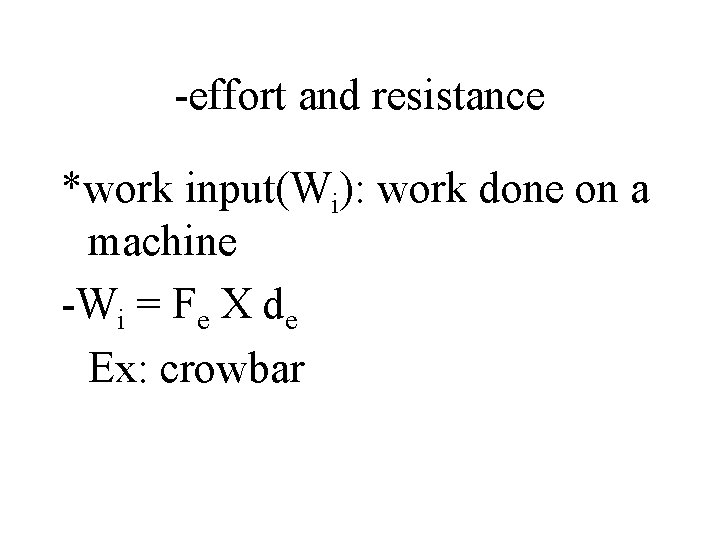
-effort and resistance *work input(Wi): work done on a machine -Wi = Fe X de Ex: crowbar
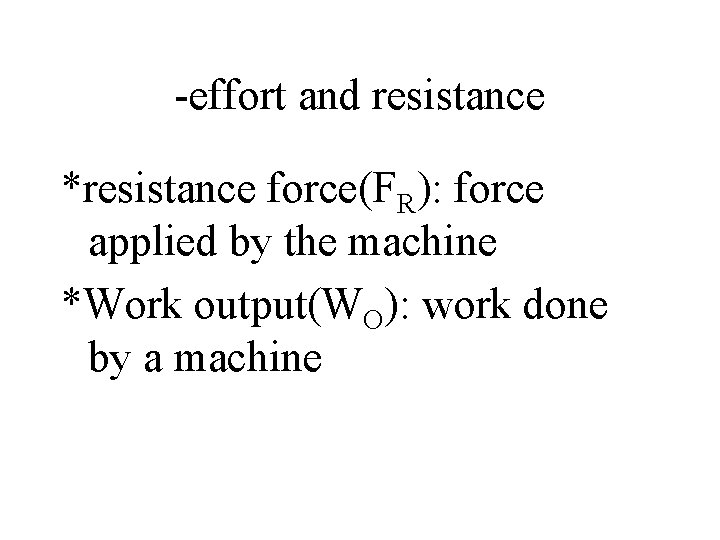
-effort and resistance *resistance force(FR): force applied by the machine *Work output(WO): work done by a machine
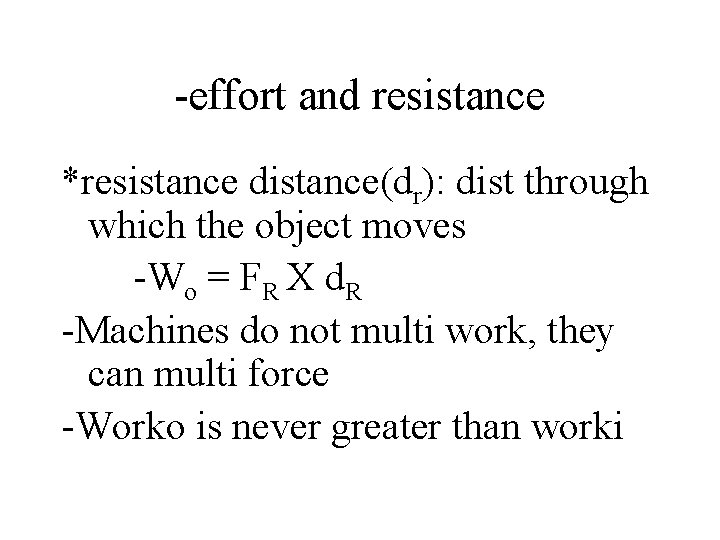
-effort and resistance *resistance distance(dr): dist through which the object moves -Wo = FR X d. R -Machines do not multi work, they can multi force -Worko is never greater than worki
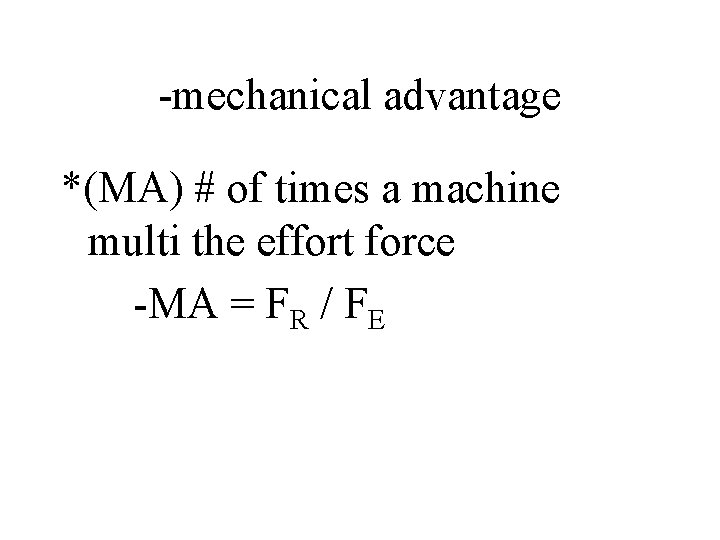
-mechanical advantage *(MA) # of times a machine multi the effort force -MA = FR / FE
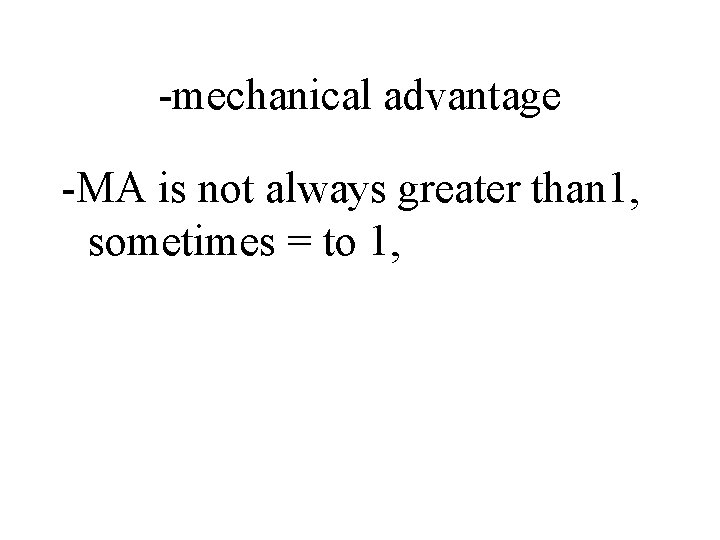
-mechanical advantage -MA is not always greater than 1, sometimes = to 1,
-mechanical advantage -MA of one changes the dir of the effort force -MA is less than 1, increases the dist an object is moved or the speed with which it is moved
-efficiency *comparison of worko to worki - Efficiency = WO / WI X 100 -High eff = worki is changed to worko -eff can never be greater than 100%
-role of friction -less friction = higher its effic -effic can be increased by reducing friction ex: oil, grease, wax, bearings
15 -4 Simple Machines -6 simp mach: incline plane, the wedge, the screw, the lever, the pulley, and the wheel and axle
-inclined plane *slanted surface used to raise an object(a ramp) -smaller effort force, but moved through a greater distance
-inclined plane -MA = length of the plane divided by its height -length can never be shorter than its height -MA = never be < 1
-wedge and screws *wedge: incline plane that moves -large force exerted on a small surface
-wedge and screws -longer and thinner the less effort force required ex: sharpening
-wedge and screws *screw: an incline plane wrapped around a cylinder to form a spiral -multi an effort force by acting through a long effort distance -the closer the threads > the MA
-levers *bar that is free to pivot about a fixed point when effort force is applied ex: seesaw, shovel, nutcracker, crowbar *fulcrum: is the fixed point
-levers -3 classes of levers -based on the position of the fulcrum, effort force, resist force
-levers 1) 1 st class: multi effort force and also change dir Ex: pliers, scissors, seesaws
-levers 2) 2 nd class: resist force is between the fulcr and the effort force -multi eff force but does not change dir Ex: wheelbarrow, door, nutcracker
-levers 3) rd 3 class: eff force > resistan -doesn’t multi force -multi dist of eff force
-levers -MA: # of times the lever increases the eff force *effort arm: dist from the eff force to the fulc *resist arm: dist from resis force to the fulc
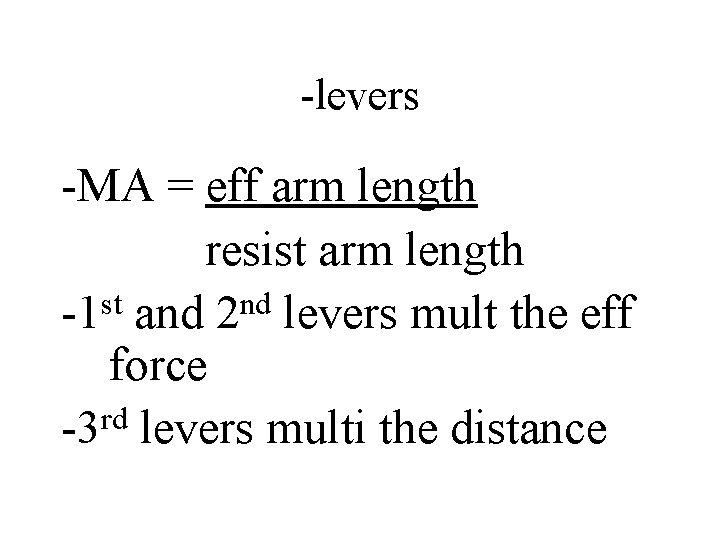
-levers -MA = eff arm length resist arm length st nd -1 and 2 levers mult the eff force -3 rd levers multi the distance
-pulleys video #43 (pulley simple machines) -can change either dir or amount of eff force -fixed pulley: attached to a stationary object -can’t multi eff force -change dir of eff force
-pulleys -MA of a fixed pulley is 1
-pulleys -movable pulley: -can multi eff force -can’t change dir of an eff force -MA>1
-pulleys -can predict MA by counting the number of supporting sections of rope.
Complex Machines *is a combination of 2 or more simple machines. **you can get no more work out of a machine than you put in it! Video: 49 (pumkin chuckin)