
CHAPTER 15 Understanding Regression Analysis Basics Copyright 2017
CHAPTER 15 Understanding Regression Analysis Basics Copyright © 2017 Pearson Education, Inc. 15 -1
Copyright © 2017 Pearson Education, Inc. 15 -2 -2
Copyright © 2017 Pearson Education, Inc. 15 -3 -3
Bivariate Linear Regression Analysis • Regression analysis is a predictive analysis technique in which one or more variables are used to predict the level of another by use of the straight-line formula. • Bivariate regression means only two variables are being analyzed, and researchers sometimes refer to this case as “simple regression”. Copyright © 2017 Pearson Education, Inc. 15 -4 -4
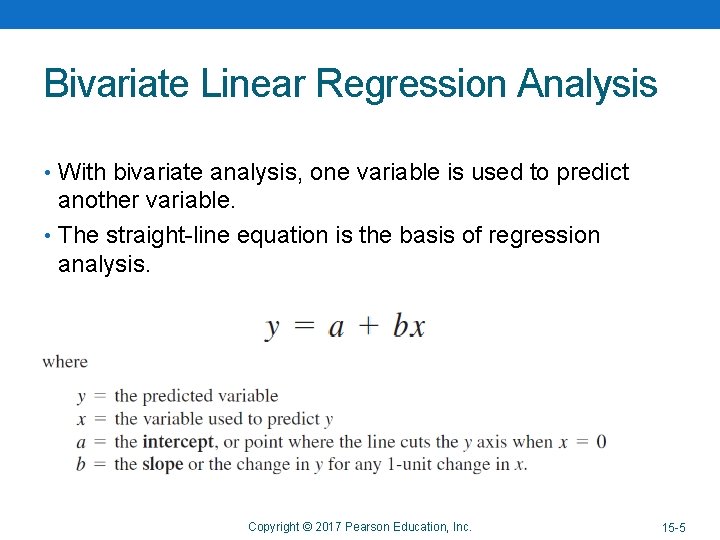
Bivariate Linear Regression Analysis • With bivariate analysis, one variable is used to predict another variable. • The straight-line equation is the basis of regression analysis. Copyright © 2017 Pearson Education, Inc. 15 -5 -5
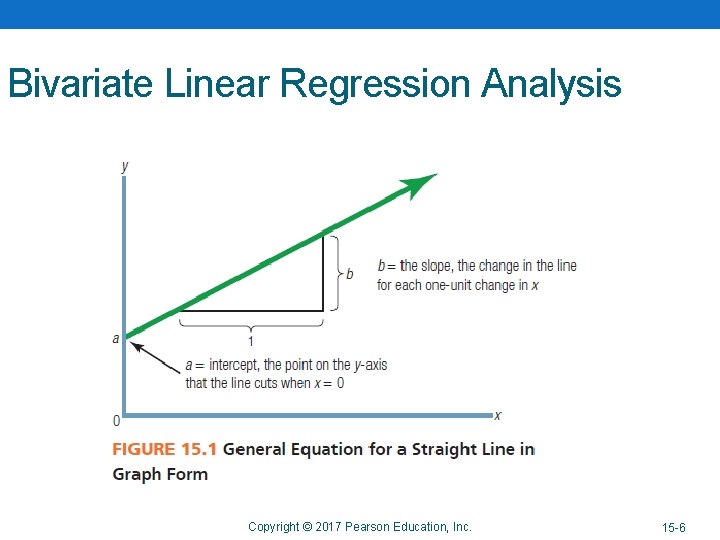
Bivariate Linear Regression Analysis Copyright © 2017 Pearson Education, Inc. 15 -6 -6
Basic Regression Analysis Concepts • Independent variable: used to predict the independent variable (x in the regression straight-line equation) • Dependent variable: that which is predicted (y in the regression straight-line equation) Copyright © 2017 Pearson Education, Inc. 15 -7 -7
Improving Regression Analysis • Identify any outlier -- a data point that is substantially outside the normal range of the data points being analyzed. Copyright © 2017 Pearson Education, Inc. 15 -8 -8
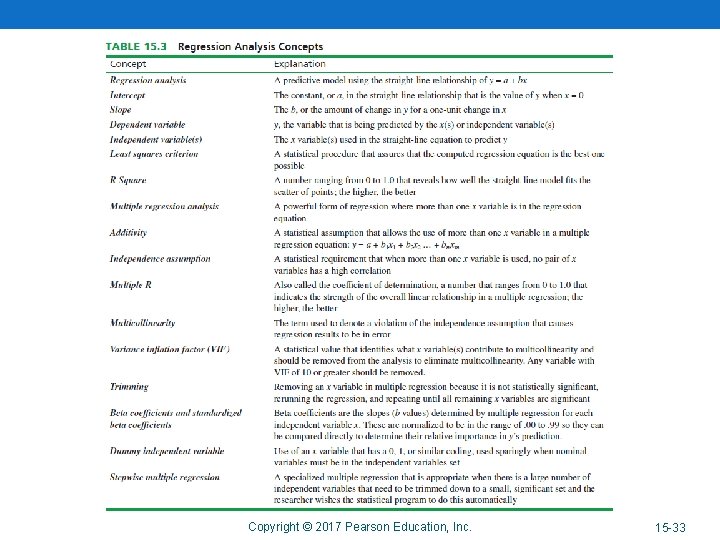
Computing the Slope and the Intercept • Least squares criterion: used in regression analysis; guarantees that the “best” straight-line slope and intercept will be calculated Copyright © 2017 Pearson Education, Inc. 15 -9 -9
Multiple Regression Analysis • Multiple regression analysis uses the same concepts as bivariate regression analysis, but uses more than one independent variable. • A general conceptual model identifies independent and dependent variables and shows their basic relationships to one another. Copyright © 2017 Pearson Education, Inc. 15 -10
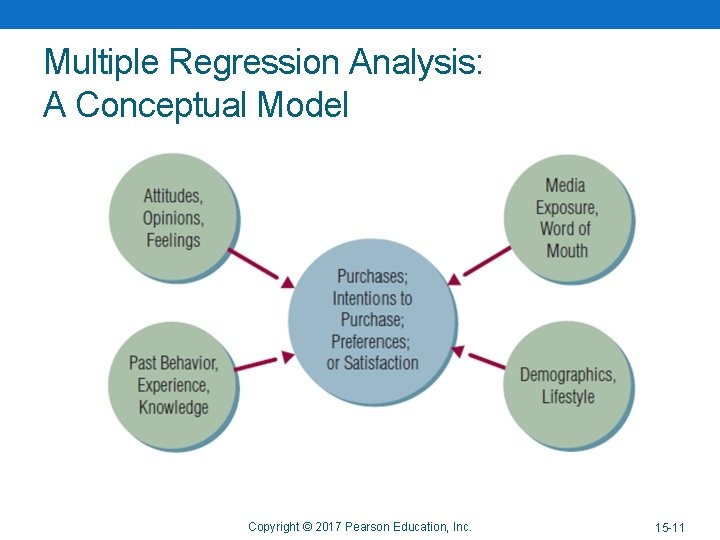
Multiple Regression Analysis: A Conceptual Model Copyright © 2017 Pearson Education, Inc. 15 -11
Multiple Regression Analysis Described • Multiple regression means that you have more than one independent variable to predict a single dependent variable. • With multiple regression, the regression plane is the shape of the dependent variables. Copyright © 2017 Pearson Education, Inc. 15 -12
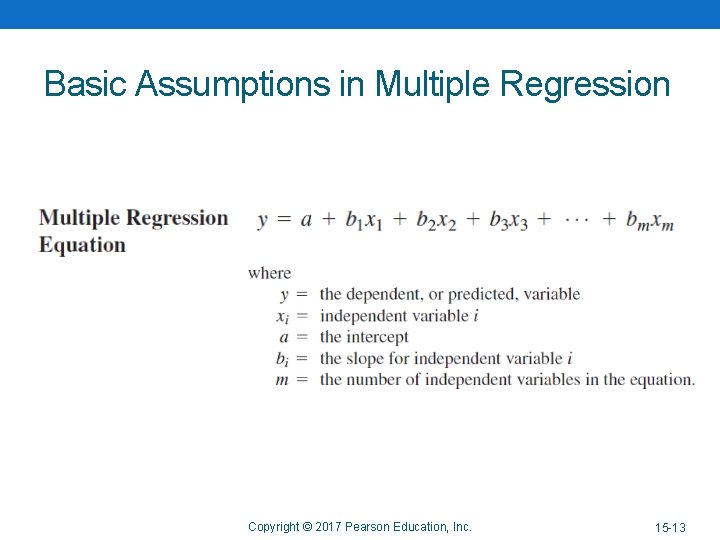
Basic Assumptions in Multiple Regression Copyright © 2017 Pearson Education, Inc. 15 -13
Example of Multiple Regression • We wish to predict customers’ intentions to purchase a Lexus automobile. • We performed a survey that included an attitude-toward. Lexus variable, a word-of-mouth variable and an income variable. Copyright © 2017 Pearson Education, Inc. 15 -14
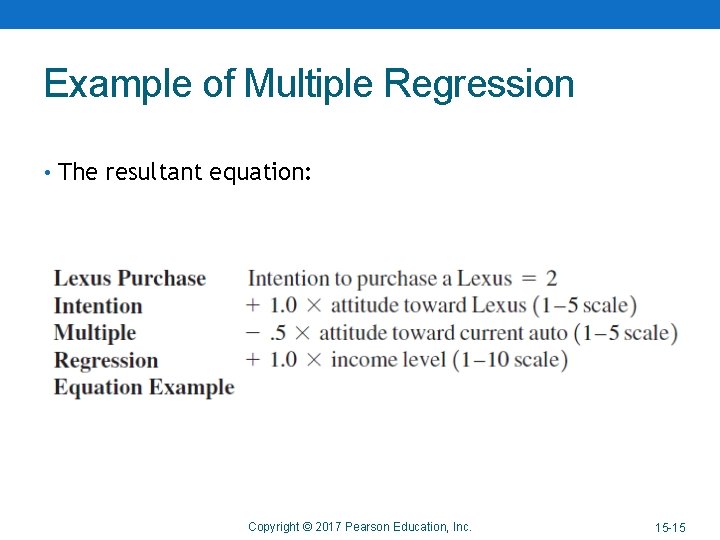
Example of Multiple Regression • The resultant equation: Copyright © 2017 Pearson Education, Inc. 15 -15
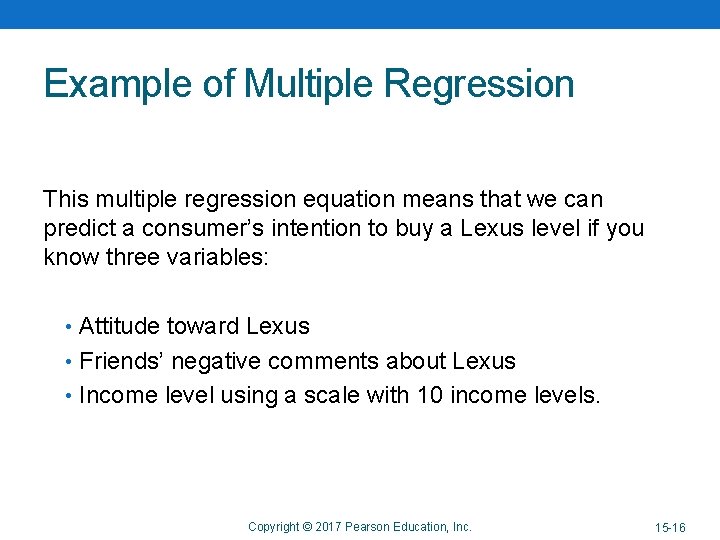
Example of Multiple Regression This multiple regression equation means that we can predict a consumer’s intention to buy a Lexus level if you know three variables: • Attitude toward Lexus • Friends’ negative comments about Lexus • Income level using a scale with 10 income levels. Copyright © 2017 Pearson Education, Inc. 15 -16
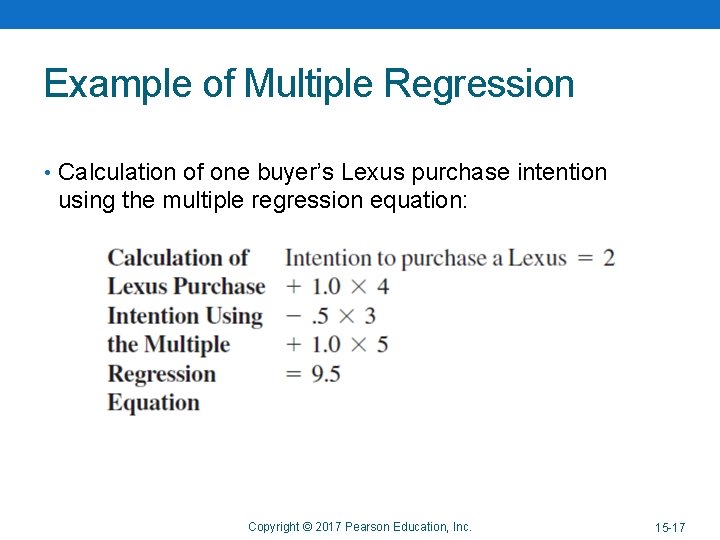
Example of Multiple Regression • Calculation of one buyer’s Lexus purchase intention using the multiple regression equation: Copyright © 2017 Pearson Education, Inc. 15 -17
Example of Multiple Regression Multiple regression is a powerful tool because it tells us: • Which factors predict the dependent variable • Which way (the sign) each factor influences the dependent variable • How much (the size of bi) each factor influences it Copyright © 2017 Pearson Education, Inc. 15 -18
Multiple R • Multiple R: also called the coefficient of determination, is a measure of the strength of the overall linear relationship in multiple regression. • It indicates how well the independent variables can predict the dependent variable. Copyright © 2017 Pearson Education, Inc. 15 -19
Multiple R • Multiple R ranges from 0 to +1 and represents the amount of the dependent variable that is “explained, ” or accounted for, by the combined independent variables. Copyright © 2017 Pearson Education, Inc. 15 -20
Multiple R • Researchers convert the Multiple R into a percentage: Multiple R of. 75 means that the regression findings will explain 75% of the dependent variable. Copyright © 2017 Pearson Education, Inc. 15 -21
Basic Assumptions of Multiple Regression • Independence assumption: the independent variables must be statistically independent and uncorrelated with one another (the presence of strong correlations among independent variables is called multicollinearity) Copyright © 2017 Pearson Education, Inc. 15 -22
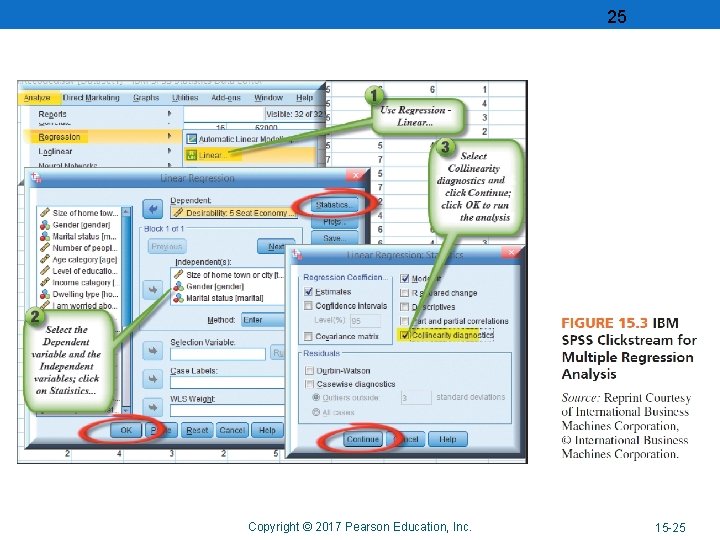
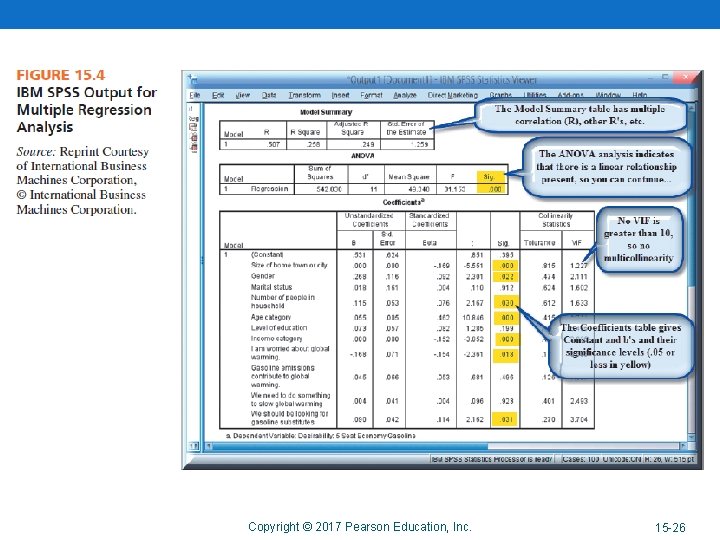
Basic Assumptions of Multiple Regression Variance inflation factor (VIF): can be used to assess and eliminate multicollinearity • VIF is a statistical value that identifies what independent variable(s) contribute to multicollinearity and should be removed • Any variable with VIF of greater than 10 should be removed Copyright © 2017 Pearson Education, Inc. 15 -23
Basic Assumptions in Multiple Regression • The inclusion of each independent variable preserves the straight-line assumptions of multiple regression analysis. This is sometimes known as additivity because each new independent variable is added to the regression equation. Copyright © 2017 Pearson Education, Inc. 15 -24
25 Copyright © 2017 Pearson Education, Inc. 15 -25
Copyright © 2017 Pearson Education, Inc. 15 -26
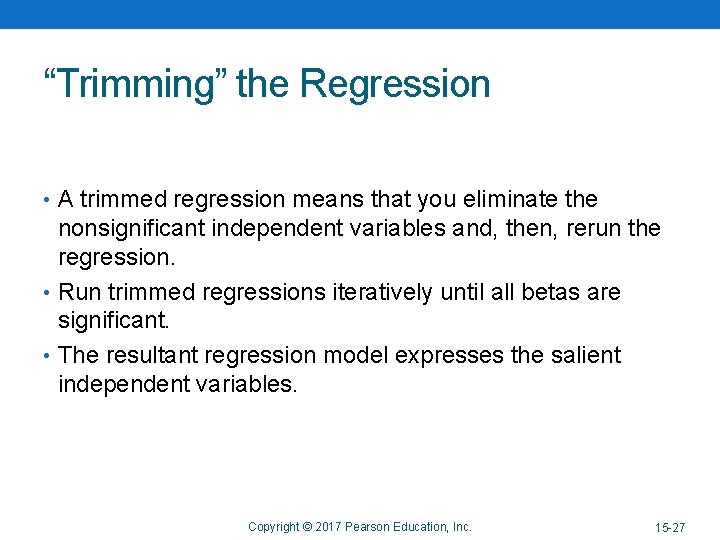
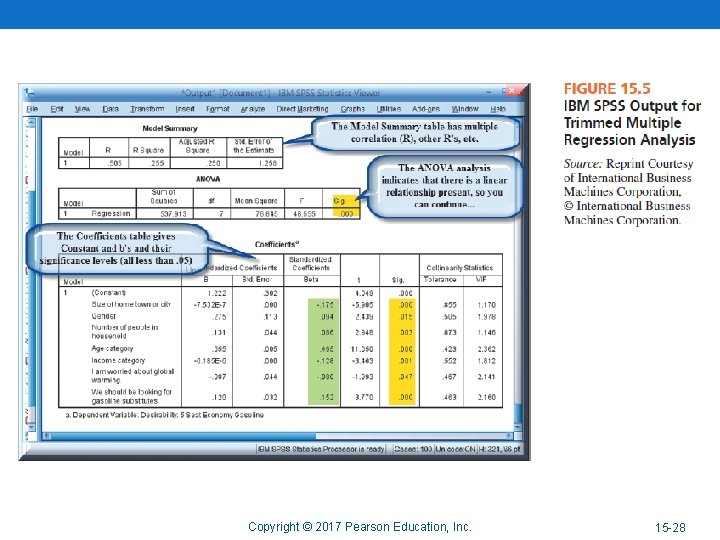
“Trimming” the Regression • A trimmed regression means that you eliminate the nonsignificant independent variables and, then, rerun the regression. • Run trimmed regressions iteratively until all betas are significant. • The resultant regression model expresses the salient independent variables. Copyright © 2017 Pearson Education, Inc. 15 -27
Copyright © 2017 Pearson Education, Inc. 15 -28
Special Uses of Multiple Regression • Dummy independent variable: scales with a nominal 0 - versus-1 coding scheme • Using standardized betas to compare independent variables: allows direct comparison of each independent value • Using multiple regression as a screening device: identify variables to exclude Copyright © 2017 Pearson Education, Inc. 15 -29
Stepwise Multiple Regression • Stepwise regression is useful when there are many independent variables, and a researcher wants to narrow the set down to a smaller number of statistically significant variables. Copyright © 2017 Pearson Education, Inc. 15 -30
Stepwise Multiple Regression • The one independent variable that is statistically significant and explains the most variance is entered first into the multiple regression equation. • Then, each statistically significant independent variable is added in order of variance explained. • All insignificant independent variables are excluded. Copyright © 2017 Pearson Education, Inc. 15 -31
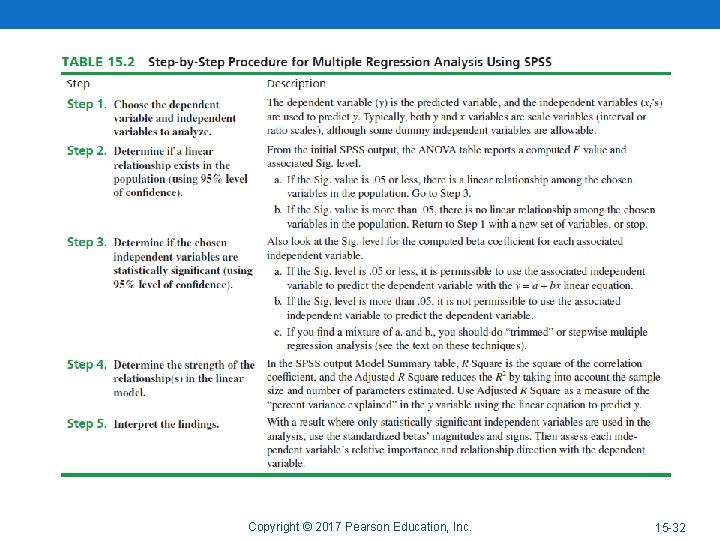
Copyright © 2017 Pearson Education, Inc. 15 -32
Copyright © 2017 Pearson Education, Inc. 15 -33
Three Warnings Regarding Multiple Regression Analysis • Regression is a statistical tool, not a cause-and-effect statement. • Regression analysis should not be applied outside the boundaries of data used to develop the regression model. • Chapter 15 is simplified…regression analysis is complex and requires additional study. Copyright © 2017 Pearson Education, Inc. 15 -34
Reporting Findings to Clients Most important when used as a screening devise: • Dependent variable • Statistically significant independent variables • Signs of beta coefficients • Standardized bets coefficients for significant variables Copyright © 2017 Pearson Education, Inc. 15 -35
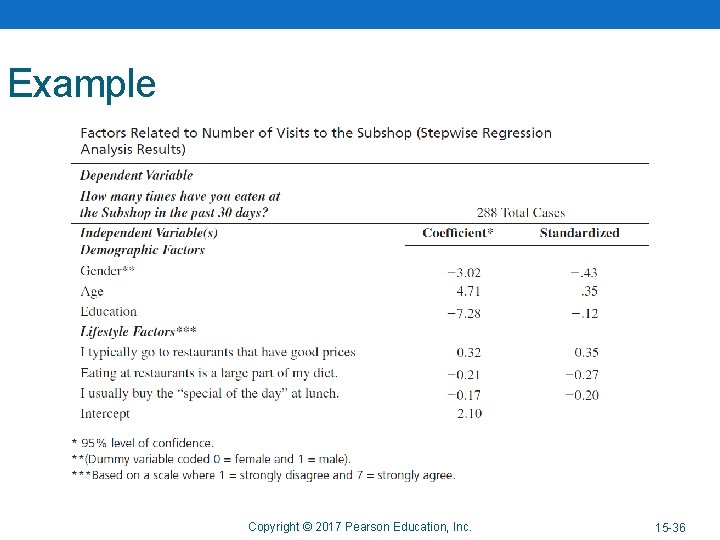
Example Copyright © 2017 Pearson Education, Inc. 15 -36
All rights reserved. No part of this publication may be reproduced, stored in a retrieval system, or transmitted, in any form or by any means, electronic, mechanical, photocopying, recording, or otherwise, without the prior written permission of the publisher. Printed in the United States of America. Copyright © 2017 Pearson Education, Inc. 15 -37
- Slides: 37