
CHAPTER 15 Understanding Marketing Processes and Consumer Behaviour

CHAPTER 15 Understanding Marketing Processes and Consumer Behaviour Business, Sixth Canadian Edition, by Griffin, Ebert, and Starke Copyright © 2008 Pearson Education Canada
2 Learning Objectives Explain the concept of marketing and describe the five forces that constitute the external marketing environment. Explain the purpose of a marketing plan and identify the four components of the marketing mix. Explain market segmentation and show it is used in target marketing. Explain the purpose and value of market research. Business, Sixth Canadian Edition, by Griffin, Ebert, and Starke Copyright © 2008 Pearson Education Canada
3 More Learning Objectives Describe the key factors that influence the consumer buying process. Discuss three categories of organizational markets and explain how organizational buying behaviour differs from consumer buying behaviour. Describe the international and small business marketing mixes. Business, Sixth Canadian Edition, by Griffin, Ebert, and Starke Copyright © 2008 Pearson Education Canada
4 What is Marketing? planning and executing the development, pricing, promotion and distribution of ideas, goods, services to create exchanges that satisfy both buyers’ and sellers’ objectives Providing Value and Satisfaction <value = comparison of benefits versus costs <utility = ability of a product to satisfy a need Business, Sixth Canadian Edition, by Griffin, Ebert, and Starke Copyright © 2008 Pearson Education Canada
5 Utility: Adding Value Time Utility < Satisfying because of when the product is available Place Utility < Satisfying because of where the product is available Ownership (Possession) Utility < Satisfying during its consumption or use Form Utility < Satisfying because of the product’s form (the transformation of raw materials into a finished product) Business, Sixth Canadian Edition, by Griffin, Ebert, and Starke Copyright © 2008 Pearson Education Canada

6 Goods, Services and Ideas Marketing can be directed to < Consumer goods: tangible products purchased by individuals for their use t food, clothing < Industrial goods: Products purchased by companies to use directly or indirectly to produce other products t components, raw materials, equipment < Services: intangible products to serve users’ needs t insurance, health care < Ideas: thoughts or philosophies t “Participaction” as a symbol for healthy living Business, Sixth Canadian Edition, by Griffin, Ebert, and Starke Copyright © 2008 Pearson Education Canada
7 Relationship Marketing A type of marketing that emphasizes lasting relationships with customers and suppliers Stronger relationships can result in greater long-term customer satisfaction and client retention Business, Sixth Canadian Edition, by Griffin, Ebert, and Starke Copyright © 2008 Pearson Education Canada

8 The Marketing Environment Competitive Environment Political & Legal Environment Economic Environment The Firm’s Marketing Plan Social & Cultural Environment Technological Environment Business, Sixth Canadian Edition, by Griffin, Ebert, and Starke Copyright © 2008 Pearson Education Canada
9 Political and Legal Environment Legislation and government programs can be favourable or not Marketing managers try to maintain favour by < gaining public support for products < advertising for public awareness of important issues < lobby and contribute to political parties (within restrictions) Business, Sixth Canadian Edition, by Griffin, Ebert, and Starke Copyright © 2008 Pearson Education Canada
10 Social and Cultural Environment Growth in the number of single parent families Move toward healthy lifestyles Focus on reduce, re-use, and recycle Women entering the work force Aging of the baby boomers Business, Sixth Canadian Edition, by Griffin, Ebert, and Starke People working from home Growing cultural and ethic diversity Copyright © 2008 Pearson Education Canada
11 Technological Environment Science and technology lead to new ways of doing everyday things <Consumers can use direct pay systems instead of carrying cash, or buy using the Internet <new goods continue to emerge (like satellite dishes and cell phones) <trends create new goods and cause others to become obsolete Business, Sixth Canadian Edition, by Griffin, Ebert, and Starke Copyright © 2008 Pearson Education Canada
12 Economic Environment Economic conditions affect the spending patterns of businesses and individuals <The Canadian Dollar <Inflation <Interest Rates <Business Cycle Trends affect price strategy and the growth of markets (domestic and global) Business, Sixth Canadian Edition, by Griffin, Ebert, and Starke Copyright © 2008 Pearson Education Canada
13 Competitive Environment Brand competition: similar products < (Coke vs. Pepsi) Substitute products <dissimilar products that can meet the same need (juice vs. Pepsi) International competition <Marketing domestic products against foreign products (Ford vs. Honda) Business, Sixth Canadian Edition, by Griffin, Ebert, and Starke Copyright © 2008 Pearson Education Canada

14 Marketing Plan A detailed, focused strategy for gearing the marketing mix to meet consumer needs and wants Product Price Place Promotion Business, Sixth Canadian Edition, by Griffin, Ebert, and Starke Marketing Mix Copyright © 2008 Pearson Education Canada
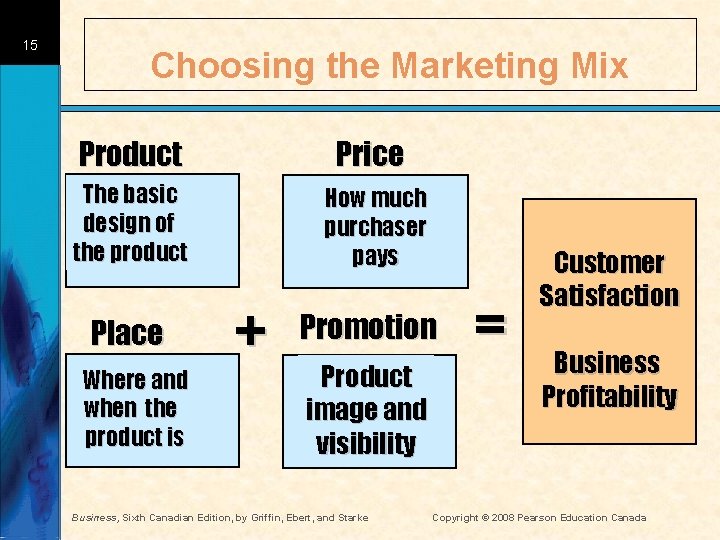
15 Choosing the Marketing Mix Product Price The basic design of the product How much purchaser pays Place Where and when the product is + Promotion Product image and visibility Business, Sixth Canadian Edition, by Griffin, Ebert, and Starke = Customer Satisfaction Business Profitability Copyright © 2008 Pearson Education Canada
16 Product Strategy Offering a good, service, or idea that satisfies the buyers’ needs is the goal of the firm Product differentiation < creating a product that has a different image than existing products on the market to attract consumers May involve < changing existing products by responding to trends or improving current offerings < adding new products Business, Sixth Canadian Edition, by Griffin, Ebert, and Starke Copyright © 2008 Pearson Education Canada
17 Pricing Strategy Choosing the right price to attract consumers and meet the firm’s profit goals May be low price strategy (salt) or high price strategy (mink coat) Price must consider all costs < operation and administration < marketing research < advertising Business, Sixth Canadian Edition, by Griffin, Ebert, and Starke Copyright © 2008 Pearson Education Canada
18 Place (Distribution Strategy) The part of the marketing mix concerned with <Getting the product from producer to buyer <Physical transportation <Choice of sales outlets Business, Sixth Canadian Edition, by Griffin, Ebert, and Starke Copyright © 2008 Pearson Education Canada
19 Promotion Strategy Choosing the right method of communicating information about the product <advertising <personal selling <sales promotions <public relations Business, Sixth Canadian Edition, by Griffin, Ebert, and Starke Copyright © 2008 Pearson Education Canada

20 Target Market and Segmentation Target market <a group of potential customers who have similar wants and needs Segmentation <dividing a consumer market into categories <selecting specific market segment(s) to pursue <positioning tprocess of fixing, adapting and communicating the product to specific segments Business, Sixth Canadian Edition, by Griffin, Ebert, and Starke Copyright © 2008 Pearson Education Canada
21 Identifying Market Segments Search for common traits between consumers Focus on traits that affect product need or purchase behaviour Geographic region Customer demographics Customer psychographics Behavioural variables Business, Sixth Canadian Edition, by Griffin, Ebert, and Starke Copyright © 2008 Pearson Education Canada
22 Geographic Variables Area of residence affects product consumption <rainfall and umbrellas <snowfall and snowmobiles or snow blowers <hot summers and backyard pools Business, Sixth Canadian Edition, by Griffin, Ebert, and Starke Copyright © 2008 Pearson Education Canada
23 Demographic Variables Age Gender Marital Status Income Religion Language Education Family Size Ethnicity Business, Sixth Canadian Edition, by Griffin, Ebert, and Starke Occupations Copyright © 2008 Pearson Education Canada
24 Psychographic Variables Psychological traits a group has in common <Attitudes <Interests and hobbies <Opinions <Motivations <Activities Business, Sixth Canadian Edition, by Griffin, Ebert, and Starke Copyright © 2008 Pearson Education Canada
25 Product-Use Variables Occasion for use Benefits Sought Reasons for Purchasing Loyalty Level Business, Sixth Canadian Edition, by Griffin, Ebert, and Starke Copyright © 2008 Pearson Education Canada
26 Market Research A systematic study of consumer needs <Focuses on the marketing mix elements <Leads to more effective marketing <Increases the accuracy and effectiveness of market segmentation Business, Sixth Canadian Edition, by Griffin, Ebert, and Starke Copyright © 2008 Pearson Education Canada
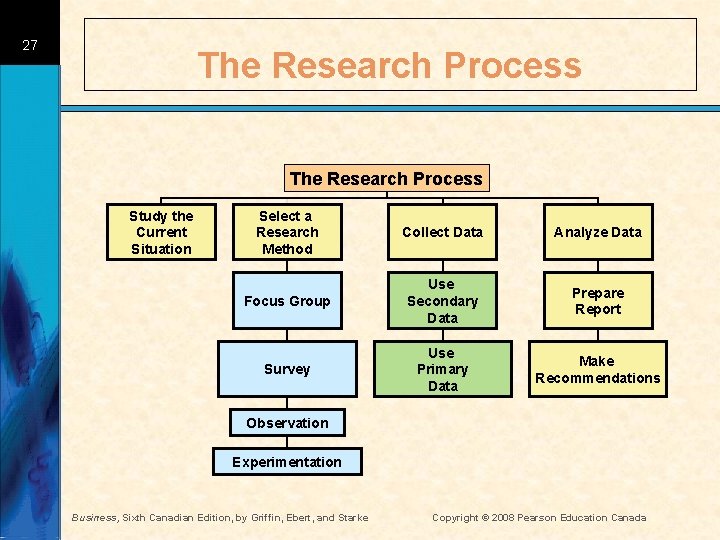
27 The Research Process Study the Current Situation Select a Research Method Collect Data Analyze Data Focus Group Use Secondary Data Prepare Report Survey Use Primary Data Make Recommendations Observation Experimentation Business, Sixth Canadian Edition, by Griffin, Ebert, and Starke Copyright © 2008 Pearson Education Canada
28 Observation Viewing or monitoring human behaviour Useful for cases where actions occur automatically without thinking < grocery shopping May be human observation or technological < supermarket scanners < video mining Business, Sixth Canadian Edition, by Griffin, Ebert, and Starke Copyright © 2008 Pearson Education Canada
29 Survey Questioning consumers about purchasing attitudes and practices <Relies on a reliable random sample <in person, via phone, mail, or the Internet <choosing appropriate questions and ensuring honest answers Business, Sixth Canadian Edition, by Griffin, Ebert, and Starke Copyright © 2008 Pearson Education Canada
30 Focus Group A small discussion group of prospective customers or product users <in-depth discussion of issues <Usually group does not know who is the sponsor <search for common themes in participants’ feedback Business, Sixth Canadian Edition, by Griffin, Ebert, and Starke Copyright © 2008 Pearson Education Canada
31 Experimentation reactions of similar people are compared under different circumstances <The situations can be manipulated to compare responses to such things as: t shelf placement of products, tpackage colours and design, tadvertising strategy <Very costly Business, Sixth Canadian Edition, by Griffin, Ebert, and Starke Copyright © 2008 Pearson Education Canada
32 Data Warehousing and Data Mining each person has a huge cache of data stored somewhere about them t purchases, personal information, phone calls, health, etc. Data warehousing = collection, storage and retrieval of such data in electronic form Data mining = using electronic technologies to search, sift and reorganize data < find useful information to planning marketing strategy Business, Sixth Canadian Edition, by Griffin, Ebert, and Starke Copyright © 2008 Pearson Education Canada
33 Consumer Behaviour The study of the process by which customers come to purchase and consume a product or service Influenced by <psychological factors <personal factors <social factors <cultural factors Business, Sixth Canadian Edition, by Griffin, Ebert, and Starke Copyright © 2008 Pearson Education Canada
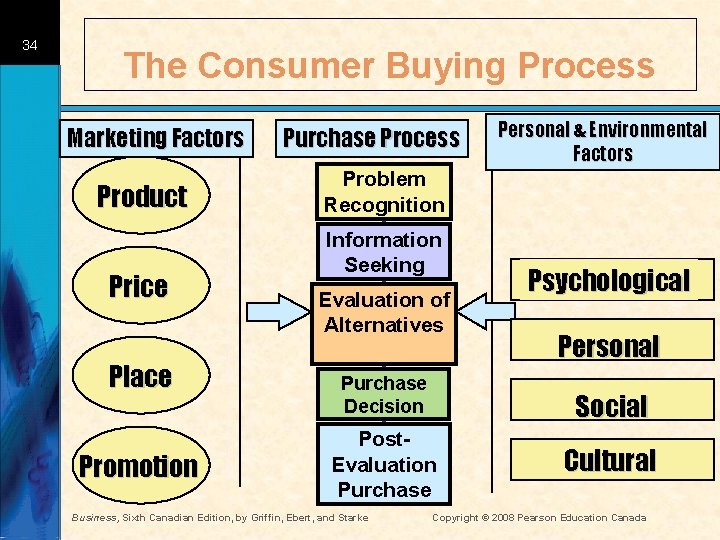
34 The Consumer Buying Process Marketing Factors Product Price Place Promotion Purchase Process Personal & Environmental Factors Problem Recognition Information Seeking Evaluation of Alternatives Purchase Decision Personal Social Post. Evaluation Purchase Business, Sixth Canadian Edition, by Griffin, Ebert, and Starke Psychological Cultural Copyright © 2008 Pearson Education Canada
35 The Consumer Buying Process Problem Recognition <Consumer becomes aware of a problem or need t. May be automatic (the need for food or sleep) t. Due to a lifestyle change (new parents, retirement) Information Seeking <The information search may be long and detailed, or short and limited t buying a car versus buying a candy bar Business, Sixth Canadian Edition, by Griffin, Ebert, and Starke Copyright © 2008 Pearson Education Canada
36 The Consumer Buying Process Evaluation of Alternatives < Products are compared to identify the best choice Purchase Decision < choice may be made based upon rational or emotional motivations < Rational motives include cost, quality, usefulness < Emotional motives include fear, sociability, aesthetics, imitation of others Business, Sixth Canadian Edition, by Griffin, Ebert, and Starke Copyright © 2008 Pearson Education Canada
37 Post-Purchase Evaluation Marketers must market after the sale < to ensure satisfaction & repeat purchases tnegative word-of-mouth can be harmful Business, Sixth Canadian Edition, by Griffin, Ebert, and Starke Copyright © 2008 Pearson Education Canada
38 Organizational Markets Organizations purchase goods and services to be used in the production of other goods and services <Industrial Market <Reseller Market <Government & Institutional Market Business, Sixth Canadian Edition, by Griffin, Ebert, and Starke Copyright © 2008 Pearson Education Canada
39 Organizational Buying Behaviour Differences in Buyers < Professionals t trained in arranging/negotiating purchase terms, contracts < Specialists t specialize in product lines < Experts t knowledge about their purchases Differences in the Buyer-Seller Relationship < emphasize personal selling by trained representatives who understand the needs of each customer < more frequent and longer-lasting < may work as a team in product design Business, Sixth Canadian Edition, by Griffin, Ebert, and Starke Copyright © 2008 Pearson Education Canada
40 International Marketing Mix Products may require substantial change before they can be marketed to different countries Pricing requires consideration of product manufacturing costs, transportation and delivery Promotion must accommodate cultural differences and social traditions Distribution may involve cooperation with other international firms and adherence to foreign packaging and labelling legislation Business, Sixth Canadian Edition, by Griffin, Ebert, and Starke Copyright © 2008 Pearson Education Canada
41 Small Business Marketing Mix Care must be taken to: <offer products to markets substantial enough to support the organization <do a complete analysis of costs prior to setting prices <develop a comprehensive promotional program using more than personal selling tlower cost options: publicity, associated events <choose a location that will attract and retain customers Business, Sixth Canadian Edition, by Griffin, Ebert, and Starke Copyright © 2008 Pearson Education Canada
- Slides: 41