
Chapter 15 The Presentation of Evidence Objectives Describe

Chapter 15 The Presentation of Evidence
Objectives • Describe the court process as an adversarial process and explain the role of defense attorneys, prosecuting attorneys, judges, and the police • Discuss the importance and value of a vigorous defense • Explain the various ways in which police misconduct and errors can lead to miscarriages of justice • Define the role of lay and expert witnesses in court, and the controversies of using experts in court Brandl, Criminal Investigation 4 e SAGE Publishing, 2018 3
Objectives • Identify the steps or stages of the trial process, and the two main questions addressed in the trial • Discuss the purpose of the cross-examination and evaluate the tactics commonly used by defense attorneys when cross-examining investigator witnesses • Identify the guidelines regarding testimony in court Brandl, Criminal Investigation 4 e SAGE Publishing, 2018 4
From the Case File: A Tragedy and Then More • On July 29, 1985 Penny Beerntsen went for a jog when she was dragged into the woods by a stranger, beaten and sexually assaulted – Finger scrapings and hair were collected as evidence – She was able to describe the suspect as 5’ 6”– 5’ 7”, stocky, brown eyes, long sandy hair, wearing a black leather jacket Brandl, Criminal Investigation 4 e SAGE Publishing, 2018 5
From the Case File: A Tragedy and Then More • One of the officers thought the description matched Steven Avery • Avery was identified by the victim during a photo lineup and a live lineup • The City of Manitowoc Police Department communicated with the District Attorney’s Office and the Manitowoc county Sheriff’s Department that they believed Gregory Allen was a suspect Brandl, Criminal Investigation 4 e SAGE Publishing, 2018 6
From the Case File: A Tragedy and Then More • A hair was recovered from Avery’s shirt that was consistent with Beerntsen’s hair • In his defense Avery presented 16 alibi witnesses • He was found guilty and sentenced to 32 years in prison Brandl, Criminal Investigation 4 e SAGE Publishing, 2018 7
From the Case File: A Tragedy and Then More • In 1995 a woman in Wisconsin was sexually assaulted and Gregory Allen was identified and arrested – He confessed to investigators in Brown County that he also sexually assaulted a Woman in Manitowoc County in 1985 o The investigators in Manitowoc County did not do anything with this information until 2003 Brandl, Criminal Investigation 4 e SAGE Publishing, 2018 8
From the Case File: A Tragedy and Then More • In 1996 DNA analysis of the evidence kit from the Beernsten assault showed DNA which was not from Beernsten or Avery • In 2002 a DNA profile of the hair recovered from Beernsten was examined and linked to Gregory Allen Brandl, Criminal Investigation 4 e SAGE Publishing, 2018 9
From the Case File: A Tragedy and Then More • In 2003 Avery’s charges were dismissed and after 18 years in prison he was released • Steven Avery filed a lawsuit against the Manitowoc County Sherriff’s Department for $36 million • A Wisconsin Department of Justice Special Agent testified that “it appears that there was no real investigation done” Brandl, Criminal Investigation 4 e SAGE Publishing, 2018 10
Why Is Documentation and Presentation of Evidence Important to Investigations? • The identification and apprehension of criminals is not the end of the road for criminal investigations • The evidence used by prosecutors in court is documented in police reports • Investigators have to be effective and competent witnesses in court Brandl, Criminal Investigation 4 e SAGE Publishing, 2018 11
Why Is Documentation and Presentation of Evidence Important to Investigations? • Investigators play an important role in the prosecution of offenders • There are severe consequences to prosecuting an individual, therefore it is important that the police are aware of the consequences of bad judicial outcomes Brandl, Criminal Investigation 4 e SAGE Publishing, 2018 12
The Adversarial Process • The court process is adversarial in nature, meaning that it is a contest to obtain justice through opposing teams (defense attorneys and prosecuting attorneys) and a neutral referee (judge) – The police are on the prosecutor’s team Brandl, Criminal Investigation 4 e SAGE Publishing, 2018 13
The Adversarial Process • Defense attorneys have to discredit witnesses • Prosecuting attorneys have the burden of proof (probable cause) in trials • Police officers and investigators are to present the observed facts of the case for the prosecution and to be tested by the defense Brandl, Criminal Investigation 4 e SAGE Publishing, 2018 14
Errors in Justice Outcomes • Errors in justice outcomes (when an innocent person receives a conviction, or a guilty person goes free) can have devastating effects Brandl, Criminal Investigation 4 e SAGE Publishing, 2018 15
Errors in Justice Outcomes • Reasons for errors in justice outcomes: – DNA evidence was collected but analysis was not done – Police misconduct and incompetence – Prosecutorial misconduct and incompetence – Defense attorney misconduct and incompetence – Inept judges – Corrupt or incompetent expert witnesses – Perjured or unreliable lay witness testimony – Inept juries Brandl, Criminal Investigation 4 e SAGE Publishing, 2018 16
The Value and Importance of Investigative Testimony • Evidence in court is presented through lay witnesses or expert witnesses – Lay witnesses can testify only on their observations of fact. They cannot offer opinions o Investigator testimony is a lay witness testimony Brandl, Criminal Investigation 4 e SAGE Publishing, 2018 17
The Value and Importance of Investigative Testimony • Expert witnesses can testify to their opinions and discuss hypothetical scenarios. They are usually persons with skill or knowledge on a particular topic – They are often compensated for their testimony – An expert witness is supposed to be an impartial educator – Scientific opinions may be complicated and misunderstood by jurors. – Testimony of an expert witness may be shaped by the questions asked by the prosecution Brandl, Criminal Investigation 4 e SAGE Publishing, 2018 18
Investigator’s Testimony • Investigators are required to provide testimony: – During a deposition o A deposition is a proceeding that occurs before a trial o A deposition provides an attorney an opportunity to ask questions of a witness before the case goes to trial Brandl, Criminal Investigation 4 e SAGE Publishing, 2018 19
Investigator’s Testimony • During a preliminary hearing – A preliminary hearing is a mini-trial of sorts with the purpose of proving that a crime occurred and that the defendant committed it – The standard of proof needed by the prosecutor is probable cause • During a trial – A trial may a bench trial (judge determines the verdict) or a jury trial (jury determines the verdict) Brandl, Criminal Investigation 4 e SAGE Publishing, 2018 20
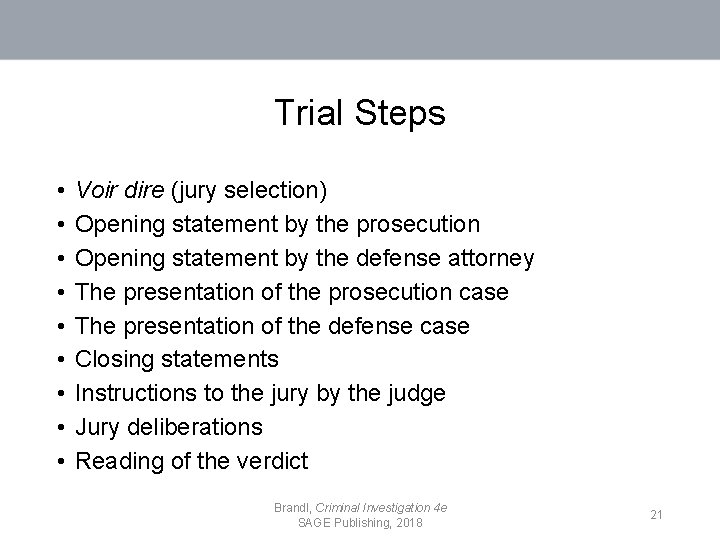
Trial Steps • • • Voir dire (jury selection) Opening statement by the prosecution Opening statement by the defense attorney The presentation of the prosecution case The presentation of the defense case Closing statements Instructions to the jury by the judge Jury deliberations Reading of the verdict Brandl, Criminal Investigation 4 e SAGE Publishing, 2018 21
Cross-examination • A direct examination elicits the facts of a case • A cross-examination is designed to “test” the evidence presented with the goal of “impeaching” the witness Brandl, Criminal Investigation 4 e SAGE Publishing, 2018 22
Cross-examination • Cross-examination strategies: – Ask leading questions – Badger, anger, to annoy the investigator – Ask difficult or slanted questions – Ask the witness about the legality of the actions taken by the investigator Brandl, Criminal Investigation 4 e SAGE Publishing, 2018 23
Cross-examination – Attack the quality/accuracy of the investigative reports – Look for inconsistencies – Call into question statements of fact and opinions – Call into question the witness’ honesty and credibility – Confuse or otherwise fluster the witness Brandl, Criminal Investigation 4 e SAGE Publishing, 2018 24
Guidelines for Investigators in Creating Effective Testimony in Court • • • Tell the truth Be prepared Stick to the facts Answer only the questions asked Be mindful of non-verbal communication Be respectful Speak directly, clearly, and confidently Listen and think before speaking Be professional Brandl, Criminal Investigation 4 e SAGE Publishing, 2018 25
Investigators Should Not • Comment on a defendant’s criminal record • Present the defendant’s use or non-use of their Miranda rights as evidence • Use a defendant’s attempts to negotiate a plea bargain as evidence • Provide testimony on evidence that has been ruled inadmissible by the judge Brandl, Criminal Investigation 4 e SAGE Publishing, 2018 26
- Slides: 26