
Chapter 15 The Lymphatic System and Immunity 2009

- Slides: 27
Chapter 15 The Lymphatic System and Immunity © 2009 Delmar, Cengage Learning
Objectives • • Describe the lymphatic system Define the components of the lymphatic system Outline the function of the lymph nodes Explain what is meant by immunity Identify the causative agents of AIDS List the symptoms of AIDS Describe the modes of AIDS transmission and measures used to prevent its transmission • Define the key words that relate to this chapter © 2009 Delmar, Cengage Learning
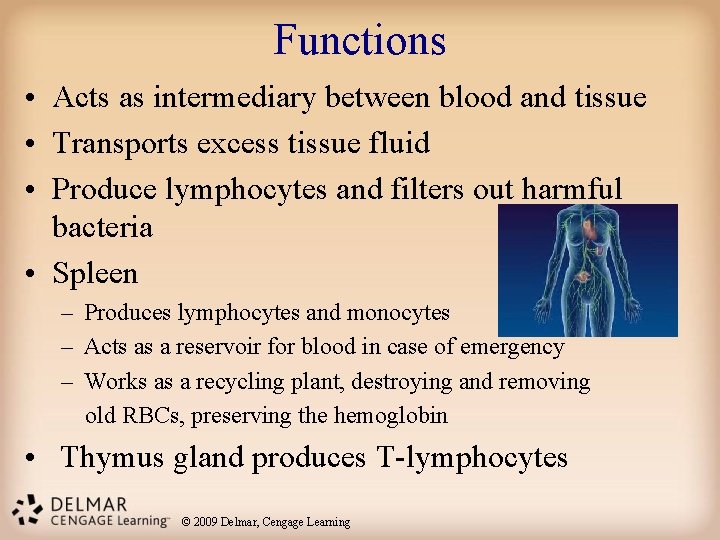
Lymphatic System • Supplements the circulatory system • Composed of lymph, lymph nodes, lymph vessels, the spleen, the thymus gland, lymphoid tissue in the intestinal tract, and the tonsils • There is no muscular pump or heart © 2009 Delmar, Cengage Learning
Functions • Acts as intermediary between blood and tissue • Transports excess tissue fluid • Produce lymphocytes and filters out harmful bacteria • Spleen – Produces lymphocytes and monocytes – Acts as a reservoir for blood in case of emergency – Works as a recycling plant, destroying and removing old RBCs, preserving the hemoglobin • Thymus gland produces T-lymphocytes © 2009 Delmar, Cengage Learning
Lymph • Straw colored • Called intercellular, interstitial fluid or tissue fluid • Composition of lymph – Water, lymphocytes, some granulocytes, oxygen, digested nutrients, hormones, salts, carbon dioxide and urea • Moves with assistance of skeletal tissue contraction, breathing movements, and valves © 2009 Delmar, Cengage Learning
Lymph Vessels • • Closely parallel the veins Right lymphatic duct Left lymphatic duct (thoracic duct) Flows in only one direction © 2009 Delmar, Cengage Learning
Lymph Nodes • Small structures located alone or grouped in various places along the lymph vessels throughout the body • Afferent and efferent lymphatic vessels • Germinal centers – When germinal centers are stimulated, the immune response is activated © 2009 Delmar, Cengage Learning
Tonsils • Masses of lymphatic tissue – Produce lymphocytes – Filter out bacteria • Three pairs of tonsils – Palatine – Adenoids – Lingual • Tonsillitis © 2009 Delmar, Cengage Learning
Spleen • Saclike mass of lymphatic tissue • Located upper left of the abdomen beneath the diaphragm • Forms lymphocytes and monocytes • Filters out bacteria • Stores red blood cells © 2009 Delmar, Cengage Learning
Thymus Gland • Located in the upper anterior part of the thorax, above the heart • Produces T-lymphocytes • It is also an endocrine gland which secretes a hormone called thymosin © 2009 Delmar, Cengage Learning
Disorders of the Lymph System • Lymphadenitis • Hodgkin’s disease • Infectious mononucleosis © 2009 Delmar, Cengage Learning
Effects of Aging • • Decline in immune function Increased risk of infection Decreased ability to fight disease Slowed wound healing © 2009 Delmar, Cengage Learning
Immunity • When pathogens and foreign materials penetrate the skin the person’s immunity comes into play • Immunity is the body’s ability to resist these invaders • Individuals differ in their ability to resist infection • Resistance varies at different times © 2009 Delmar, Cengage Learning
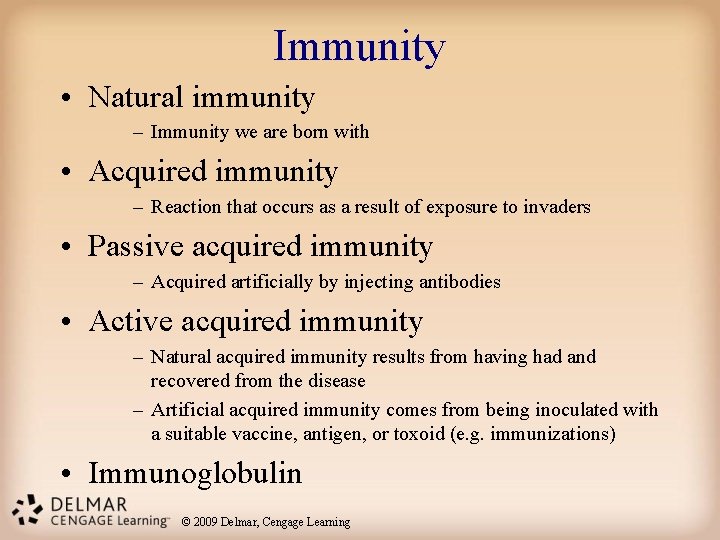
Immunity • Natural immunity – Immunity we are born with • Acquired immunity – Reaction that occurs as a result of exposure to invaders • Passive acquired immunity – Acquired artificially by injecting antibodies • Active acquired immunity – Natural acquired immunity results from having had and recovered from the disease – Artificial acquired immunity comes from being inoculated with a suitable vaccine, antigen, or toxoid (e. g. immunizations) • Immunoglobulin © 2009 Delmar, Cengage Learning
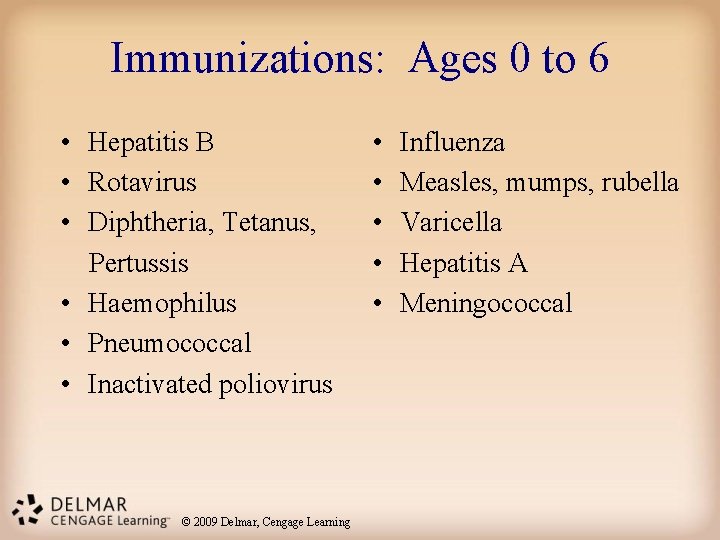
Immunizations: Ages 0 to 6 • Hepatitis B • Rotavirus • Diphtheria, Tetanus, Pertussis • Haemophilus • Pneumococcal • Inactivated poliovirus © 2009 Delmar, Cengage Learning • • • Influenza Measles, mumps, rubella Varicella Hepatitis A Meningococcal
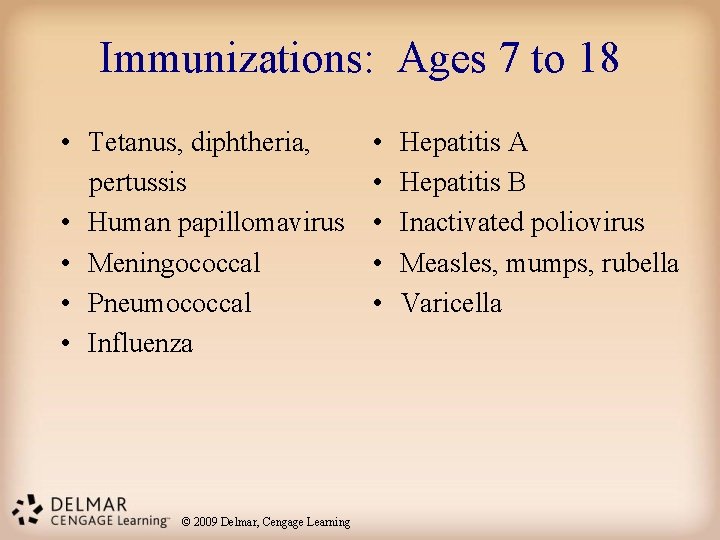
Immunizations: Ages 7 to 18 • Tetanus, diphtheria, pertussis • Human papillomavirus • Meningococcal • Pneumococcal • Influenza © 2009 Delmar, Cengage Learning • • • Hepatitis A Hepatitis B Inactivated poliovirus Measles, mumps, rubella Varicella
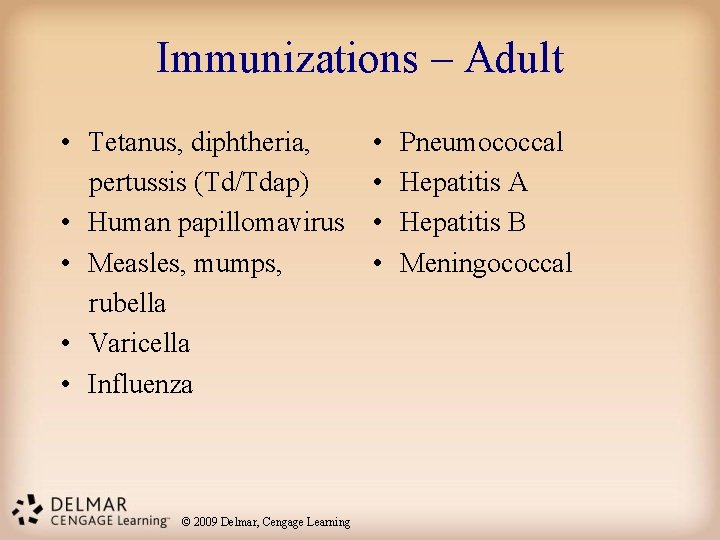
Immunizations – Adult • Tetanus, diphtheria, pertussis (Td/Tdap) • Human papillomavirus • Measles, mumps, rubella • Varicella • Influenza © 2009 Delmar, Cengage Learning • • Pneumococcal Hepatitis A Hepatitis B Meningococcal
Autoimmunity • Autoimmune disorder – When the body mistakenly targets the normal cells, tissues, and organs of a person’s own body • Multiple causes can trigger the disorder © 2009 Delmar, Cengage Learning
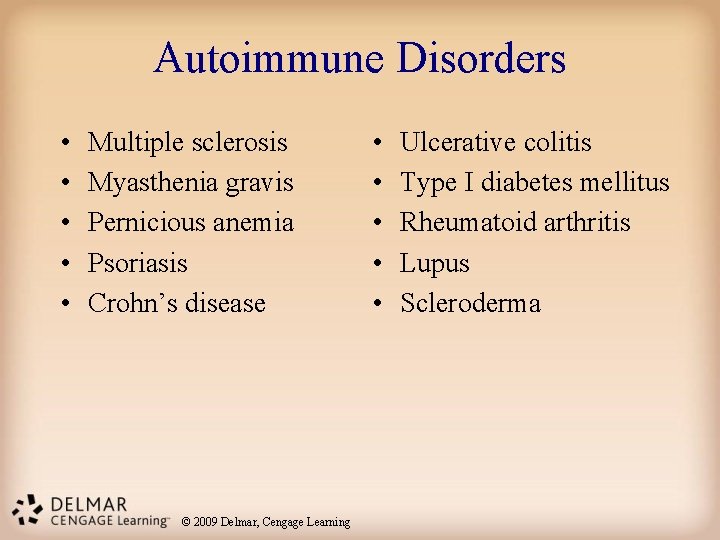
Autoimmune Disorders • • • Multiple sclerosis Myasthenia gravis Pernicious anemia Psoriasis Crohn’s disease © 2009 Delmar, Cengage Learning • • • Ulcerative colitis Type I diabetes mellitus Rheumatoid arthritis Lupus Scleroderma
Hypersensitivity • When the body’s immune system fails to protect itself against foreign material • Allergens • Anaphylaxis or anaphylactic shock © 2009 Delmar, Cengage Learning
AIDS/HIV • A – Acquired – The disease is not inherited • I – Immune – Refers to body’s natural defenses against cancers, disease, and infections • D – Deficiency – Lacks cellular immunity • S – Syndrome – Involves the set of diseases or conditions that are present to signal the diagnosis © 2009 Delmar, Cengage Learning
AIDS/HIV • Human immunodeficiency virus (HIV) causes AIDS • HIV destroys the body’s T 4 -lymphocyte cells • Opportunistic infections • Three outcomes from infection with HIV – AIDS-related complex (ARC) – Asymptomatic infection • HIV/AIDS Statistics © 2009 Delmar, Cengage Learning
Transmission of AIDS • Sexual contact • Sharing hypodermic needles • In utero or at birth © 2009 Delmar, Cengage Learning
Screening Tests for HIV/AIDS • ELISA • Western blot • Rapid test © 2009 Delmar, Cengage Learning
Symptoms of HIV/AIDS • Flu-like symptoms • More persistent symptoms • Opportunistic conditions © 2009 Delmar, Cengage Learning
Treatment of HIV/AIDS • No cure for AIDS • Prevention and treatment have prolonged and improved the lives of many – AZT – Protease inhibitors – AIDS cocktail © 2009 Delmar, Cengage Learning
Preventing Transmission of HIV/AIDS • • • Limit sexual contacts Have protected sex Do not share needles Clean up soiled materials Cover wounds Standard precautions used by all health care workers © 2009 Delmar, Cengage Learning