
Chapter 15 The Chromosomal Basis of Inheritance Lecture
Chapter 15 The Chromosomal Basis of Inheritance Lecture Presentations by Nicole Tunbridge and Kathleen Fitzpatrick 2019 -2020 © 2017 Pearson Education, Inc.
15. 1 Locating Genes Along Chromosomes § Mendel’s “hereditary factors” were purely abstract when first proposed § Today, we know genes are located on chromosomes § Early genetics work used Drosophila melanogaster, a common species of fruit fly § Several characteristics make fruit flies a convenient organism for genetic studies: 1. They produce many offspring 2. A generation can be bred every two weeks 3. They have only four pairs of chromosomes © 2017 Pearson Education, Inc.
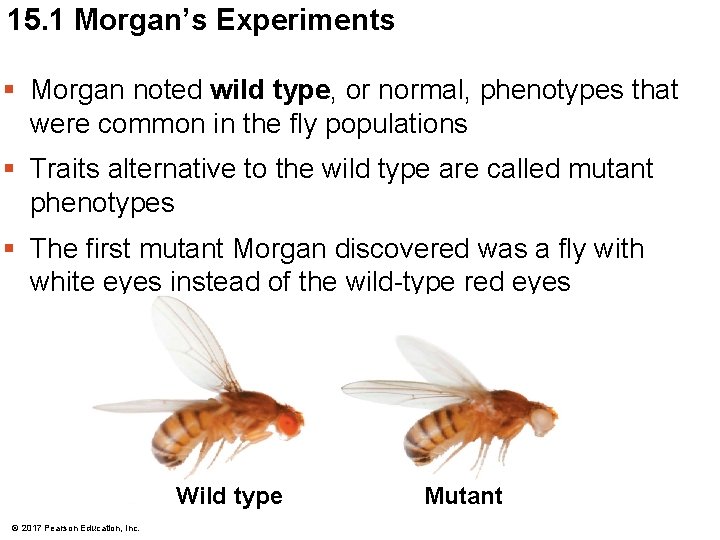
15. 1 Morgan’s Experiments § Morgan noted wild type, or normal, phenotypes that were common in the fly populations § Traits alternative to the wild type are called mutant phenotypes § The first mutant Morgan discovered was a fly with white eyes instead of the wild-type red eyes Wild type © 2017 Pearson Education, Inc. Mutant
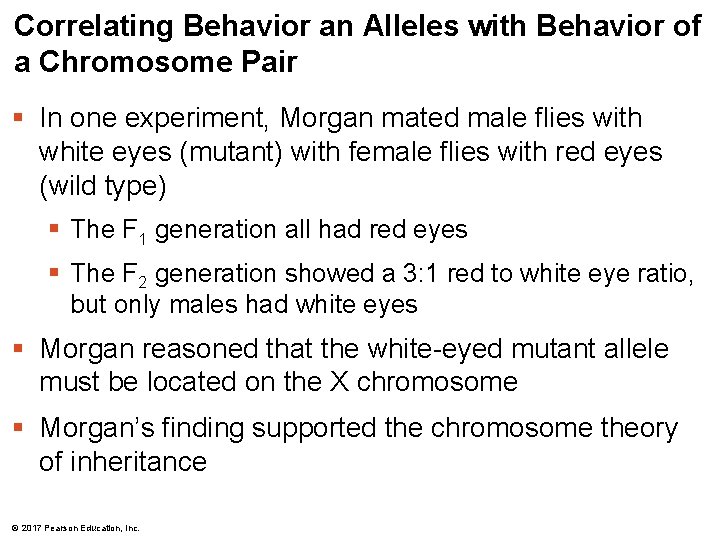
Correlating Behavior an Alleles with Behavior of a Chromosome Pair § In one experiment, Morgan mated male flies with white eyes (mutant) with female flies with red eyes (wild type) § The F 1 generation all had red eyes § The F 2 generation showed a 3: 1 red to white eye ratio, but only males had white eyes § Morgan reasoned that the white-eyed mutant allele must be located on the X chromosome § Morgan’s finding supported the chromosome theory of inheritance © 2017 Pearson Education, Inc.
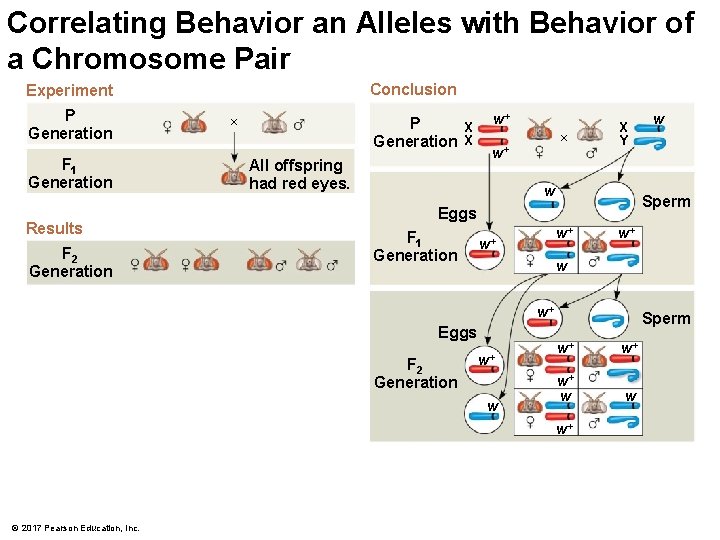
Correlating Behavior an Alleles with Behavior of a Chromosome Pair Conclusion Experiment P Generation F 1 Generation Results F 2 Generation × P X Generation X All offspring had red eyes. w+ × w+ X Y w Sperm Eggs F 1 Generation w+ w+ w+ w w+ Eggs F 2 Generation w+ w Sperm w+ w+ w+ w w w+ © 2017 Pearson Education, Inc. w
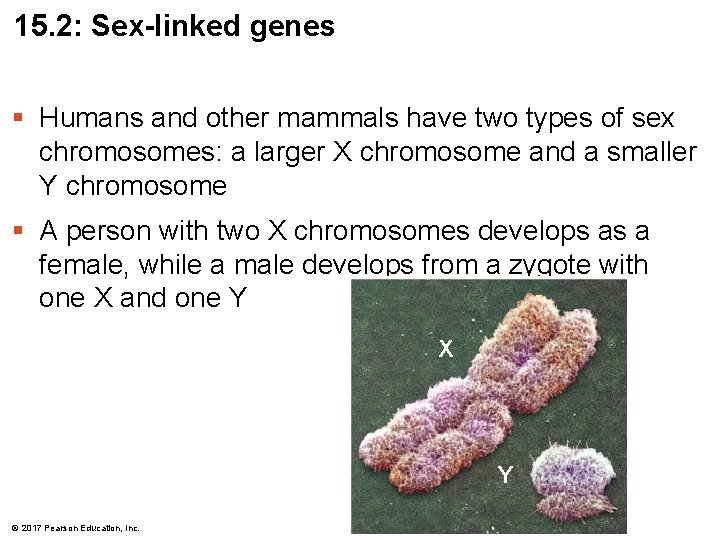
15. 2: Sex-linked genes § Humans and other mammals have two types of sex chromosomes: a larger X chromosome and a smaller Y chromosome § A person with two X chromosomes develops as a female, while a male develops from a zygote with one X and one Y X Y © 2017 Pearson Education, Inc.
15. 2 The Chromosomal Basis of Sex § Short segments at the ends of the Y chromosomes are homologous with the X, allowing the two to behave like homologs during meiosis in males § A gene on the Y chromosome called SRY (sexdetermining region on the Y) is responsible for development of the testes in an embryo © 2017 Pearson Education, Inc.
15. 2 The Chromosomal Basis of Sex § A gene that is located on either sex chromosome is called a sex-linked gene § Genes on the Y chromosome are called Y-linked genes § Only 78 genes, coding for about 25 proteins, have been identified on the human Y chromosome § Genes on the X chromosome are called X-linked genes; the human X chromosome contains about 1, 100 genes © 2017 Pearson Education, Inc.
15. 2 Inheritance of X-Linked and Y-Linked Genes § X chromosomes have genes for many characters unrelated to sex § For a recessive X-linked trait to be expressed, 1. females needs two copies of the allele (homozygous) 2. males needs only one copy of the allele (hemizygous) 3. X-linked recessive disorders much more common in males than in females § Many Y-linked genes are related to sex determination (about 200 genes) § Male pattern baldness as example © 2017 Pearson Education, Inc.
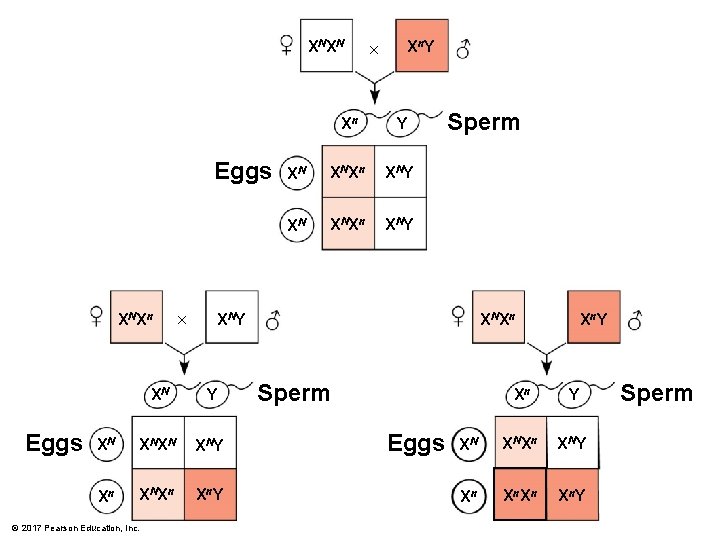
X NX N Eggs X NX n Eggs × Xn Y XN X NX n X NY Sperm X NX n X NY XN X NX N X NY Xn X NX n Xn Y © 2017 Pearson Education, Inc. × Sperm Eggs Xn Y XN X NX n X NY Xn Xn Y Sperm
15. 2 Inheritance of X-Linked and Y-Linked Genes § Some disorders caused by recessive alleles on the X chromosome in humans: 1. Color blindness (mostly X-linked) 2. Duchenne muscular dystrophy 3. Hemophilia © 2017 Pearson Education, Inc.
15. 2 X Inactivation in Female Mammals § In mammalian females, one of the two X chromosomes in each cell is randomly inactivated during embryonic development § The inactive X condenses into a Barr body § If a female is heterozygous for a particular gene located on the X chromosome, she will be a mosaic for that character © 2017 Pearson Education, Inc.
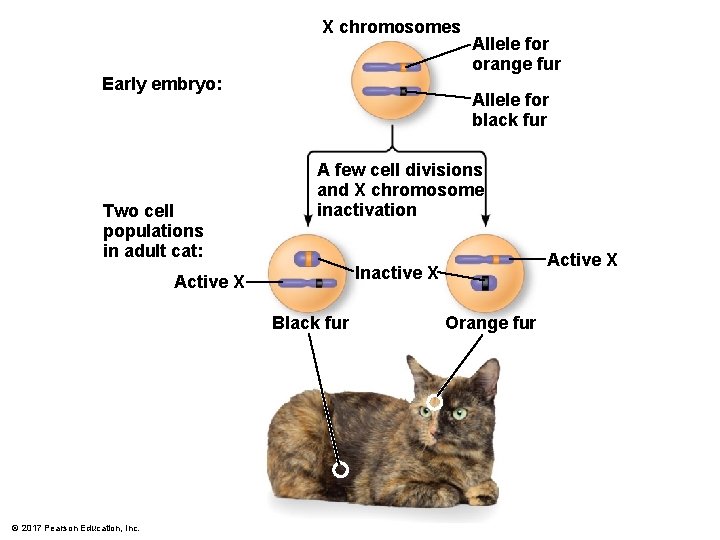
X chromosomes Early embryo: Two cell populations in adult cat: Allele for black fur A few cell divisions and X chromosome inactivation Active X Inactive X Active X Black fur © 2017 Pearson Education, Inc. Allele for orange fur Orange fur
15. 3 Linked genes § Each chromosome has hundreds or thousands of genes (except the Y chromosome) § Genes that are located on the same chromosome tend to be inherited together and are called linked genes § In fruit flies, body color and wing size are usually inherited together in specific combinations (parental phenotypes) § Genes do not assort independently and they may be on the same chromosome © 2017 Pearson Education, Inc.
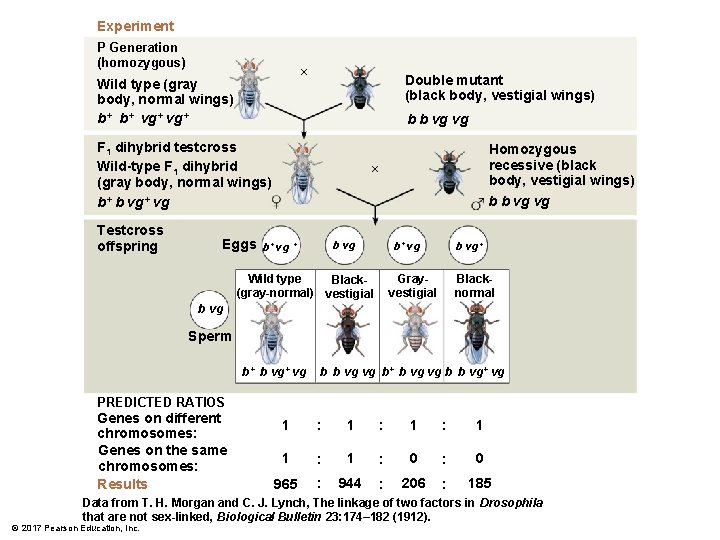
Experiment P Generation (homozygous) × Wild type (gray body, normal wings) b+ b+ vg+ Double mutant (black body, vestigial wings) b b vg vg F 1 dihybrid testcross Wild-type F 1 dihybrid (gray body, normal wings) b+ b vg+ vg Testcross offspring Eggs Homozygous recessive (black body, vestigial wings) b b vg vg × b vg b+ vg + b+ vg Wild type Black(gray-normal) vestigial b vg+ Grayvestigial Blacknormal b vg Sperm b+ b vg+ vg b b vg vg b+ b vg vg b b vg+ vg PREDICTED RATIOS Genes on different chromosomes: Genes on the same chromosomes: Results 1 : 1 : 0 965 : 944 : 206 : 185 Data from T. H. Morgan and C. J. Lynch, The linkage of two factors in Drosophila that are not sex-linked, Biological Bulletin 23: 174– 182 (1912). © 2017 Pearson Education, Inc.
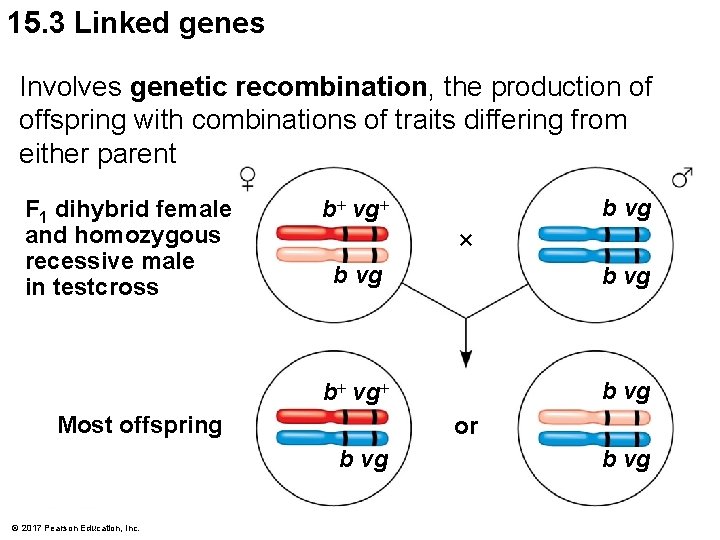
15. 3 Linked genes Involves genetic recombination, the production of offspring with combinations of traits differing from either parent F 1 dihybrid female and homozygous recessive male in testcross × b vg b+ vg+ b vg Most offspring or b vg © 2017 Pearson Education, Inc. b vg b+ vg+ b vg
15. 3 Recombination of Unlinked Genes § Offspring with a phenotype matching one of the parental (P) phenotypes are called parental types § Offspring with nonparental phenotypes (new combinations of traits) are called recombinant types, or recombinants § A 50% frequency of recombination is observed for any two genes on different chromosomes © 2017 Pearson Education, Inc.
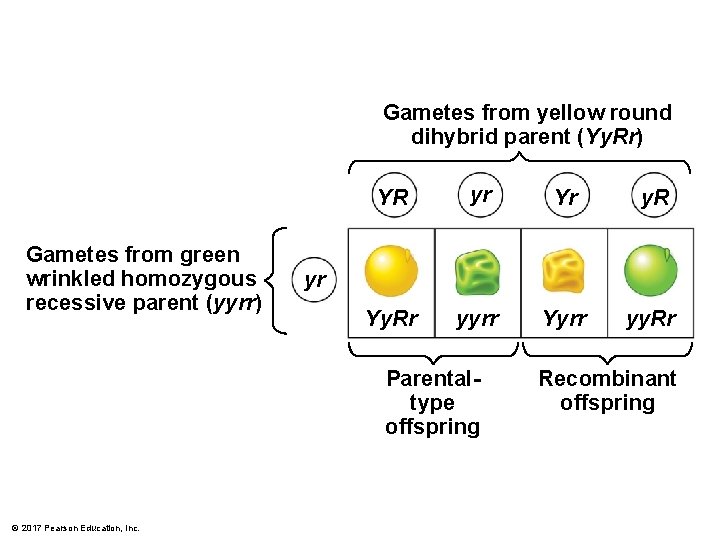
Gametes from yellow round dihybrid parent (Yy. Rr) Gametes from green wrinkled homozygous recessive parent (yyrr) YR yr Yr y. R Yy. Rr yyrr Yyrr yy. Rr yr Parentaltype offspring © 2017 Pearson Education, Inc. Recombinant offspring
15. 3 Crossing Over § Some genes are linked, nonparental allele combinations are still produced § Occasionally there is a physical connection between genes on the same chromosome § That mechanism was the crossing over of homologous chromosomes © 2017 Pearson Education, Inc.
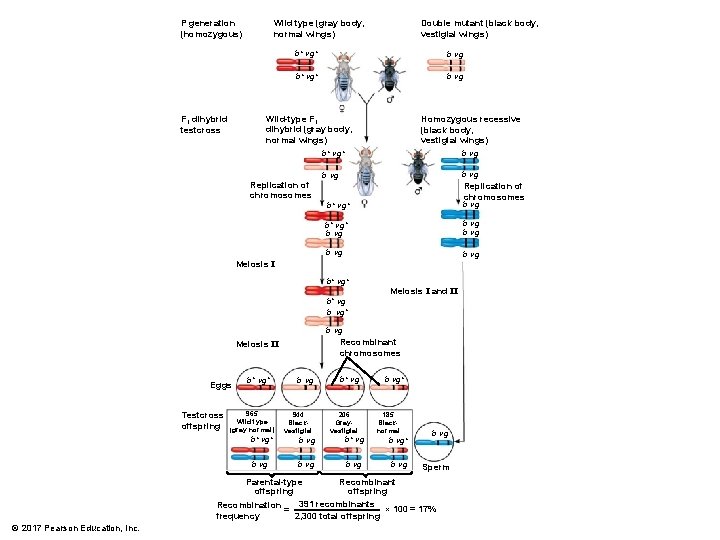
P generation (homozygous) Wild type (gray body, normal wings) Double mutant (black body, vestigial wings) b+ vg+ b vg Wild-type F 1 dihybrid (gray body, normal wings) F 1 dihybrid testcross Homozygous recessive (black body, vestigial wings) b+ vg+ b vg Replication of chromosomes b+ vg+ b vg b vg Meiosis I b+ vg+ Meiosis I and II b+ vg b vg+ b vg Recombinant chromosomes Meiosis II Eggs Testcross offspring b+ vg+ 965 Wild type (gray normal) b vg b+ vg 944 Blackvestigial 206 Grayvestigial b vg+ 185 Blacknormal b+ vg+ b vg b+ vg b vg+ b vg b vg Sperm Recombinant Parental-type offspring 391 recombinants Recombination × 100 = 17% = frequency 2, 300 total offspring © 2017 Pearson Education, Inc.
15. 3 New Combinations of Alleles § Recombinant chromosomes bring alleles together in new combinations in gametes § Random fertilization increases even further the number of variant combinations that can be produced § This abundance of genetic variation is the raw material upon which natural selection works © 2017 Pearson Education, Inc.
15. 4 Alterations of chromosome § Large-scale chromosomal alterations in humans and other mammals often lead to spontaneous abortions (miscarriages) or cause a variety of developmental disorders § Plants tolerate such genetic changes better than animals do § In nondisjunction, pairs of homologous chromosomes do not separate normally during meiosis § As a result, one gamete receives two of the same type of chromosome, and another gamete receives no copy © 2017 Pearson Education, Inc.
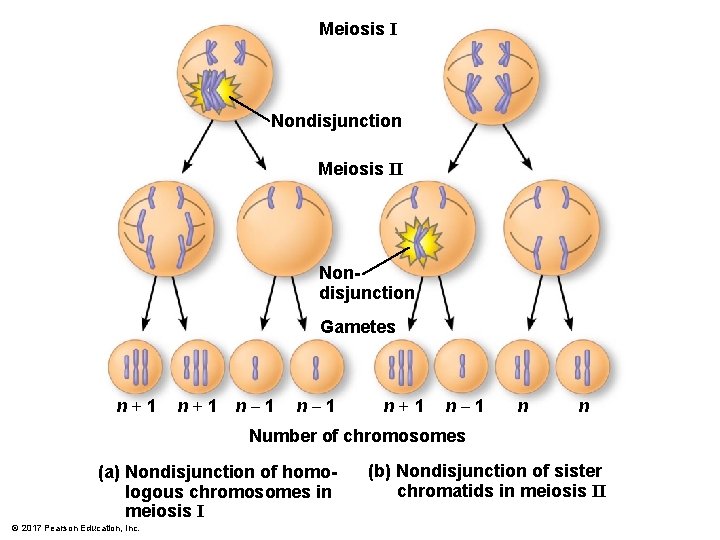
Meiosis I Nondisjunction Meiosis II Nondisjunction Gametes n+1 n– 1 n n Number of chromosomes (a) Nondisjunction of homologous chromosomes in meiosis I © 2017 Pearson Education, Inc. (b) Nondisjunction of sister chromatids in meiosis II
15. 4 Abnormal Chromosome Number § Aneuploidy results from the fertilization of gametes in which nondisjunction occurred § Offspring with this condition have an abnormal number of a particular chromosome § A monosomic zygote has only one copy of a particular chromosome § A trisomic zygote has three copies of a particular chromosome © 2017 Pearson Education, Inc.
15. 4 Abnormal Chromosome Number § Polyploidy is a condition in which an organism has more than two complete sets of chromosomes § Triploidy (3 n) is three sets of chromosomes § Tetraploidy (4 n) is four sets of chromosomes § Polyploidy is common in plants, but not animals § Polyploids are more normal in appearance than aneuploids © 2017 Pearson Education, Inc.
15. 4 Alterations of Chromosome Structure § Breakage of a chromosome can lead to four types of changes in chromosome structure: 1. Deletion removes a chromosomal fragment 2. Duplication repeats a segment 3. Inversion reverses orientation of a segment within a chromosome 4. Translocation moves a segment from one chromosome to another © 2017 Pearson Education, Inc.
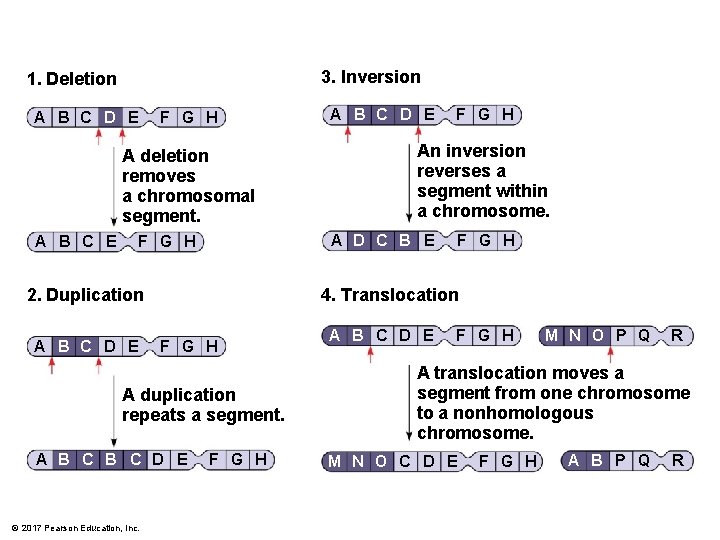
3. Inversion 1. Deletion A B C D E F G H A deletion removes a chromosomal segment. A B C E 2. Duplication F G H 4. Translocation F G H A duplication repeats a segment. A B C D E © 2017 Pearson Education, Inc. F G H An inversion reverses a segment within a chromosome. A D C B E F G H A B C D E F G H M N O P Q R A translocation moves a segment from one chromosome to a nonhomologous chromosome. M N O C D E F G H A B P Q R
15. 4 Human Disorders Due to Chromosomal Alterations § Alterations of chromosome number and structure associated with some serious disorders § Some types of aneuploidy appear to upset the genetic balance less than others, resulting in individuals surviving to birth and beyond § These surviving individuals have a set of symptoms, or syndrome, characteristic of the type of aneuploidy © 2017 Pearson Education, Inc.
15. 4 Down Syndrome (Trisomy 21) § Down syndrome is an aneuploid condition that results from three copies of chromosome 21 § It affects about one out of every 830 children born in the United States § The frequency of Down syndrome increases with the age of the mother, a correlation that has not been explained © 2017 Pearson Education, Inc.
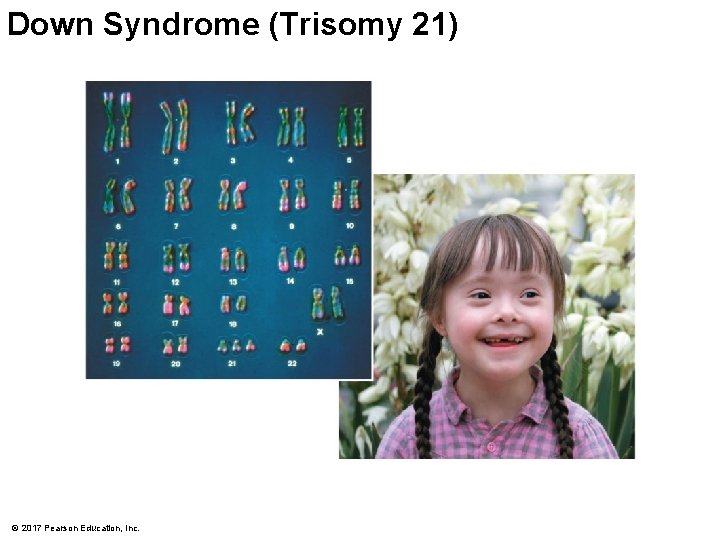
Down Syndrome (Trisomy 21) © 2017 Pearson Education, Inc.
15. 4 Aneuploidy of Sex Chromosomes § Nondisjunction of sex chromosomes produces a variety of aneuploid conditions in males § Examples: § Klinefelter syndrome is the result of an extra chromosome in a male, producing XXY individuals § Taller (Maybe Abe Lincoln had this? ) § Lower amounts of testosterone = lower fertility § About one in 1, 000 males is XYY § These males do not exhibit any syndrome © 2017 Pearson Education, Inc.
15. 4 Aneuploidy of Sex Chromosomes § Nondisjunction of sex chromosomes produces a variety of aneuploid conditions in females § Example: § XXX females occur with a frequency of about one in 1, 000 § They are healthy, with no unusual physical features § They are at risk for learning disabilities § Monosomy X, called Turner syndrome § Produces X 0 females, who are sterile § Only known viable monosomy in humans © 2017 Pearson Education, Inc.
15. 4 Disorders Caused by Structurally Altered Chromosomes § The syndrome cri du chat (“cry of the cat”), results from a specific deletion in chromosome 5 § A child born with this syndrome is severely intellectually disabled and has a catlike cry; individuals usually die in infancy or early childhood § Certain cancers, including chronic myelogenous leukemia (CML), are caused by translocations of chromosomes © 2017 Pearson Education, Inc.
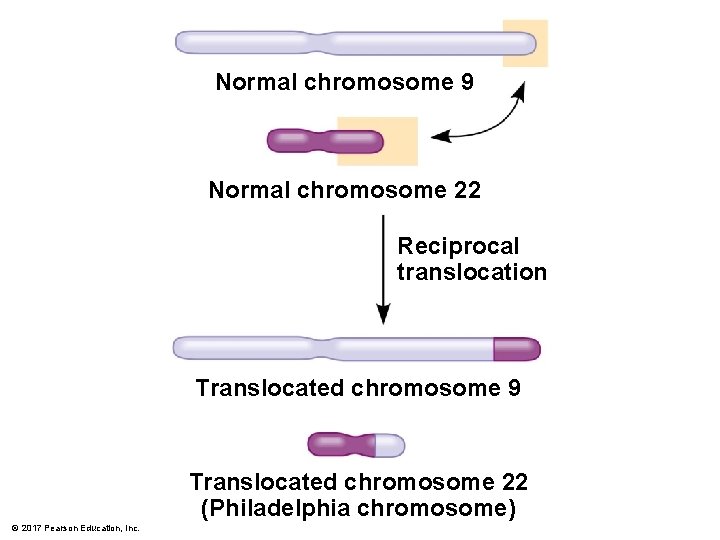
Normal chromosome 9 Normal chromosome 22 Reciprocal translocation Translocated chromosome 9 Translocated chromosome 22 (Philadelphia chromosome) © 2017 Pearson Education, Inc.
15. 5 Some Inheritance patterns are exceptions to standard Mendelian inheritance § There are two normally occurring exceptions to Mendelian genetics: 1. Genomic imprinting 2. Extranuclear genes § In both cases, the sex of the parent contributing an allele is a factor in the pattern of inheritance © 2017 Pearson Education, Inc.
15. 4 Genomic Imprinting § For a few mammalian traits, the phenotype depends on which parent passed along the alleles for those traits § Genomic imprinting involves the silencing of certain genes depending on which parent passes them on © 2017 Pearson Education, Inc.
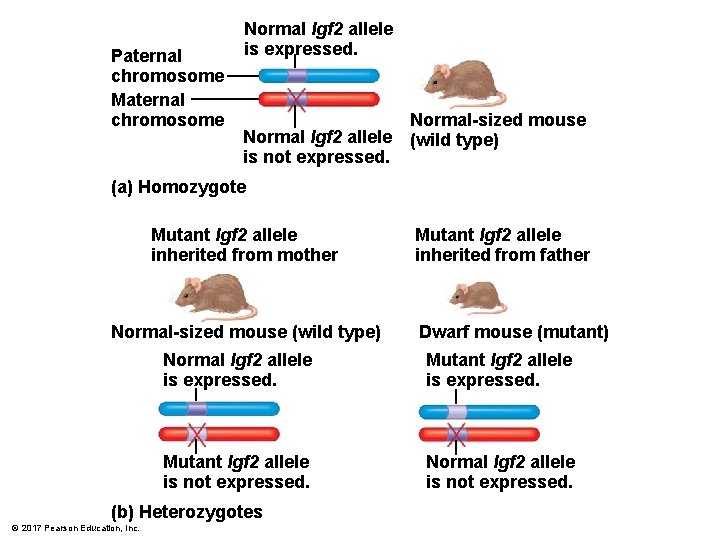
Paternal chromosome Maternal chromosome Normal Igf 2 allele is expressed. Normal Igf 2 allele is not expressed. Normal-sized mouse (wild type) (a) Homozygote Mutant Igf 2 allele inherited from mother Normal-sized mouse (wild type) Dwarf mouse (mutant) Normal Igf 2 allele is expressed. Mutant Igf 2 allele is not expressed. Normal Igf 2 allele is not expressed. (b) Heterozygotes © 2017 Pearson Education, Inc. Mutant Igf 2 allele inherited from father
15. 5 Genomic Imprinting § It seems that imprinting is the result of the methylation (addition of —CH 3 groups) of cysteine nucleotides § Genomic imprinting may affect only a small fraction of mammalian genes § Most imprinted genes are critical for embryonic development © 2017 Pearson Education, Inc.
15. 5 Inheritance of Organelle Genes § Extranuclear genes (or cytoplasmic genes) are found in organelles in the cytoplasm § Mitochondria, chloroplasts, and other plant plastids carry small circular DNA molecules § Extranuclear genes are inherited maternally because the zygote’s cytoplasm comes from the egg © 2017 Pearson Education, Inc.
15. 5 Inheritance of Organelle Genes § Some defects in mitochondrial genes prevent cells from making enough ATP and result in diseases that affect the muscular and nervous systems § It may be possible to avoid passing along mitochondrial disorders § The chromosomes from the egg of an affected mother could be transferred to an egg of a healthy donor, generating a “two-mother” egg § This egg could then be fertilized by sperm from the prospective father and transplanted to the womb of the prospective mother § Three person baby! © 2017 Pearson Education, Inc.
- Slides: 40