
Chapter 15 The Chemistry of Household Products Nivaldo
- Slides: 77
Chapter 15 The Chemistry of Household Products Nivaldo J. Tro • Westmont College Copyright © 2019 Cengage Learning. All Rights Reserved. May not be scanned, copied or duplicated, or posted to a publicly accessible website, in whole or in part.
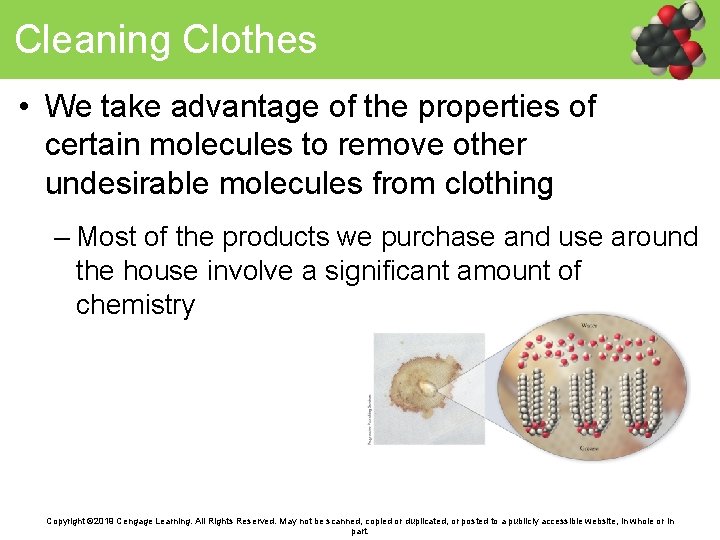
Cleaning Clothes • We take advantage of the properties of certain molecules to remove other undesirable molecules from clothing – Most of the products we purchase and use around the house involve a significant amount of chemistry Copyright © 2019 Cengage Learning. All Rights Reserved. May not be scanned, copied or duplicated, or posted to a publicly accessible website, in whole or in part.
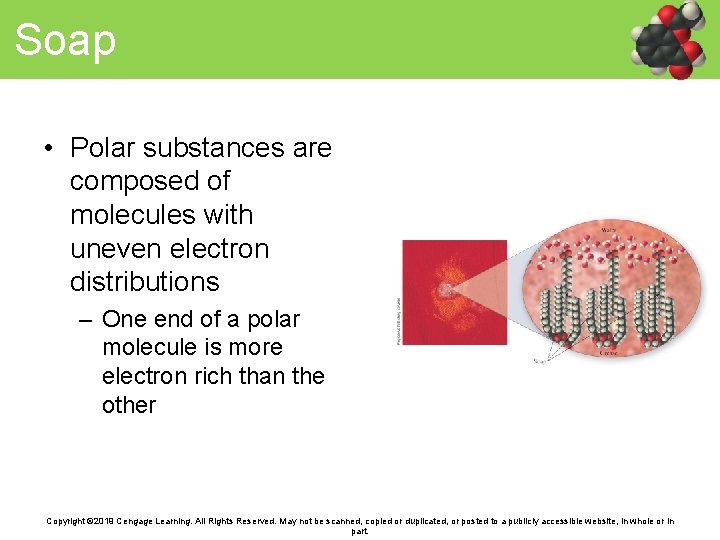
Soap • Polar substances are composed of molecules with uneven electron distributions – One end of a polar molecule is more electron rich than the other Copyright © 2019 Cengage Learning. All Rights Reserved. May not be scanned, copied or duplicated, or posted to a publicly accessible website, in whole or in part.
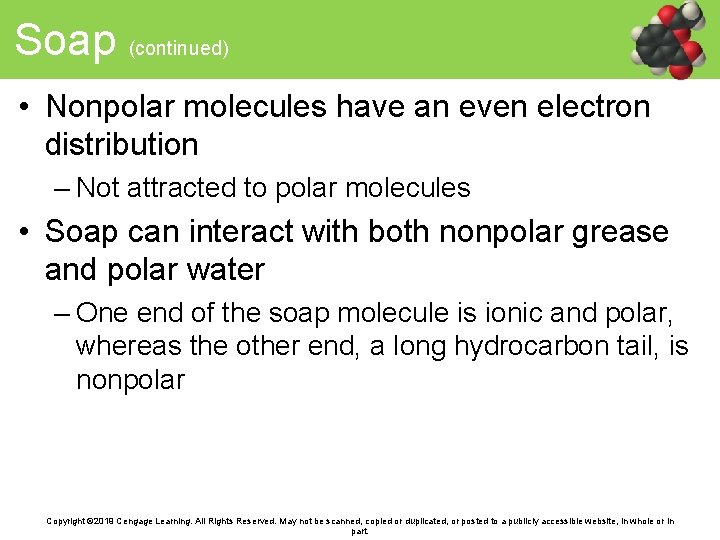
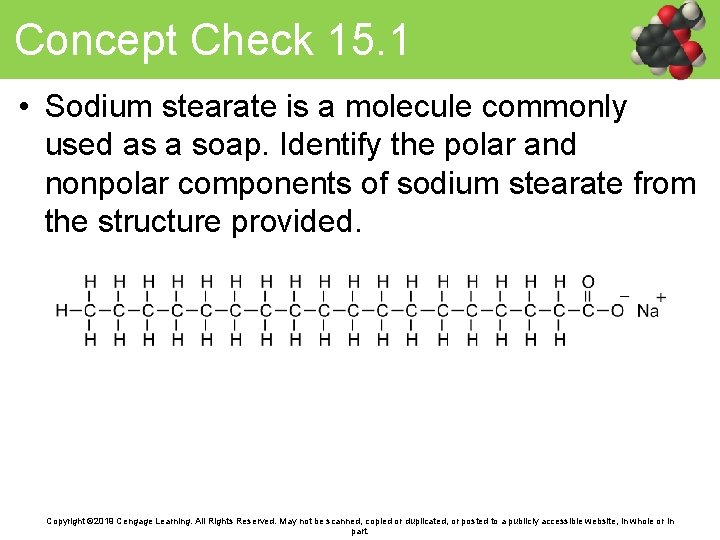
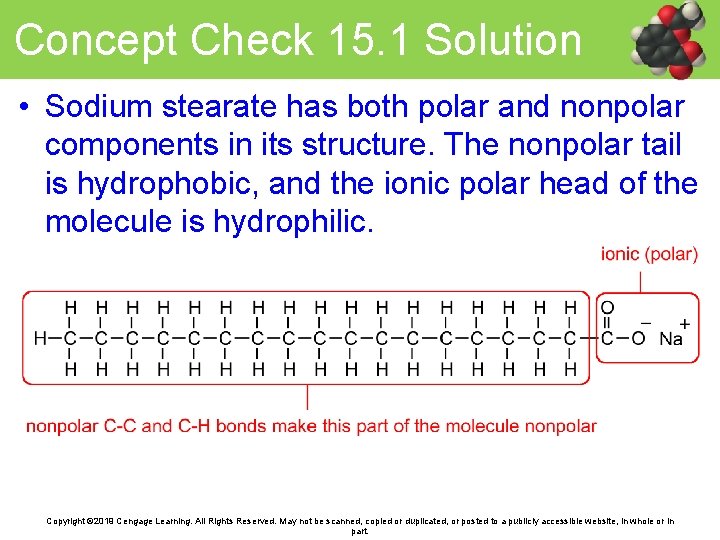
Soap (continued) • Nonpolar molecules have an even electron distribution – Not attracted to polar molecules • Soap can interact with both nonpolar grease and polar water – One end of the soap molecule is ionic and polar, whereas the other end, a long hydrocarbon tail, is nonpolar Copyright © 2019 Cengage Learning. All Rights Reserved. May not be scanned, copied or duplicated, or posted to a publicly accessible website, in whole or in part.
Concept Check 15. 1 • Sodium stearate is a molecule commonly used as a soap. Identify the polar and nonpolar components of sodium stearate from the structure provided. Copyright © 2019 Cengage Learning. All Rights Reserved. May not be scanned, copied or duplicated, or posted to a publicly accessible website, in whole or in part.
Concept Check 15. 1 Solution • Sodium stearate has both polar and nonpolar components in its structure. The nonpolar tail is hydrophobic, and the ionic polar head of the molecule is hydrophilic. Copyright © 2019 Cengage Learning. All Rights Reserved. May not be scanned, copied or duplicated, or posted to a publicly accessible website, in whole or in part.
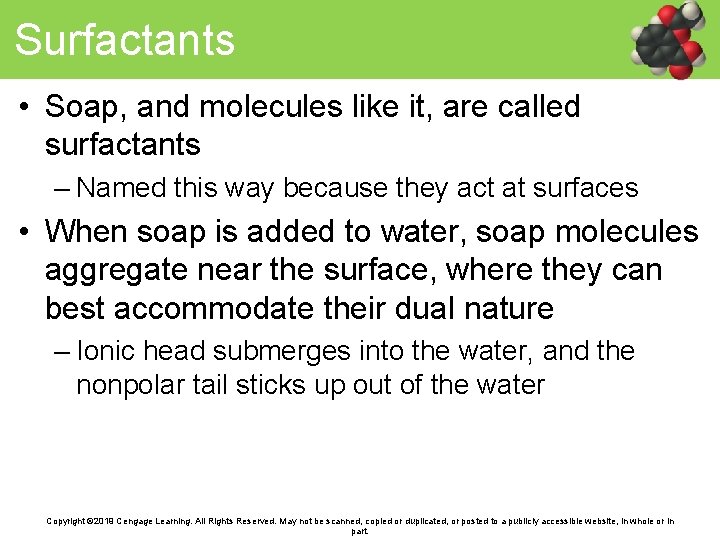
Surfactants • Soap, and molecules like it, are called surfactants – Named this way because they act at surfaces • When soap is added to water, soap molecules aggregate near the surface, where they can best accommodate their dual nature – Ionic head submerges into the water, and the nonpolar tail sticks up out of the water Copyright © 2019 Cengage Learning. All Rights Reserved. May not be scanned, copied or duplicated, or posted to a publicly accessible website, in whole or in part.
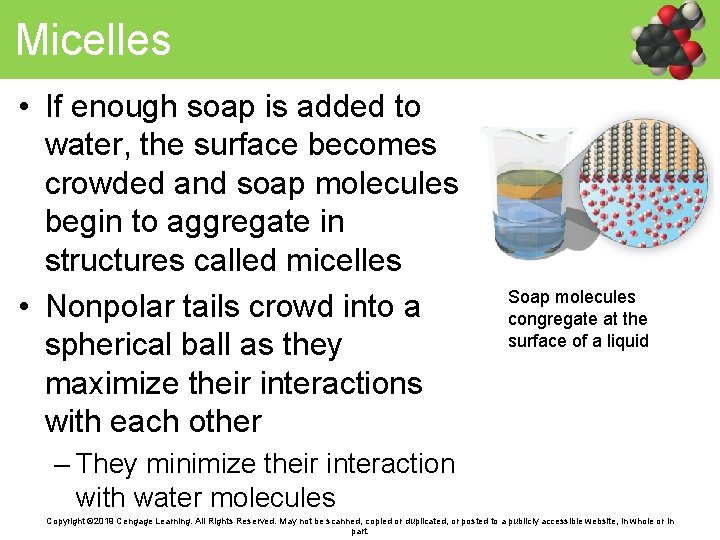
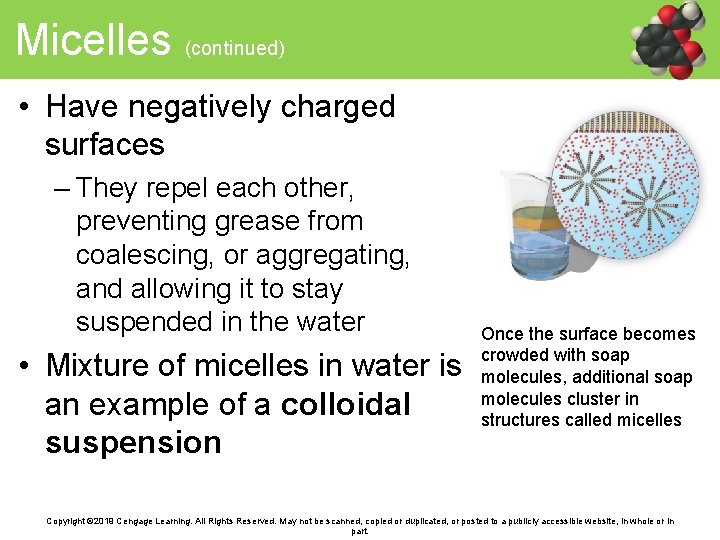
Micelles • If enough soap is added to water, the surface becomes crowded and soap molecules begin to aggregate in structures called micelles • Nonpolar tails crowd into a spherical ball as they maximize their interactions with each other Soap molecules congregate at the surface of a liquid – They minimize their interaction with water molecules Copyright © 2019 Cengage Learning. All Rights Reserved. May not be scanned, copied or duplicated, or posted to a publicly accessible website, in whole or in part.
Micelles (continued) • Have negatively charged surfaces – They repel each other, preventing grease from coalescing, or aggregating, and allowing it to stay suspended in the water • Mixture of micelles in water is an example of a colloidal suspension Once the surface becomes crowded with soap molecules, additional soap molecules cluster in structures called micelles Copyright © 2019 Cengage Learning. All Rights Reserved. May not be scanned, copied or duplicated, or posted to a publicly accessible website, in whole or in part.
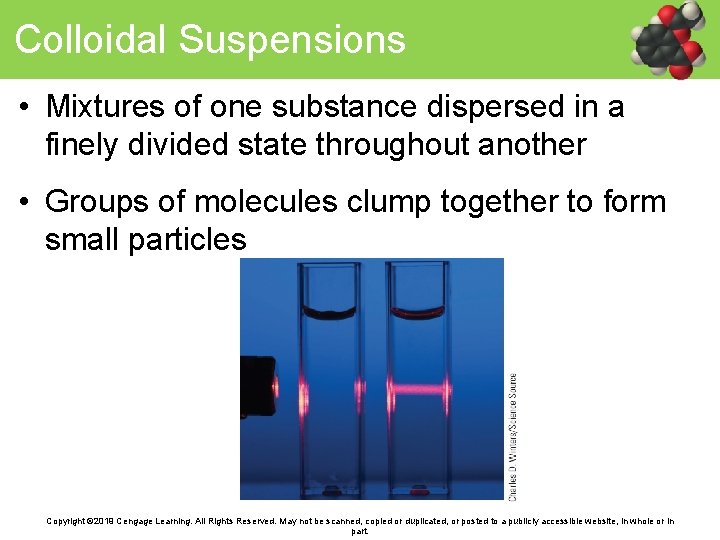
Colloidal Suspensions • Mixtures of one substance dispersed in a finely divided state throughout another • Groups of molecules clump together to form small particles Copyright © 2019 Cengage Learning. All Rights Reserved. May not be scanned, copied or duplicated, or posted to a publicly accessible website, in whole or in part.
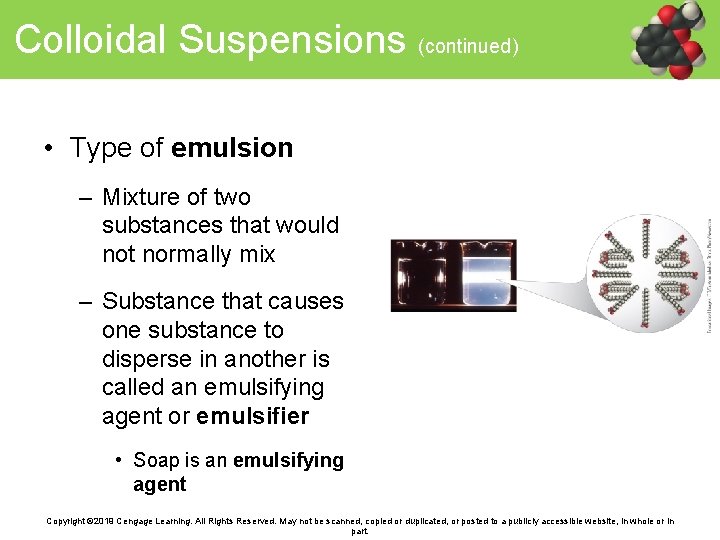
Colloidal Suspensions (continued) • Type of emulsion – Mixture of two substances that would not normally mix – Substance that causes one substance to disperse in another is called an emulsifying agent or emulsifier • Soap is an emulsifying agent Copyright © 2019 Cengage Learning. All Rights Reserved. May not be scanned, copied or duplicated, or posted to a publicly accessible website, in whole or in part.
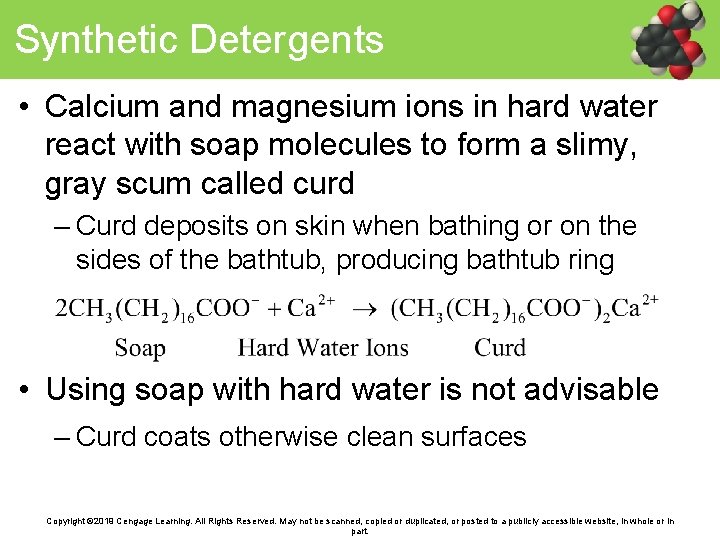
Synthetic Detergents • Calcium and magnesium ions in hard water react with soap molecules to form a slimy, gray scum called curd – Curd deposits on skin when bathing or on the sides of the bathtub, producing bathtub ring • Using soap with hard water is not advisable – Curd coats otherwise clean surfaces Copyright © 2019 Cengage Learning. All Rights Reserved. May not be scanned, copied or duplicated, or posted to a publicly accessible website, in whole or in part.
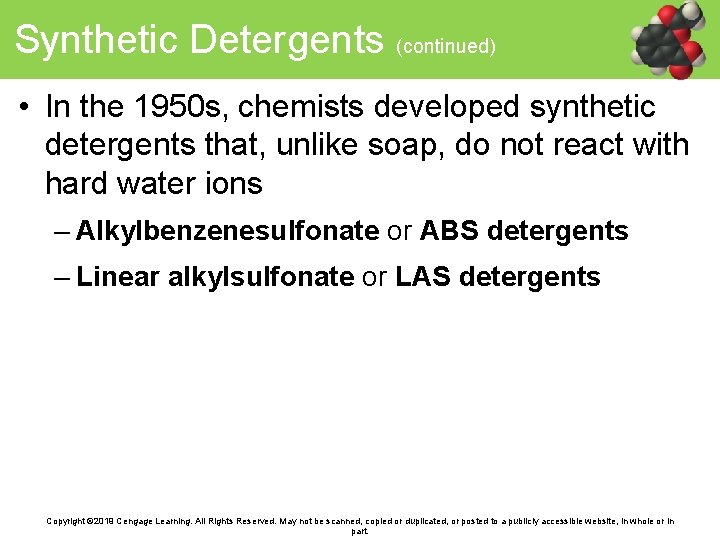
Synthetic Detergents (continued) • In the 1950 s, chemists developed synthetic detergents that, unlike soap, do not react with hard water ions – Alkylbenzenesulfonate or ABS detergents – Linear alkylsulfonate or LAS detergents Copyright © 2019 Cengage Learning. All Rights Reserved. May not be scanned, copied or duplicated, or posted to a publicly accessible website, in whole or in part.
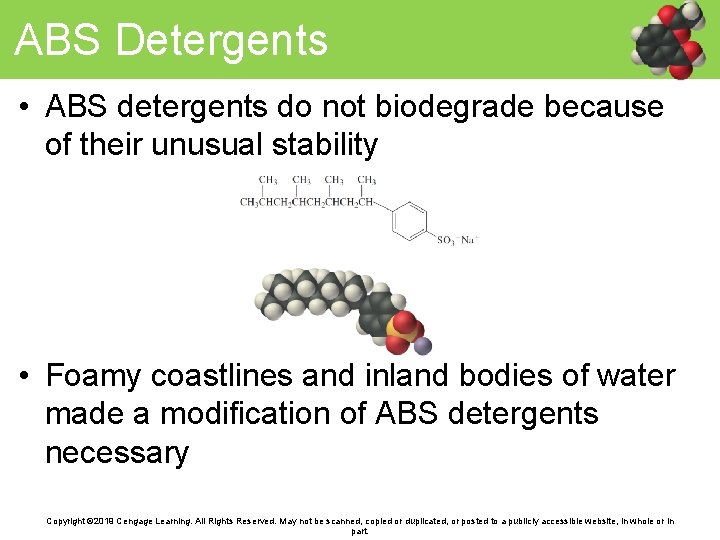
ABS Detergents • ABS detergents do not biodegrade because of their unusual stability • Foamy coastlines and inland bodies of water made a modification of ABS detergents necessary Copyright © 2019 Cengage Learning. All Rights Reserved. May not be scanned, copied or duplicated, or posted to a publicly accessible website, in whole or in part.
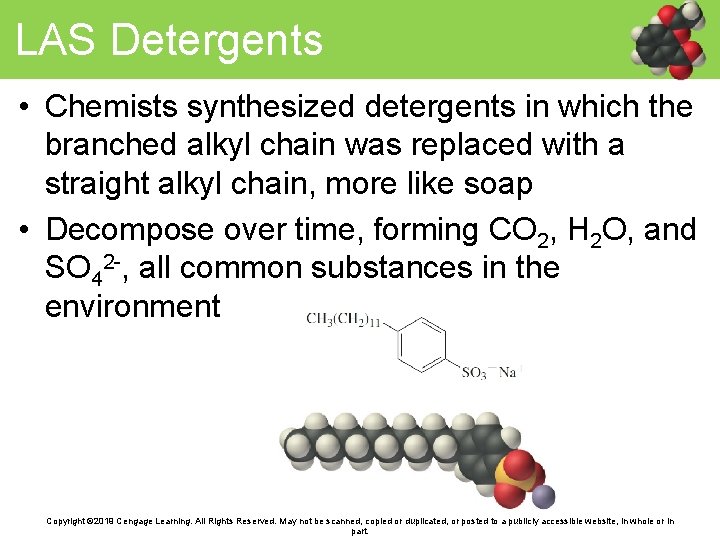
LAS Detergents • Chemists synthesized detergents in which the branched alkyl chain was replaced with a straight alkyl chain, more like soap • Decompose over time, forming CO 2, H 2 O, and SO 42 -, all common substances in the environment Copyright © 2019 Cengage Learning. All Rights Reserved. May not be scanned, copied or duplicated, or posted to a publicly accessible website, in whole or in part.
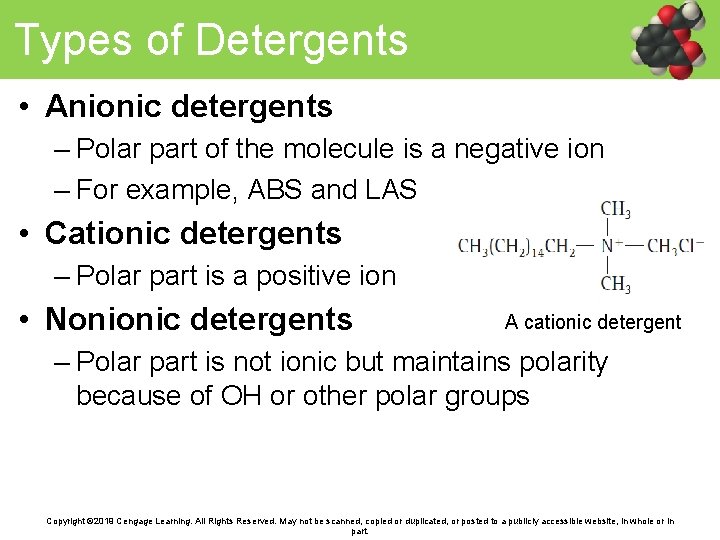
Types of Detergents • Anionic detergents – Polar part of the molecule is a negative ion – For example, ABS and LAS • Cationic detergents – Polar part is a positive ion • Nonionic detergents A cationic detergent – Polar part is not ionic but maintains polarity because of OH or other polar groups Copyright © 2019 Cengage Learning. All Rights Reserved. May not be scanned, copied or duplicated, or posted to a publicly accessible website, in whole or in part.
Concept Check 15. 2 • What structural features do soaps and detergents have in common? Copyright © 2019 Cengage Learning. All Rights Reserved. May not be scanned, copied or duplicated, or posted to a publicly accessible website, in whole or in part.
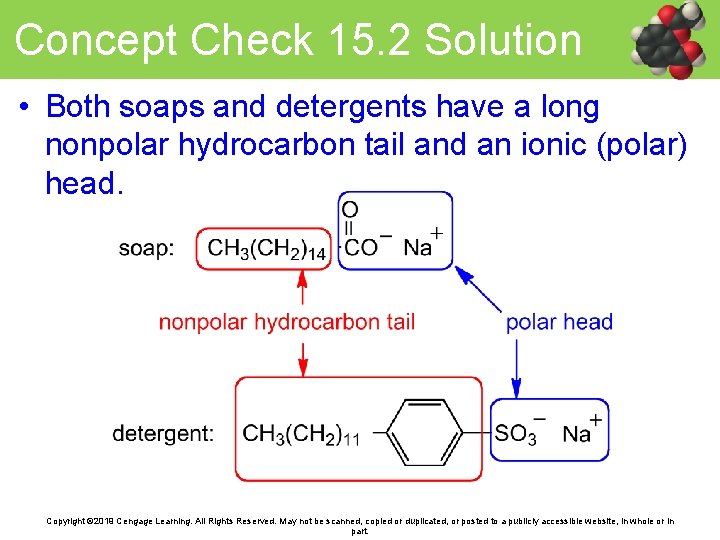
Concept Check 15. 2 Solution • Both soaps and detergents have a long nonpolar hydrocarbon tail and an ionic (polar) head. Copyright © 2019 Cengage Learning. All Rights Reserved. May not be scanned, copied or duplicated, or posted to a publicly accessible website, in whole or in part.
Laundry-Cleaning Formulations • Surfactants – Recent trends favor a combination of anionic LAS surfactants with nonionic surfactants • Builders – Substances that increase the effectiveness of a surfactant – Primary function is to soften water – Help suspend solid soil particles in solution once they are removed from fabrics Copyright © 2019 Cengage Learning. All Rights Reserved. May not be scanned, copied or duplicated, or posted to a publicly accessible website, in whole or in part.
Laundry-Cleaning Formulations (continued 1) – Sodium tripolyphosphate is the best single builder for laundry detergents • Use has been banned in many places because its presence in wastewater can threaten marine life in a process called eutrophication • Replaced by sodium carbonate and zeolites • Fillers – Serve no laundering purpose except to increase the bulk of the detergent and control consistency and density Copyright © 2019 Cengage Learning. All Rights Reserved. May not be scanned, copied or duplicated, or posted to a publicly accessible website, in whole or in part.
Laundry-Cleaning Formulations (continued 2) • Enzymes – Help degrade certain types of stains • Brighteners – Dye molecules that bind to clothing fibers and make clothes appear bright – They absorb ultraviolet or UV light and emit visible light, usually blue • Bleaching agents – Oxidizing agents that help decompose tough stains like wine or fruit juice by converting them into colorless substances Copyright © 2019 Cengage Learning. All Rights Reserved. May not be scanned, copied or duplicated, or posted to a publicly accessible website, in whole or in part.
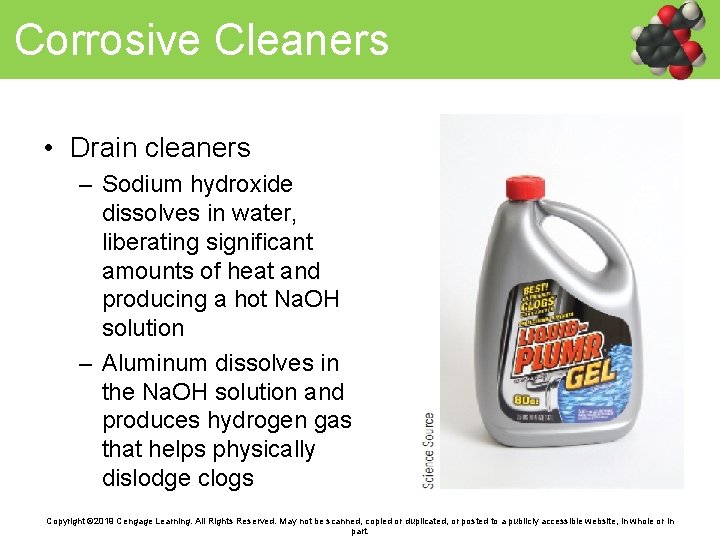
Corrosive Cleaners • Drain cleaners – Sodium hydroxide dissolves in water, liberating significant amounts of heat and producing a hot Na. OH solution – Aluminum dissolves in the Na. OH solution and produces hydrogen gas that helps physically dislodge clogs Copyright © 2019 Cengage Learning. All Rights Reserved. May not be scanned, copied or duplicated, or posted to a publicly accessible website, in whole or in part.
Corrosive Cleaners (continued) • Toilet bowl cleaners – Many are acidic solutions of hydrochloric acid or citric acid that dissolve carbonates left by hard water Copyright © 2019 Cengage Learning. All Rights Reserved. May not be scanned, copied or duplicated, or posted to a publicly accessible website, in whole or in part.
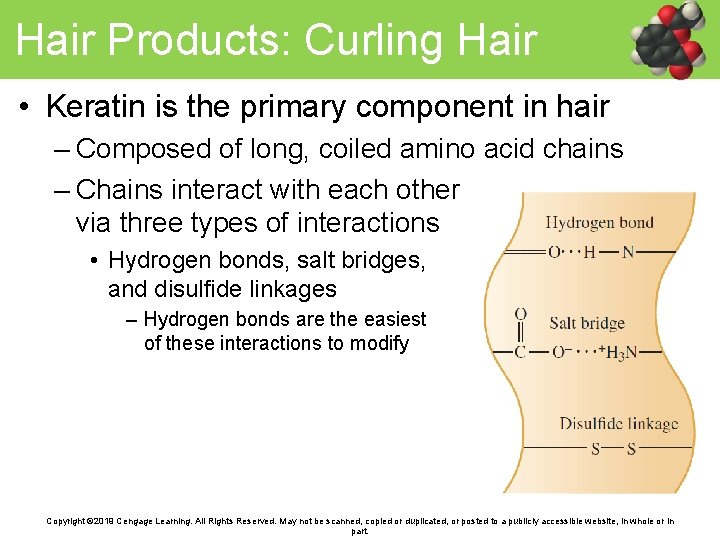
Hair Products: Curling Hair • Keratin is the primary component in hair – Composed of long, coiled amino acid chains – Chains interact with each other via three types of interactions • Hydrogen bonds, salt bridges, and disulfide linkages – Hydrogen bonds are the easiest of these interactions to modify Copyright © 2019 Cengage Learning. All Rights Reserved. May not be scanned, copied or duplicated, or posted to a publicly accessible website, in whole or in part.
Hair Products: Curling Hair (continued) – p. H • Hair is sensitive to p. H because of the salt bridges between keratin protein strands • Salt bridges are strongest under slightly acidic conditions – Disulfide linkage • Covalent chemical bond that is not easily broken • Can be broken and reformed to change permanently with chemical treatment Copyright © 2019 Cengage Learning. All Rights Reserved. May not be scanned, copied or duplicated, or posted to a publicly accessible website, in whole or in part.
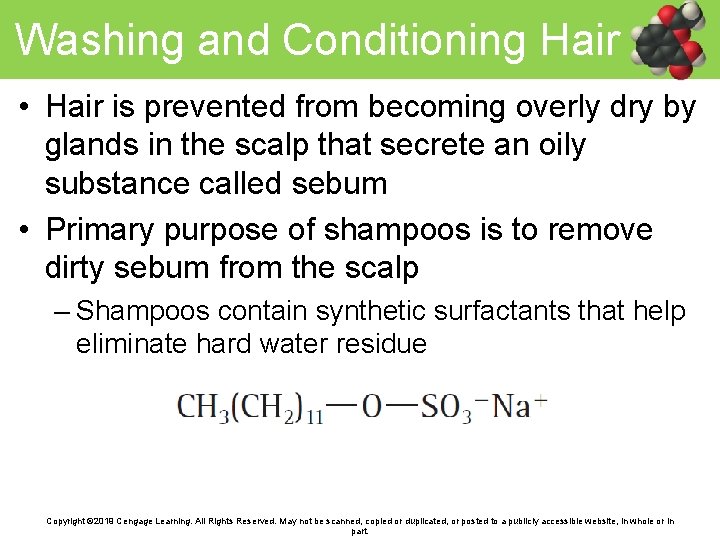
Washing and Conditioning Hair • Hair is prevented from becoming overly dry by glands in the scalp that secrete an oily substance called sebum • Primary purpose of shampoos is to remove dirty sebum from the scalp – Shampoos contain synthetic surfactants that help eliminate hard water residue Copyright © 2019 Cengage Learning. All Rights Reserved. May not be scanned, copied or duplicated, or posted to a publicly accessible website, in whole or in part.
Washing and Conditioning Hair (continued) • Conditioners contain cationic surfactants that bind with residual anionic surfactants and help rinse them out – Cationic surfactants are usually quaternary ammonium compounds Copyright © 2019 Cengage Learning. All Rights Reserved. May not be scanned, copied or duplicated, or posted to a publicly accessible website, in whole or in part.
Coloring Hair • Natural color of hair depends primarily on two pigments – Melanin, a dark pigment – Phaeomelanin, a red–orange pigment • Lightening of hair color requires removal of these pigments by using bleach • Darkening or adding color to hair can be accomplished by several different treatments – Applying a dye of the desired color to the hair • Dye molecules are fairly large and only coat the surface of hair strands and are only temporary Copyright © 2019 Cengage Learning. All Rights Reserved. May not be scanned, copied or duplicated, or posted to a publicly accessible website, in whole or in part.
Coloring Hair (continued) – Permanent coloring of hair involves two or more components being added to hair • These molecules diffuse into hair strands and react to produce a larger, colored molecule Copyright © 2019 Cengage Learning. All Rights Reserved. May not be scanned, copied or duplicated, or posted to a publicly accessible website, in whole or in part.
Skin Products • Dead cells that compose the skin’s surface are lubricated by sebum that regulates the moisture content of the skin – Optimal moisture content is 10% • Amount of moisture held in the skin varies with environmental conditions • Products designed for use on the skin include creams, lotions, and sunscreen Copyright © 2019 Cengage Learning. All Rights Reserved. May not be scanned, copied or duplicated, or posted to a publicly accessible website, in whole or in part.
Creams and Lotions • Emulsions of water and oil designed to help the skin maintain enough moisture – Water adds moisture to the skin, and the oil holds the moisture in the skin – Lotions contain more water than oils • Include olive oil, mineral oil, almond oil, and lanolin • Oils tend to be liquids at room temperature – Creams contain more oils than water • Oils tend to be solids at room temperature • Include waxes, such as beeswax or carnauba Copyright © 2019 Cengage Learning. All Rights Reserved. May not be scanned, copied or duplicated, or posted to a publicly accessible website, in whole or in part.
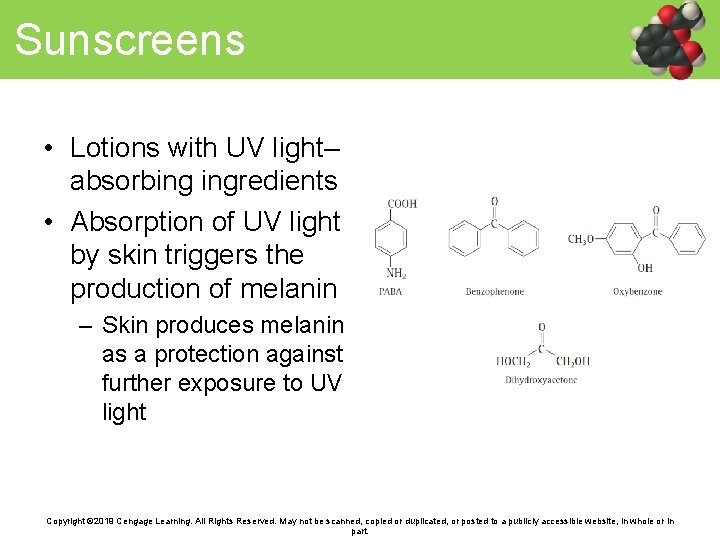
Sunscreens • Lotions with UV light– absorbing ingredients • Absorption of UV light by skin triggers the production of melanin – Skin produces melanin as a protection against further exposure to UV light Copyright © 2019 Cengage Learning. All Rights Reserved. May not be scanned, copied or duplicated, or posted to a publicly accessible website, in whole or in part.
Sunscreens (continued 1) • UV light causes damage fragile biological molecules that compose skin, producing sunburn – Divided into several categories, including UV-A and UV-B • UV-B light is more harmful to humans, increasing skin cancer risk • Excessive exposure to UV-B light causes premature skin aging and weakens the immune system Copyright © 2019 Cengage Learning. All Rights Reserved. May not be scanned, copied or duplicated, or posted to a publicly accessible website, in whole or in part.
Sunscreens (continued 2) • Sunscreens contain compounds that absorb light in the UV-B range – Ability of a sunscreen to absorb UV light is specified by its sun protection factor or SPF Copyright © 2019 Cengage Learning. All Rights Reserved. May not be scanned, copied or duplicated, or posted to a publicly accessible website, in whole or in part.
Concept Check 15. 3 • Which UV light has more energy—UV-A or UV-B? Copyright © 2019 Cengage Learning. All Rights Reserved. May not be scanned, copied or duplicated, or posted to a publicly accessible website, in whole or in part.
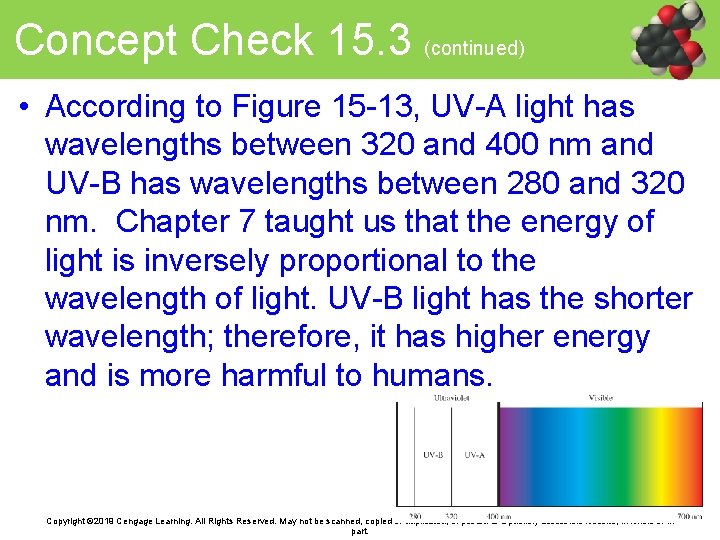
Concept Check 15. 3 (continued) • According to Figure 15 -13, UV-A light has wavelengths between 320 and 400 nm and UV-B has wavelengths between 280 and 320 nm. Chapter 7 taught us that the energy of light is inversely proportional to the wavelength of light. UV-B light has the shorter wavelength; therefore, it has higher energy and is more harmful to humans. Copyright © 2019 Cengage Learning. All Rights Reserved. May not be scanned, copied or duplicated, or posted to a publicly accessible website, in whole or in part.
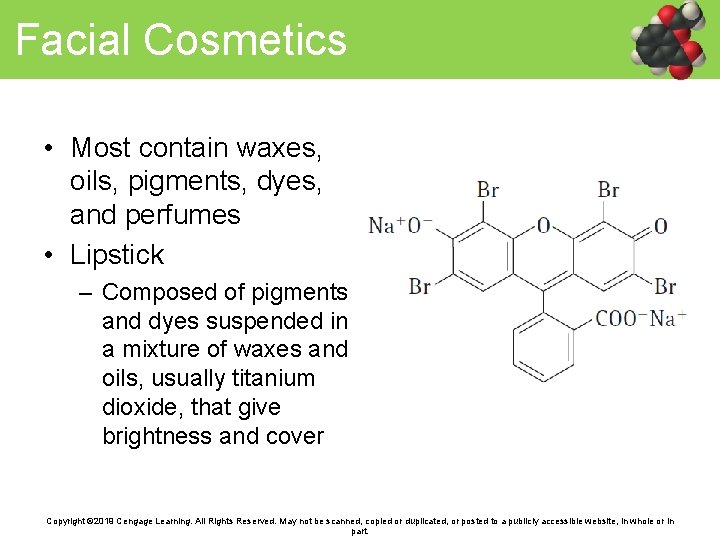
Facial Cosmetics • Most contain waxes, oils, pigments, dyes, and perfumes • Lipstick – Composed of pigments and dyes suspended in a mixture of waxes and oils, usually titanium dioxide, that give brightness and cover Copyright © 2019 Cengage Learning. All Rights Reserved. May not be scanned, copied or duplicated, or posted to a publicly accessible website, in whole or in part.
Facial Cosmetics (continued) • Dye, usually a bromoacid, provides color • Oils and waxes are the base for the pigments and dyes and help keep lips soft and moist Copyright © 2019 Cengage Learning. All Rights Reserved. May not be scanned, copied or duplicated, or posted to a publicly accessible website, in whole or in part.
Cosmetics • Foundation – Oil and water emulsions with a soaplike emulsifying agent – Face powders contain talc, calcium carbonate, pigments, and dyes – Other moisture-absorbing substances and dyes Copyright © 2019 Cengage Learning. All Rights Reserved. May not be scanned, copied or duplicated, or posted to a publicly accessible website, in whole or in part.
Cosmetics (continued) • Mascara – Composed of soap, oils, waxes, and pigments – Possible pigments include iron oxide, which is brown, and carbon black, which is black Copyright © 2019 Cengage Learning. All Rights Reserved. May not be scanned, copied or duplicated, or posted to a publicly accessible website, in whole or in part.
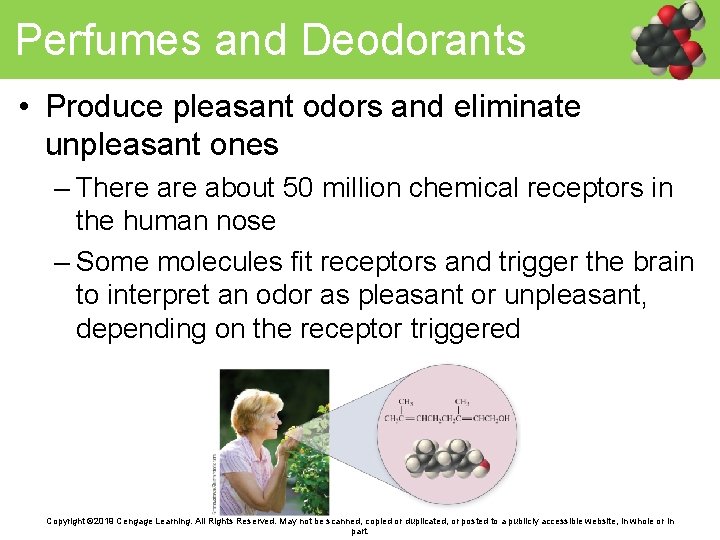
Perfumes and Deodorants • Produce pleasant odors and eliminate unpleasant ones – There about 50 million chemical receptors in the human nose – Some molecules fit receptors and trigger the brain to interpret an odor as pleasant or unpleasant, depending on the receptor triggered Copyright © 2019 Cengage Learning. All Rights Reserved. May not be scanned, copied or duplicated, or posted to a publicly accessible website, in whole or in part.
Perfumes and Deodorants (continued) – Odorless molecules do not fit any receptors – Brain’s processing centers for smell are linked to its processing centers for emotions Copyright © 2019 Cengage Learning. All Rights Reserved. May not be scanned, copied or duplicated, or posted to a publicly accessible website, in whole or in part.
Perfumes • Chemists synthesize many of the compounds responsible for characteristic plant and animal scents • Perfumes are designed to be experienced in three stages or notes – Top note: Refreshing; first one encountered when opening a bottle of perfume – Middle note: Full and solid in character, persist on skin – End note: More animal or earthy fragrances; least easily evaporated Copyright © 2019 Cengage Learning. All Rights Reserved. May not be scanned, copied or duplicated, or posted to a publicly accessible website, in whole or in part.
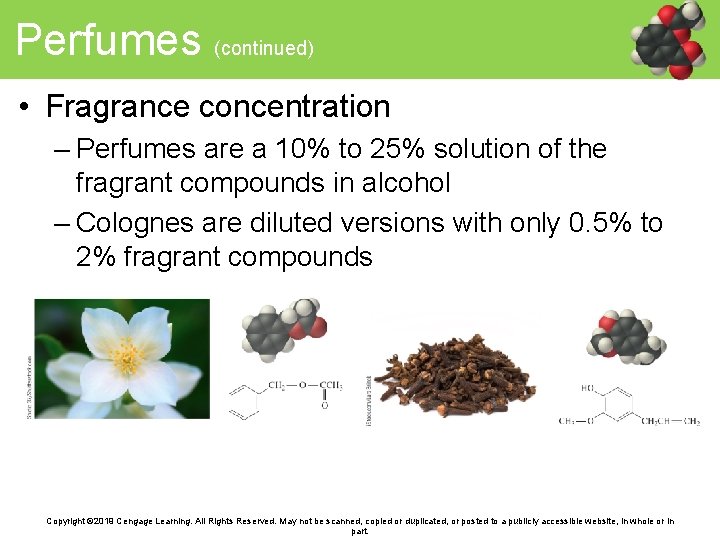
Perfumes (continued) • Fragrance concentration – Perfumes are a 10% to 25% solution of the fragrant compounds in alcohol – Colognes are diluted versions with only 0. 5% to 2% fragrant compounds Copyright © 2019 Cengage Learning. All Rights Reserved. May not be scanned, copied or duplicated, or posted to a publicly accessible website, in whole or in part.
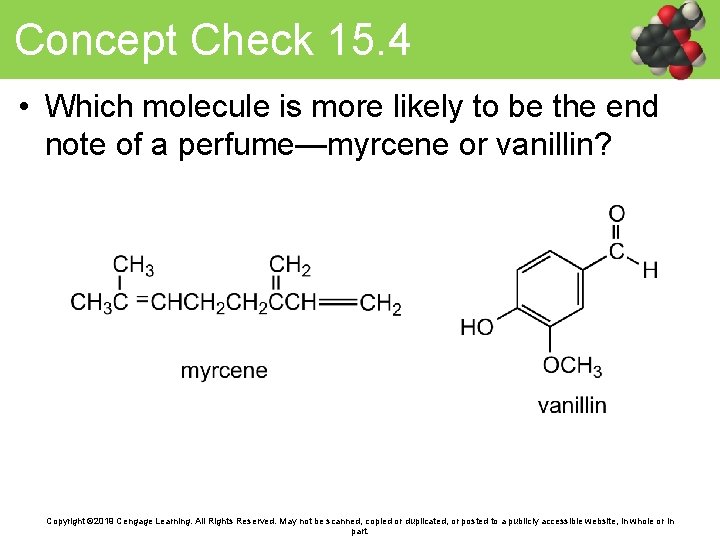
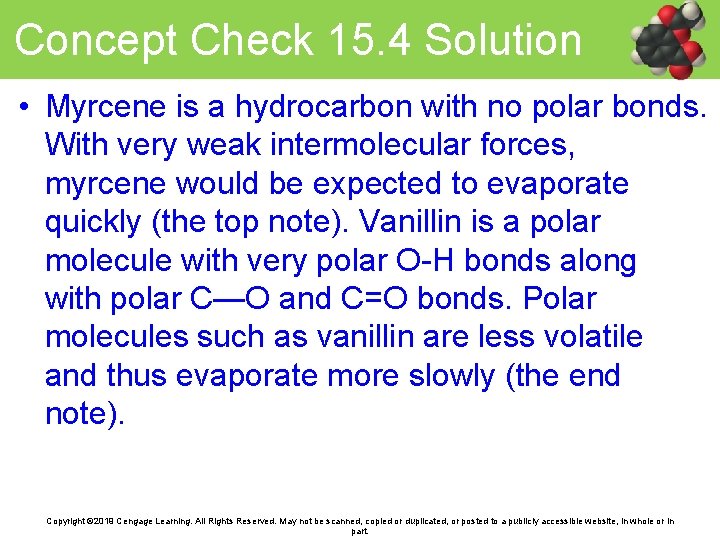
Concept Check 15. 4 • Which molecule is more likely to be the end note of a perfume—myrcene or vanillin? Copyright © 2019 Cengage Learning. All Rights Reserved. May not be scanned, copied or duplicated, or posted to a publicly accessible website, in whole or in part.
Concept Check 15. 4 Solution • Myrcene is a hydrocarbon with no polar bonds. With very weak intermolecular forces, myrcene would be expected to evaporate quickly (the top note). Vanillin is a polar molecule with very polar O-H bonds along with polar C—O and C=O bonds. Polar molecules such as vanillin are less volatile and thus evaporate more slowly (the end note). Copyright © 2019 Cengage Learning. All Rights Reserved. May not be scanned, copied or duplicated, or posted to a publicly accessible website, in whole or in part.
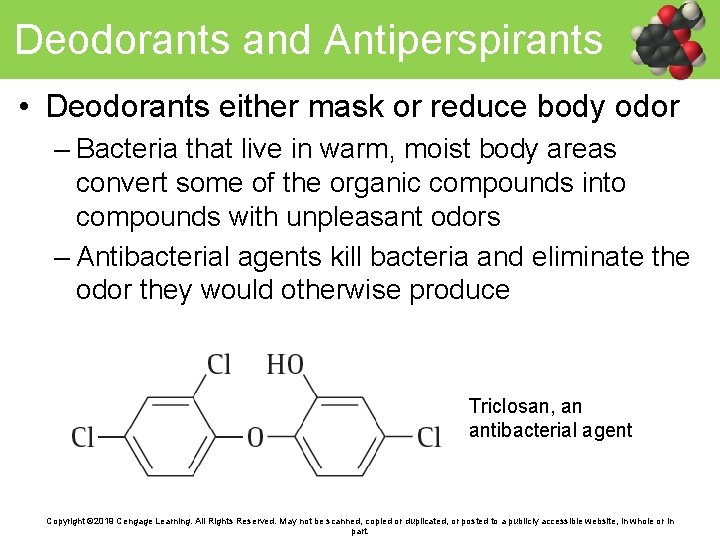
Deodorants and Antiperspirants • Deodorants either mask or reduce body odor – Bacteria that live in warm, moist body areas convert some of the organic compounds into compounds with unpleasant odors – Antibacterial agents kill bacteria and eliminate the odor they would otherwise produce Triclosan, an antibacterial agent Copyright © 2019 Cengage Learning. All Rights Reserved. May not be scanned, copied or duplicated, or posted to a publicly accessible website, in whole or in part.
Deodorants and Antiperspirants (continued) • Antiperspirants reduce the amount of perspiration that sweat glands produce – Aluminum chlorohydrates, such as Al 2(OH)4 Cl 2, constrict the opening of sweat glands Copyright © 2019 Cengage Learning. All Rights Reserved. May not be scanned, copied or duplicated, or posted to a publicly accessible website, in whole or in part.
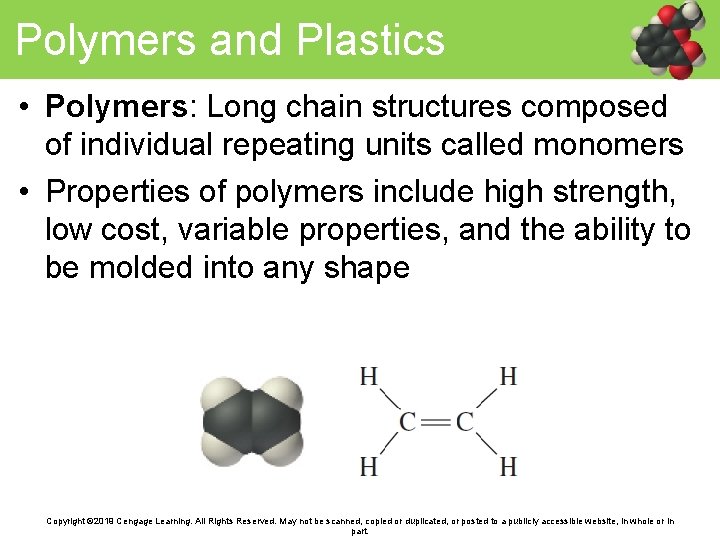
Polymers and Plastics • Polymers: Long chain structures composed of individual repeating units called monomers • Properties of polymers include high strength, low cost, variable properties, and the ability to be molded into any shape Copyright © 2019 Cengage Learning. All Rights Reserved. May not be scanned, copied or duplicated, or posted to a publicly accessible website, in whole or in part.
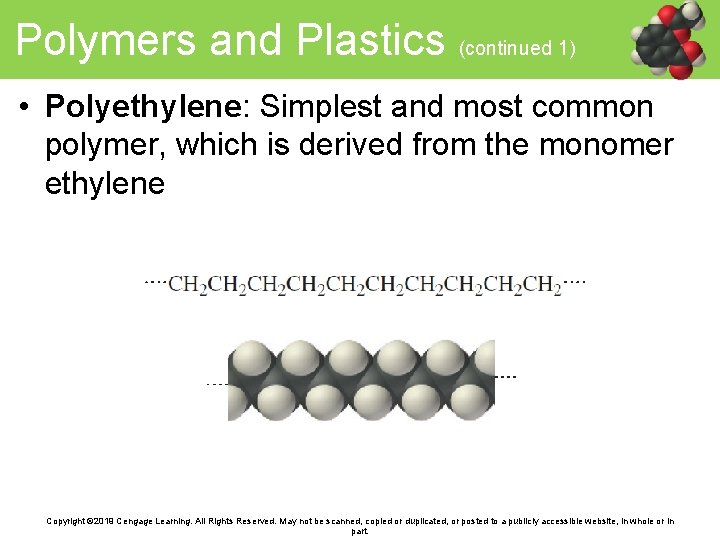
Polymers and Plastics (continued 1) • Polyethylene: Simplest and most common polymer, which is derived from the monomer ethylene Copyright © 2019 Cengage Learning. All Rights Reserved. May not be scanned, copied or duplicated, or posted to a publicly accessible website, in whole or in part.
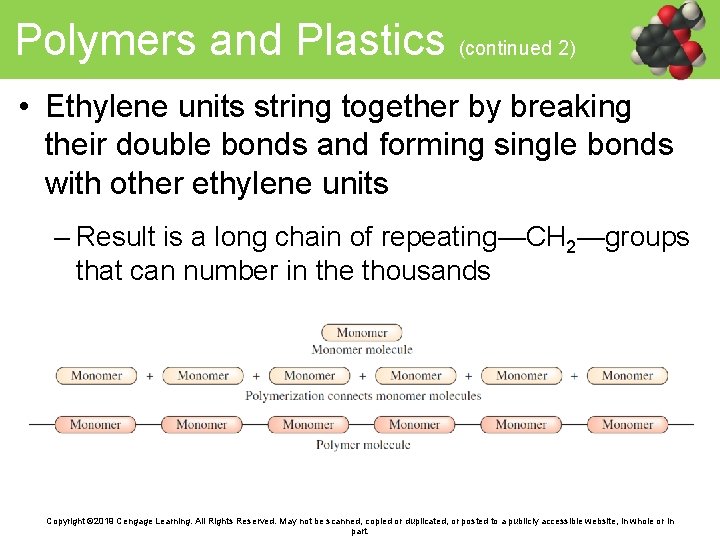
Polymers and Plastics (continued 2) • Ethylene units string together by breaking their double bonds and forming single bonds with other ethylene units – Result is a long chain of repeating—CH 2—groups that can number in the thousands Copyright © 2019 Cengage Learning. All Rights Reserved. May not be scanned, copied or duplicated, or posted to a publicly accessible website, in whole or in part.
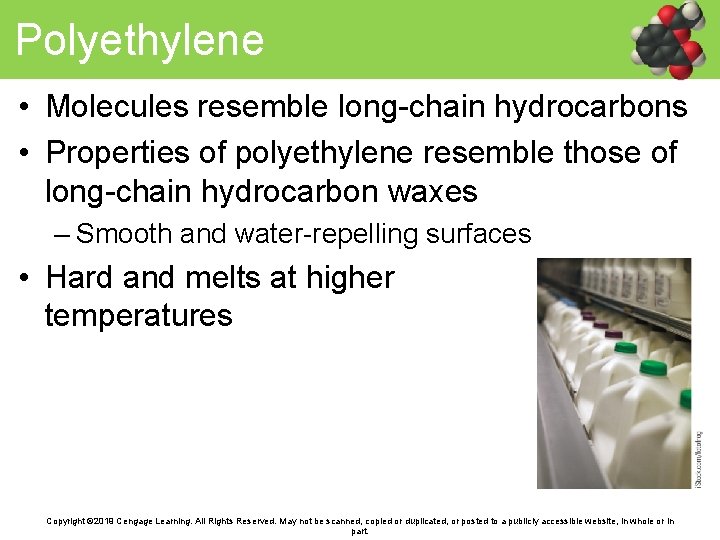
Polyethylene • Molecules resemble long-chain hydrocarbons • Properties of polyethylene resemble those of long-chain hydrocarbon waxes – Smooth and water-repelling surfaces • Hard and melts at higher temperatures Copyright © 2019 Cengage Learning. All Rights Reserved. May not be scanned, copied or duplicated, or posted to a publicly accessible website, in whole or in part.
Polyethylene (continued 1) • Does not expel oils or other nonpolar materials – Can be stained by oils and greases • Example of a thermoplastic and an addition polymer – Thermoplastic: Softens when heated and hardens when cooled – Addition polymer: Formed by the addition of monomer units, one to the other without the elimination of any atoms Copyright © 2019 Cengage Learning. All Rights Reserved. May not be scanned, copied or duplicated, or posted to a publicly accessible website, in whole or in part.
Polyethylene (continued 2) • Formed in two different ways – Low-density polyethylene (LDPE) • Chains branch as they form • Soft, flexible plastic used in garbage bags and shopping bags – High-density polyethylene (HDPE) • Reaction conditions are controlled such that the ethylene units add to form long straight chains • Denser, tougher plastic Copyright © 2019 Cengage Learning. All Rights Reserved. May not be scanned, copied or duplicated, or posted to a publicly accessible website, in whole or in part.
Concept Check 15. 5 • What are the differences between LDPE and HDPE? Copyright © 2019 Cengage Learning. All Rights Reserved. May not be scanned, copied or duplicated, or posted to a publicly accessible website, in whole or in part.
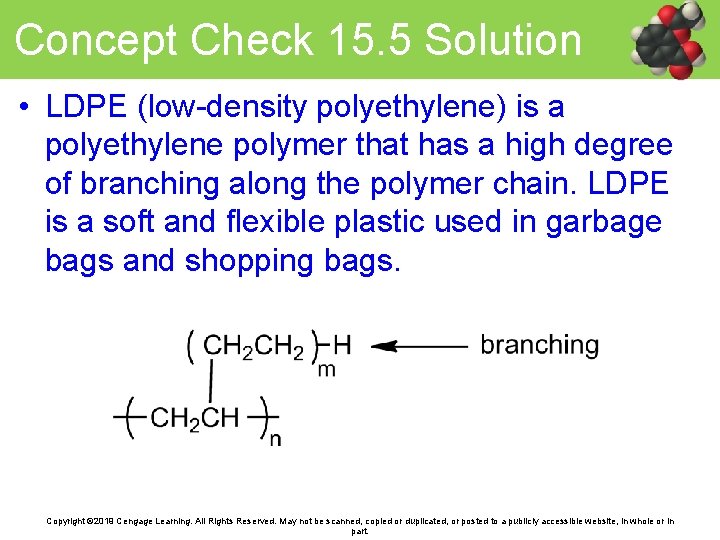
Concept Check 15. 5 Solution • LDPE (low-density polyethylene) is a polyethylene polymer that has a high degree of branching along the polymer chain. LDPE is a soft and flexible plastic used in garbage bags and shopping bags. Copyright © 2019 Cengage Learning. All Rights Reserved. May not be scanned, copied or duplicated, or posted to a publicly accessible website, in whole or in part.
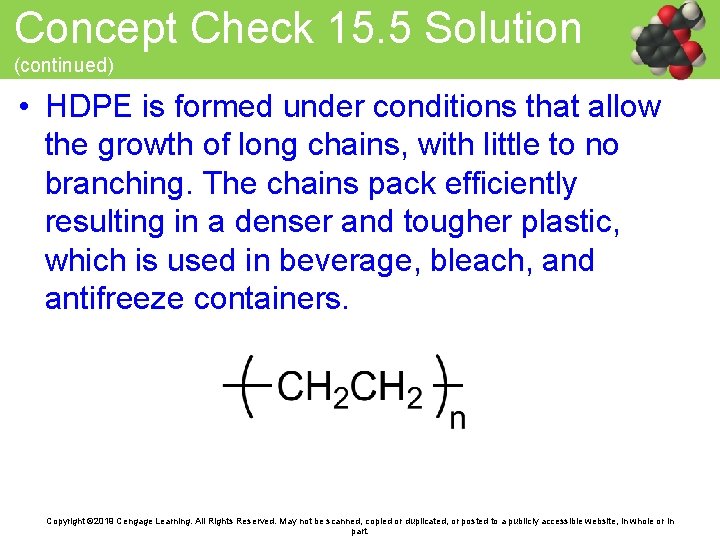
Concept Check 15. 5 Solution (continued) • HDPE is formed under conditions that allow the growth of long chains, with little to no branching. The chains pack efficiently resulting in a denser and tougher plastic, which is used in beverage, bleach, and antifreeze containers. Copyright © 2019 Cengage Learning. All Rights Reserved. May not be scanned, copied or duplicated, or posted to a publicly accessible website, in whole or in part.
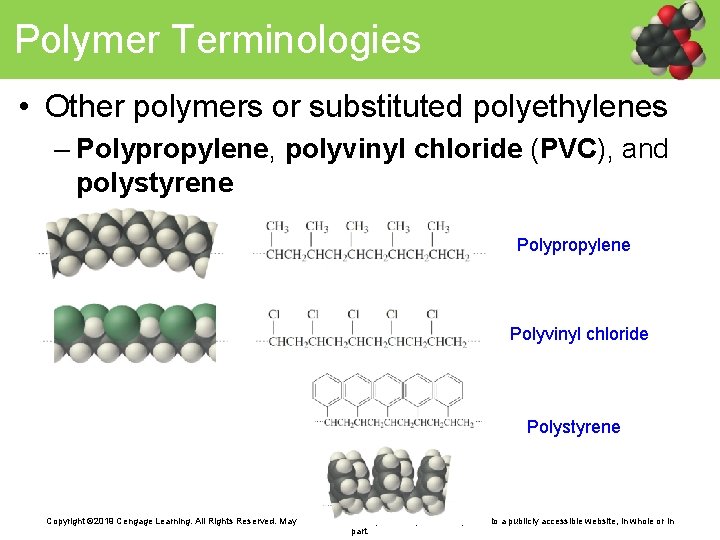
Polymer Terminologies • Other polymers or substituted polyethylenes – Polypropylene, polyvinyl chloride (PVC), and polystyrene Polypropylene Polyvinyl chloride Polystyrene Copyright © 2019 Cengage Learning. All Rights Reserved. May not be scanned, copied or duplicated, or posted to a publicly accessible website, in whole or in part.
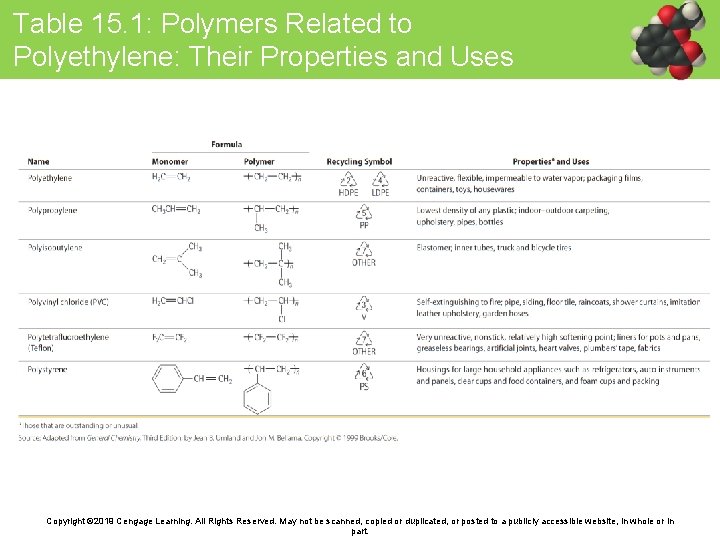
Table 15. 1: Polymers Related to Polyethylene: Their Properties and Uses Copyright © 2019 Cengage Learning. All Rights Reserved. May not be scanned, copied or duplicated, or posted to a publicly accessible website, in whole or in part.
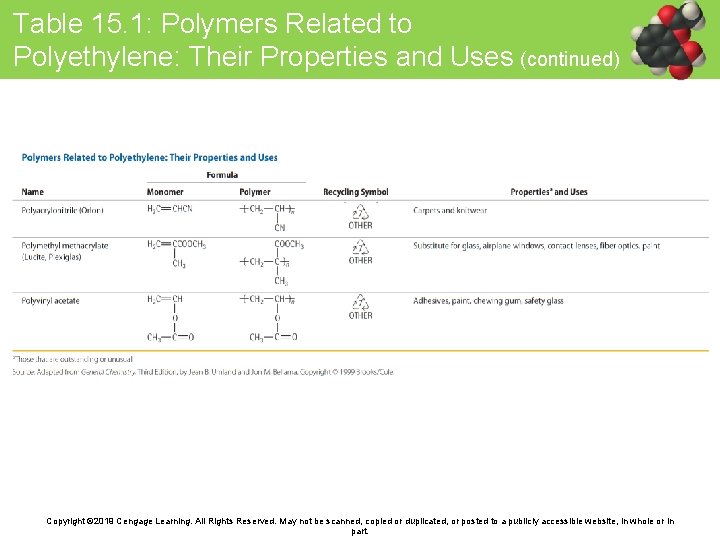
Table 15. 1: Polymers Related to Polyethylene: Their Properties and Uses (continued) Copyright © 2019 Cengage Learning. All Rights Reserved. May not be scanned, copied or duplicated, or posted to a publicly accessible website, in whole or in part.
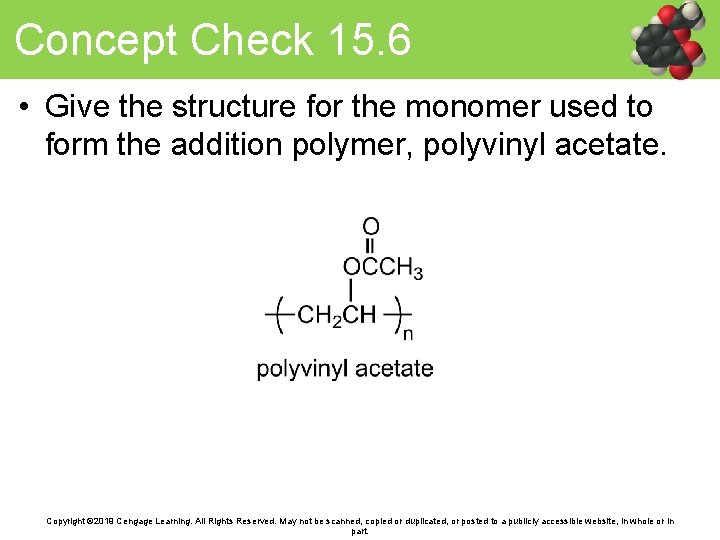
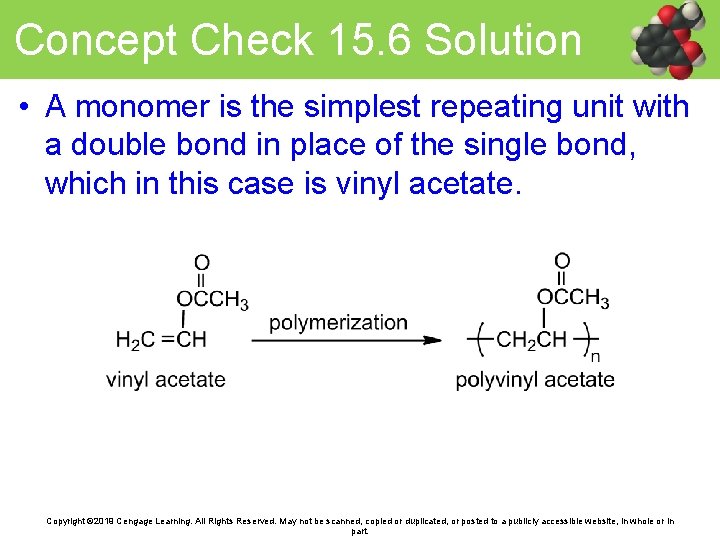
Concept Check 15. 6 • Give the structure for the monomer used to form the addition polymer, polyvinyl acetate. Copyright © 2019 Cengage Learning. All Rights Reserved. May not be scanned, copied or duplicated, or posted to a publicly accessible website, in whole or in part.
Concept Check 15. 6 Solution • A monomer is the simplest repeating unit with a double bond in place of the single bond, which in this case is vinyl acetate. Copyright © 2019 Cengage Learning. All Rights Reserved. May not be scanned, copied or duplicated, or posted to a publicly accessible website, in whole or in part.
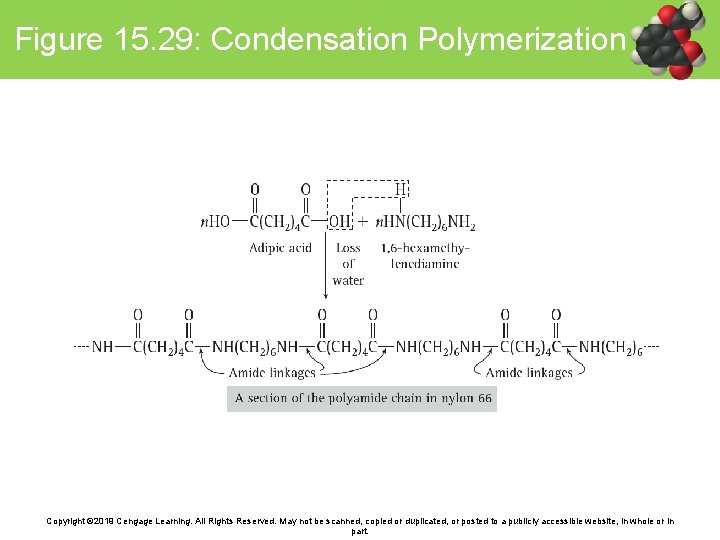
Copolymers: Nylon • Copolymers: Polymers composed of two types of monomers – Result in chains composed of alternating units rather than a single repeating unit – Nylon, also called nylon 66 • Copolymer of the monomers adipic acid and hexamethylenediamine • Condensation polymers – Polymers that expel atoms or small molecules, usually water, during their formation Copyright © 2019 Cengage Learning. All Rights Reserved. May not be scanned, copied or duplicated, or posted to a publicly accessible website, in whole or in part.
Figure 15. 29: Condensation Polymerization Copyright © 2019 Cengage Learning. All Rights Reserved. May not be scanned, copied or duplicated, or posted to a publicly accessible website, in whole or in part.
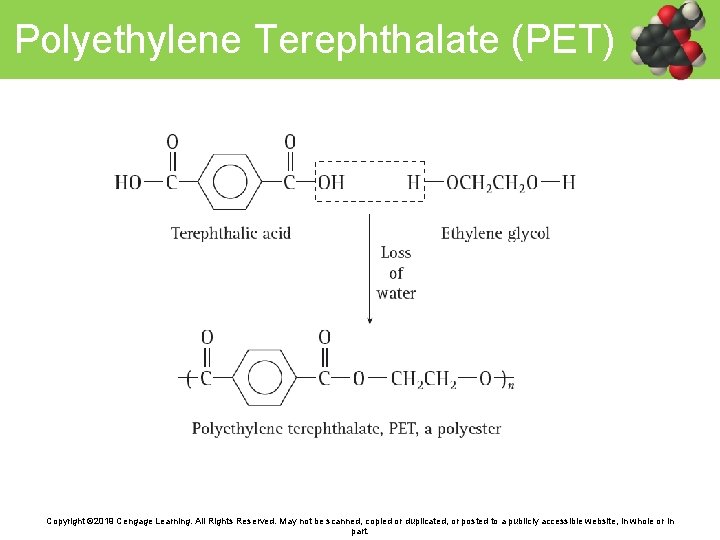
Copolymers: Polyethylene Terephthalate (PET) • Condensation copolymer formed by the reaction of terephthalic acid with ethylene glycol – Repeating ester groups (—RCOOR—) – Polymers with this structure are called polyesters • Dacron – PET drawn into fibers; used in making cloth – Can be made into thin sheets called Mylar • Used in packaging as a waterproof coating on sails, as a base for magnetic video and audio tapes, and as a base for photographic film Copyright © 2019 Cengage Learning. All Rights Reserved. May not be scanned, copied or duplicated, or posted to a publicly accessible website, in whole or in part.
Polyethylene Terephthalate (PET) Copyright © 2019 Cengage Learning. All Rights Reserved. May not be scanned, copied or duplicated, or posted to a publicly accessible website, in whole or in part.
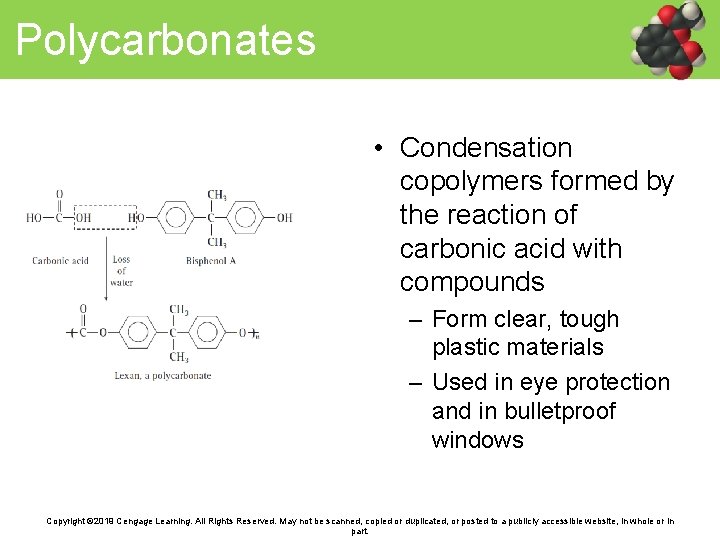
Polycarbonates • Condensation copolymers formed by the reaction of carbonic acid with compounds – Form clear, tough plastic materials – Used in eye protection and in bulletproof windows Copyright © 2019 Cengage Learning. All Rights Reserved. May not be scanned, copied or duplicated, or posted to a publicly accessible website, in whole or in part.
Concept Check 15. 7 • Why are polymers such as Lexan, PET, and nylon considered condensation polymers? Why are they also considered copolymers? Copyright © 2019 Cengage Learning. All Rights Reserved. May not be scanned, copied or duplicated, or posted to a publicly accessible website, in whole or in part.
Concept Check 15. 7 (continued) • Lexan, PET, and nylon are considered condensation polymers because during their formation, small molecules such as water are expelled for each bond that forms linking monomer units. • They are also considered copolymers because they are composed of alternating single repeating units. Copyright © 2019 Cengage Learning. All Rights Reserved. May not be scanned, copied or duplicated, or posted to a publicly accessible website, in whole or in part.
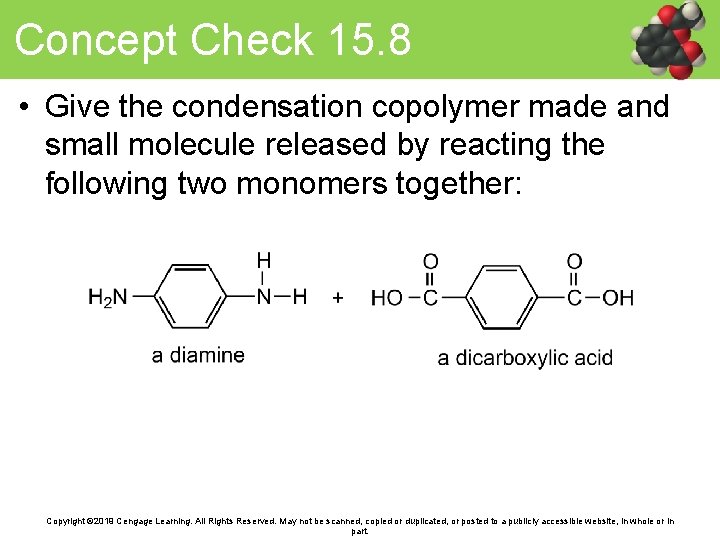
Concept Check 15. 8 • Give the condensation copolymer made and small molecule released by reacting the following two monomers together: Copyright © 2019 Cengage Learning. All Rights Reserved. May not be scanned, copied or duplicated, or posted to a publicly accessible website, in whole or in part.
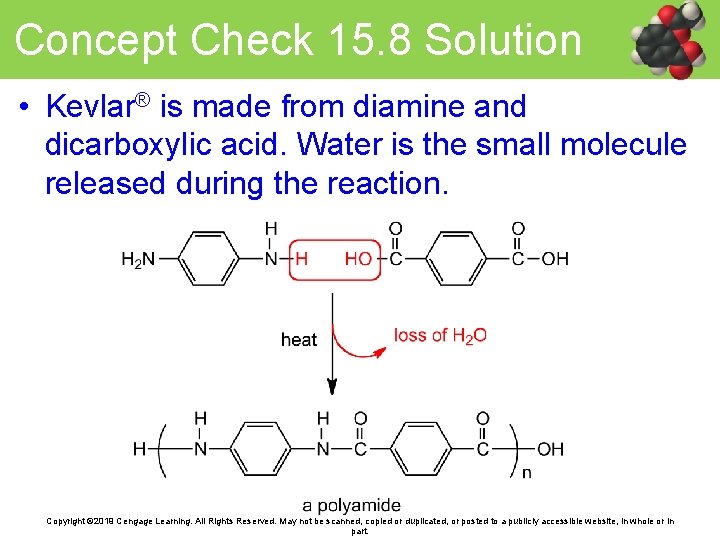
Concept Check 15. 8 Solution • Kevlar® is made from diamine and dicarboxylic acid. Water is the small molecule released during the reaction. Copyright © 2019 Cengage Learning. All Rights Reserved. May not be scanned, copied or duplicated, or posted to a publicly accessible website, in whole or in part.
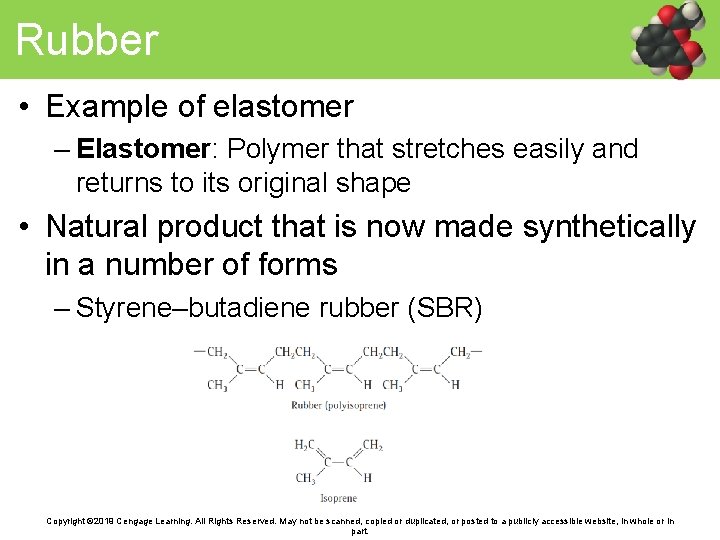
Rubber • Example of elastomer – Elastomer: Polymer that stretches easily and returns to its original shape • Natural product that is now made synthetically in a number of forms – Styrene–butadiene rubber (SBR) Copyright © 2019 Cengage Learning. All Rights Reserved. May not be scanned, copied or duplicated, or posted to a publicly accessible website, in whole or in part.
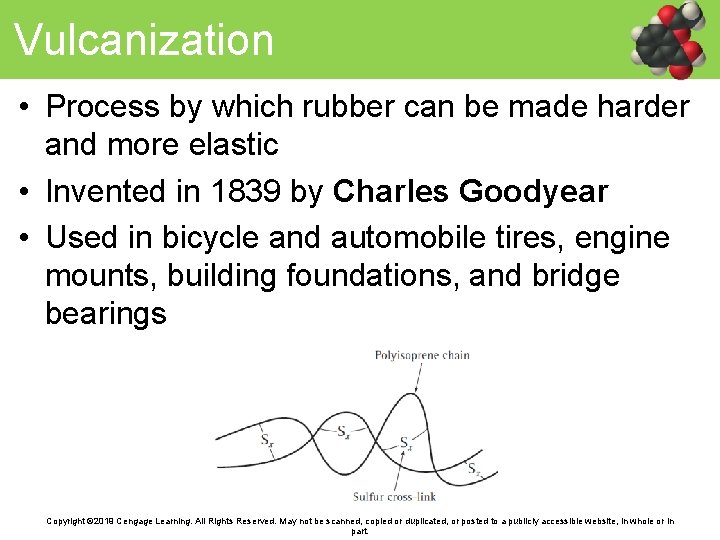
Vulcanization • Process by which rubber can be made harder and more elastic • Invented in 1839 by Charles Goodyear • Used in bicycle and automobile tires, engine mounts, building foundations, and bridge bearings Copyright © 2019 Cengage Learning. All Rights Reserved. May not be scanned, copied or duplicated, or posted to a publicly accessible website, in whole or in part.
Vulcanization (continued) • In this process, sulfur atoms form cross-links between the polyisoprene chains • These cross-links still allow the polymer chains to uncoil under stress, but the crosslinks force the chains to snap back to their original positions when the stress is released, even if the rubber is warm Copyright © 2019 Cengage Learning. All Rights Reserved. May not be scanned, copied or duplicated, or posted to a publicly accessible website, in whole or in part.
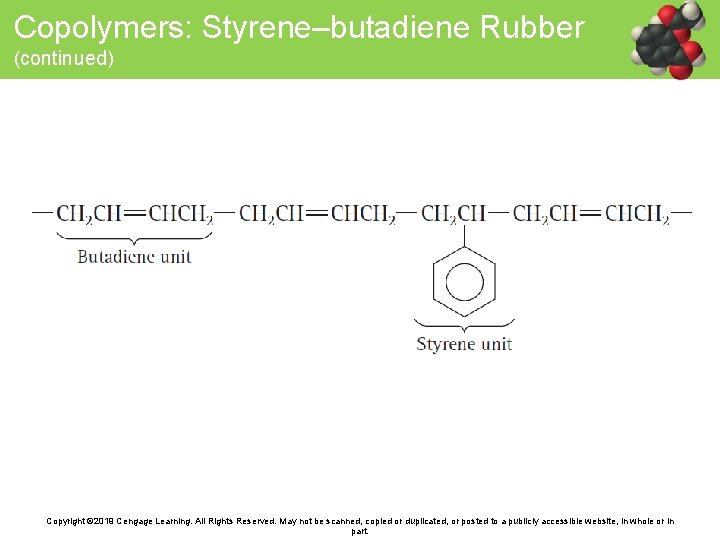
Copolymers: Styrene–Butadiene Rubber • Unlike many copolymers that must be combined in a 1: 1 ratio, SBR can be made with varying amounts of each of its constituents – Copolymer of styrene (25%) and butadiene (75%) • Used extensively to replace natural rubber in automobile tires • Ages better than natural rubber Copyright © 2019 Cengage Learning. All Rights Reserved. May not be scanned, copied or duplicated, or posted to a publicly accessible website, in whole or in part.
Copolymers: Styrene–butadiene Rubber (continued) Copyright © 2019 Cengage Learning. All Rights Reserved. May not be scanned, copied or duplicated, or posted to a publicly accessible website, in whole or in part.
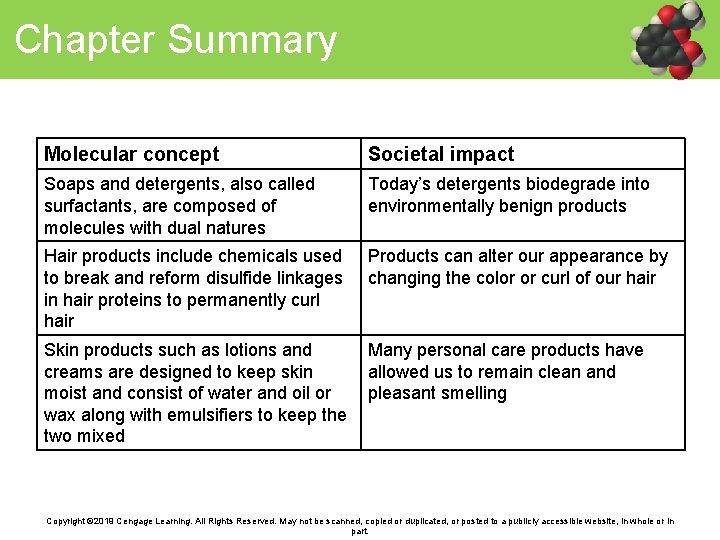
Chapter Summary Molecular concept Societal impact Soaps and detergents, also called surfactants, are composed of molecules with dual natures Today’s detergents biodegrade into environmentally benign products Hair products include chemicals used to break and reform disulfide linkages in hair proteins to permanently curl hair Products can alter our appearance by changing the color or curl of our hair Skin products such as lotions and creams are designed to keep skin moist and consist of water and oil or wax along with emulsifiers to keep the two mixed Many personal care products have allowed us to remain clean and pleasant smelling Copyright © 2019 Cengage Learning. All Rights Reserved. May not be scanned, copied or duplicated, or posted to a publicly accessible website, in whole or in part.