
Chapter 15 The Autonomic Nervous System 16 1


- Slides: 29
Chapter 15 The Autonomic Nervous System 16 -1
Autonomic Nervous System 16 -2
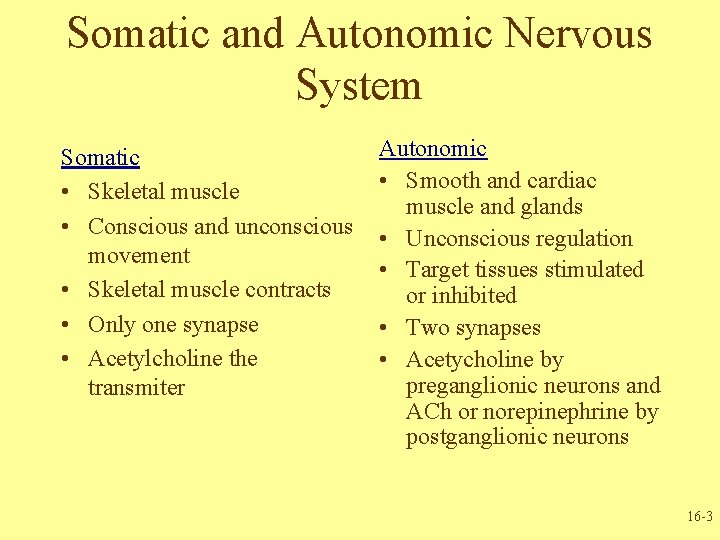
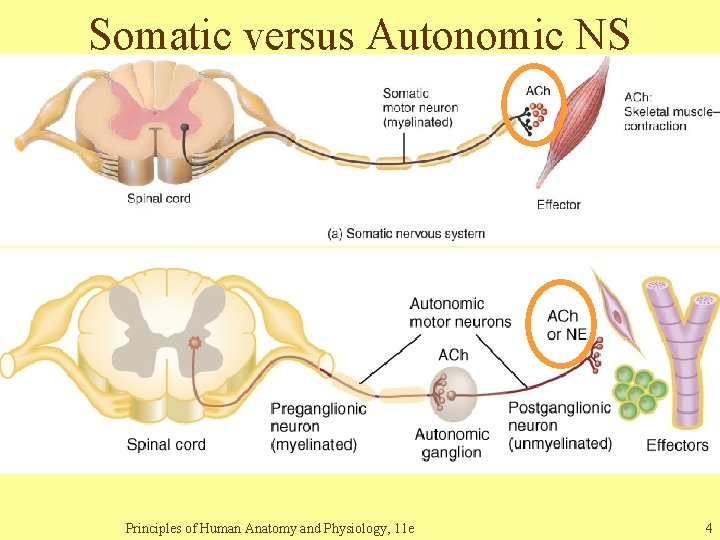
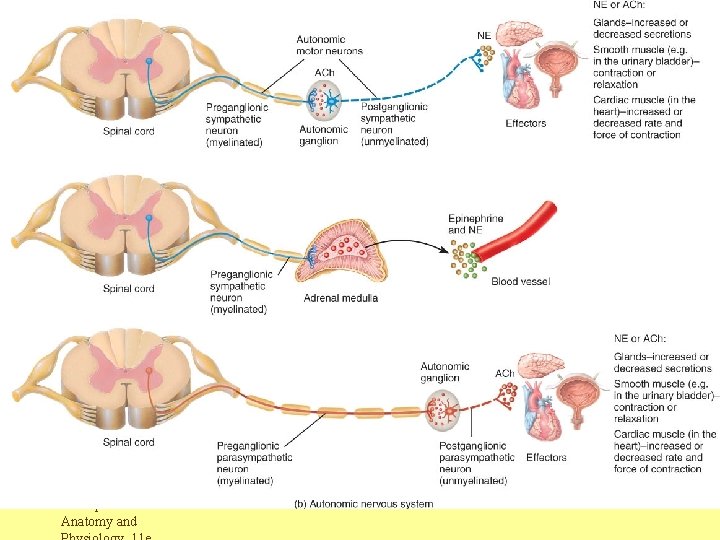
Somatic and Autonomic Nervous System Somatic • Skeletal muscle • Conscious and unconscious movement • Skeletal muscle contracts • Only one synapse • Acetylcholine the transmiter Autonomic • Smooth and cardiac muscle and glands • Unconscious regulation • Target tissues stimulated or inhibited • Two synapses • Acetycholine by preganglionic neurons and ACh or norepinephrine by postganglionic neurons 16 -3
Somatic versus Autonomic NS Principles of Human Anatomy and Physiology, 11 e 4
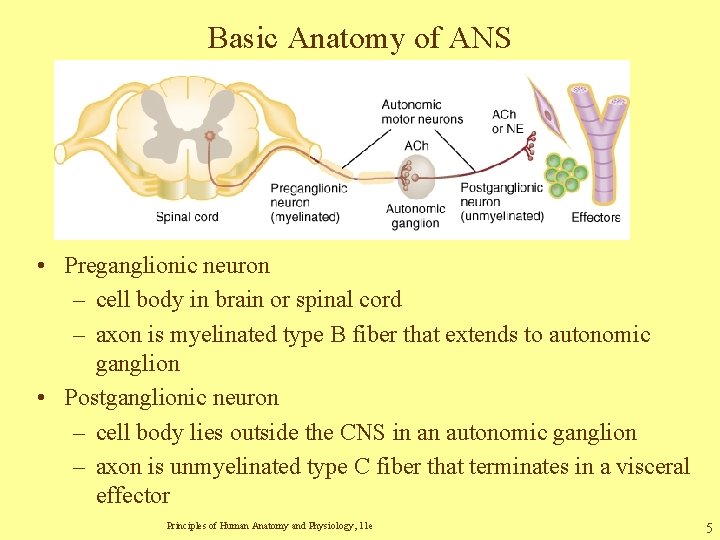
Basic Anatomy of ANS • Preganglionic neuron – cell body in brain or spinal cord – axon is myelinated type B fiber that extends to autonomic ganglion • Postganglionic neuron – cell body lies outside the CNS in an autonomic ganglion – axon is unmyelinated type C fiber that terminates in a visceral effector Principles of Human Anatomy and Physiology, 11 e 5
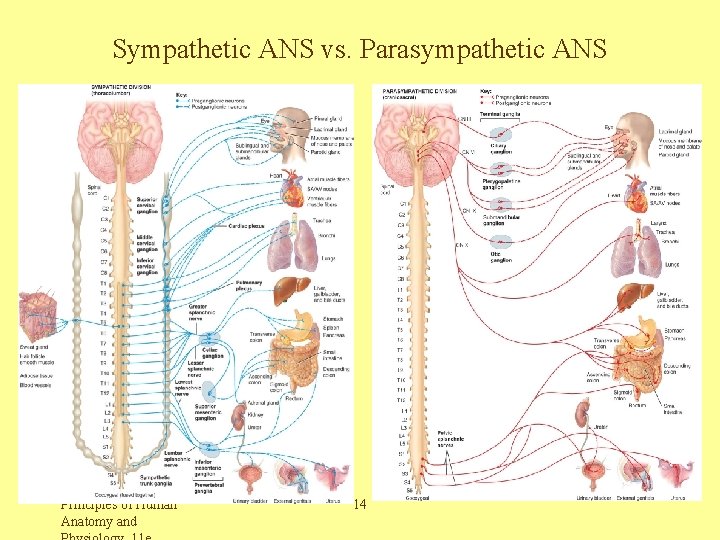
Sympathetic vs. Parasympathetic NS Principles of Human Anatomy and 6
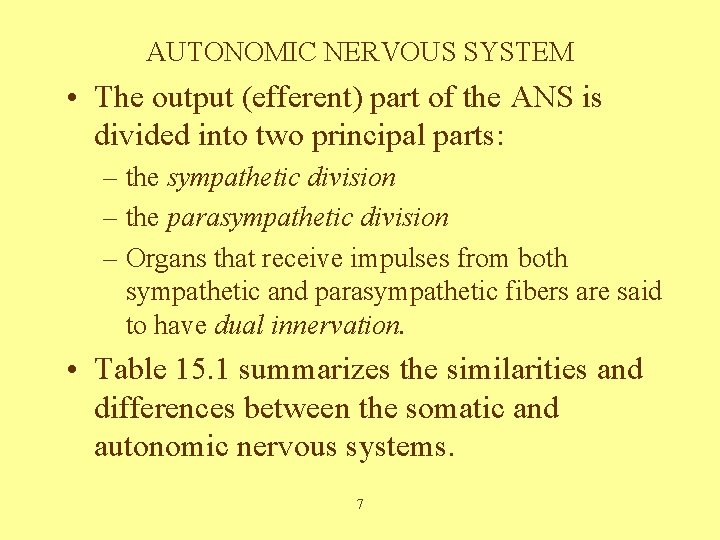
AUTONOMIC NERVOUS SYSTEM • The output (efferent) part of the ANS is divided into two principal parts: – the sympathetic division – the parasympathetic division – Organs that receive impulses from both sympathetic and parasympathetic fibers are said to have dual innervation. • Table 15. 1 summarizes the similarities and differences between the somatic and autonomic nervous systems. 7
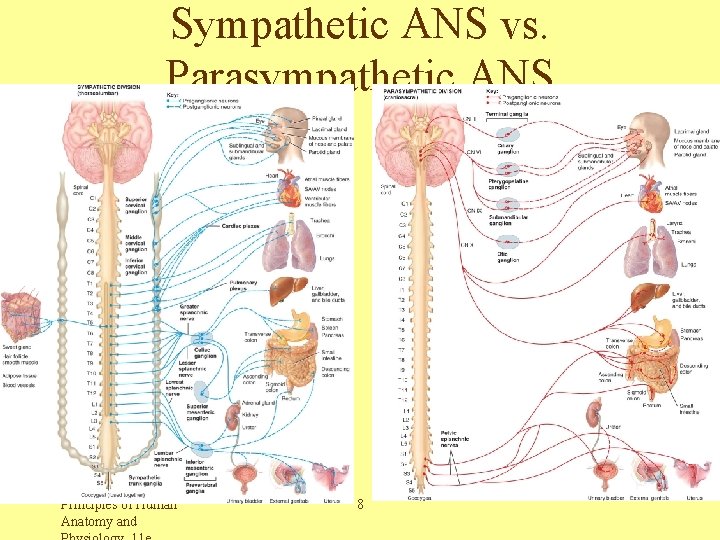
Sympathetic ANS vs. Parasympathetic ANS Principles of Human Anatomy and 8
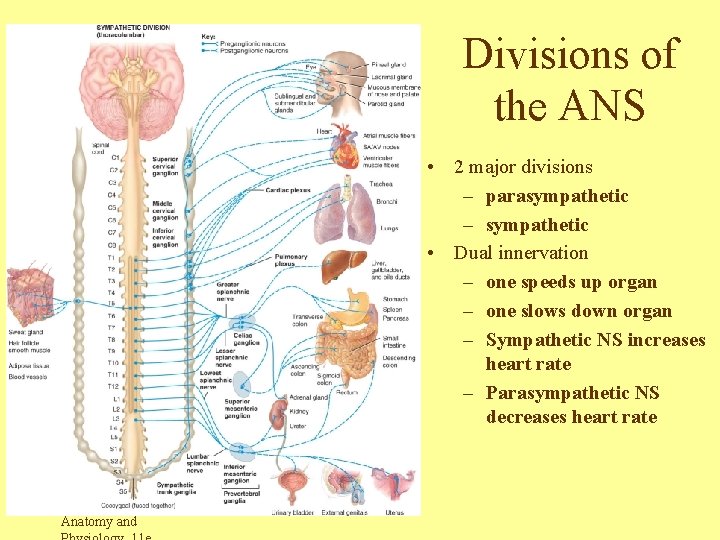
Divisions of the ANS • 2 major divisions – parasympathetic – sympathetic • Dual innervation – one speeds up organ – one slows down organ – Sympathetic NS increases heart rate – Parasympathetic NS decreases heart rate Principles of Human Anatomy and 9
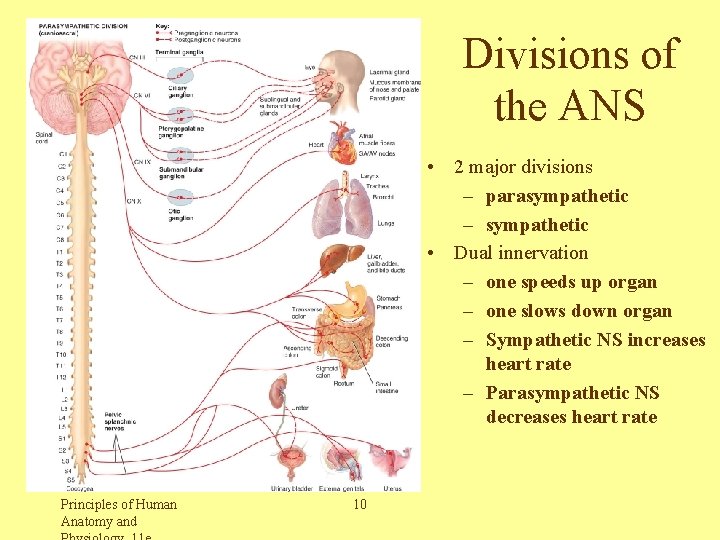
Divisions of the ANS • 2 major divisions – parasympathetic – sympathetic • Dual innervation – one speeds up organ – one slows down organ – Sympathetic NS increases heart rate – Parasympathetic NS decreases heart rate Principles of Human Anatomy and 10
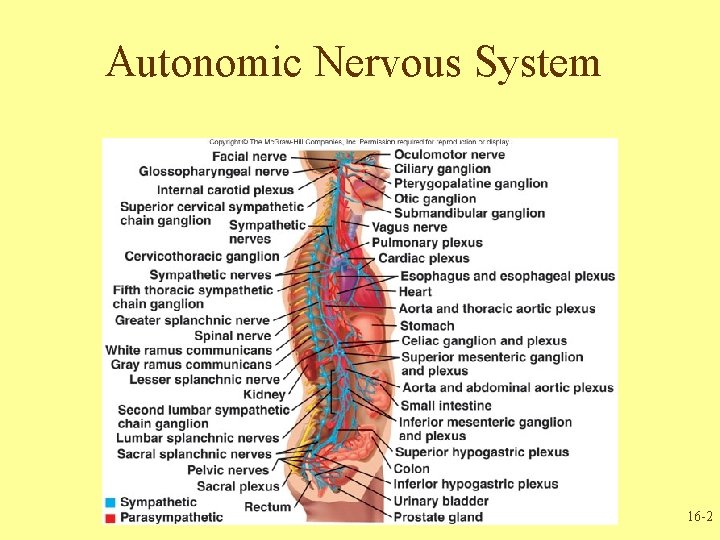
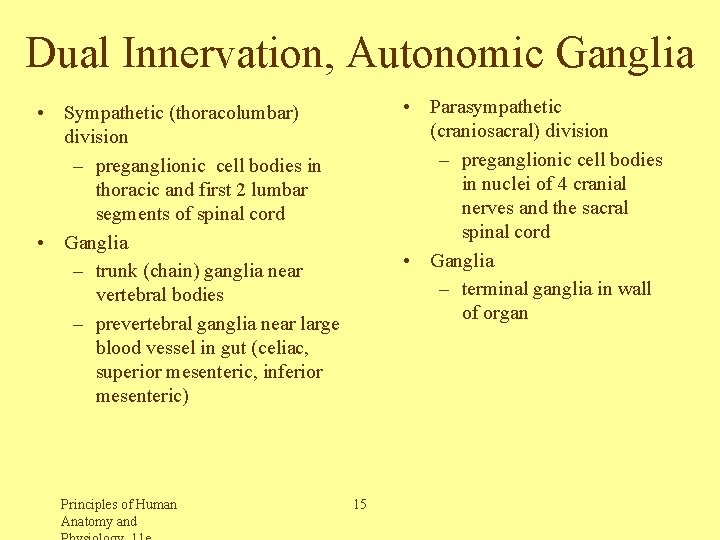
Sympathetic Ganglia • These ganglia include the sympathetic trunk or vertebral chain or paravertebral ganglia that lie in a vertical row on either side of the vertebral column • Other sympathetic ganglia are the prevertebral or collateral ganglia that lie anterior to the spinal column and close to large abdominal arteries. – celiac – superior mesenteric – inferior mesenteric ganglia 11
Parasympathetic Ganglia • Parasympathetic ganglia are the terminal or intramural ganglia that are located very close to or actually within the wall of a visceral organ. • Examples of terminal ganglia include – ciliary, – pterygopalatine, – submandibular, – otic ganglia Principles of Human Anatomy and 12
16 -13
Sympathetic ANS vs. Parasympathetic ANS Principles of Human Anatomy and 14
Dual Innervation, Autonomic Ganglia • Parasympathetic (craniosacral) division – preganglionic cell bodies in nuclei of 4 cranial nerves and the sacral spinal cord • Ganglia – terminal ganglia in wall of organ • Sympathetic (thoracolumbar) division – preganglionic cell bodies in thoracic and first 2 lumbar segments of spinal cord • Ganglia – trunk (chain) ganglia near vertebral bodies – prevertebral ganglia near large blood vessel in gut (celiac, superior mesenteric, inferior mesenteric) Principles of Human Anatomy and 15
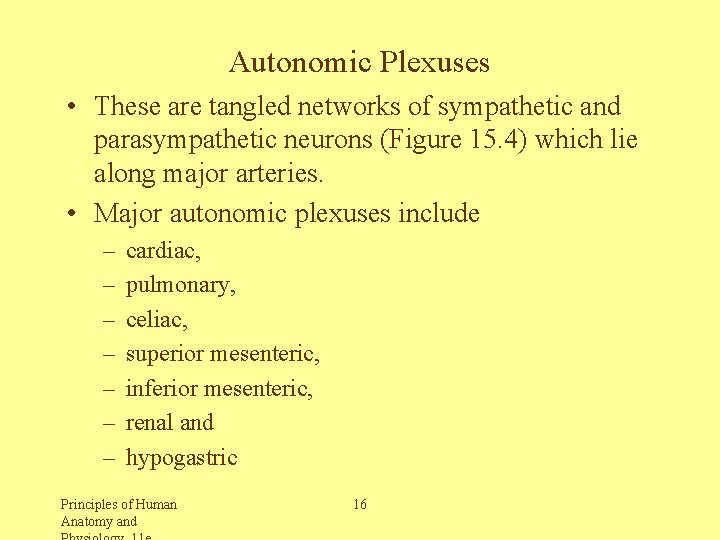
Autonomic Plexuses • These are tangled networks of sympathetic and parasympathetic neurons (Figure 15. 4) which lie along major arteries. • Major autonomic plexuses include – – – – cardiac, pulmonary, celiac, superior mesenteric, inferior mesenteric, renal and hypogastric Principles of Human Anatomy and 16
16 -17
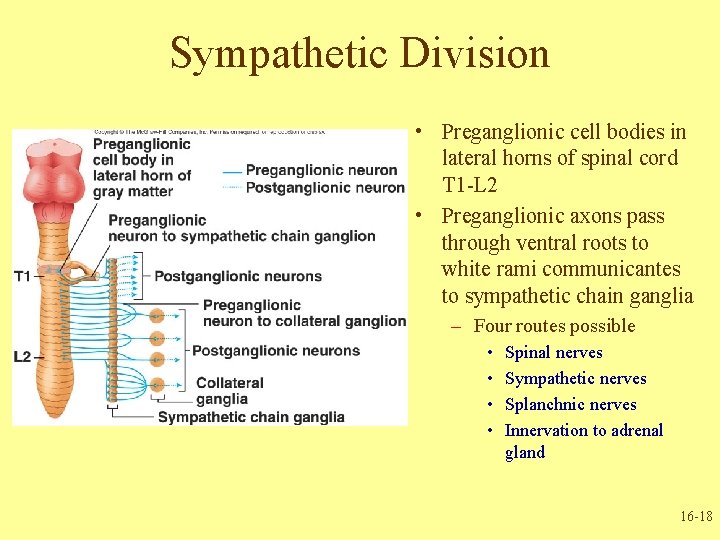
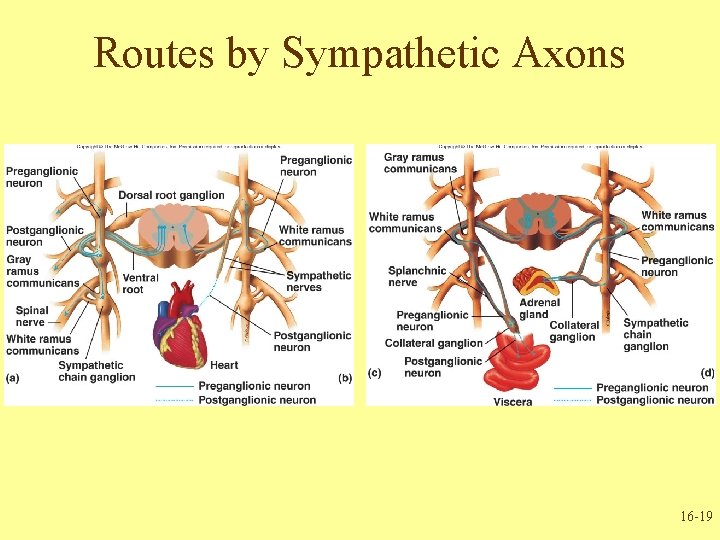
Sympathetic Division • Preganglionic cell bodies in lateral horns of spinal cord T 1 -L 2 • Preganglionic axons pass through ventral roots to white rami communicantes to sympathetic chain ganglia – Four routes possible • • Spinal nerves Sympathetic nerves Splanchnic nerves Innervation to adrenal gland 16 -18
Routes by Sympathetic Axons 16 -19
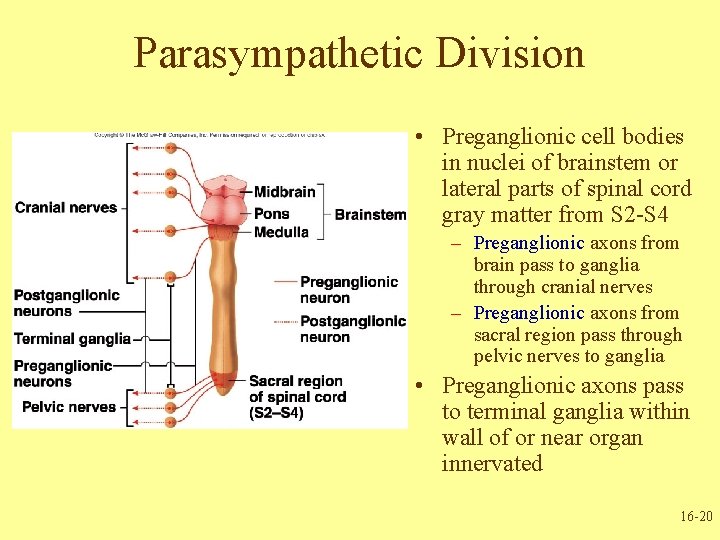
Parasympathetic Division • Preganglionic cell bodies in nuclei of brainstem or lateral parts of spinal cord gray matter from S 2 -S 4 – Preganglionic axons from brain pass to ganglia through cranial nerves – Preganglionic axons from sacral region pass through pelvic nerves to ganglia • Preganglionic axons pass to terminal ganglia within wall of or near organ innervated 16 -20
Enteric Nervous System • Consists of nerve plexuses within wall of digestive tract – Sources • Sensory neurons that connect the digestive tract to CNS • ANS motor neurons that connect CNS to digestive tract • Enteric neuron which are confined to enteric plexuses 16 -21
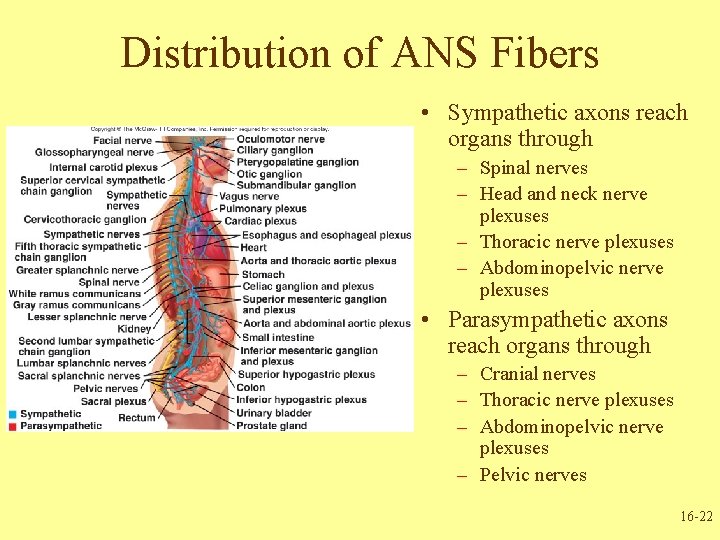
Distribution of ANS Fibers • Sympathetic axons reach organs through – Spinal nerves – Head and neck nerve plexuses – Thoracic nerve plexuses – Abdominopelvic nerve plexuses • Parasympathetic axons reach organs through – Cranial nerves – Thoracic nerve plexuses – Abdominopelvic nerve plexuses – Pelvic nerves 16 -22
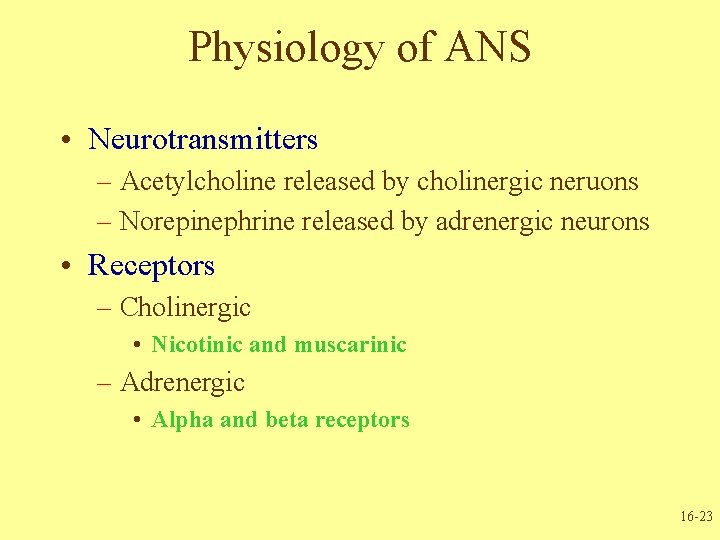
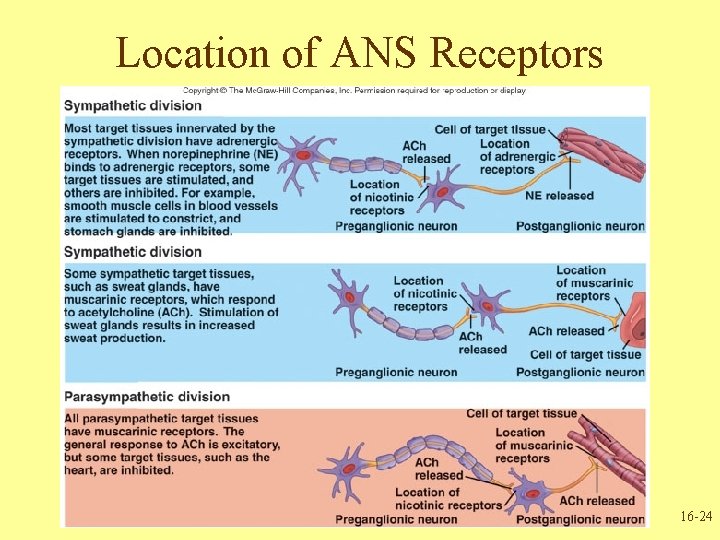
Physiology of ANS • Neurotransmitters – Acetylcholine released by cholinergic neruons – Norepinephrine released by adrenergic neurons • Receptors – Cholinergic • Nicotinic and muscarinic – Adrenergic • Alpha and beta receptors 16 -23
Location of ANS Receptors 16 -24
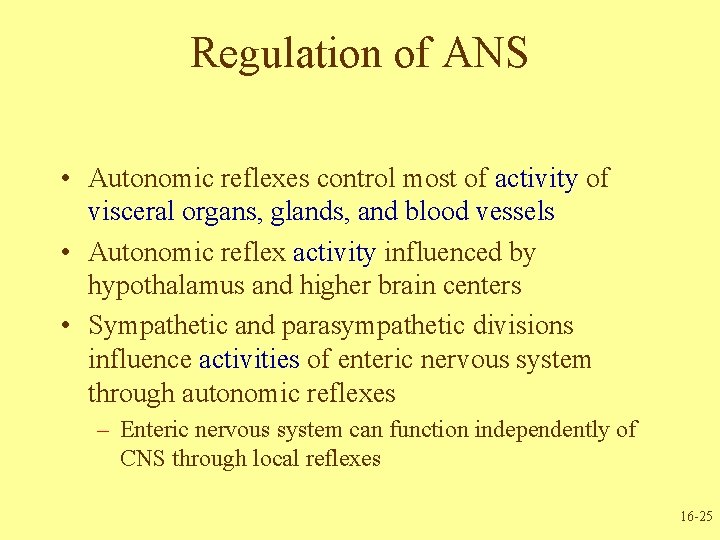
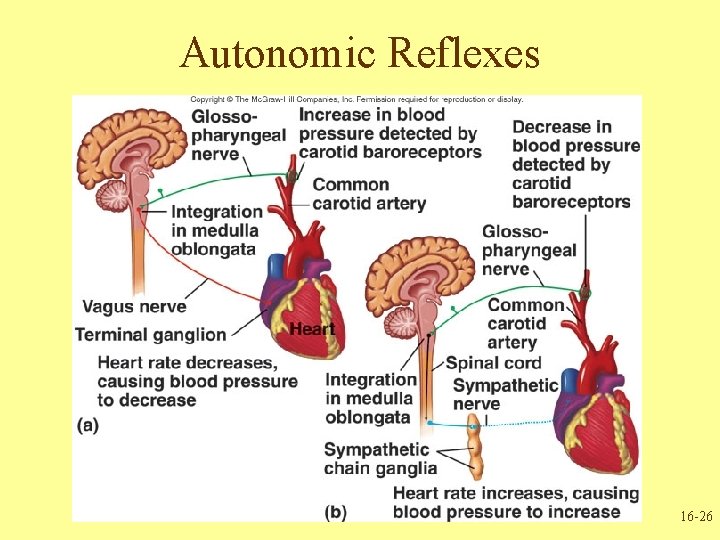
Regulation of ANS • Autonomic reflexes control most of activity of visceral organs, glands, and blood vessels • Autonomic reflex activity influenced by hypothalamus and higher brain centers • Sympathetic and parasympathetic divisions influence activities of enteric nervous system through autonomic reflexes – Enteric nervous system can function independently of CNS through local reflexes 16 -25
Autonomic Reflexes 16 -26
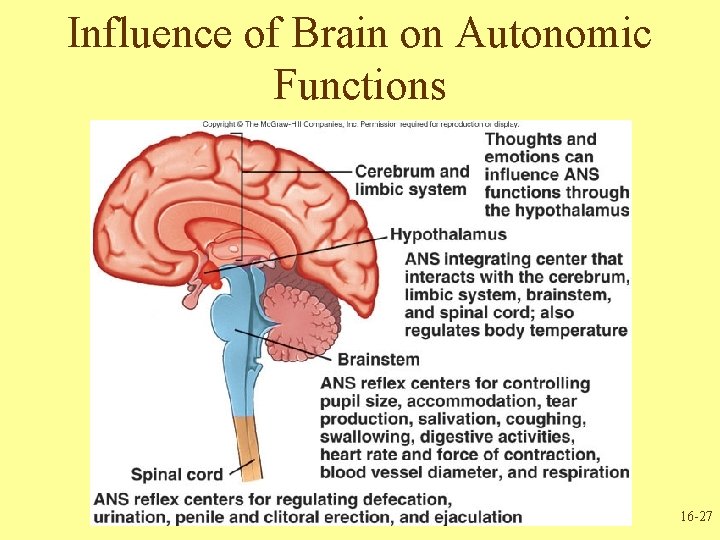
Influence of Brain on Autonomic Functions 16 -27
Functional Generalizations of ANS • Stimulatory versus inhibitory effects – Both divisions of ANS • Dual innervation – Most organs innervated by both • Either division alone or both working together can coordinate activities of different structures • Sympathetic produces more generalized effects – Prepares body for physical activity or flight-or-fight response • Parasympathetic more important for resting conditions – SLUDD: Salivation, lacrimation, urination, digestion, defecation 16 -28
“Fight-or-Flight” Responses • Increased heart rate and force • Blood vessel dilation in skeletal and cardiac muscles • Dilation of air passageways • Energy sources availability increased – Glycogen to glucose – Fat cells break down triglycerides • Muscles generate heat, body temperature increases • Sweat gland activity increases • Decrease in nonessential organ activities 16 -29