
CHAPTER 15 Suggestions for Case Analysis STRATEGIC MANAGEMENT
![Index of Sustainable Growth g*= [ p (1 – D) (1 + L)] /](https://slidetodoc.com/presentation_image_h/17413a67fa5a549592cd8fcc5f69b254/image-19.jpg "Index of Sustainable Growth g*= [ p (1 – D) (1 + L)] /")
- Slides: 21
CHAPTER 15 Suggestions for Case Analysis STRATEGIC MANAGEMENT & BUSINESS POLICY 10 TH EDITION THOMAS L. WHEELEN Prentice Hall, Inc. © 2006 J. DAVID HUNGER 15 -1
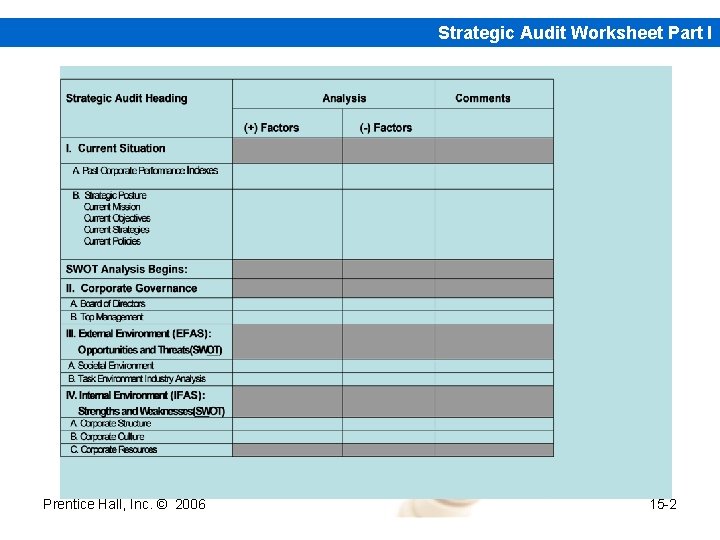
Strategic Audit Worksheet Part I Prentice Hall, Inc. © 2006 15 -2
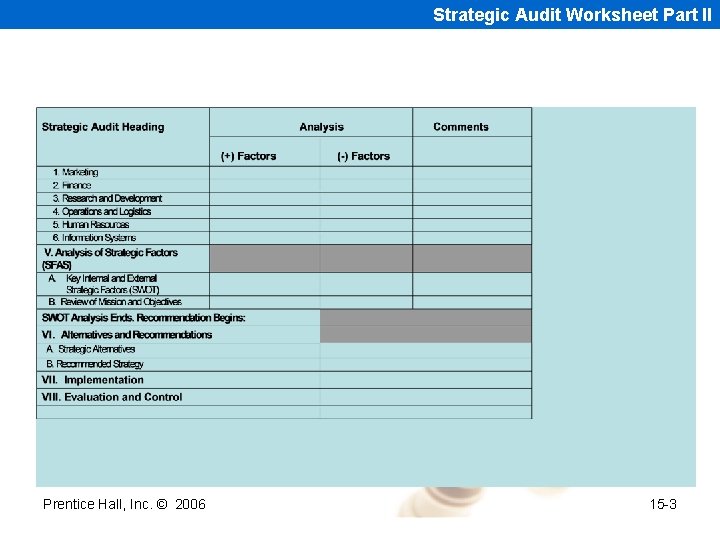
Strategic Audit Worksheet Part II Prentice Hall, Inc. © 2006 15 -3
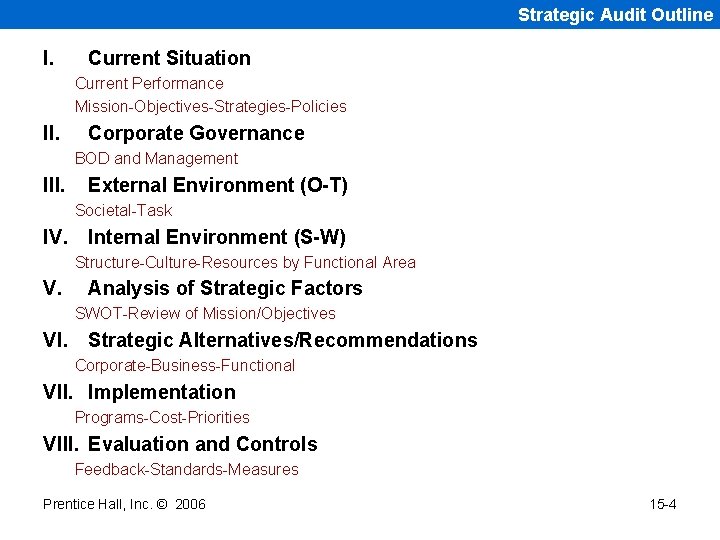
Strategic Audit Outline I. Current Situation Current Performance Mission-Objectives-Strategies-Policies II. Corporate Governance BOD and Management III. External Environment (O-T) Societal-Task IV. Internal Environment (S-W) Structure-Culture-Resources by Functional Area V. Analysis of Strategic Factors SWOT-Review of Mission/Objectives VI. Strategic Alternatives/Recommendations Corporate-Business-Functional VII. Implementation Programs-Cost-Priorities VIII. Evaluation and Controls Feedback-Standards-Measures Prentice Hall, Inc. © 2006 15 -4
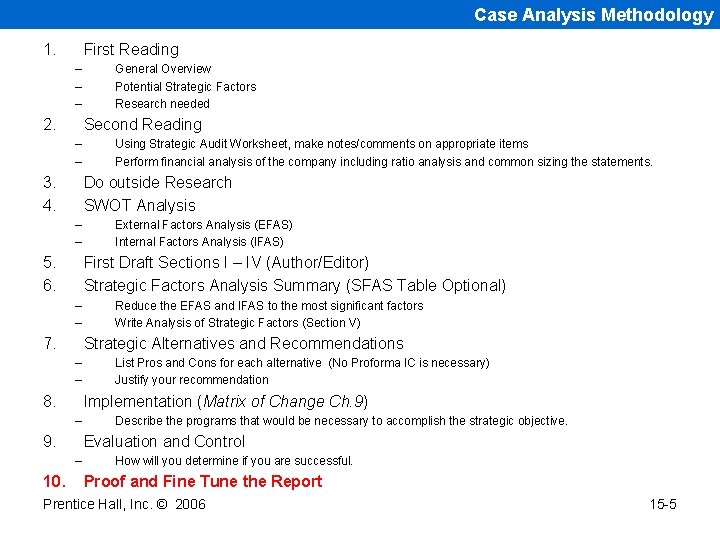
Case Analysis Methodology 1. First Reading – – – 2. Second Reading – – 3. 4. Using Strategic Audit Worksheet, make notes/comments on appropriate items Perform financial analysis of the company including ratio analysis and common sizing the statements. Do outside Research SWOT Analysis – – 5. 6. External Factors Analysis (EFAS) Internal Factors Analysis (IFAS) First Draft Sections I – IV (Author/Editor) Strategic Factors Analysis Summary (SFAS Table Optional) – – 7. Reduce the EFAS and IFAS to the most significant factors Write Analysis of Strategic Factors (Section V) Strategic Alternatives and Recommendations – – 8. List Pros and Cons for each alternative (No Proforma IC is necessary) Justify your recommendation Implementation (Matrix of Change Ch. 9) – 9. Describe the programs that would be necessary to accomplish the strategic objective. Evaluation and Control – 10. General Overview Potential Strategic Factors Research needed How will you determine if you are successful. Proof and Fine Tune the Report Prentice Hall, Inc. © 2006 15 -5
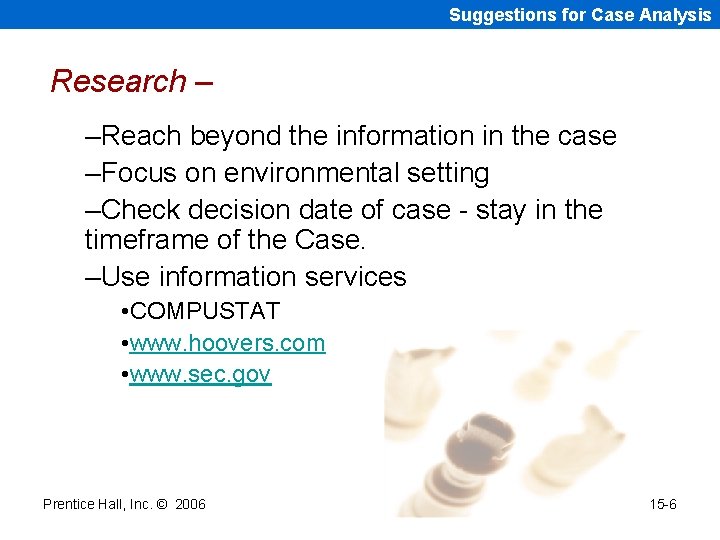
Suggestions for Case Analysis Research – –Reach beyond the information in the case –Focus on environmental setting –Check decision date of case - stay in the timeframe of the Case. –Use information services • COMPUSTAT • www. hoovers. com • www. sec. gov Prentice Hall, Inc. © 2006 15 -6
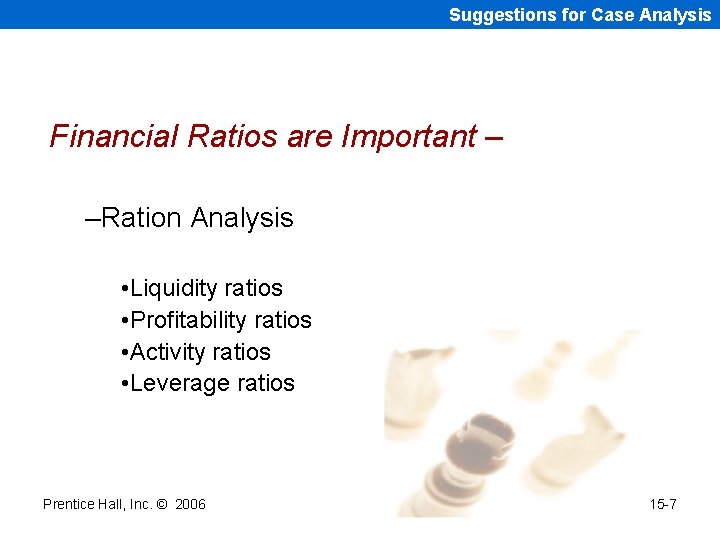
Suggestions for Case Analysis Financial Ratios are Important – –Ration Analysis • Liquidity ratios • Profitability ratios • Activity ratios • Leverage ratios Prentice Hall, Inc. © 2006 15 -7
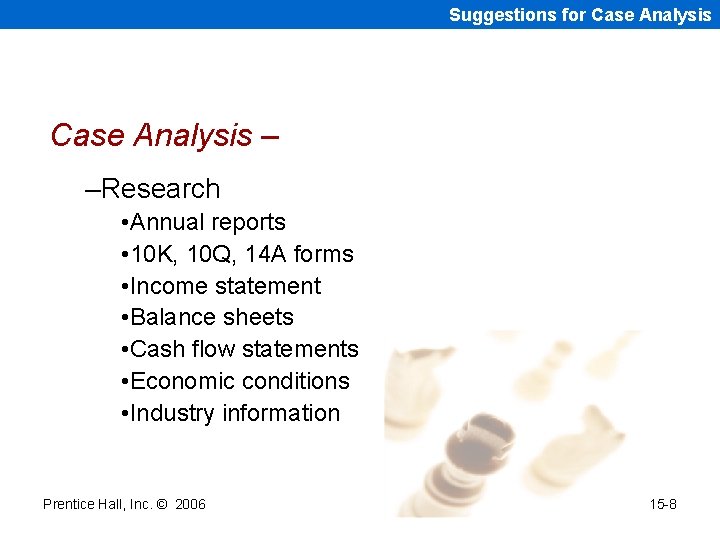
Suggestions for Case Analysis – –Research • Annual reports • 10 K, 10 Q, 14 A forms • Income statement • Balance sheets • Cash flow statements • Economic conditions • Industry information Prentice Hall, Inc. © 2006 15 -8
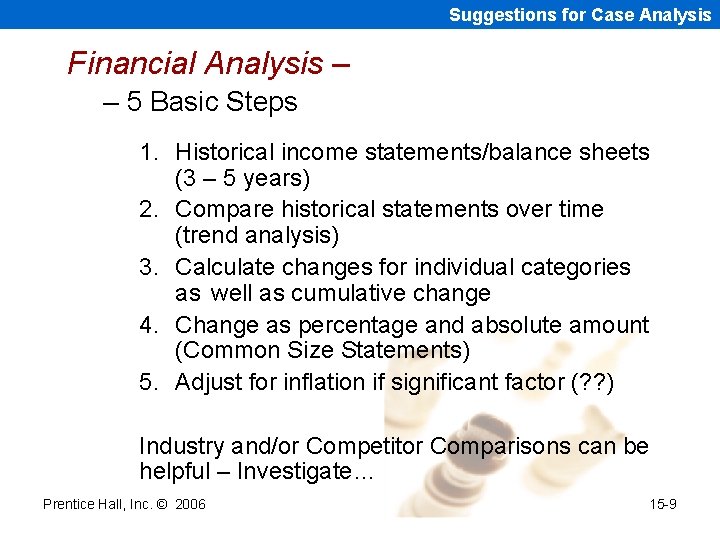
Suggestions for Case Analysis Financial Analysis – – 5 Basic Steps 1. Historical income statements/balance sheets (3 – 5 years) 2. Compare historical statements over time (trend analysis) 3. Calculate changes for individual categories as well as cumulative change 4. Change as percentage and absolute amount (Common Size Statements) 5. Adjust for inflation if significant factor (? ? ) Industry and/or Competitor Comparisons can be helpful – Investigate… Prentice Hall, Inc. © 2006 15 -9
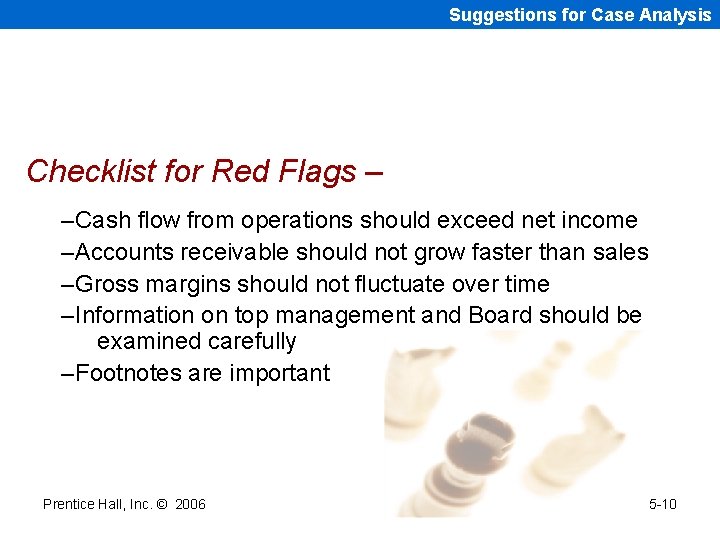
Suggestions for Case Analysis Checklist for Red Flags – –Cash flow from operations should exceed net income –Accounts receivable should not grow faster than sales –Gross margins should not fluctuate over time –Information on top management and Board should be examined carefully –Footnotes are important Prentice Hall, Inc. © 2006 15 -10
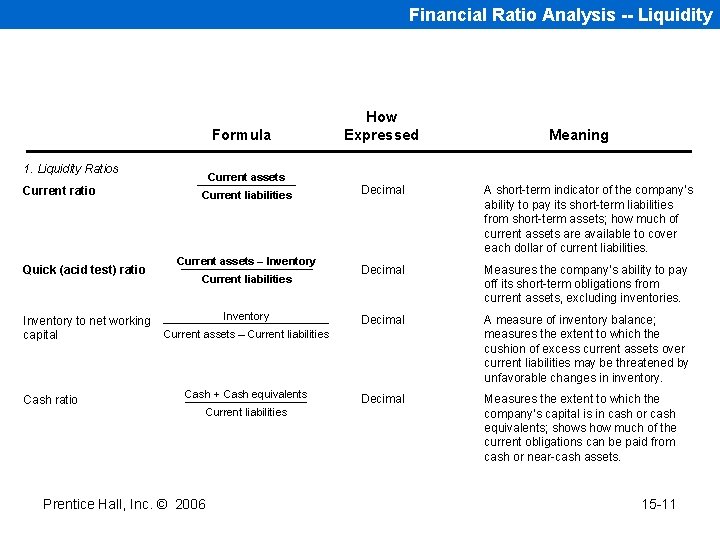
Financial Ratio Analysis -- Liquidity Formula 1. Liquidity Ratios Current ratio Quick (acid test) ratio Meaning Current assets ————— Current liabilities Decimal A short-term indicator of the company’s ability to pay its short-term liabilities from short-term assets; how much of current assets are available to cover each dollar of current liabilities. Current assets – Inventory —————— Current liabilities Decimal Measures the company’s ability to pay off its short-term obligations from current assets, excluding inventories. Decimal A measure of inventory balance; measures the extent to which the cushion of excess current assets over current liabilities may be threatened by unfavorable changes in inventory. Decimal Measures the extent to which the company’s capital is in cash or cash equivalents; shows how much of the current obligations can be paid from cash or near-cash assets. Inventory to net working ———————— Current assets – Current liabilities capital Cash ratio How Expressed Cash + Cash equivalents —————— Current liabilities Prentice Hall, Inc. © 2006 15 -11
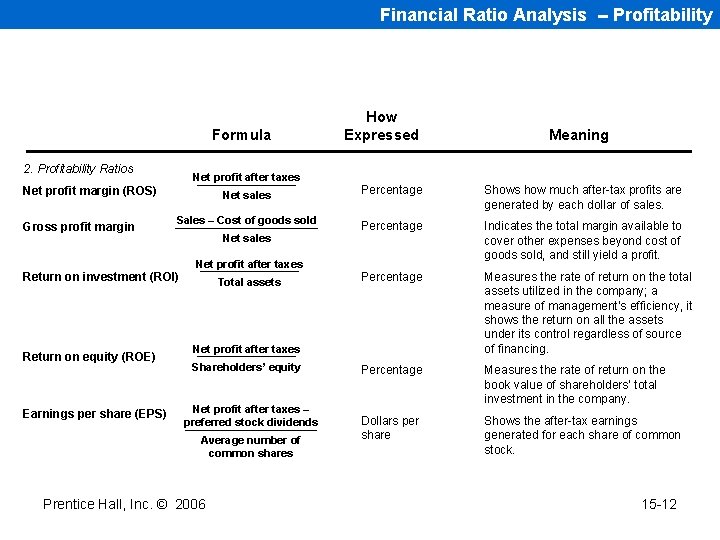
Financial Ratio Analysis -- Profitability Formula 2. Profitability Ratios Percentage Shows how much after-tax profits are generated by each dollar of sales. Sales – Cost of goods sold ——————— Net sales Percentage Net profit after taxes ————— Total assets Indicates the total margin available to cover other expenses beyond cost of goods sold, and still yield a profit. Percentage Net profit after taxes ————— Shareholders’ equity Measures the rate of return on the total assets utilized in the company; a measure of management’s efficiency, it shows the return on all the assets under its control regardless of source of financing. Percentage Measures the rate of return on the book value of shareholders’ total investment in the company. Dollars per share Shows the after-tax earnings generated for each share of common stock. Return on investment (ROI) Return on equity (ROE) Earnings per share (EPS) Meaning Net profit after taxes ————— Net sales Net profit margin (ROS) Gross profit margin How Expressed Net profit after taxes – preferred stock dividends —————— Average number of common shares Prentice Hall, Inc. © 2006 15 -12
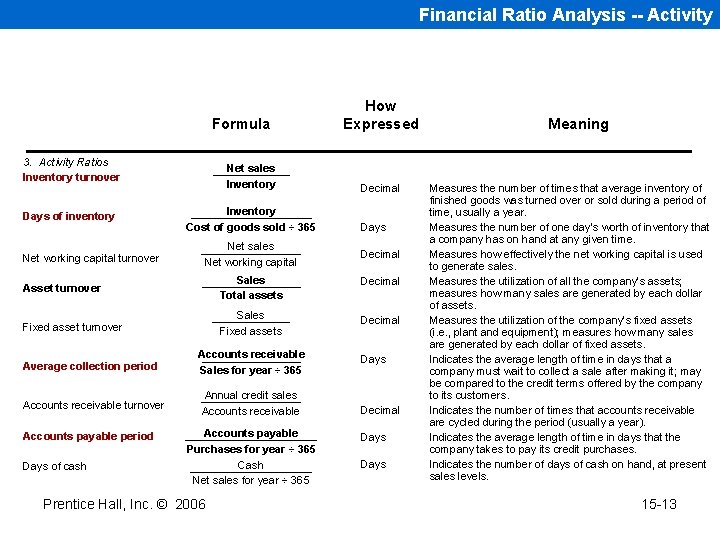
Financial Ratio Analysis -- Activity Formula 3. Activity Ratios Inventory turnover Days of inventory Net sales ——————— Inventory —————— Cost of goods sold ÷ 365 How Expressed Decimal Days Net working capital turnover Net sales ————— Net working capital Asset turnover Sales ————— Total assets Decimal Sales ——————— Fixed assets Decimal Fixed asset turnover Average collection period Accounts receivable turnover Accounts payable period Days of cash Accounts receivable ————— Sales for year ÷ 365 Annual credit sales ————— Accounts receivable Accounts payable —————— Purchases for year ÷ 365 Cash —————— Net sales for year ÷ 365 Prentice Hall, Inc. © 2006 Decimal Days Meaning Measures the number of times that average inventory of finished goods was turned over or sold during a period of time, usually a year. Measures the number of one day’s worth of inventory that a company has on hand at any given time. Measures how effectively the net working capital is used to generate sales. Measures the utilization of all the company’s assets; measures how many sales are generated by each dollar of assets. Measures the utilization of the company’s fixed assets (i. e. , plant and equipment); measures how many sales are generated by each dollar of fixed assets. Indicates the average length of time in days that a company must wait to collect a sale after making it; may be compared to the credit terms offered by the company to its customers. Indicates the number of times that accounts receivable are cycled during the period (usually a year). Indicates the average length of time in days that the company takes to pay its credit purchases. Indicates the number of days of cash on hand, at present sales levels. 15 -13
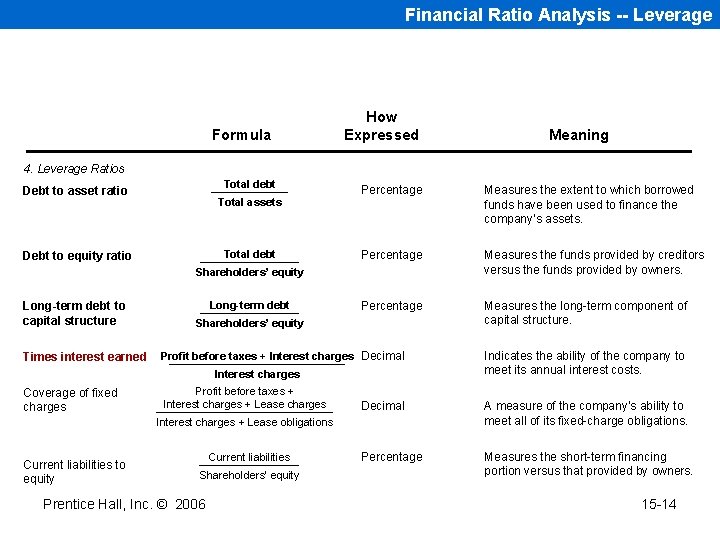
Financial Ratio Analysis -- Leverage Formula How Expressed Meaning 4. Leverage Ratios Total debt ——————— Total assets Percentage Measures the extent to which borrowed funds have been used to finance the company’s assets. Debt to equity ratio Total debt ————— Shareholders’ equity Percentage Measures the funds provided by creditors versus the funds provided by owners. Long-term debt to capital structure Long-term debt ————— Shareholders’ equity Percentage Measures the long-term component of capital structure. Debt to asset ratio Times interest earned Coverage of fixed charges Current liabilities to equity Profit before taxes + Interest charges Decimal ———————— Interest charges Profit before taxes + Interest charges + Lease charges ———————— Interest charges + Lease obligations Current liabilities ————— Shareholders’ equity Prentice Hall, Inc. © 2006 Indicates the ability of the company to meet its annual interest costs. Decimal A measure of the company’s ability to meet all of its fixed-charge obligations. Percentage Measures the short-term financing portion versus that provided by owners. 15 -14
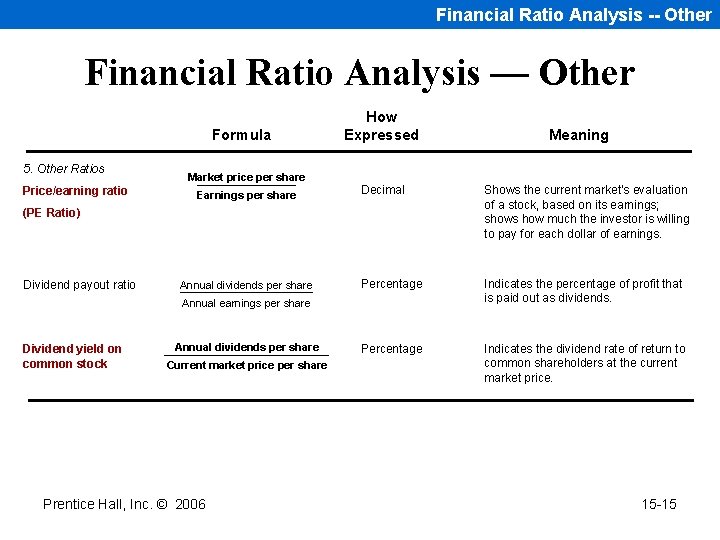
Financial Ratio Analysis -- Other Financial Ratio Analysis — Other Formula 5. Other Ratios Price/earning ratio Market price per share ————— Earnings per share How Expressed Decimal Shows the current market’s evaluation of a stock, based on its earnings; shows how much the investor is willing to pay for each dollar of earnings. Annual dividends per share —————— Annual earnings per share Percentage Indicates the percentage of profit that is paid out as dividends. Annual dividends per share ———————— Current market price per share Percentage Indicates the dividend rate of return to common shareholders at the current market price. (PE Ratio) Dividend payout ratio Dividend yield on common stock Meaning Prentice Hall, Inc. © 2006 15 -15
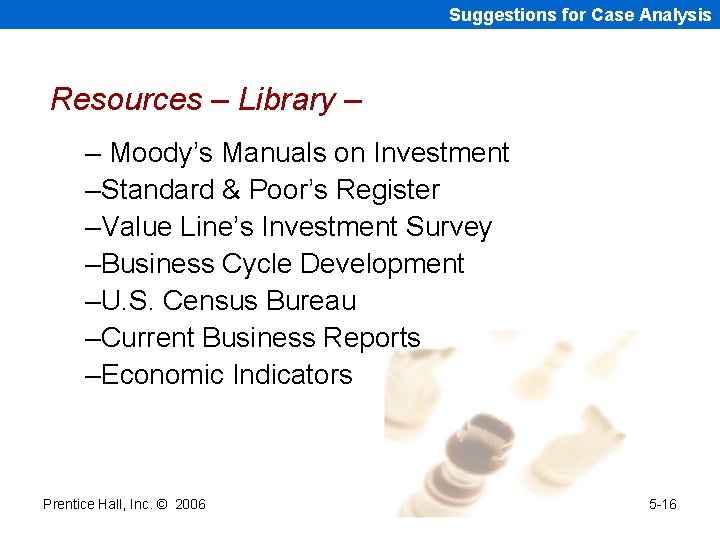
Suggestions for Case Analysis Resources – Library – – Moody’s Manuals on Investment –Standard & Poor’s Register –Value Line’s Investment Survey –Business Cycle Development –U. S. Census Bureau –Current Business Reports –Economic Indicators Prentice Hall, Inc. © 2006 15 -16
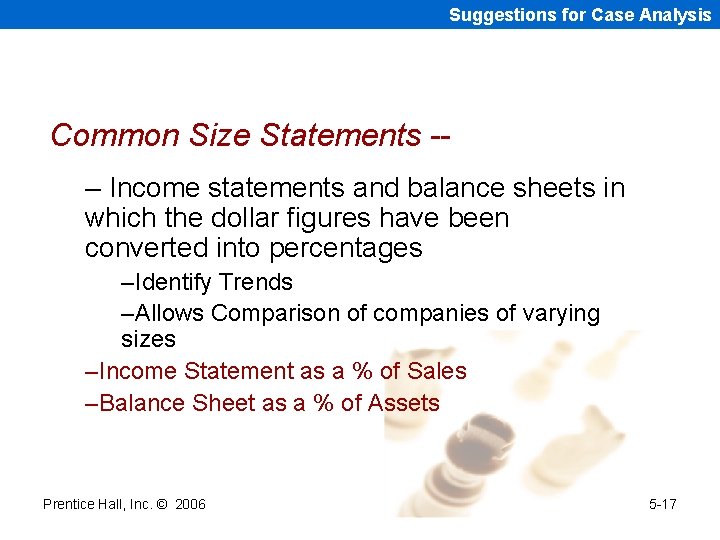
Suggestions for Case Analysis Common Size Statements -– Income statements and balance sheets in which the dollar figures have been converted into percentages –Identify Trends –Allows Comparison of companies of varying sizes –Income Statement as a % of Sales –Balance Sheet as a % of Assets Prentice Hall, Inc. © 2006 15 -17
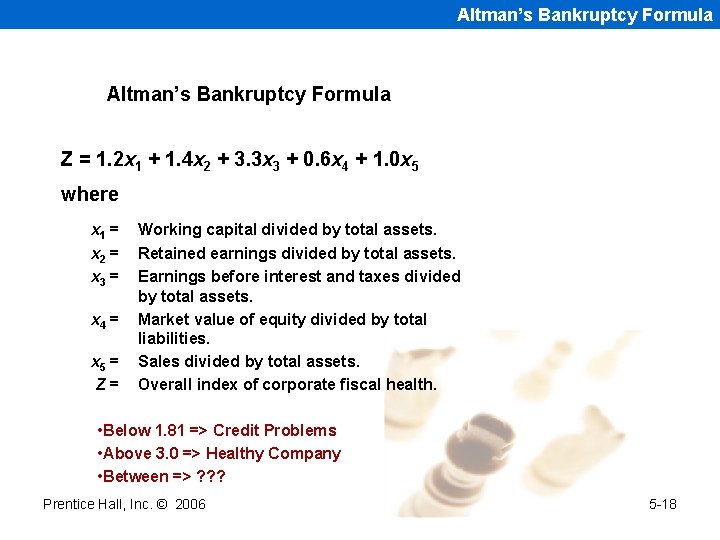
Altman’s Bankruptcy Formula Z = 1. 2 x 1 + 1. 4 x 2 + 3. 3 x 3 + 0. 6 x 4 + 1. 0 x 5 where x 1 = x 2 = x 3 = x 4 = x 5 = Z= Working capital divided by total assets. Retained earnings divided by total assets. Earnings before interest and taxes divided by total assets. Market value of equity divided by total liabilities. Sales divided by total assets. Overall index of corporate fiscal health. • Below 1. 81 => Credit Problems • Above 3. 0 => Healthy Company • Between => ? ? ? Prentice Hall, Inc. © 2006 15 -18
Index of Sustainable Growth g*= [ p (1 – D) (1 + L)] / [T – P (1 – D) (1+L)] where P = (Net profit before taxes/net sales) x 100 D = Target dividends/profit after tax L = Total liabilities/net worth T = (Total assets/net sales) x 100 If planned growth is greater than g* than external capital will be needed. Prentice Hall, Inc. © 2006 15 -19
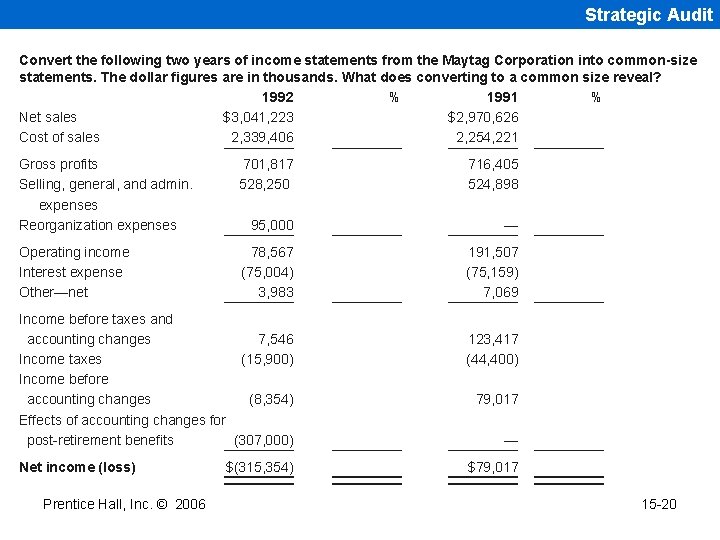
Strategic Audit Convert the following two years of income statements from the Maytag Corporation into common-size statements. The dollar figures are in thousands. What does converting to a common size reveal? 1992 % 1991 % Net sales $3, 041, 223 $2, 970, 626 Cost of sales 2, 339, 406 2, 254, 221 ————— Gross profits 701, 817 716, 405 Selling, general, and admin. 528, 250 524, 898 expenses Reorganization expenses 95, 000 — ————— Operating income 78, 567 191, 507 Interest expense (75, 004) (75, 159) Other—net 3, 983 7, 069 ————— Income before taxes and accounting changes 7, 546 123, 417 Income taxes (15, 900) (44, 400) Income before accounting changes (8, 354) 79, 017 Effects of accounting changes for post-retirement benefits (307, 000) — ————— Net income (loss) $(315, 354) $79, 017 ————— ————— Prentice Hall, Inc. © 2006 15 -20
CHAPTER 15 Suggestions for Case Analysis STRATEGIC MANAGEMENT & BUSINESS POLICY 10 TH EDITION THOMAS L. WHEELEN Prentice Hall, Inc. © 2006 J. DAVID HUNGER 15 -21