
Chapter 15 Sound Properties of Sound Section 15
- Slides: 59
Chapter 15 Sound
Properties of Sound Section 15. 1 Objectives • Explain how sound waves are transmitted through the air. • Relate the physical properties of sound waves to our perception of sound. • Use the Doppler effect to explain changes in pitch as objects move toward and away from you.
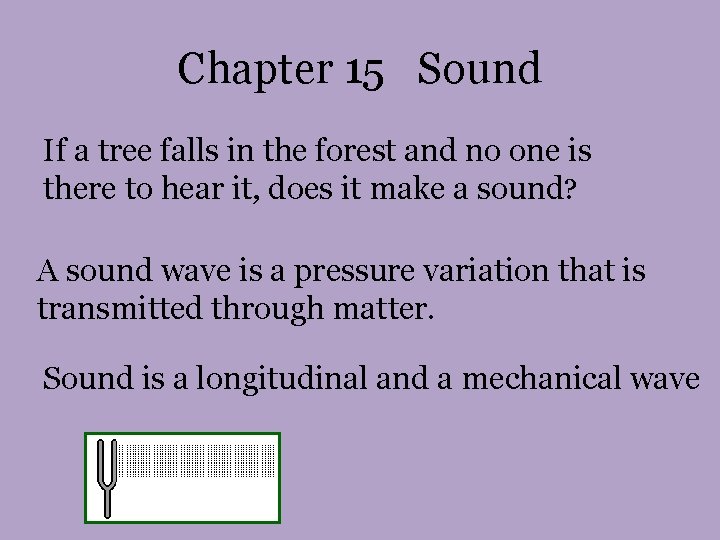
Chapter 15 Sound If a tree falls in the forest and no one is there to hear it, does it make a sound? A sound wave is a pressure variation that is transmitted through matter. Sound is a longitudinal and a mechanical wave
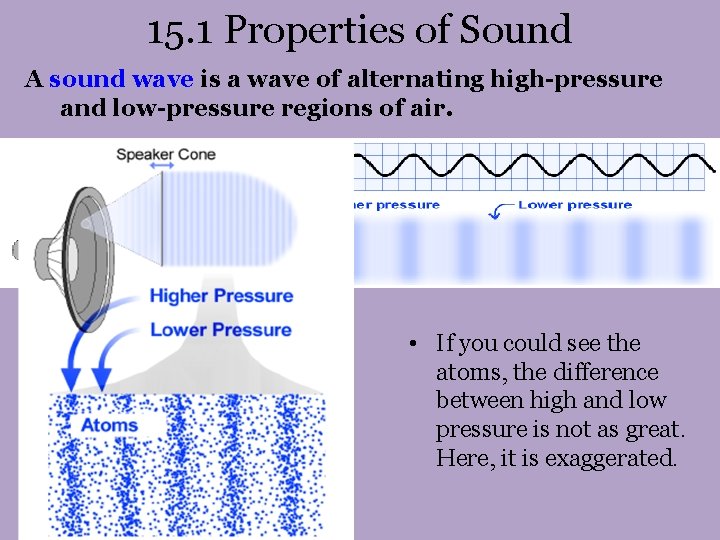
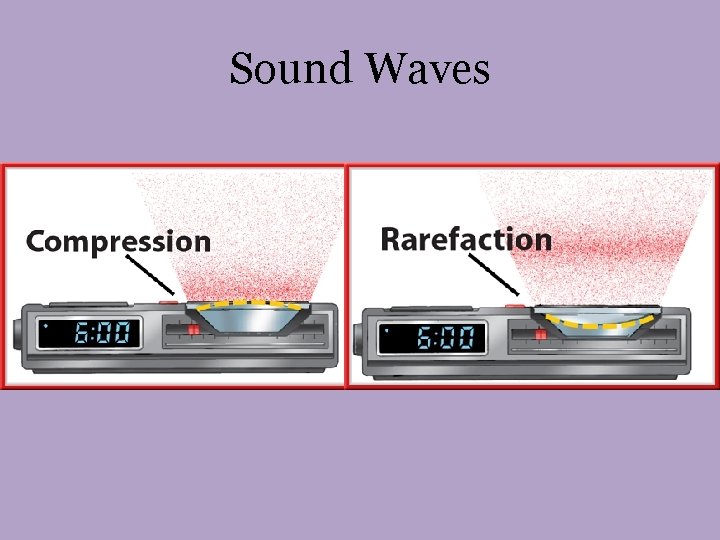
15. 1 Properties of Sound A sound wave is a wave of alternating high-pressure and low-pressure regions of air. • If you could see the atoms, the difference between high and low pressure is not as great. Here, it is exaggerated.
Sound Waves
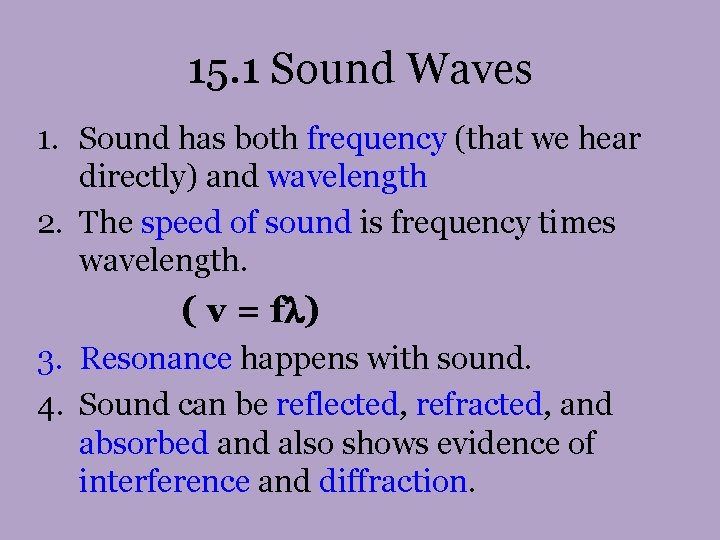
15. 1 Sound Waves 1. Sound has both frequency (that we hear directly) and wavelength 2. The speed of sound is frequency times wavelength. ( v = f ) 3. Resonance happens with sound. 4. Sound can be reflected, refracted, and absorbed and also shows evidence of interference and diffraction.
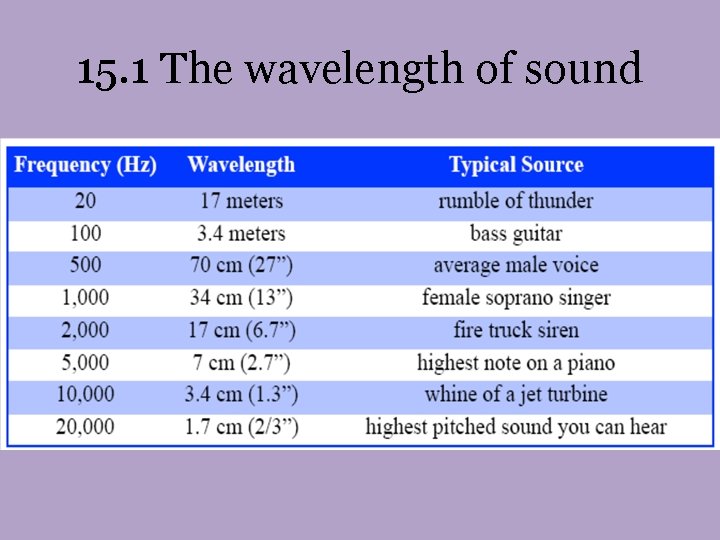
15. 1 The wavelength of sound
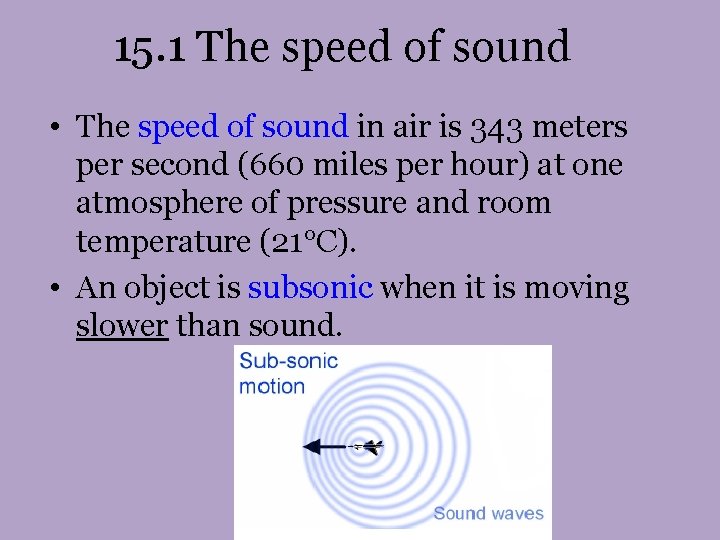
15. 1 The speed of sound • The speed of sound in air is 343 meters per second (660 miles per hour) at one atmosphere of pressure and room temperature (21°C). • An object is subsonic when it is moving slower than sound.
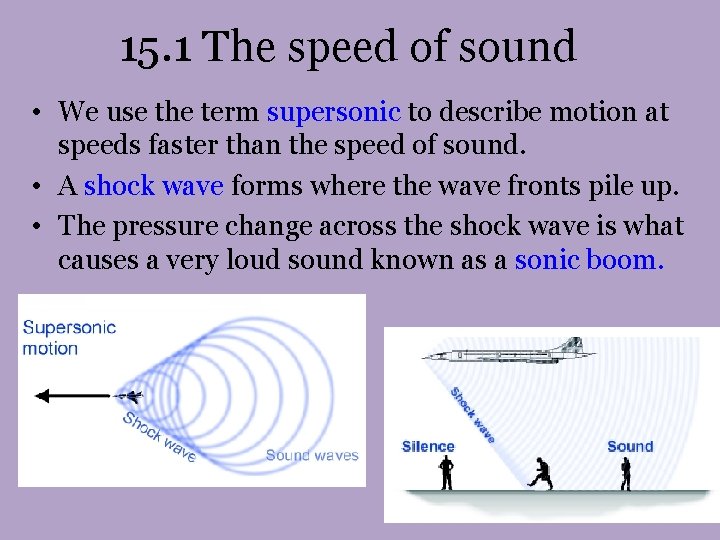
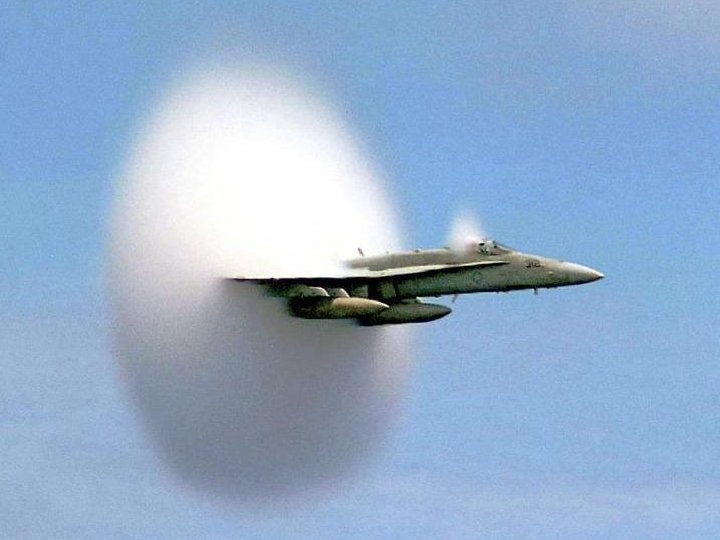
15. 1 The speed of sound • We use the term supersonic to describe motion at speeds faster than the speed of sound. • A shock wave forms where the wave fronts pile up. • The pressure change across the shock wave is what causes a very loud sound known as a sonic boom.
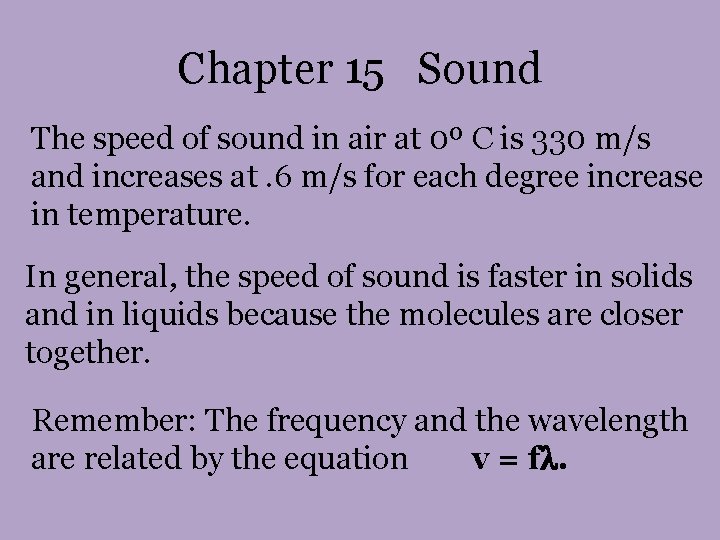
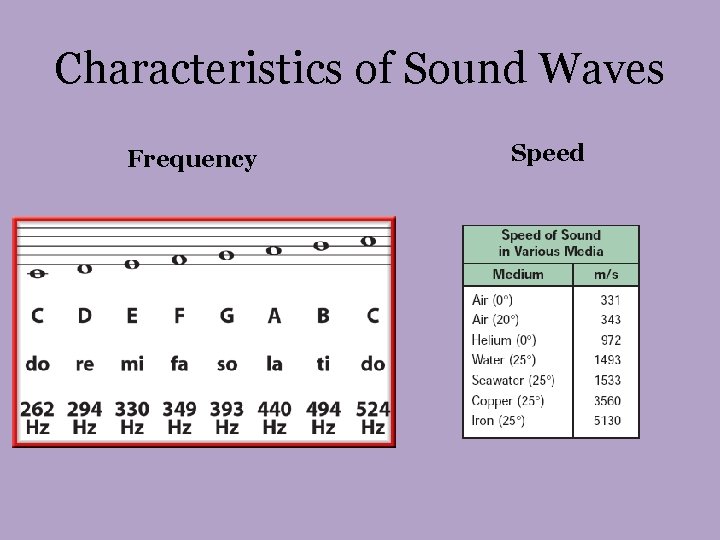
Chapter 15 Sound The speed of sound in air at 0º C is 330 m/s and increases at. 6 m/s for each degree increase in temperature. In general, the speed of sound is faster in solids and in liquids because the molecules are closer together. Remember: The frequency and the wavelength are related by the equation v = f.
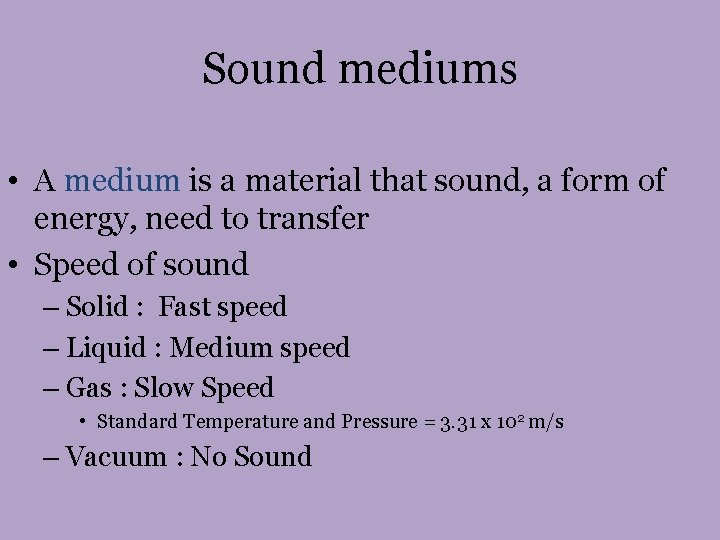
Sound mediums • A medium is a material that sound, a form of energy, need to transfer • Speed of sound – Solid : Fast speed – Liquid : Medium speed – Gas : Slow Speed • Standard Temperature and Pressure = 3. 31 x 102 m/s – Vacuum : No Sound
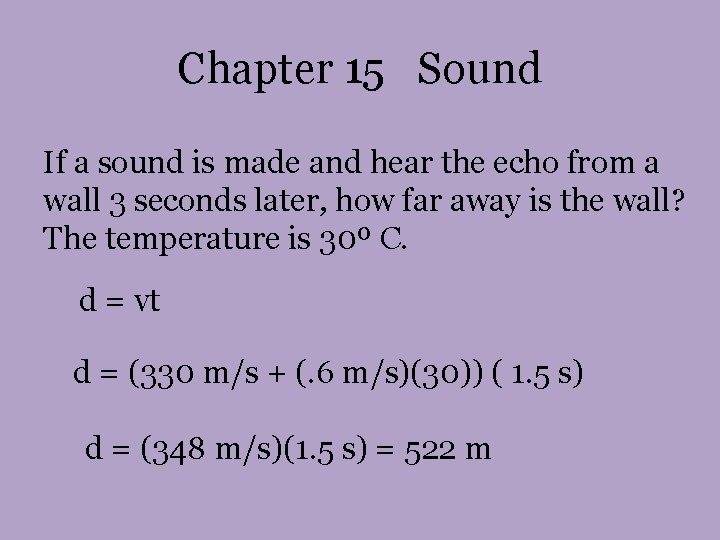
Chapter 15 Sound If a sound is made and hear the echo from a wall 3 seconds later, how far away is the wall? The temperature is 30º C. d = vt d = (330 m/s + (. 6 m/s)(30)) ( 1. 5 s) d = (348 m/s)(1. 5 s) = 522 m
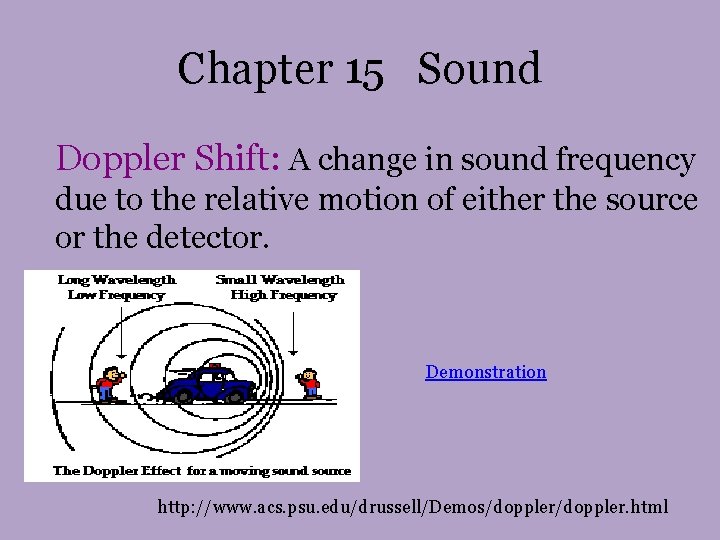
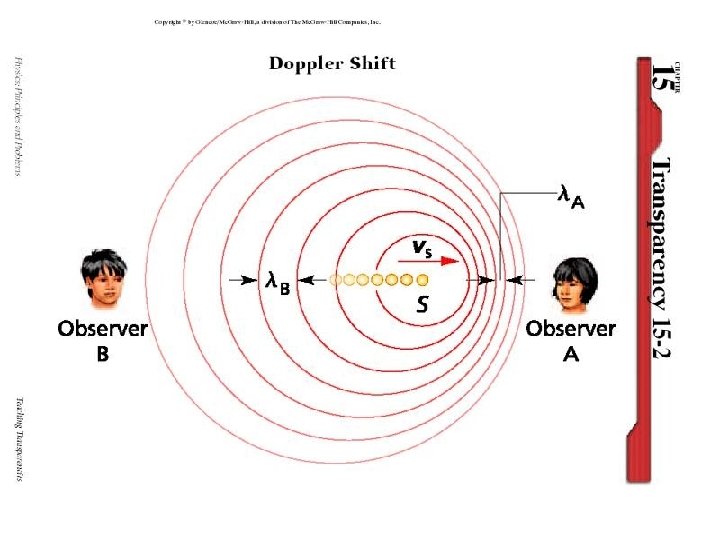
Chapter 15 Sound Doppler Shift: A change in sound frequency due to the relative motion of either the source or the detector. Demonstration http: //www. acs. psu. edu/drussell/Demos/doppler. html
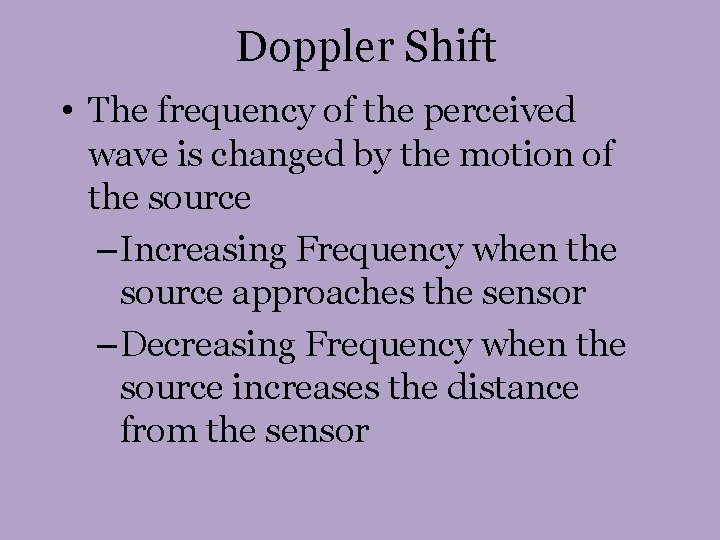
Doppler Shift • The frequency of the perceived wave is changed by the motion of the source – Increasing Frequency when the source approaches the sensor – Decreasing Frequency when the source increases the distance from the sensor
Chapter 15 Sound Homework: • Practice Problems: 1 -4, page 309 • Due Thurs 5/1
Chapter 15 Pitch & Loudness Objectives: • Relate physical properties of sound to pitch and loudness • Describe what an octave is • Be able to use the decibel scale
Chapter 15 Sound Loudness: The loudness of a sound depends primarily on the amplitude of the pressure wave. Loudness is measured in decibels. Frequency: The number of cycles per second. The human ear can detect frequencies between 20 and 20, 000 Hz. Frequency and loudness are not related.
Characteristics of Sound Waves Frequency Speed
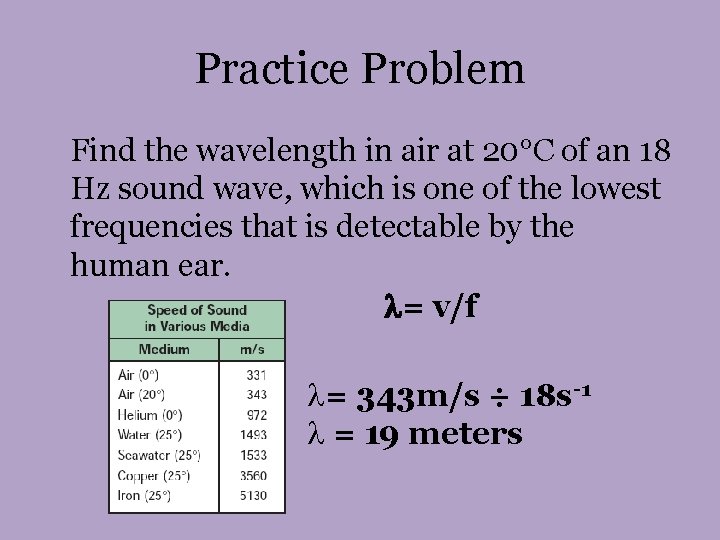
Practice Problem Find the wavelength in air at 20°C of an 18 Hz sound wave, which is one of the lowest frequencies that is detectable by the human ear. = v/f = 343 m/s ÷ 18 s-1 = 19 meters
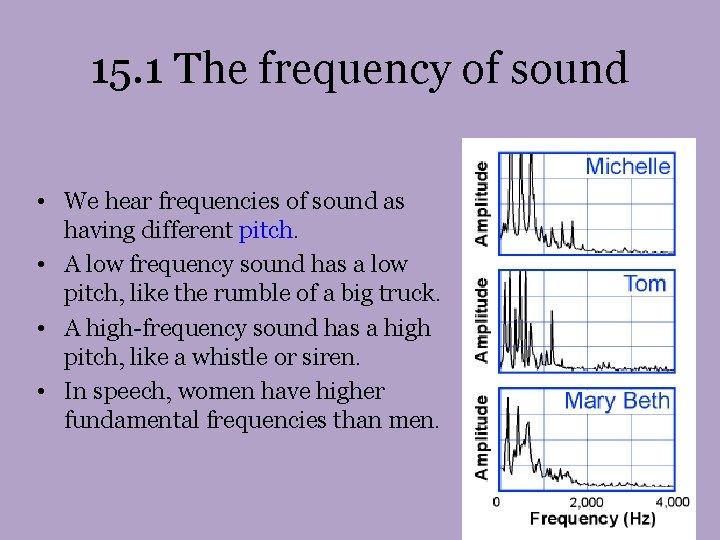
15. 1 The frequency of sound • We hear frequencies of sound as having different pitch. • A low frequency sound has a low pitch, like the rumble of a big truck. • A high-frequency sound has a high pitch, like a whistle or siren. • In speech, women have higher fundamental frequencies than men.
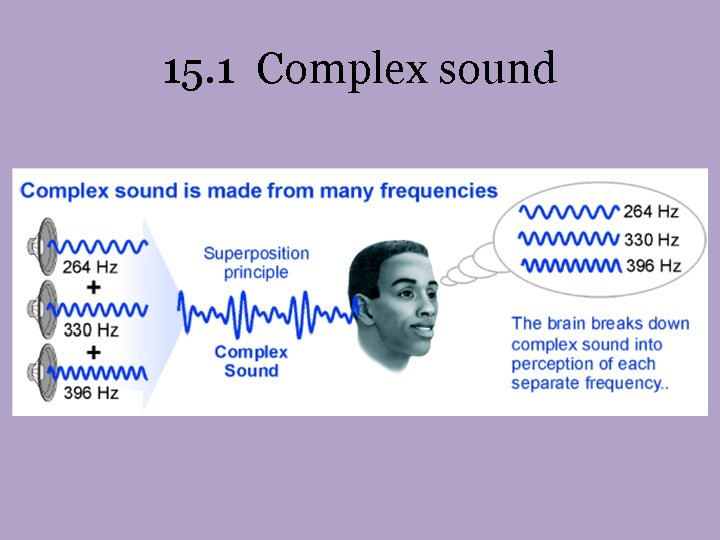
15. 1 Complex sound
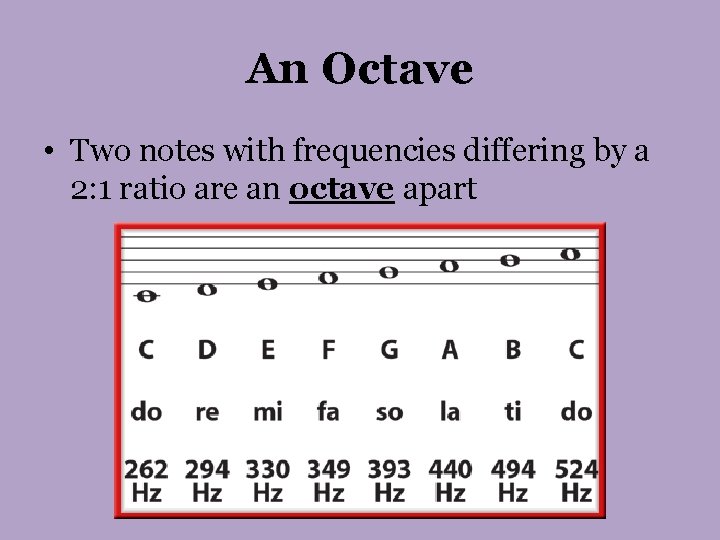
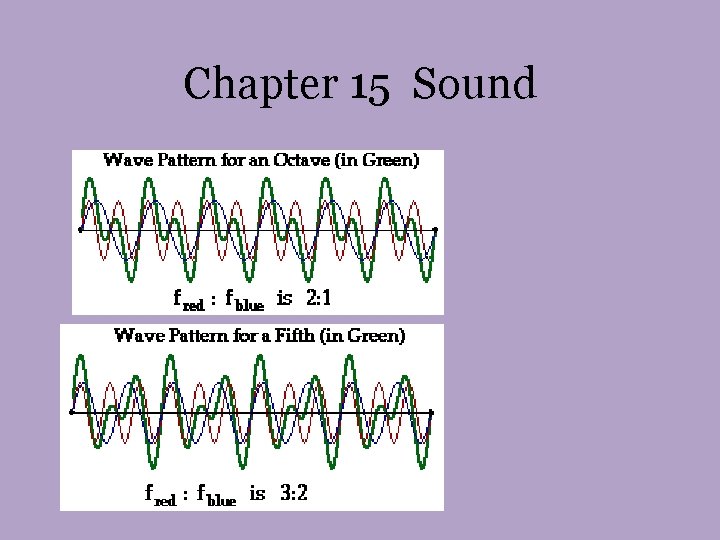
An Octave • Two notes with frequencies differing by a 2: 1 ratio are an octave apart
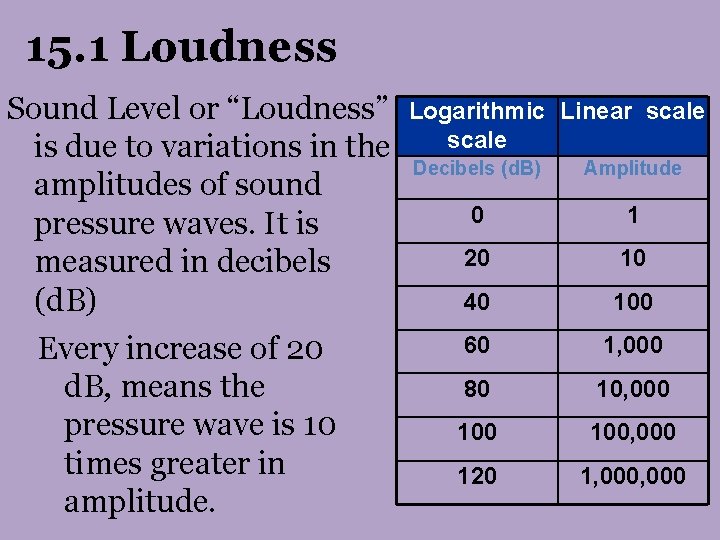
15. 1 Loudness Sound Level or “Loudness” is due to variations in the amplitudes of sound pressure waves. It is measured in decibels (d. B) Every increase of 20 d. B, means the pressure wave is 10 times greater in amplitude. Logarithmic Linear scale Decibels (d. B) Amplitude 0 1 20 10 40 100 60 1, 000 80 10, 000 100, 000 120 1, 000
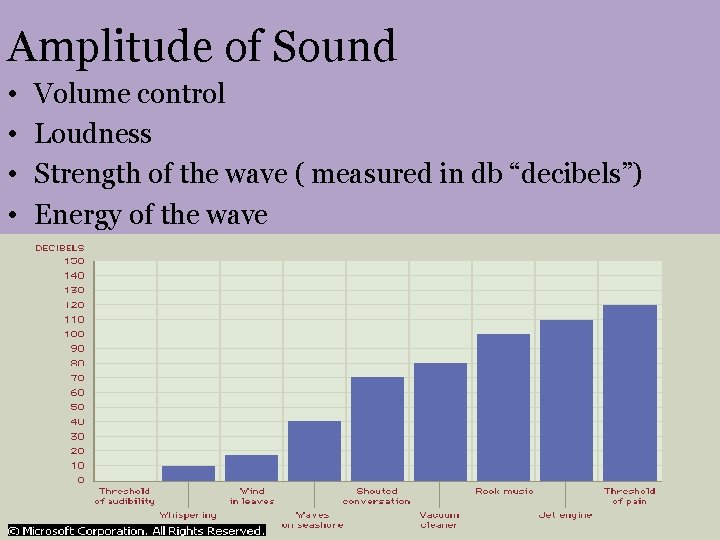
Amplitude of Sound • • Volume control Loudness Strength of the wave ( measured in db “decibels”) Energy of the wave
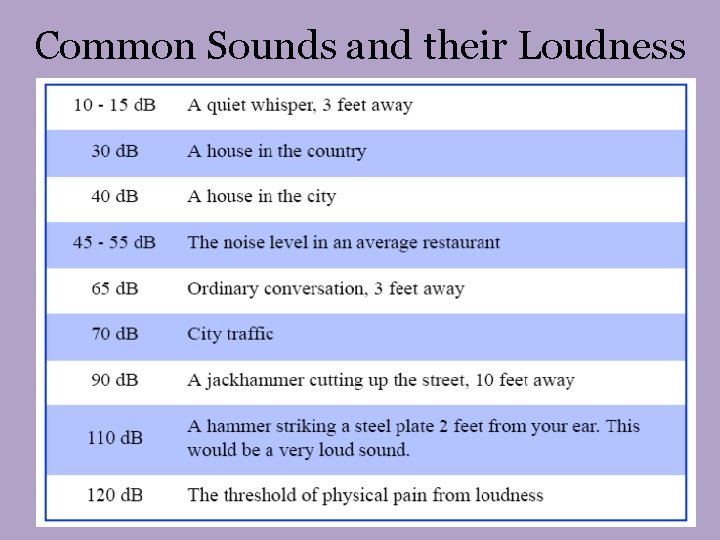
Common Sounds and their Loudness
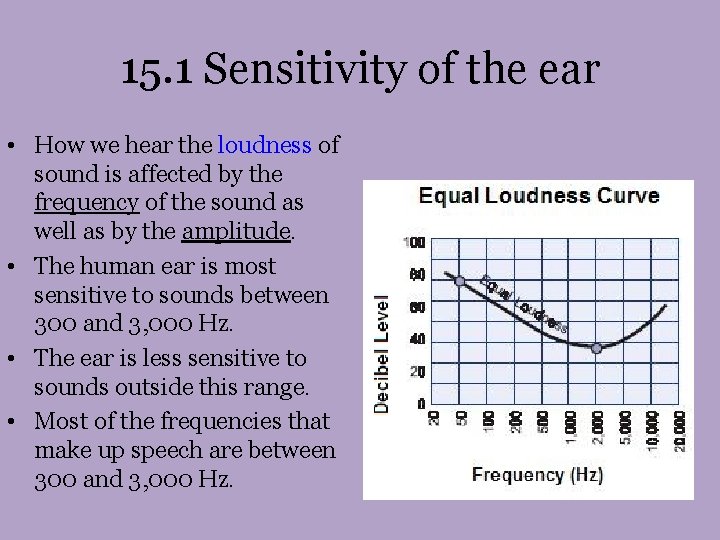
15. 1 Sensitivity of the ear • How we hear the loudness of sound is affected by the frequency of the sound as well as by the amplitude. • The human ear is most sensitive to sounds between 300 and 3, 000 Hz. • The ear is less sensitive to sounds outside this range. • Most of the frequencies that make up speech are between 300 and 3, 000 Hz.
Homework Complete concept review problems: • 1. 1 thru 1. 4, page 312 • Due Friday 5/2 • Lab Tomorrow (Measuring the Speed of Sound)
15. 2 The Sound of Music Objectives • Describe how sound is originated • Apply the concept of resonance to air columns and strings. • Differentiate between open- and closedpipe resonators. • Solve problems of standing waves in resonating air columns
Frequency of Sound • Pitch of the sound is the frequency of the sound wave • Musical notes: there are 12 notes on a staff from A to G# • Bass : Low frequency 0 to 300 Hz • Mid range : “voice” 300 to 6, 000 Hz • Treble : High frequency, Above “middle” C note, 6, 000 to 20, 000 Hz • Spectrum of frequency http: //www. youtube. com/watch? v=q. Nf 9 nzvnd 1 k
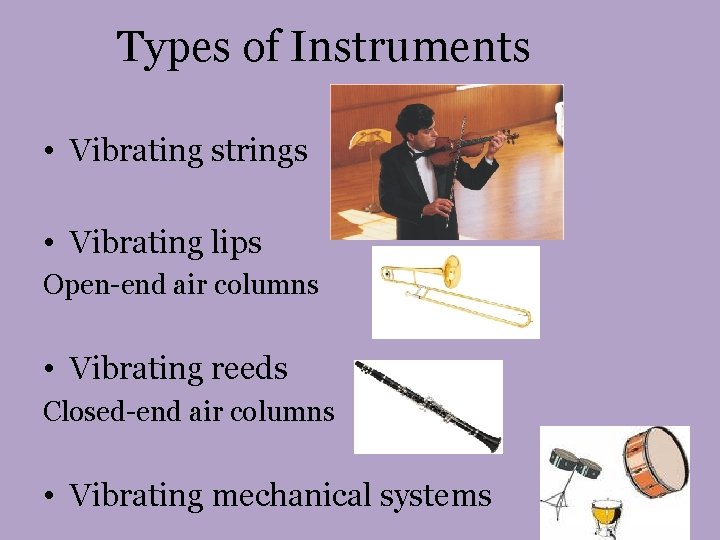
Types of Instruments • Vibrating strings • Vibrating lips Open-end air columns • Vibrating reeds Closed-end air columns • Vibrating mechanical systems
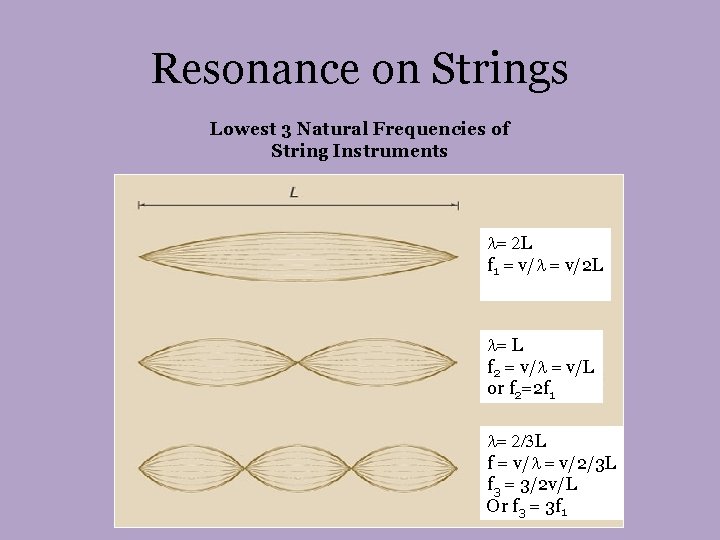
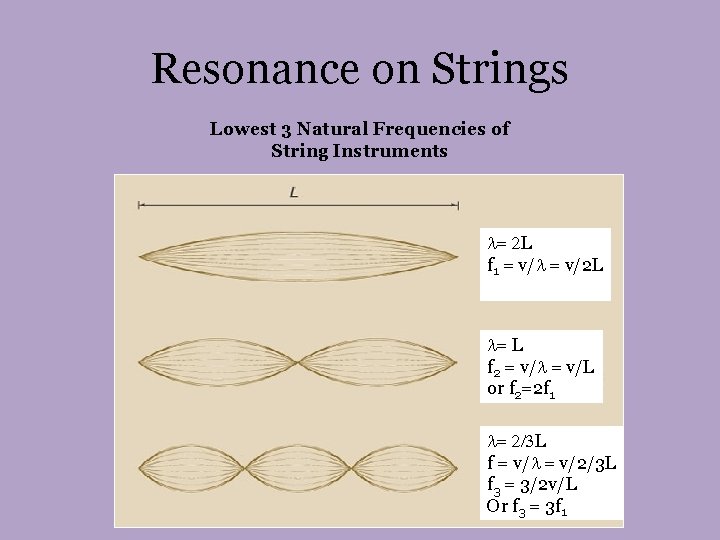
Resonance on Strings Lowest 3 Natural Frequencies of String Instruments = 2 L f 1 = v/2 L = L f 2 = v/L or f 2=2 f 1 = 2/3 L f = v/2/3 L f 3 = 3/2 v/L Or f 3 = 3 f 1
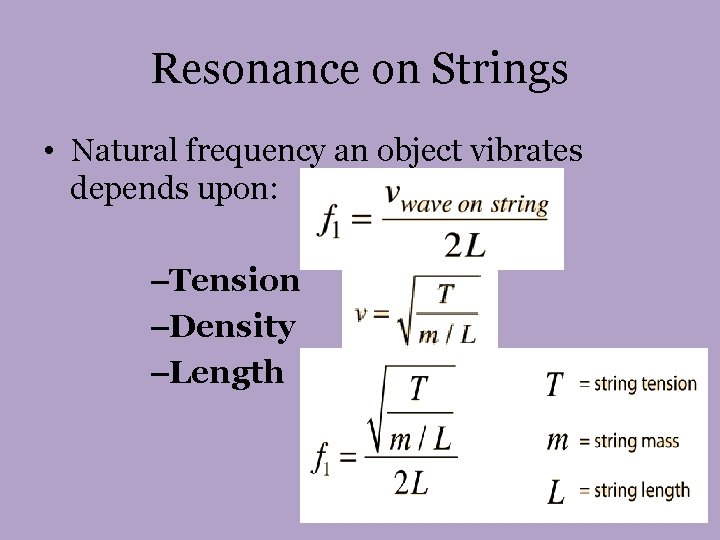
Resonance on Strings • Natural frequency an object vibrates depends upon: –Tension –Density –Length
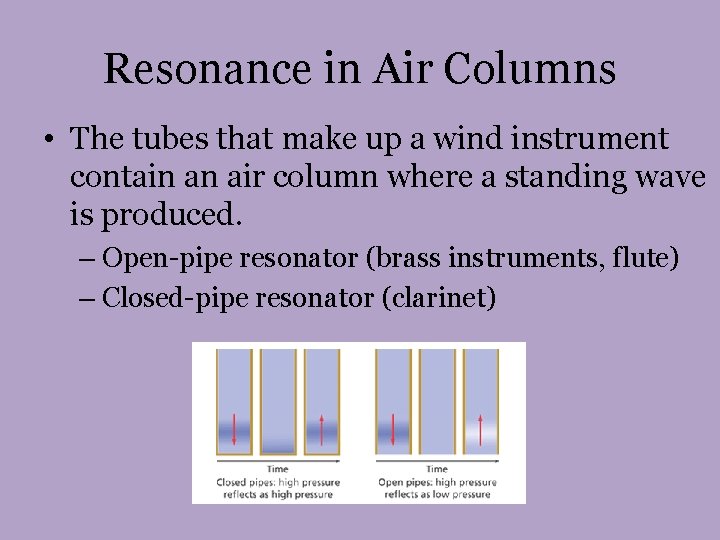
Resonance in Air Columns • The tubes that make up a wind instrument contain an air column where a standing wave is produced. – Open-pipe resonator (brass instruments, flute) – Closed-pipe resonator (clarinet)
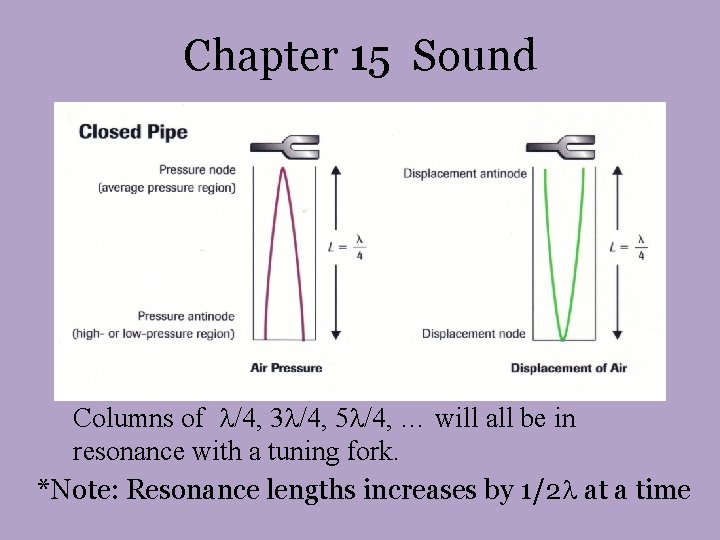
Chapter 15 Sound Columns of /4, 3 /4, 5 /4, … will all be in resonance with a tuning fork. *Note: Resonance lengths increases by 1/2 at a time
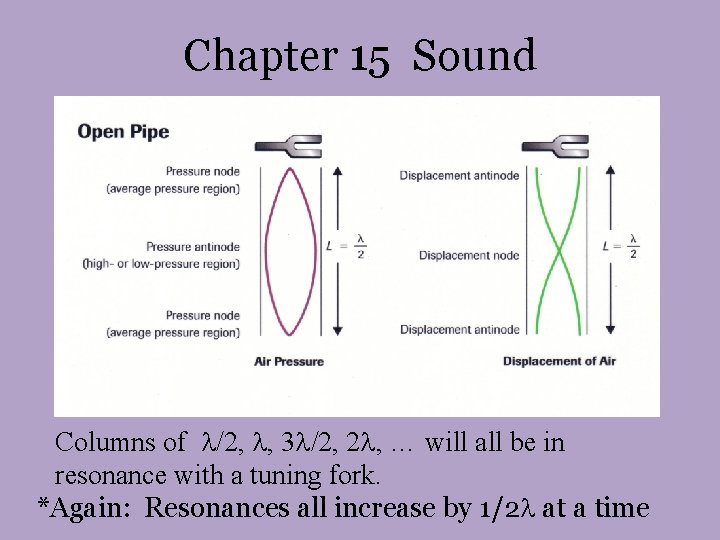
Chapter 15 Sound Columns of /2, , 3 /2, 2 , … will all be in resonance with a tuning fork. *Again: Resonances all increase by 1/2 at a time
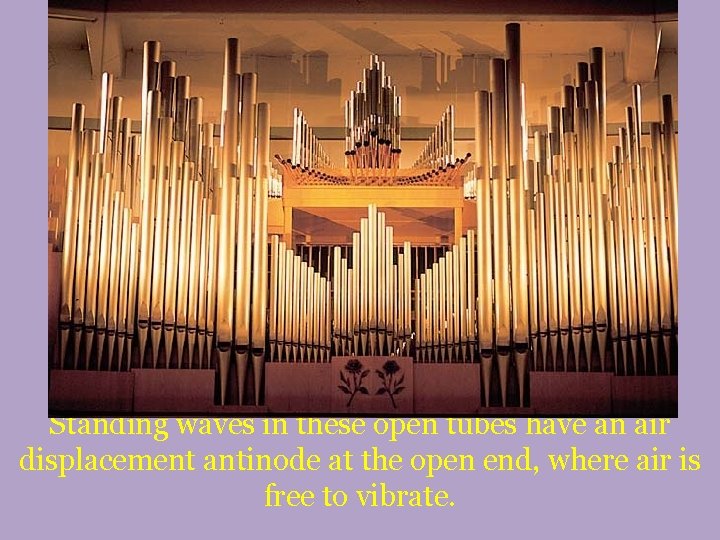
Standing waves in these open tubes have an air displacement antinode at the open end, where air is free to vibrate.
Animation: Open vs. Closed Ended Resonance: http: //www. acs. psu. edu/drussell/Demos/Standing. Waves/standing. gif http: //www. acs. psu. edu/drussell/Demos/Standing. Waves. html http: //www. phys. unsw. edu. au/jw/flutes. v. clarinets. html http: //glencoe. com/sec/science/physics/ppp_09/animation/Chapter%2015/Resonance%20 in%20 Closed%20 and%20 Open%20 Pipes. swf
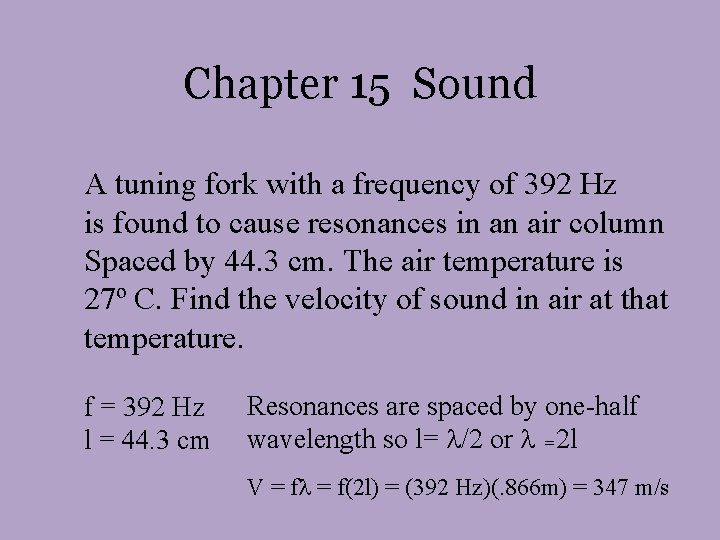
Chapter 15 Sound A tuning fork with a frequency of 392 Hz is found to cause resonances in an air column Spaced by 44. 3 cm. The air temperature is 27º C. Find the velocity of sound in air at that temperature. f = 392 Hz l = 44. 3 cm Resonances are spaced by one-half wavelength so l= /2 or =2 l V = f(2 l) = (392 Hz)(. 866 m) = 347 m/s
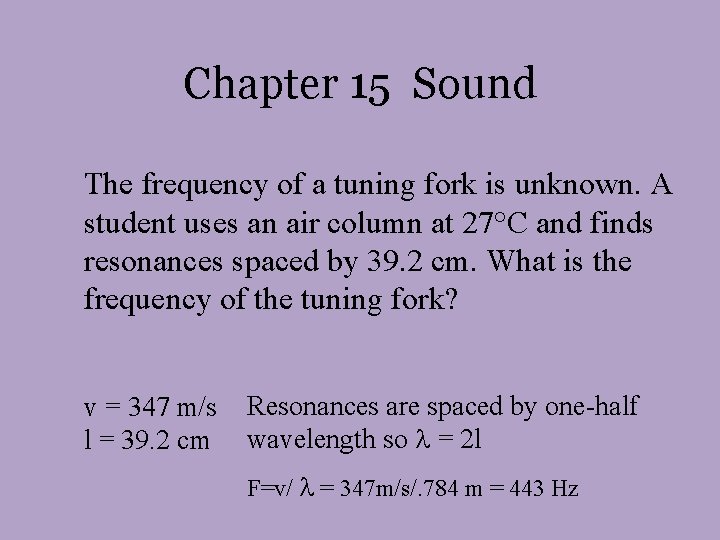
Chapter 15 Sound The frequency of a tuning fork is unknown. A student uses an air column at 27°C and finds resonances spaced by 39. 2 cm. What is the frequency of the tuning fork? v = 347 m/s l = 39. 2 cm Resonances are spaced by one-half wavelength so = 2 l F=v/ = 347 m/s/. 784 m = 443 Hz
Resonance When the frequency of sound waves exactly matches the natural frequency of an object. Look what can happen!……. . In black and white. http: //www. youtube. com/watch? v=xox 9 BVSu 7 Ok In living color! http: //www. youtube. com/watch? v=l. Xy. G 68_ca. V 4 Now lets resonant Oma’s crystal wine glass and see if it will shatter!!! Resonant frequency 762 Hz…. It was resonating at my house with computer speakers!
Homework • Practice Problems: 5 -8, pg 318 • Due Weds 5/7
15. 2 The Sound of Music (cont’d) Objectives • Identify the function of each part of the ear in detecting sound • Define timbre, harmonics and beats
Chapter 15 Sound
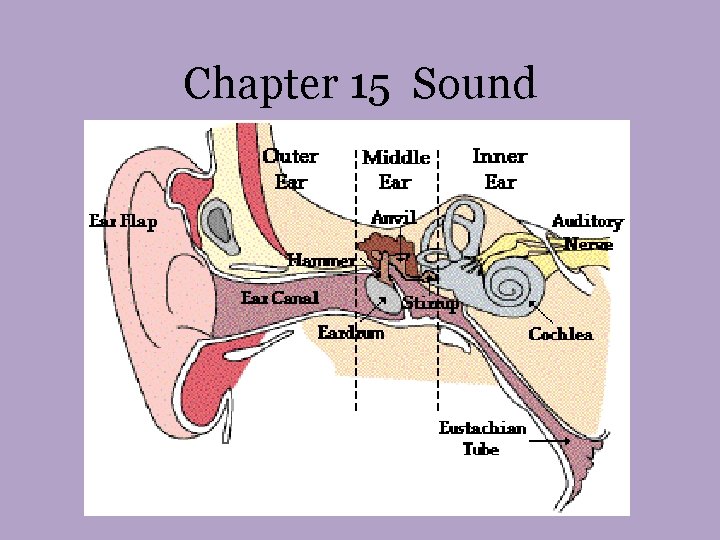
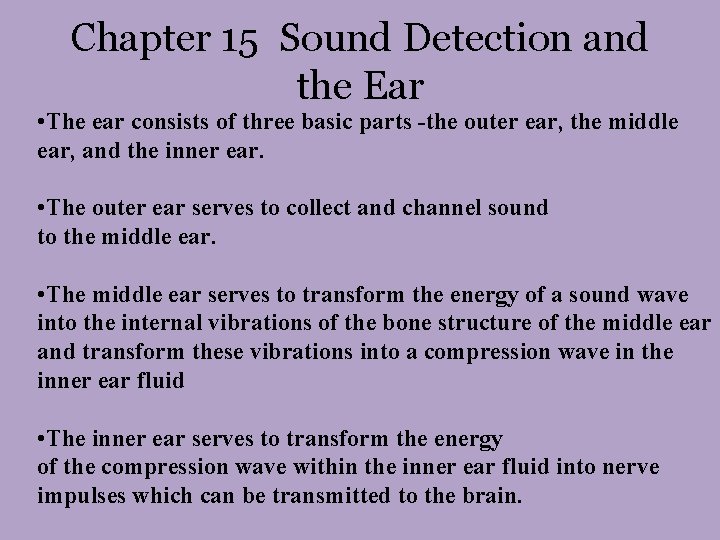
Chapter 15 Sound Detection and the Ear • The ear consists of three basic parts -the outer ear, the middle ear, and the inner ear. • The outer ear serves to collect and channel sound to the middle ear. • The middle ear serves to transform the energy of a sound wave into the internal vibrations of the bone structure of the middle ear and transform these vibrations into a compression wave in the inner ear fluid • The inner ear serves to transform the energy of the compression wave within the inner ear fluid into nerve impulses which can be transmitted to the brain.
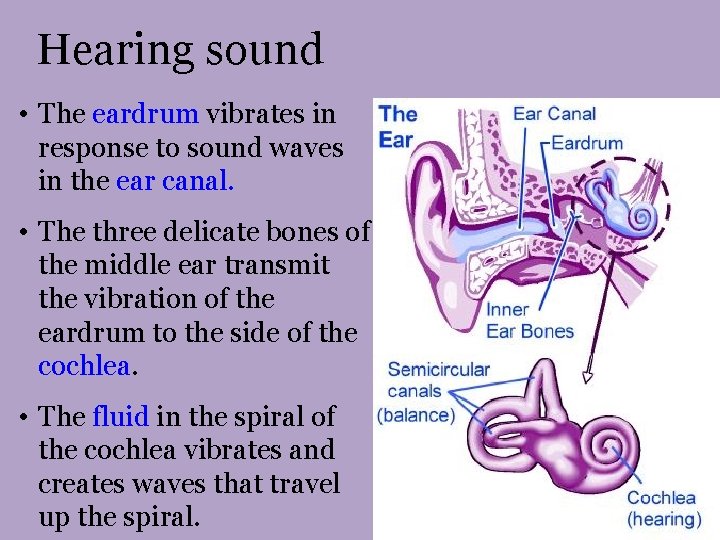
Hearing sound • The eardrum vibrates in response to sound waves in the ear canal. • The three delicate bones of the middle ear transmit the vibration of the eardrum to the side of the cochlea. • The fluid in the spiral of the cochlea vibrates and creates waves that travel up the spiral.
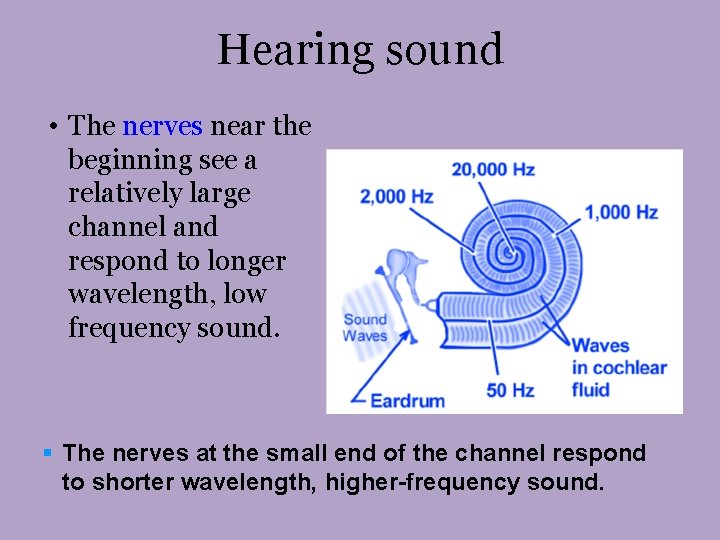
Hearing sound • The nerves near the beginning see a relatively large channel and respond to longer wavelength, low frequency sound. § The nerves at the small end of the channel respond to shorter wavelength, higher-frequency sound.
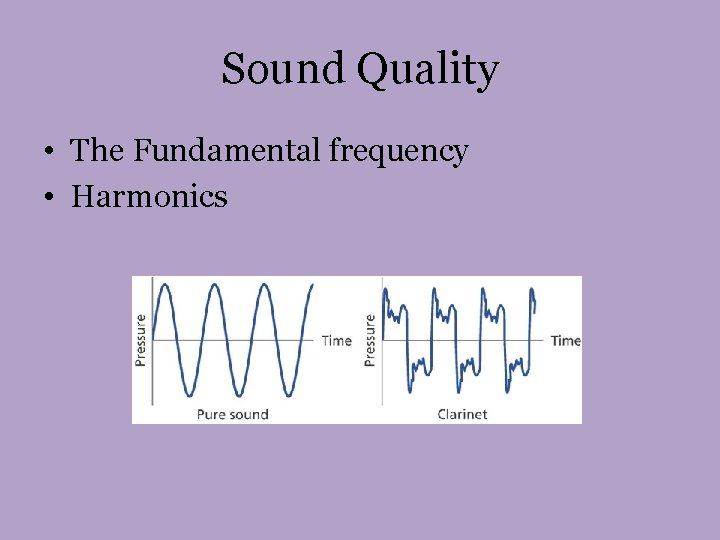
Sound Quality • The Fundamental frequency • Harmonics
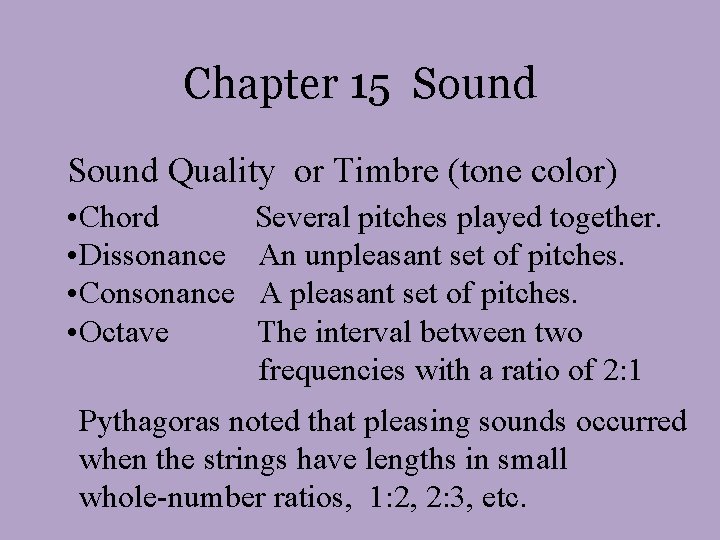
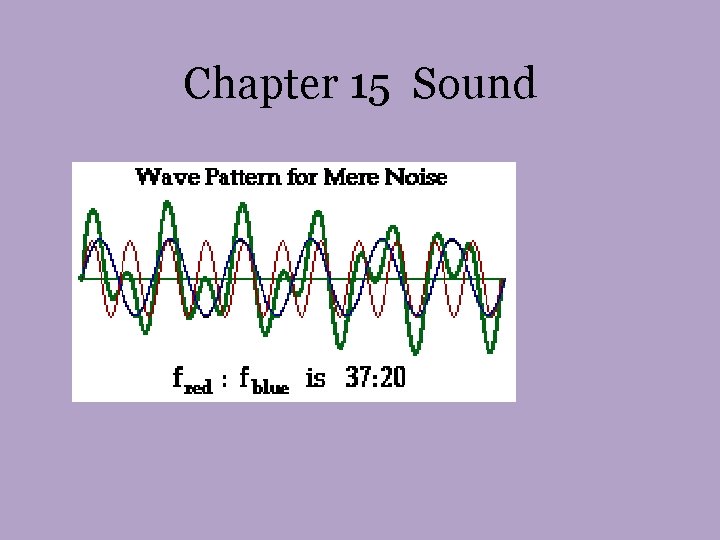
Chapter 15 Sound Quality or Timbre (tone color) • Chord • Dissonance • Consonance • Octave Several pitches played together. An unpleasant set of pitches. A pleasant set of pitches. The interval between two frequencies with a ratio of 2: 1 Pythagoras noted that pleasing sounds occurred when the strings have lengths in small whole-number ratios, 1: 2, 2: 3, etc.
Chapter 15 Sound
Chapter 15 Sound
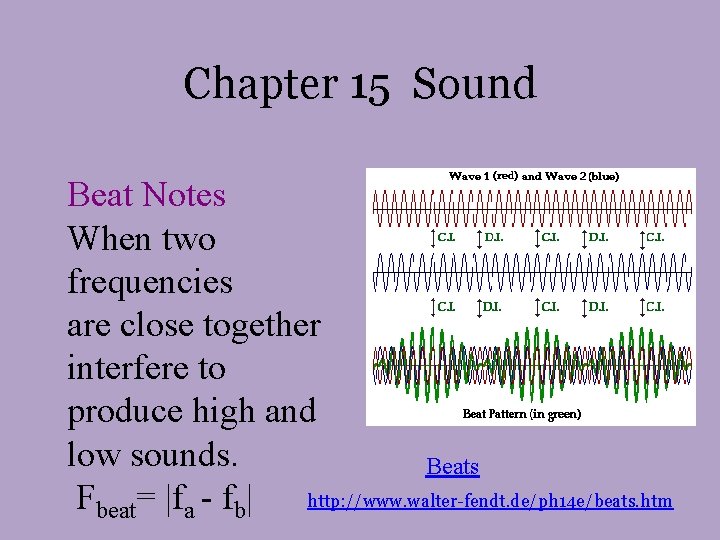
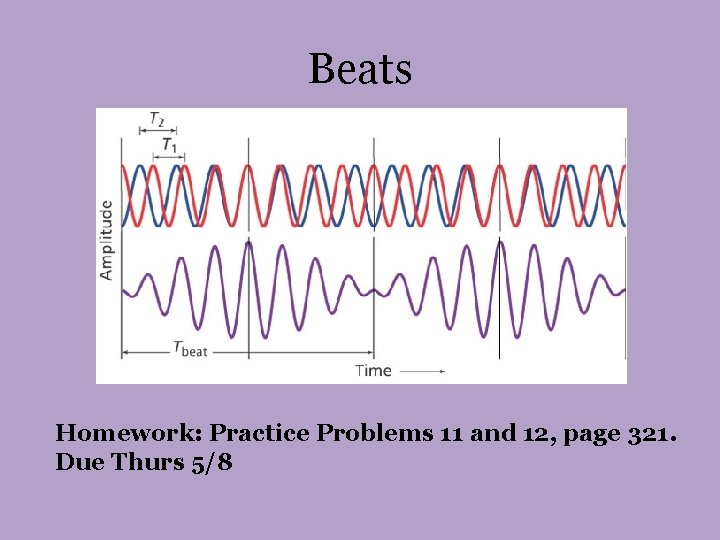
Chapter 15 Sound Beat Notes When two frequencies are close together interfere to produce high and low sounds. Beats http: //www. walter-fendt. de/ph 14 e/beats. htm Fbeat= |fa - fb|
Beats Homework: Practice Problems 11 and 12, page 321. Due Thurs 5/8
Interference • https: //phet. colorado. edu/en/simulation/ sound • http: //www. animations. physics. unsw. edu. au/waves-sound/ • http: //www. falstad. com/interference/ • http: //www. falstad. com/ripple/
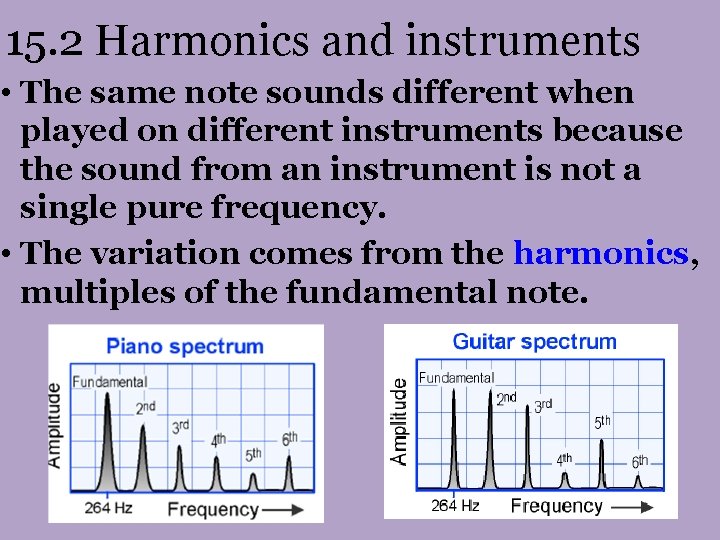
15. 2 Harmonics and instruments • The same note sounds different when played on different instruments because the sound from an instrument is not a single pure frequency. • The variation comes from the harmonics, multiples of the fundamental note.
Resonance on Strings Lowest 3 Natural Frequencies of String Instruments = 2 L f 1 = v/2 L = L f 2 = v/L or f 2=2 f 1 = 2/3 L f = v/2/3 L f 3 = 3/2 v/L Or f 3 = 3 f 1
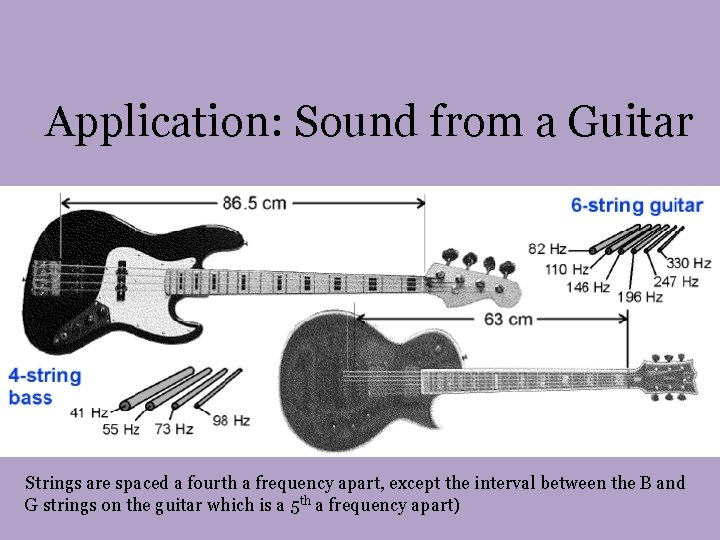
Application: Sound from a Guitar Strings are spaced a fourth a frequency apart, except the interval between the B and G strings on the guitar which is a 5 th a frequency apart)
The End of Sound The Ocean • http: //www. youtube. com/watch? v=Ib. Sug n 0 d. B 4 c&list=RDm. YWx. E-Shd. Xc Heartbreaker • http: //www. youtube. com/watch? v=m. YW x. E-Shd. Xc&list=RDm. YWx. E-Shd. Xc Black Dog • http: //www. youtube. com/watch? v=m. YW x. E-Shd. Xc&list=RDm. YWx. E-Shd. Xc