
Chapter 15 Riches in Rock Mineral Resources LECTURE

- Slides: 43
Chapter 15 Riches in Rock: Mineral Resources LECTURE OUTLINE earth Portrait of a Planet Third Edition © 2008 W. W. Norton & Company, Inc. Earth: Portrait of a Planet, 3 rd edition, by Stephen Marshak Chapter 15: Riches in Rock: Mineral Resources
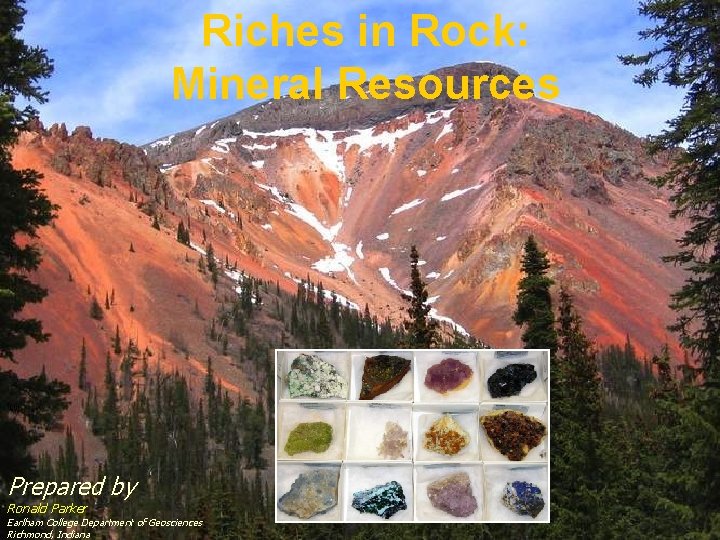
Riches in Rock: Mineral Resources Prepared by Ronald Parker Earlham College Department of Geosciences Richmond, Indiana
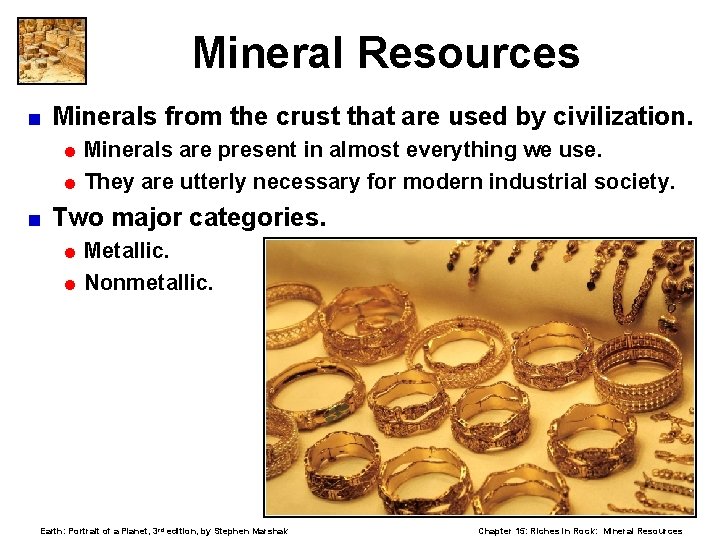
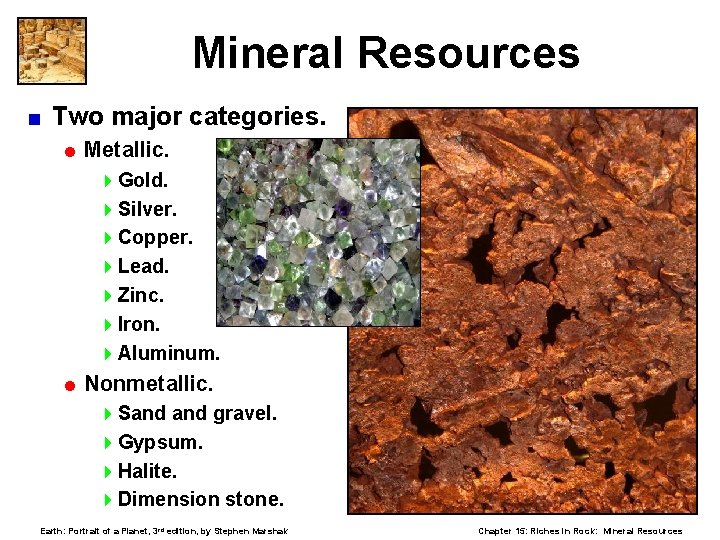
Mineral Resources < Minerals from the crust that are used by civilization. = Minerals are present in almost everything we use. = They are utterly necessary for modern industrial society. < Two major categories. = Metallic. = Nonmetallic. Earth: Portrait of a Planet, 3 rd edition, by Stephen Marshak Chapter 15: Riches in Rock: Mineral Resources
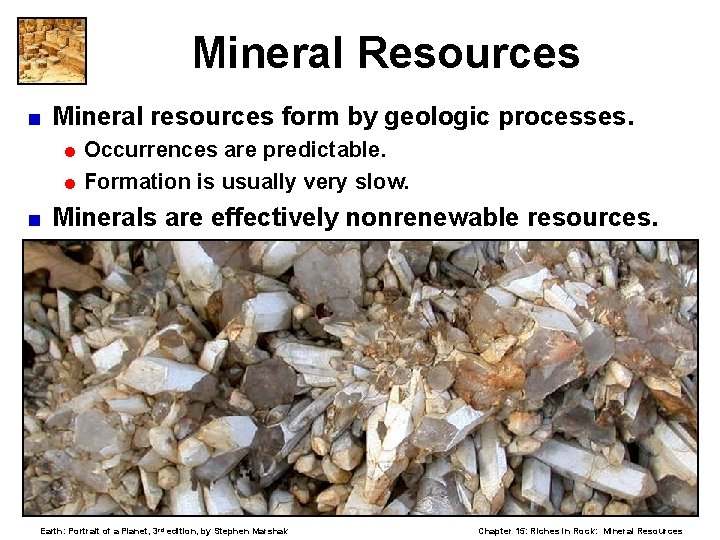
Mineral Resources < Mineral resources form by geologic processes. = Occurrences are predictable. = Formation is usually very slow. < Minerals are effectively nonrenewable resources. Earth: Portrait of a Planet, 3 rd edition, by Stephen Marshak Chapter 15: Riches in Rock: Mineral Resources
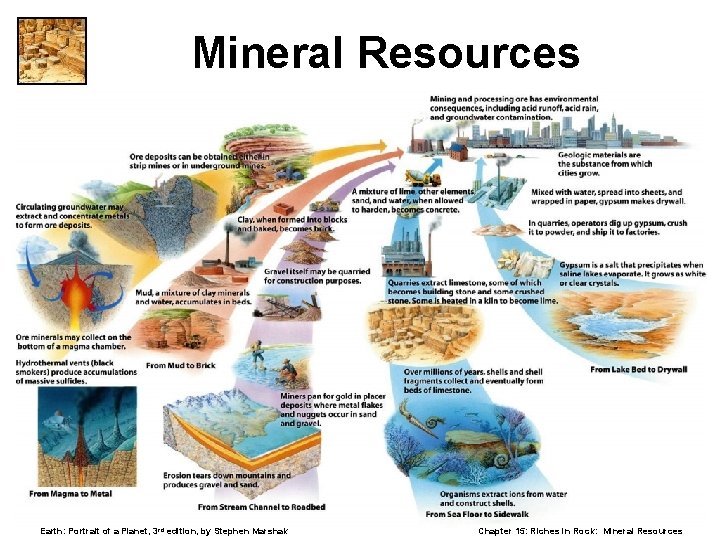
Mineral Resources Earth: Portrait of a Planet, 3 rd edition, by Stephen Marshak Chapter 15: Riches in Rock: Mineral Resources
Mineral Resources < Two major categories. = Metallic. 4 Gold. 4 Silver. 4 Copper. 4 Lead. 4 Zinc. 4 Iron. 4 Aluminum. = Nonmetallic. 4 Sand gravel. 4 Gypsum. 4 Halite. 4 Dimension stone. Earth: Portrait of a Planet, 3 rd edition, by Stephen Marshak Chapter 15: Riches in Rock: Mineral Resources
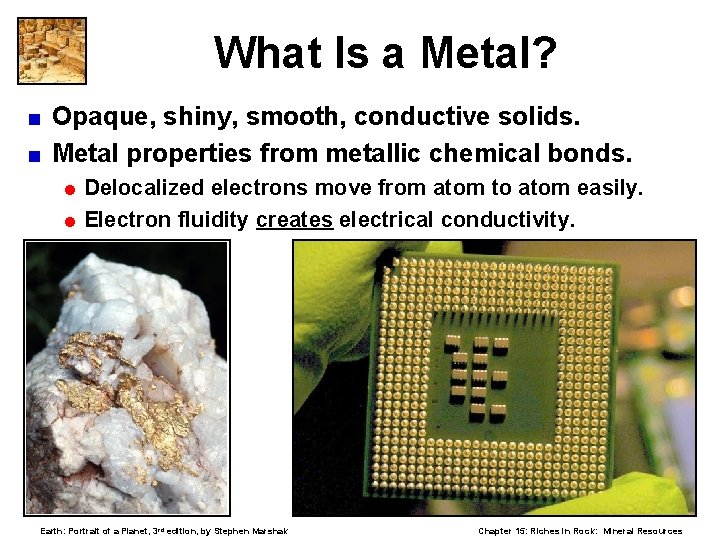
What Is a Metal? Opaque, shiny, smooth, conductive solids. < Metal properties from metallic chemical bonds. < = Delocalized electrons move from atom to atom easily. = Electron fluidity creates electrical conductivity. Earth: Portrait of a Planet, 3 rd edition, by Stephen Marshak Chapter 15: Riches in Rock: Mineral Resources
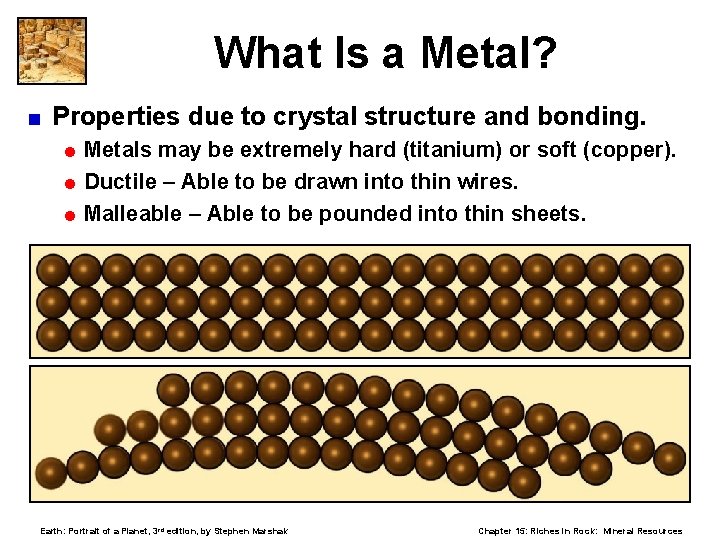
What Is a Metal? < Properties due to crystal structure and bonding. = Metals may be extremely hard (titanium) or soft (copper). = Ductile – Able to be drawn into thin wires. = Malleable – Able to be pounded into thin sheets. Earth: Portrait of a Planet, 3 rd edition, by Stephen Marshak Chapter 15: Riches in Rock: Mineral Resources
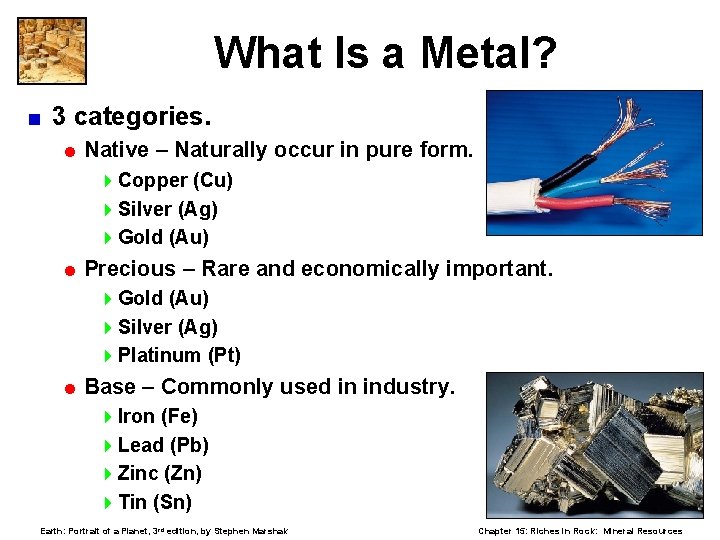
What Is a Metal? < 3 categories. = Native – Naturally occur in pure form. 4 Copper (Cu) 4 Silver (Ag) 4 Gold (Au) = Precious – Rare and economically important. 4 Gold (Au) 4 Silver (Ag) 4 Platinum (Pt) = Base – Commonly used in industry. 4 Iron (Fe) 4 Lead (Pb) 4 Zinc (Zn) 4 Tin (Sn) Earth: Portrait of a Planet, 3 rd edition, by Stephen Marshak Chapter 15: Riches in Rock: Mineral Resources
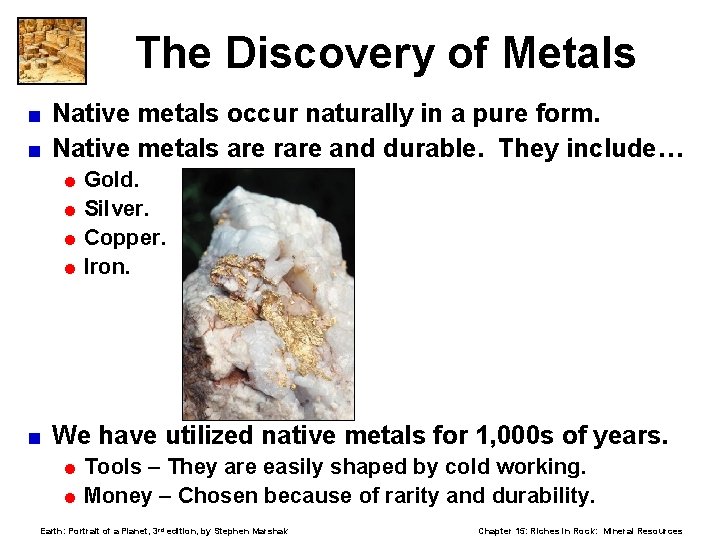
The Discovery of Metals Native metals occur naturally in a pure form. < Native metals are rare and durable. They include… < = Gold. = Silver. = Copper. = Iron. < We have utilized native metals for 1, 000 s of years. = Tools – They are easily shaped by cold working. = Money – Chosen because of rarity and durability. Earth: Portrait of a Planet, 3 rd edition, by Stephen Marshak Chapter 15: Riches in Rock: Mineral Resources
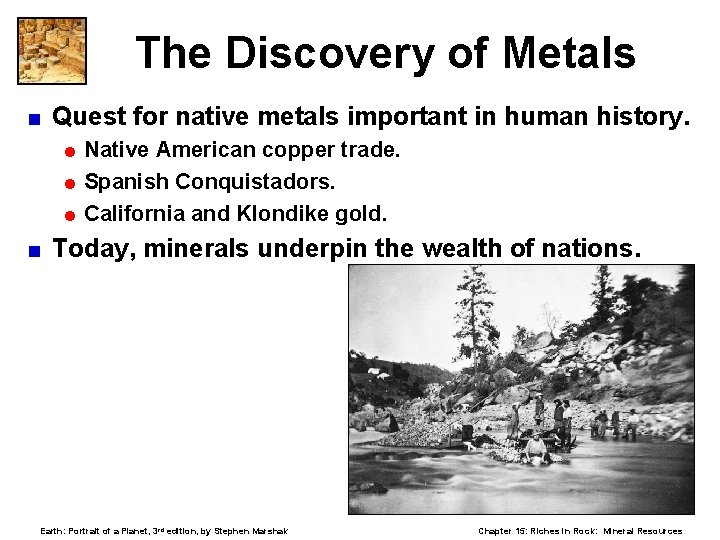
The Discovery of Metals < Quest for native metals important in human history. = Native American copper trade. = Spanish Conquistadors. = California and Klondike gold. < Today, minerals underpin the wealth of nations. Earth: Portrait of a Planet, 3 rd edition, by Stephen Marshak Chapter 15: Riches in Rock: Mineral Resources
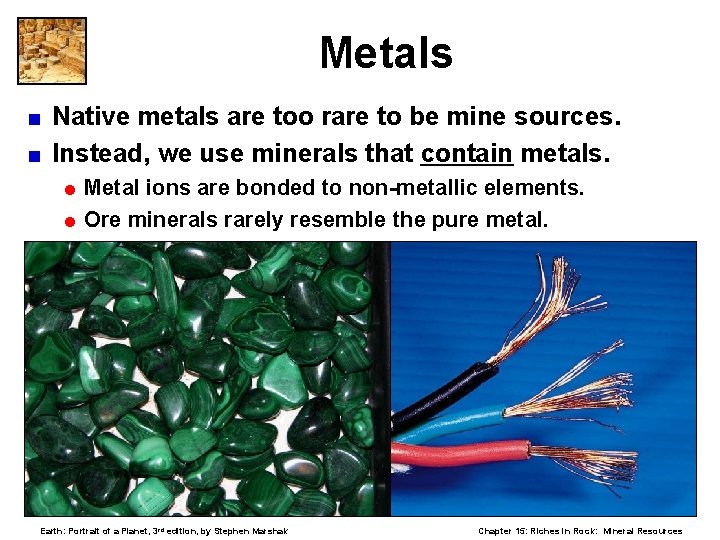
Metals Native metals are too rare to be mine sources. < Instead, we use minerals that contain metals. < = Metal ions are bonded to non-metallic elements. = Ore minerals rarely resemble the pure metal. Earth: Portrait of a Planet, 3 rd edition, by Stephen Marshak Chapter 15: Riches in Rock: Mineral Resources
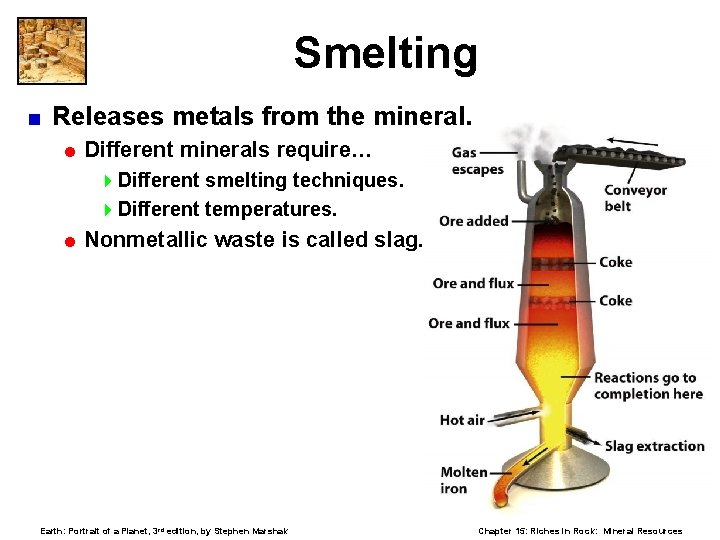
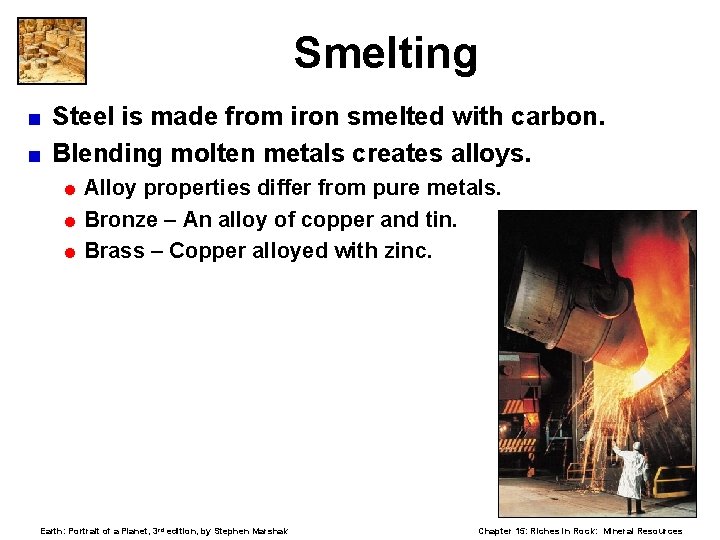
Smelting < Releases metals from the mineral. = Different minerals require… 4 Different smelting techniques. 4 Different temperatures. = Nonmetallic waste is called slag. Earth: Portrait of a Planet, 3 rd edition, by Stephen Marshak Chapter 15: Riches in Rock: Mineral Resources
Smelting Steel is made from iron smelted with carbon. < Blending molten metals creates alloys. < = Alloy properties differ from pure metals. = Bronze – An alloy of copper and tin. = Brass – Copper alloyed with zinc. Earth: Portrait of a Planet, 3 rd edition, by Stephen Marshak Chapter 15: Riches in Rock: Mineral Resources
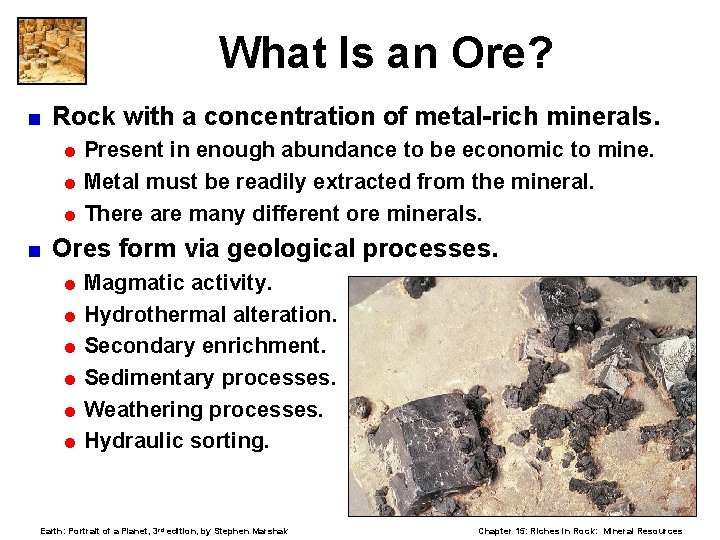
What Is an Ore? < Rock with a concentration of metal-rich minerals. = Present in enough abundance to be economic to mine. = Metal must be readily extracted from the mineral. = There are many different ore minerals. < Ores form via geological processes. = Magmatic activity. = Hydrothermal alteration. = Secondary enrichment. = Sedimentary processes. = Weathering processes. = Hydraulic sorting. Earth: Portrait of a Planet, 3 rd edition, by Stephen Marshak Chapter 15: Riches in Rock: Mineral Resources
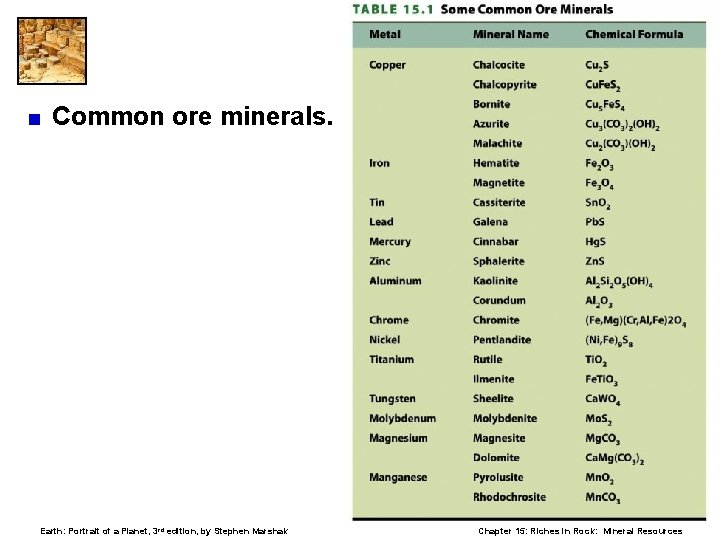
< Common ore minerals. Earth: Portrait of a Planet, 3 rd edition, by Stephen Marshak Chapter 15: Riches in Rock: Mineral Resources
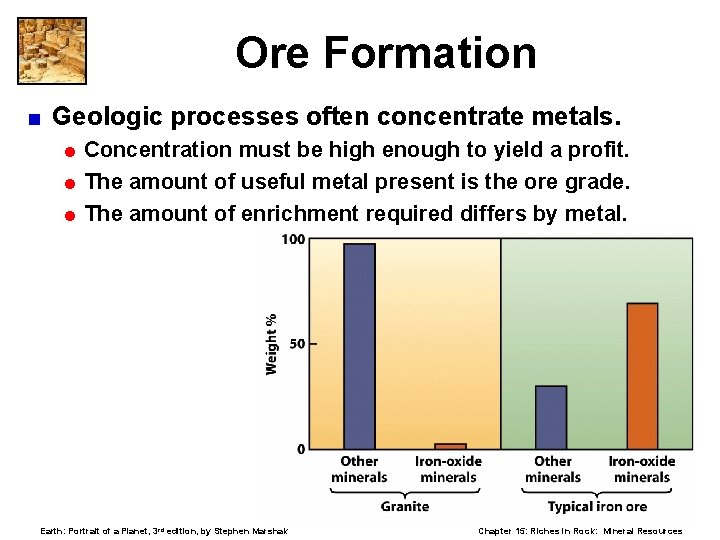
Ore Formation < Geologic processes often concentrate metals. = Concentration must be high enough to yield a profit. = The amount of useful metal present is the ore grade. = The amount of enrichment required differs by metal. Earth: Portrait of a Planet, 3 rd edition, by Stephen Marshak Chapter 15: Riches in Rock: Mineral Resources
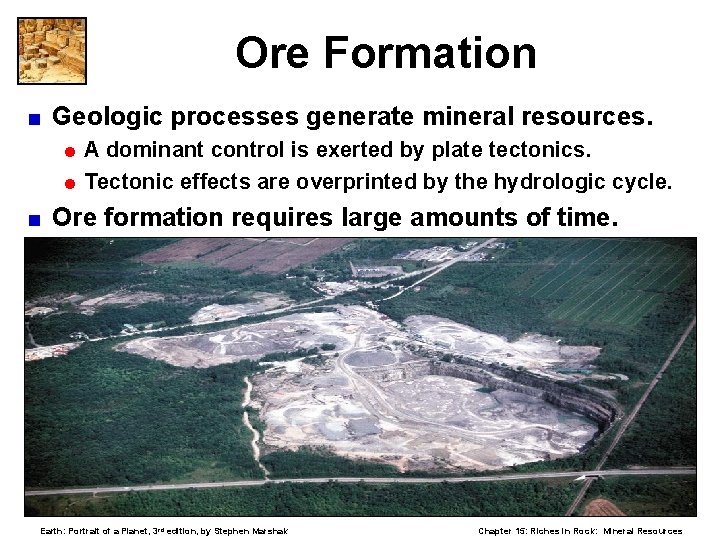
Ore Formation < Geologic processes generate mineral resources. =A dominant control is exerted by plate tectonics. = Tectonic effects are overprinted by the hydrologic cycle. < Ore formation requires large amounts of time. Earth: Portrait of a Planet, 3 rd edition, by Stephen Marshak Chapter 15: Riches in Rock: Mineral Resources
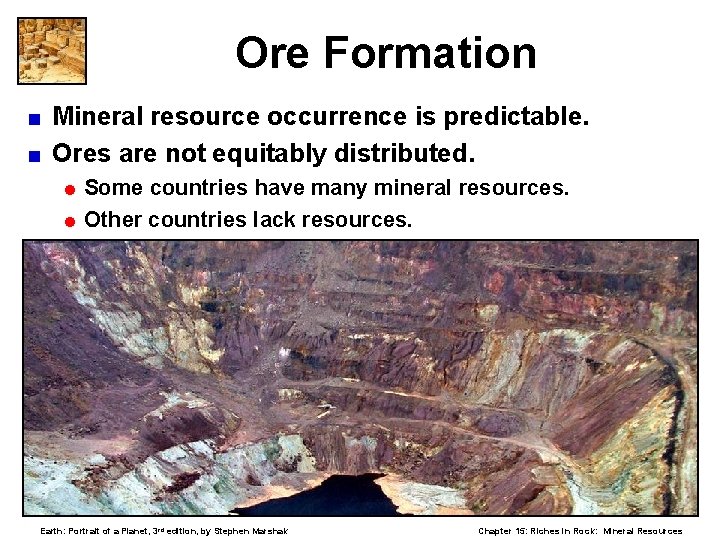
Ore Formation Mineral resource occurrence is predictable. < Ores are not equitably distributed. < = Some countries have many mineral resources. = Other countries lack resources. Earth: Portrait of a Planet, 3 rd edition, by Stephen Marshak Chapter 15: Riches in Rock: Mineral Resources
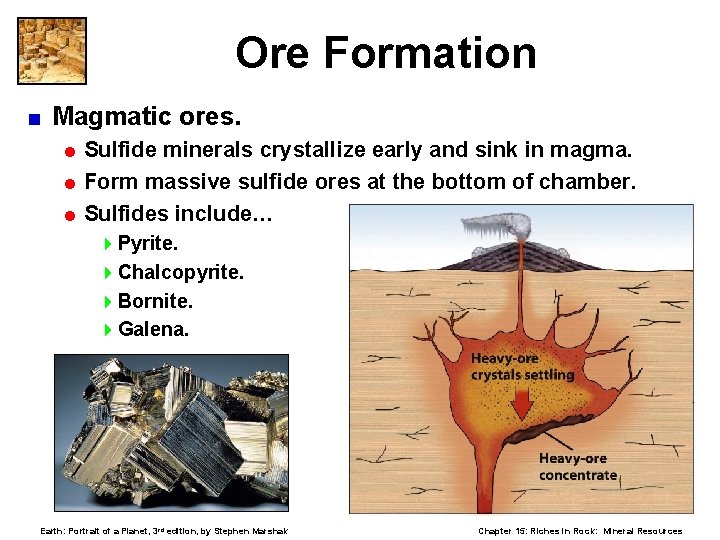
Ore Formation < Magmatic ores. = Sulfide minerals crystallize early and sink in magma. = Form massive sulfide ores at the bottom of chamber. = Sulfides include… 4 Pyrite. 4 Chalcopyrite. 4 Bornite. 4 Galena. Earth: Portrait of a Planet, 3 rd edition, by Stephen Marshak Chapter 15: Riches in Rock: Mineral Resources
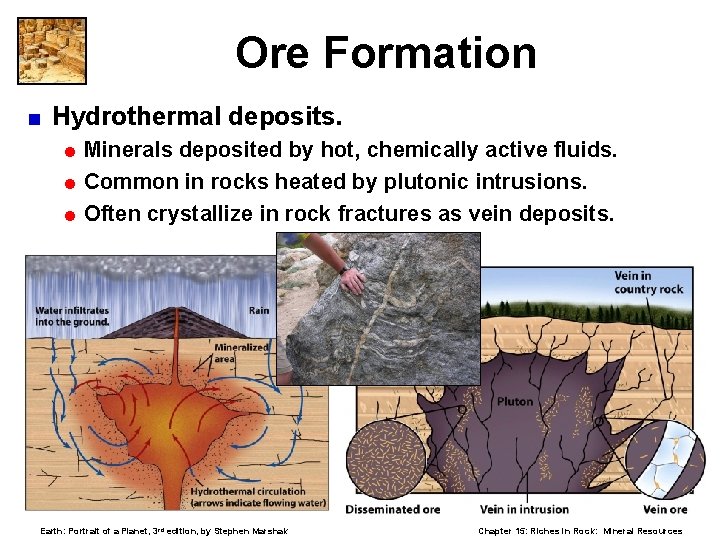
Ore Formation < Hydrothermal deposits. = Minerals deposited by hot, chemically active fluids. = Common in rocks heated by plutonic intrusions. = Often crystallize in rock fractures as vein deposits. Earth: Portrait of a Planet, 3 rd edition, by Stephen Marshak Chapter 15: Riches in Rock: Mineral Resources
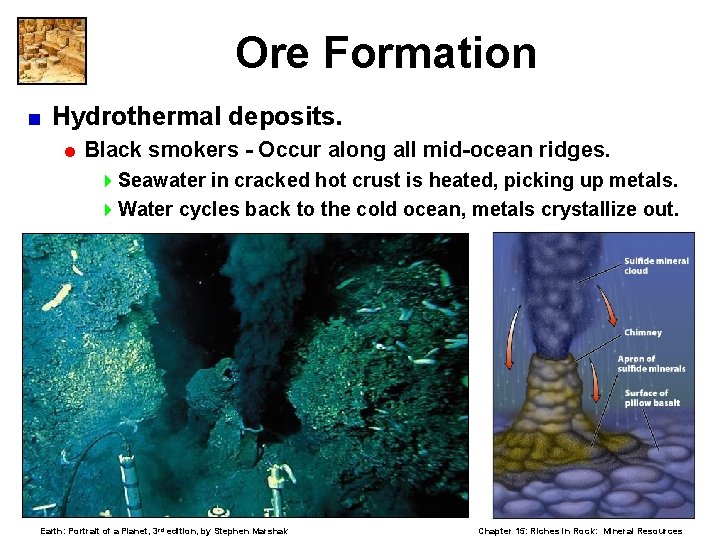
Ore Formation < Hydrothermal deposits. = Black smokers - Occur along all mid-ocean ridges. 4 Seawater in cracked hot crust is heated, picking up metals. 4 Water cycles back to the cold ocean, metals crystallize out. Earth: Portrait of a Planet, 3 rd edition, by Stephen Marshak Chapter 15: Riches in Rock: Mineral Resources
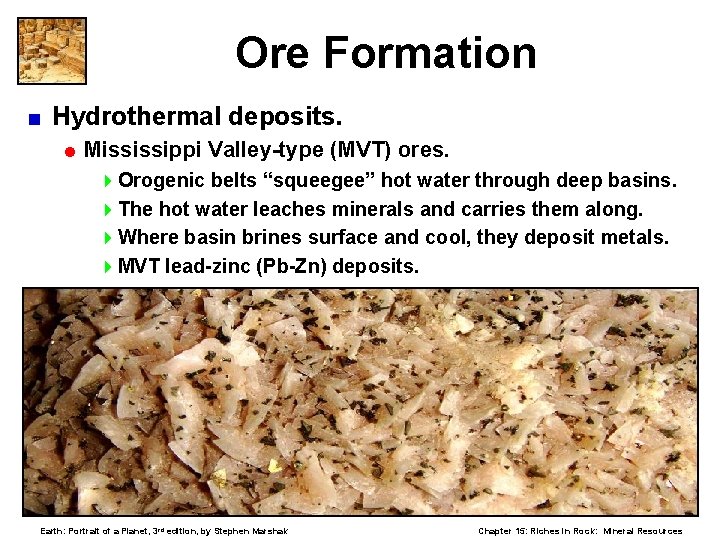
Ore Formation < Hydrothermal deposits. = Mississippi Valley-type (MVT) ores. 4 Orogenic belts “squeegee” hot water through deep basins. 4 The hot water leaches minerals and carries them along. 4 Where basin brines surface and cool, they deposit metals. 4 MVT lead-zinc (Pb-Zn) deposits. Earth: Portrait of a Planet, 3 rd edition, by Stephen Marshak Chapter 15: Riches in Rock: Mineral Resources
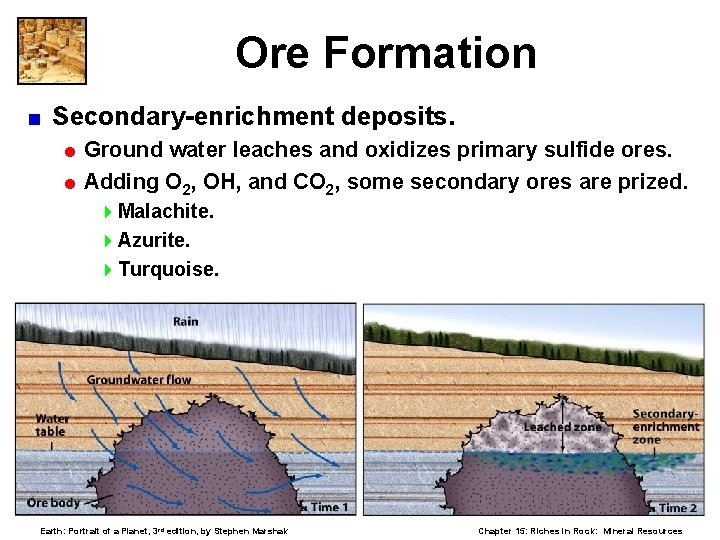
Ore Formation < Secondary-enrichment deposits. = Ground water leaches and oxidizes primary sulfide ores. = Adding O 2, OH, and CO 2, some secondary ores are prized. 4 Malachite. 4 Azurite. 4 Turquoise. Earth: Portrait of a Planet, 3 rd edition, by Stephen Marshak Chapter 15: Riches in Rock: Mineral Resources
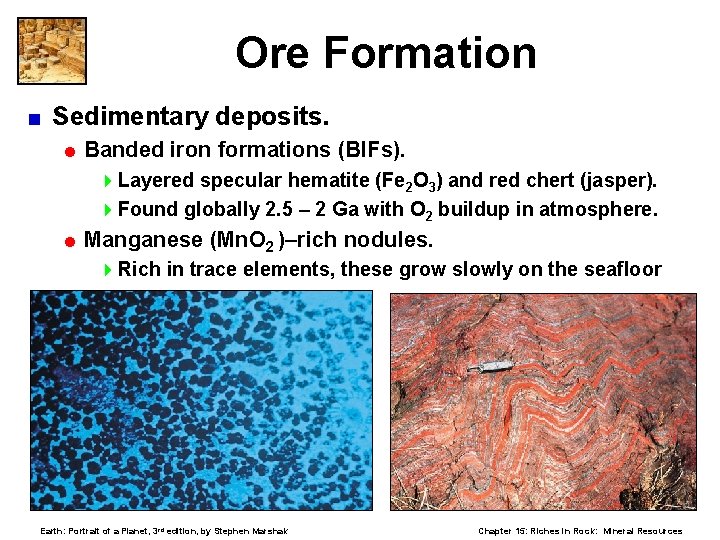
Ore Formation < Sedimentary deposits. = Banded iron formations (BIFs). 4 Layered specular hematite (Fe 2 O 3) and red chert (jasper). 4 Found globally 2. 5 – 2 Ga with O 2 buildup in atmosphere. = Manganese (Mn. O 2 )–rich nodules. 4 Rich in trace elements, these grow slowly on the seafloor Earth: Portrait of a Planet, 3 rd edition, by Stephen Marshak Chapter 15: Riches in Rock: Mineral Resources
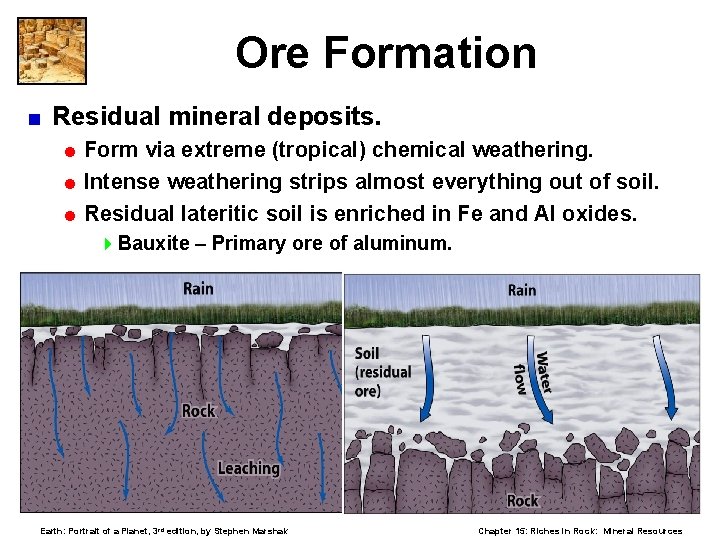
Ore Formation < Residual mineral deposits. = Form via extreme (tropical) chemical weathering. = Intense weathering strips almost everything out of soil. = Residual lateritic soil is enriched in Fe and Al oxides. 4 Bauxite – Primary ore of aluminum. Earth: Portrait of a Planet, 3 rd edition, by Stephen Marshak Chapter 15: Riches in Rock: Mineral Resources
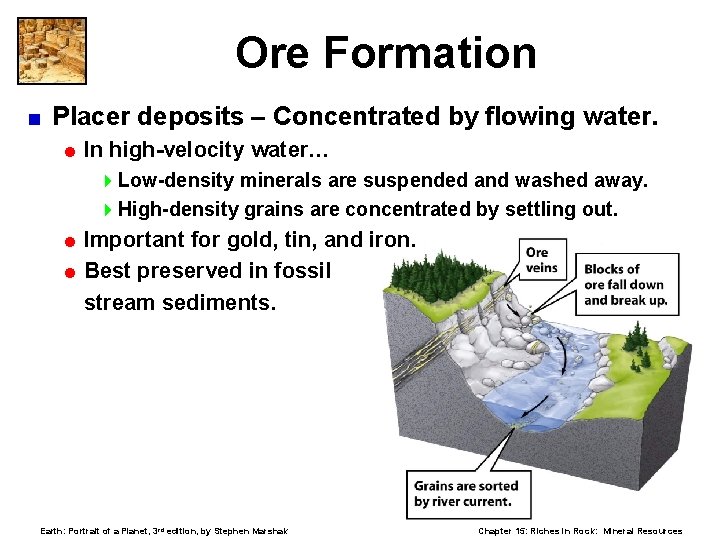
Ore Formation < Placer deposits – Concentrated by flowing water. = In high-velocity water… 4 Low-density minerals are suspended and washed away. 4 High-density grains are concentrated by settling out. = Important for gold, tin, and iron. = Best preserved in fossil stream sediments. Earth: Portrait of a Planet, 3 rd edition, by Stephen Marshak Chapter 15: Riches in Rock: Mineral Resources
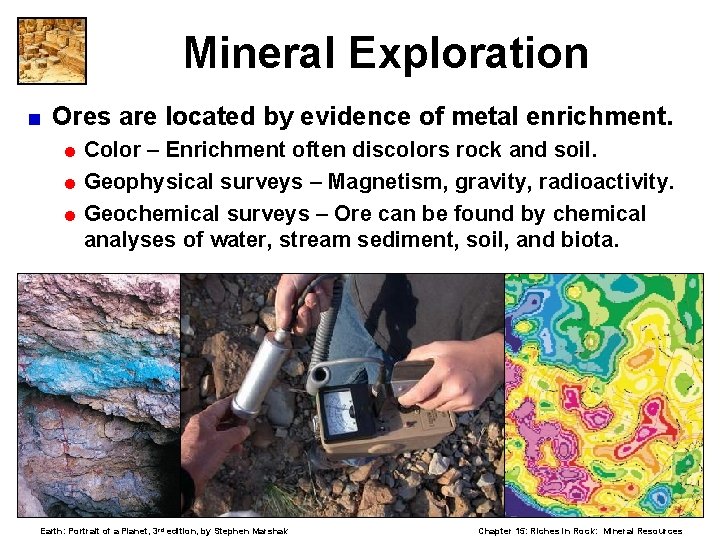
Mineral Exploration < Ores are located by evidence of metal enrichment. = Color – Enrichment often discolors rock and soil. = Geophysical surveys – Magnetism, gravity, radioactivity. = Geochemical surveys – Ore can be found by chemical analyses of water, stream sediment, soil, and biota. Earth: Portrait of a Planet, 3 rd edition, by Stephen Marshak Chapter 15: Riches in Rock: Mineral Resources
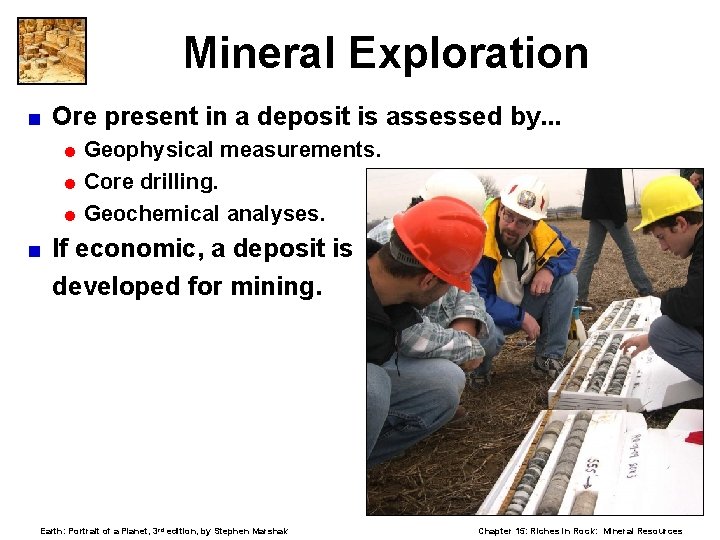
Mineral Exploration < Ore present in a deposit is assessed by. . . = Geophysical measurements. = Core drilling. = Geochemical analyses. < If economic, a deposit is developed for mining. Earth: Portrait of a Planet, 3 rd edition, by Stephen Marshak Chapter 15: Riches in Rock: Mineral Resources
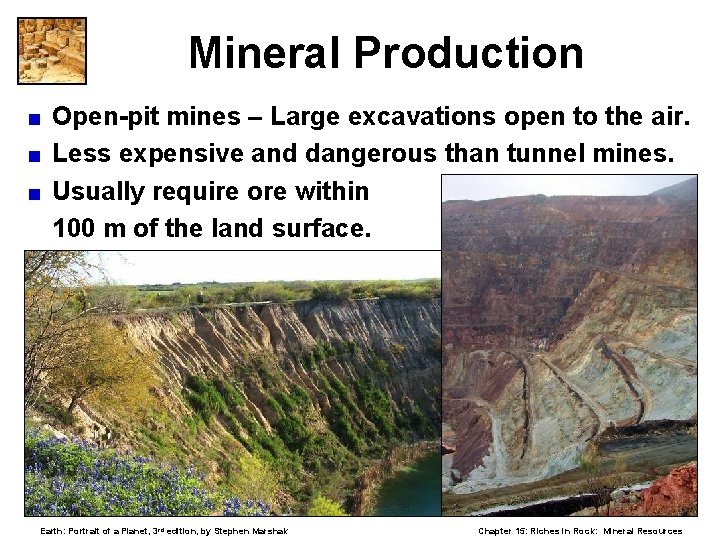
Mineral Production Open-pit mines – Large excavations open to the air. < Less expensive and dangerous than tunnel mines. < Usually require ore within 100 m of the land surface. < Earth: Portrait of a Planet, 3 rd edition, by Stephen Marshak Chapter 15: Riches in Rock: Mineral Resources
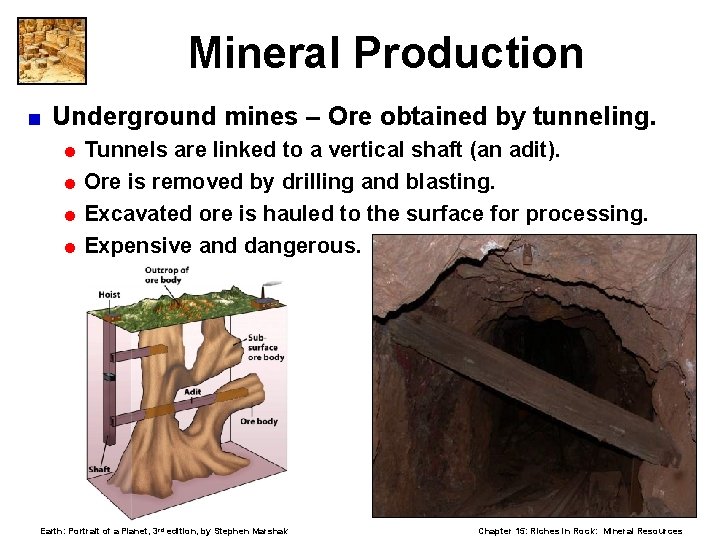
Mineral Production < Underground mines – Ore obtained by tunneling. = Tunnels are linked to a vertical shaft (an adit). = Ore is removed by drilling and blasting. = Excavated ore is hauled to the surface for processing. = Expensive and dangerous. Earth: Portrait of a Planet, 3 rd edition, by Stephen Marshak Chapter 15: Riches in Rock: Mineral Resources
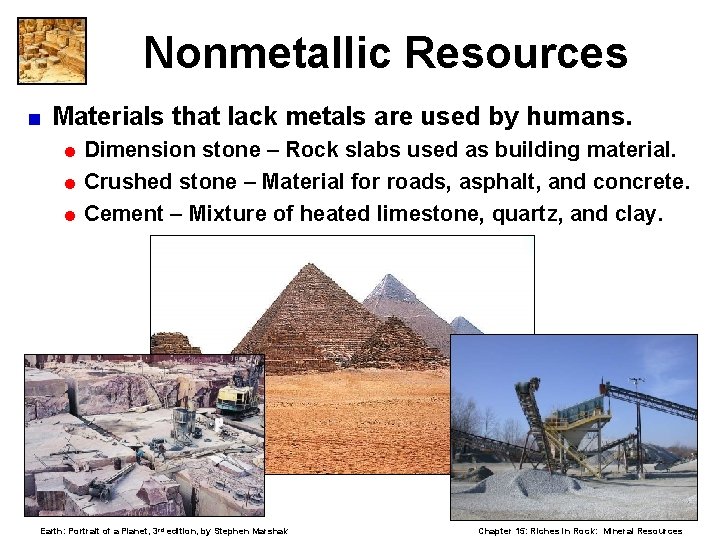
Nonmetallic Resources < Materials that lack metals are used by humans. = Dimension stone – Rock slabs used as building material. = Crushed stone – Material for roads, asphalt, and concrete. = Cement – Mixture of heated limestone, quartz, and clay. Earth: Portrait of a Planet, 3 rd edition, by Stephen Marshak Chapter 15: Riches in Rock: Mineral Resources
Earth: Portrait of a Planet, 3 rd edition, by Stephen Marshak Chapter 15: Riches in Rock: Mineral Resources
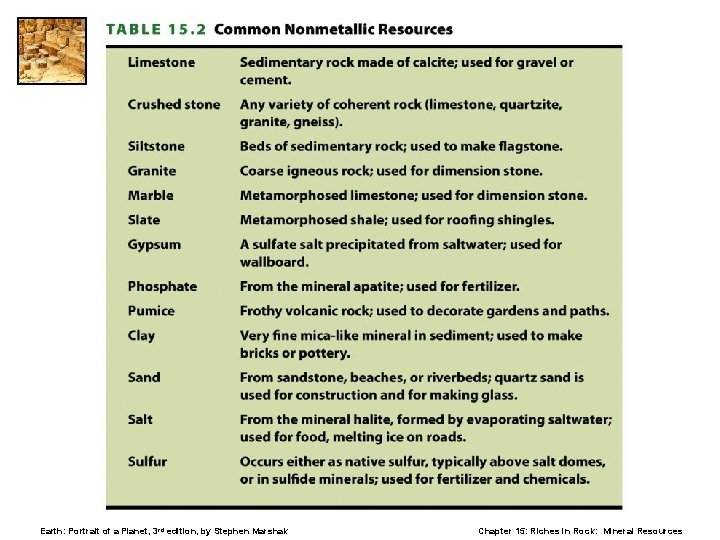
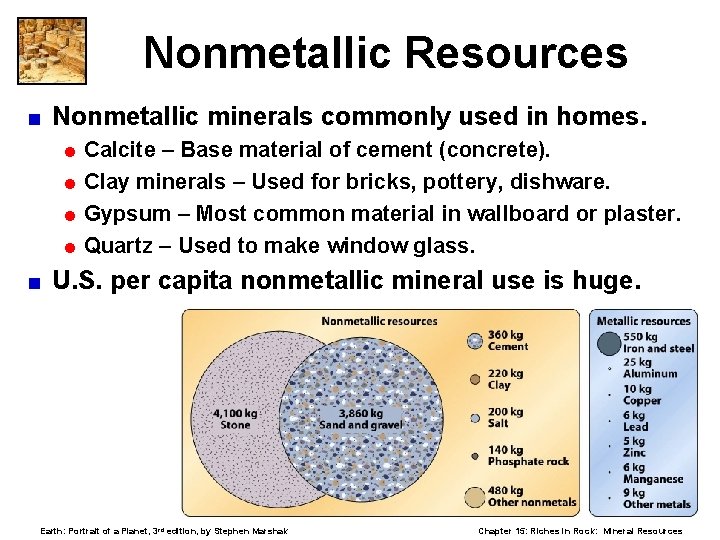
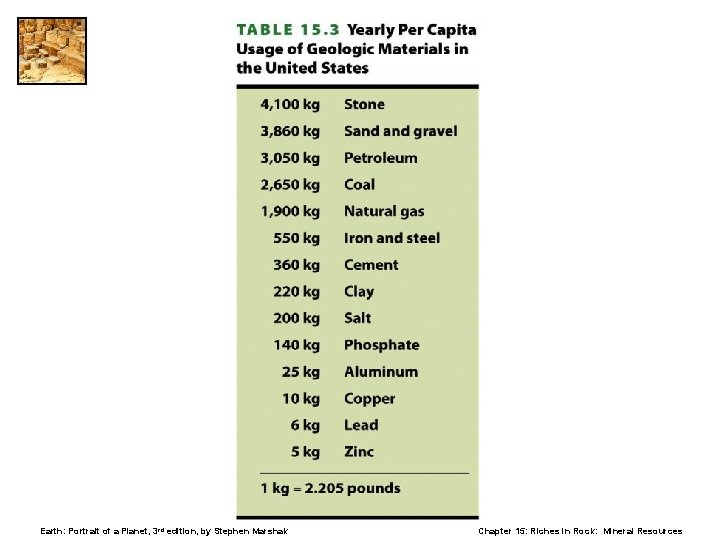
Nonmetallic Resources < Nonmetallic minerals commonly used in homes. = Calcite – Base material of cement (concrete). = Clay minerals – Used for bricks, pottery, dishware. = Gypsum – Most common material in wallboard or plaster. = Quartz – Used to make window glass. < U. S. per capita nonmetallic mineral use is huge. Earth: Portrait of a Planet, 3 rd edition, by Stephen Marshak Chapter 15: Riches in Rock: Mineral Resources
Earth: Portrait of a Planet, 3 rd edition, by Stephen Marshak Chapter 15: Riches in Rock: Mineral Resources
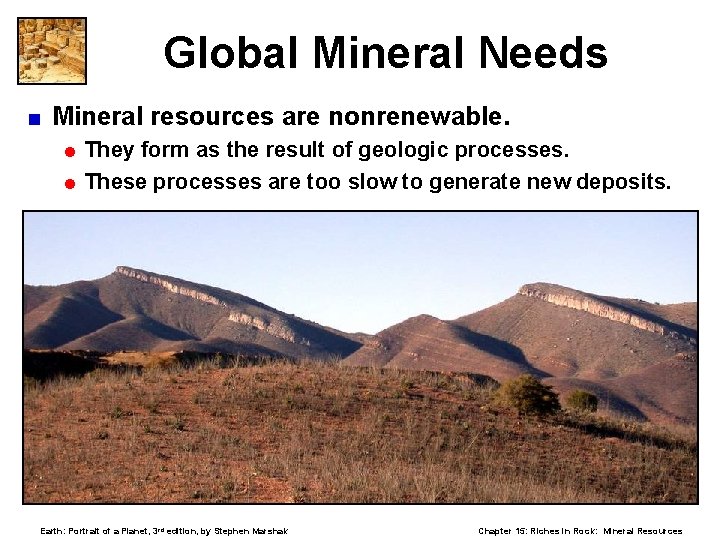
Global Mineral Needs < Mineral resources are nonrenewable. = They form as the result of geologic processes. = These processes are too slow to generate new deposits. Earth: Portrait of a Planet, 3 rd edition, by Stephen Marshak Chapter 15: Riches in Rock: Mineral Resources
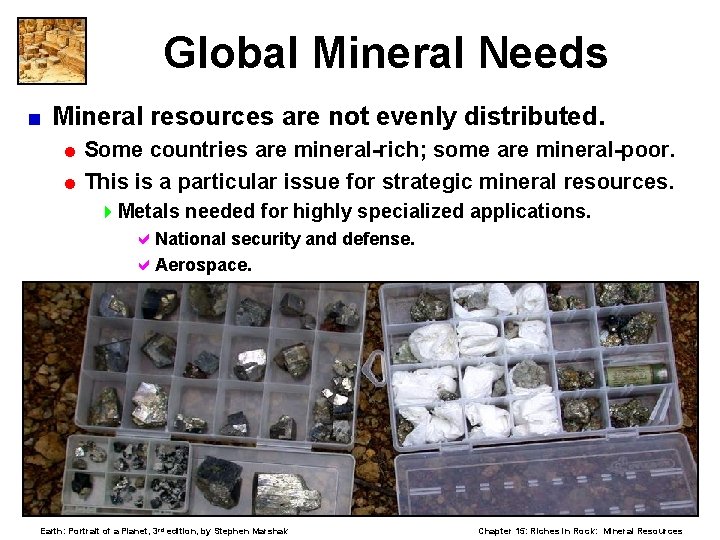
Global Mineral Needs < Mineral resources are not evenly distributed. = Some countries are mineral-rich; some are mineral-poor. = This is a particular issue for strategic mineral resources. 4 Metals needed for highly specialized applications. a. National security and defense. a. Aerospace. Earth: Portrait of a Planet, 3 rd edition, by Stephen Marshak Chapter 15: Riches in Rock: Mineral Resources
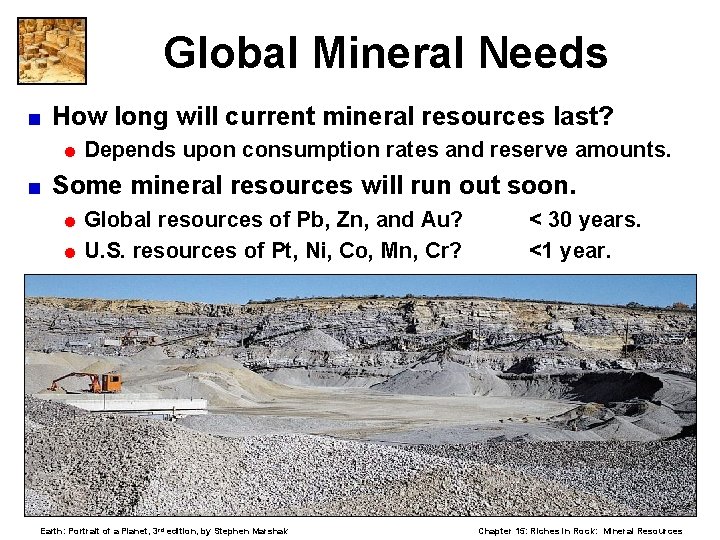
Global Mineral Needs < How long will current mineral resources last? = Depends < upon consumption rates and reserve amounts. Some mineral resources will run out soon. = Global resources of Pb, Zn, and Au? = U. S. resources of Pt, Ni, Co, Mn, Cr? Earth: Portrait of a Planet, 3 rd edition, by Stephen Marshak < 30 years. <1 year. Chapter 15: Riches in Rock: Mineral Resources
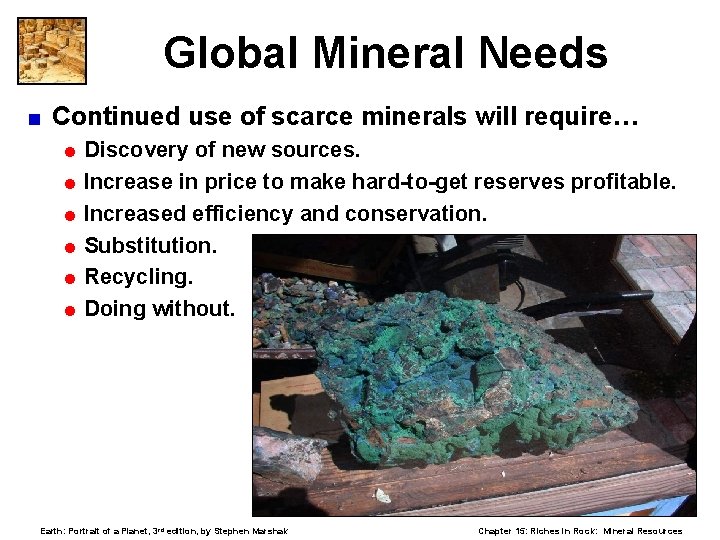
Global Mineral Needs < Continued use of scarce minerals will require… = Discovery of new sources. = Increase in price to make hard-to-get reserves profitable. = Increased efficiency and conservation. = Substitution. = Recycling. = Doing without. Earth: Portrait of a Planet, 3 rd edition, by Stephen Marshak Chapter 15: Riches in Rock: Mineral Resources
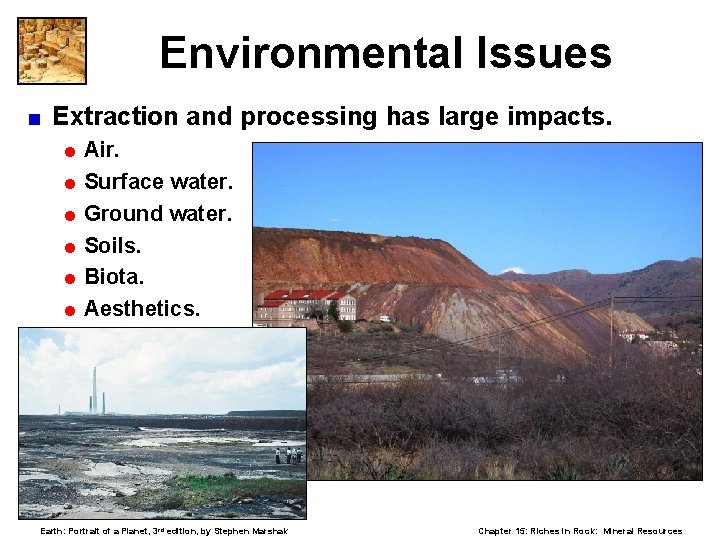
Environmental Issues < Extraction and processing has large impacts. = Air. = Surface water. = Ground water. = Soils. = Biota. = Aesthetics. Earth: Portrait of a Planet, 3 rd edition, by Stephen Marshak Chapter 15: Riches in Rock: Mineral Resources
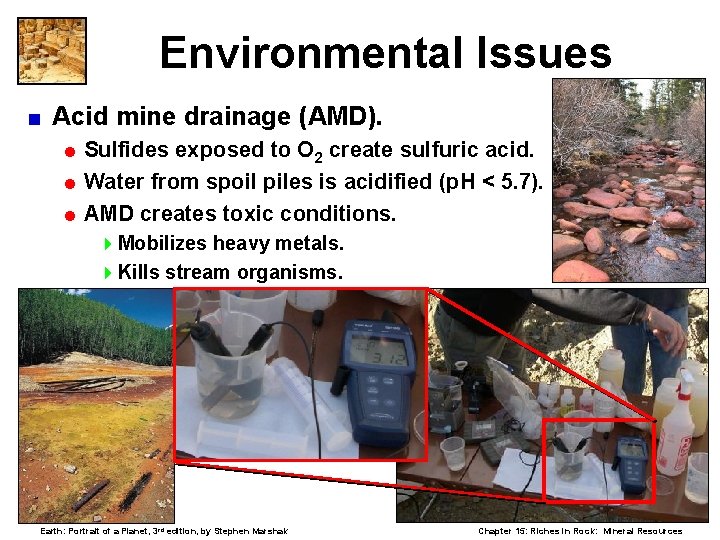
Environmental Issues < Acid mine drainage (AMD). = Sulfides exposed to O 2 create sulfuric acid. = Water from spoil piles is acidified (p. H < 5. 7). = AMD creates toxic conditions. 4 Mobilizes heavy metals. 4 Kills stream organisms. Earth: Portrait of a Planet, 3 rd edition, by Stephen Marshak Chapter 15: Riches in Rock: Mineral Resources
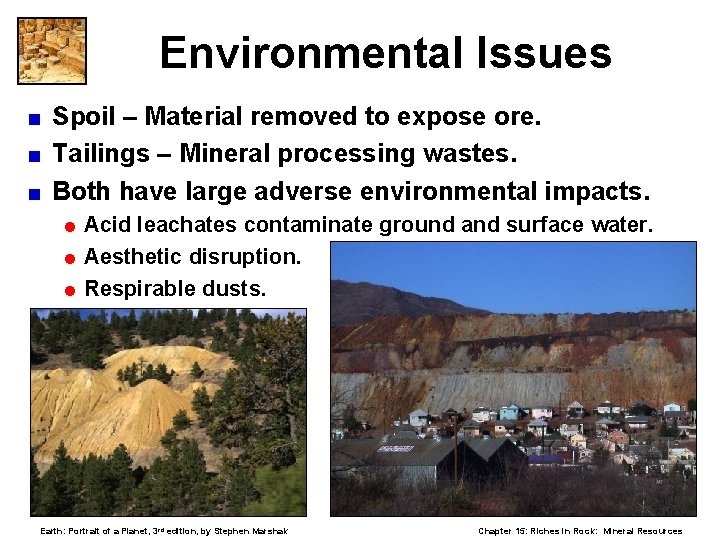
Environmental Issues Spoil – Material removed to expose ore. < Tailings – Mineral processing wastes. < Both have large adverse environmental impacts. < = Acid leachates contaminate ground and surface water. = Aesthetic disruption. = Respirable dusts. Earth: Portrait of a Planet, 3 rd edition, by Stephen Marshak Chapter 15: Riches in Rock: Mineral Resources
This concludes the Chapter 15 Riches in Rock: Mineral Resources LECTURE OUTLINE earth Portrait of a Planet Third Edition © 2008 W. W. Norton & Company, Inc. Earth: Portrait of a Planet, 3 rd edition, by Stephen Marshak Chapter 15: Riches in Rock: Mineral Resources