
Chapter 15 Required Returns and the Cost of

![Economic Value Added EVA = NOPAT – [Cost of Capital x Capital Employed] 15](https://slidetodoc.com/presentation_image/c545c50cdfe5b879303d2b926ebabd0b/image-22.jpg "Economic Value Added EVA = NOPAT – [Cost of Capital x Capital Employed] 15")
- Slides: 24
Chapter 15 Required Returns and the Cost of Capital 15 -1 © Pearson Education Limited 2004 Fundamentals of Financial Management, 12/e Created by: Gregory A. Kuhlemeyer, Ph. D. Carroll College, Waukesha, WI
Overall Cost of Capital of the Firm Cost of Capital is the required rate of return on the various types of financing. The overall cost of capital is a weighted average of the individual required rates of return (costs). 15 -2
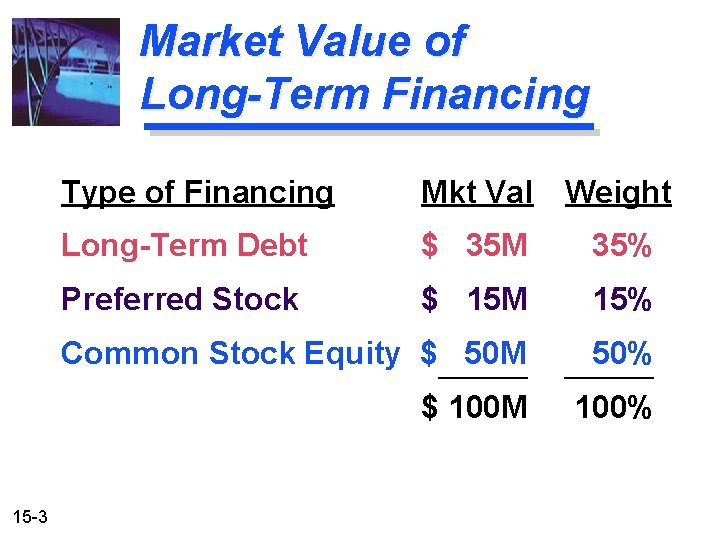
Market Value of Long-Term Financing 15 -3 Type of Financing Mkt Val Weight Long-Term Debt $ 35 M 35% Preferred Stock $ 15 M 15% Common Stock Equity $ 50 M 50% $ 100 M 100%
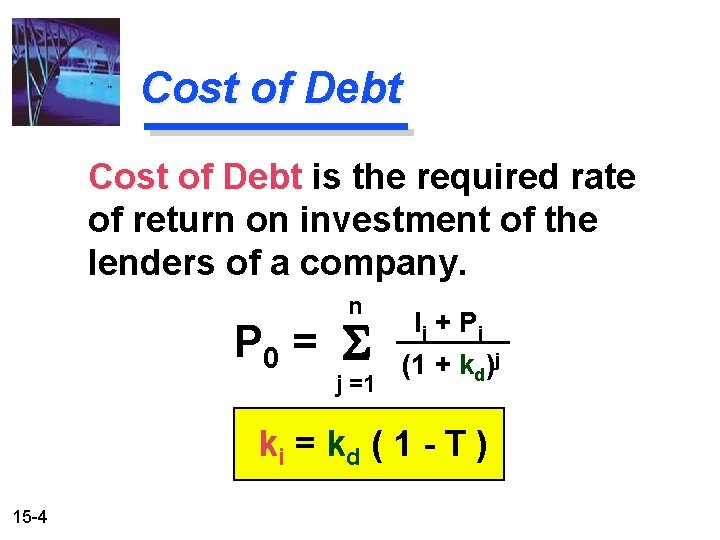
Cost of Debt is the required rate of return on investment of the lenders of a company. n P 0 = S j =1 Ij + P j (1 + kd)j ki = kd ( 1 - T ) 15 -4
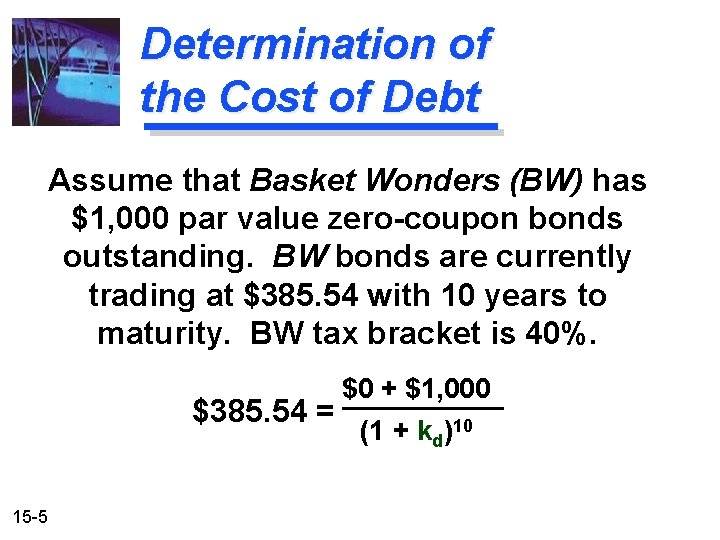
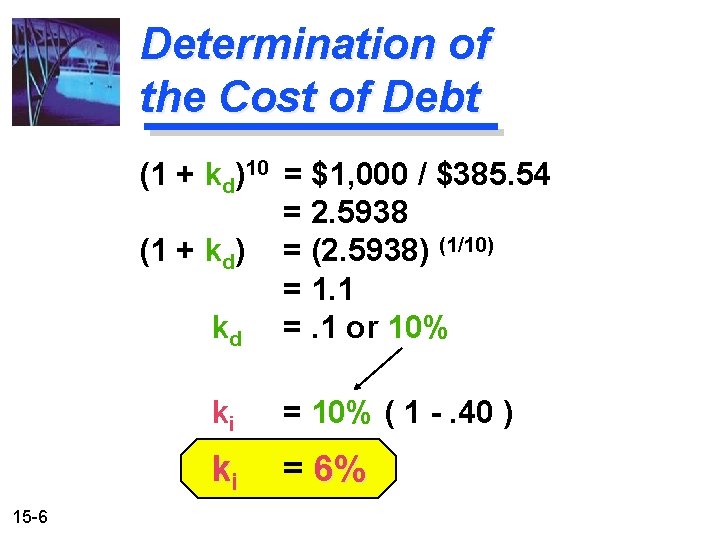
Determination of the Cost of Debt Assume that Basket Wonders (BW) has $1, 000 par value zero-coupon bonds outstanding. BW bonds are currently trading at $385. 54 with 10 years to maturity. BW tax bracket is 40%. $0 + $1, 000 $385. 54 = (1 + kd)10 15 -5
Determination of the Cost of Debt (1 + kd)10 = $1, 000 / $385. 54 = 2. 5938 (1 + kd) = (2. 5938) (1/10) = 1. 1 kd =. 1 or 10% 15 -6 ki = 10% ( 1 -. 40 ) ki = 6%
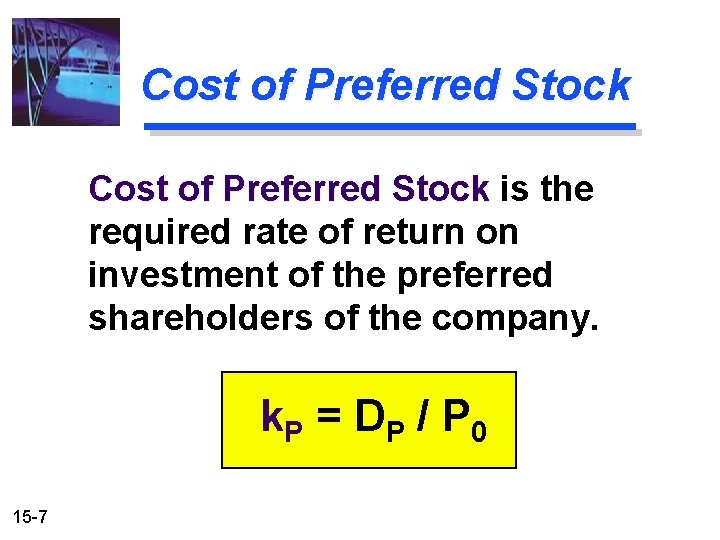
Cost of Preferred Stock is the required rate of return on investment of the preferred shareholders of the company. k. P = D P / P 0 15 -7
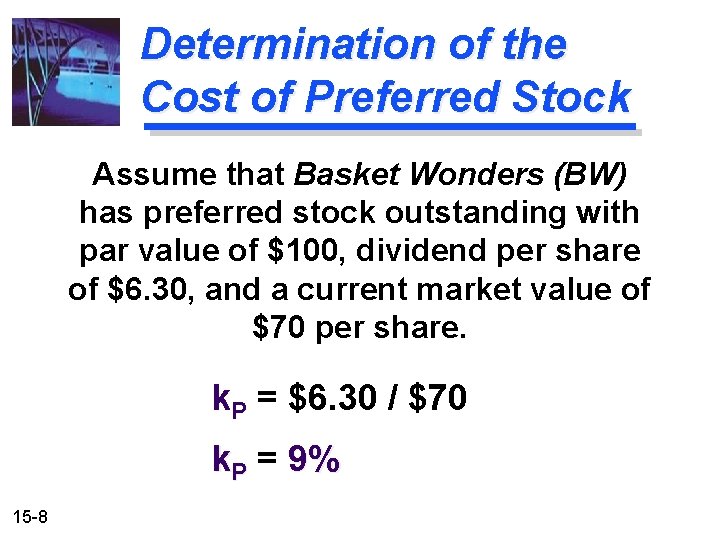
Determination of the Cost of Preferred Stock Assume that Basket Wonders (BW) has preferred stock outstanding with par value of $100, dividend per share of $6. 30, and a current market value of $70 per share. k. P = $6. 30 / $70 k. P = 9% 15 -8
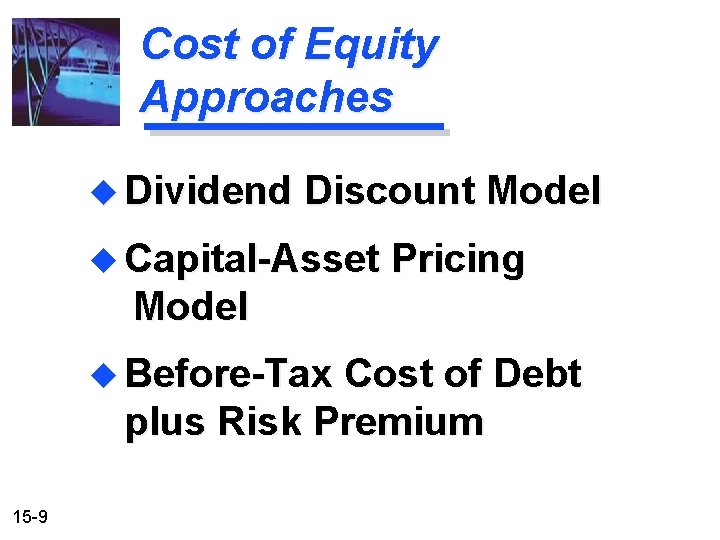
Cost of Equity Approaches u Dividend Discount Model u Capital-Asset Pricing Model u Before-Tax Cost of Debt plus Risk Premium 15 -9
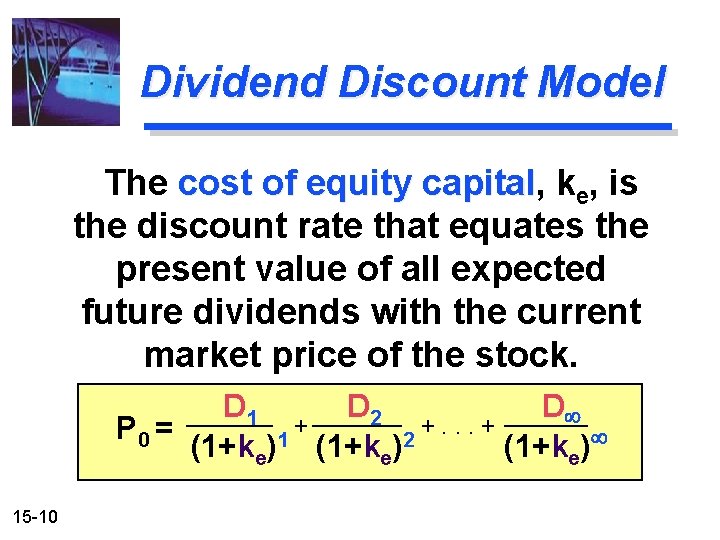
Dividend Discount Model The cost of equity capital, capital ke, is the discount rate that equates the present value of all expected future dividends with the current market price of the stock. D 1 D 2 D¥ + +. . . + P 0 = 1 2 (1+ke)¥ 15 -10
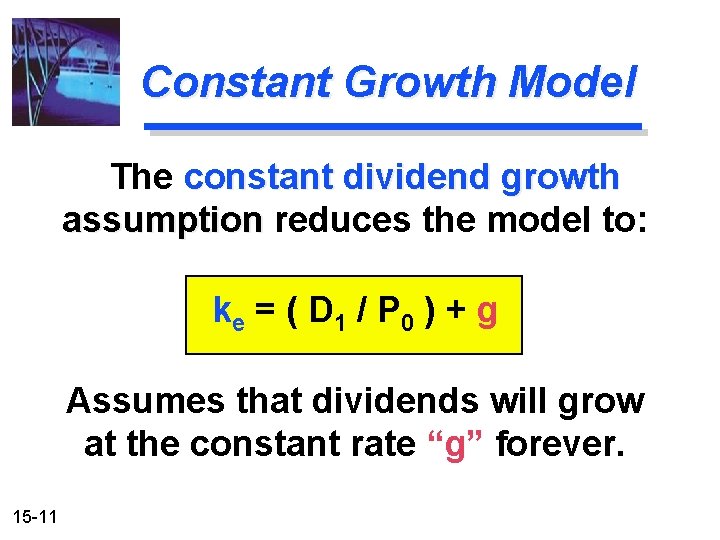
Constant Growth Model The constant dividend growth assumption reduces the model to: ke = ( D 1 / P 0 ) + g Assumes that dividends will grow at the constant rate “g” forever. 15 -11
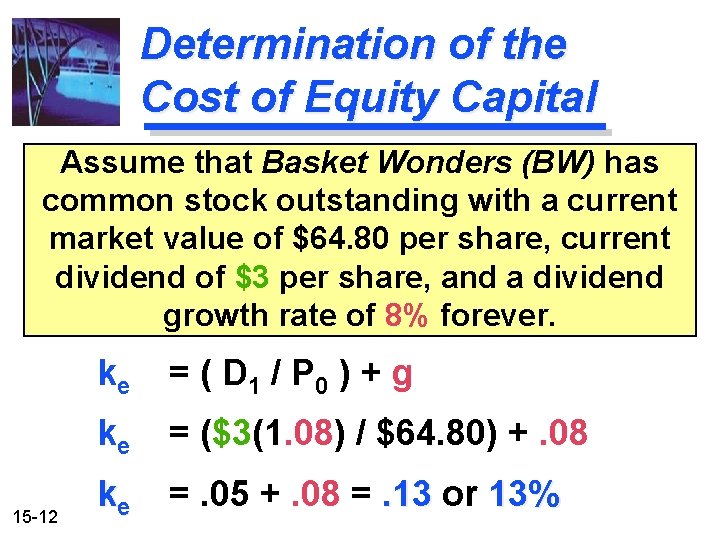
Determination of the Cost of Equity Capital Assume that Basket Wonders (BW) has common stock outstanding with a current market value of $64. 80 per share, current dividend of $3 per share, and a dividend growth rate of 8% forever. 15 -12 ke = ( D 1 / P 0 ) + g ke = ($3(1. 08) / $64. 80) +. 08 ke =. 05 +. 08 =. 13 or 13%
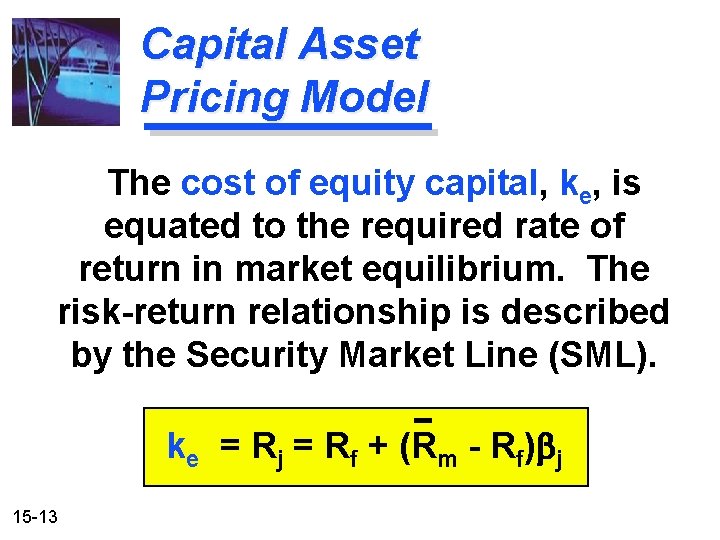
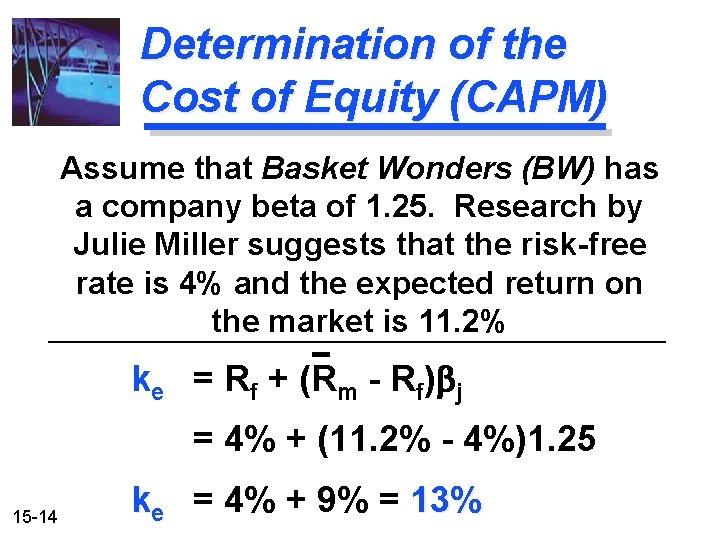
Capital Asset Pricing Model The cost of equity capital, ke, is equated to the required rate of return in market equilibrium. The risk-return relationship is described by the Security Market Line (SML). ke = Rj = Rf + (Rm - Rf)bj 15 -13
Determination of the Cost of Equity (CAPM) Assume that Basket Wonders (BW) has a company beta of 1. 25. Research by Julie Miller suggests that the risk-free rate is 4% and the expected return on the market is 11. 2% ke = Rf + (Rm - Rf)bj = 4% + (11. 2% - 4%)1. 25 15 -14 ke = 4% + 9% = 13%
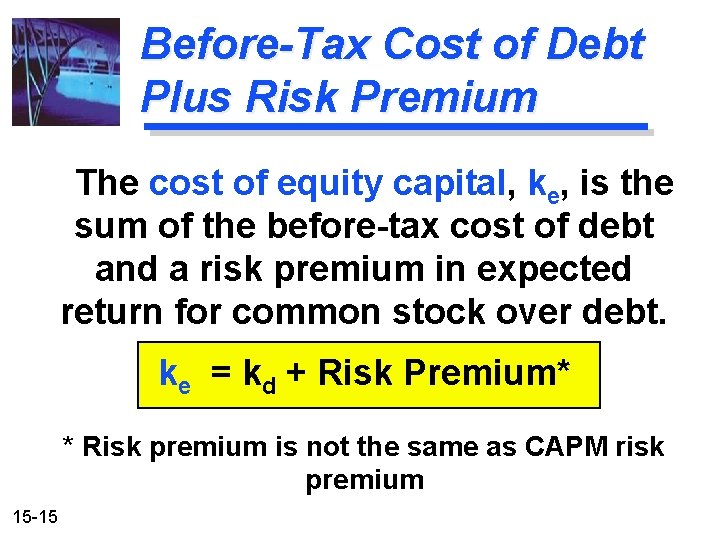
Before-Tax Cost of Debt Plus Risk Premium The cost of equity capital, ke, is the sum of the before-tax cost of debt and a risk premium in expected return for common stock over debt. ke = kd + Risk Premium* * Risk premium is not the same as CAPM risk premium 15 -15
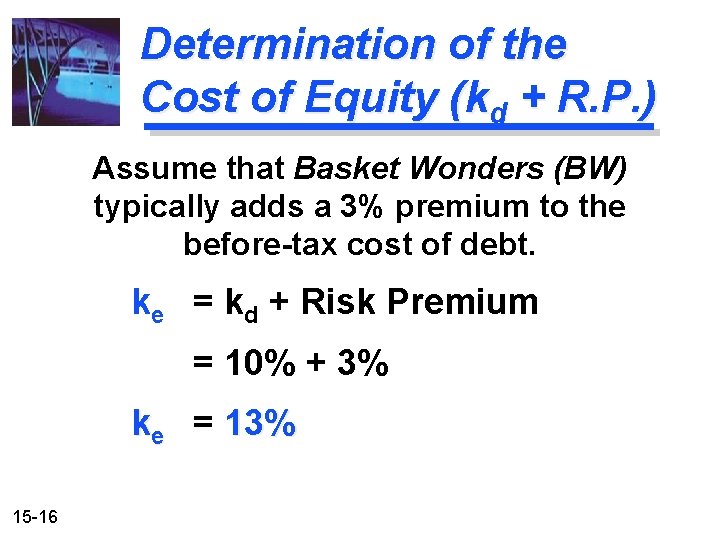
Determination of the Cost of Equity (kd + R. P. ) Assume that Basket Wonders (BW) typically adds a 3% premium to the before-tax cost of debt. ke = kd + Risk Premium = 10% + 3% ke = 13% 15 -16
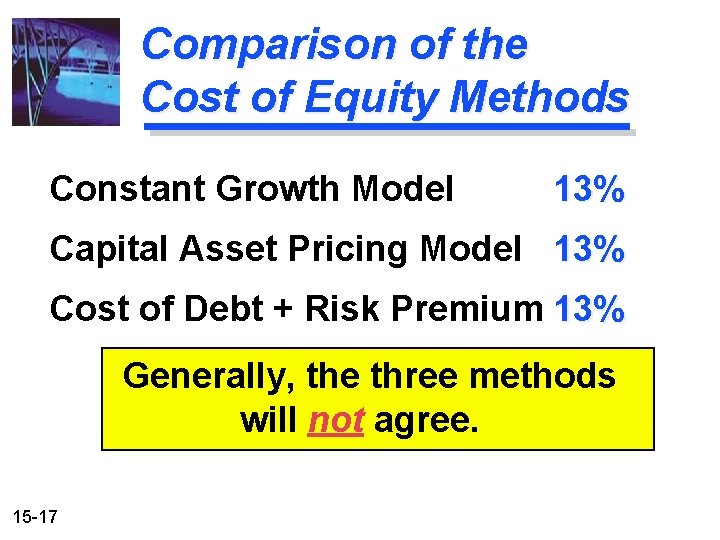
Comparison of the Cost of Equity Methods Constant Growth Model 13% Capital Asset Pricing Model 13% Cost of Debt + Risk Premium 13% Generally, the three methods will not agree. 15 -17
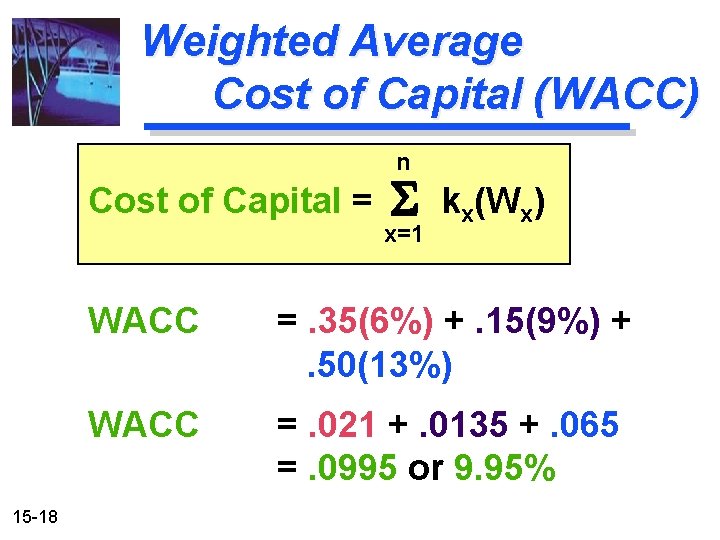
Weighted Average Cost of Capital (WACC) n Cost of Capital = 15 -18 S x=1 kx(Wx) WACC =. 35(6%) +. 15(9%) +. 50(13%) WACC =. 021 +. 0135 +. 065 =. 0995 or 9. 95%
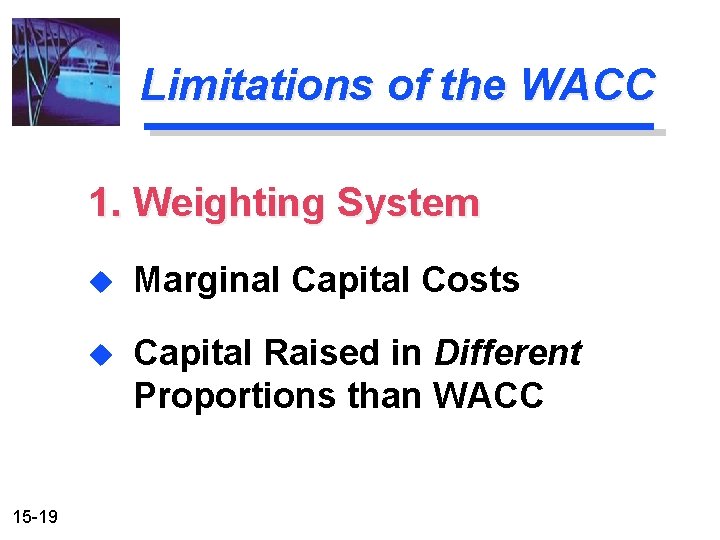
Limitations of the WACC 1. Weighting System 15 -19 u Marginal Capital Costs u Capital Raised in Different Proportions than WACC
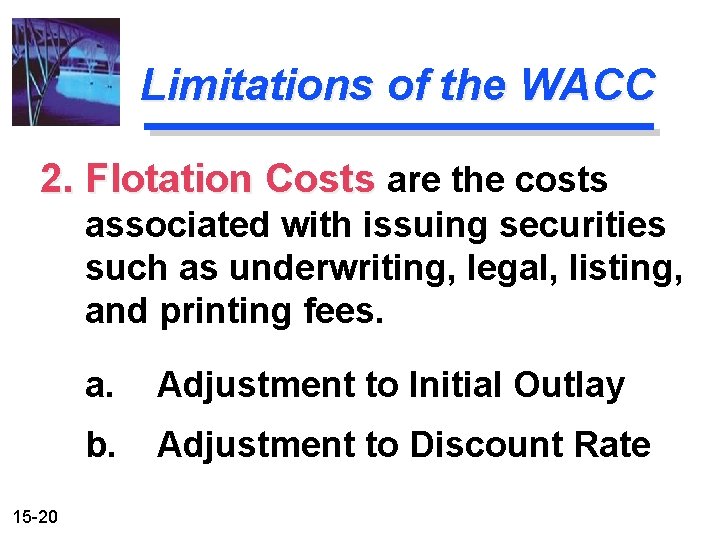
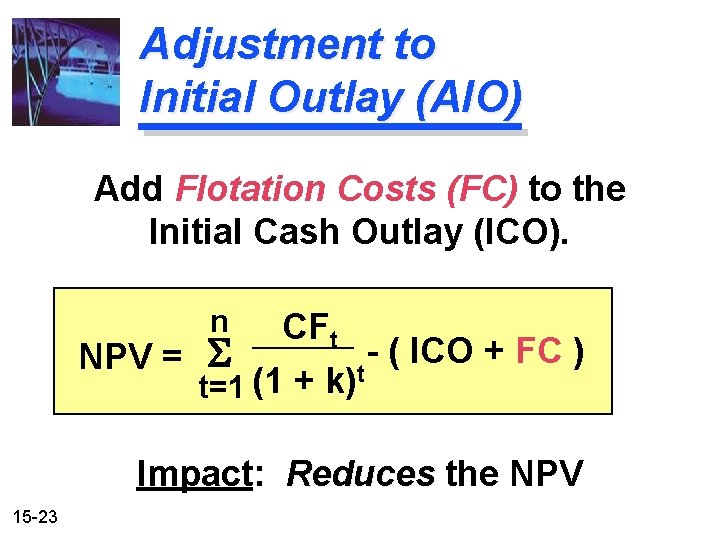
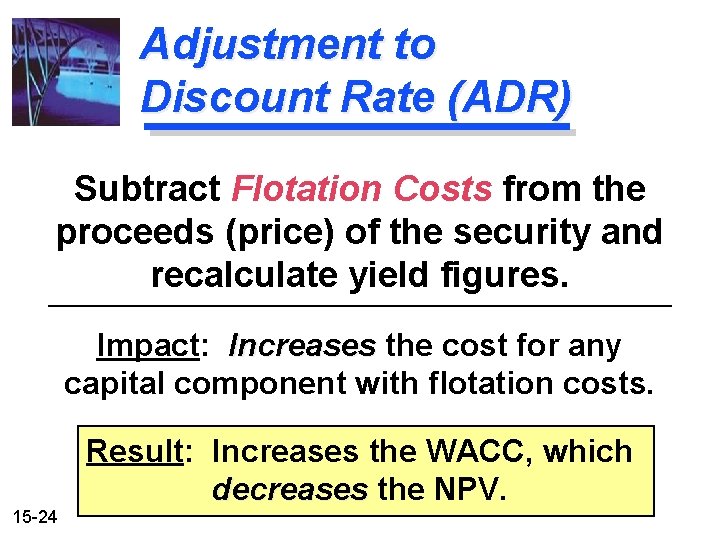
Limitations of the WACC 2. Flotation Costs are the costs associated with issuing securities such as underwriting, legal, listing, and printing fees. 15 -20 a. Adjustment to Initial Outlay b. Adjustment to Discount Rate
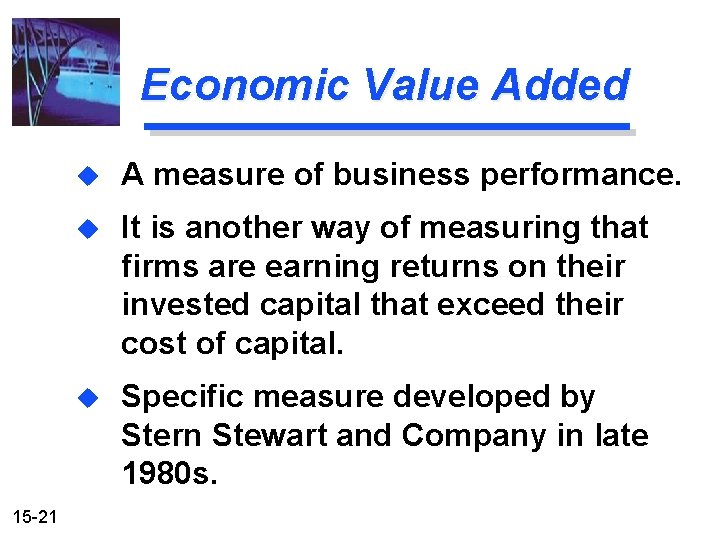
Economic Value Added 15 -21 u A measure of business performance. u It is another way of measuring that firms are earning returns on their invested capital that exceed their cost of capital. u Specific measure developed by Stern Stewart and Company in late 1980 s.
Economic Value Added EVA = NOPAT – [Cost of Capital x Capital Employed] 15 -22 u Since a cost is charged for equity capital also, a positive EVA generally indicates shareholder value is being created. u Based on Economic NOT Accounting Profit. u NOPAT – net operating profit after tax is a company’s potential after-tax profit if it was allequity-financed or “unlevered. ”
Adjustment to Initial Outlay (AIO) Add Flotation Costs (FC) to the Initial Cash Outlay (ICO). n CFt - ( ICO + FC ) NPV = S t (1 + k) t=1 Impact: Reduces the NPV 15 -23
Adjustment to Discount Rate (ADR) Subtract Flotation Costs from the proceeds (price) of the security and recalculate yield figures. Impact: Increases the cost for any capital component with flotation costs. 15 -24 Result: Increases the WACC, which decreases the NPV.