
CHAPTER 15 Reconstruction 1865 1877 Copyright 2014 by
CHAPTER 15 Reconstruction 1865– 1877 Copyright © 2014 by Bedford/St. Martin’s
I. The Struggle for National Reconstruction A. Presidential Approaches: From Lincoln to Johnson 1. Lincoln- offered a Ten Percent Plan (restoration to Union when 10 percent of the state’s voters had sworn loyalty); He felt everyone had lost someone during the war and tried to make the readmittence as easy as possible. Confederate states rejected this plan, and Radical Republican held Congress felt it was too lenient, so they proposed Wade. Davis Bill (required loyalty of a majority of adult white men, no rebels in government, and permanent disenfranchisement of CSA leaders). Lincoln pocket-vetoed Wade-Davis; his assassination plunged the nation into political uncertainty.
I. The Struggle for National Reconstruction 2. Johnson (D-TN)- Was a self-styled “common man” from Tennessee; was loyal to the Union during the war; offered amnesty to all Southerners who swore allegiance except CSA aristocratic leaders (they had to ask him personally). Provisional governors for South and asked for ratification of the Thirteenth Amendment; he supported it because it hurt rich plantation owners, and not because he cared for black people. Republicans disliked Johnson and called him a traitor to the Union. Furthermore, he encouraged Black Codes to be passed in the South (imposed penalties against unemployed blacks, curfew laws, no firearms, no jury duty, interracial marriage prohibited, and apprenticed them to former slave holders under “work contracts”); and he eased restrictions on ex. Confederates who wanted reenter local & state politics.
I. The Struggle for National Reconstruction B. Congress Versus the President 1. Freedmen’s Bureau – Anti-black violence increased in the South under Johnson; in March 1865, Freedmen’s Bureau had been established by Congress to assist former slaves and was given direct funding in early 1866; Civil Rights Act of 1866 declared formerly enslaved people to be citizens and granted them equal protection and rights of contract, with full access to courts; both bills were vetoed by Johnson; Congress overrode vetoes and passed both; violence increased further by terrorist groups (KKK). 2. Radical Republicans and the Fourteenth Amendment Stated that “all persons born or naturalized in the United States” were citizens; 1866 congressional elections gave Republicans a 3 -to-1 majority; Radical Republicans were led by Senator Charles Sumner (R-MA) and House leader Thaddeus Stevens (R-PA). Johnson vetoed, but it was overridden.
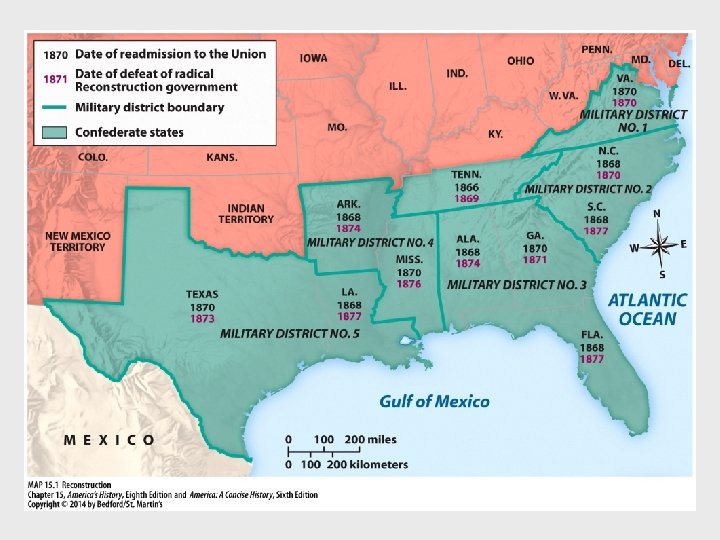
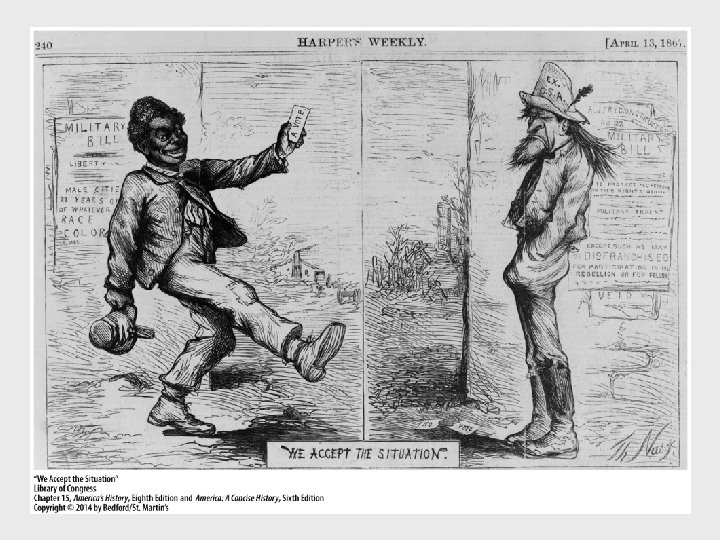
I. The Struggle for National Reconstruction C. Radical Reconstruction 1. The Reconstruction Act of 1867 – Divides the South into 5 military districts. Gave vote to all freedmen and denied it to ex. Confederates; 14 th Amendments to be ratified in each state. Johnson vetoes, but it is overridden. 2. The Impeachment of Andrew Johnson - Radicals passed the Tenure of Office Act in 1867 (prohibited the dismissing of cabinet members without the consent of the Senate). Johnson formally dismissed one of Lincoln’s cabinet choices Edwin Stanton (Sec. War). Impeachment charges were brought and by 1 vote he was not found guilty. Although most people in Congress disliked Johnson, the dissenting opinion was based on the damage this “political” power play would have on the check and balance system established by the Constitution.
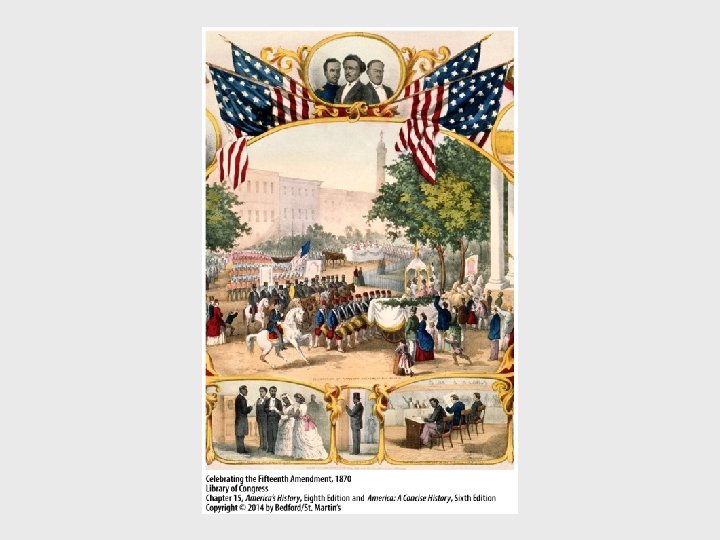
I. The Struggle for National Reconstruction 3. Election of 1868 and the Fifteenth Amendment Grant was viewed as a war hero and a political hero (for his dislike of Johnson’s policies). He wanted reconciliation between the states and won easily. Republicans produced the Fifteenth Amendment: “federal government and states could not deny citizens voting rights on the basis of race, color, or previous condition of servitude. ” However, it did not outlaw poll taxes or literacy tests (used in northern and , western states to keep immigrants and poor from the polls).
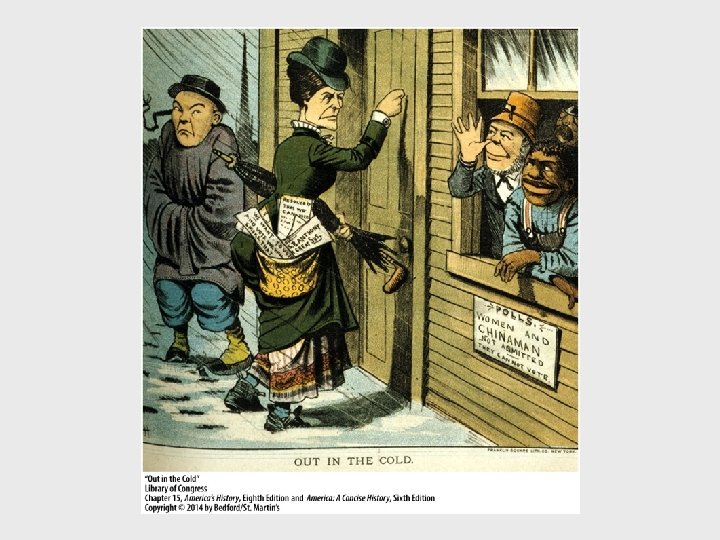
I. The Struggle for National Reconstruction D. Woman Suffrage Denied 1. The movement splits - Frustration felt within the women’s movement when black men were granted suffrage; northern men opposed suffrage for women; Equal Rights Association convention revealed some of the women’s frustration (ex: Elizabeth Cady Stanton). 2. National Woman Suffrage Association (NWSA) Women’s rights supporters split over the issue of black male suffrage; Lucy Stone and Julia Ward Howe organized American Woman Suffrage Association (AWSA) to support Republicans’ efforts for black men; Stanton and Susan B. Anthony created NWSA to advocate for a suffrage amendment for women. Legal challenges to the Constitution ruled that while women were citizens, they could still be denied suffrage by their states.
II. The Meaning of Freedom A. The Quest for Land 1. Freed Slaves and Northerners: Conflicting Goals Gaps between the goals of freedmen and of politicians; many Northerners believed that wage labor would overtake the South; instead, former slaves wanted land; Republicans did not want to confiscate land, though former slaves felt entitled to it; few states developed opportunities for freedmen to purchase land; most were economically vulnerable to discrimination.
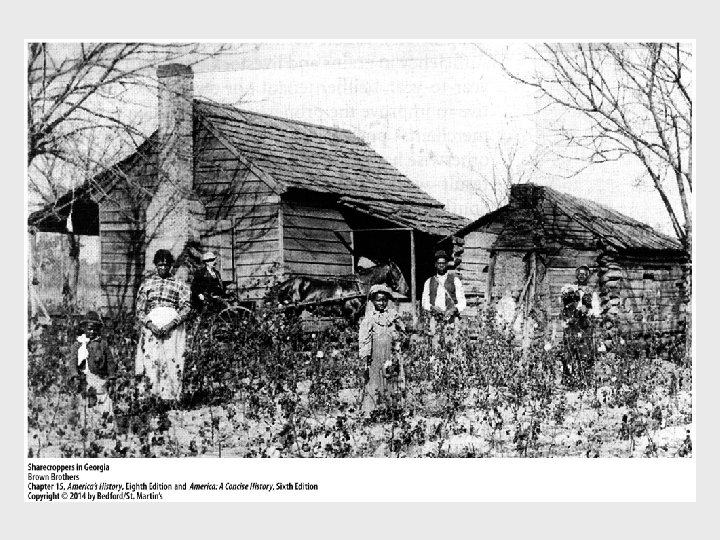
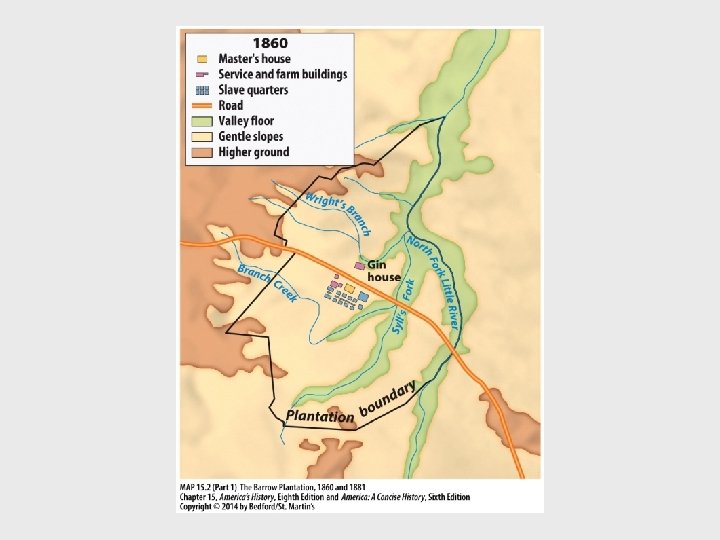
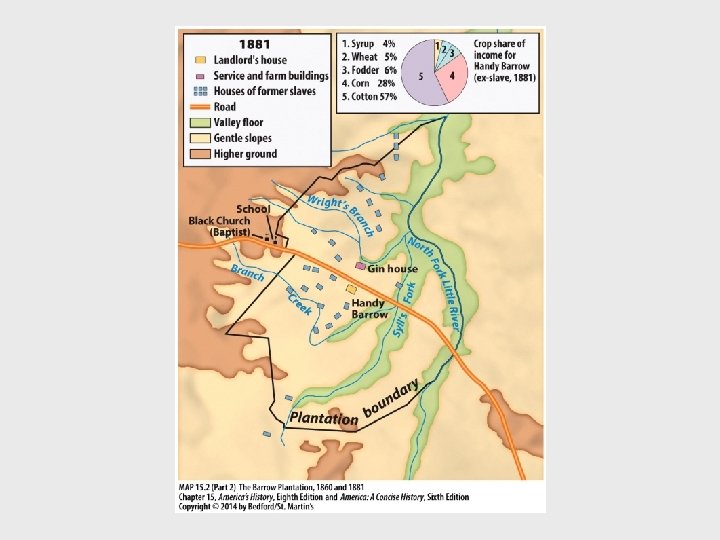
II. The Meaning of Freedom – 2. Wage Labor and Sharecropping - Many former slaves had to work former owners; received a wage instead of food, clothing, shelter; extremely low wages meant starvation; system of sharecropping arose, in which freedmen worked as renters, exchanging their labor for the use of land, house, tools, and sometimes seed/fertilizer; as cotton prices declined in the 1870 s, more and more sharecroppers fell into permanent debt, which became a pretext forced labor, or peonage; industrialization did not replace agriculture in the South.
II. The Meaning of Freedom B. Republican Governments in the South 1. Rejoining the Union - All southern states rejoined the Union between 1868 and 1871; Republican governments included African Americans. They were progressive, eyeing reform in education, social services, commerce, and transportation. In the late 1860 s, the southern Republican Party included whites and blacks. Freedmen’s Bureau played key role in creating colleges for African Americans. 2. Scalawags and carpetbaggers - Ex-CSA men viewed the southern whites who supported Reconstruction as “scalawags”; they denounced northern whites as “carpetbaggers, ” self-seeking interlopers who moved to the South with belongings in cheap suitcases called carpetbags; many who came to the South did so for economic opportunity.
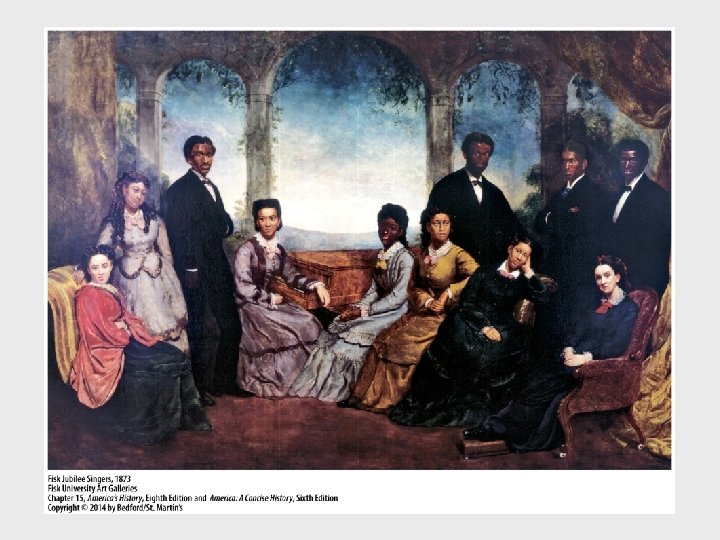
II. The Meaning of Freedom C. Building Black Communities 1. Churches - Aided by northern missionaries and teachers, independent black churches grew quickly; became center of black life in the South; joined black congregations in the North to create National Baptist Convention and African Methodist Episcopal Church; operated as schools and meeting halls; black ministers were leaders of their communities. – 2. “Race uplift” - Teachers and charity leaders desired to build businesses and institutions to serve black Americans; some wanted integration; others wanted all-black schools/churches. Some Republicans argued for desegregation of public transportation, hotels, and churches in 1870; opponents feared that shared public spaces would lead to violence, interracial marriage, and race mixing. Civil Rights Act of 1875 required “full and equal” access to jury service, transportation, and public accommodations, irrespective of race.
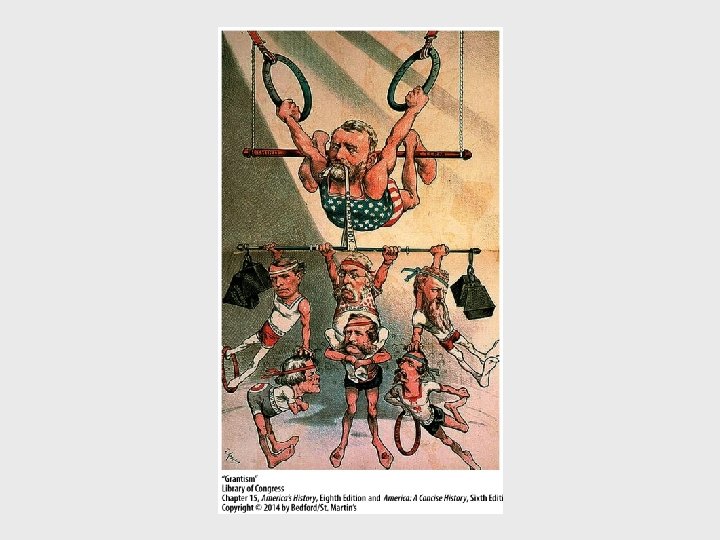
III. The Undoing of Reconstruction A. The Republicans Unravel 1. The Depression of 1873 - Global economic crisis triggered in part by Northern Pacific Railroad declaring bankruptcy; crop prices fell, iron manufacturing fell 50 percent, half of railroads were bankrupt, and construction of new railways stopped; Republican policies in the South became too expensive (ex: Freedmen’s Bureau). 2. The Disillusioned Liberals - Revolt emerged within Republican Party; led by “classical liberals” who advocated free trade, smaller government, and limited voting rights; formed the Liberal Republican Party in 1872; the second Grant administration had numerous financial scandals, including Crédit Mobilier, a sham corporation set up by Union Pacific Railroad shareholders to profit on grants from the federal government.
III. The Undoing of Reconstruction B. Counterrevolution in the South 1. “Redemption” and Nathan Bedford Forrest -Efforts by ex-Confederates to take back the South from the Republican Party intensified amidst economic crisis; terror campaign in which black politicians and white supporters were hanged, beaten to death, and shot; Forrest was a decorated Confederate general. 2. Ku Klux Klan -Organization of ex-Confederates who joined together in 1866; led by Forrest in Tennessee to target Republicans in the state; tied to the Democratic Party; campaign of murder and terror throughout the South. 3. Enforcement laws - Congress passed laws to control the spread of violence; U. S. troops occupied parts of the South to stop the outbreak of violence, but as the Republican Party began to suffer political losses in the South as fear and violence increased.
III. The Undoing of Reconstruction C. Reconstruction Rolled Back 1. The Supreme Court Rejects Equal Rights - Slaughter. House Cases (1873): Court diminished the power of the Fourteenth Amendment by arguing that it offered only a few federal protections; civil rights violations were viewed as state issues, not within the federal government’s jurisdiction; 1883 Court struck down the Civil Rights Act of 1875. 2. The Political Crisis of 1877 - Gov. Rutherford Hayes (R-OH) versus Gov. Samuel Tilden (D-NY). Tilden led popular vote; Hayes had an electoral lead. No majority. Congress gave it to Hayes--why? 3. Pacification of the South - Hayes had publicly indicated his desire to offer federal money for education, economic growth, and internal improvements. However, in Secret talks with key congressmen he had Hayes stated he would order Union troops out of the South and Reconstruction would end.
Were the Pre-Civil War Issues Resolved? • Politically- federal authority v. states rights • New states like Nevada and all Southern States had to put in their state constitutions a “Paramount Allegiance Clause” and no right to secede statements. Art. VI of the Constitution “Supremacy Clause” had always gave more power to the federal level. However, the 10 th Amendment secures rights of the states. • Socially – Issue of Slavery • The 13 th, 14 th, and 15 th Amendments resolved this issue. However, social equality would not be achieved until the Civil Rights Movements of the 1950’s & 1960’s. • Economically – Industry v. Agriculture • Although the South remained agricultural, the rest of the country moved rapidly into industrialization based on free market ideals and wage labor. By 1900, the United States was the leading industrial power of the world.
- Slides: 24