
Chapter 15 Reactions of Aromatic Compounds Created by
Chapter 15 Reactions of Aromatic Compounds Created by Professor William Tam & Dr. Phillis Chang Copyright © 2014 by John Wiley & Sons, Inc. All rights reserved.
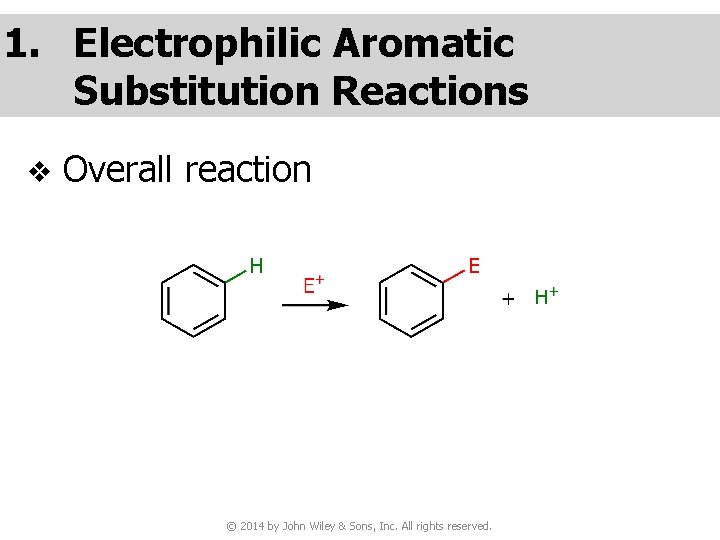
1. Electrophilic Aromatic Substitution Reactions v Overall reaction © 2014 by John Wiley & Sons, Inc. All rights reserved.
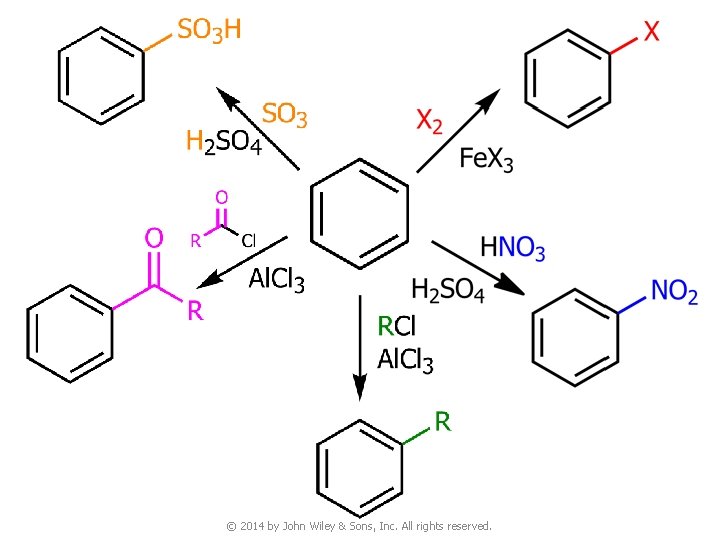
© 2014 by John Wiley & Sons, Inc. All rights reserved.
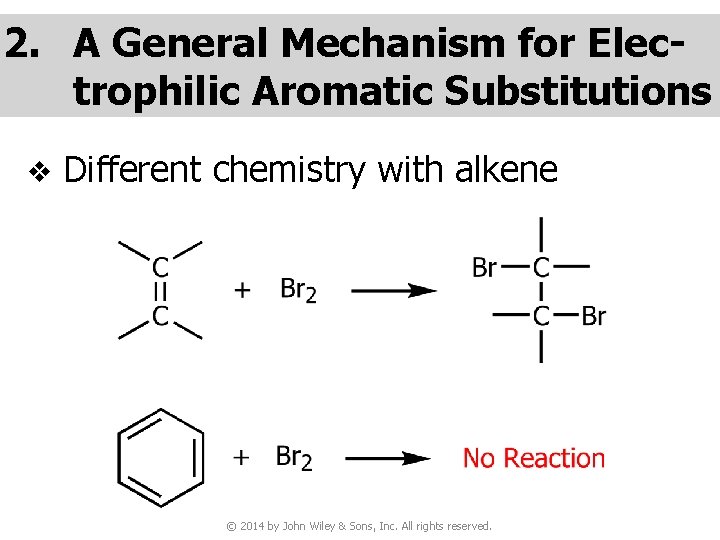
2. A General Mechanism for Electrophilic Aromatic Substitutions v Different chemistry with alkene © 2014 by John Wiley & Sons, Inc. All rights reserved.
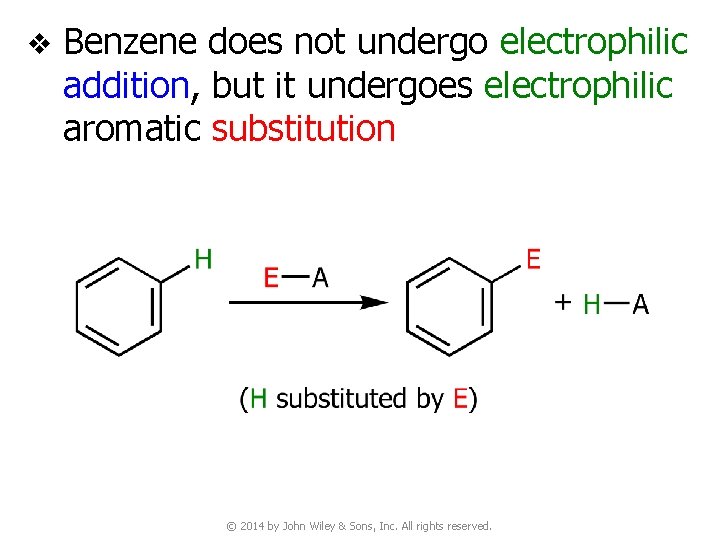
v Benzene does not undergo electrophilic addition, but it undergoes electrophilic aromatic substitution © 2014 by John Wiley & Sons, Inc. All rights reserved.
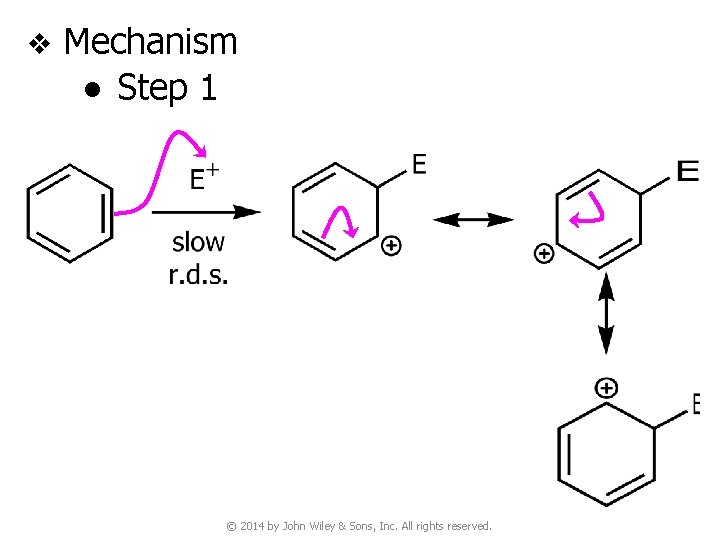
v Mechanism ● Step 1 © 2014 by John Wiley & Sons, Inc. All rights reserved.
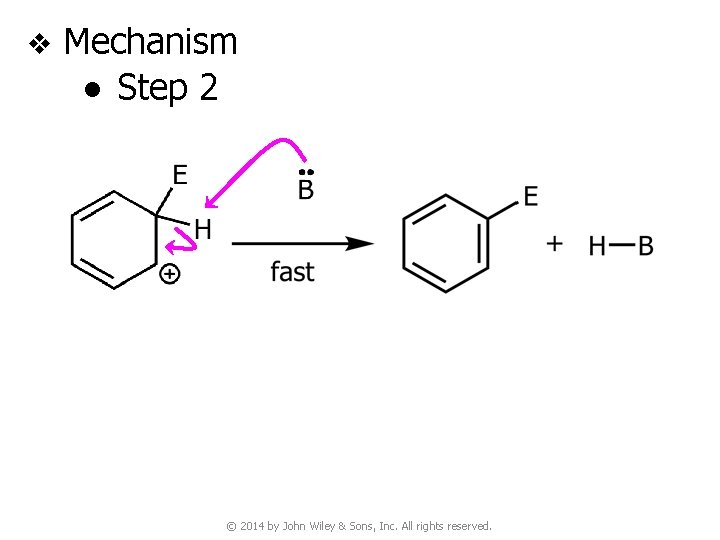
v Mechanism ● Step 2 © 2014 by John Wiley & Sons, Inc. All rights reserved.
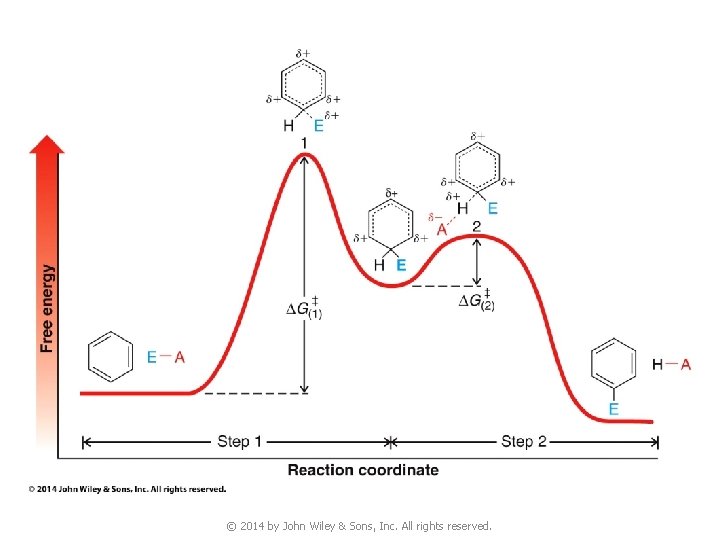
© 2014 by John Wiley & Sons, Inc. All rights reserved.
3. Halogenation of Benzene v Benzene does not react with Br 2 or Cl 2 unless a Lewis acid is present (a catalytic amount is usually enough) © 2014 by John Wiley & Sons, Inc. All rights reserved.
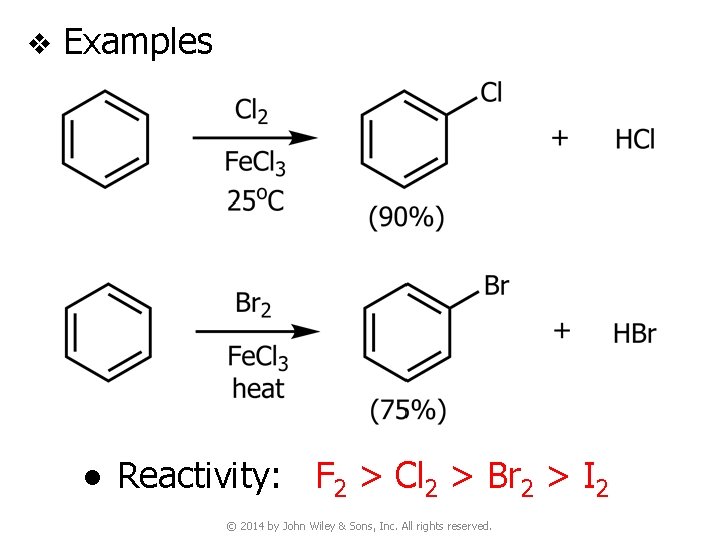
v Examples ● Reactivity: F 2 > Cl 2 > Br 2 > I 2 © 2014 by John Wiley & Sons, Inc. All rights reserved.
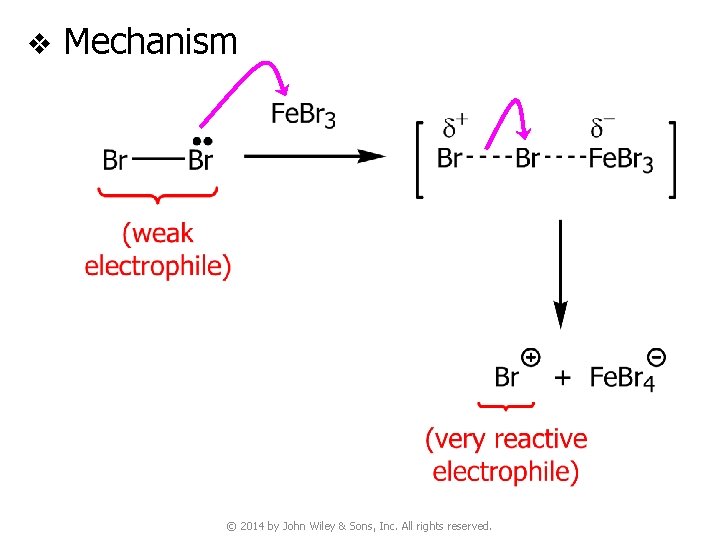
v Mechanism © 2014 by John Wiley & Sons, Inc. All rights reserved.
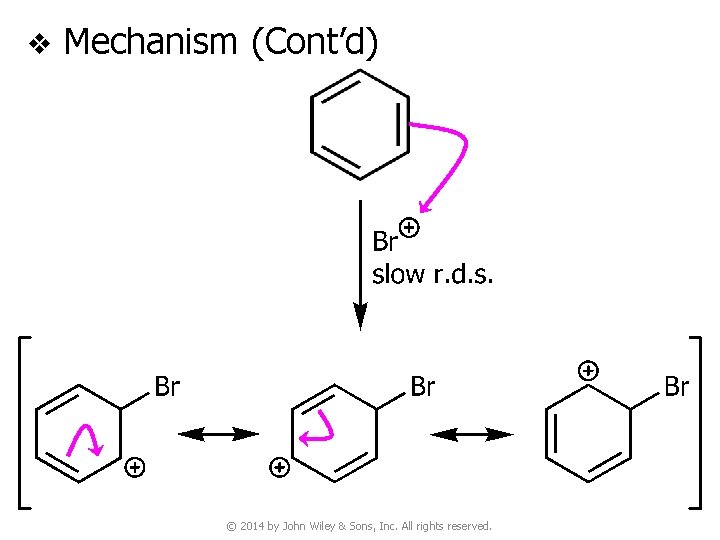
v Mechanism (Cont’d) © 2014 by John Wiley & Sons, Inc. All rights reserved.
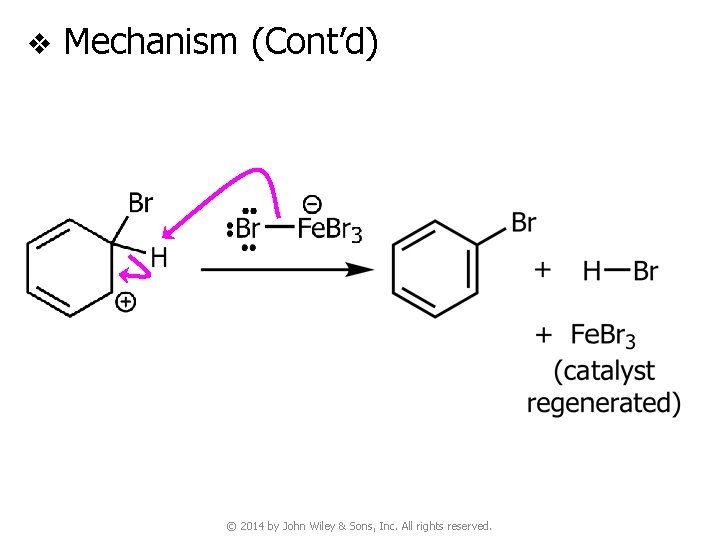
v Mechanism (Cont’d) © 2014 by John Wiley & Sons, Inc. All rights reserved.
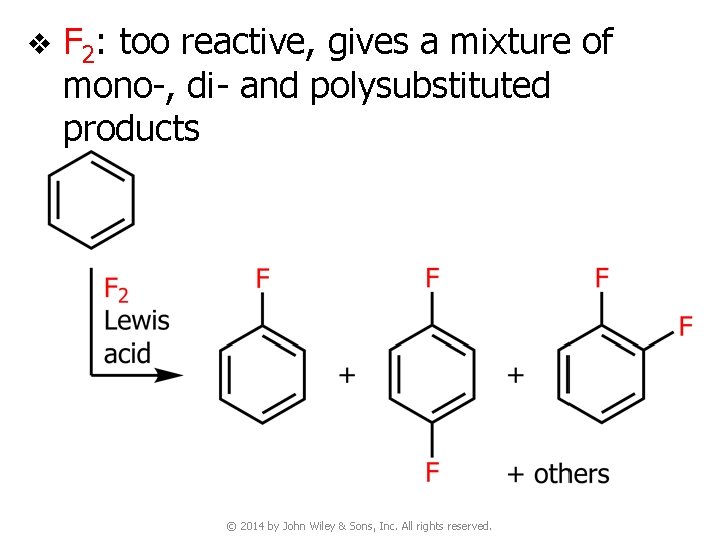
v F 2: too reactive, gives a mixture of mono-, di- and polysubstituted products © 2014 by John Wiley & Sons, Inc. All rights reserved.
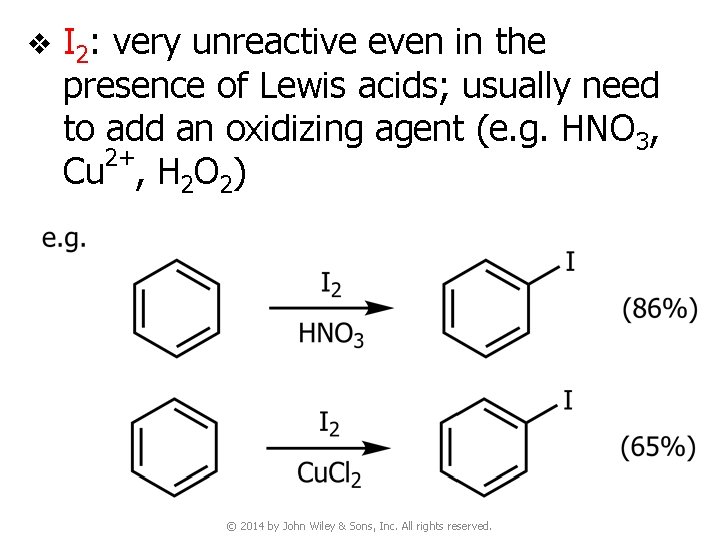
v I 2 : very unreactive even in the presence of Lewis acids; usually need to add an oxidizing agent (e. g. HNO 3, 2+ Cu , H 2 O 2) © 2014 by John Wiley & Sons, Inc. All rights reserved.
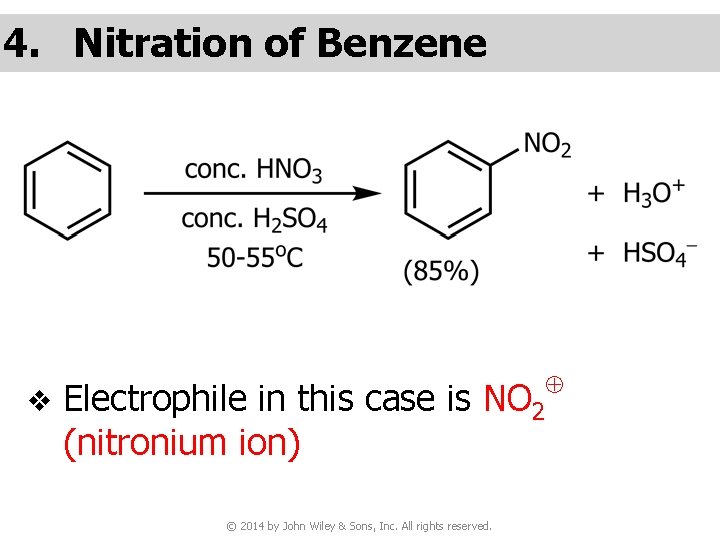
4. Nitration of Benzene v Electrophile in this case is NO 2 (nitronium ion) © 2014 by John Wiley & Sons, Inc. All rights reserved.

v Mechanism © 2014 by John Wiley & Sons, Inc. All rights reserved.
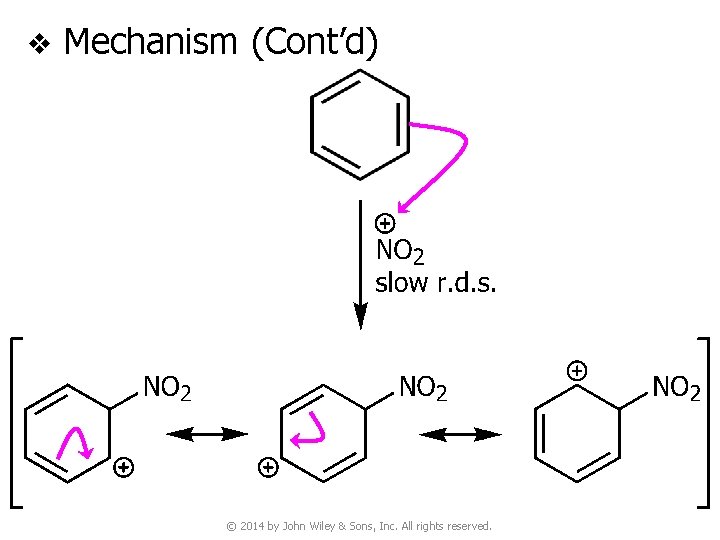
v Mechanism (Cont’d) © 2014 by John Wiley & Sons, Inc. All rights reserved.
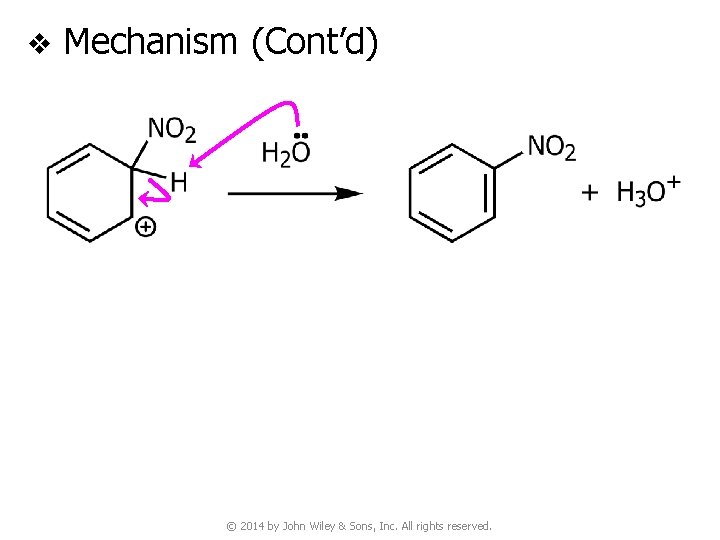
v Mechanism (Cont’d) © 2014 by John Wiley & Sons, Inc. All rights reserved.
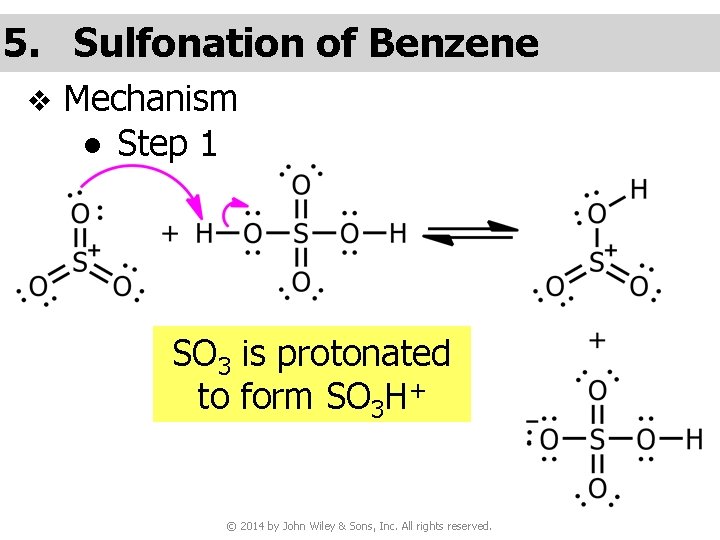
5. Sulfonation of Benzene v Mechanism ● Step 1 SO 3 is protonated to form SO 3 H+ © 2014 by John Wiley & Sons, Inc. All rights reserved.
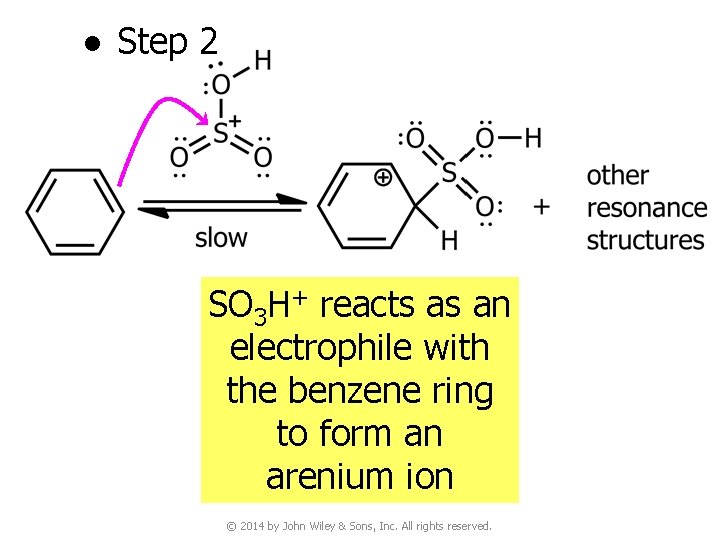
● Step 2 SO 3 H+ reacts as an electrophile with the benzene ring to form an arenium ion © 2014 by John Wiley & Sons, Inc. All rights reserved.
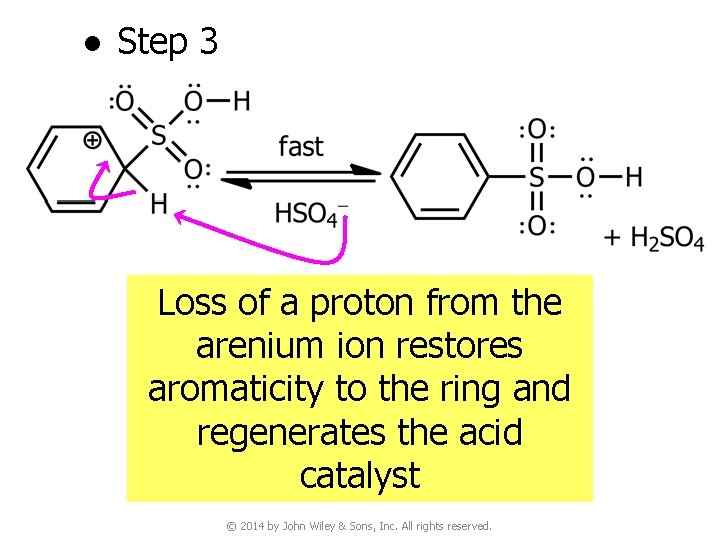
● Step 3 Loss of a proton from the arenium ion restores aromaticity to the ring and regenerates the acid catalyst © 2014 by John Wiley & Sons, Inc. All rights reserved.
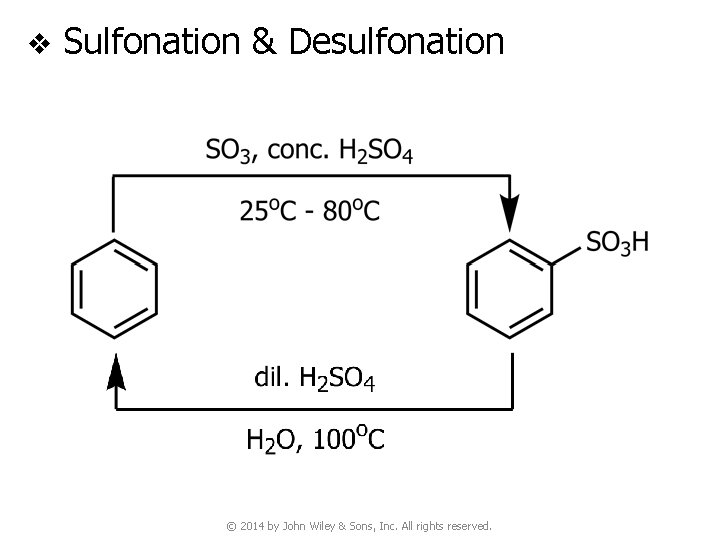
v Sulfonation & Desulfonation © 2014 by John Wiley & Sons, Inc. All rights reserved.
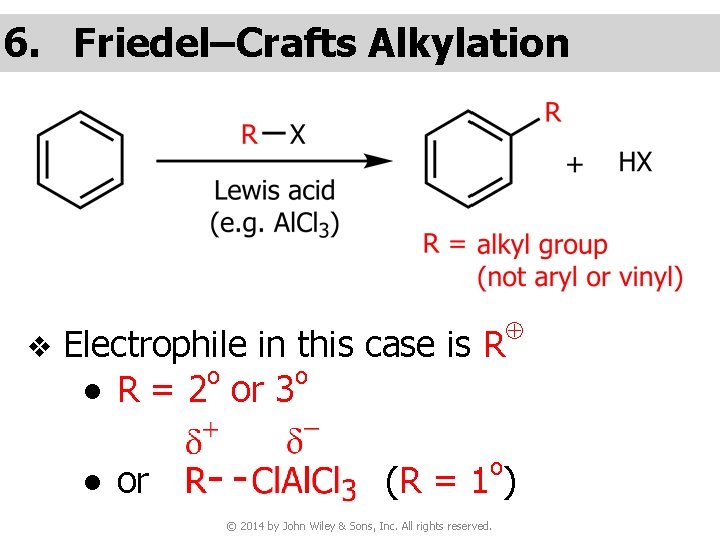
6. Friedel–Crafts Alkylation v Electrophile in this case is R o o ● R = 2 or 3 ● or o (R = 1 ) © 2014 by John Wiley & Sons, Inc. All rights reserved.
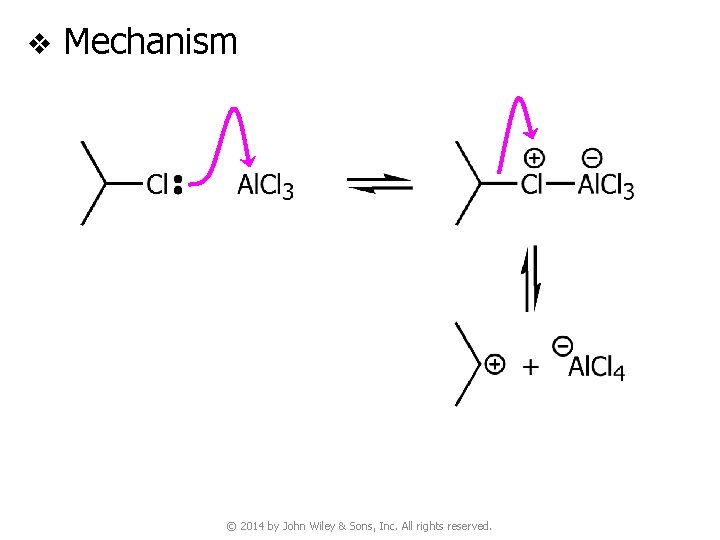
v Mechanism © 2014 by John Wiley & Sons, Inc. All rights reserved.

v Mechanism (Cont’d) © 2014 by John Wiley & Sons, Inc. All rights reserved.
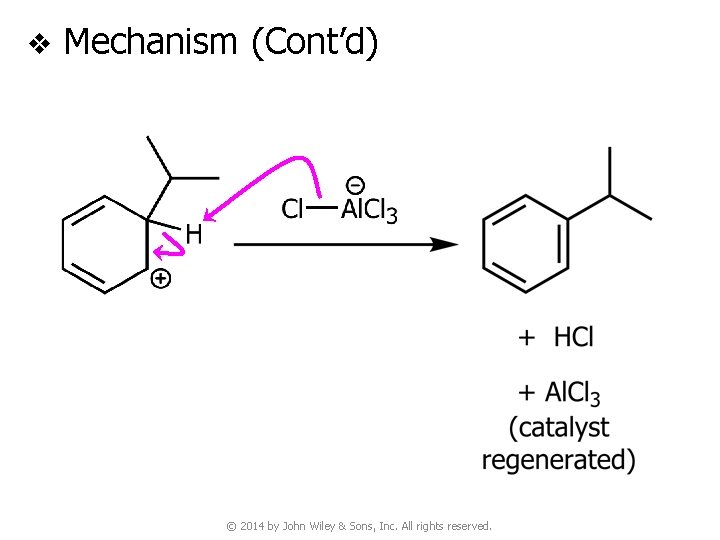
v Mechanism (Cont’d) © 2014 by John Wiley & Sons, Inc. All rights reserved.
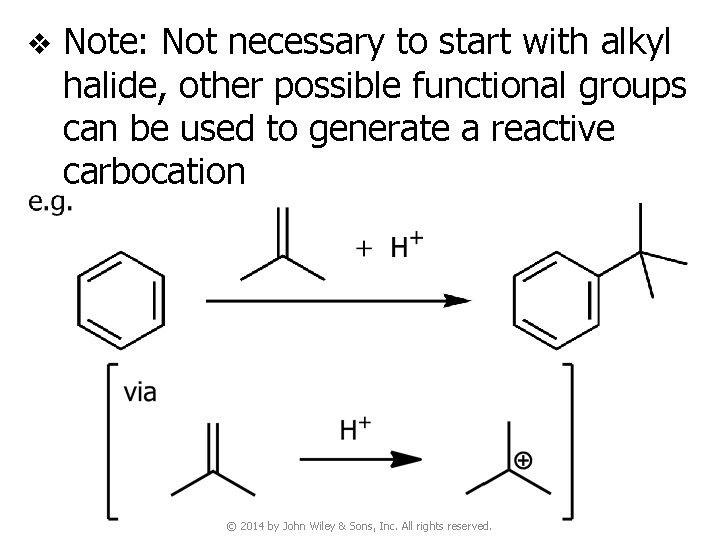
v Note: Not necessary to start with alkyl halide, other possible functional groups can be used to generate a reactive carbocation © 2014 by John Wiley & Sons, Inc. All rights reserved.
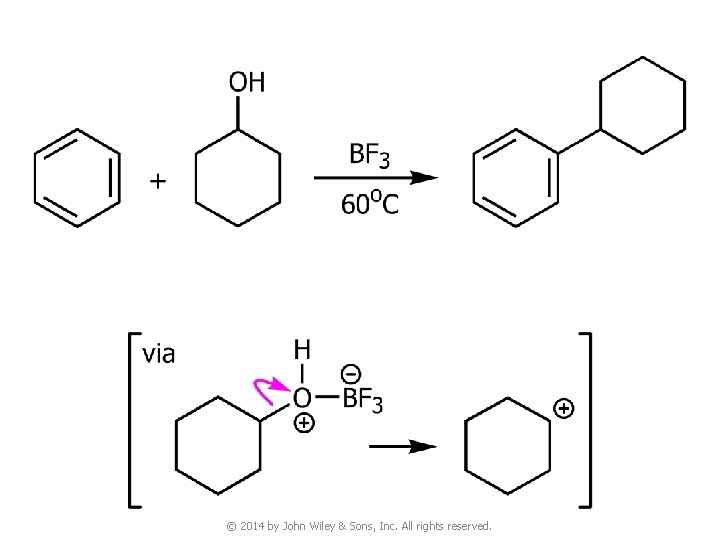
© 2014 by John Wiley & Sons, Inc. All rights reserved.
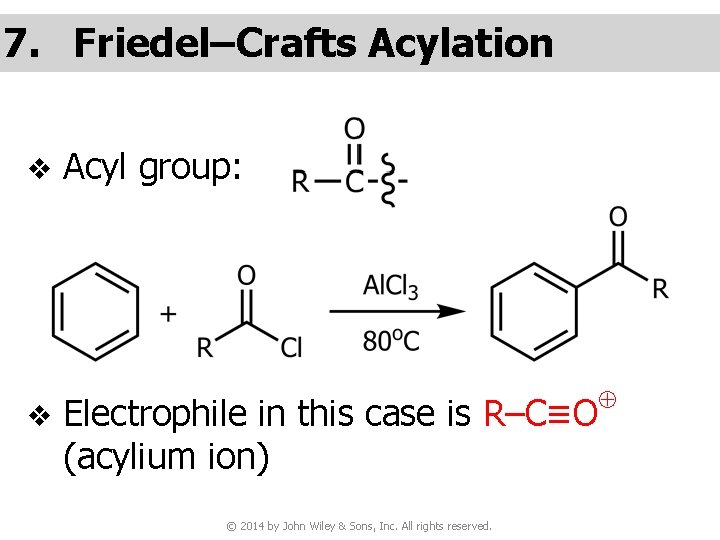
7. Friedel–Crafts Acylation v v Acyl group: Electrophile in this case is R–C≡O (acylium ion) © 2014 by John Wiley & Sons, Inc. All rights reserved.

v Mechanism © 2014 by John Wiley & Sons, Inc. All rights reserved.
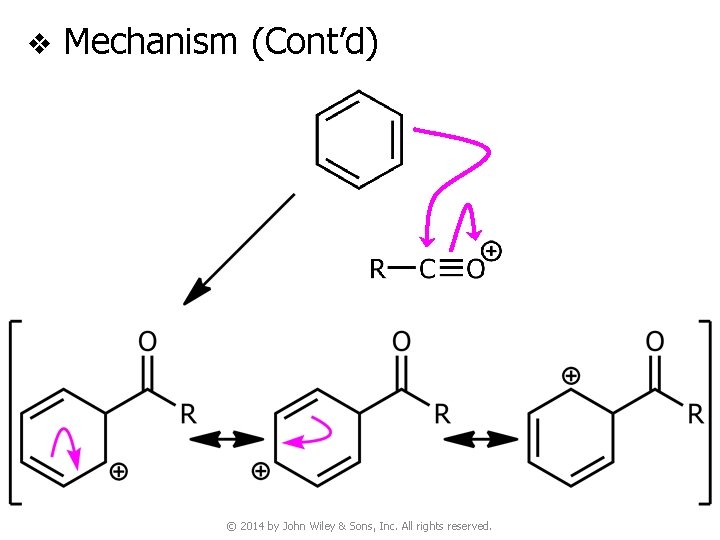
v Mechanism (Cont’d) © 2014 by John Wiley & Sons, Inc. All rights reserved.
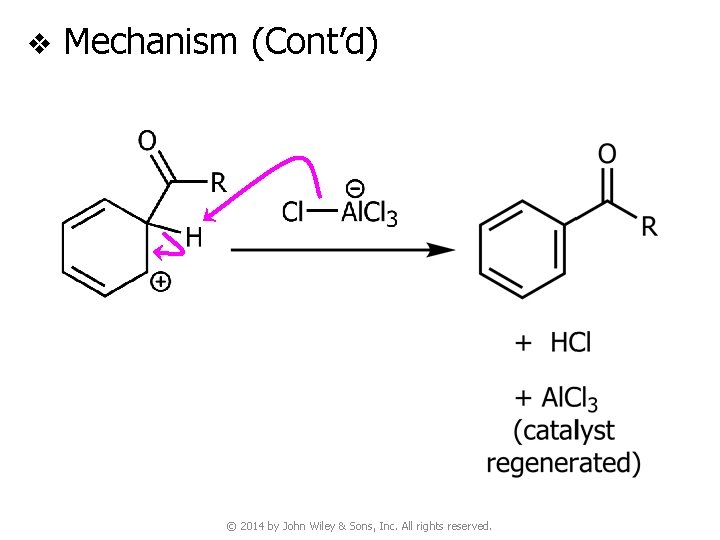
v Mechanism (Cont’d) © 2014 by John Wiley & Sons, Inc. All rights reserved.
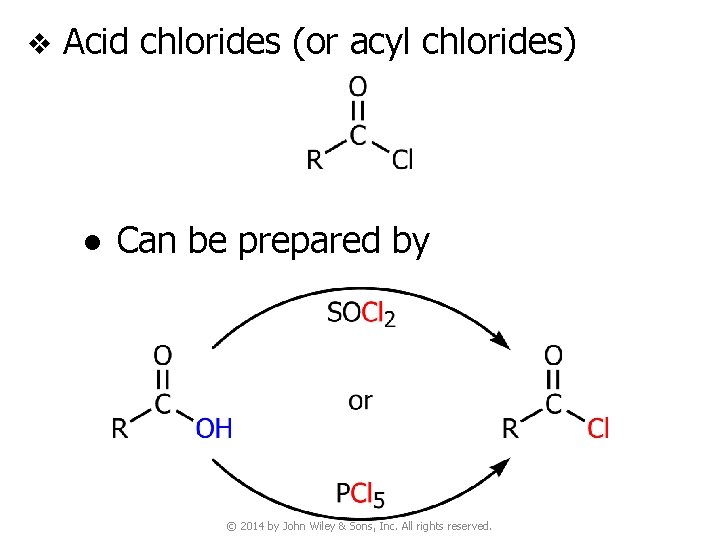
v Acid chlorides (or acyl chlorides) ● Can be prepared by © 2014 by John Wiley & Sons, Inc. All rights reserved.
8. Limitations of Friedel–Crafts Reactions v When the carbocation formed from an alkyl halide, alkene, or alcohol can rearrange to one or more carbocations that are more stable, it usually does so, and the major products obtained from the reaction are usually those from the more stable carbocations. © 2014 by John Wiley & Sons, Inc. All rights reserved.
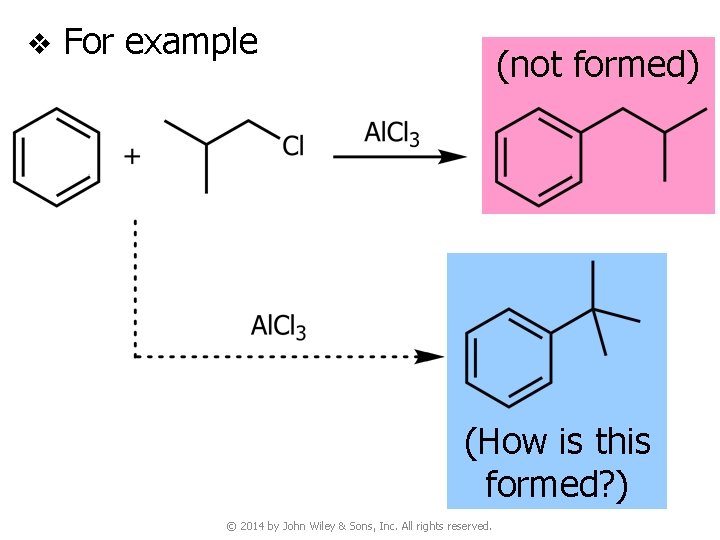
v For example (not formed) (How is this formed? ) © 2014 by John Wiley & Sons, Inc. All rights reserved.
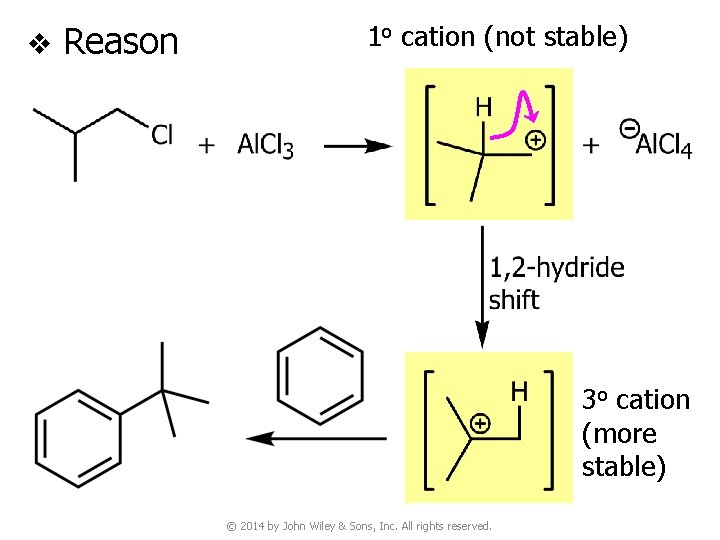
v Reason 1 o cation (not stable) 3 o cation (more stable) © 2014 by John Wiley & Sons, Inc. All rights reserved.
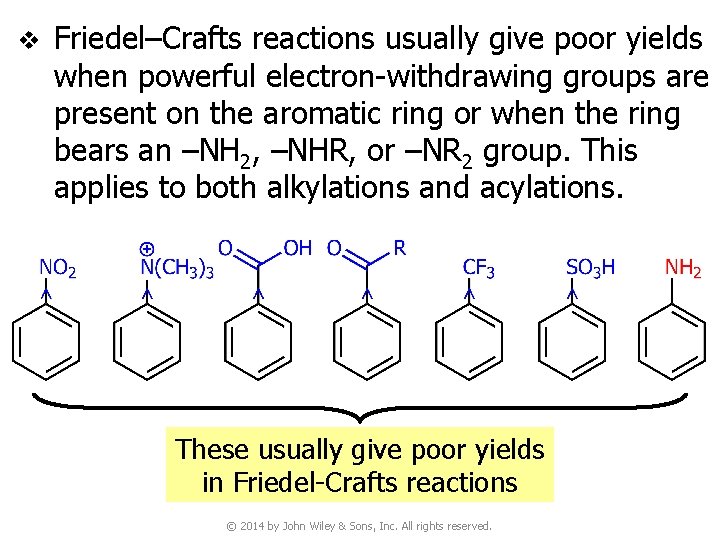
v Friedel–Crafts reactions usually give poor yields when powerful electron-withdrawing groups are present on the aromatic ring or when the ring bears an –NH 2, –NHR, or –NR 2 group. This applies to both alkylations and acylations. These usually give poor yields in Friedel-Crafts reactions © 2014 by John Wiley & Sons, Inc. All rights reserved.
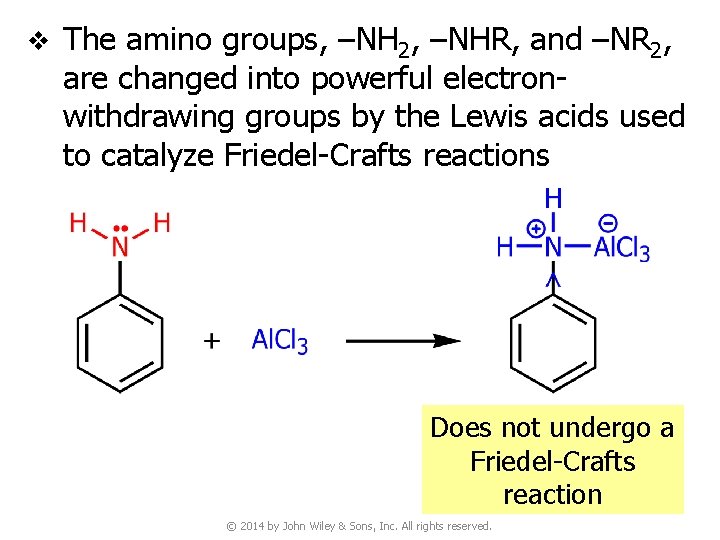
v The amino groups, –NH 2, –NHR, and –NR 2, are changed into powerful electronwithdrawing groups by the Lewis acids used to catalyze Friedel-Crafts reactions Does not undergo a Friedel-Crafts reaction © 2014 by John Wiley & Sons, Inc. All rights reserved.
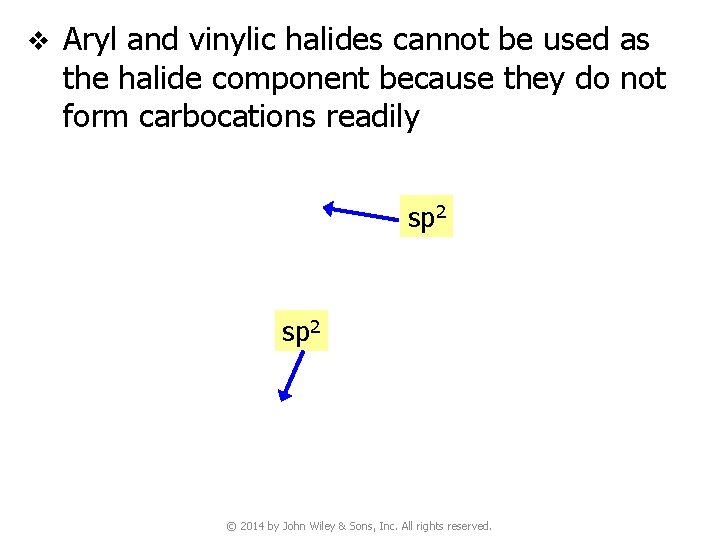
v Aryl and vinylic halides cannot be used as the halide component because they do not form carbocations readily sp 2 © 2014 by John Wiley & Sons, Inc. All rights reserved.
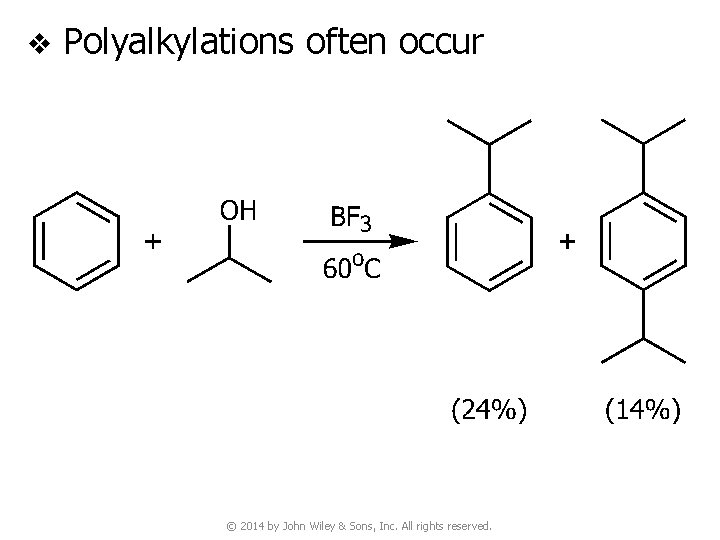
v Polyalkylations often occur © 2014 by John Wiley & Sons, Inc. All rights reserved.
9. Synthetic Applications of Friedel-Crafts Acylations: The Clemmensen Reduction & Wolff–Kishner Reductions Rearrangements of the carbon chain do not occur in Friedel–Crafts acylations v The acylium ion, because it is stabilized by resonance, is more stable than most other carbocations. Thus, there is no driving force for a rearrangement. v © 2014 by John Wiley & Sons, Inc. All rights reserved.
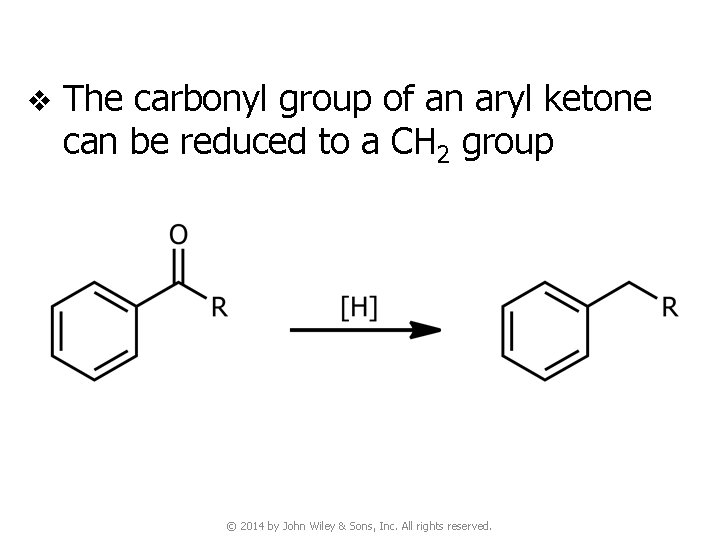
v The carbonyl group of an aryl ketone can be reduced to a CH 2 group © 2014 by John Wiley & Sons, Inc. All rights reserved.
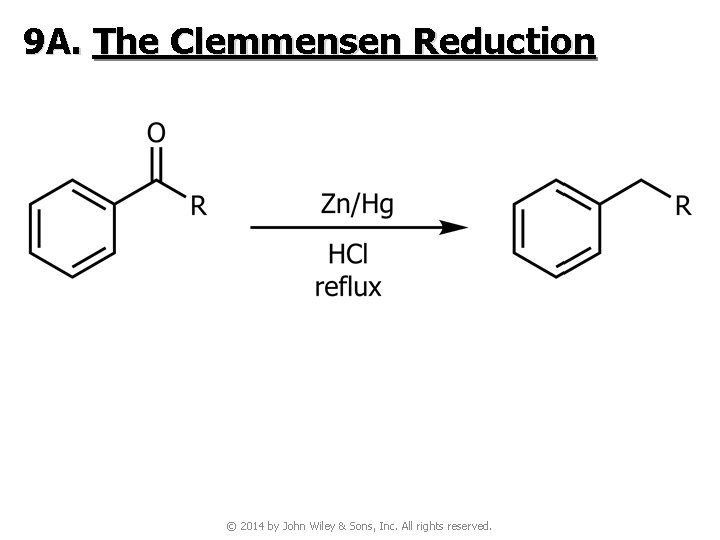
9 A. The Clemmensen Reduction © 2014 by John Wiley & Sons, Inc. All rights reserved.
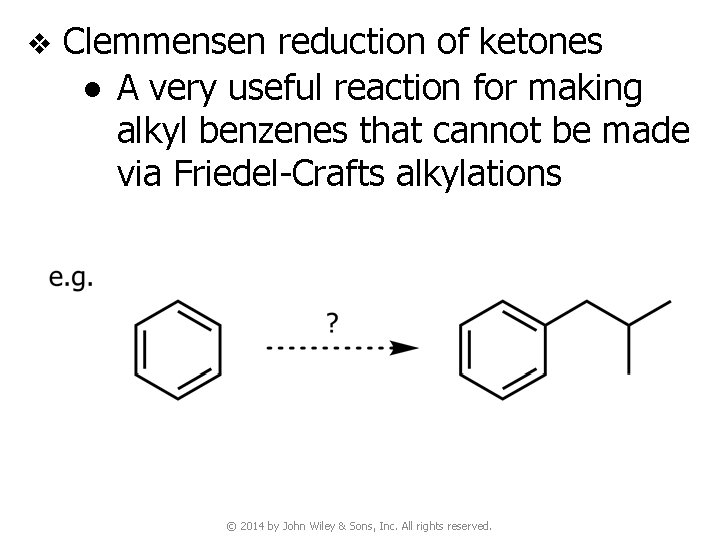
v Clemmensen reduction of ketones ● A very useful reaction for making alkyl benzenes that cannot be made via Friedel-Crafts alkylations © 2014 by John Wiley & Sons, Inc. All rights reserved.
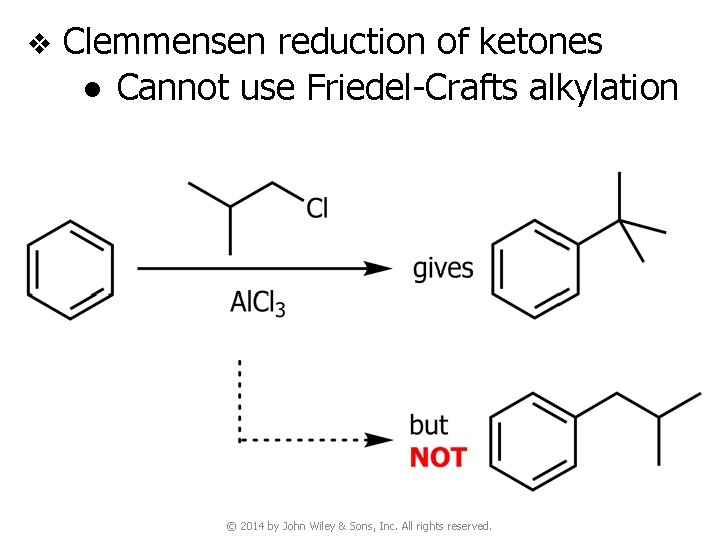
v Clemmensen reduction of ketones ● Cannot use Friedel-Crafts alkylation © 2014 by John Wiley & Sons, Inc. All rights reserved.
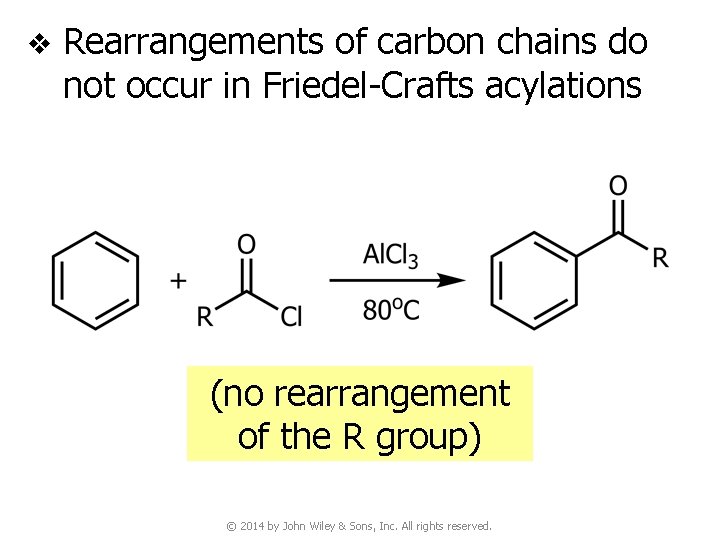
v Rearrangements of carbon chains do not occur in Friedel-Crafts acylations (no rearrangement of the R group) © 2014 by John Wiley & Sons, Inc. All rights reserved.
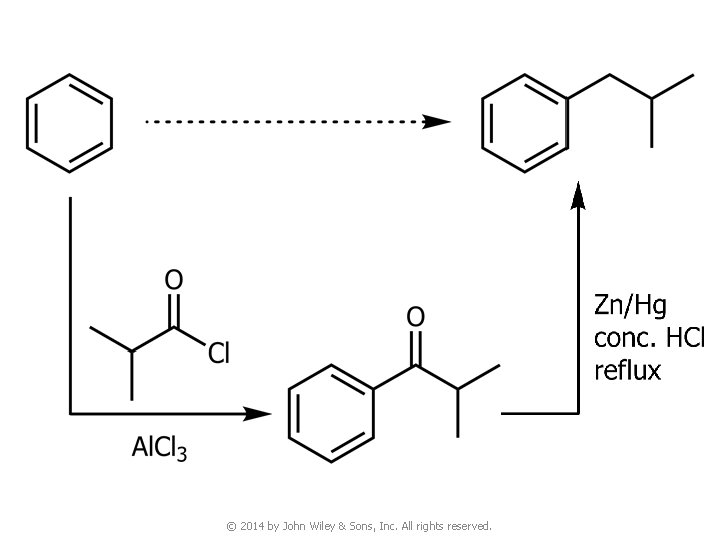
© 2014 by John Wiley & Sons, Inc. All rights reserved.
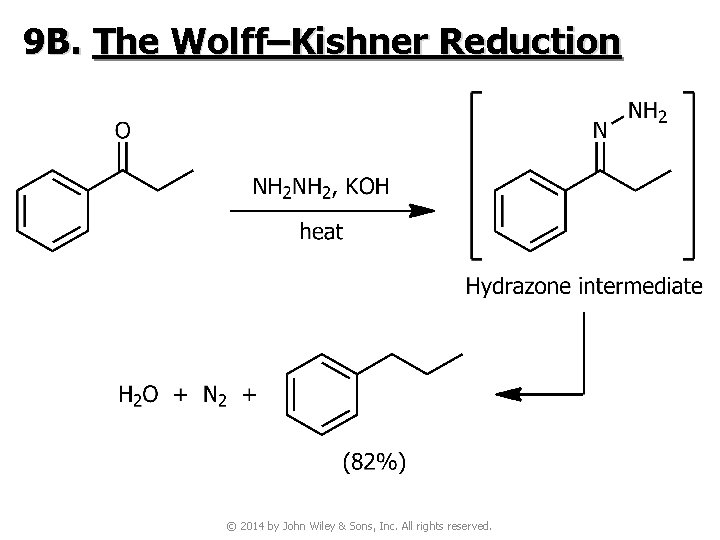
9 B. The Wolff–Kishner Reduction © 2014 by John Wiley & Sons, Inc. All rights reserved.
10. Substituents Can Affect Both the Reactivity of the Ring and the Orientation of the Incoming Group v Two questions have to be addressed: ● Reactivity ● Regiochemistry © 2014 by John Wiley & Sons, Inc. All rights reserved.
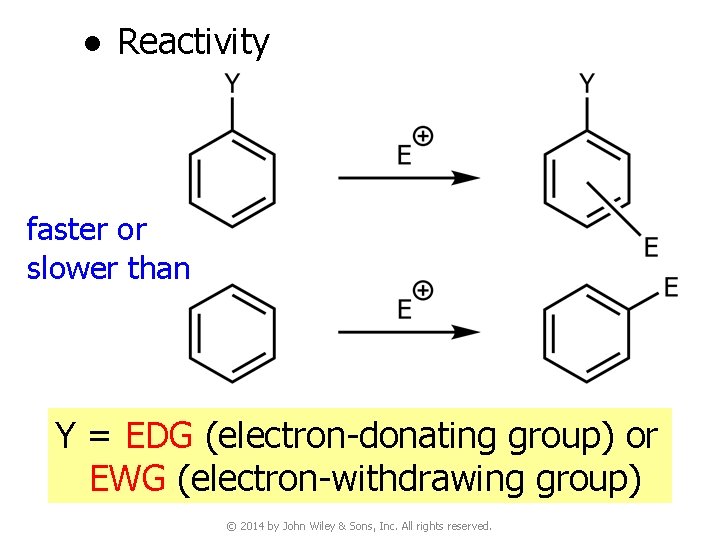
● Reactivity faster or slower than Y = EDG (electron-donating group) or EWG (electron-withdrawing group) © 2014 by John Wiley & Sons, Inc. All rights reserved.
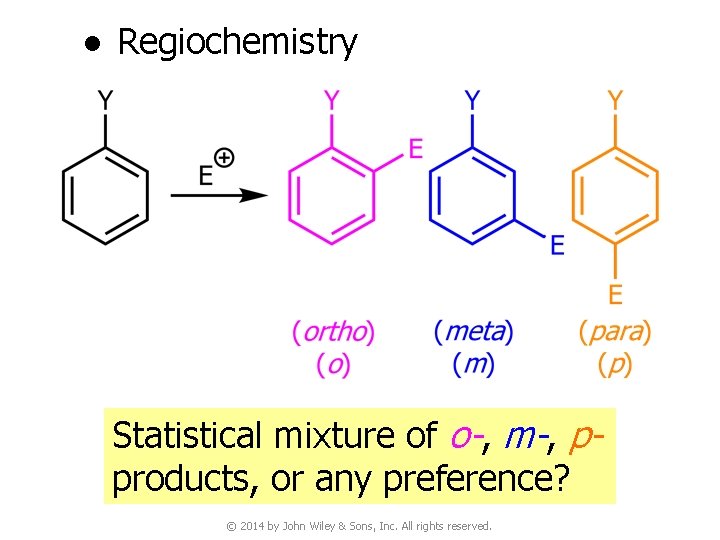
● Regiochemistry Statistical mixture of o-, m-, pproducts, or any preference? © 2014 by John Wiley & Sons, Inc. All rights reserved.
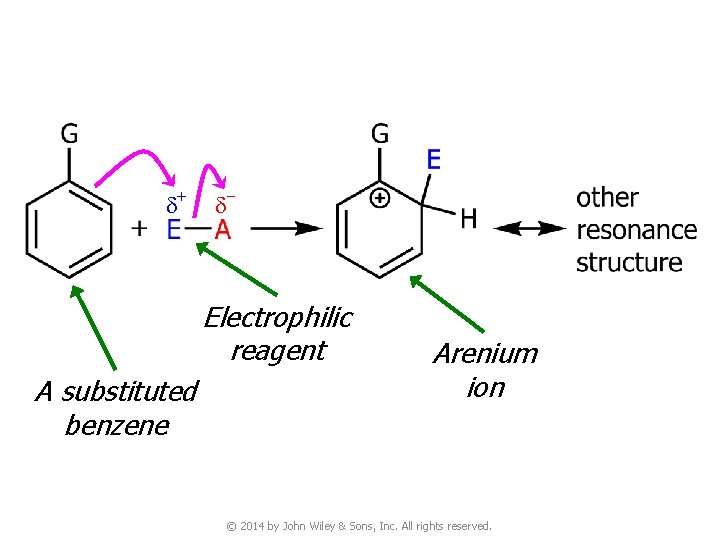
d+ d- Electrophilic reagent A substituted benzene Arenium ion © 2014 by John Wiley & Sons, Inc. All rights reserved.

Z donates electrons Y withdraws electrons The ring is more electron rich and reacts faster with an electrophile The ring is electron poor and reacts more slowly with an electrophile © 2014 by John Wiley & Sons, Inc. All rights reserved.
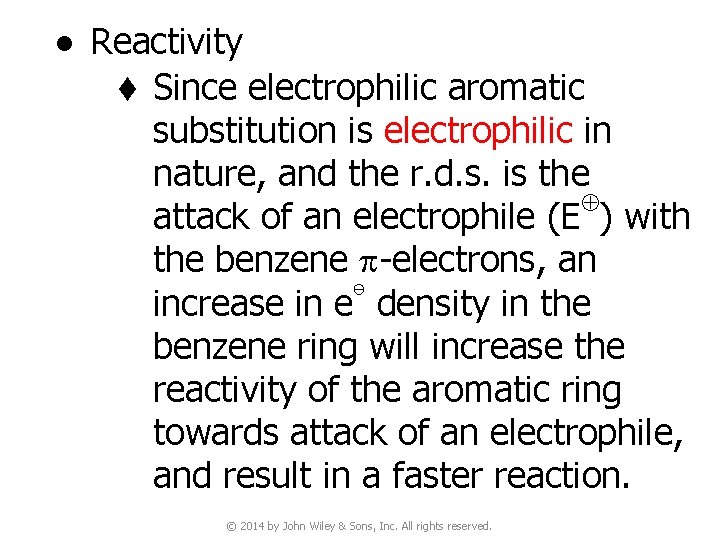
● Reactivity t Since electrophilic aromatic substitution is electrophilic in nature, and the r. d. s. is the attack of an electrophile (E ) with the benzene p-electrons, an ⊖ increase in e density in the benzene ring will increase the reactivity of the aromatic ring towards attack of an electrophile, and result in a faster reaction. © 2014 by John Wiley & Sons, Inc. All rights reserved.
● Reactivity t On the other hand, a decrease ⊖ in e density in the benzene ring will decrease the reactivity of the aromatic ring towards the attack of an electrophile, and result in a slower reaction. © 2014 by John Wiley & Sons, Inc. All rights reserved.

Increasing activity ● Reactivity Substituent –EDG –H –EWG © 2014 by John Wiley & Sons, Inc. All rights reserved.
● Reactivity t EDG (electron-donating group) on benzene ring q Increases electron density in the benzene ring q More reactive towards electrophilic aromatic substitution © 2014 by John Wiley & Sons, Inc. All rights reserved.
● Reactivity t EWG (electron-withdrawing group) on benzene ring q Decreases electron density in the benzene ring q Less reactive towards electrophilic aromatic substitution © 2014 by John Wiley & Sons, Inc. All rights reserved.
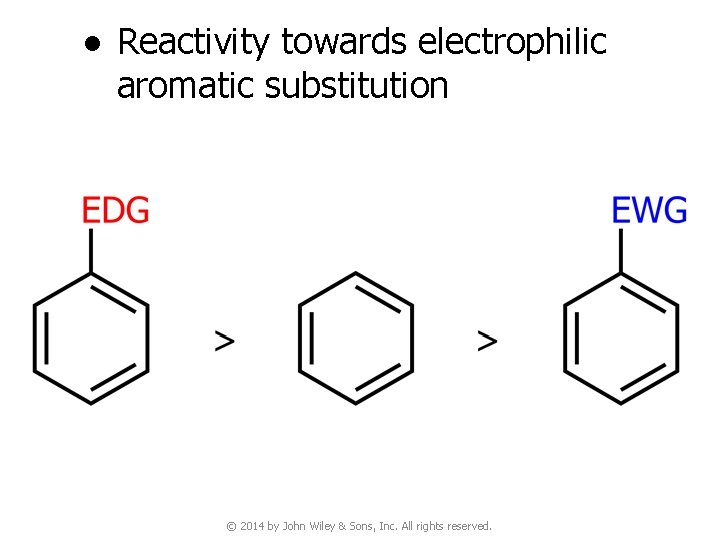
● Reactivity towards electrophilic aromatic substitution © 2014 by John Wiley & Sons, Inc. All rights reserved.
v Regiochemistry: directing effect ● General aspects t Either o-, p- directing or mdirecting t Rate-determining step is pelectrons on the benzene ring attacking an electrophile (E ) © 2014 by John Wiley & Sons, Inc. All rights reserved.
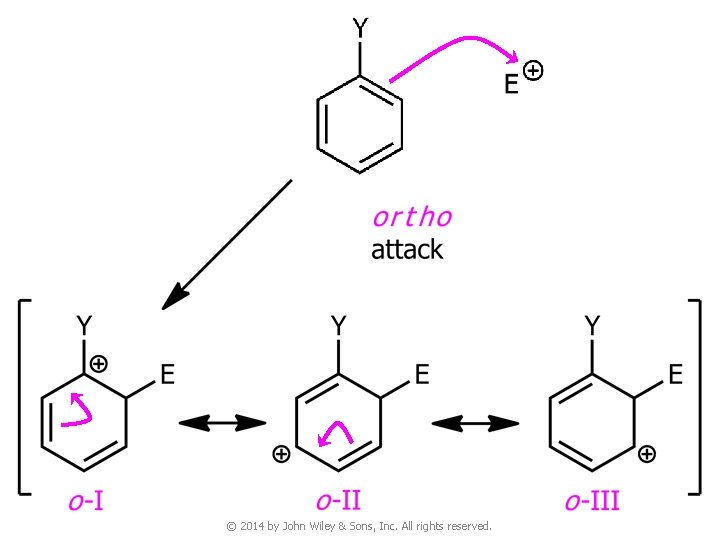
© 2014 by John Wiley & Sons, Inc. All rights reserved.
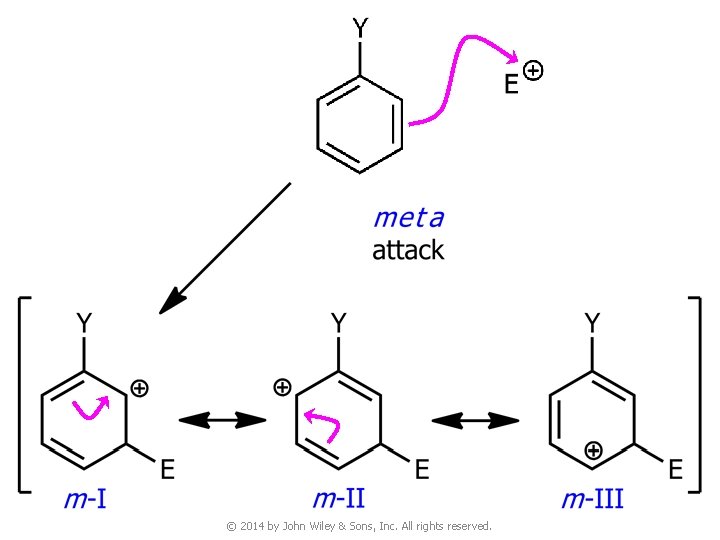
© 2014 by John Wiley & Sons, Inc. All rights reserved.
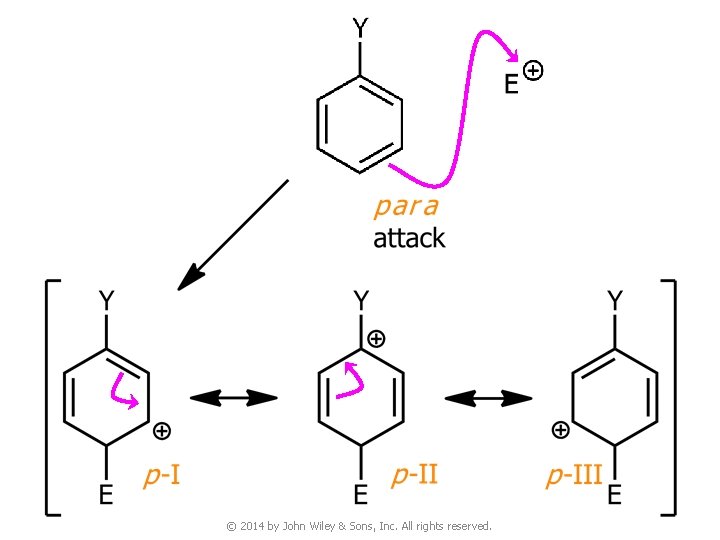
© 2014 by John Wiley & Sons, Inc. All rights reserved.
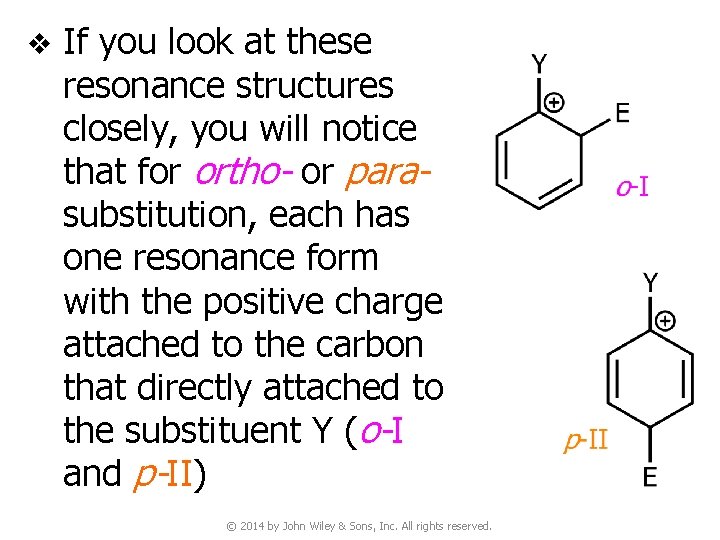
v If you look at these resonance structures closely, you will notice that for ortho- or parasubstitution, each has one resonance form with the positive charge attached to the carbon that directly attached to the substituent Y (o-I and p-II) © 2014 by John Wiley & Sons, Inc. All rights reserved.

v When Y = EWG, these resonance forms (o-I and p-II) are highly unstable and unfavorable, thus not favoring the formation of o- and p- regioisomers, and m- product will form preferentially © 2014 by John Wiley & Sons, Inc. All rights reserved.
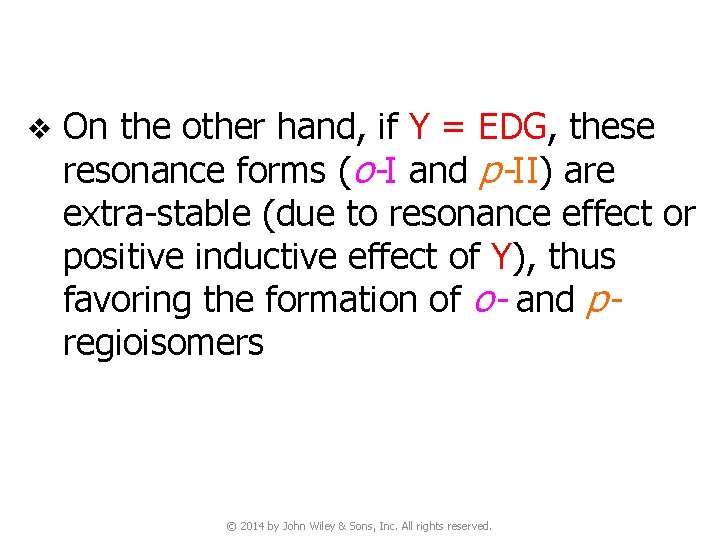
v On the other hand, if Y = EDG, these resonance forms (o-I and p-II) are extra-stable (due to resonance effect or positive inductive effect of Y), thus favoring the formation of o- and pregioisomers © 2014 by John Wiley & Sons, Inc. All rights reserved.
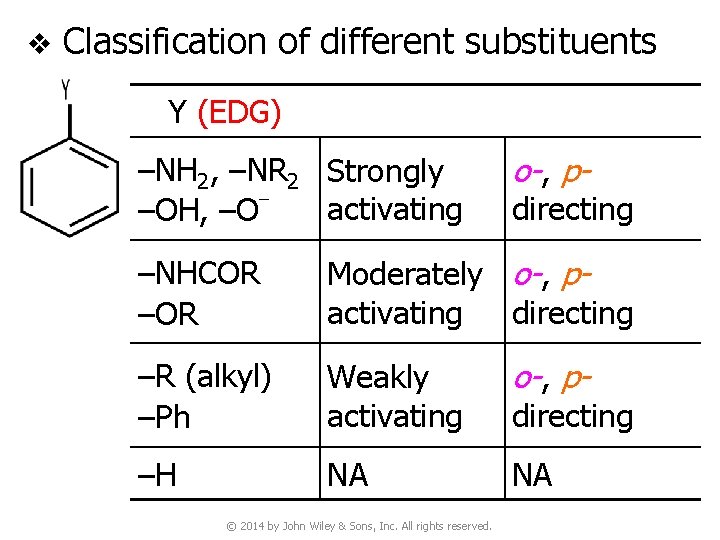
v Classification of different substituents Y (EDG) –NH 2, –NR 2 Strongly activating –OH, –O o-, p- directing –NHCOR –OR Moderately o-, pactivating directing –R (alkyl) –Ph Weakly activating o-, p- –H NA NA © 2014 by John Wiley & Sons, Inc. All rights reserved. directing
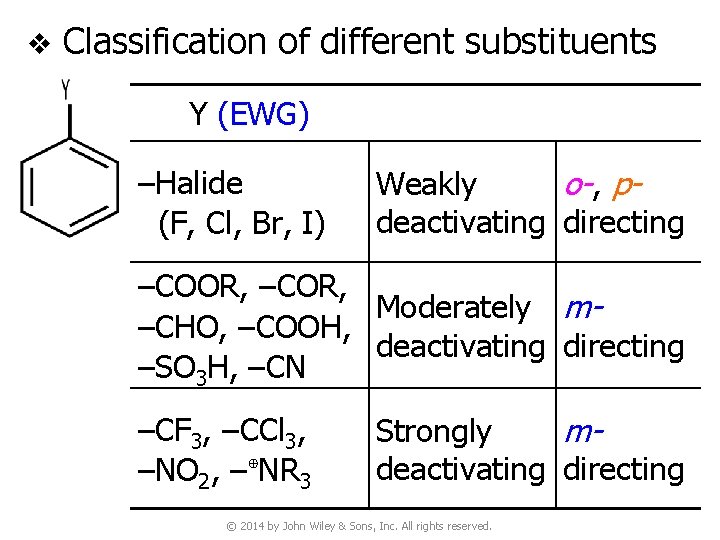
v Classification of different substituents Y (EWG) –Halide (F, Cl, Br, I) Weakly o-, pdeactivating directing –COOR, –COR, Moderately m–CHO, –COOH, deactivating directing –SO 3 H, –CN –CF 3, –CCl 3, –NO 2, –⊕NR 3 Strongly mdeactivating directing © 2014 by John Wiley & Sons, Inc. All rights reserved.
11. How Substituents Affect Electrophilic Aromatic Substitution: A Closer Look © 2014 by John Wiley & Sons, Inc. All rights reserved.
11 A. Reactivity: The Effect of Electron. Releasing & Electron-Withdrawing Groups v If G is an electron-releasing group (relative to hydrogen), the reaction occurs faster than the corresponding reaction of benzene When G is electron donating, the reaction is faster © 2014 by John Wiley & Sons, Inc. All rights reserved.
v If G is an electron-withdrawing group, the reaction is slower than that of benzene When G is electron withdrawing, the reaction is slower © 2014 by John Wiley & Sons, Inc. All rights reserved.

© 2014 by John Wiley & Sons, Inc. All rights reserved.
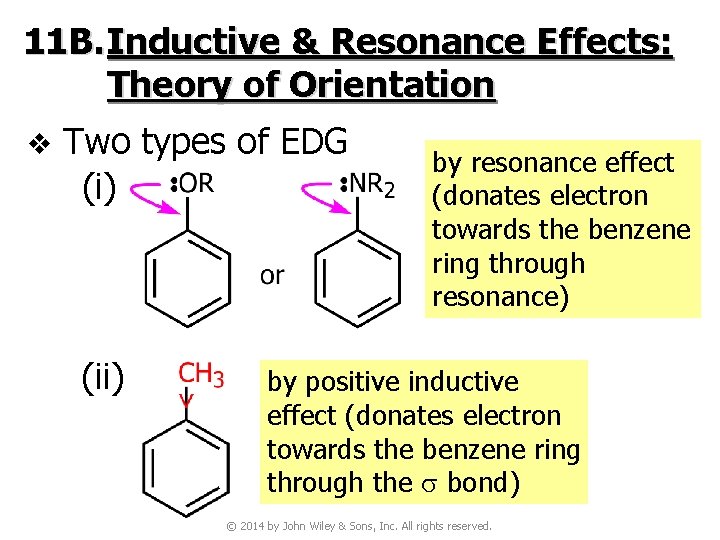
11 B. Inductive & Resonance Effects: Theory of Orientation v Two types of EDG (i) (ii) by resonance effect (donates electron towards the benzene ring through resonance) by positive inductive effect (donates electron towards the benzene ring through the s bond) © 2014 by John Wiley & Sons, Inc. All rights reserved.
v Two types of EDG ● The resonance effect is usually stronger than the positive inductive effect if the atoms directly attached to the benzene ring are in the same row as carbon in the periodic table © 2014 by John Wiley & Sons, Inc. All rights reserved.
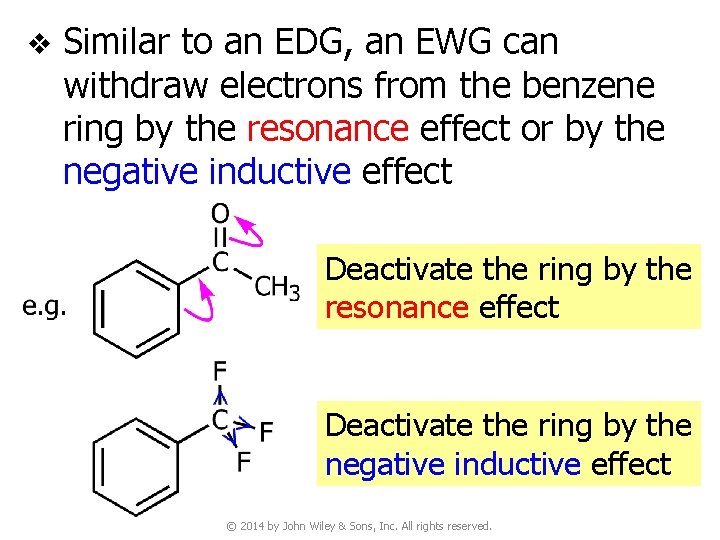
v Similar to an EDG, an EWG can withdraw electrons from the benzene ring by the resonance effect or by the negative inductive effect Deactivate the ring by the resonance effect Deactivate the ring by the negative inductive effect © 2014 by John Wiley & Sons, Inc. All rights reserved.
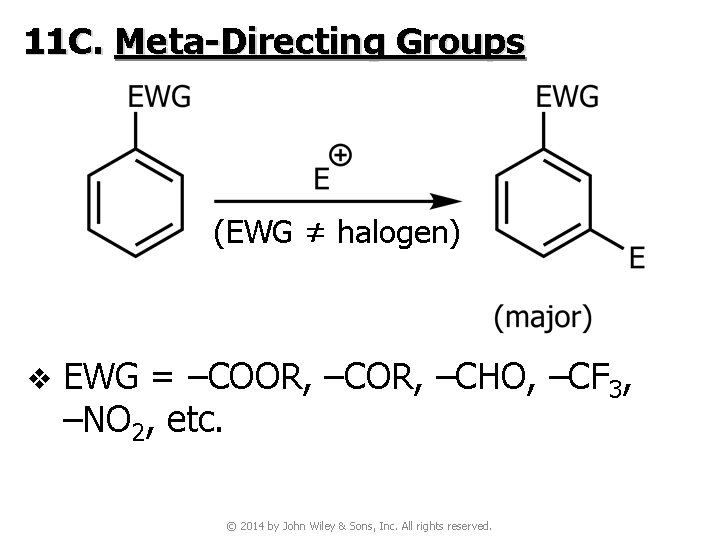
11 C. Meta-Directing Groups (EWG ≠ halogen) v EWG = –COOR, –CHO, –CF 3, –NO 2, etc. © 2014 by John Wiley & Sons, Inc. All rights reserved.
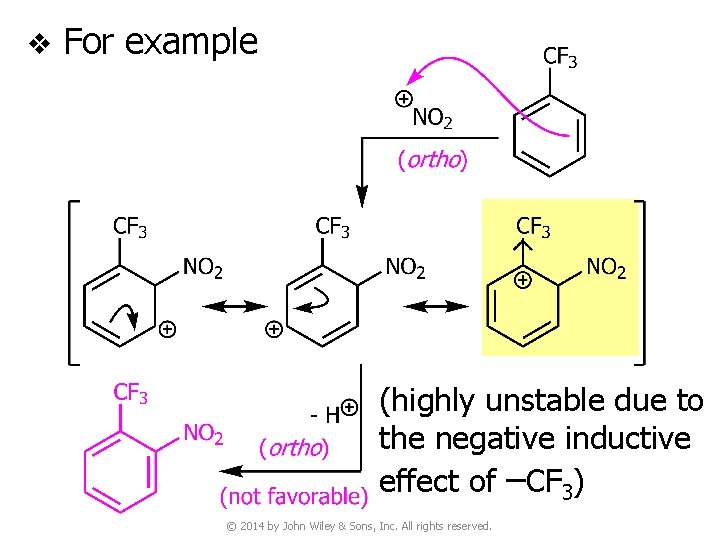
v For example (highly unstable due to the negative inductive effect of –CF 3) © 2014 by John Wiley & Sons, Inc. All rights reserved.
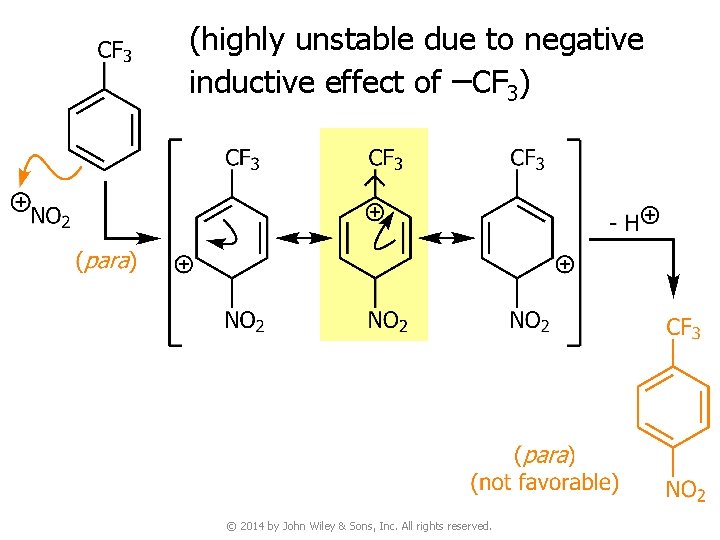
(highly unstable due to negative inductive effect of –CF 3) © 2014 by John Wiley & Sons, Inc. All rights reserved.
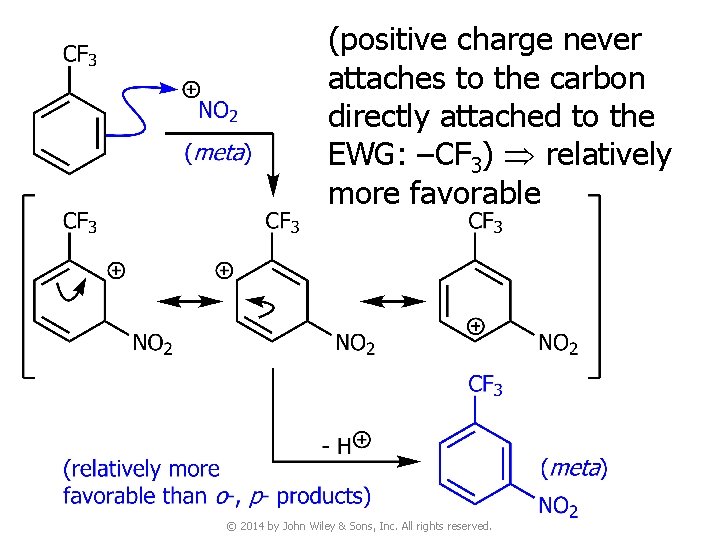
(positive charge never attaches to the carbon directly attached to the EWG: –CF 3) relatively more favorable © 2014 by John Wiley & Sons, Inc. All rights reserved.

11 D. Ortho/Para-Directing Groups v EDG = –NR 2, –OR, –OH, etc. © 2014 by John Wiley & Sons, Inc. All rights reserved.
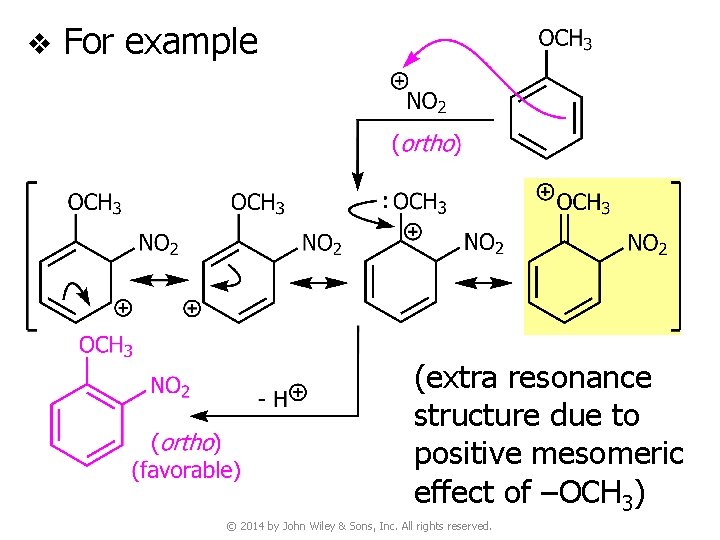
v For example (extra resonance structure due to positive mesomeric effect of –OCH 3) © 2014 by John Wiley & Sons, Inc. All rights reserved.
(extra resonance structure due to resonance effect of –OCH 3) © 2014 by John Wiley & Sons, Inc. All rights reserved.
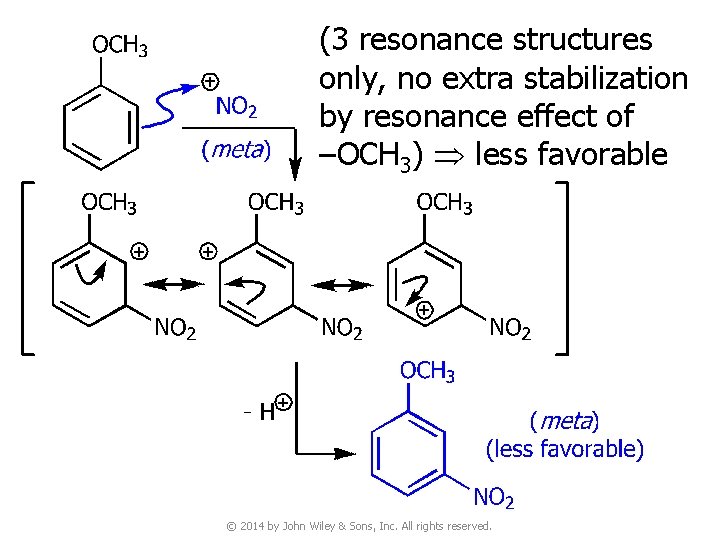
(3 resonance structures only, no extra stabilization by resonance effect of –OCH 3) less favorable © 2014 by John Wiley & Sons, Inc. All rights reserved.
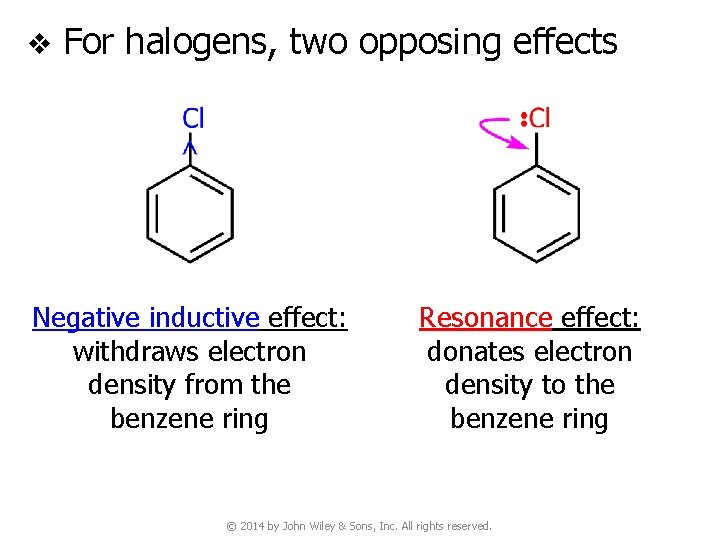
v For halogens, two opposing effects Negative inductive effect: withdraws electron density from the benzene ring Resonance effect: donates electron density to the benzene ring © 2014 by John Wiley & Sons, Inc. All rights reserved.
v Overall ● Halogens are weak deactivating groups t Negative inductive effect > resonance effect in this case © 2014 by John Wiley & Sons, Inc. All rights reserved.
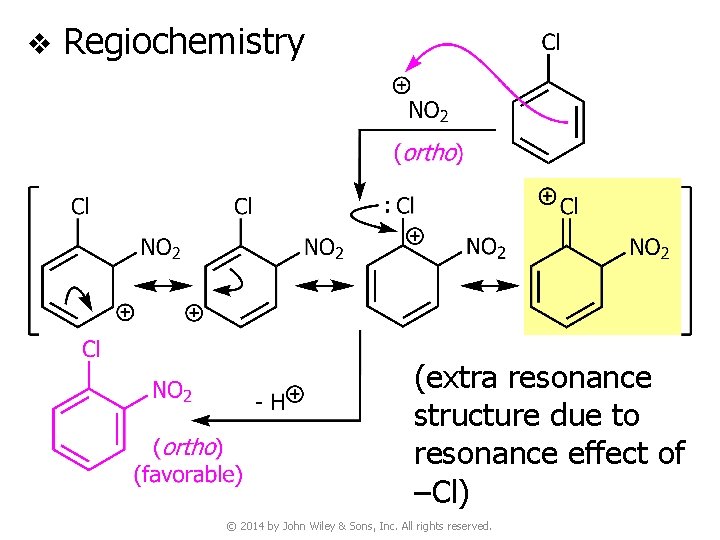
v Regiochemistry (extra resonance structure due to resonance effect of –Cl) © 2014 by John Wiley & Sons, Inc. All rights reserved.
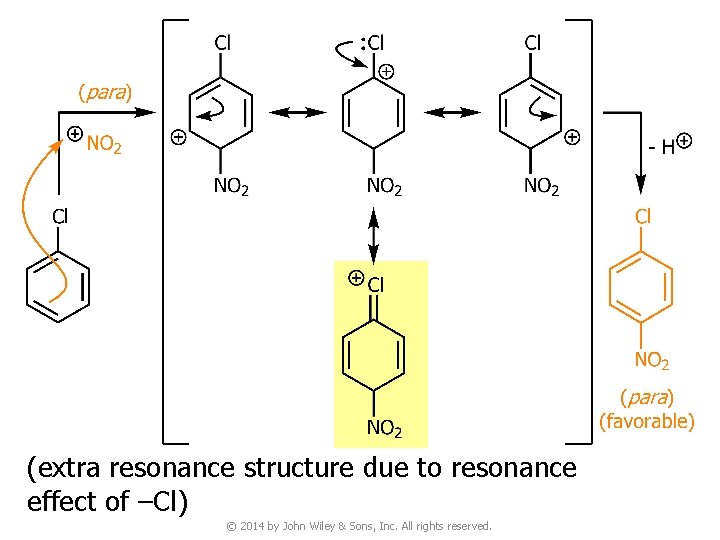
(extra resonance structure due to resonance effect of –Cl) © 2014 by John Wiley & Sons, Inc. All rights reserved.
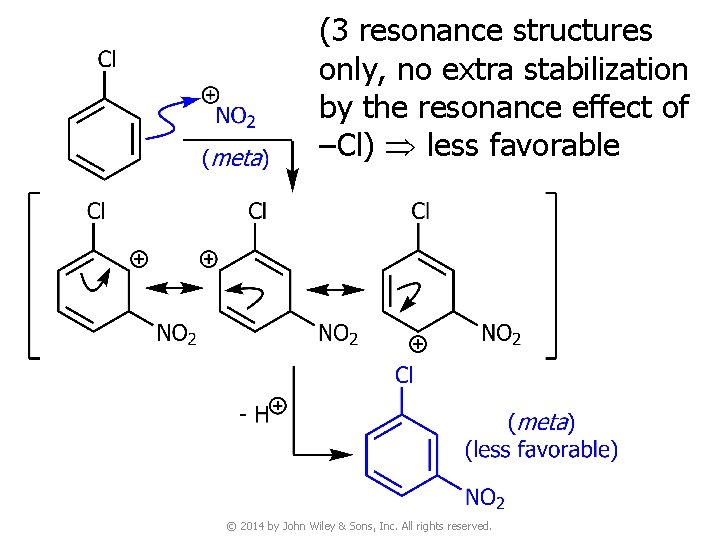
(3 resonance structures only, no extra stabilization by the resonance effect of –Cl) less favorable © 2014 by John Wiley & Sons, Inc. All rights reserved.
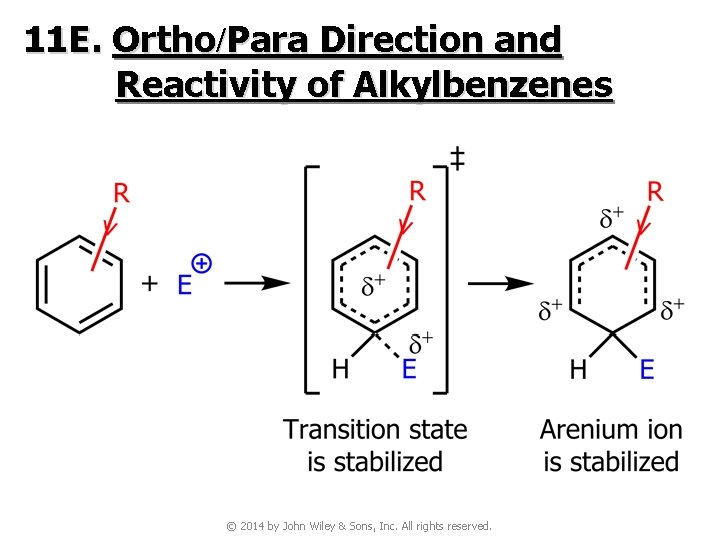
11 E. Ortho/Para Direction and Reactivity of Alkylbenzenes © 2014 by John Wiley & Sons, Inc. All rights reserved.
v Ortho attack Relatively stable contributor © 2014 by John Wiley & Sons, Inc. All rights reserved.
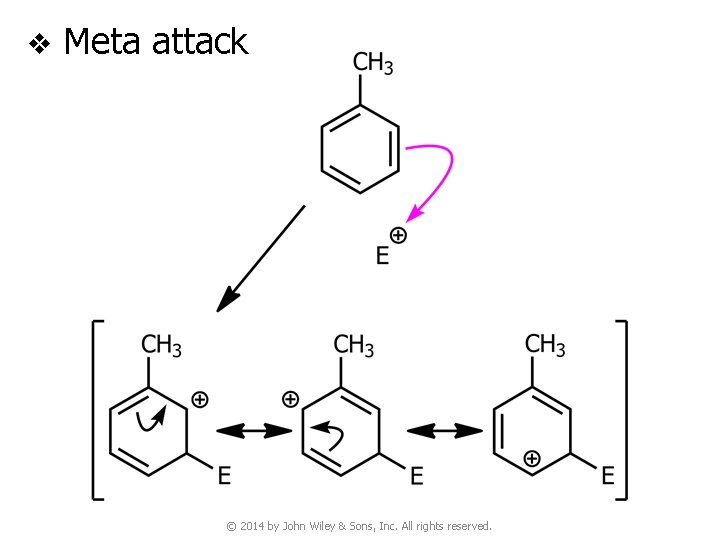
v Meta attack © 2014 by John Wiley & Sons, Inc. All rights reserved.
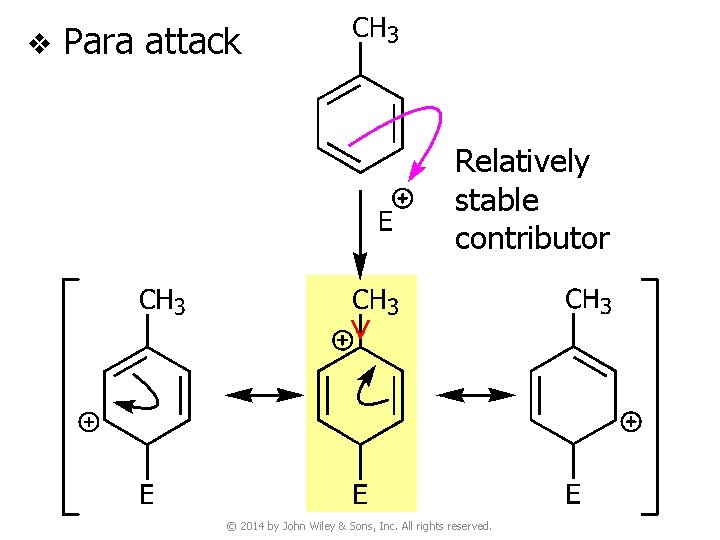
v Para attack Relatively stable contributor © 2014 by John Wiley & Sons, Inc. All rights reserved.
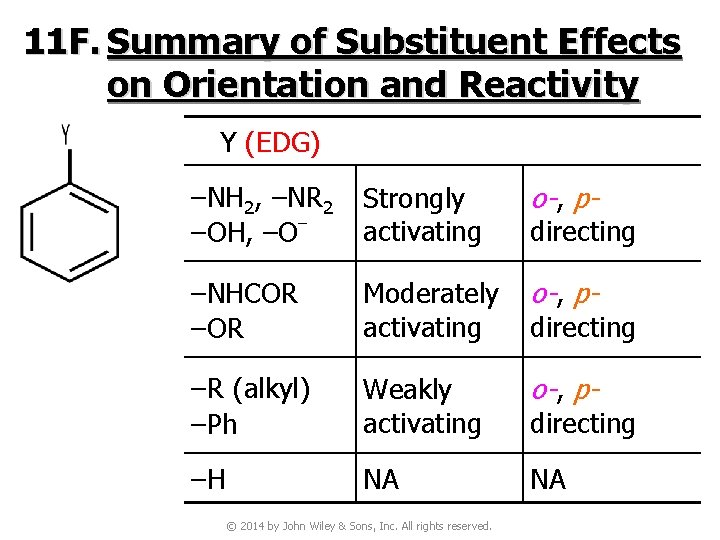
11 F. Summary of Substituent Effects on Orientation and Reactivity Y (EDG) –NH 2, –NR 2 –OH, –O- Strongly activating o-, p- –NHCOR –OR Moderately activating o-, p- –R (alkyl) –Ph Weakly activating o-, p- –H NA NA © 2014 by John Wiley & Sons, Inc. All rights reserved. directing
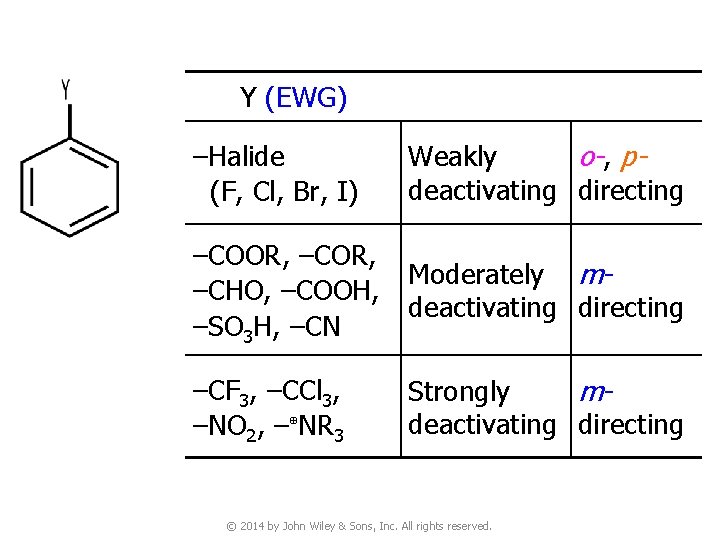
Y (EWG) –Halide (F, Cl, Br, I) Weakly o-, pdeactivating directing –COOR, –CHO, –COOH, –SO 3 H, –CN Moderately mdeactivating directing –CF 3, –CCl 3, –NO 2, –⊕NR 3 Strongly mdeactivating directing © 2014 by John Wiley & Sons, Inc. All rights reserved.
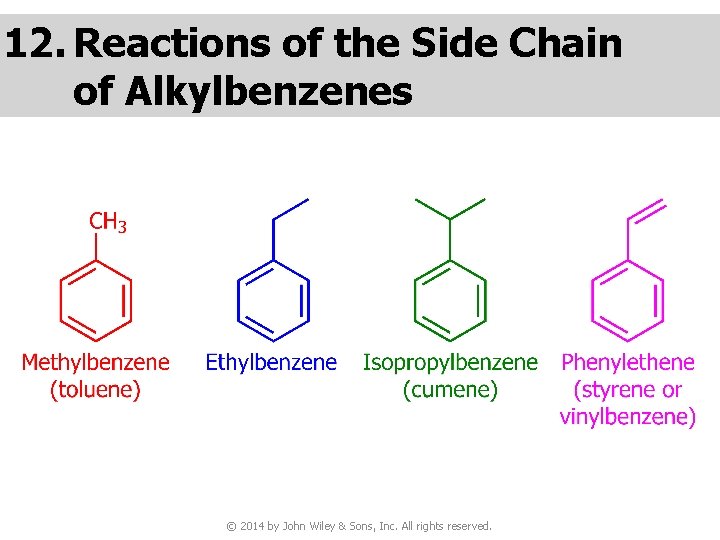
12. Reactions of the Side Chain of Alkylbenzenes © 2014 by John Wiley & Sons, Inc. All rights reserved.
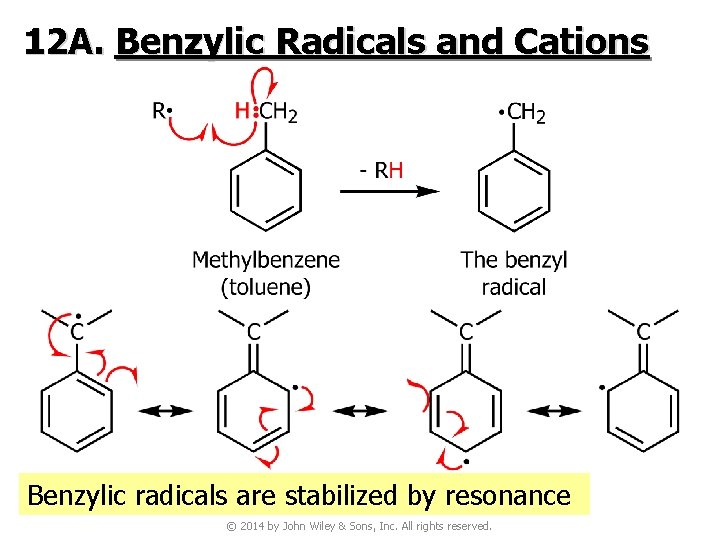
12 A. Benzylic Radicals and Cations Benzylic radicals are stabilized by resonance © 2014 by John Wiley & Sons, Inc. All rights reserved.

Benzylic cations are stabilized by resonance © 2014 by John Wiley & Sons, Inc. All rights reserved.
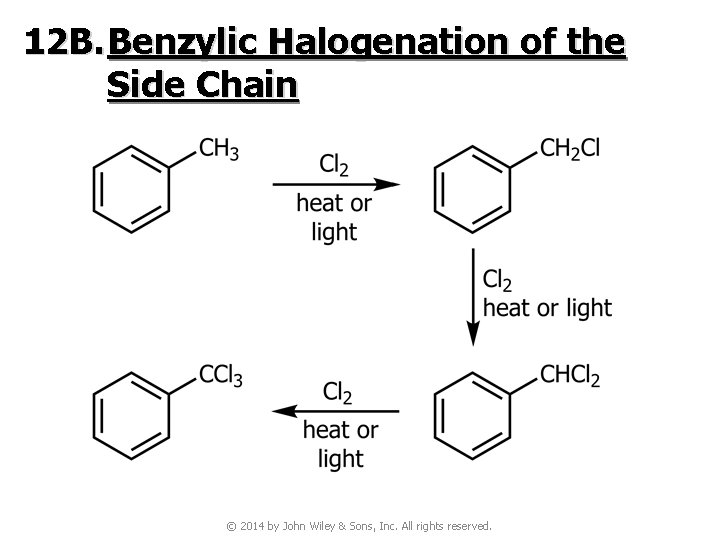
12 B. Benzylic Halogenation of the Side Chain © 2014 by John Wiley & Sons, Inc. All rights reserved.
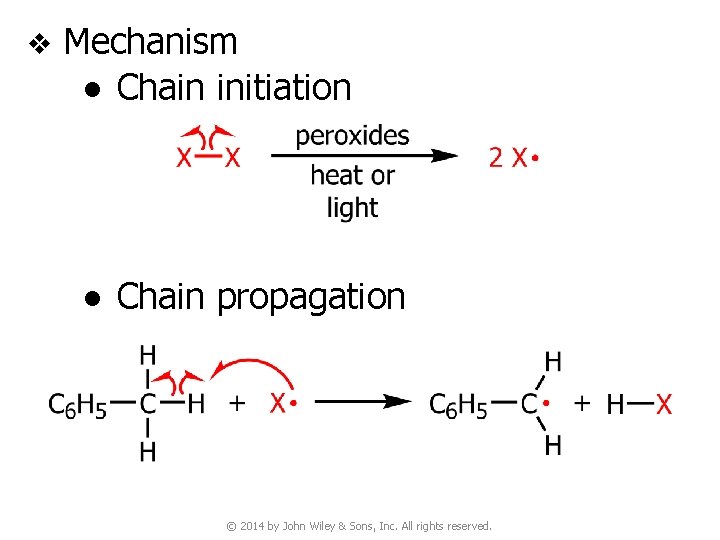
v Mechanism ● Chain initiation ● Chain propagation © 2014 by John Wiley & Sons, Inc. All rights reserved.
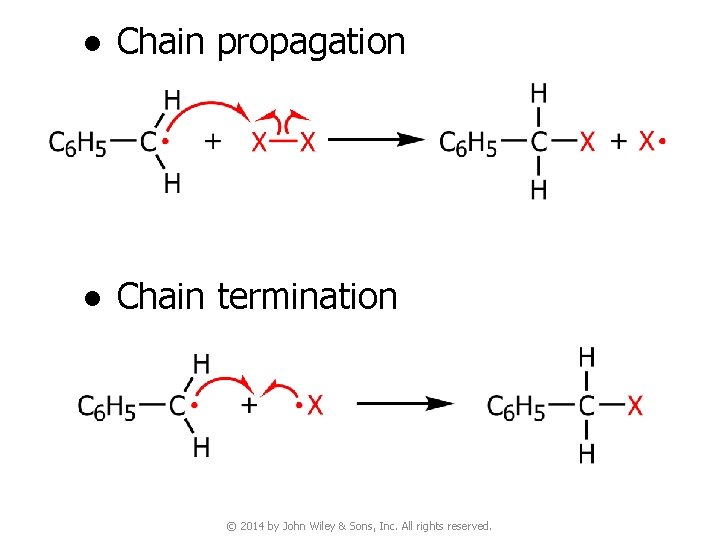
● Chain propagation ● Chain termination © 2014 by John Wiley & Sons, Inc. All rights reserved.
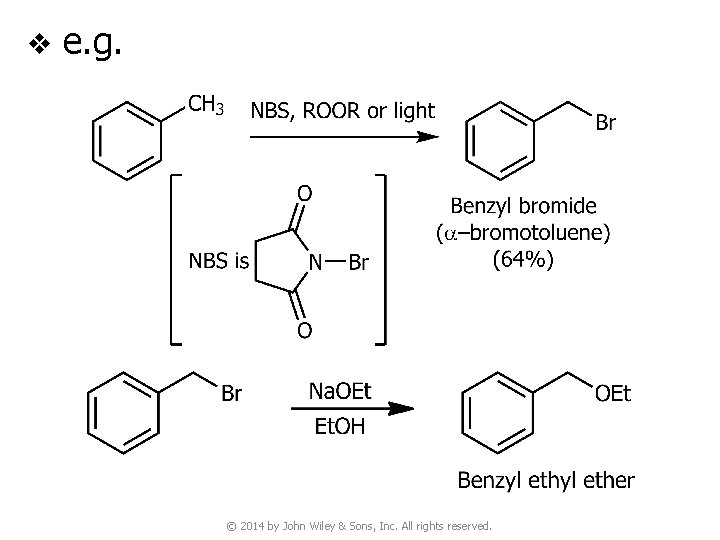
v e. g. © 2014 by John Wiley & Sons, Inc. All rights reserved.
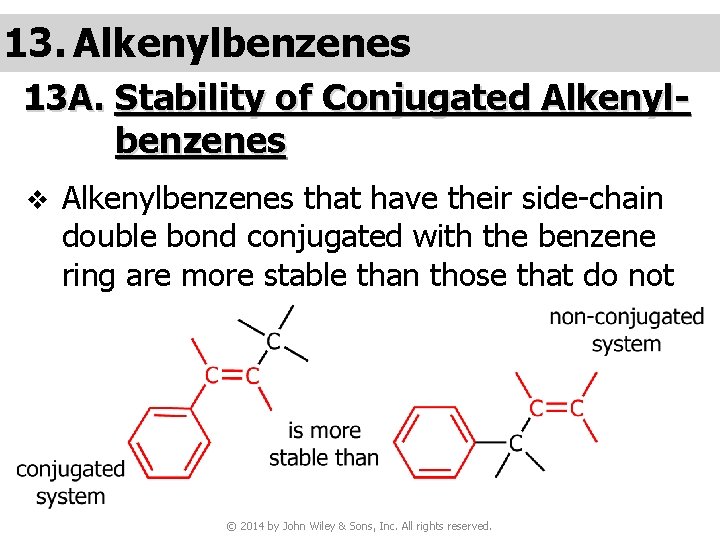
13. Alkenylbenzenes 13 A. Stability of Conjugated Alkenylbenzenes v Alkenylbenzenes that have their side-chain double bond conjugated with the benzene ring are more stable than those that do not © 2014 by John Wiley & Sons, Inc. All rights reserved.
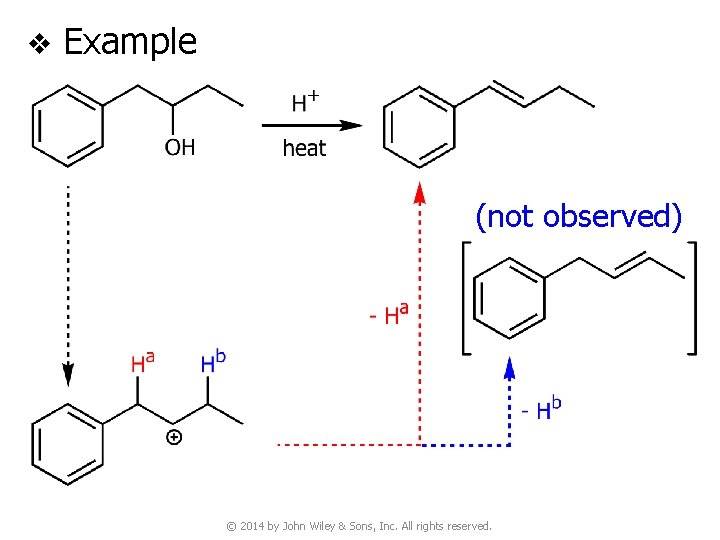
v Example (not observed) © 2014 by John Wiley & Sons, Inc. All rights reserved.
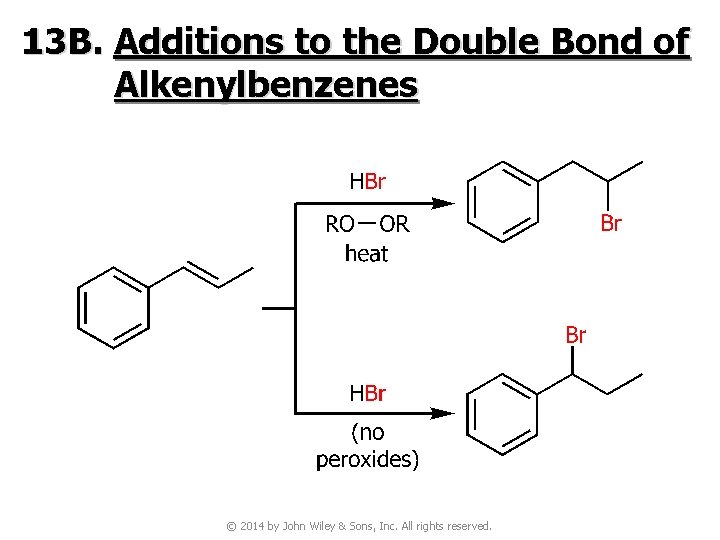
13 B. Additions to the Double Bond of Alkenylbenzenes © 2014 by John Wiley & Sons, Inc. All rights reserved.
v Mechanism (top reaction) © 2014 by John Wiley & Sons, Inc. All rights reserved.
v Mechanism (bottom reaction) © 2014 by John Wiley & Sons, Inc. All rights reserved.
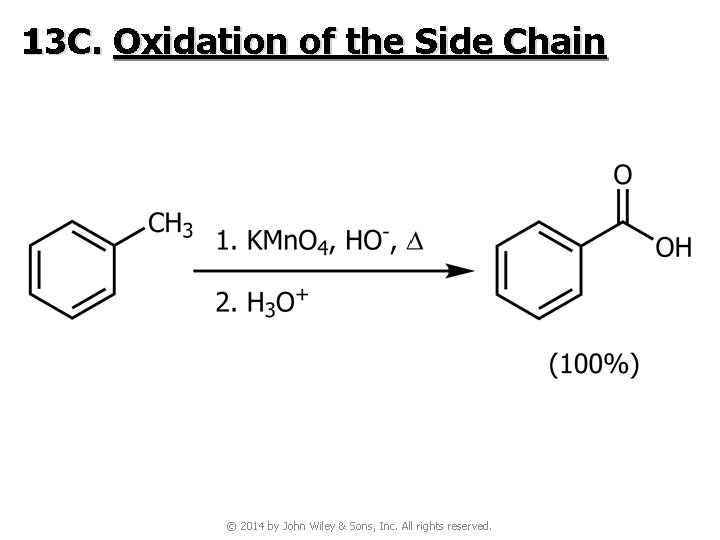
13 C. Oxidation of the Side Chain © 2014 by John Wiley & Sons, Inc. All rights reserved.
© 2014 by John Wiley & Sons, Inc. All rights reserved.
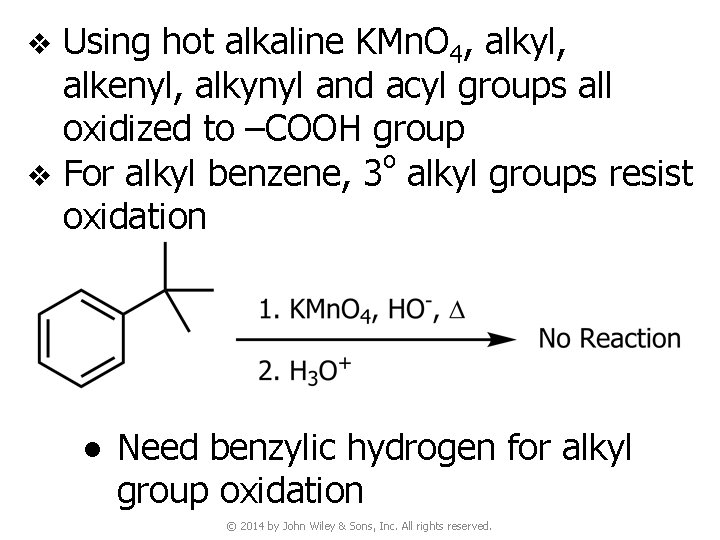
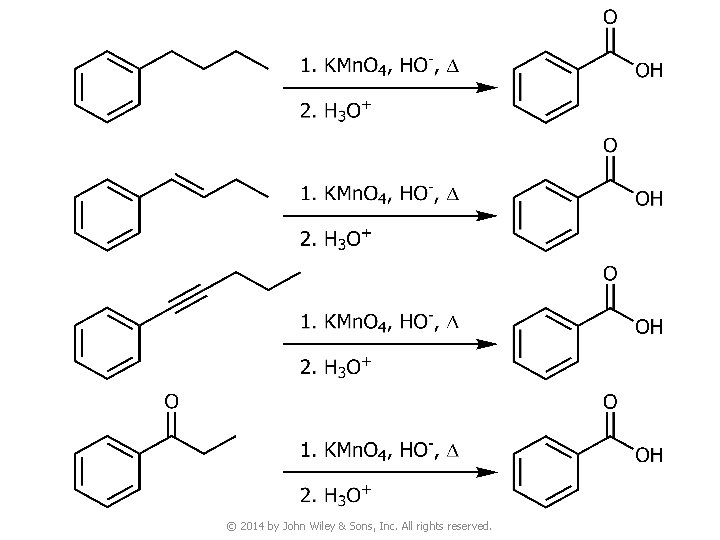
Using hot alkaline KMn. O 4, alkyl, alkenyl, alkynyl and acyl groups all oxidized to –COOH group o v For alkyl benzene, 3 alkyl groups resist oxidation v ● Need benzylic hydrogen for alkyl group oxidation © 2014 by John Wiley & Sons, Inc. All rights reserved.
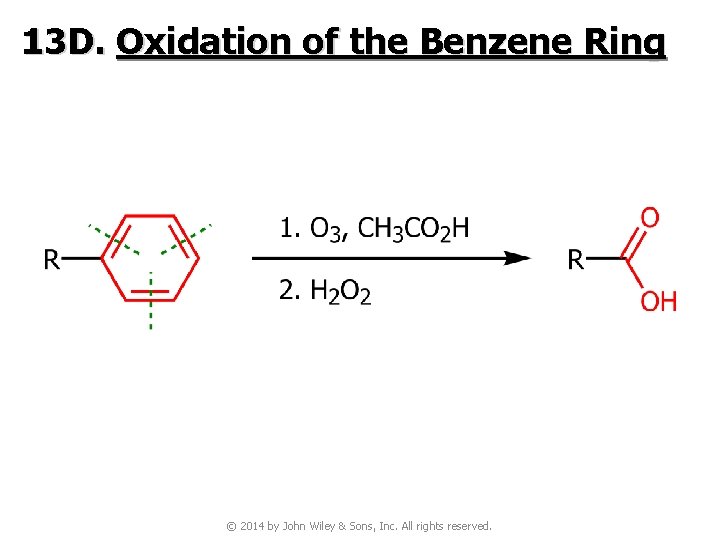
13 D. Oxidation of the Benzene Ring © 2014 by John Wiley & Sons, Inc. All rights reserved.
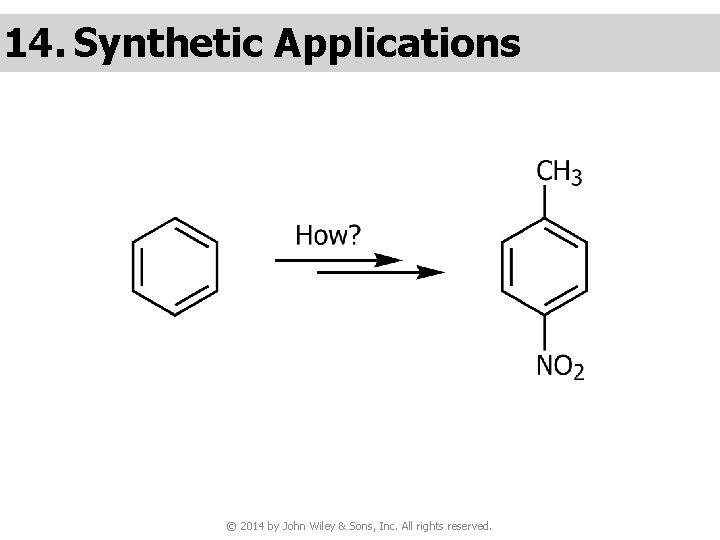
14. Synthetic Applications © 2014 by John Wiley & Sons, Inc. All rights reserved.
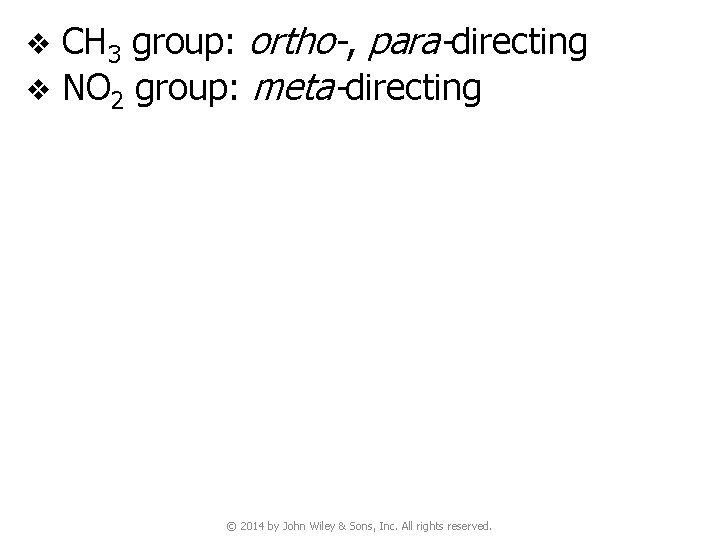
CH 3 group: ortho-, para-directing v NO 2 group: meta-directing v © 2014 by John Wiley & Sons, Inc. All rights reserved.
v If the order is reversed the wrong regioisomer is produced © 2014 by John Wiley & Sons, Inc. All rights reserved.
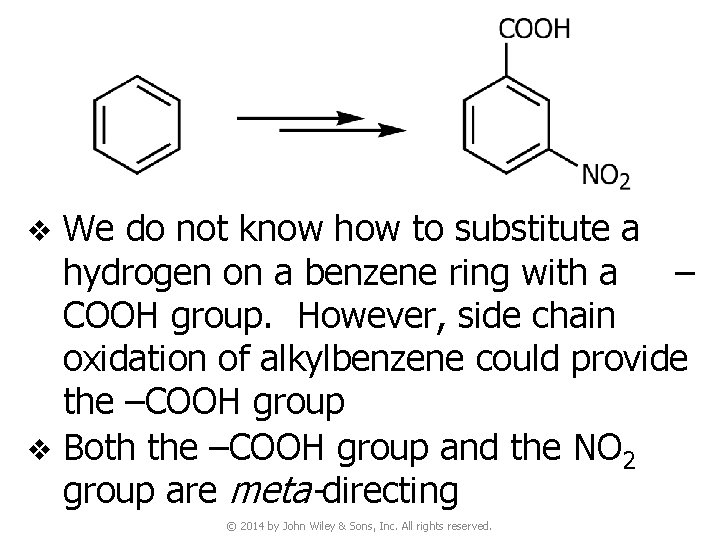
We do not know how to substitute a hydrogen on a benzene ring with a – COOH group. However, side chain oxidation of alkylbenzene could provide the –COOH group v Both the –COOH group and the NO 2 group are meta-directing v © 2014 by John Wiley & Sons, Inc. All rights reserved.
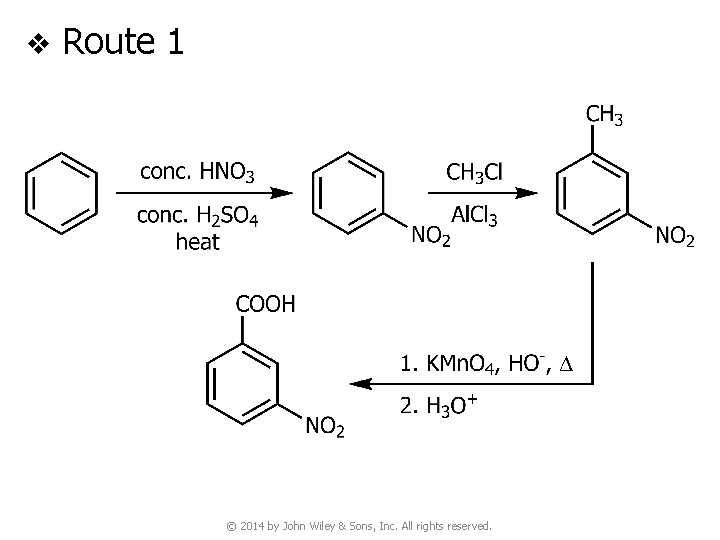
v Route 1 © 2014 by John Wiley & Sons, Inc. All rights reserved.
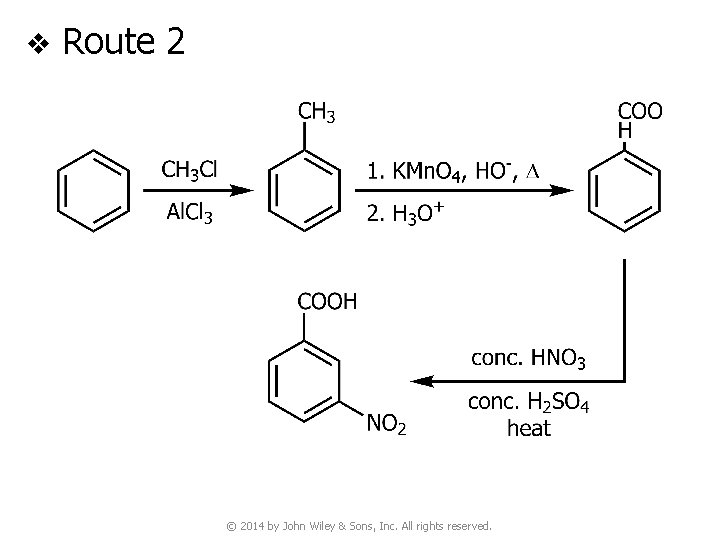
v Route 2 © 2014 by John Wiley & Sons, Inc. All rights reserved.
v Which synthetic route is better? ● Recall “Limitations of Friedel-Crafts Reactions, Section 15. 8” Friedel–Crafts reactions usually give poor yields when powerful electronwithdrawing groups are present on the aromatic ring or when the ring bears an –NH 2, –NHR, or –NR 2 group. This applies to both alkylations and acylations t Route 2 is a better route t © 2014 by John Wiley & Sons, Inc. All rights reserved.
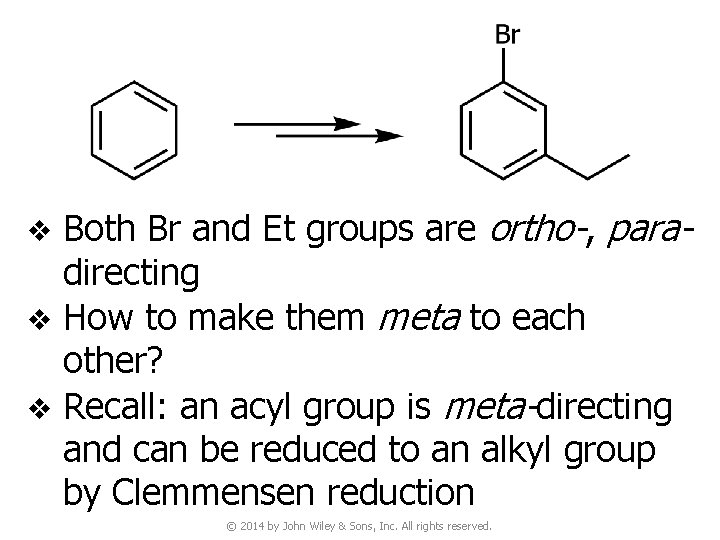
Both Br and Et groups are ortho-, paradirecting v How to make them meta to each other? v Recall: an acyl group is meta-directing and can be reduced to an alkyl group by Clemmensen reduction v © 2014 by John Wiley & Sons, Inc. All rights reserved.

© 2014 by John Wiley & Sons, Inc. All rights reserved.
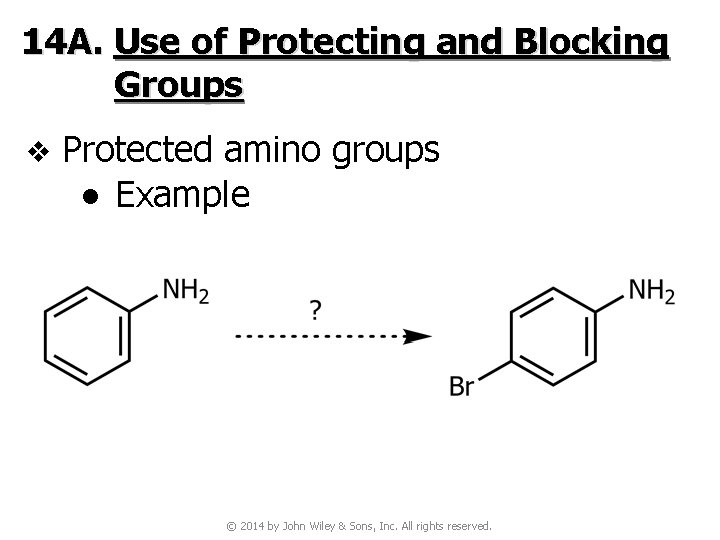
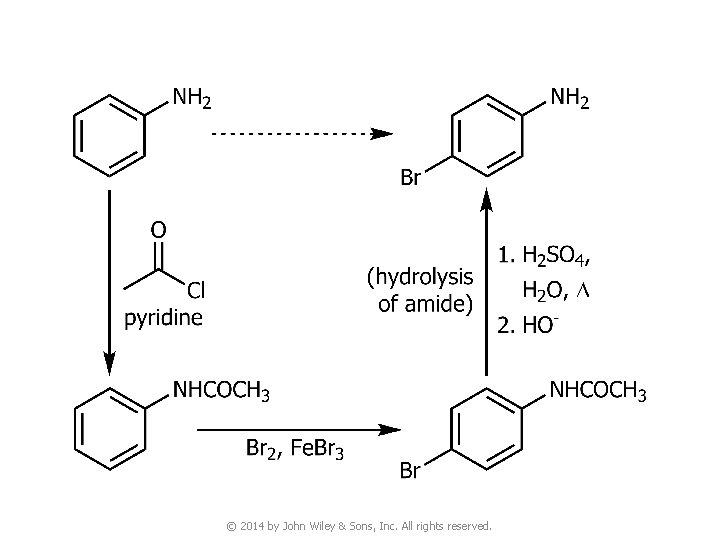
14 A. Use of Protecting and Blocking Groups v Protected amino groups ● Example © 2014 by John Wiley & Sons, Inc. All rights reserved.
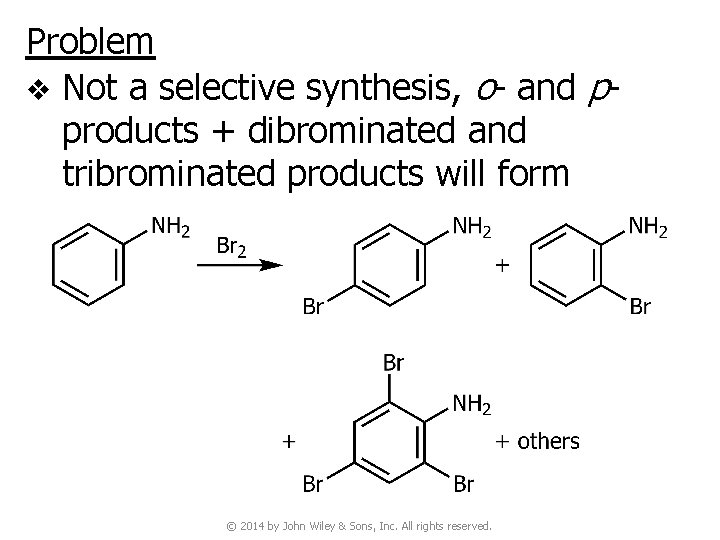
Problem v Not a selective synthesis, o- and pproducts + dibrominated and tribrominated products will form © 2014 by John Wiley & Sons, Inc. All rights reserved.
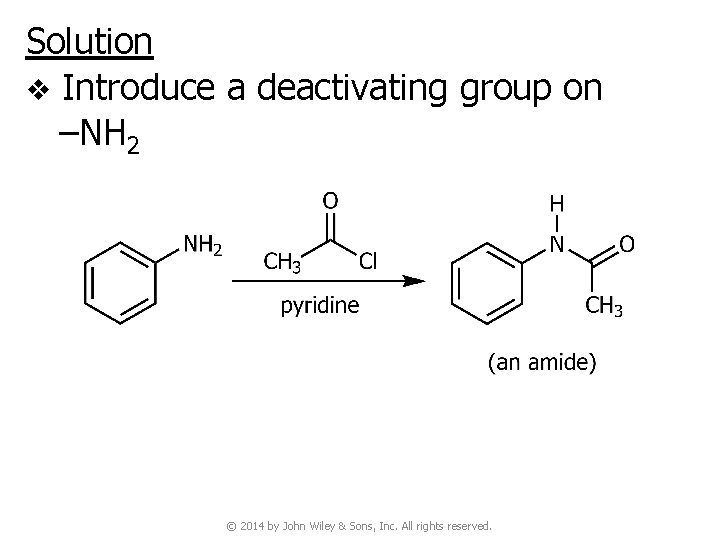
Solution v Introduce a deactivating group on –NH 2 © 2014 by John Wiley & Sons, Inc. All rights reserved.

v The amide group is less activating than –NH 2 group ● No problem for over bromination v The steric bulkiness of this group also decreases the formation of the obrominated product © 2014 by John Wiley & Sons, Inc. All rights reserved.
© 2014 by John Wiley & Sons, Inc. All rights reserved.
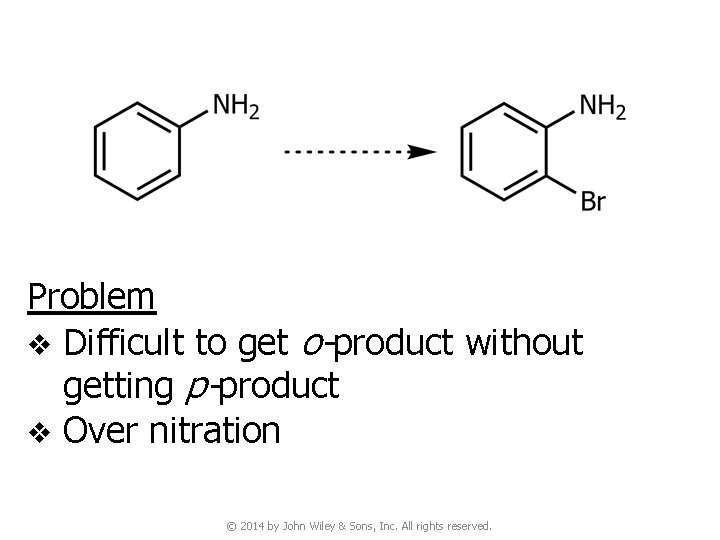
Problem v Difficult to get o-product without getting p-product v Over nitration © 2014 by John Wiley & Sons, Inc. All rights reserved.
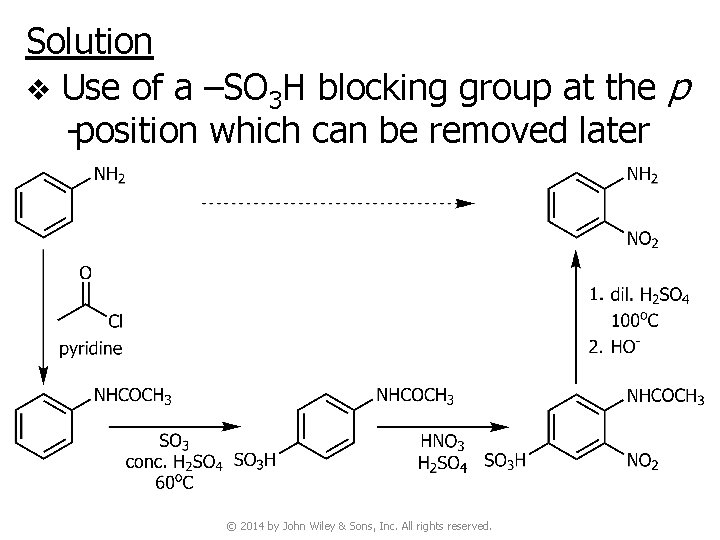
Solution v Use of a –SO 3 H blocking group at the p -position which can be removed later © 2014 by John Wiley & Sons, Inc. All rights reserved.
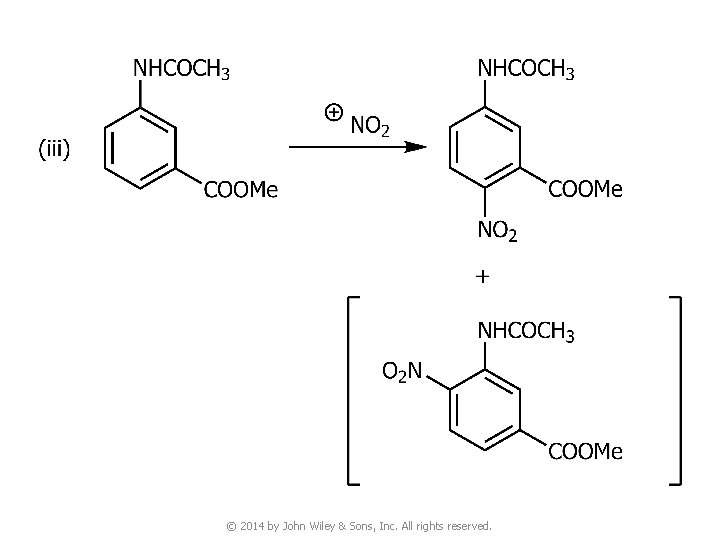
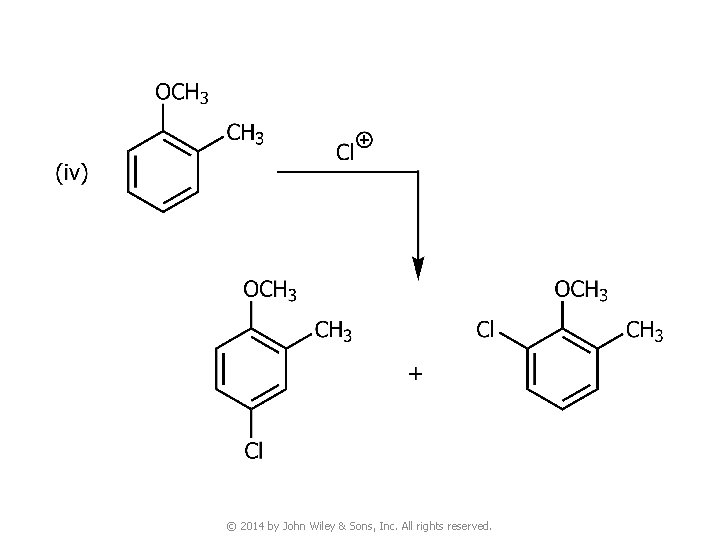
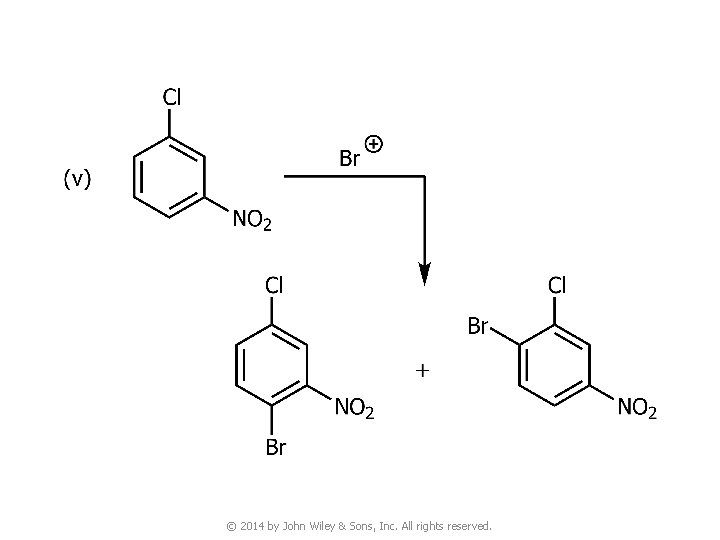
14 B. Orientation in Disubstituted Benzenes v Directing effect of EDG usually outweighs that of EWG v With two EDGs, the directing effect is usually controlled by the stronger EDG © 2014 by John Wiley & Sons, Inc. All rights reserved.
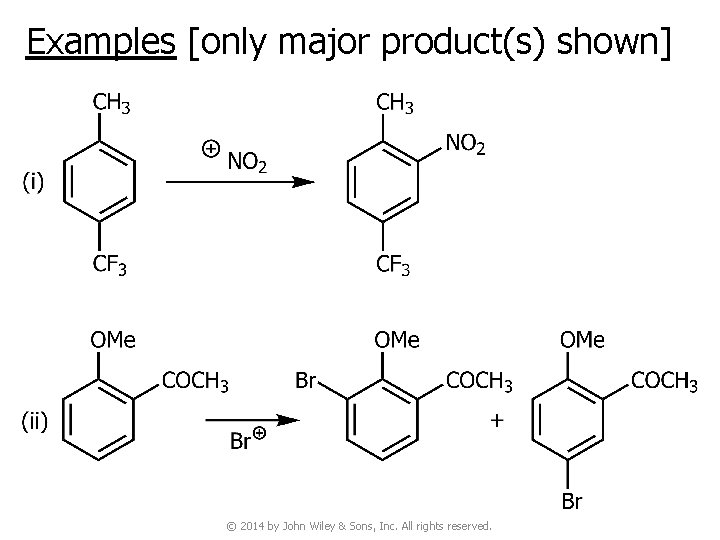
Examples [only major product(s) shown] © 2014 by John Wiley & Sons, Inc. All rights reserved.
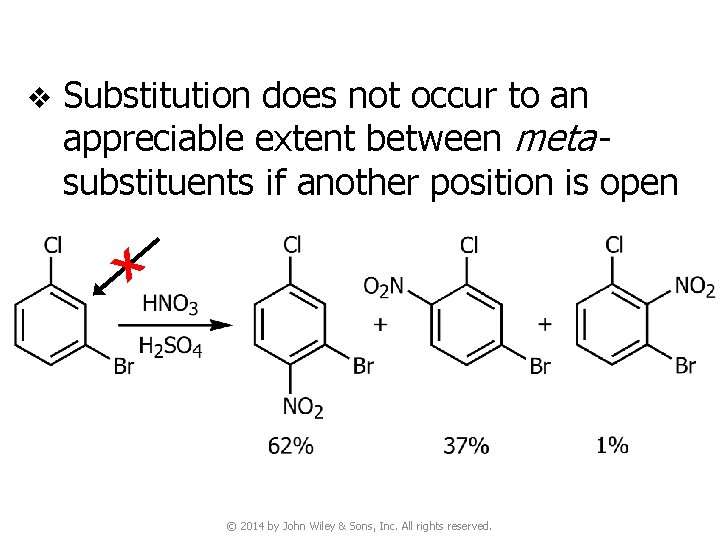
v Substitution does not occur to an appreciable extent between metasubstituents if another position is open X © 2014 by John Wiley & Sons, Inc. All rights reserved.
© 2014 by John Wiley & Sons, Inc. All rights reserved.
© 2014 by John Wiley & Sons, Inc. All rights reserved.
© 2014 by John Wiley & Sons, Inc. All rights reserved.
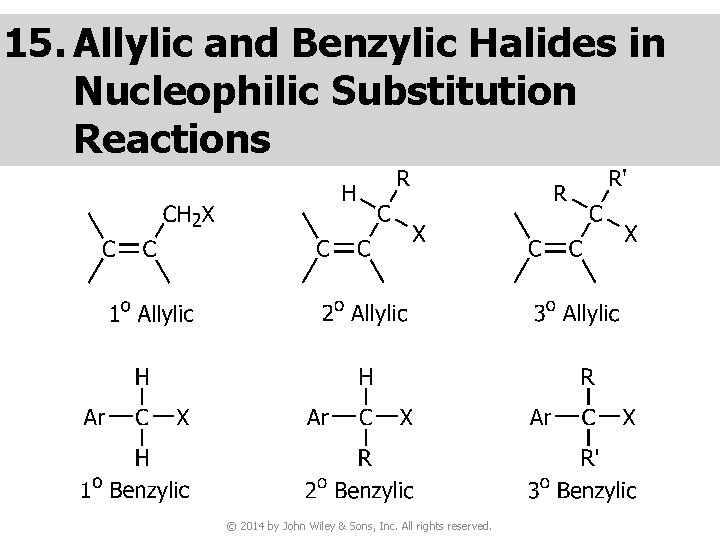
15. Allylic and Benzylic Halides in Nucleophilic Substitution Reactions © 2014 by John Wiley & Sons, Inc. All rights reserved.
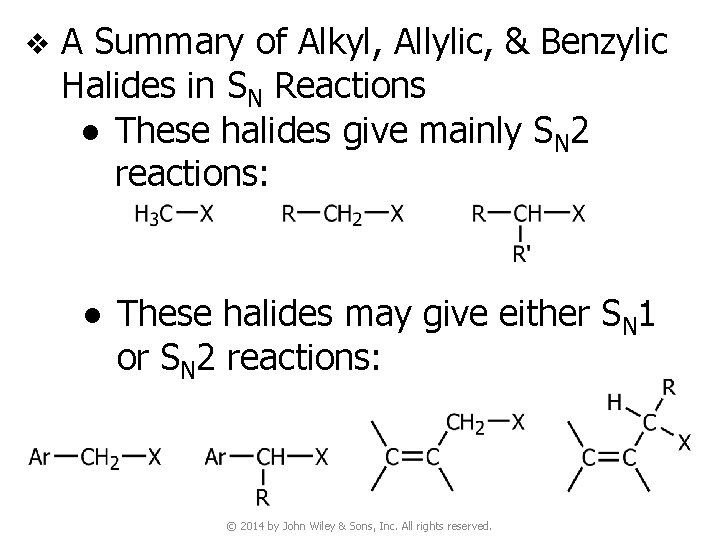
v A Summary of Alkyl, Allylic, & Benzylic Halides in SN Reactions ● These halides give mainly SN 2 reactions: ● These halides may give either SN 1 or SN 2 reactions: © 2014 by John Wiley & Sons, Inc. All rights reserved.
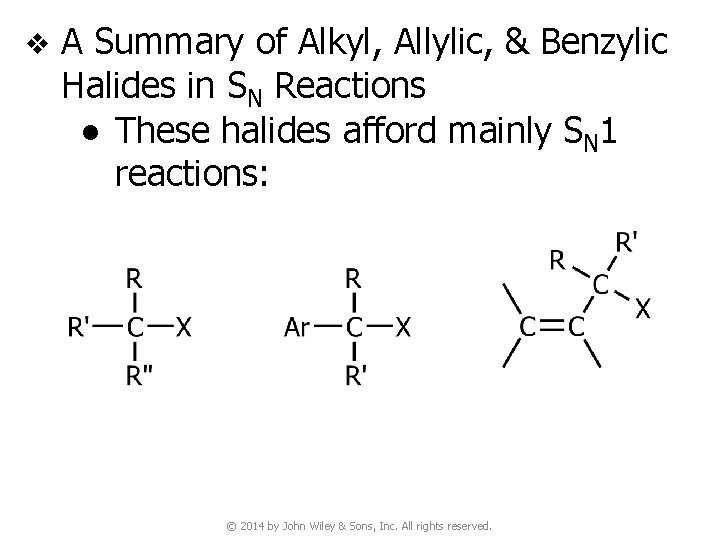
v A Summary of Alkyl, Allylic, & Benzylic Halides in SN Reactions ● These halides afford mainly SN 1 reactions: © 2014 by John Wiley & Sons, Inc. All rights reserved.
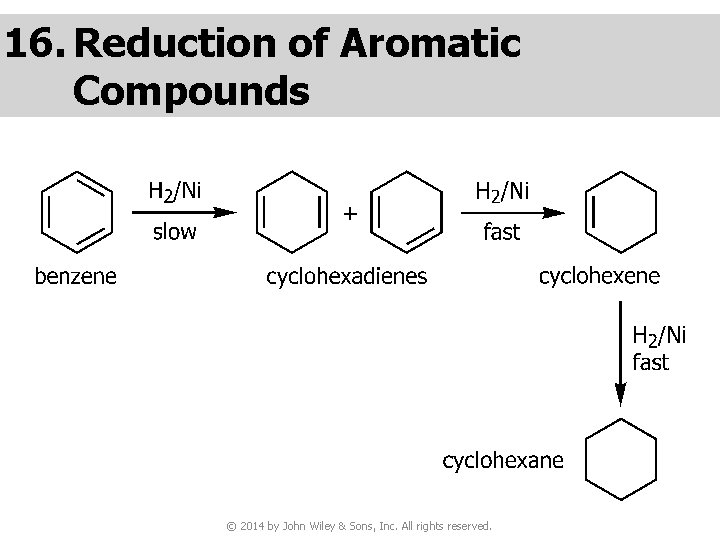
16. Reduction of Aromatic Compounds © 2014 by John Wiley & Sons, Inc. All rights reserved.
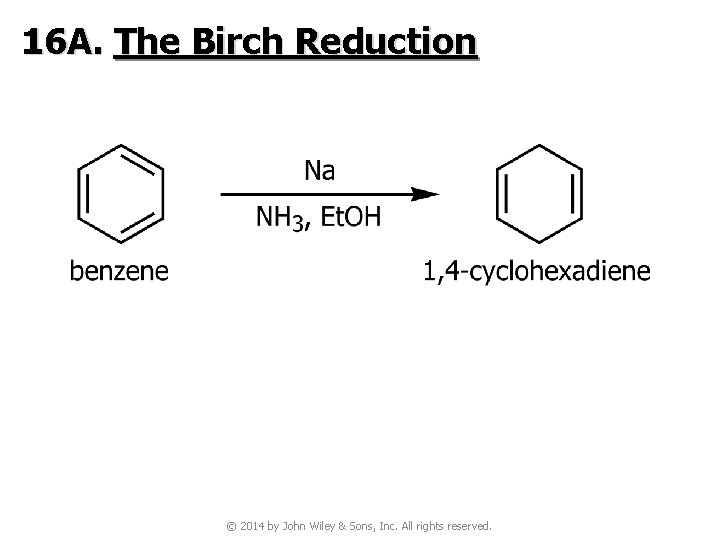
16 A. The Birch Reduction © 2014 by John Wiley & Sons, Inc. All rights reserved.
v Mechanism © 2014 by John Wiley & Sons, Inc. All rights reserved.
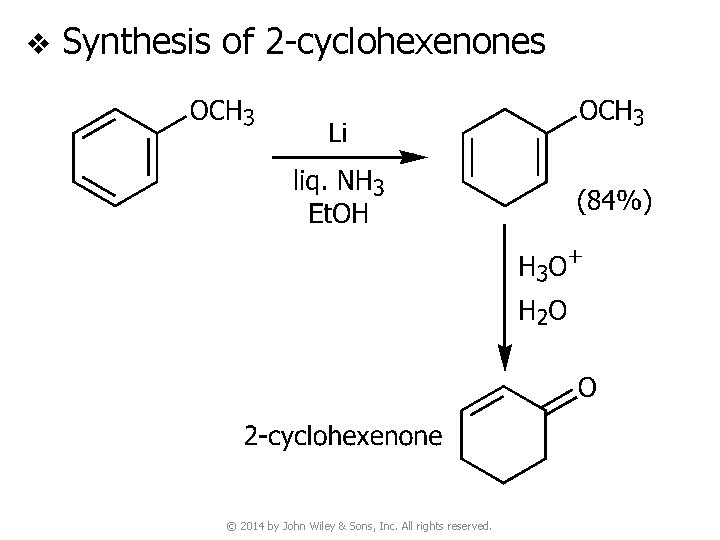
v Synthesis of 2 -cyclohexenones © 2014 by John Wiley & Sons, Inc. All rights reserved.
- Slides: 140