
Chapter 15 Reactions of Aromatic Compounds Chapter 15

- Slides: 43
Chapter 15 Reactions of Aromatic Compounds Chapter 15
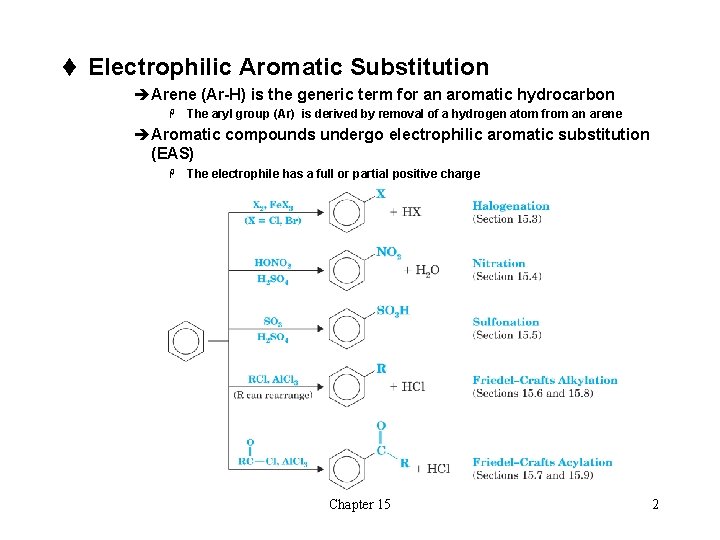
t Electrophilic Aromatic Substitution èArene (Ar-H) is the generic term for an aromatic hydrocarbon H The aryl group (Ar) is derived by removal of a hydrogen atom from an arene èAromatic compounds undergo electrophilic aromatic substitution (EAS) H The electrophile has a full or partial positive charge Chapter 15 2
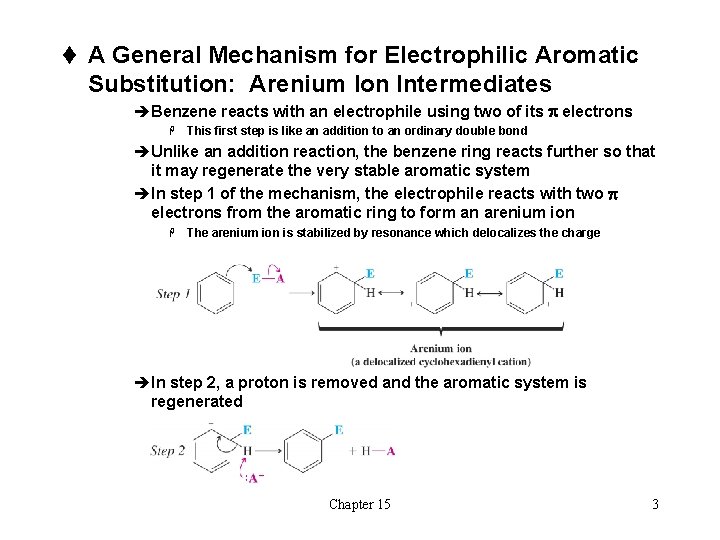
t A General Mechanism for Electrophilic Aromatic Substitution: Arenium Ion Intermediates èBenzene reacts with an electrophile using two of its p electrons H This first step is like an addition to an ordinary double bond èUnlike an addition reaction, the benzene ring reacts further so that it may regenerate the very stable aromatic system èIn step 1 of the mechanism, the electrophile reacts with two p electrons from the aromatic ring to form an arenium ion H The arenium ion is stabilized by resonance which delocalizes the charge èIn step 2, a proton is removed and the aromatic system is regenerated Chapter 15 3
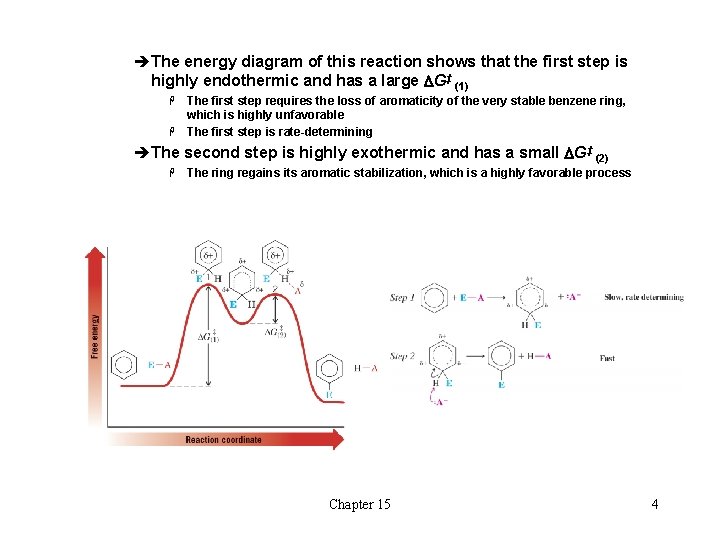
èThe energy diagram of this reaction shows that the first step is highly endothermic and has a large DG‡ (1) The first step requires the loss of aromaticity of the very stable benzene ring, which is highly unfavorable H The first step is rate-determining H èThe second step is highly exothermic and has a small DG‡ (2) H The ring regains its aromatic stabilization, which is a highly favorable process Chapter 15 4
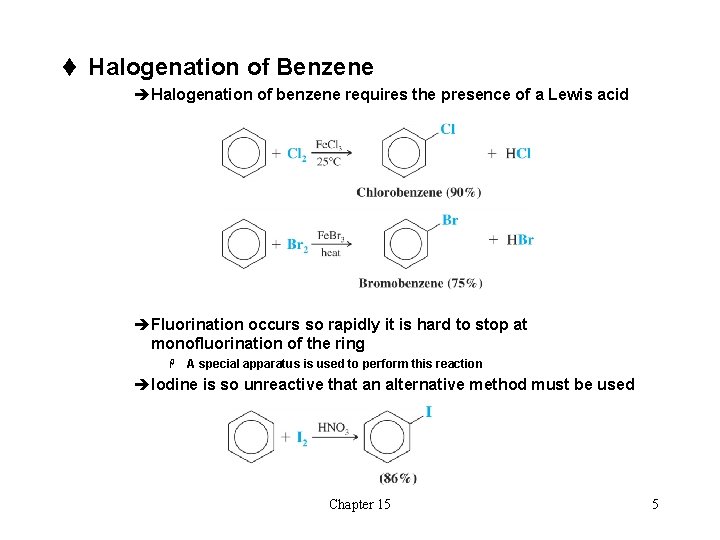
t Halogenation of Benzene èHalogenation of benzene requires the presence of a Lewis acid èFluorination occurs so rapidly it is hard to stop at monofluorination of the ring H A special apparatus is used to perform this reaction èIodine is so unreactive that an alternative method must be used Chapter 15 5
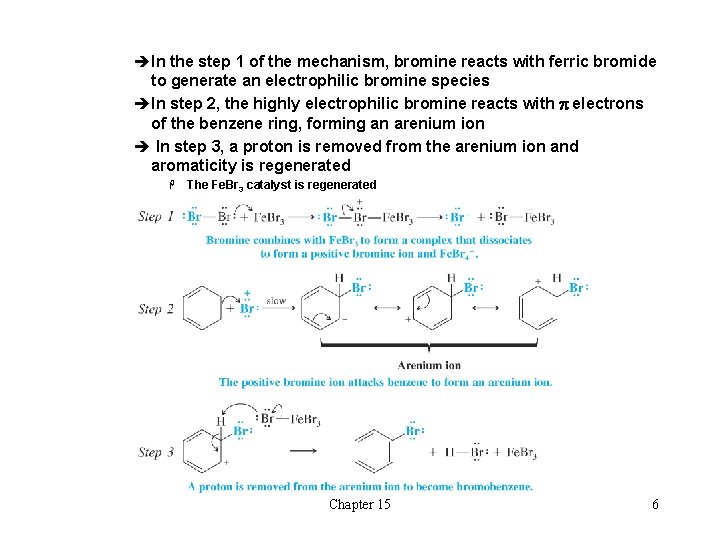
èIn the step 1 of the mechanism, bromine reacts with ferric bromide to generate an electrophilic bromine species èIn step 2, the highly electrophilic bromine reacts with p electrons of the benzene ring, forming an arenium ion è In step 3, a proton is removed from the arenium ion and aromaticity is regenerated H The Fe. Br 3 catalyst is regenerated Chapter 15 6
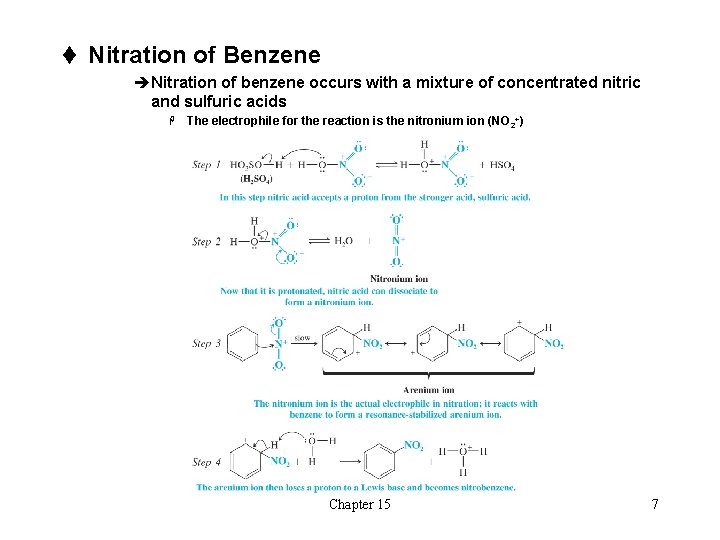
t Nitration of Benzene èNitration of benzene occurs with a mixture of concentrated nitric and sulfuric acids H The electrophile for the reaction is the nitronium ion (NO 2+) Chapter 15 7
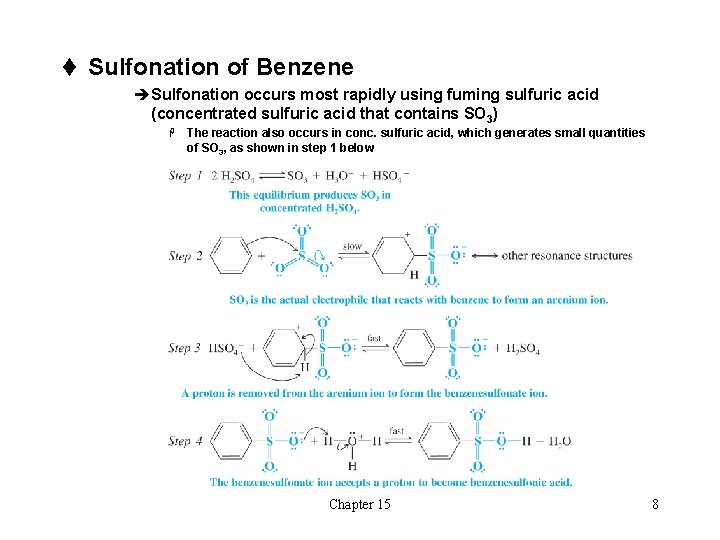
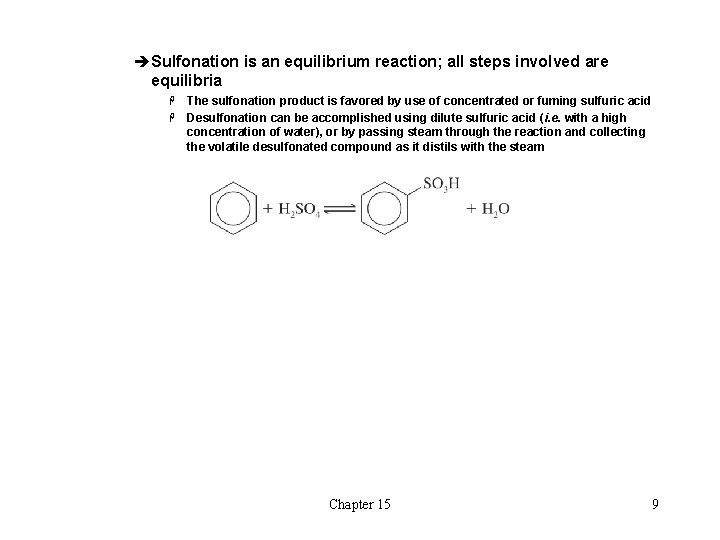
t Sulfonation of Benzene èSulfonation occurs most rapidly using fuming sulfuric acid (concentrated sulfuric acid that contains SO 3) H The reaction also occurs in conc. sulfuric acid, which generates small quantities of SO 3, as shown in step 1 below Chapter 15 8
èSulfonation is an equilibrium reaction; all steps involved are equilibria The sulfonation product is favored by use of concentrated or fuming sulfuric acid H Desulfonation can be accomplished using dilute sulfuric acid (i. e. with a high concentration of water), or by passing steam through the reaction and collecting the volatile desulfonated compound as it distils with the steam H Chapter 15 9
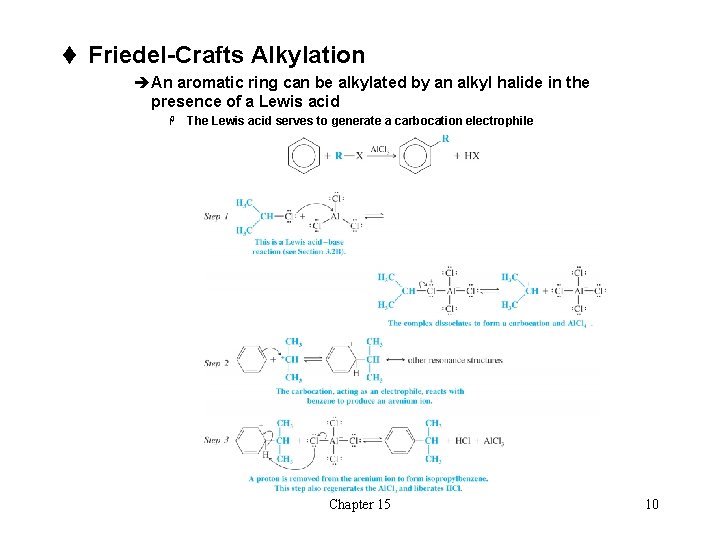
t Friedel-Crafts Alkylation èAn aromatic ring can be alkylated by an alkyl halide in the presence of a Lewis acid H The Lewis acid serves to generate a carbocation electrophile Chapter 15 10
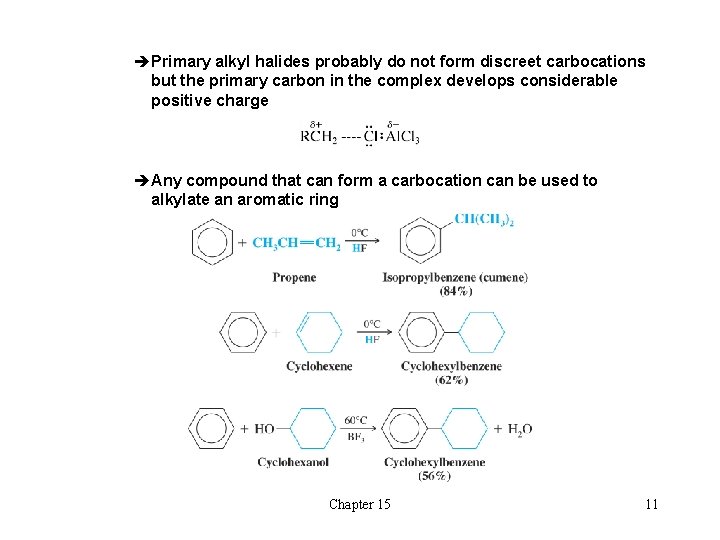
èPrimary alkyl halides probably do not form discreet carbocations but the primary carbon in the complex develops considerable positive charge èAny compound that can form a carbocation can be used to alkylate an aromatic ring Chapter 15 11
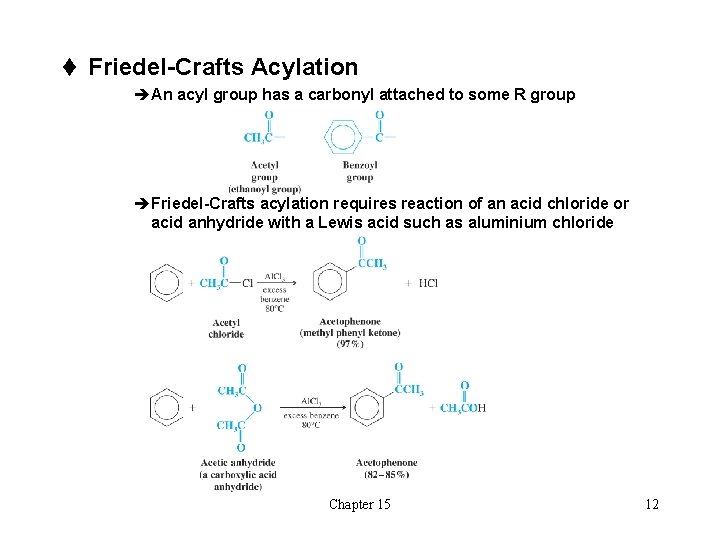
t Friedel-Crafts Acylation èAn acyl group has a carbonyl attached to some R group èFriedel-Crafts acylation requires reaction of an acid chloride or acid anhydride with a Lewis acid such as aluminium chloride Chapter 15 12
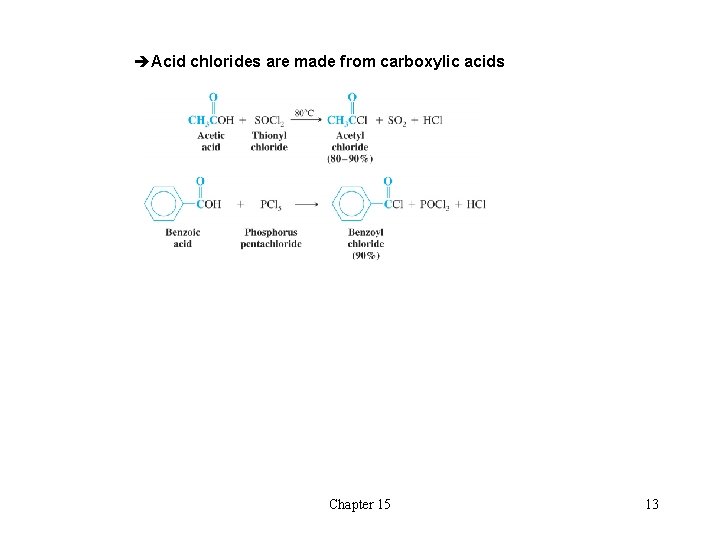
èAcid chlorides are made from carboxylic acids Chapter 15 13
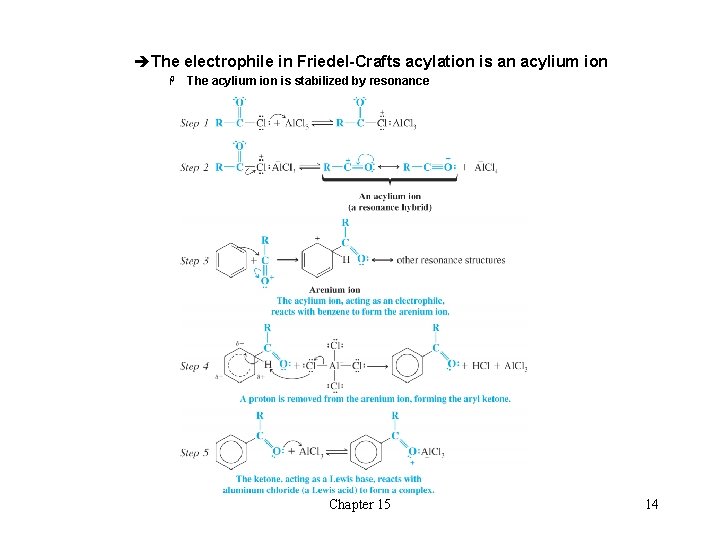
èThe electrophile in Friedel-Crafts acylation is an acylium ion H The acylium ion is stabilized by resonance Chapter 15 14
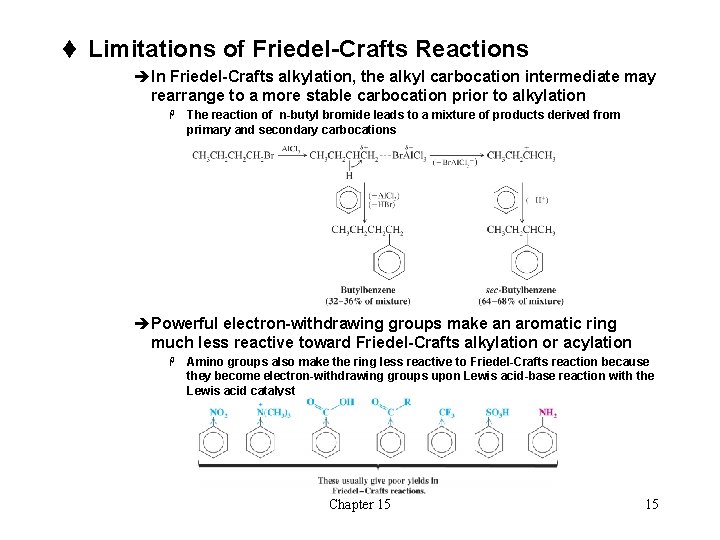
t Limitations of Friedel-Crafts Reactions èIn Friedel-Crafts alkylation, the alkyl carbocation intermediate may rearrange to a more stable carbocation prior to alkylation H The reaction of n-butyl bromide leads to a mixture of products derived from primary and secondary carbocations èPowerful electron-withdrawing groups make an aromatic ring much less reactive toward Friedel-Crafts alkylation or acylation H Amino groups also make the ring less reactive to Friedel-Crafts reaction because they become electron-withdrawing groups upon Lewis acid-base reaction with the Lewis acid catalyst Chapter 15 15
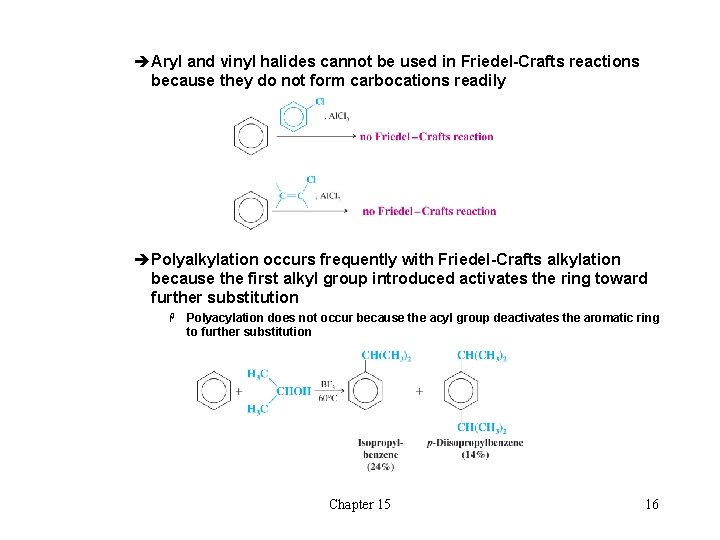
èAryl and vinyl halides cannot be used in Friedel-Crafts reactions because they do not form carbocations readily èPolyalkylation occurs frequently with Friedel-Crafts alkylation because the first alkyl group introduced activates the ring toward further substitution H Polyacylation does not occur because the acyl group deactivates the aromatic ring to further substitution Chapter 15 16
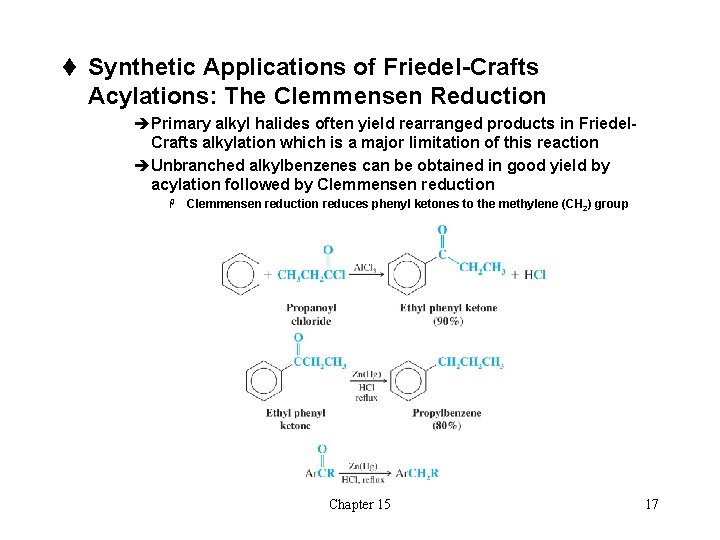
t Synthetic Applications of Friedel-Crafts Acylations: The Clemmensen Reduction èPrimary alkyl halides often yield rearranged products in Friedel. Crafts alkylation which is a major limitation of this reaction èUnbranched alkylbenzenes can be obtained in good yield by acylation followed by Clemmensen reduction H Clemmensen reduction reduces phenyl ketones to the methylene (CH 2) group Chapter 15 17
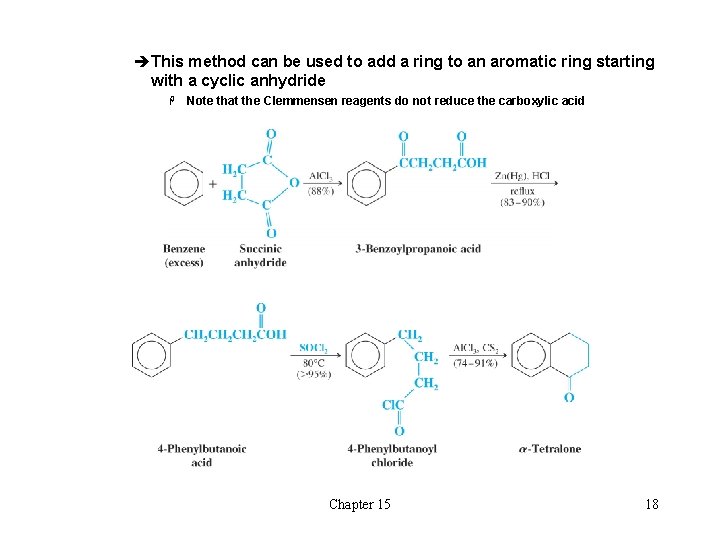
èThis method can be used to add a ring to an aromatic ring starting with a cyclic anhydride H Note that the Clemmensen reagents do not reduce the carboxylic acid Chapter 15 18
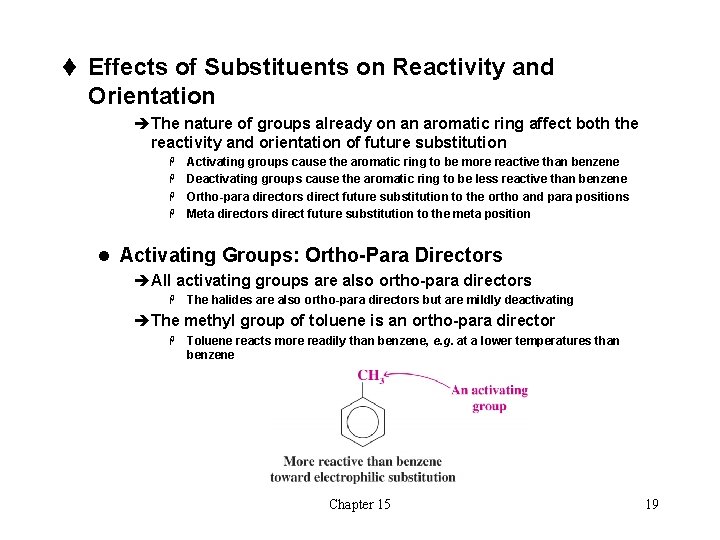
t Effects of Substituents on Reactivity and Orientation èThe nature of groups already on an aromatic ring affect both the reactivity and orientation of future substitution Activating groups cause the aromatic ring to be more reactive than benzene H Deactivating groups cause the aromatic ring to be less reactive than benzene H Ortho-para directors direct future substitution to the ortho and para positions H Meta directors direct future substitution to the meta position H l Activating Groups: Ortho-Para Directors èAll activating groups are also ortho-para directors H The halides are also ortho-para directors but are mildly deactivating èThe methyl group of toluene is an ortho-para director H Toluene reacts more readily than benzene, e. g. at a lower temperatures than benzene Chapter 15 19
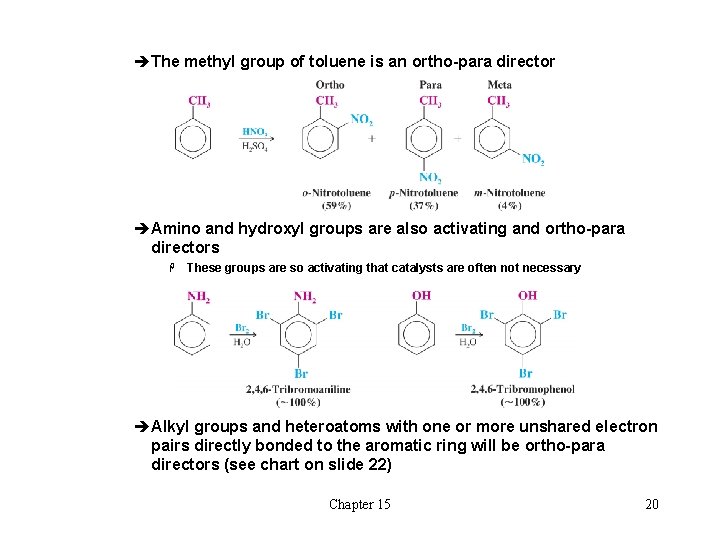
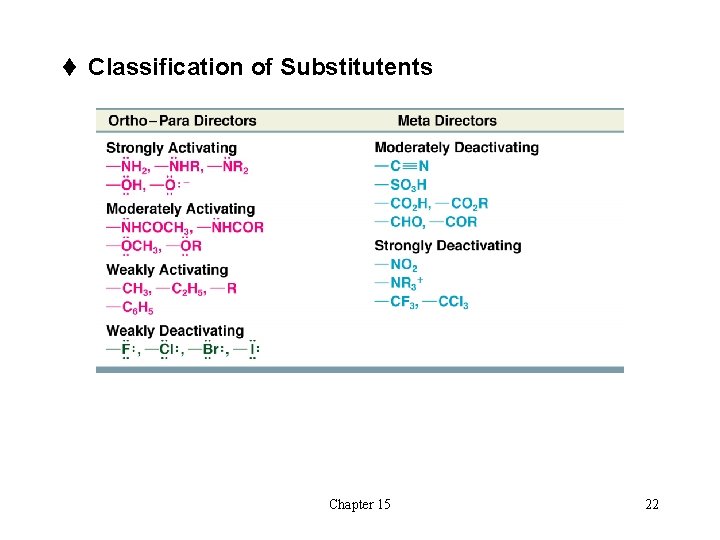
èThe methyl group of toluene is an ortho-para director èAmino and hydroxyl groups are also activating and ortho-para directors H These groups are so activating that catalysts are often not necessary èAlkyl groups and heteroatoms with one or more unshared electron pairs directly bonded to the aromatic ring will be ortho-para directors (see chart on slide 22) Chapter 15 20
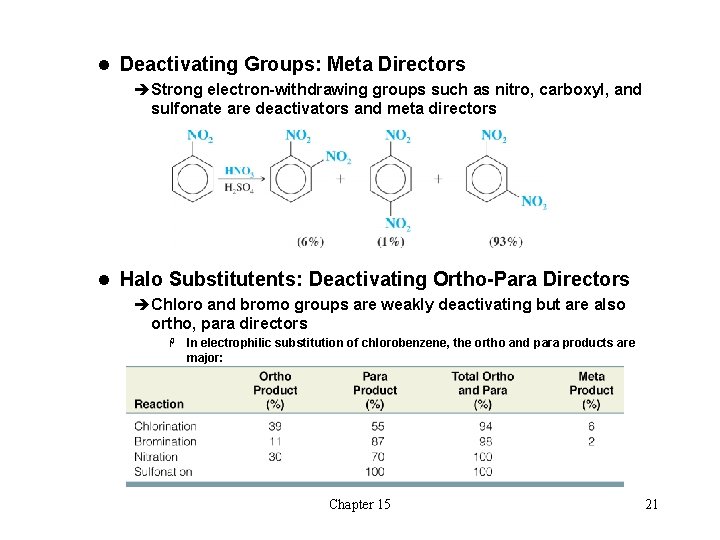
l Deactivating Groups: Meta Directors èStrong electron-withdrawing groups such as nitro, carboxyl, and sulfonate are deactivators and meta directors l Halo Substitutents: Deactivating Ortho-Para Directors èChloro and bromo groups are weakly deactivating but are also ortho, para directors H In electrophilic substitution of chlorobenzene, the ortho and para products are major: Chapter 15 21
t Classification of Substitutents Chapter 15 22
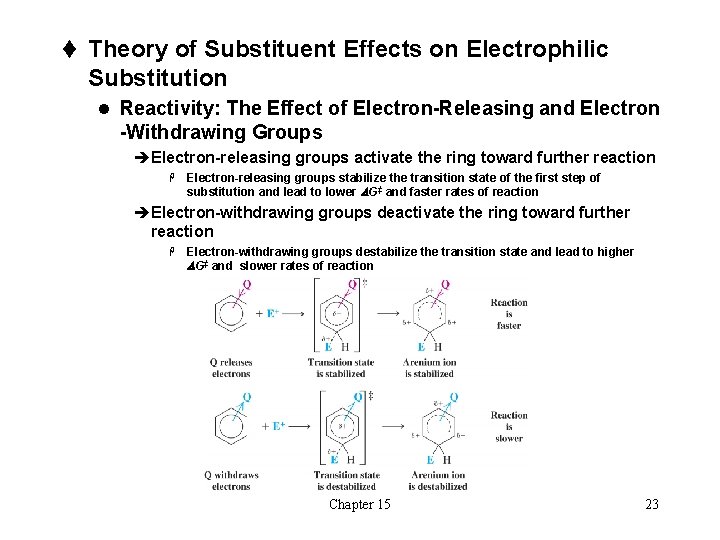
t Theory of Substituent Effects on Electrophilic Substitution l Reactivity: The Effect of Electron-Releasing and Electron -Withdrawing Groups èElectron-releasing groups activate the ring toward further reaction H Electron-releasing groups stabilize the transition state of the first step of substitution and lead to lower DG‡ and faster rates of reaction èElectron-withdrawing groups deactivate the ring toward further reaction H Electron-withdrawing groups destabilize the transition state and lead to higher DG‡ and slower rates of reaction Chapter 15 23
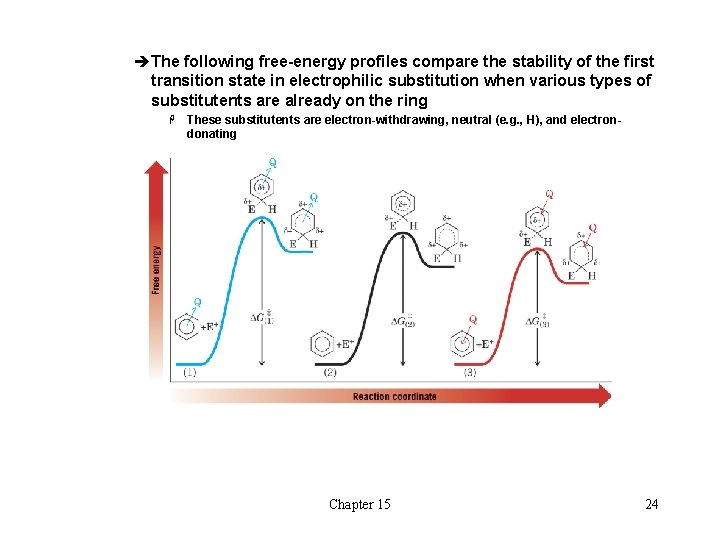
èThe following free-energy profiles compare the stability of the first transition state in electrophilic substitution when various types of substitutents are already on the ring H These substitutents are electron-withdrawing, neutral (e. g. , H), and electrondonating Chapter 15 24
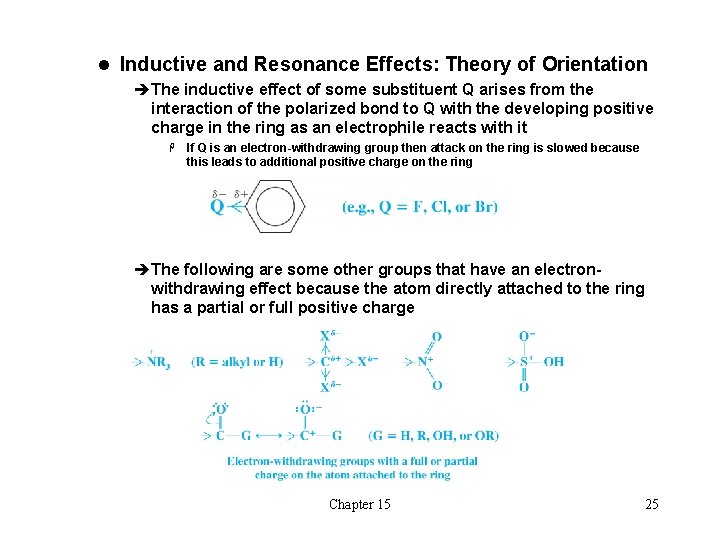
l Inductive and Resonance Effects: Theory of Orientation èThe inductive effect of some substituent Q arises from the interaction of the polarized bond to Q with the developing positive charge in the ring as an electrophile reacts with it H If Q is an electron-withdrawing group then attack on the ring is slowed because this leads to additional positive charge on the ring èThe following are some other groups that have an electronwithdrawing effect because the atom directly attached to the ring has a partial or full positive charge Chapter 15 25
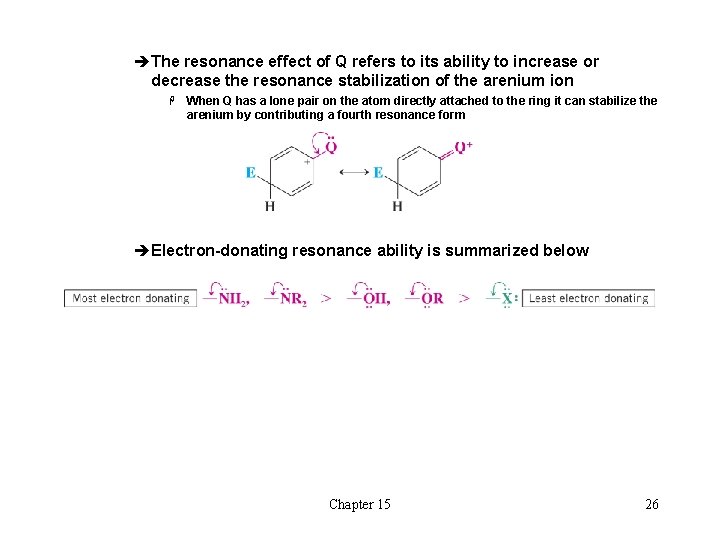
èThe resonance effect of Q refers to its ability to increase or decrease the resonance stabilization of the arenium ion H When Q has a lone pair on the atom directly attached to the ring it can stabilize the arenium by contributing a fourth resonance form èElectron-donating resonance ability is summarized below Chapter 15 26
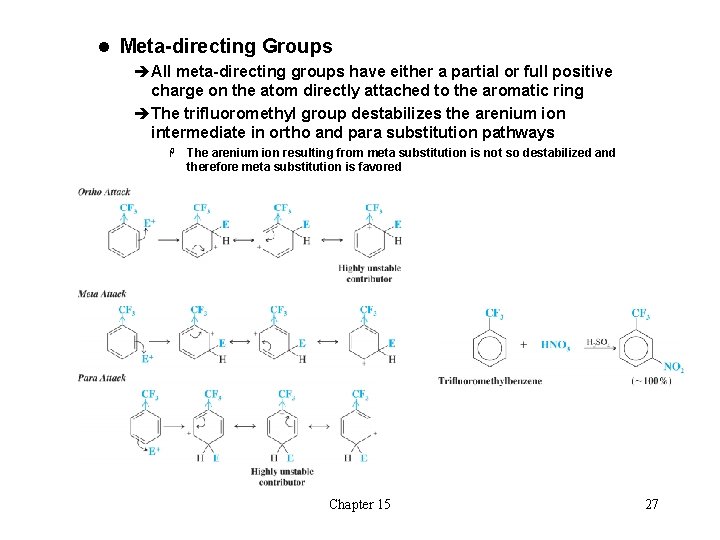
l Meta-directing Groups èAll meta-directing groups have either a partial or full positive charge on the atom directly attached to the aromatic ring èThe trifluoromethyl group destabilizes the arenium ion intermediate in ortho and para substitution pathways H The arenium ion resulting from meta substitution is not so destabilized and therefore meta substitution is favored Chapter 15 27
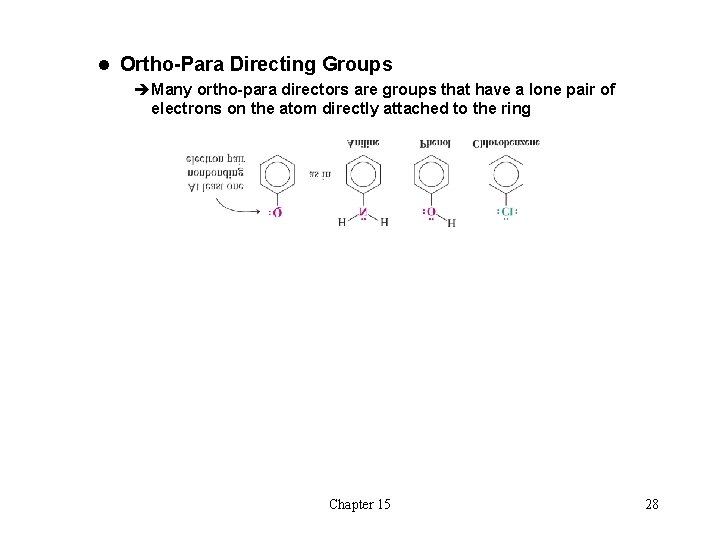
l Ortho-Para Directing Groups èMany ortho-para directors are groups that have a lone pair of electrons on the atom directly attached to the ring Chapter 15 28
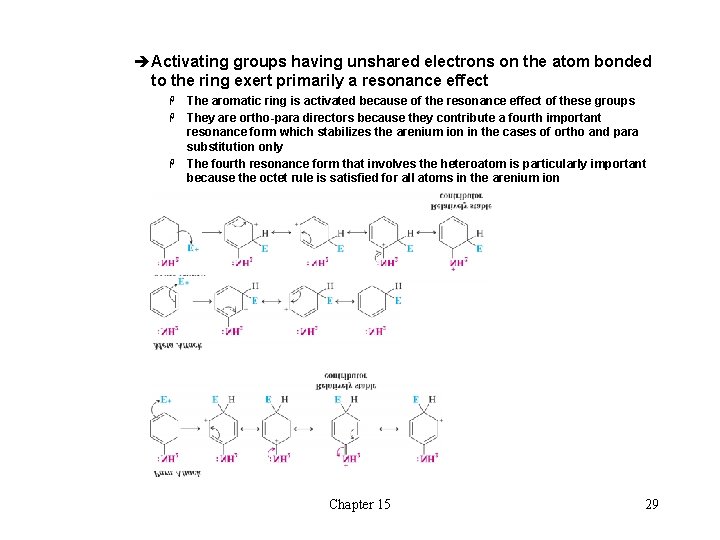
èActivating groups having unshared electrons on the atom bonded to the ring exert primarily a resonance effect The aromatic ring is activated because of the resonance effect of these groups H They are ortho-para directors because they contribute a fourth important resonance form which stabilizes the arenium ion in the cases of ortho and para substitution only H The fourth resonance form that involves the heteroatom is particularly important because the octet rule is satisfied for all atoms in the arenium ion H Chapter 15 29
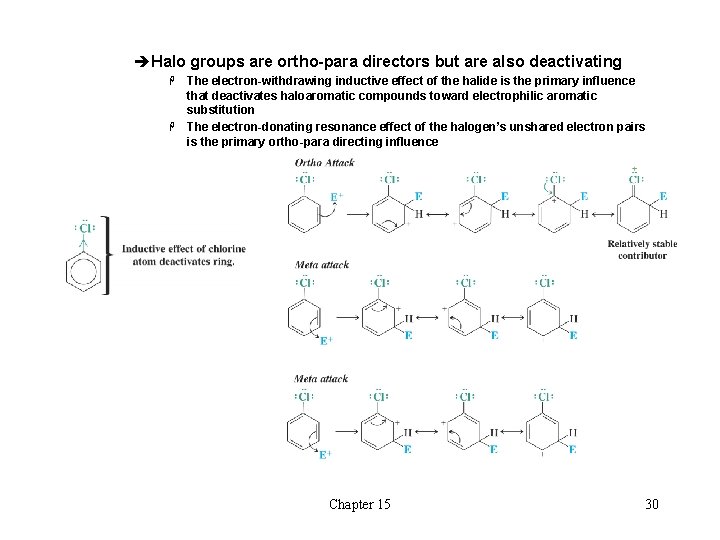
èHalo groups are ortho-para directors but are also deactivating The electron-withdrawing inductive effect of the halide is the primary influence that deactivates haloaromatic compounds toward electrophilic aromatic substitution H The electron-donating resonance effect of the halogen’s unshared electron pairs is the primary ortho-para directing influence H Chapter 15 30
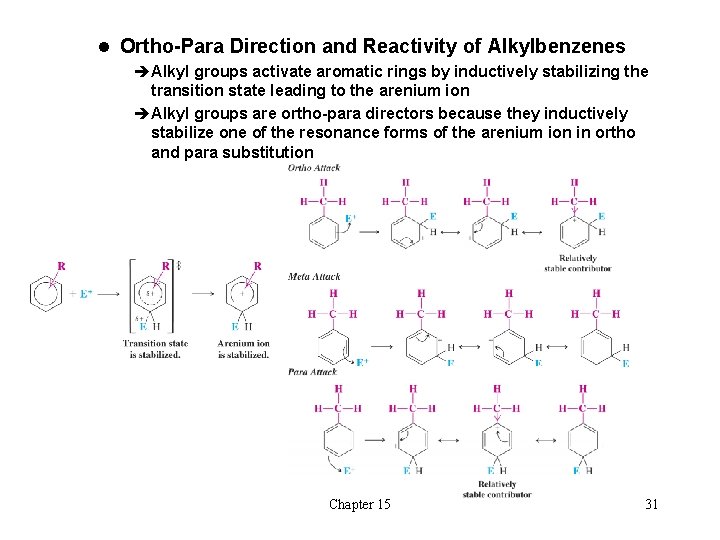
l Ortho-Para Direction and Reactivity of Alkylbenzenes èAlkyl groups activate aromatic rings by inductively stabilizing the transition state leading to the arenium ion èAlkyl groups are ortho-para directors because they inductively stabilize one of the resonance forms of the arenium ion in ortho and para substitution Chapter 15 31
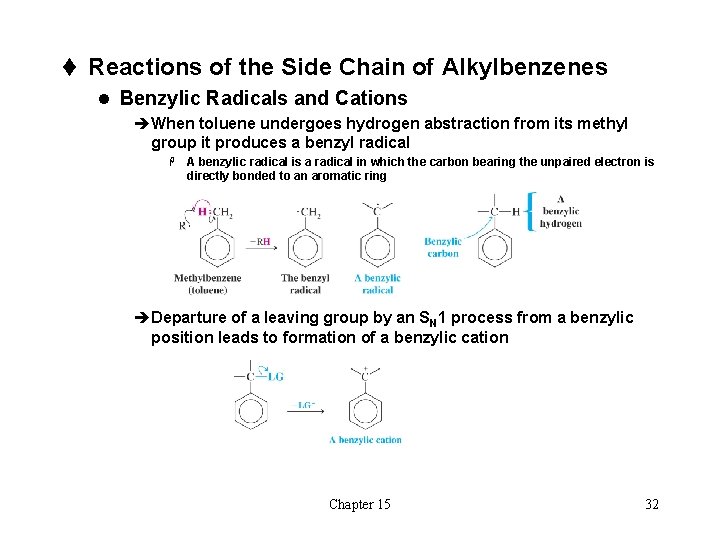
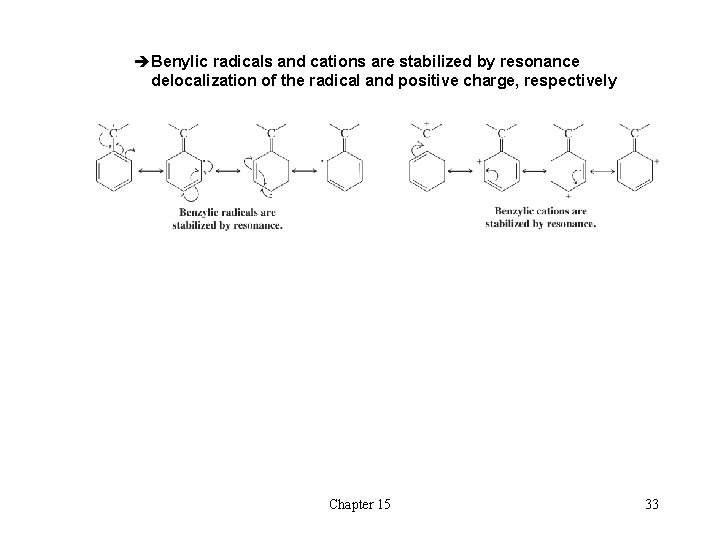
t Reactions of the Side Chain of Alkylbenzenes l Benzylic Radicals and Cations èWhen toluene undergoes hydrogen abstraction from its methyl group it produces a benzyl radical H A benzylic radical is a radical in which the carbon bearing the unpaired electron is directly bonded to an aromatic ring èDeparture of a leaving group by an SN 1 process from a benzylic position leads to formation of a benzylic cation Chapter 15 32
èBenylic radicals and cations are stabilized by resonance delocalization of the radical and positive charge, respectively Chapter 15 33
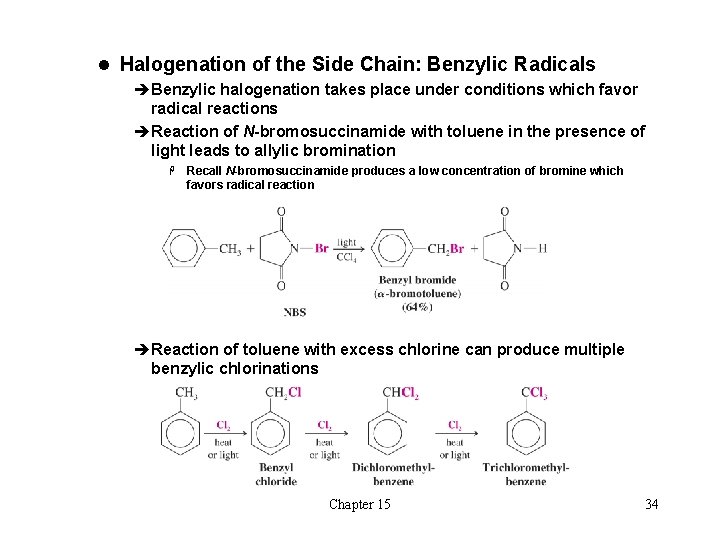
l Halogenation of the Side Chain: Benzylic Radicals èBenzylic halogenation takes place under conditions which favor radical reactions èReaction of N-bromosuccinamide with toluene in the presence of light leads to allylic bromination H Recall N-bromosuccinamide produces a low concentration of bromine which favors radical reaction èReaction of toluene with excess chlorine can produce multiple benzylic chlorinations Chapter 15 34
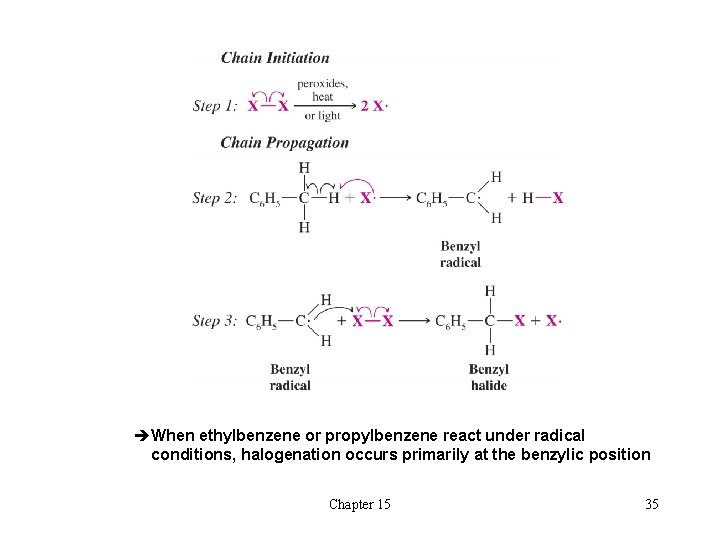
èWhen ethylbenzene or propylbenzene react under radical conditions, halogenation occurs primarily at the benzylic position Chapter 15 35
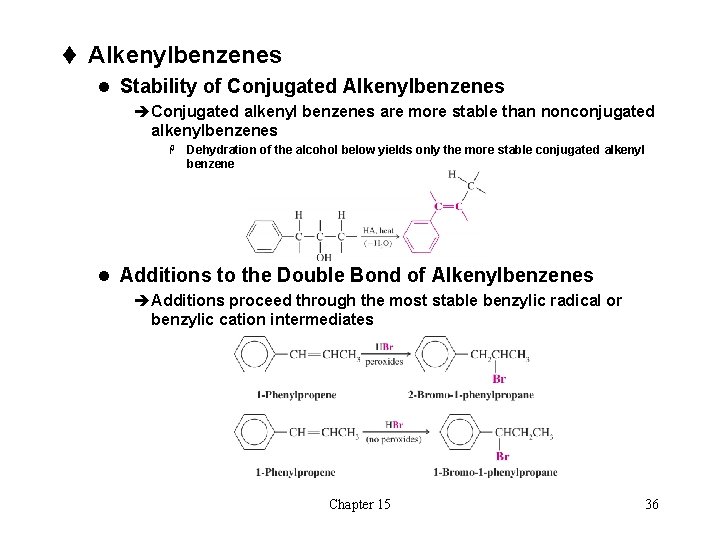
t Alkenylbenzenes l Stability of Conjugated Alkenylbenzenes èConjugated alkenyl benzenes are more stable than nonconjugated alkenylbenzenes H Dehydration of the alcohol below yields only the more stable conjugated alkenyl benzene l Additions to the Double Bond of Alkenylbenzenes èAdditions proceed through the most stable benzylic radical or benzylic cation intermediates Chapter 15 36
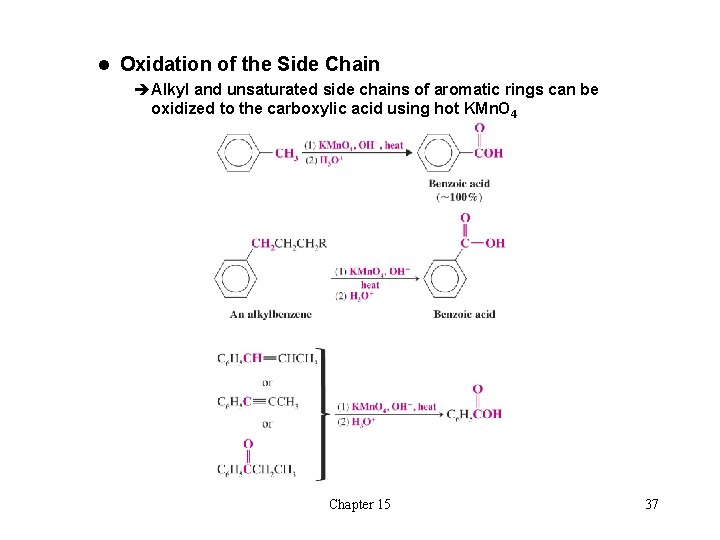
l Oxidation of the Side Chain èAlkyl and unsaturated side chains of aromatic rings can be oxidized to the carboxylic acid using hot KMn. O 4 Chapter 15 37
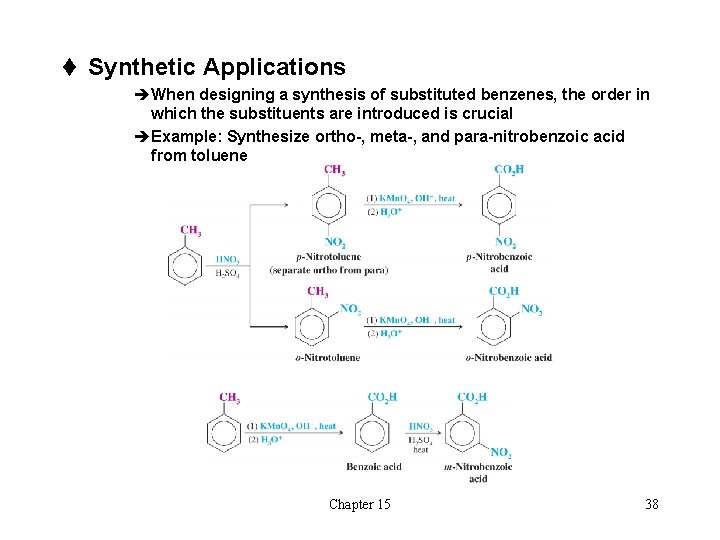
t Synthetic Applications èWhen designing a synthesis of substituted benzenes, the order in which the substituents are introduced is crucial èExample: Synthesize ortho-, meta-, and para-nitrobenzoic acid from toluene Chapter 15 38
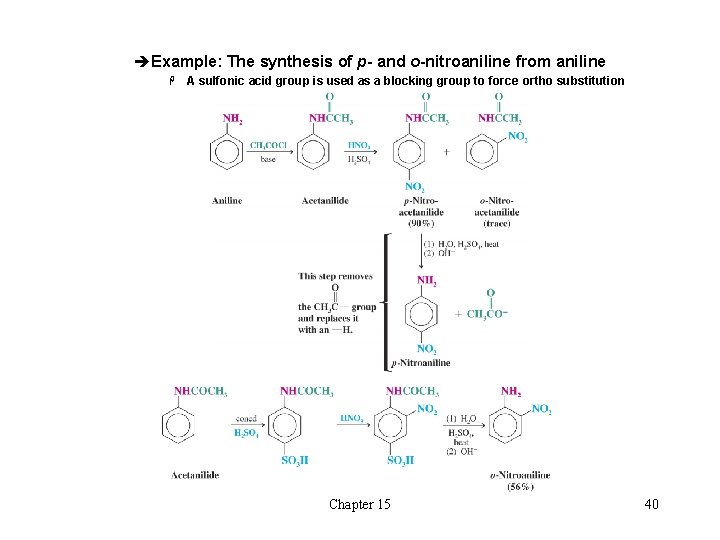
l Use of Protecting and Blocking Groups èStrong activating groups such as amino and hydroxyl cause the aromatic ring to be so reactive that unwanted reactions can take place These groups activate aromatic rings to oxidation by nitric acid when nitration is attempted; the ring is destroyed H An amino group can be protected (and turned into a moderately activating group) by acetylation H Chapter 15 39
èExample: The synthesis of p- and o-nitroaniline from aniline H A sulfonic acid group is used as a blocking group to force ortho substitution Chapter 15 40
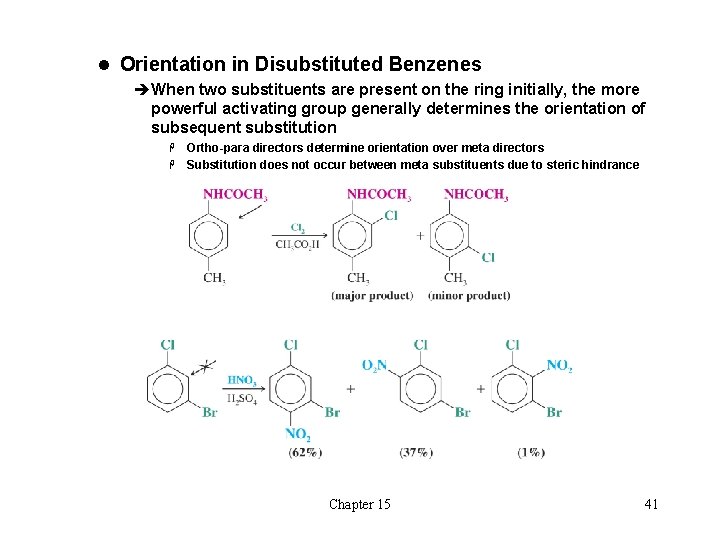
l Orientation in Disubstituted Benzenes èWhen two substituents are present on the ring initially, the more powerful activating group generally determines the orientation of subsequent substitution Ortho-para directors determine orientation over meta directors H Substitution does not occur between meta substituents due to steric hindrance H Chapter 15 41
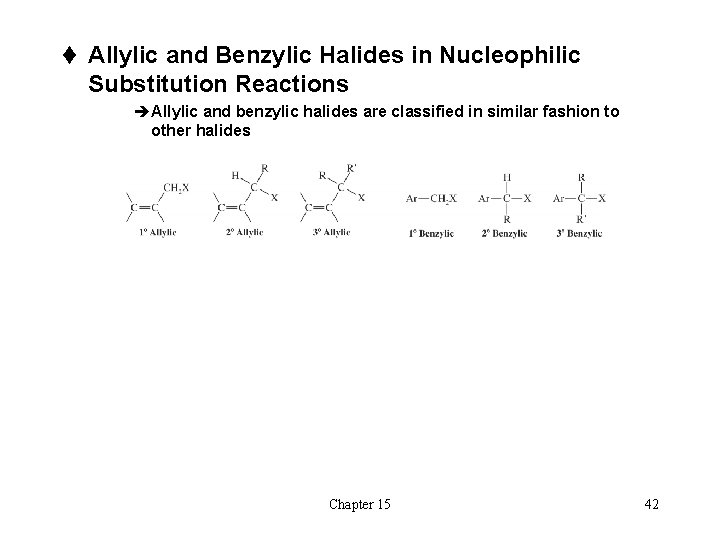
t Allylic and Benzylic Halides in Nucleophilic Substitution Reactions èAllylic and benzylic halides are classified in similar fashion to other halides Chapter 15 42
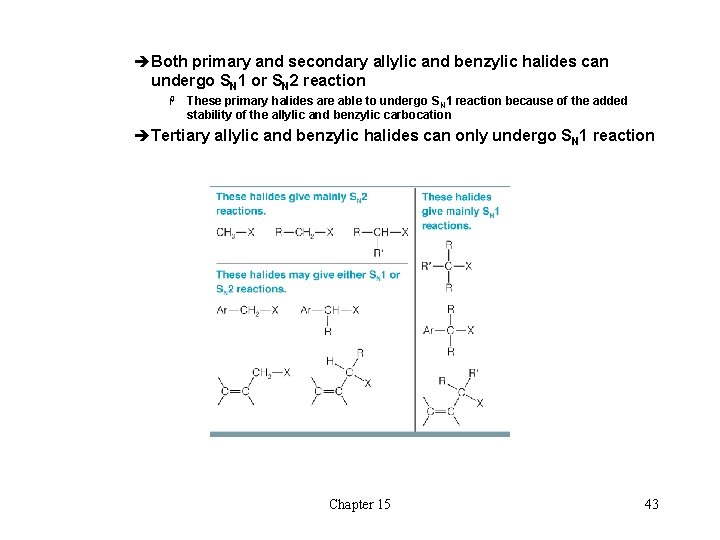
èBoth primary and secondary allylic and benzylic halides can undergo SN 1 or SN 2 reaction H These primary halides are able to undergo S N 1 reaction because of the added stability of the allylic and benzylic carbocation èTertiary allylic and benzylic halides can only undergo SN 1 reaction Chapter 15 43