
Chapter 15 Rank in order from most positive

- Slides: 19
Chapter 15
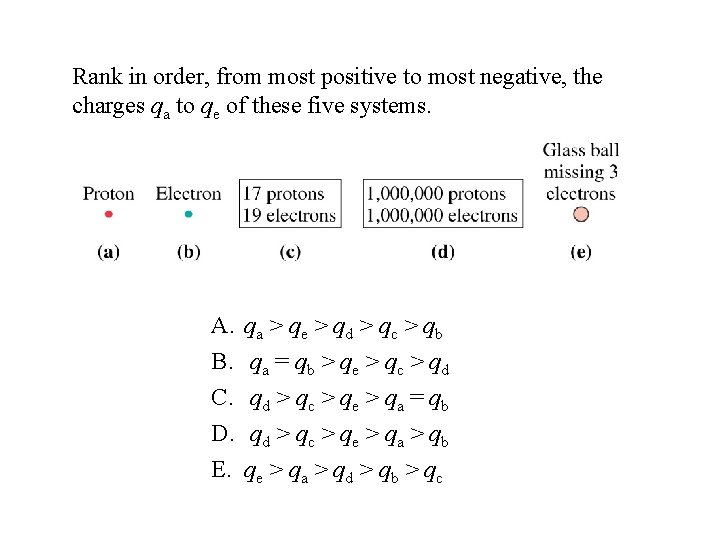
Rank in order, from most positive to most negative, the charges qa to qe of these five systems. A. B. C. D. E. qa > qe > qd > qc > qb qa = qb > qe > qc > qd qd > qc > qe > qa = qb qd > qc > qe > qa > qb qe > qa > qd > qb > qc
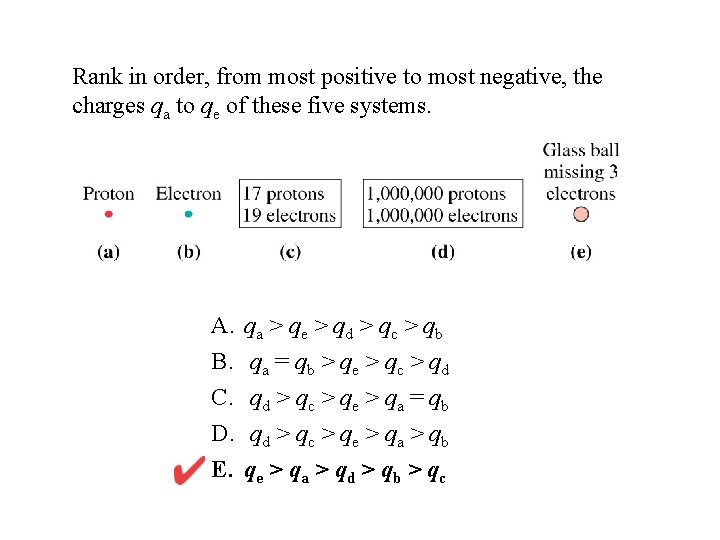
Rank in order, from most positive to most negative, the charges qa to qe of these five systems. A. B. C. D. E. qa > qe > qd > qc > qb qa = qb > qe > qc > qd qd > qc > qe > qa = qb qd > qc > qe > qa > qb qe > qa > qd > qb > qc
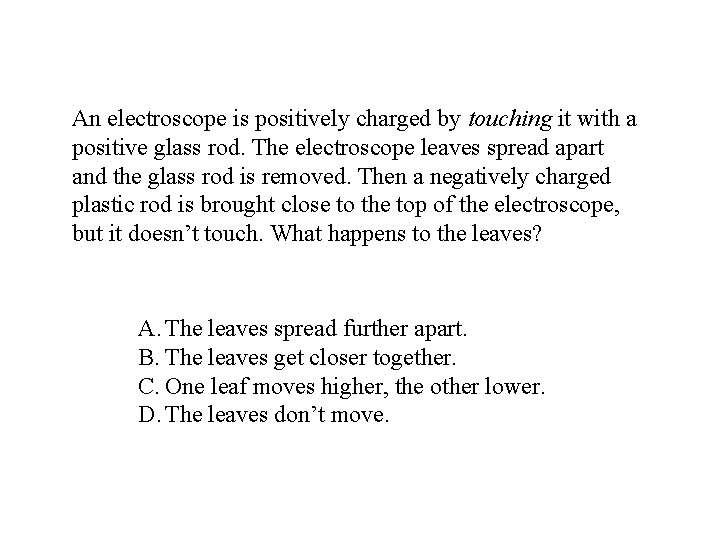
An electroscope is positively charged by touching it with a positive glass rod. The electroscope leaves spread apart and the glass rod is removed. Then a negatively charged plastic rod is brought close to the top of the electroscope, but it doesn’t touch. What happens to the leaves? A. The leaves spread further apart. B. The leaves get closer together. C. One leaf moves higher, the other lower. D. The leaves don’t move.
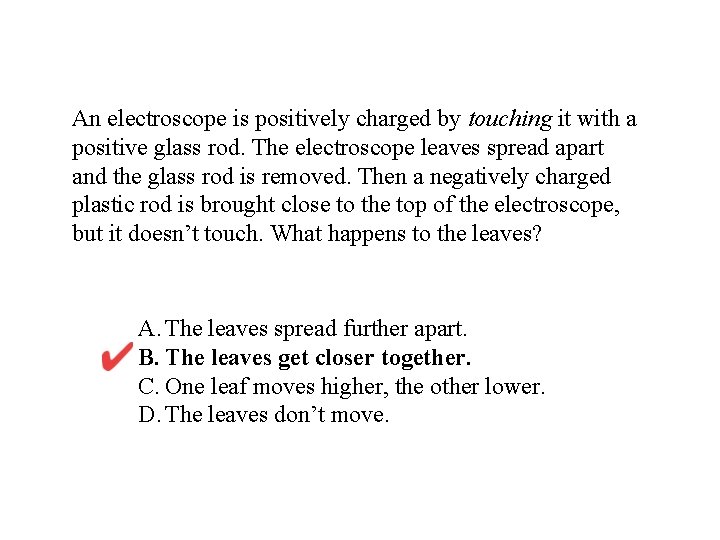
An electroscope is positively charged by touching it with a positive glass rod. The electroscope leaves spread apart and the glass rod is removed. Then a negatively charged plastic rod is brought close to the top of the electroscope, but it doesn’t touch. What happens to the leaves? A. The leaves spread further apart. B. The leaves get closer together. C. One leaf moves higher, the other lower. D. The leaves don’t move.
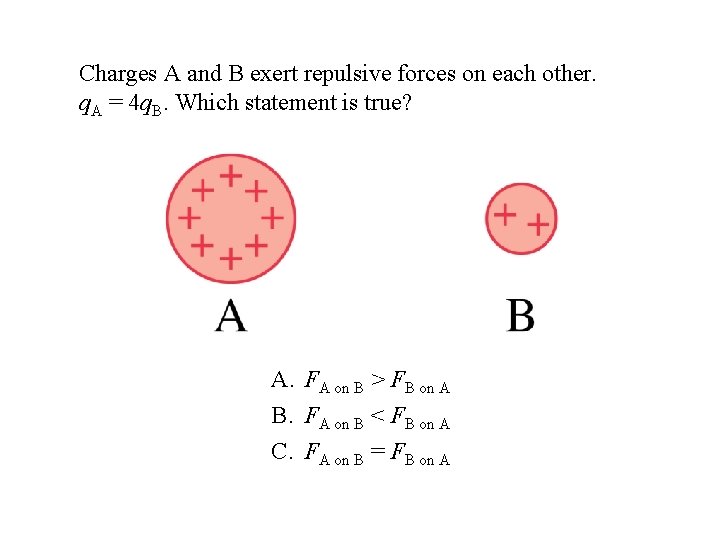
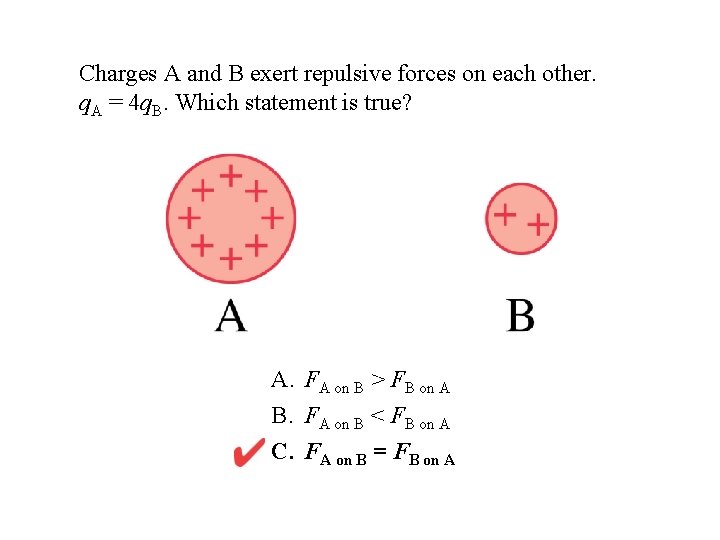
Charges A and B exert repulsive forces on each other. q. A = 4 q. B. Which statement is true? A. FA on B > FB on A B. FA on B < FB on A C. FA on B = FB on A
Charges A and B exert repulsive forces on each other. q. A = 4 q. B. Which statement is true? A. FA on B > FB on A B. FA on B < FB on A C. FA on B = FB on A
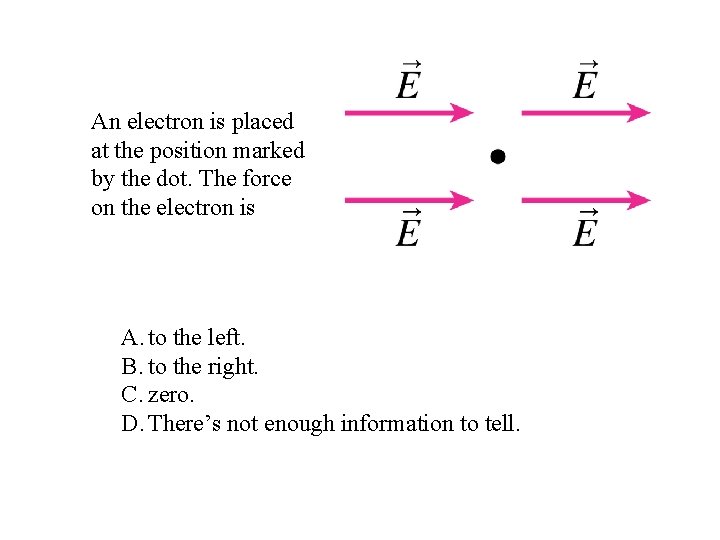
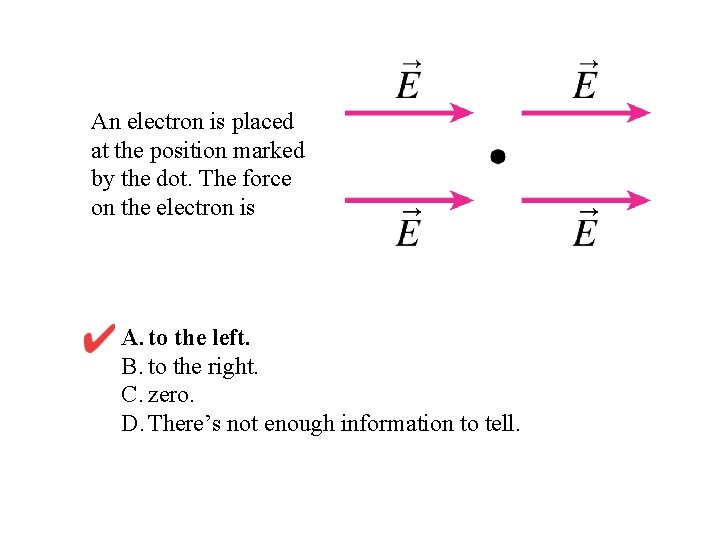
An electron is placed at the position marked by the dot. The force on the electron is A. to the left. B. to the right. C. zero. D. There’s not enough information to tell.
An electron is placed at the position marked by the dot. The force on the electron is A. to the left. B. to the right. C. zero. D. There’s not enough information to tell.
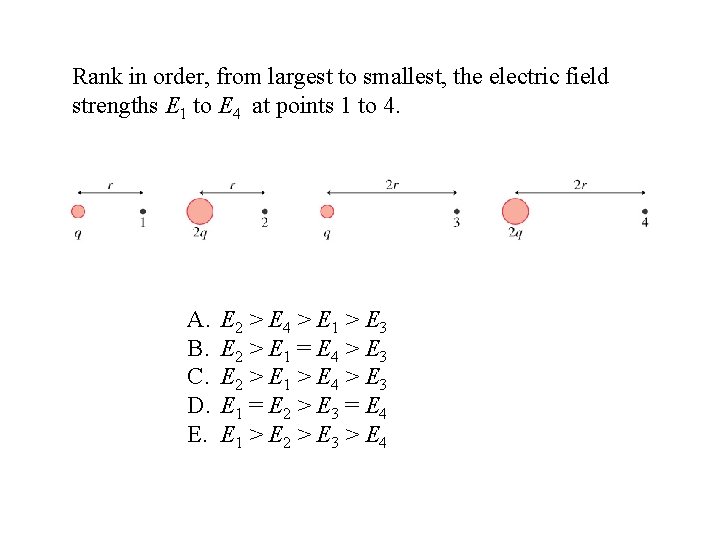
Rank in order, from largest to smallest, the electric field strengths E 1 to E 4 at points 1 to 4. A. B. C. D. E. E 2 > E 4 > E 1 > E 3 E 2 > E 1 = E 4 > E 3 E 2 > E 1 > E 4 > E 3 E 1 = E 2 > E 3 = E 4 E 1 > E 2 > E 3 > E 4
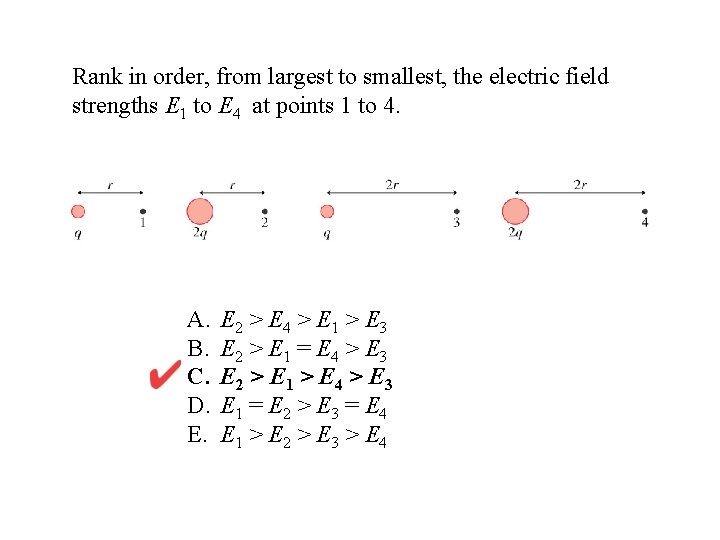
Rank in order, from largest to smallest, the electric field strengths E 1 to E 4 at points 1 to 4. A. B. C. D. E. E 2 > E 4 > E 1 > E 3 E 2 > E 1 = E 4 > E 3 E 2 > E 1 > E 4 > E 3 E 1 = E 2 > E 3 = E 4 E 1 > E 2 > E 3 > E 4
What is the SI unit of charge? A. Coulomb B. Faraday C. Ampere D. Ohm E. Volt
What is the SI unit of charge? A. Coulomb B. Faraday C. Ampere D. Ohm E. Volt
A charge alters the space around it. What is this alteration of space called? A. Charged plasma B. Charge sphere C. Electric ether D. Electric field E. Electrophoresys
A charge alters the space around it. What is this alteration of space called? A. Charged plasma B. Charge sphere C. Electric ether D. Electric field E. Electrophoresys
If a negative charged rod is held near a neutral metal ball, the ball is attracted to the rod. This happens A. because of magnetic effects. B. because the ball tries to pull the rod’s electrons over to it. C. because the rod polarizes the metal. D. because the rod and the ball have opposite charges.
If a negative charged rod is held near a neutral metal ball, the ball is attracted to the rod. This happens A. because of magnetic effects. B. because the ball tries to pull the rod’s electrons over to it. C. because the rod polarizes the metal. D. because the rod and the ball have opposite charges.
The electric field of a charge is defined by the force on A. an electron. B. a proton. C. a source charge. D. a test charge.
The electric field of a charge is defined by the force on A. an electron. B. a proton. C. a source charge. D. a test charge.