
Chapter 15 POWER INFLUENCE AND POLITICS For use
- Slides: 23
Chapter 15 POWER, INFLUENCE AND POLITICS For use with Organizational Behaviour and Management by John Martin and Martin Fellenz 1408018128© 2010 Cengage Learning
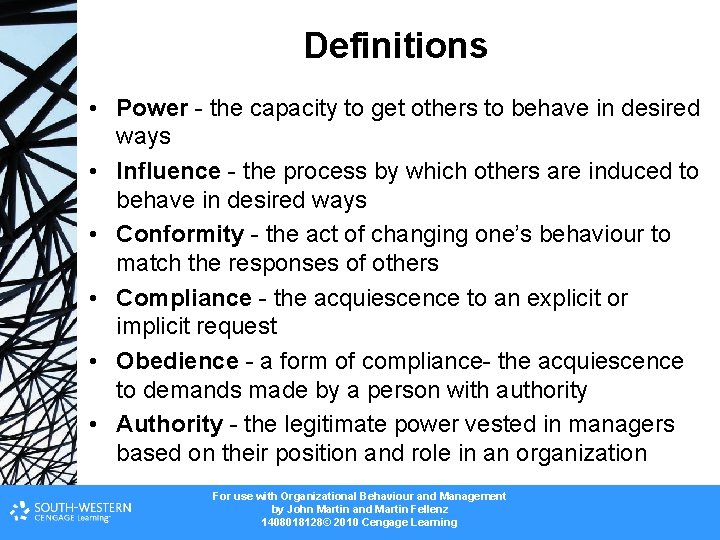
Definitions • Power - the capacity to get others to behave in desired ways • Influence - the process by which others are induced to behave in desired ways • Conformity - the act of changing one’s behaviour to match the responses of others • Compliance - the acquiescence to an explicit or implicit request • Obedience - a form of compliance- the acquiescence to demands made by a person with authority • Authority - the legitimate power vested in managers based on their position and role in an organization For use with Organizational Behaviour and Management by John Martin and Martin Fellenz 1408018128© 2010 Cengage Learning
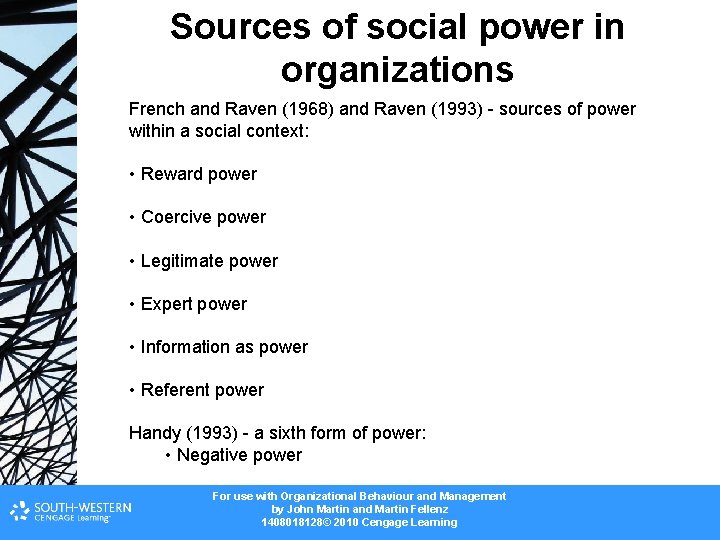
Sources of social power in organizations French and Raven (1968) and Raven (1993) - sources of power within a social context: • Reward power • Coercive power • Legitimate power • Expert power • Information as power • Referent power Handy (1993) - a sixth form of power: • Negative power For use with Organizational Behaviour and Management by John Martin and Martin Fellenz 1408018128© 2010 Cengage Learning
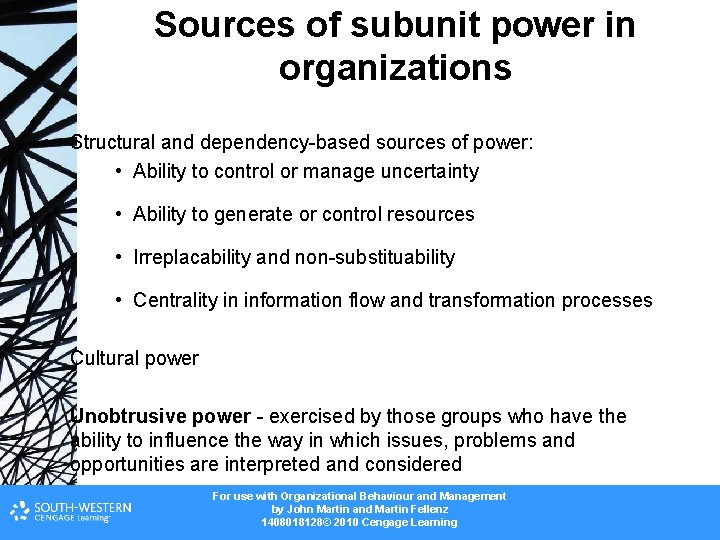
Sources of subunit power in organizations • Structural and dependency-based sources of power: • Ability to control or manage uncertainty • Ability to generate or control resources • Irreplacability and non-substituability • Centrality in information flow and transformation processes • Cultural power • Unobtrusive power - exercised by those groups who have the ability to influence the way in which issues, problems and opportunities are interpreted and considered For use with Organizational Behaviour and Management by John Martin and Martin Fellenz 1408018128© 2010 Cengage Learning
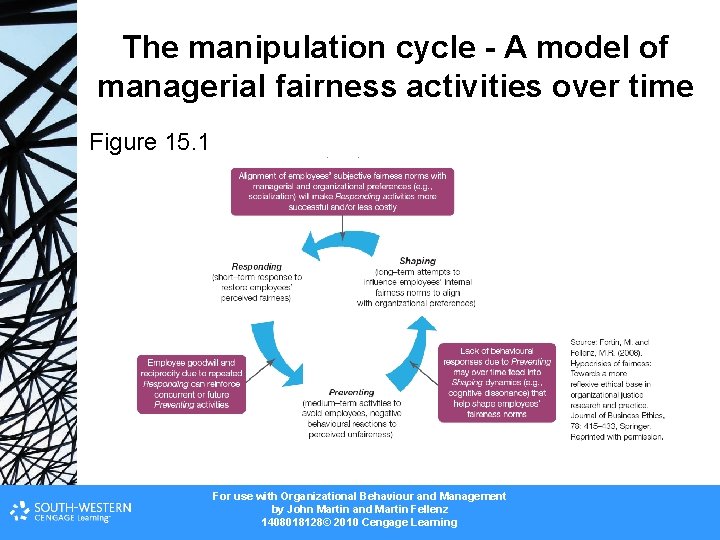
The manipulation cycle - A model of managerial fairness activities over time Figure 15. 1 For use with Organizational Behaviour and Management by John Martin and Martin Fellenz 1408018128© 2010 Cengage Learning
Influence tactics (1) Specific interaction patterns used by agents to bring about the target’s compliance with a particular request: • Rationality – using logic to gain compliance • Exchange – offering incentives for compliance • Ingratiation – praising and flattering target to induce positive emotional disposition • Assertiveness – using frequent demands, reminders, checks, or even threats to gain compliance • Coalition – enlisting third parties to exert pressure or to show broad support for request • Upward appeal – obtain approval and support from authority to sway target For use with Organizational Behaviour and Management by John Martin and Martin Fellenz 1408018128© 2010 Cengage Learning
Influence tactics (2) • Consultation – using participation to gain commitment from target • Inspirational appeal – call on values and ideals to sway target • Personal appeal – using personal relationship to gain commitment • Legitimating – using rules, norms, policies, or other sources • Collaboration – using involvement and interdependent work in pursuit of the objective behind the request • Apprising – pointing out the benefits for the target from agreeing • Self-promotion – creating an appearance of competence that the agent is capable of successfully completing the task For use with Organizational Behaviour and Management by John Martin and Martin Fellenz 1408018128© 2010 Cengage Learning
Influence mechanisms • Actions and interaction patterns that prompt automatic response patterns which increase the likelihood of acquiescence with influencing attempts • Cialdini (2008) Identifies six central influence mechanisms: • Reciprocity. Based on the social exchange norms • Consistency and commitment • Social proof • Liking • Authority • Scarcity For use with Organizational Behaviour and Management by John Martin and Martin Fellenz 1408018128© 2010 Cengage Learning
Traditional perspectives on power Generally based on the existence of three features: – Humans have needs, wants and desires that can only be met by the individual engaging with an organization – The existence of resources through which these needs and wants can be met – The existence of a manager acting as the go-between in facilitating the ‘deal’ between the individual and the organization and subsequently managing its realization in practice – Pfeffer (1992) argues that power is a commodity for managers and that political activity is the means through which it is obtained and traded – Lower level employees can also gain and exercise power in a number of ways For use with Organizational Behaviour and Management by John Martin and Martin Fellenz 1408018128© 2010 Cengage Learning
Foucault and power Power is a condition that exists in society as a whole Power in this context uses discourse (language) to create the rules which in turn creates and classifies the knowledge and social practice in particular ways In organizations this allows the compartmentalisation and hierarchical framework to be perpetuated as legitimate Boundaries around the things that we see, understand take for granted are in fact artificial and socially created We are effectively socialized into seeing and understanding the world in which we live through the discourses that we experience and these are a reflection of the distribution of power as it exists in society O’Neill (1986) describes organizations as - places where the system can project its conception of the disciplinary society in the reformed criminal, the good worker, student, loyal soldier and committed citizen – the outcome of power For use with Organizational Behaviour and Management by John Martin and Martin Fellenz 1408018128© 2010 Cengage Learning
Labour process theory and Lukes’ view on power Labour process theory: originated from the Marxist tradition - ‘the means by which raw materials are transformed by human labour, acting on the objects with tools and machinery first into products for use and, under capitalism, into commodities to be exchanged on the market’ Manufacture of consent Lukes (1982) - three dimensional model: First dimension - reflects the nature of power as described in literature Second dimension - the agenda Third dimension - concepts of hegemony, incorporation, dependency and inaction underpin authority For use with Organizational Behaviour and Management by John Martin and Martin Fellenz 1408018128© 2010 Cengage Learning
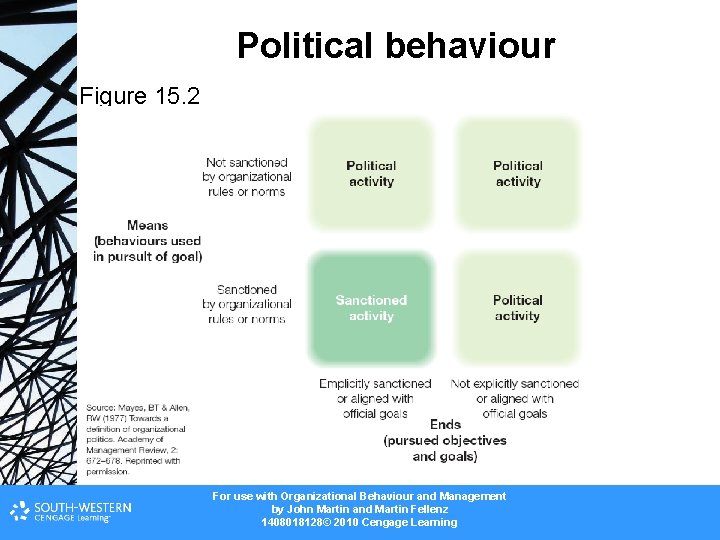
Politics within organizations Early work (Renaissance Italy) - Machiavelli – The prince The negative view of politics imposes a definition that considers it to be outside normal practice used to enhance existing power or to offset the power of another, with the purpose of achieving self-serving goals The more positive view regards it as an inevitable part of the need for individuals and groups to function in a collective context Most managers recognize that politics contains elements of both good and bad and that it can be an important, indeed inevitable part of the experience of work Political behaviour - deliberately designed social-influence processes that aim at covertly or overtly advancing the actor’s self-interest regardless of its alignment with other parties’ interests For use with Organizational Behaviour and Management by John Martin and Martin Fellenz 1408018128© 2010 Cengage Learning
Political behaviour Figure 15. 2 For use with Organizational Behaviour and Management by John Martin and Martin Fellenz 1408018128© 2010 Cengage Learning
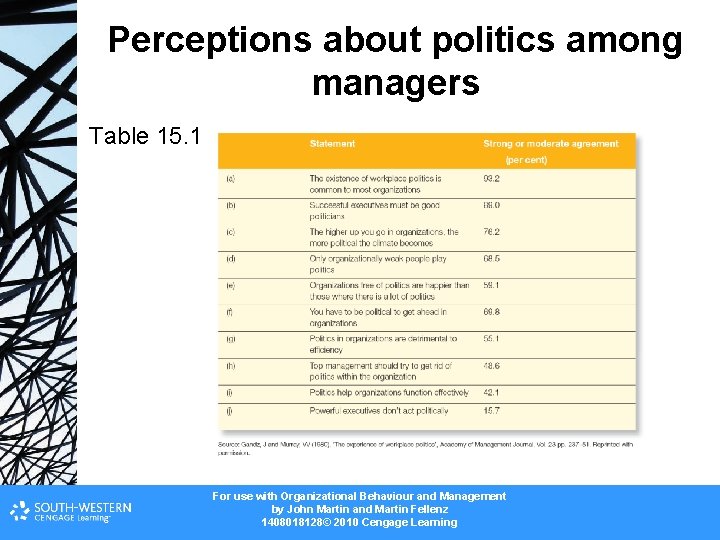
Perceptions about politics among managers Table 15. 1 For use with Organizational Behaviour and Management by John Martin and Martin Fellenz 1408018128© 2010 Cengage Learning
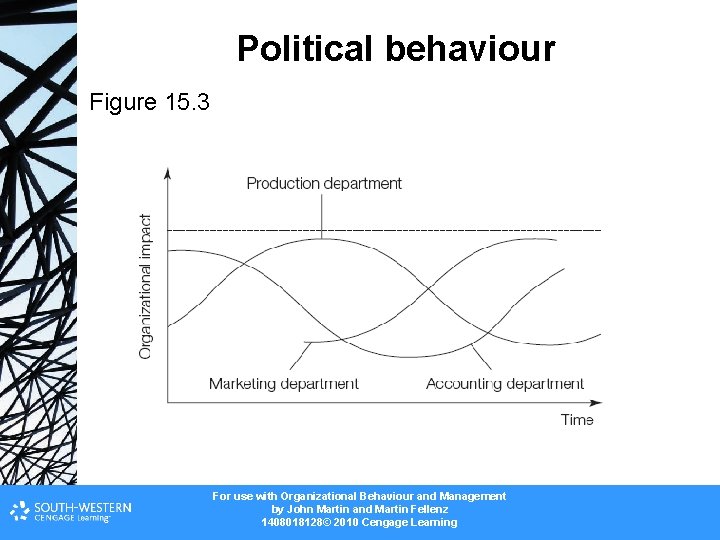
Political behaviour Figure 15. 3 For use with Organizational Behaviour and Management by John Martin and Martin Fellenz 1408018128© 2010 Cengage Learning
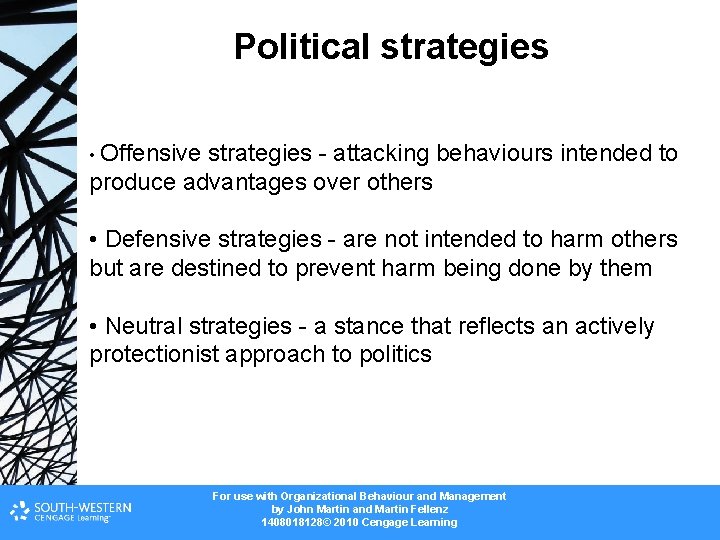
Political strategies • Offensive strategies - attacking behaviours intended to produce advantages over others • Defensive strategies - are not intended to harm others but are destined to prevent harm being done by them • Neutral strategies - a stance that reflects an actively protectionist approach to politics For use with Organizational Behaviour and Management by John Martin and Martin Fellenz 1408018128© 2010 Cengage Learning
Political tactics • Approaches that combine power generation and influencing tactics in concerted ways to orchestrate influence attempts aimed at getting other people to accept or take decisions, viewpoint or courses of action favoured by the initiator For use with Organizational Behaviour and Management by John Martin and Martin Fellenz 1408018128© 2010 Cengage Learning
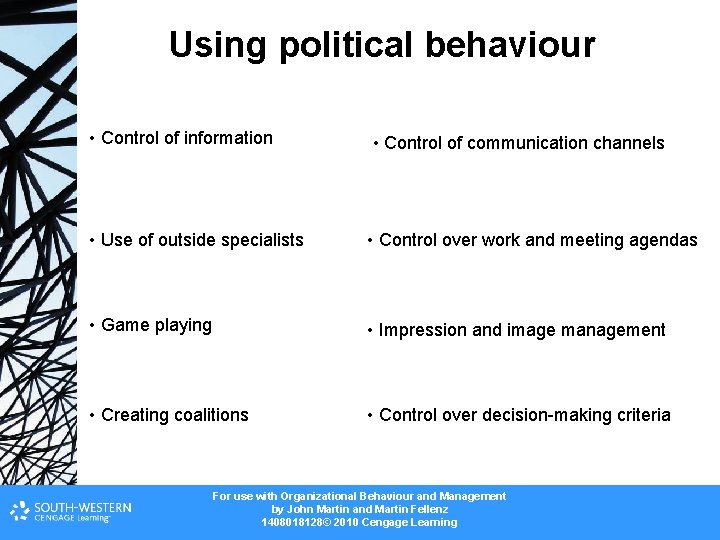
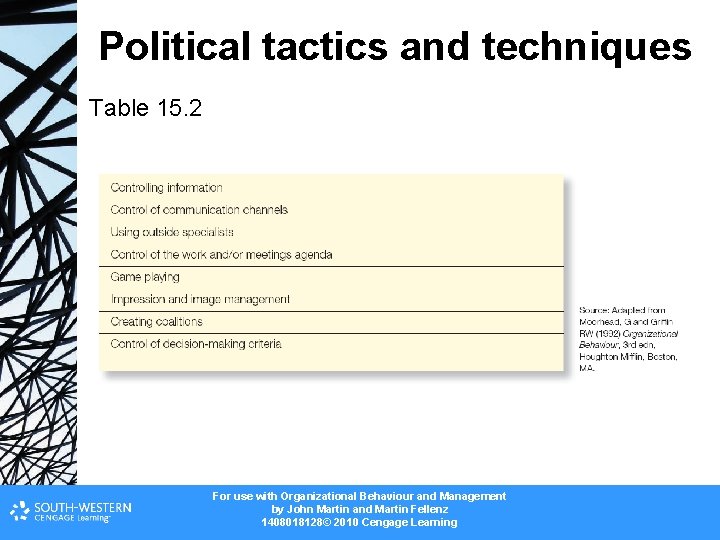
Using political behaviour • Control of information • Control of communication channels • Use of outside specialists • Control over work and meeting agendas • Game playing • Impression and image management • Creating coalitions • Control over decision-making criteria For use with Organizational Behaviour and Management by John Martin and Martin Fellenz 1408018128© 2010 Cengage Learning
Political tactics and techniques Table 15. 2 For use with Organizational Behaviour and Management by John Martin and Martin Fellenz 1408018128© 2010 Cengage Learning
MANAGING POLITICAL BEHAVIOUR Political skill - the ability to effectively understand others at work, and to use such knowledge to influence others to act in ways that enhance one’s personal and/or organizational objectives - Ferris et al. , 2005) For use with Organizational Behaviour and Management by John Martin and Martin Fellenz 1408018128© 2010 Cengage Learning
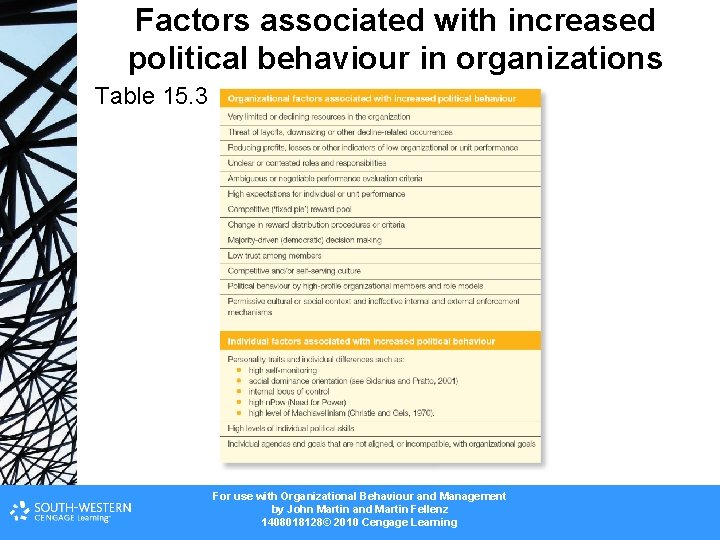
Factors associated with increased political behaviour in organizations Table 15. 3 For use with Organizational Behaviour and Management by John Martin and Martin Fellenz 1408018128© 2010 Cengage Learning
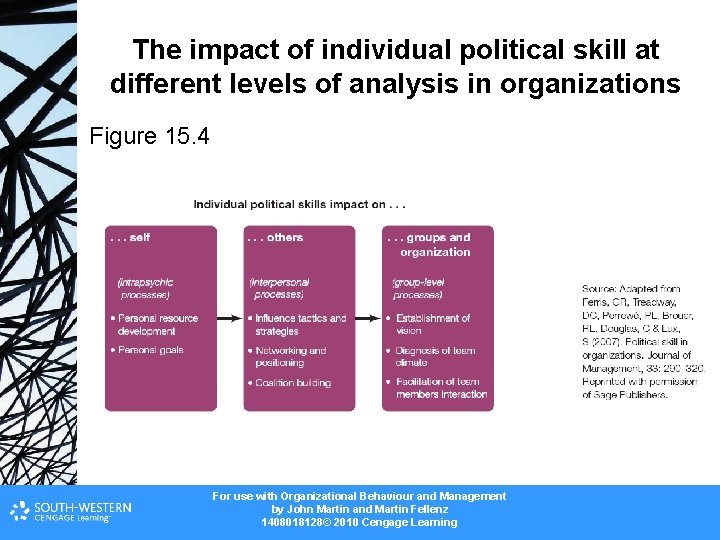
The impact of individual political skill at different levels of analysis in organizations Figure 15. 4 For use with Organizational Behaviour and Management by John Martin and Martin Fellenz 1408018128© 2010 Cengage Learning
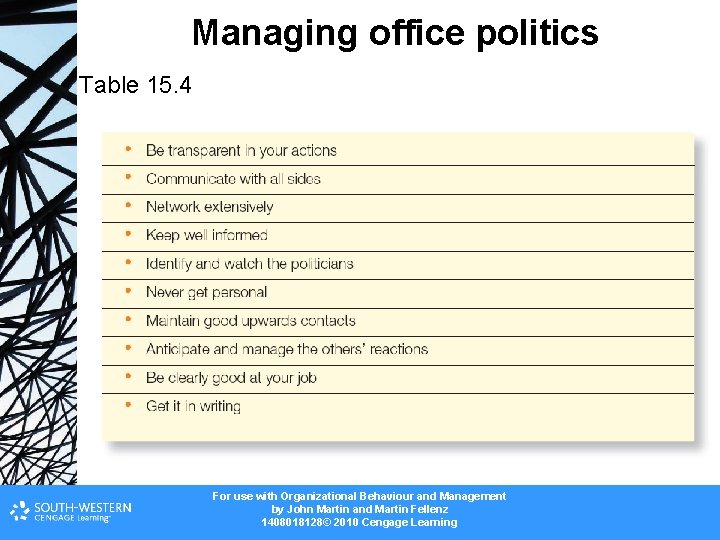
Managing office politics Table 15. 4 For use with Organizational Behaviour and Management by John Martin and Martin Fellenz 1408018128© 2010 Cengage Learning