
Chapter 15 Polymorphism and Virtual Functions 1 Learning



- Slides: 37
Chapter 15 Polymorphism and Virtual Functions 1
Learning Objectives § Virtual Function Basics § § § Late binding Implementing virtual functions When to use a virtual function Abstract classes and pure virtual functions Pointers and Virtual Functions § § § Extended type compatibility Downcasting and upcasting C++ ‘under the hood’ with virtual functions 2
Virtual Function Basics § Polymorphism § § Virtual § § Associating many meanings to one function Virtual functions provide this capability Fundamental principle of object-oriented programming! Existing in ‘essence’ though not in fact Virtual Function § Can be ‘used’ before it’s ‘defined’ 3
Figures Example § § Best explained by example: Classes for several kinds of figures § § Rectangles, circles, ovals, etc. Each figure an object of different class § § Rectangle data: height, width, center point Circle data: center point, radius All derive from one parent-class: Figure Require function: draw() § Different instructions for each figure 4
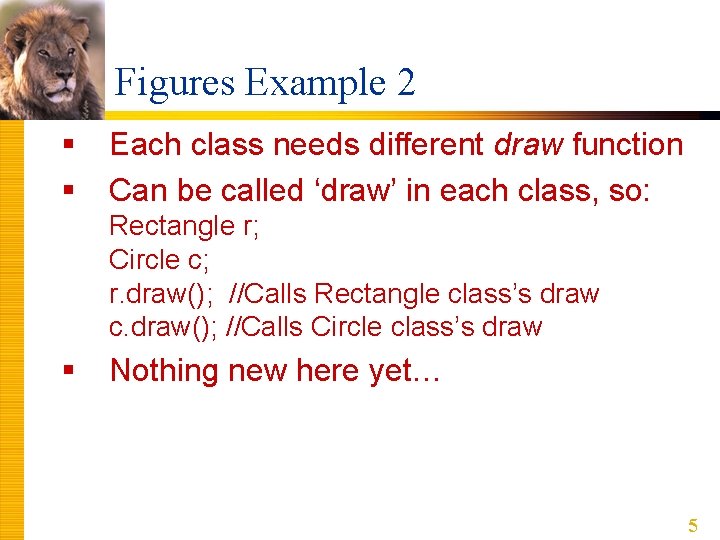
Figures Example 2 § § Each class needs different draw function Can be called ‘draw’ in each class, so: Rectangle r; Circle c; r. draw(); //Calls Rectangle class’s draw c. draw(); //Calls Circle class’s draw § Nothing new here yet… 5
Figures Example: center() § Parent class Figure contains functions that apply to ‘all’ figures; consider: center(): moves a figure to center of screen § Erases 1 st, then re-draws § So Figure: : center() would use function draw() to re-draw § Complications! § § Which draw() function? From which class? 6
Figures Example: New Figure § Consider new kind of figure comes along: § Triangle class derived from Figure class Function center() inherited from Figure § § Will it work for triangles? It uses draw(), which is different for each figure! It will use Figure: : draw() won’t work for triangles Want inherited function center() to use function Triangle: : draw() NOT function Figure: : draw() § But class Triangle wasn’t even WRITTEN when Figure: : center() was! Doesn’t know ‘triangles’! 7
Figures Example: Virtual! § § Virtual functions are the answer Tells compiler: § § “Don’t know how function is implemented” “Wait until used in program” “Then get implementation from object instance” Called late binding or dynamic binding § Virtual functions implement late binding 8
Virtual Functions: Another Example § § Bigger example best to demonstrate Record-keeping program for automotive parts store § § Track sales Don’t know all sales yet 1 st only regular retail sales Later: Discount sales, mail-order, etc. § Depend on other factors besides just price, tax 9
Virtual Functions: Auto Parts § Program must: § § Compute daily gross sales Calculate largest/smallest sales of day Perhaps average sale for day All come from individual bills § But many functions for computing bills will be added ‘later’! § § When different types of sales added! So function for ‘computing a bill’ will be virtual! 10
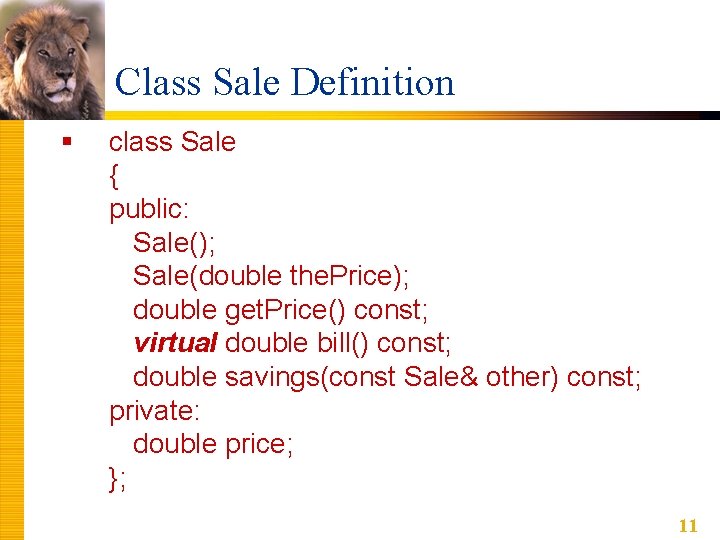
Class Sale Definition § class Sale { public: Sale(); Sale(double the. Price); double get. Price() const; virtual double bill() const; double savings(const Sale& other) const; private: double price; }; 11
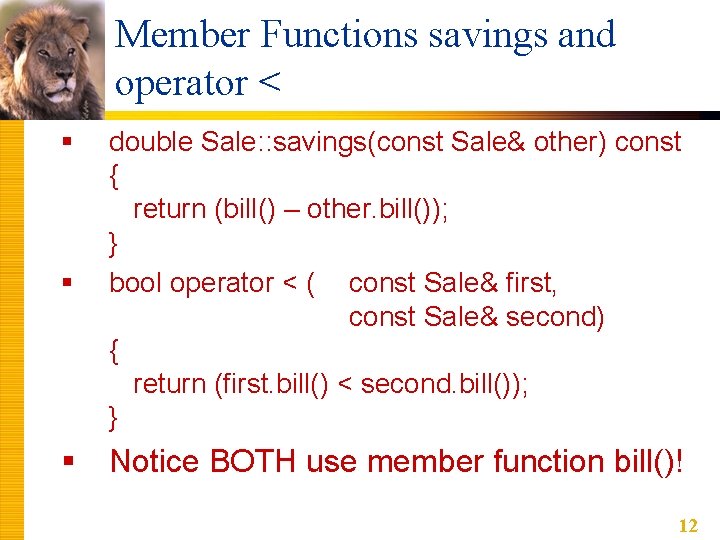
Member Functions savings and operator < § § double Sale: : savings(const Sale& other) const { return (bill() – other. bill()); } bool operator < ( const Sale& first, const Sale& second) { return (first. bill() < second. bill()); } § Notice BOTH use member function bill()! 12
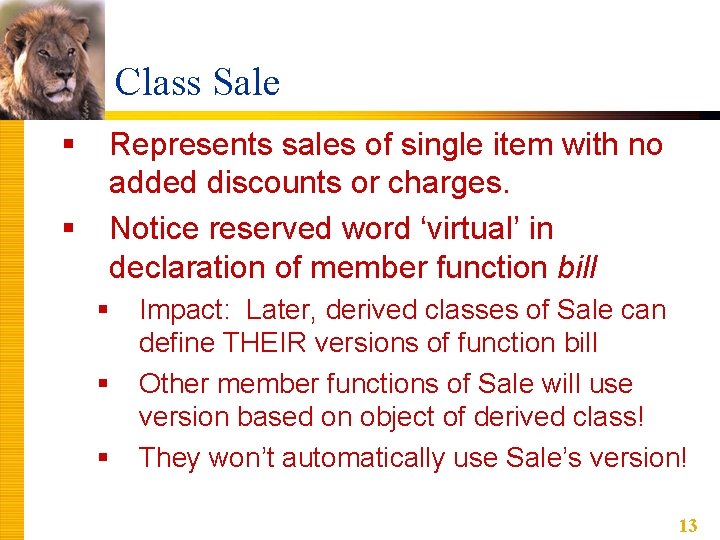
Class Sale § § Represents sales of single item with no added discounts or charges. Notice reserved word ‘virtual’ in declaration of member function bill § § § Impact: Later, derived classes of Sale can define THEIR versions of function bill Other member functions of Sale will use version based on object of derived class! They won’t automatically use Sale’s version! 13
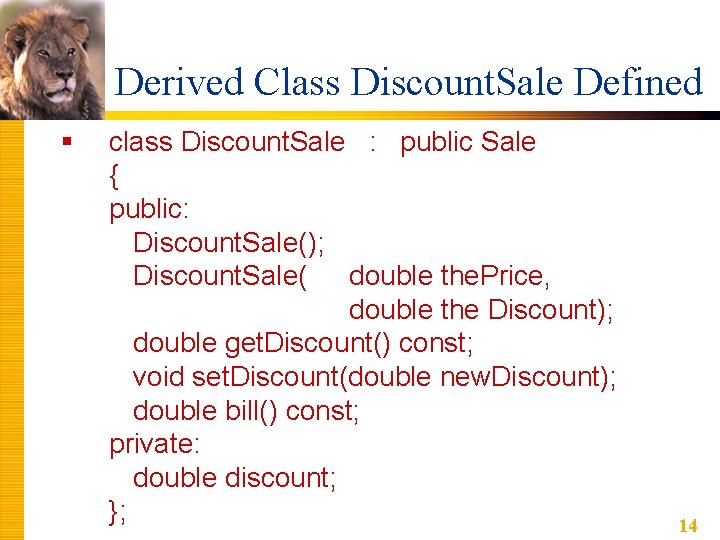
Derived Class Discount. Sale Defined § class Discount. Sale : public Sale { public: Discount. Sale(); Discount. Sale( double the. Price, double the Discount); double get. Discount() const; void set. Discount(double new. Discount); double bill() const; private: double discount; }; 14
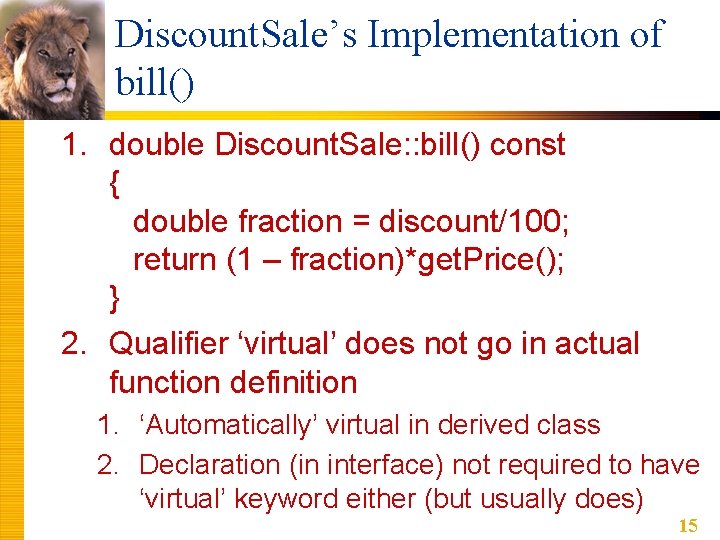
Discount. Sale’s Implementation of bill() 1. double Discount. Sale: : bill() const { double fraction = discount/100; return (1 – fraction)*get. Price(); } 2. Qualifier ‘virtual’ does not go in actual function definition 1. ‘Automatically’ virtual in derived class 2. Declaration (in interface) not required to have ‘virtual’ keyword either (but usually does) 15
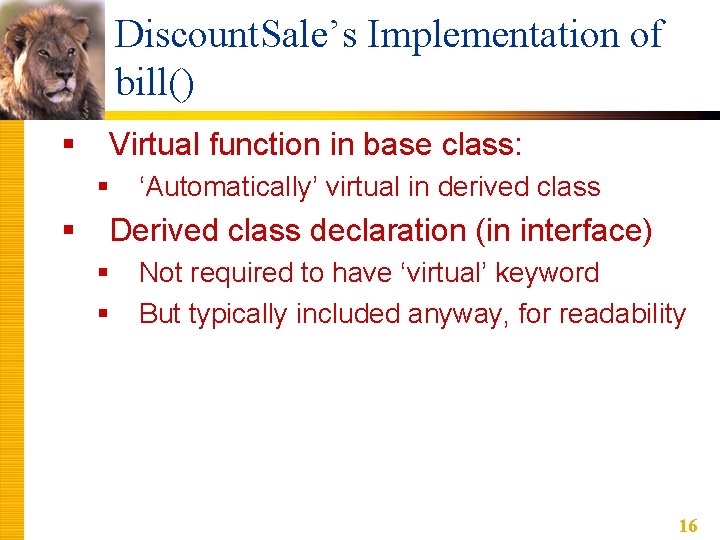
Discount. Sale’s Implementation of bill() § Virtual function in base class: § § ‘Automatically’ virtual in derived class Derived class declaration (in interface) § § Not required to have ‘virtual’ keyword But typically included anyway, for readability 16
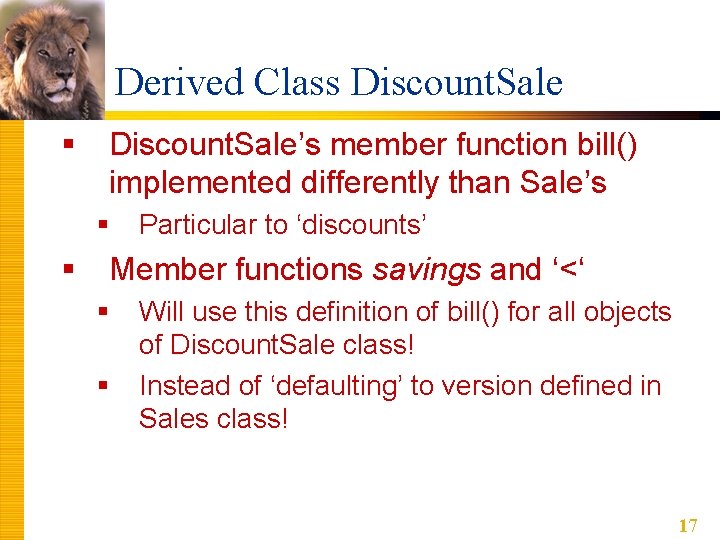
Derived Class Discount. Sale § Discount. Sale’s member function bill() implemented differently than Sale’s § § Particular to ‘discounts’ Member functions savings and ‘<‘ § § Will use this definition of bill() for all objects of Discount. Sale class! Instead of ‘defaulting’ to version defined in Sales class! 17
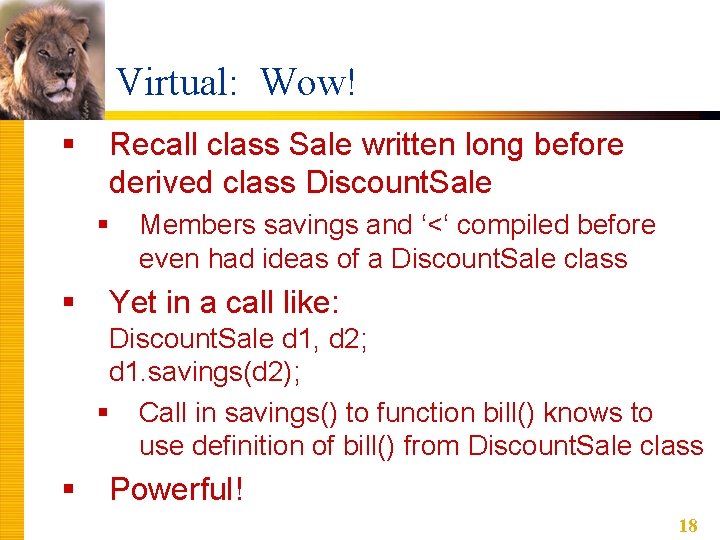
Virtual: Wow! § Recall class Sale written long before derived class Discount. Sale § § Members savings and ‘<‘ compiled before even had ideas of a Discount. Sale class Yet in a call like: Discount. Sale d 1, d 2; d 1. savings(d 2); § Call in savings() to function bill() knows to use definition of bill() from Discount. Sale class § Powerful! 18
Virtual: How? § To write C++ programs: § § But explanation involves late binding § § Assume it happens by ‘magic’! Virtual functions implement late binding Tells compiler to ‘wait’ until function is used in program Decide which definition to use based on calling object Very important OOP principle! 19
Overriding § Virtual function definition changed in a derived class § § Similar to redefined § § We say it’s been ‘overidden’ Recall: for standard functions So: § § Virtual functions changed: overridden Non-virtual functions changed: redefined 20
Virtual Functions: Why Not All? § § Clear advantages to virtual functions as we’ve seen One major disadvantage: overhead! § § § Uses more storage Late binding is ‘on the fly’, so programs run slower So if virtual functions not needed, should not be used 21
Pure Virtual Functions § Base class might not have ‘meaningful’ definition for some of it’s members! § § It’s purpose solely for others to derive from Recall class Figure § All figures are objects of derived classes § § § Rectangles, circles, triangles, etc. Class Figure has no idea how to draw! Make it a pure virtual function: virtual void draw() = 0; 22
Abstract Base Classes § Pure virtual functions require no definition § § Forces all derived classes to define ‘their own’ version Class with one or more pure virtual functions is: abstract base class § § Can only be used as base class No objects can ever be created from it § § Since it doesn’t have complete ‘definitions’ of all it’s members! If derived class fails to define all pure’s: § It’s an abstract base class too 23
Extended Type Compatibility § Given: Derived is derived class of Base § § § Derived objects can be assigned to objects of type Base But NOT the other way! Consider previous example: § A Discount. Sale “is a” Sale, but reverse not true 24
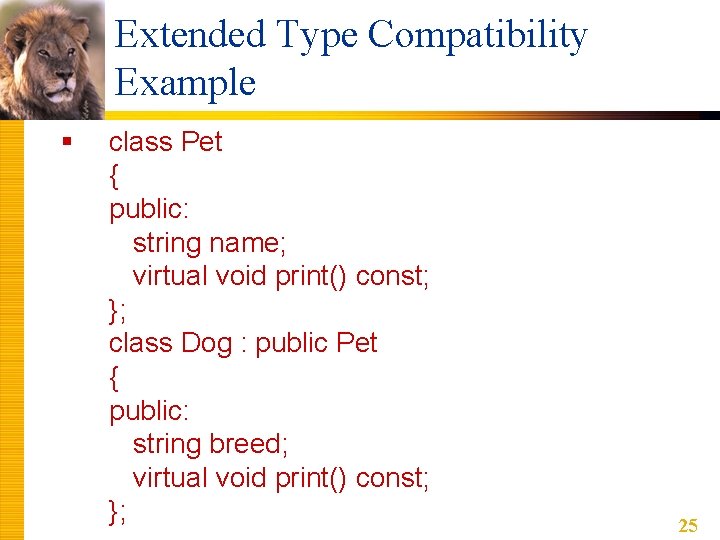
Extended Type Compatibility Example § class Pet { public: string name; virtual void print() const; }; class Dog : public Pet { public: string breed; virtual void print() const; }; 25
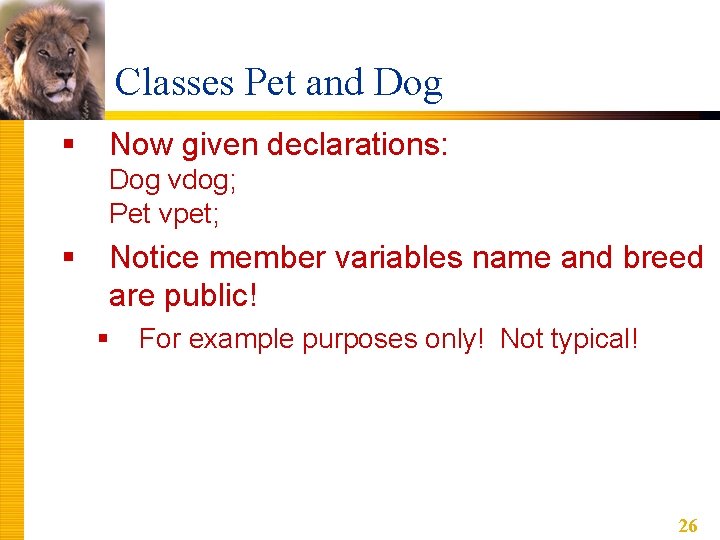
Classes Pet and Dog § Now given declarations: Dog vdog; Pet vpet; § Notice member variables name and breed are public! § For example purposes only! Not typical! 26
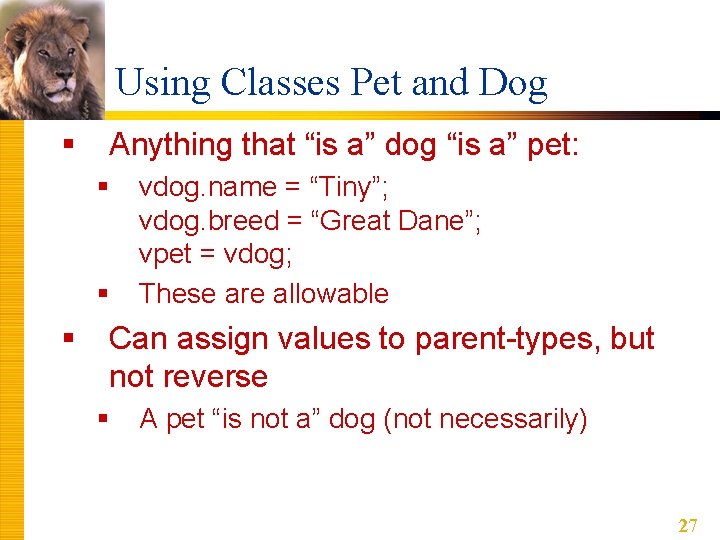
Using Classes Pet and Dog § Anything that “is a” dog “is a” pet: § § § vdog. name = “Tiny”; vdog. breed = “Great Dane”; vpet = vdog; These are allowable Can assign values to parent-types, but not reverse § A pet “is not a” dog (not necessarily) 27
Slicing Problem § Notice value assigned to vpet ‘loses’ it’s breed field! § cout << vpet. breed; § § § Produces ERROR msg! Called slicing problem Might seem appropriate § Dog was moved to Pet variable, so it should be treated like a Pet § § And therefore not have ‘dog’ properties Makes for interesting philosphical debate 28
Slicing Problem Fix § In C++, slicing problem is nuisance § § § It still ‘is a’ Great Dane named Tiny We’d like to refer to it’s breed even if it’s been treated as a Pet Can do so with pointers to dynamic variables 29
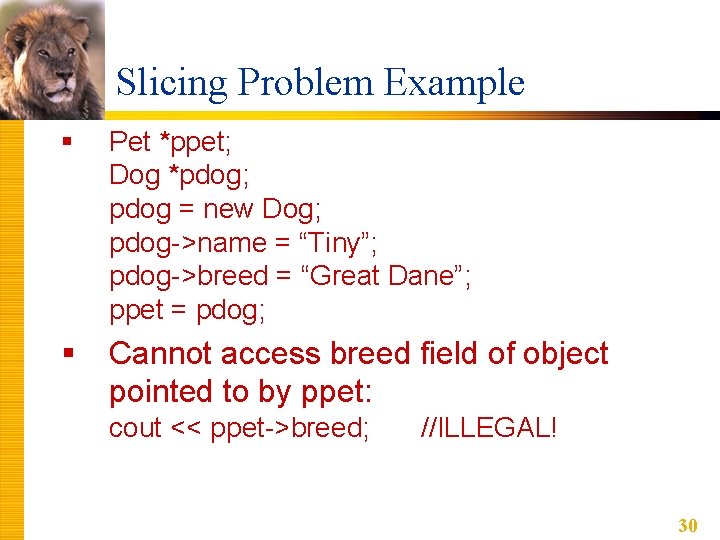
Slicing Problem Example § Pet *ppet; Dog *pdog; pdog = new Dog; pdog->name = “Tiny”; pdog->breed = “Great Dane”; ppet = pdog; § Cannot access breed field of object pointed to by ppet: cout << ppet->breed; //ILLEGAL! 30
Slicing Problem Example § Must use virtual member function: ppet->print(); § Calls print member function in Dog class! § § Because it’s virtual C++ ‘waits’ to see what object pointer ppet is actually pointing to before ‘binding’ call 31
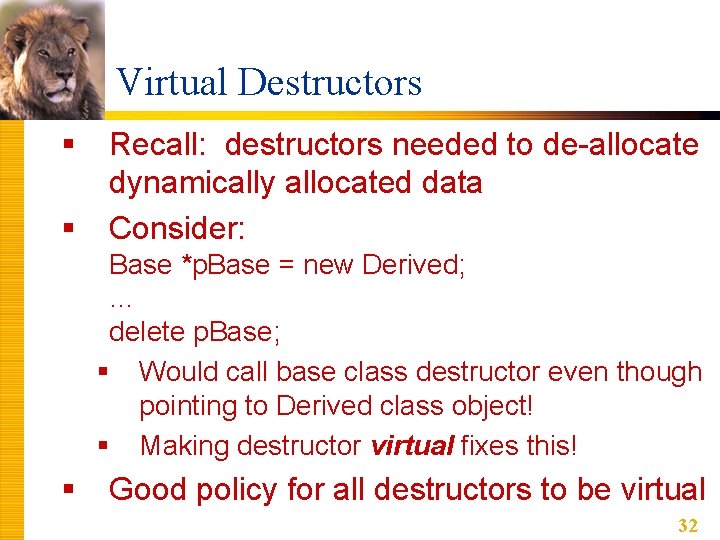
Virtual Destructors § § Recall: destructors needed to de-allocate dynamically allocated data Consider: Base *p. Base = new Derived; … delete p. Base; § Would call base class destructor even though pointing to Derived class object! § Making destructor virtual fixes this! § Good policy for all destructors to be virtual 32
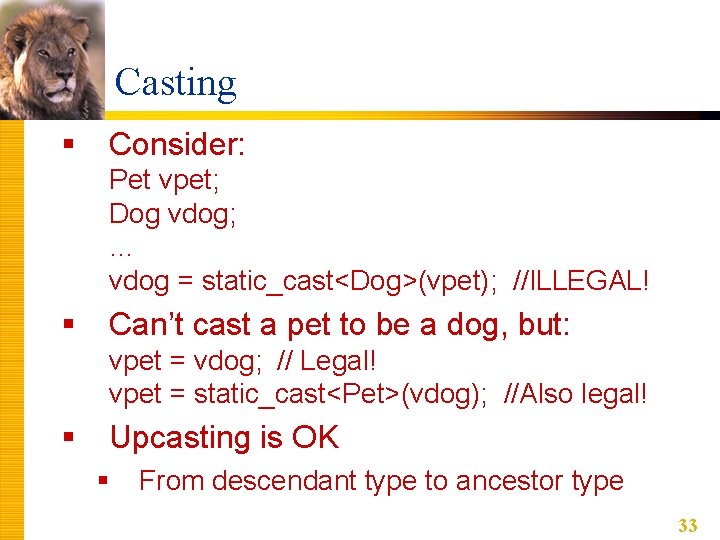
Casting § Consider: Pet vpet; Dog vdog; … vdog = static_cast<Dog>(vpet); //ILLEGAL! § Can’t cast a pet to be a dog, but: vpet = vdog; // Legal! vpet = static_cast<Pet>(vdog); //Also legal! § Upcasting is OK § From descendant type to ancestor type 33
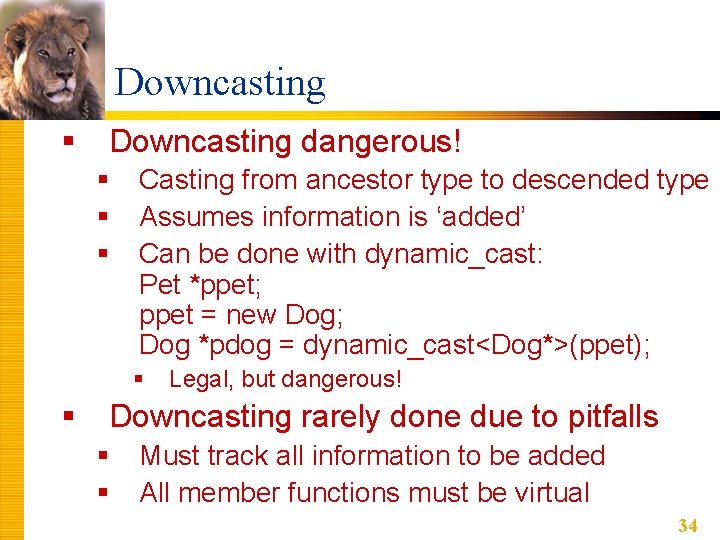
Downcasting § Downcasting dangerous! § § § Casting from ancestor type to descended type Assumes information is ‘added’ Can be done with dynamic_cast: Pet *ppet; ppet = new Dog; Dog *pdog = dynamic_cast<Dog*>(ppet); § § Legal, but dangerous! Downcasting rarely done due to pitfalls § § Must track all information to be added All member functions must be virtual 34
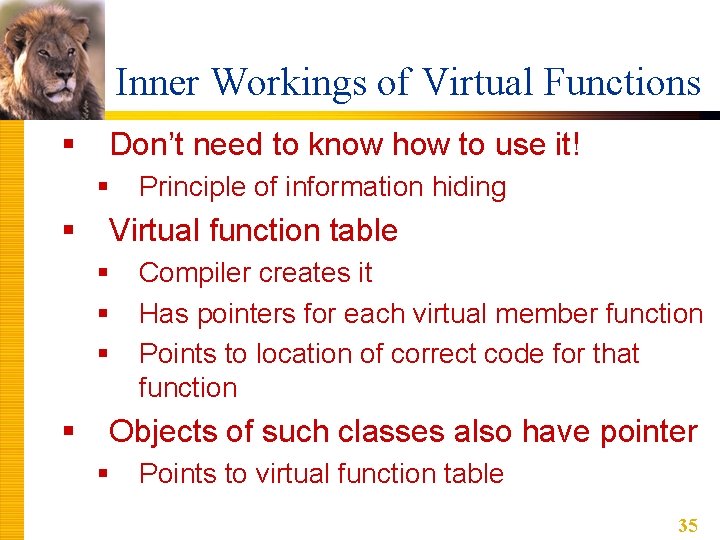
Inner Workings of Virtual Functions § Don’t need to know how to use it! § § Virtual function table § § Principle of information hiding Compiler creates it Has pointers for each virtual member function Points to location of correct code for that function Objects of such classes also have pointer § Points to virtual function table 35
Summary 1 § Late binding delays decision of which member function is called until runtime § § In C++, virtual functions use late binding Pure virtual functions have no definition § § § Classes with at least one are abstract No objects can be created from abstract class Used strictly as base for others to derive 36
Summary 2 1. Derived class objects can be assigned to base class objects 1. Base class members are lost; slicing problem 2. Pointer assignments and dynamic objects 1. Allow ‘fix’ to slicing problem 3. Make all destructors virtual 1. Good programming practice 2. Ensures memory correctly de-allocated 37