
Chapter 15 Polymers Characteristics Applications and Processing ISSUES


- Slides: 27
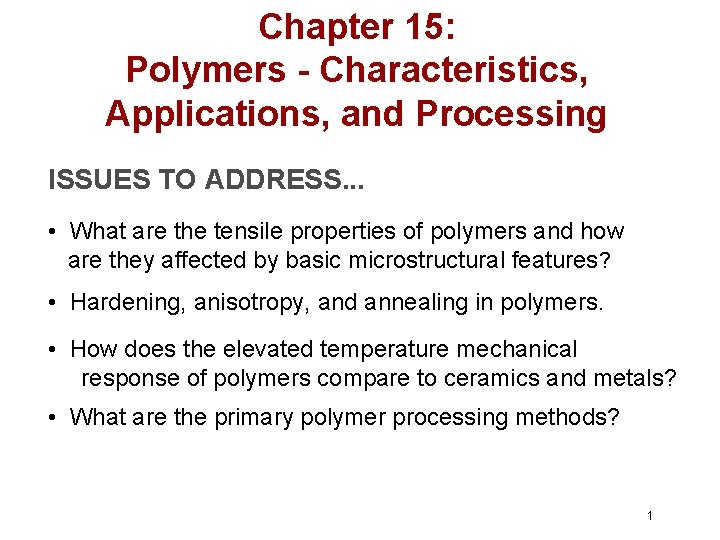
Chapter 15: Polymers - Characteristics, Applications, and Processing ISSUES TO ADDRESS. . . • What are the tensile properties of polymers and how are they affected by basic microstructural features? • Hardening, anisotropy, and annealing in polymers. • How does the elevated temperature mechanical response of polymers compare to ceramics and metals? • What are the primary polymer processing methods? 1
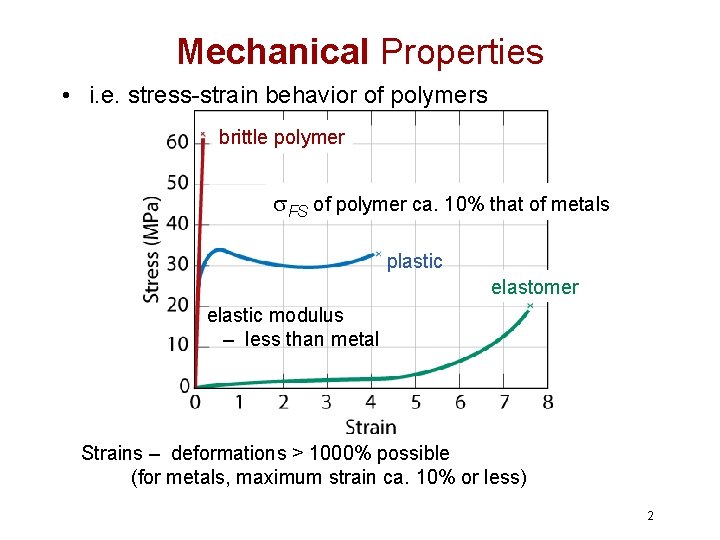
Mechanical Properties • i. e. stress-strain behavior of polymers brittle polymer FS of polymer ca. 10% that of metals plastic elastomer elastic modulus – less than metal Strains – deformations > 1000% possible (for metals, maximum strain ca. 10% or less) 2
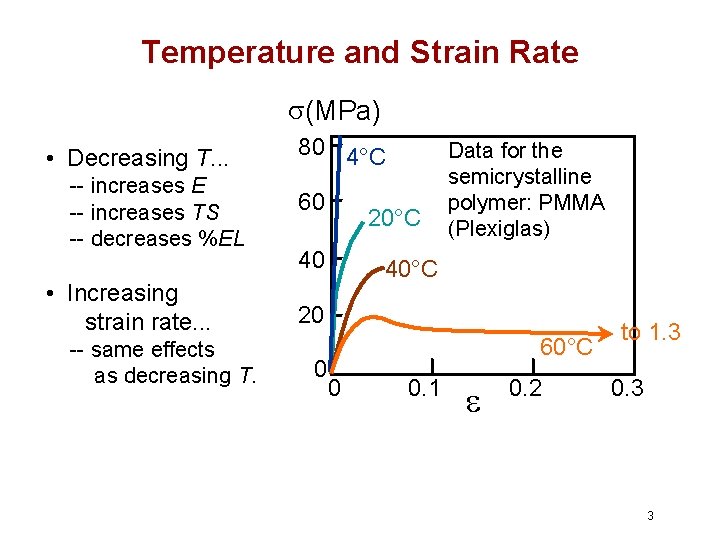
Temperature and Strain Rate (MPa) • Decreasing T. . . -- increases E -- increases TS -- decreases %EL • Increasing strain rate. . . -- same effects as decreasing T. 80 4°C 60 20°C 40 Data for the semicrystalline polymer: PMMA (Plexiglas) 40°C 20 0 60°C 0 0. 1 e 0. 2 to 1. 3 0. 3 3
Tensile Response: Brittle & Plastic Near Failure (MPa) fibrillar structure x brittle failure onset of necking near failure plastic failure x Initial unload/reload e aligned, networked crosscase linked case crystalline regions slide semicrystalline case amorphous regions elongate crystalline regions align 4
Predeformation by Drawing • Drawing -- stretches the polymer prior to use -- aligns chains in the stretching direction • Results of drawing: -- increases the elastic modulus (E) in the stretching direction -- increases the tensile strength (TS) in the stretching direction -- decreases ductility (%EL) • Annealing after drawing. . . -- decreases alignment -- reverses effects of drawing. • Compare to cold working in metals! Is it like Strain Hardening ? 5
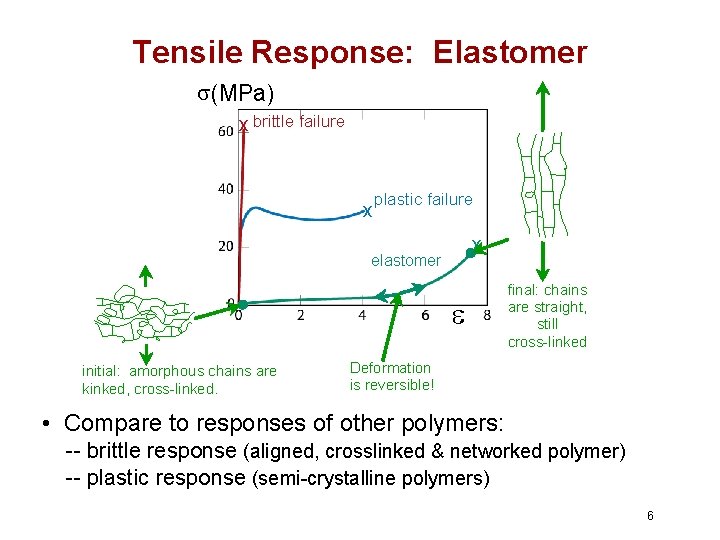
Tensile Response: Elastomer (MPa) x brittle failure x plastic failure x elastomer e initial: amorphous chains are kinked, cross-linked. final: chains are straight, still cross-linked Deformation is reversible! • Compare to responses of other polymers: -- brittle response (aligned, crosslinked & networked polymer) -- plastic response (semi-crystalline polymers) 6
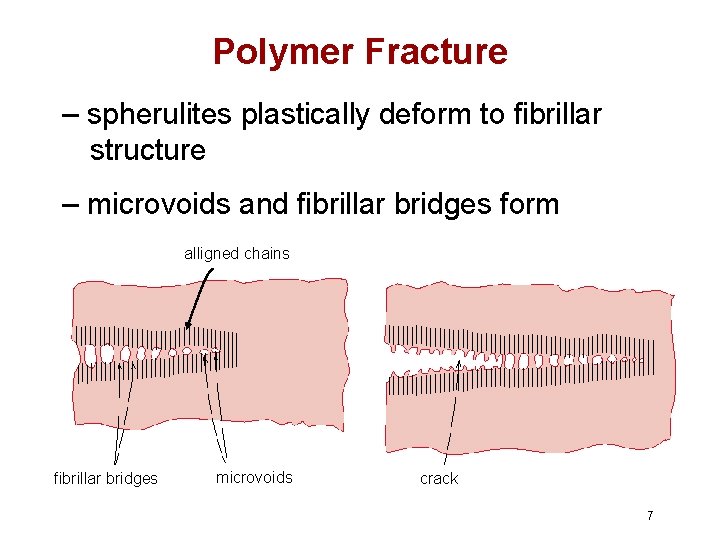
Polymer Fracture – spherulites plastically deform to fibrillar structure – microvoids and fibrillar bridges form alligned chains fibrillar bridges microvoids crack 7
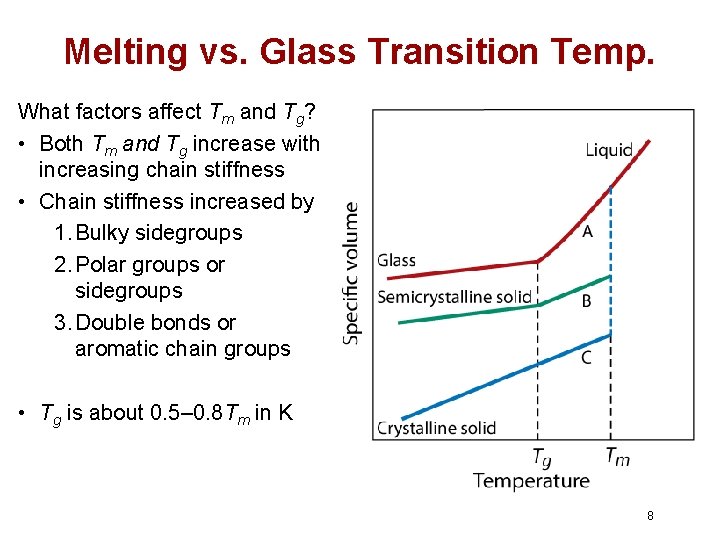
Melting vs. Glass Transition Temp. What factors affect Tm and Tg? • Both Tm and Tg increase with increasing chain stiffness • Chain stiffness increased by 1. Bulky sidegroups 2. Polar groups or sidegroups 3. Double bonds or aromatic chain groups • Tg is about 0. 5– 0. 8 Tm in K 8
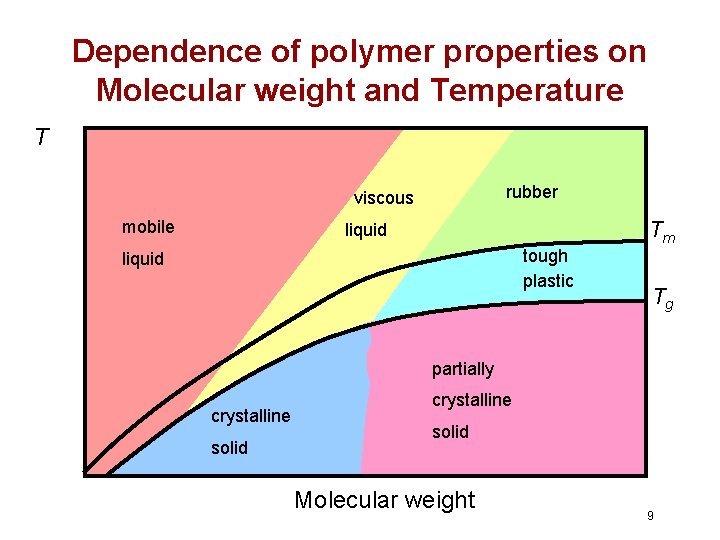
Dependence of polymer properties on Molecular weight and Temperature T Callister, rubber Fig. 16. 9 viscous mobile liquid tough plastic liquid Tm Tg partially crystalline solid Molecular weight 9
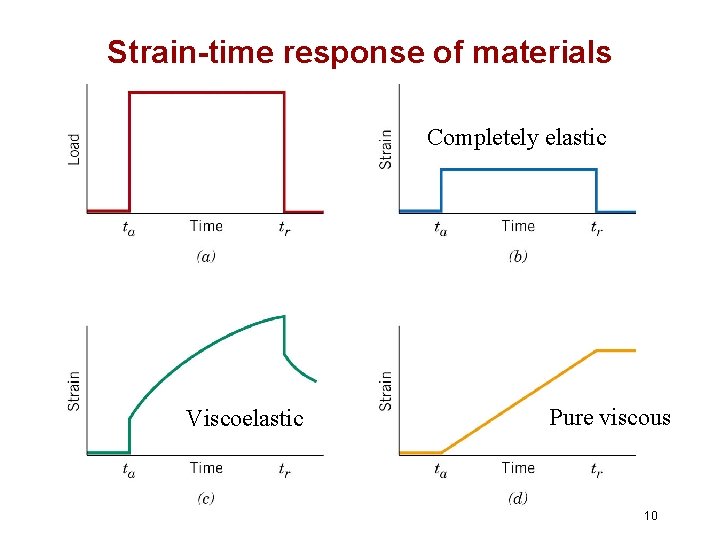
Strain-time response of materials Completely elastic Viscoelastic Pure viscous 10
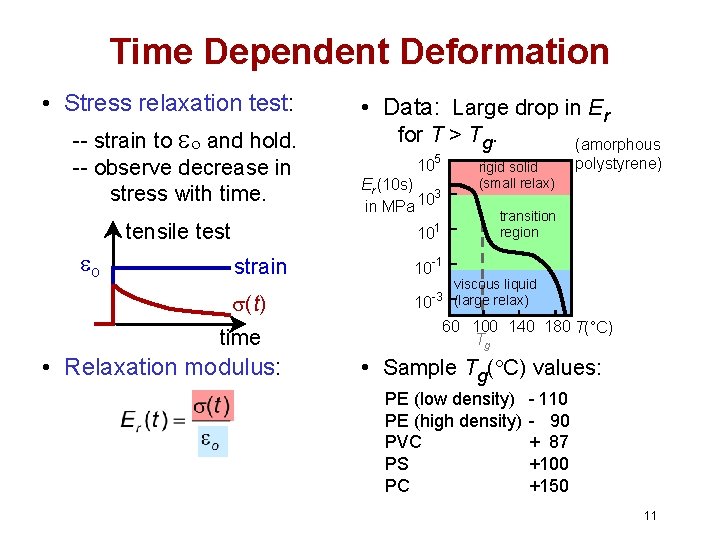
Time Dependent Deformation • Stress relaxation test: -- strain to eo and hold. -- observe decrease in stress with time. tensile test eo • Data: Large drop in Er for T > Tg. 5 10 rigid solid (small relax) Er (10 s) 3 in MPa 10 transition region 1 10 strain 10 -1 (t) 10 -3 (large relax) time • Relaxation modulus: (amorphous polystyrene) viscous liquid 60 100 140 180 T(°C) Tg • Sample Tg( C) values: PE (low density) PE (high density) PVC PS PC - 110 - 90 + 87 +100 +150 11
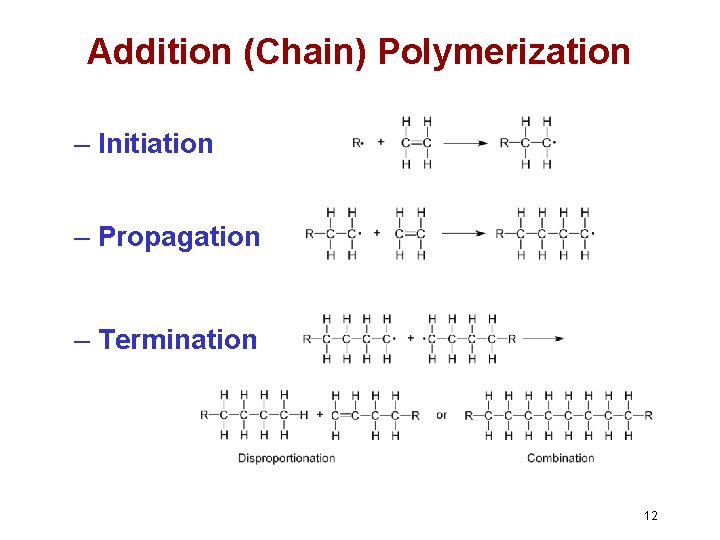
Addition (Chain) Polymerization – Initiation – Propagation – Termination 12
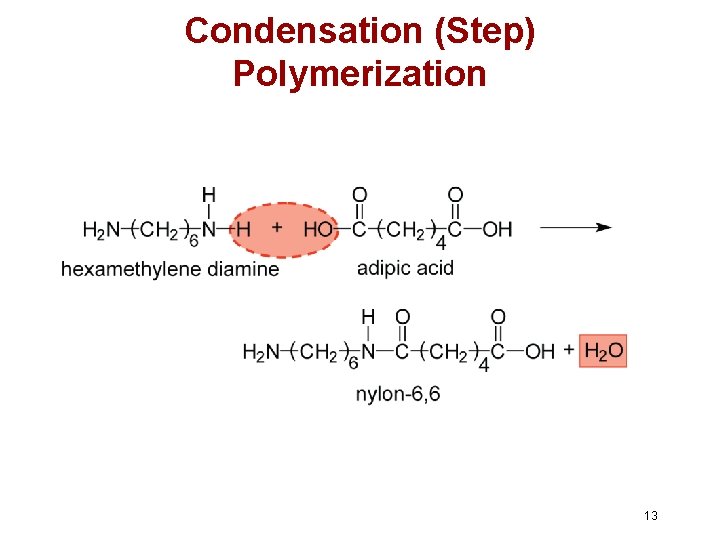
Condensation (Step) Polymerization 13
Polymer Additives Improve mechanical properties, processability, durability, etc. • Fillers – Added to improve tensile strength & abrasion resistance, toughness, thermal and dimension stability & decrease cost – ex: carbon black, silica gel, wood flour, glass, limestone, etc. • Plasticizers – Improve flexibility, ductility and toughness – Added to reduce the glass transition temperature Tg – commonly added to PVC - otherwise reduction of hardness and stiffness 14
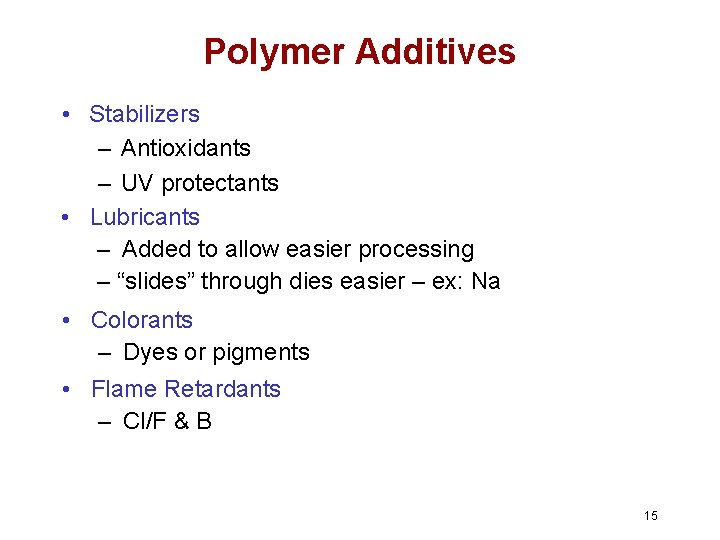
Polymer Additives • Stabilizers – Antioxidants – UV protectants • Lubricants – Added to allow easier processing – “slides” through dies easier – ex: Na • Colorants – Dyes or pigments • Flame Retardants – Cl/F & B 15
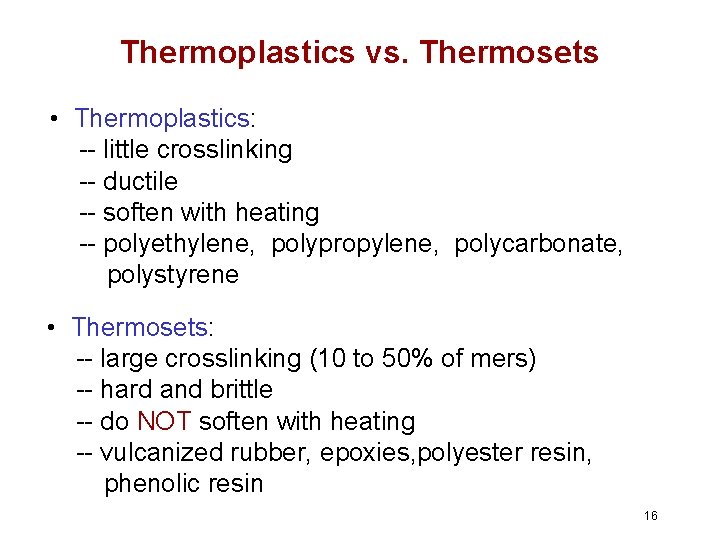
Thermoplastics vs. Thermosets • Thermoplastics: -- little crosslinking -- ductile -- soften with heating -- polyethylene, polypropylene, polycarbonate, polystyrene • Thermosets: -- large crosslinking (10 to 50% of mers) -- hard and brittle -- do NOT soften with heating -- vulcanized rubber, epoxies, polyester resin, phenolic resin 16
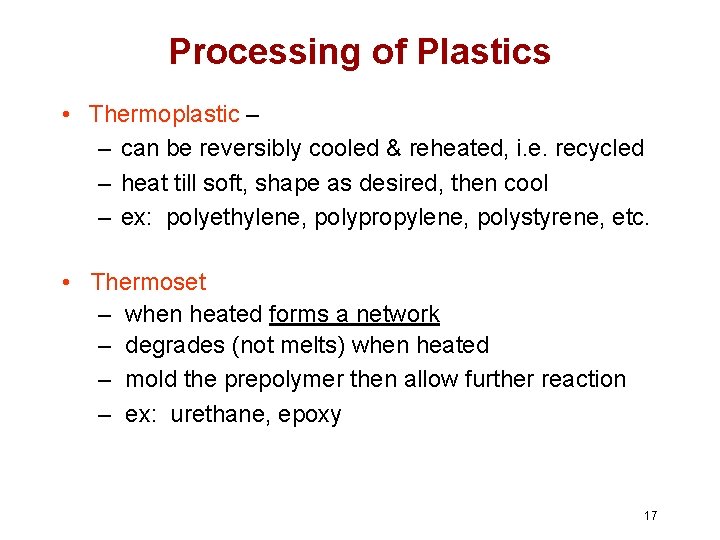
Processing of Plastics • Thermoplastic – – can be reversibly cooled & reheated, i. e. recycled – heat till soft, shape as desired, then cool – ex: polyethylene, polypropylene, polystyrene, etc. • Thermoset – when heated forms a network – degrades (not melts) when heated – mold the prepolymer then allow further reaction – ex: urethane, epoxy 17
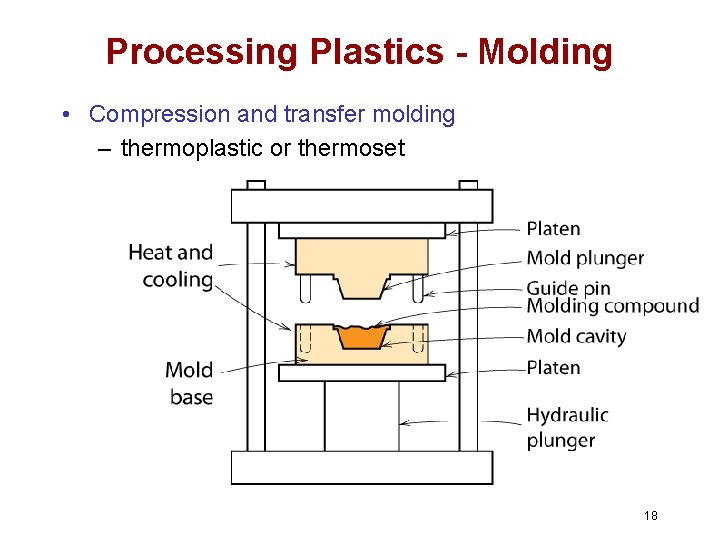
Processing Plastics - Molding • Compression and transfer molding – thermoplastic or thermoset 18
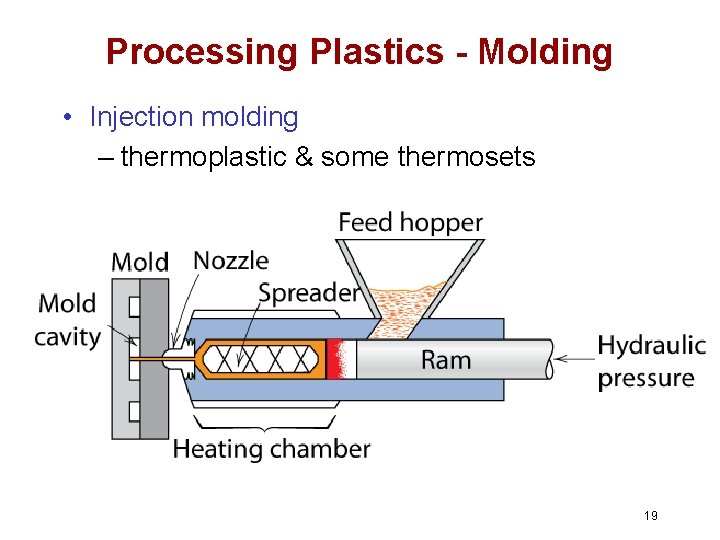
Processing Plastics - Molding • Injection molding – thermoplastic & some thermosets 19
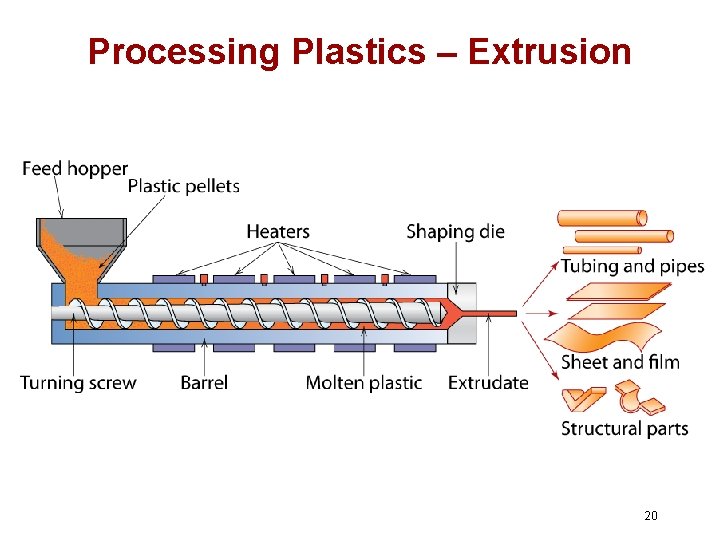
Processing Plastics – Extrusion 20
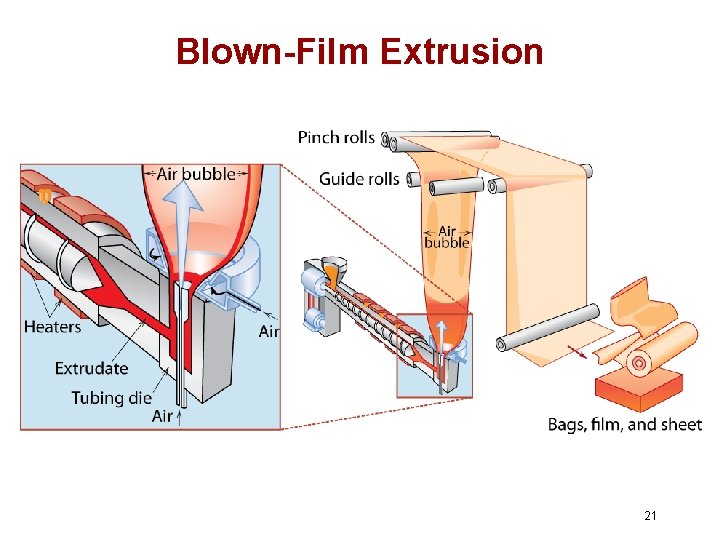
Blown-Film Extrusion 21
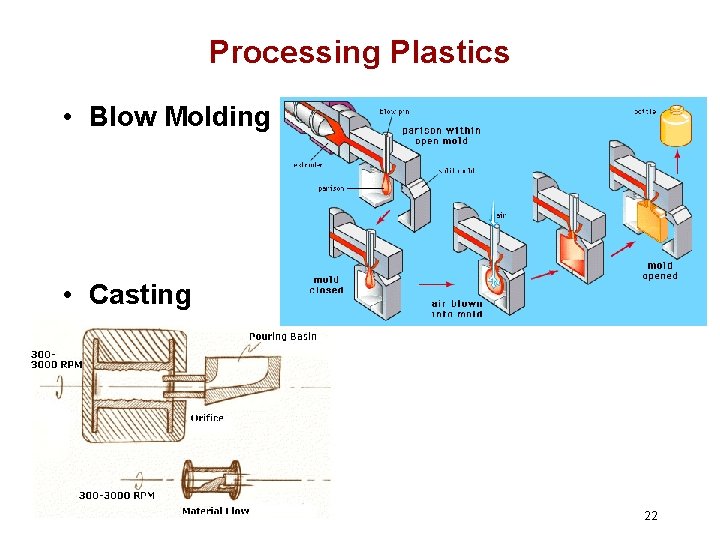
Processing Plastics • Blow Molding • Casting 22
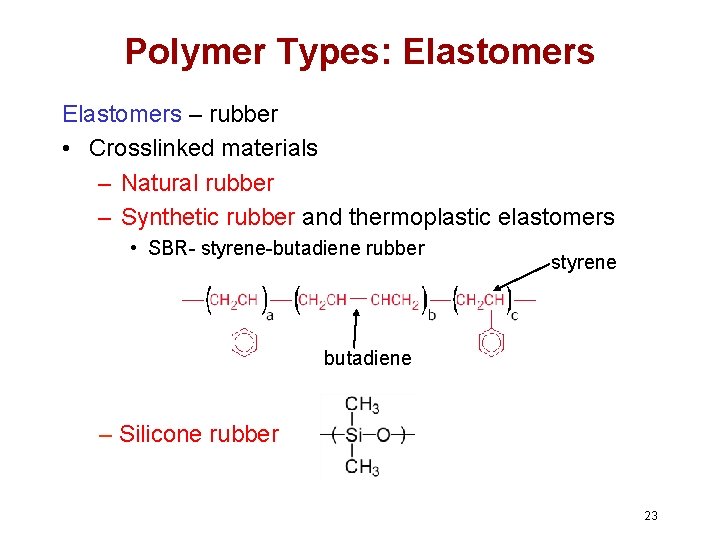
Polymer Types: Elastomers – rubber • Crosslinked materials – Natural rubber – Synthetic rubber and thermoplastic elastomers • SBR- styrene-butadiene rubber styrene butadiene – Silicone rubber 23
Polymer Types: Fibers - length/diameter >100 • Textiles are majority use – Must have high tensile strength – Usually highly crystalline & highly polar • Formed by spinning – ex: extrude polymer through a spinnerette • Pt plate with 1000’s of holes for nylon • ex: rayon – dissolved in solvent then pumped through die head to make fibers – the fibers are drawn – leads to highly aligned chains- fibrillar structure 24
Polymer Types • • Coatings – thin film on surface – i. e. paint, varnish – To protect item – Improve appearance – Electrical insulation Adhesives – produce bond between two adherands – Usually bonded by: 1. Secondary bonds 2. Mechanical bonding • • Films – blown film extrusion Foams – gas bubbles in plastic 25
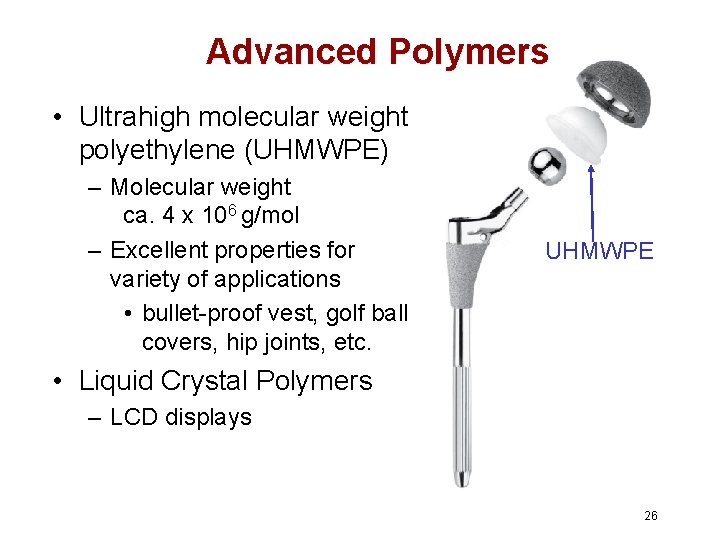
Advanced Polymers • Ultrahigh molecular weight polyethylene (UHMWPE) – Molecular weight ca. 4 x 10⁶ g/mol – Excellent properties for variety of applications • bullet-proof vest, golf ball covers, hip joints, etc. UHMWPE • Liquid Crystal Polymers – LCD displays 26
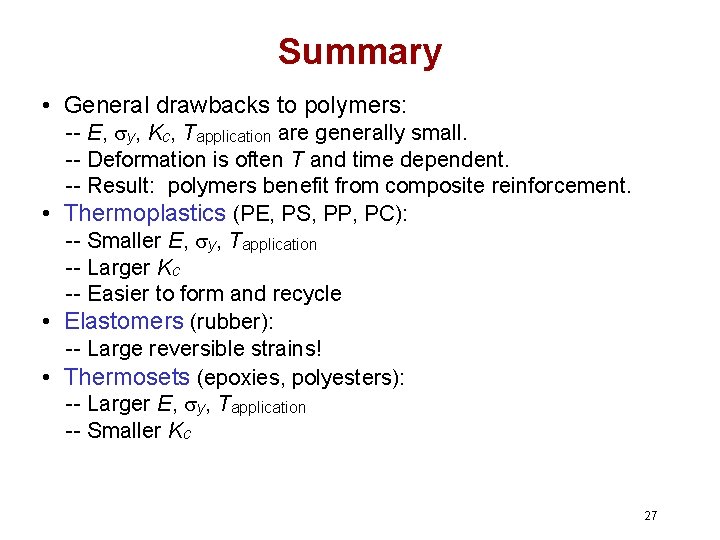
Summary • General drawbacks to polymers: -- E, y, Kc, Tapplication are generally small. -- Deformation is often T and time dependent. -- Result: polymers benefit from composite reinforcement. • Thermoplastics (PE, PS, PP, PC): -- Smaller E, y, Tapplication -- Larger Kc -- Easier to form and recycle • Elastomers (rubber): -- Large reversible strains! • Thermosets (epoxies, polyesters): -- Larger E, y, Tapplication -- Smaller Kc 27