
CHAPTER 15 Partnerships Prepared by Nathalie Johnstone University
CHAPTER 15: Partnerships Prepared by Nathalie Johnstone University of Saskatchewan Electronic Presentations in Microsoft® Power. Point® Copyright © 2015 Mc. Graw-Hill Ryerson, Limited. All rights reserved. 1
Partnerships I. The Standard Partnership – Definition and Format II. Taxation of Partnership Operations III. Partnership Structure – Impact on Decision Making Copyright © 2015 Mc. Graw-Hill Ryerson, Limited. All rights reserved. 2
Partnerships Different alternative structures for a business activity includes: – Partnerships • Useful for individuals who practice together in a profession and small business enterprise • Also used to form part of a business structure of large public and private corporations. Copyright © 2015 Mc. Graw-Hill Ryerson, Limited. All rights reserved. 3
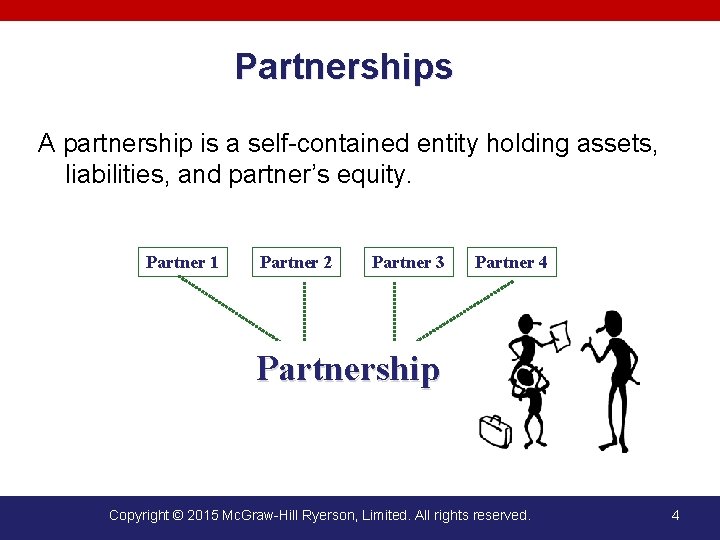
Partnerships A partnership is a self-contained entity holding assets, liabilities, and partner’s equity. Partner 1 Partner 2 Partner 3 Partner 4 Partnership Copyright © 2015 Mc. Graw-Hill Ryerson, Limited. All rights reserved. 4
Very Important to have a Partnership Agreement • • A partnership is created by the execution of a partnership agreement. The partnership agreement outlines: 1. Each partner’s required contributions to the entity. 2. The format and rules for decision making and the management of the partnership’s business affairs. 3. How profits or losses are to be shared by the participating partners. Copyright © 2015 Mc. Graw-Hill Ryerson, Limited. All rights reserved. 5
Sharing of Operating Results • Profits or losses are usually shared: • as a function of capital contributions, or • the degree of effort or participation in the business process, or • Both of the above. • The sharing of profits and losses is a function of the partnership agreement. Copyright © 2015 Mc. Graw-Hill Ryerson, Limited. All rights reserved. 6
Partner Liability • Standard partnership is a separate functioning entity for management purposes. • It is not a protected legal entity that is separate from the affairs of the partners. – All obligations and debts incurred are the responsibility of each partner – All negligent activities performed by them, are the full responsibility of each partner. • Each partner is jointly and severally liable for all partnership activities. – Can be limited under certain circumstances. (LLCs) Copyright © 2015 Mc. Graw-Hill Ryerson, Limited. All rights reserved. 7
II. Taxation of Partnership Operations • Not a taxable entity • Income earned or losses incurred by the partnership are allocated to the partners: – in accordance with the agreed sharing ratio, – for inclusion in each partner’s income for tax purposes. • Income is allocated for tax purposes regardless of whether actually distributed to the partners. Copyright © 2015 Mc. Graw-Hill Ryerson, Limited. All rights reserved. 8
II. Taxation of Partnership Operations • ITA 96(1) (a) to (c) • Income earned or losses incurred is determined as if the partnership were a separate taxable entity. • Can earn business income, property income, and capital gains; – all of these are determined according to the normal rules. • Income allocated retains its source and characteristics when included in the partner’s income. • Split the income since different tax treatment per income type Copyright © 2015 Mc. Graw-Hill Ryerson, Limited. All rights reserved. 9
Income Allocation – an example Type of Activity Partnership 60% partner 40% partner Business Income $500, 000 $300, 000 $200, 000 Manufacturing loss (100, 000) (60, 000) (40, 000) Interest Income 10, 000 6, 000 4, 000 Dividend Income 40, 000 24, 000 16, 000 100, 000 60, 000 40, 000 20, 000 12, 000 8, 000 $570, 000 $342, 000 $228, 000 Rental Income Net Capital Gains Copyright © 2015 Mc. Graw-Hill Ryerson, Limited. All rights reserved. 10
The Partnership Interest • A partner is considered to own a partnership interest whenever that partner has rights and obligations created by being party to a partnership agreement. • The partnership interest is a tradable asset – can be bought and sold. • Usually treated as capital property for tax purposes; – disposition results in a capital gain or loss. Copyright © 2015 Mc. Graw-Hill Ryerson, Limited. All rights reserved. 11
The Partnership Interest • • Usually created when the participants contribute capital in the form of cash or assets in return for a partnership interest. Can become a partner by: a) Purchasing a departing partner’s interest, b) Acquiring a portion of the interest of each remaining partner; or, c) Contributing cash or assets to the partnership in return for a new partnership interest. Copyright © 2015 Mc. Graw-Hill Ryerson, Limited. All rights reserved. 12
The Partnership Interest • Existing partners can depart or diminish their percentage of participation by: a) Selling all or a portion of their partnership interest to a new partner or existing partner(s); or, b) Withdrawing their capital directly from the partnership treasury. Copyright © 2015 Mc. Graw-Hill Ryerson, Limited. All rights reserved. 13
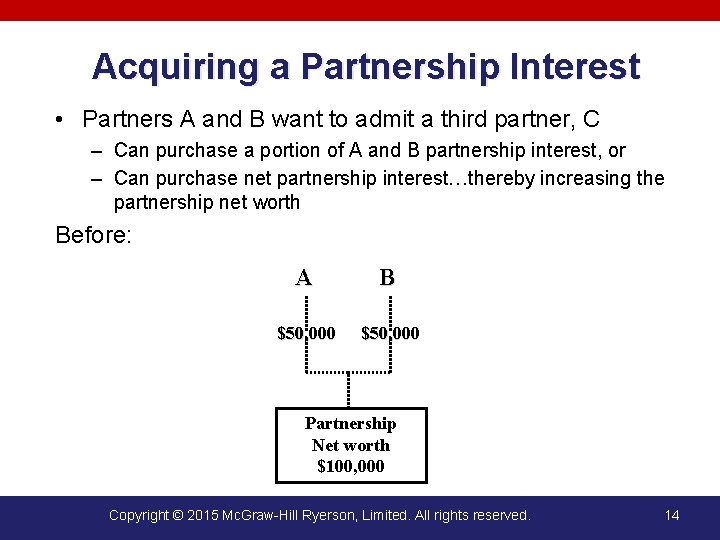
Acquiring a Partnership Interest • Partners A and B want to admit a third partner, C – Can purchase a portion of A and B partnership interest, or – Can purchase net partnership interest…thereby increasing the partnership net worth Before: A B $50, 000 Partnership Net worth $100, 000 Copyright © 2015 Mc. Graw-Hill Ryerson, Limited. All rights reserved. 14
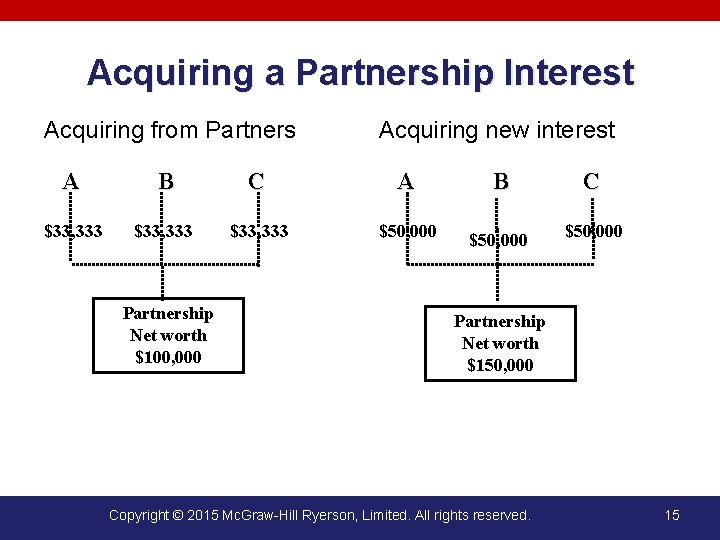
Acquiring a Partnership Interest Acquiring from Partners Acquiring new interest A B C $33, 333 $50, 000 Partnership Net worth $100, 000 Partnership Net worth $150, 000 Copyright © 2015 Mc. Graw-Hill Ryerson, Limited. All rights reserved. 15
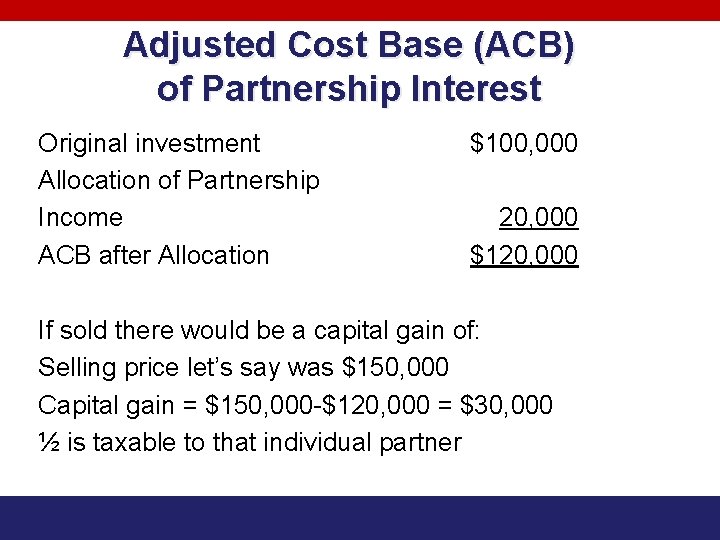
Adjusted Cost Base (ACB) of Partnership Interest Original investment Allocation of Partnership Income ACB after Allocation $100, 000 20, 000 $120, 000 If sold there would be a capital gain of: Selling price let’s say was $150, 000 Capital gain = $150, 000 -$120, 000 = $30, 000 ½ is taxable to that individual partner
Partnership Interest - ACB Every partner has his own ACB Additions to the ACB (most common) – Partner's contribution of capital – Partner’s share of income from the partnership (every year add NI to ACB). Increase ACB by NI to ensure not to pay capital gain on it and be double taxed – Partner’s share of Capital Dividends received by the partnership. – Partner’s share of the net proceeds of life insurance Deductions from ACB ( most common) – Partner’s share of loss – Partner’s share of charitable gifts or political contributions (decrease ACB since benifited from tax savings from original donation)
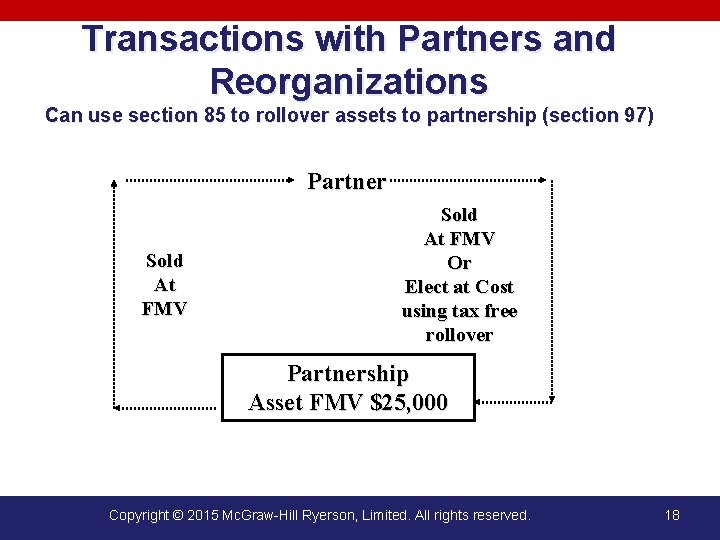
Transactions with Partners and Reorganizations Can use section 85 to rollover assets to partnership (section 97) Partner Sold At FMV Or Elect at Cost using tax free rollover Partnership Asset FMV $25, 000 Copyright © 2015 Mc. Graw-Hill Ryerson, Limited. All rights reserved. 18
Transactions with Partners and Reorganizations • A partnership is considered to be a separate entity for purposes of holding assets. • Transactions between partners and the partnership are automatically taken place at FMV. • HOWEVER A partner can elect to transfer property into a partnership at Cost (I. E TAX FREE ROLLOVER) [ITA 97(1)]. • BUT when a Partnership transfers its assets to a partner, it can only be sold at FMV. Copyright © 2015 Mc. Graw-Hill Ryerson, Limited. All rights reserved. 19
Transactions with Partners and Reorganizations • For exam – new business venture: better to incorporate, partnership. If capital intensive and generate losses, better to have partnership since loss not locked up in corp (open, generate loss on you then when profitable incorporate and rollover assets) • The choice of a partnership form of organization is not binding on the participants. • A partnership can be converted into a corporation in which the former partners are shareholders. • A partnership can elect to convert itself into a corporation without tax consequences Copyright © 2015 Mc. Graw-Hillimmediate Ryerson, Limited. All rights reserved. 20
Small Business Deduction and Private Corporate Partners • Active Income earned by a partnership can be entitled to use the SBD by a CCPC partner. • The active business income earned by the partnership that is eligible for the SBD is limited to $500, 000 annually (whole income of partnership maxes at 500 k, disadvantage of partnership) Copyright © 2015 Mc. Graw-Hill Ryerson, Limited. All rights reserved. 21
Other decision criteria for corp or partnership 800 k cap gain lifetime deduction for individual (person owning share of corporation involved in active business) Partner who sells partnership interest is not eligible for 800 k$ cap gain Copyright © 2015 Mc. Graw-Hill Ryerson, Limited. All rights reserved. 22
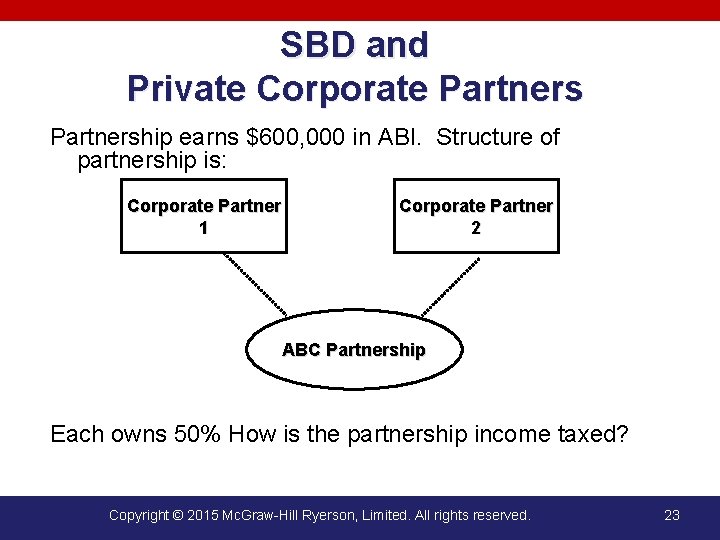
SBD and Private Corporate Partnership earns $600, 000 in ABI. Structure of partnership is: Corporate Partner 1 Corporate Partner 2 ABC Partnership Each owns 50% How is the partnership income taxed? Copyright © 2015 Mc. Graw-Hill Ryerson, Limited. All rights reserved. 23
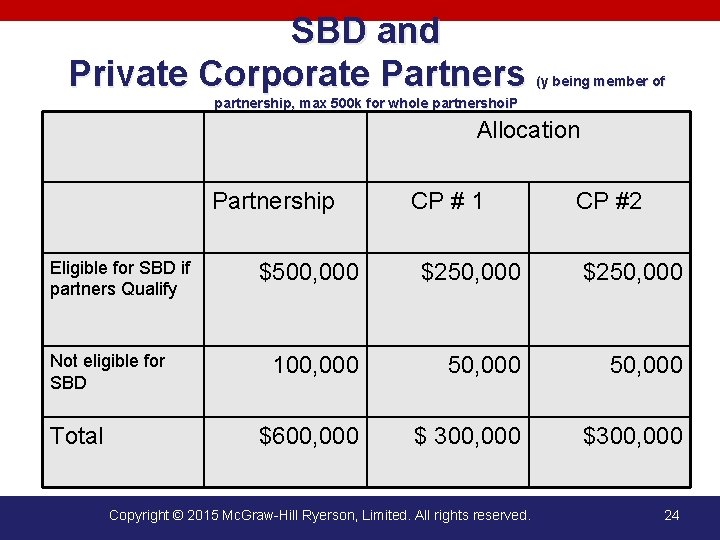
SBD and Private Corporate Partners (y being member of partnership, max 500 k for whole partnershoi. P Allocation Partnership Eligible for SBD if partners Qualify Not eligible for SBD Total CP # 1 CP #2 $500, 000 $250, 000 100, 000 50, 000 $600, 000 $ 300, 000 $300, 000 Copyright © 2015 Mc. Graw-Hill Ryerson, Limited. All rights reserved. 24
III. Partnership Structure – Impact on Decision Making Must consider these four fundamental tax issues: 1. What will be the tax cost on the annual operating profits generated from the new venture? 2. If operating losses are expected during the start-up phase, how and when can such losses be utilized against other sources of income of the venture itself or of the participating parties? (Don’t want capital losses since only 50% deduction and applicable against cap gains) 3. What will the tax implications be if the venture fails and is either terminated or sold off at a loss? 4. How will the capital invested and the accumulated profits be returned to the investor? (how can you get
- Slides: 25