
Chapter 15 Oligopoly Definition Price and output determination






- Slides: 23
Chapter 15: Oligopoly • Definition • Price and output determination – game theory • Cartels • Anti-trust laws and regulation of markets
What is Oligopoly? The distinguishing features of oligopoly are: § Natural or legal barriers that prevent entry of new firms § A “small” number of firms compete causing “interdependent” decision making.
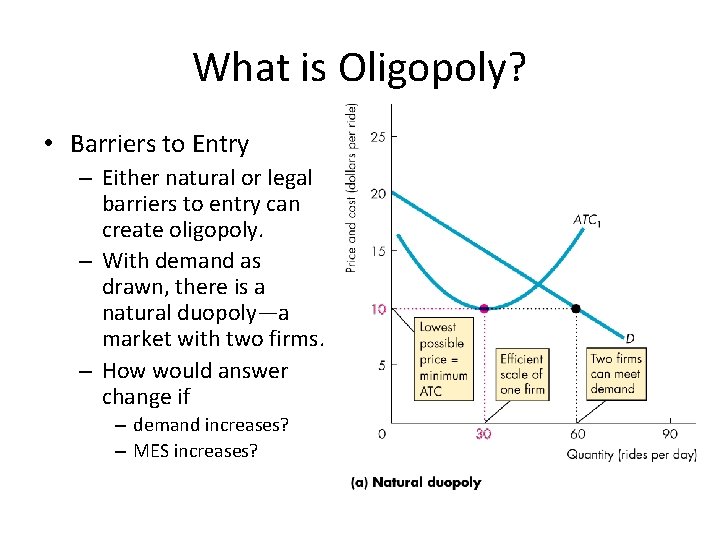
What is Oligopoly? • Barriers to Entry – Either natural or legal barriers to entry can create oligopoly. – With demand as drawn, there is a natural duopoly—a market with two firms. – How would answer change if – demand increases? – MES increases?
What is Oligopoly? • Small Number of Firms § With a small number of firms, each firm’s profit depends on every firm’s actions. § Firms are interdependent and face a temptation to collude. § Cartel: § group of firms acting together to limit output, raise price, and increase profit. § Can be illegal. § Firms in oligopoly face the temptation to form a cartel, but aside from being illegal, cartels often “break down”.
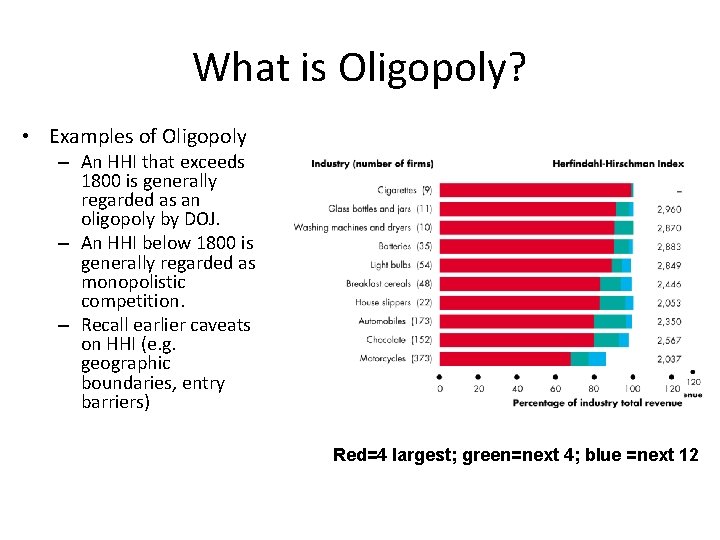
What is Oligopoly? • Examples of Oligopoly – An HHI that exceeds 1800 is generally regarded as an oligopoly by DOJ. – An HHI below 1800 is generally regarded as monopolistic competition. – Recall earlier caveats on HHI (e. g. geographic boundaries, entry barriers) Red=4 largest; green=next 4; blue =next 12
Two Traditional Oligopoly Models • The Kinked Demand Curve Model. SKIP IT. • Dominant Firm Oligopoly SKIP IT.
Oligopoly Games Game theory § a tool for studying strategic behavior, which is behavior that takes into account the expected behavior of others and the mutual recognition of interdependence.
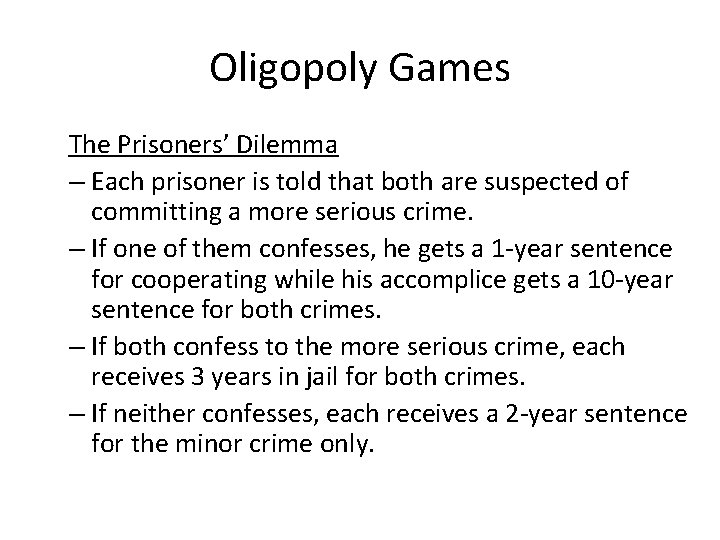
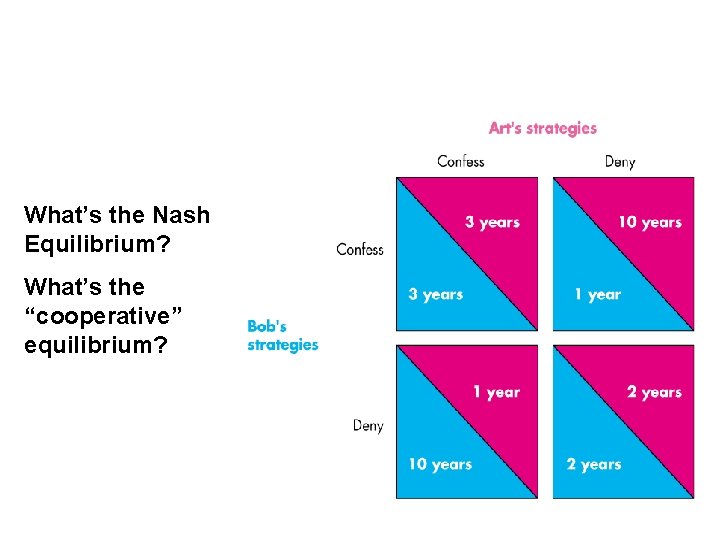
Oligopoly Games The Prisoners’ Dilemma – Each prisoner is told that both are suspected of committing a more serious crime. – If one of them confesses, he gets a 1 -year sentence for cooperating while his accomplice gets a 10 -year sentence for both crimes. – If both confess to the more serious crime, each receives 3 years in jail for both crimes. – If neither confesses, each receives a 2 -year sentence for the minor crime only.
What’s the Nash Equilibrium? What’s the “cooperative” equilibrium?
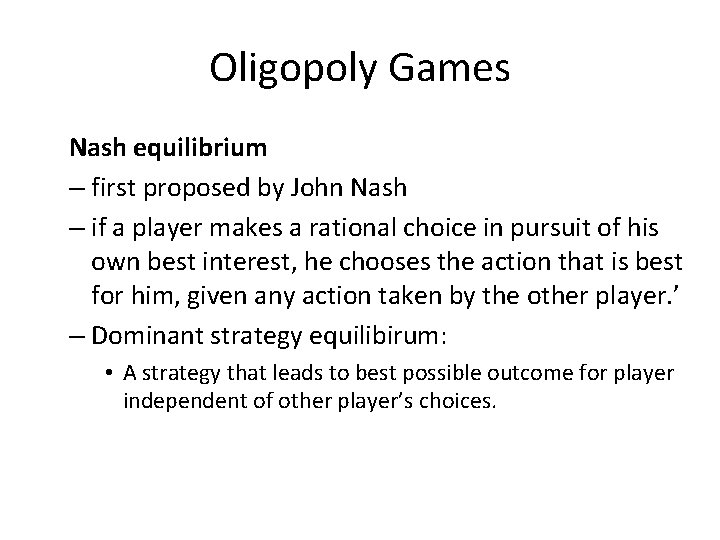
Oligopoly Games Nash equilibrium – first proposed by John Nash – if a player makes a rational choice in pursuit of his own best interest, he chooses the action that is best for him, given any action taken by the other player. ’ – Dominant strategy equilibirum: • A strategy that leads to best possible outcome for player independent of other player’s choices.
British game show illustrates a common type of “game” that arises in economics Golden Balls – compliments of youtube http: //www. youtube. com/watch? v=p 3 Uos 2 fz. IJ 0
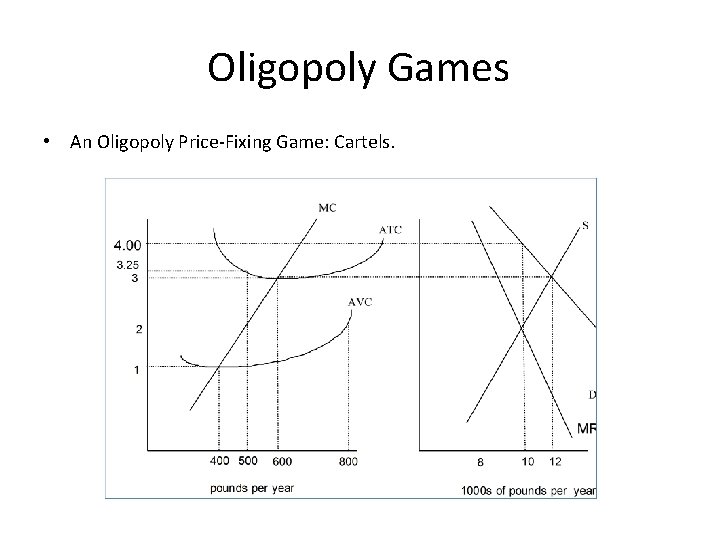
Oligopoly Games • An Oligopoly Price-Fixing Game: Cartels.
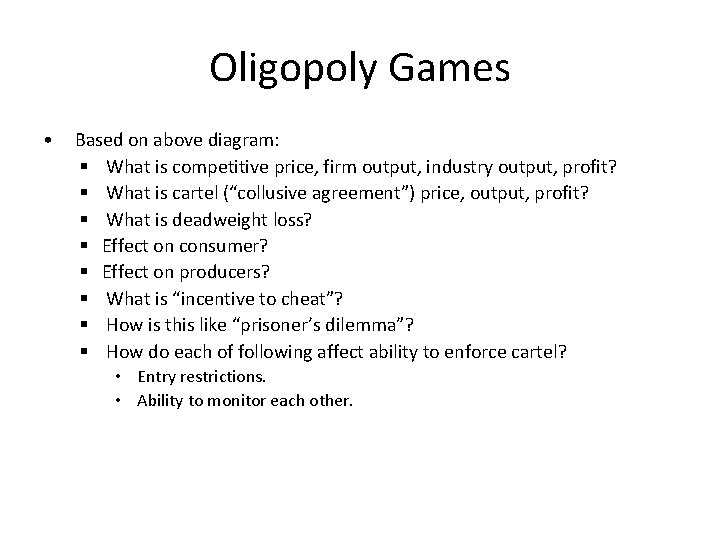
Oligopoly Games • Based on above diagram: § What is competitive price, firm output, industry output, profit? § What is cartel (“collusive agreement”) price, output, profit? § What is deadweight loss? § Effect on consumer? § Effect on producers? § What is “incentive to cheat”? § How is this like “prisoner’s dilemma”? § How do each of following affect ability to enforce cartel? • Entry restrictions. • Ability to monitor each other.
Examples of cartels • • OPEC Drug cartels NCAA Unions
Oligopoly Games • Other Oligopoly Games – Advertising and R & D games are prisoners’ dilemmas. • An R & D Game – Procter & Gamble and Kimberley Clark play an R&D game in the market for disposable diapers.
Anti-trust policy • Measuring concentration. – DOJ formed merger guidelines in early 1980 s. • if post-merger HHI<1000==>industry competitive. • if 1000<HHI<1800==>merger scrutinized (gray area). • if HHI>1800==> merger likely to be challenged (red zone). – Difficulties in using concentration measures as indicators of competition for mergers. • geographic scope of market • product boundaries • firms produce multiple products.
Anti-trust policy • Likelihood of collusion and DOJ anti-trust policy. – When HHI is in a questionable area, other factors are considered. • Barriers to entry • Ability to monitor each other’s behavior. • Is the game “repeated”?
Anti-trust policy – Theories of regulation. • Public interest theory – political process generates regulations designed to achieve “socially efficient” outcome. • Capture theory – regulations are designed to satisfy the demand of producers to maximize producer surplus. – benefit producers (concentrated group) at expense of consumers (disperse group).
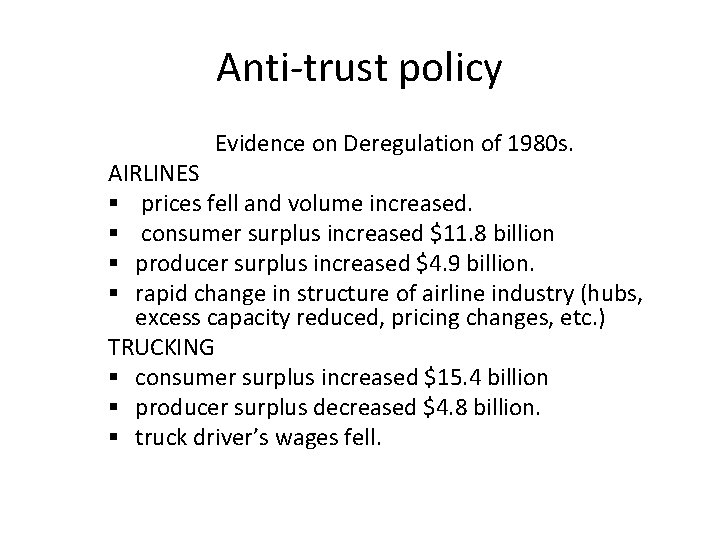
Anti-trust policy Evidence on Deregulation of 1980 s. AIRLINES § prices fell and volume increased. § consumer surplus increased $11. 8 billion § producer surplus increased $4. 9 billion. § rapid change in structure of airline industry (hubs, excess capacity reduced, pricing changes, etc. ) TRUCKING § consumer surplus increased $15. 4 billion § producer surplus decreased $4. 8 billion. § truck driver’s wages fell.
Anti-trust policy – Anti-trust policy. The Standard Oil Story: • John D. Rockefeller owned standard oil. • Able to extract discounts from the railroads for shipping • During the 1870 s, Standard Oil increased its capacity from 10 to 90 percent of the U. S. total. • In 1882, the independent members of standard oil contributed shares to a central trust • Allowed a central body to manage all firms. • The central body shut down some refineries, restricted production, and drove up oil prices.
Anti-trust policy 1890: Sherman Act § passed partly in response to the monopolization of the oil industry. § Law prohibited “combination, trust, or conspiracy to restrict interstate or international trade”. § Sherman Act used in 1911 to break up Standard Oil (created Exxon, Sohio, Chevron, etc. )
Anti-trust policy § 1914: Clayton Act. § prohibited interlocking directorates & tying contracts § 1914: Federal Trade Commission Act § created FTC to prosecute “unfair competition” § outlawed misleading advertising.
Anti-trust policy § 1936: Robinson-Patman Act (Chain store law) § made “quantity discounts” illegal § prevented stores from selling to public at “unreasonably low” prices. § 1937: Miller-Tydings Act § allowed Resale Price Maintenace if state approved. § arguments against RPM (cartel enforcement) § argument for RPM (high quality service) § Mc. Travel § Apple computer