
Chapter 15 Oligopoly and Game Theory MODERN PRINCIPLES

- Slides: 57
Chapter 15 Oligopoly and Game Theory MODERN PRINCIPLES OF ECONOMICS Third Edition
Outline § § Cartels The Prisoner’s Dilemma Oligopolies When Are Cartels and Oligopolies Most Successful? § Government Policy toward Cartels and Oligopolies § Business Strategy and Changing the Game 2
Introduction § An oligopoly is an industry that is dominated by a small number of firms. § A cartel is an oligopoly that tries to act together to reduce supply, raise prices, and increase profits. § Even when an oligopoly is not able to collude, prices are likely to be higher than in a competitive market. § Game theory is used to model decisions in situations where the players interact. 3
Definition Oligopoly: a market that is dominated by a small number of firms. Cartel: a group of suppliers who try to act as if they were a monopoly. 4
Definition Strategic decision making: decision making in situations that are interactive. 5
Self-Check An oligopoly is a market that is: a. Dominated by one firm. b. Dominated by cartels. c. Dominated by a few firms. Answer: c – an oligopoly is a market that is dominated by a few firms. 6
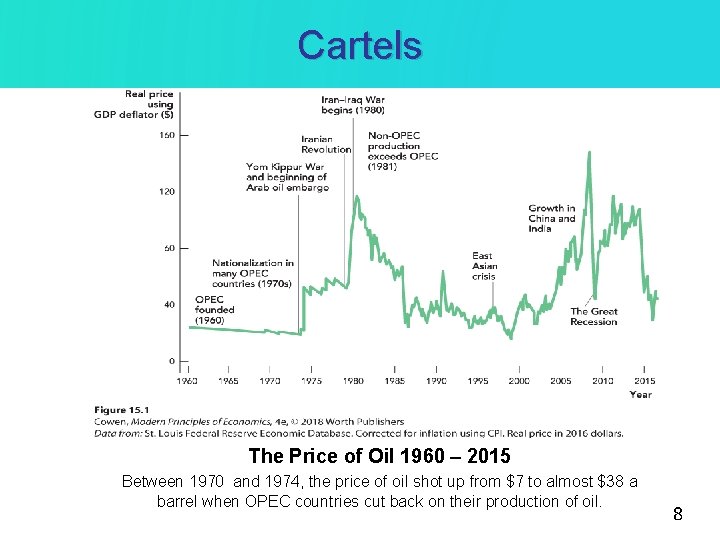
Cartels § The Organization of Petroleum Exporting Countries (OPEC) is a cartel of oil-exporting countries. § Between 1970 and 1974 OPEC cut back on their production of oil. § The price of oil shot up from $7 per barrel to almost $38 a barrel. 7
Cartels The Price of Oil 1960 – 2015 Between 1970 and 1974, the price of oil shot up from $7 to almost $38 a barrel when OPEC countries cut back on their production of oil. 8
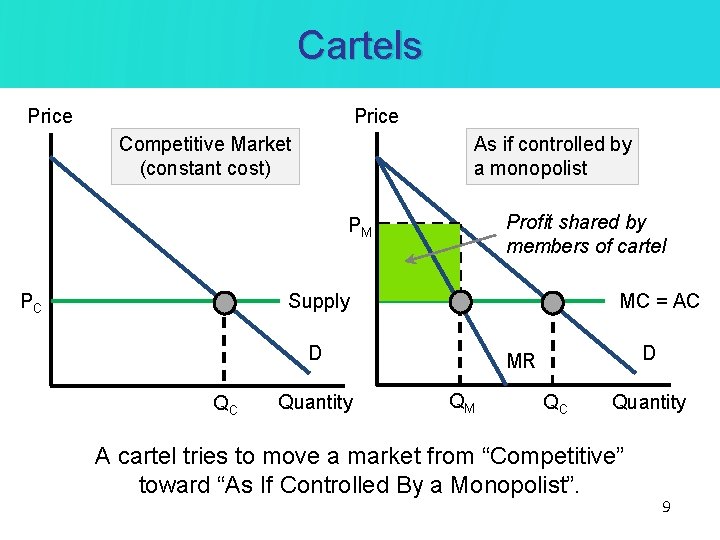
Cartels Price Competitive Market (constant cost) As if controlled by a monopolist Profit shared by members of cartel PM PC MC = AC Supply D QC Quantity D MR QM QC Quantity A cartel tries to move a market from “Competitive” toward “As If Controlled By a Monopolist”. 9
Self-Check Cartels try to increase their profits by: a. Reducing costs. b. Reducing quantity. c. Increasing quantity. Answer: b – cartels try to increase profits by reducing quantity and therefore increasing price. 10
Cartels § Cartels tend to collapse and lose their power for three reasons: 1. Cheating by the cartel members. 2. New entrants and demand response. 3. Government prosecution and regulation. 11
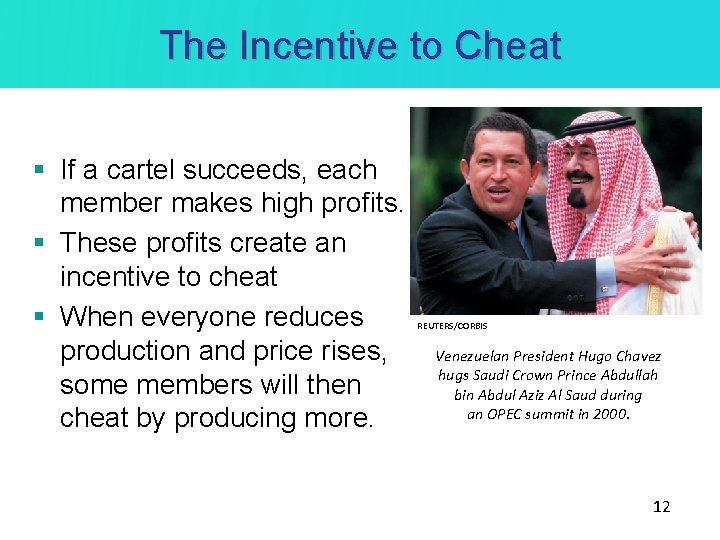
The Incentive to Cheat § If a cartel succeeds, each member makes high profits. § These profits create an incentive to cheat § When everyone reduces production and price rises, some members will then cheat by producing more. REUTERS/CORBIS Venezuelan President Hugo Chavez hugs Saudi Crown Prince Abdullah bin Abdul Aziz Al Saud during an OPEC summit in 2000. 12
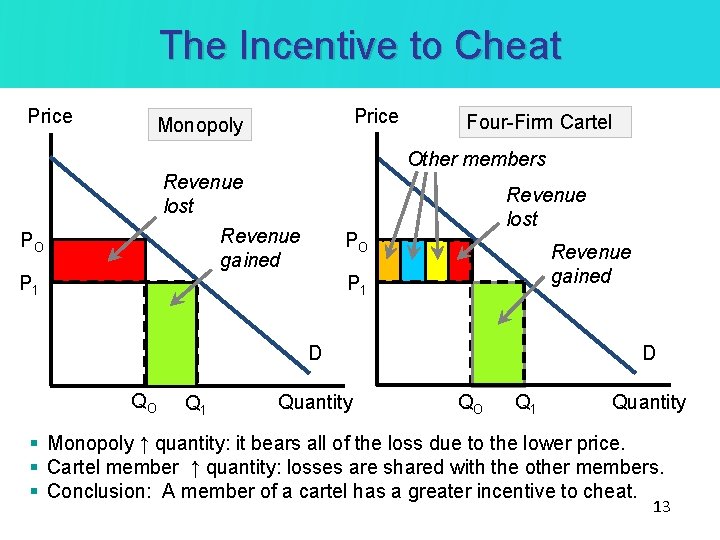
The Incentive to Cheat Price Monopoly Four-Firm Cartel Other members Revenue lost Revenue gained PO Revenue lost PO P 1 Revenue gained P 1 D QO Q 1 Quantity § Monopoly ↑ quantity: it bears all of the loss due to the lower price. § Cartel member ↑ quantity: losses are shared with the other members. § Conclusion: A member of a cartel has a greater incentive to cheat. 13
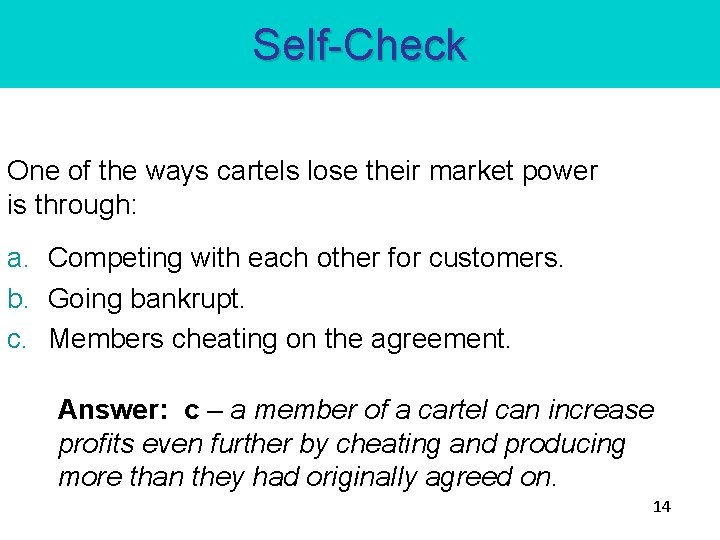
Self-Check One of the ways cartels lose their market power is through: a. Competing with each other for customers. b. Going bankrupt. c. Members cheating on the agreement. Answer: c – a member of a cartel can increase profits even further by cheating and producing more than they had originally agreed on. 14
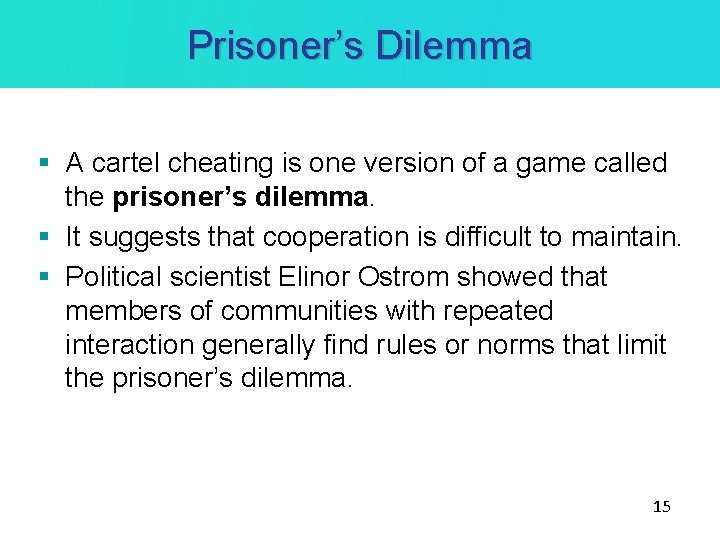
Prisoner’s Dilemma § A cartel cheating is one version of a game called the prisoner’s dilemma. § It suggests that cooperation is difficult to maintain. § Political scientist Elinor Ostrom showed that members of communities with repeated interaction generally find rules or norms that limit the prisoner’s dilemma. 15
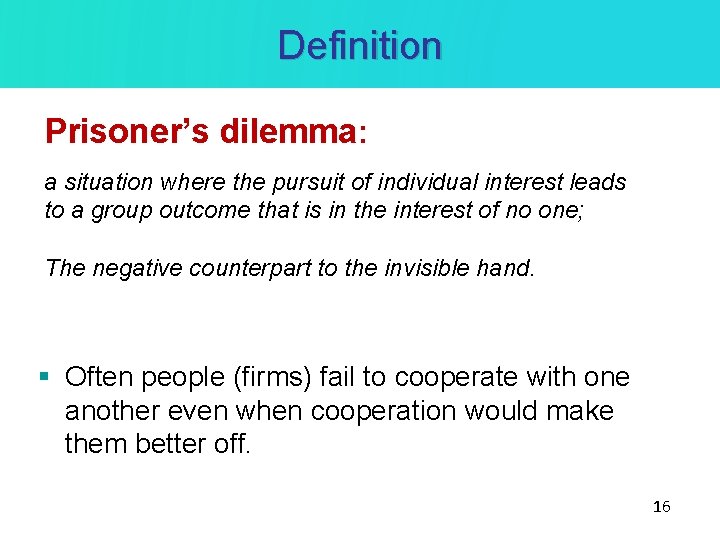
Definition Prisoner’s dilemma: a situation where the pursuit of individual interest leads to a group outcome that is in the interest of no one; The negative counterpart to the invisible hand. § Often people (firms) fail to cooperate with one another even when cooperation would make them better off. 16
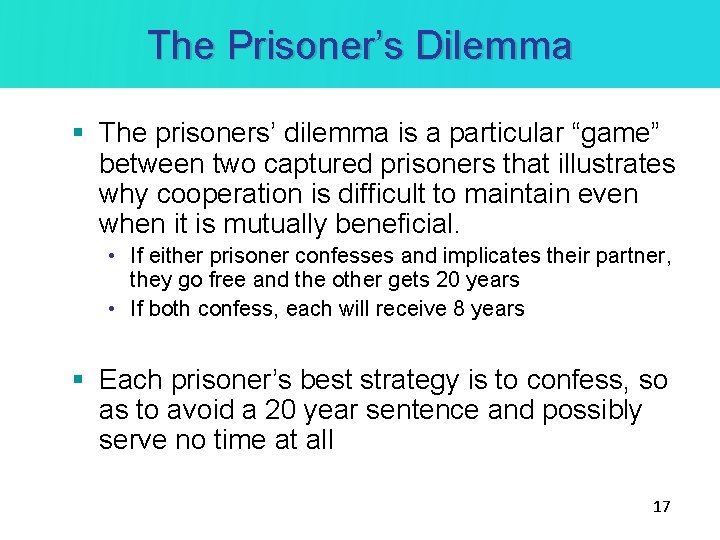
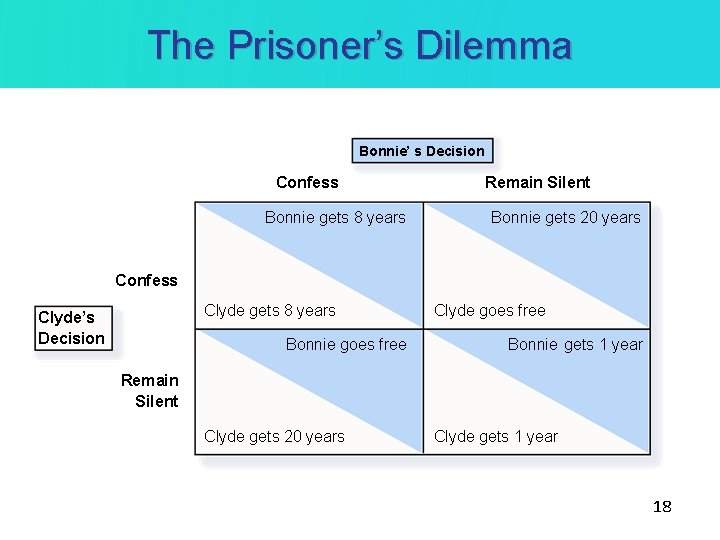
The Prisoner’s Dilemma § The prisoners’ dilemma is a particular “game” between two captured prisoners that illustrates why cooperation is difficult to maintain even when it is mutually beneficial. • If either prisoner confesses and implicates their partner, they go free and the other gets 20 years • If both confess, each will receive 8 years § Each prisoner’s best strategy is to confess, so as to avoid a 20 year sentence and possibly serve no time at all 17
The Prisoner’s Dilemma Bonnie’ s Decision Confess Bonnie gets 8 years Remain Silent Bonnie gets 20 years Confess Clyde gets 8 years Clyde’s Decision Bonnie goes free Clyde goes free Bonnie gets 1 year Remain Silent Clyde gets 20 years Clyde gets 1 year 18
The Prisoner’s Dilemma § This is known as the dominant strategy § The dominant strategy is the best strategy for a player to follow regardless of the strategies chosen by the other players. 19
The Prisoner’s Dilemma § Cooperation is difficult to maintain, because cooperation is not in the best interest of the individual player. § If they cooperated and both remained silent, they would have each served only 1 year § But the dominant strategy will prevent this from happening given each prisoner’s selfinterest § Cooperation is “individually irrational” 20
Oligopolies as a Prisoner’s Dilemma § What the major point of game theory with regards to the economics of different market structures? § Self-interest makes it difficult for the oligopoly to maintain a cooperative outcome with low production, high prices, and monopoly profits 21
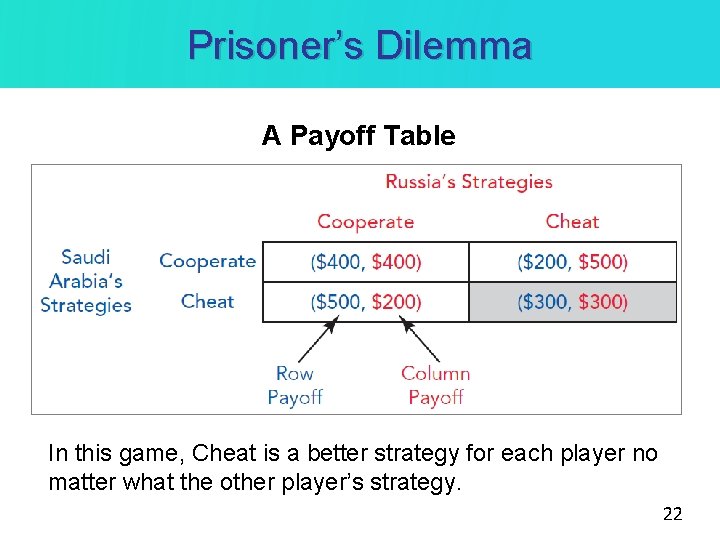
Prisoner’s Dilemma A Payoff Table In this game, Cheat is a better strategy for each player no matter what the other player’s strategy. 22
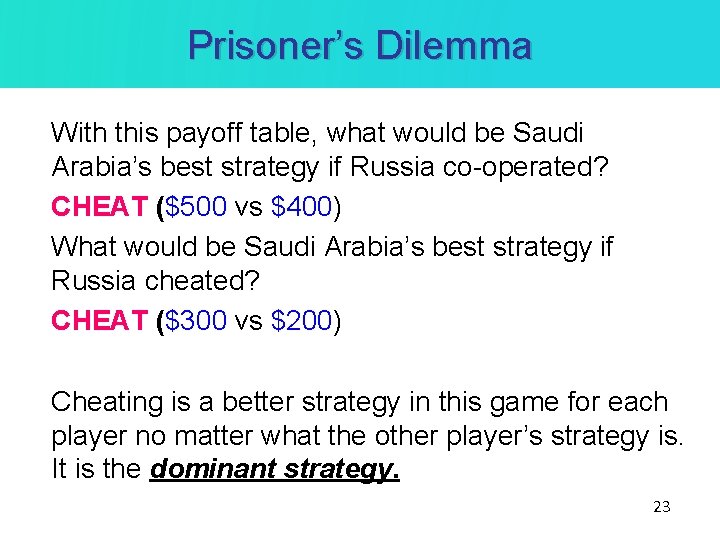
Prisoner’s Dilemma With this payoff table, what would be Saudi Arabia’s best strategy if Russia co-operated? CHEAT ($500 vs $400) What would be Saudi Arabia’s best strategy if Russia cheated? CHEAT ($300 vs $200) Cheating is a better strategy in this game for each player no matter what the other player’s strategy is. It is the dominant strategy. 23
Self-Check A game where pursuing one’s own interest leads to an outcome that is in no one’s interest is called the: a. Oligopoly outcome. b. Dominant strategy. c. Prisoner’s dilemma. Answer: c – this is called the prisoner’s dilemma. 24
Collusion § When only a handful of firms can realistically bid on a contract, it becomes profitable to collude. § Firms can agree to take turns being the “low” bidder. § Collusive outcomes may evolve even without explicit agreement. § Collusion/cartels are illegal in the US except for… § Government sanctioned cartels (agriculture, professional sports, taxi cab companies, etc) 25
Definition Tacit collusion: when firms limit competition with one another but they do so without explicit agreement or communication. 26
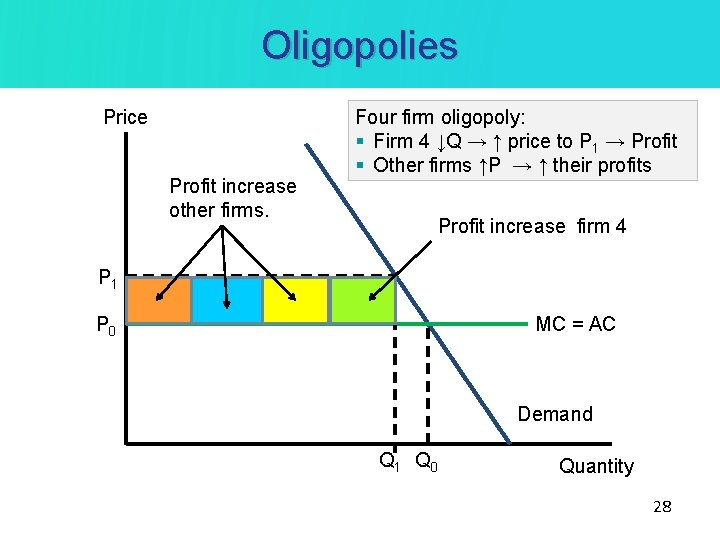
Oligopolies § Oligopolies are markets dominated by a small number of firms. § A firm in an oligopoly has some influence over price and therefore has an incentive to reduce output and increase price. § Price in an oligopoly is likely to be below monopoly levels but above competitive levels. § The more firms in an industry, the closer price will be to competitive levels. 27
Oligopolies Price Profit increase other firms. Four firm oligopoly: § Firm 4 ↓Q → ↑ price to P 1 → Profit § Other firms ↑P → ↑ their profits Profit increase firm 4 P 1 P 0 MC = AC Demand Q 1 Q 0 Quantity 28
Self-Check Oligopoly prices tend to be: a. Lower than monopoly but higher than competitive prices. b. Lower than monopoly or competitive prices. c. Higher than monopoly but lower than competitive prices. Answer: a – oligopoly prices tend to be lower than monopoly but higher than competitive prices. 29
Definition Barriers to entry: factors that increase the cost to new firms of entering an industry. 30
Oligopolies § Cartels and oligopolies tend to be most successful when there are barriers to entry. § Important barriers to entry include: 1. 2. 3. 4. Control over a key resource or input. Economies of scale. Network effects. Government barriers. 31
Government Policy § Most cartels have been illegal in the United States since the Sherman Antitrust Act of 1890. § Antitrust laws are used to prosecute cartels, block mergers, and break up very large firms. § Sometimes governments reduce competition and create barriers to entry by supporting cartels. § For example, the U. S. government raises the price of milk through subsidies and quotas. § The US Government encouraged creation of cartels (price fixing) during the Great Depression. 32
Government Policy § Are cartels strictly a form of crony capitalism? § Government-enforced monopolies and cartels are a serious problem facing poor nations. § Government-supported cartels usually mean higher prices, lower-quality service, and less innovation. § People spend their energies trying to get monopoly or cartel privileges from governments. (rent seeking) § Government becomes more corrupt. § The most successful cartels operate with the explicit support of (and enforcement by) the government. 33
Government Cartels Government sponsored Cartel examples: • Raisins (Raisin Administrative Committee) • Raisin growers required to keep some portion of crop off market in a “raisin reserve” • Growers who don’t collude are fined and/or penalized • WHY DO THIS? ? ? • Who pays? Who benefits? • The free market is a dangerous idea apparently • Crony capitalism 34
Government Cartels § Government sponsored Cartel examples: • Milk Cartels – price fixing by region • Created in 1930 s to keep prices from falling (via Keynesian aggregate demand arguments even though people were going hungry) • Cartels created for political reasons, not economic, producers abhor competition • Yet people think that the government protects them from this sort of behavior • Who pays? Who benefits? 35
Government Cartels § Government sponsored Cartel examples: • Other examples: • • • Credit rating agencies Certain labor unions, occupational licensing Sugar TBTF banks Numerous state and local laws or licensing requirements that protect politically favored businesses • • Taxi cartels (local government) Louisiana casket cartel 36
Government Cartels § "We never face a choice between regulation and no regulation. We face a choice between kinds of regulation: regulation by legislatures and bureaucracies, or regulation by market forces — regulation by restriction of choice, or regulation by the exercise of choice. “ § – Howard Baetjer § http: //fee. org/freeman/detail/theres-no-such-thing -as-an-unregulated-market 37
There’s No Such Thing as an “Unregulated” Market When market failure occurs, the presumption is that regulation will solve the problem: Nirvana Fallacy is a name given to the informal fallacy of comparing actual things with unrealistic, idealized alternatives. It can also refer to the tendency to assume that there is a perfect solution to a particular problem. (perfectly) Many regulatory agencies are subject to “regulatory capture” 38
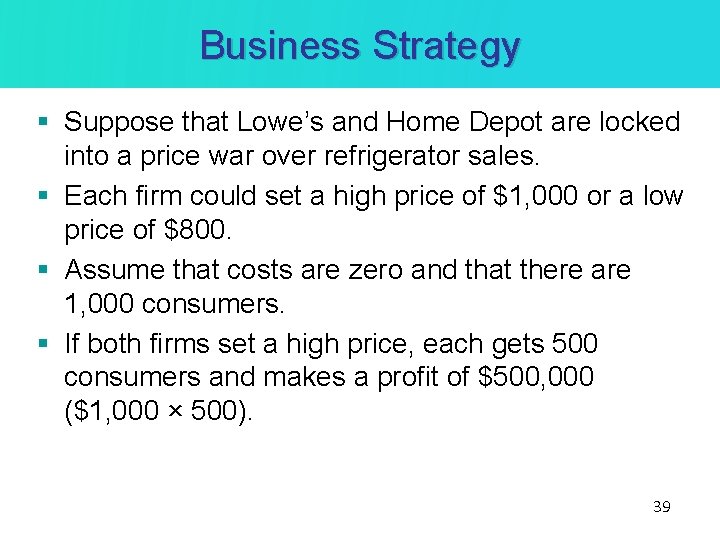
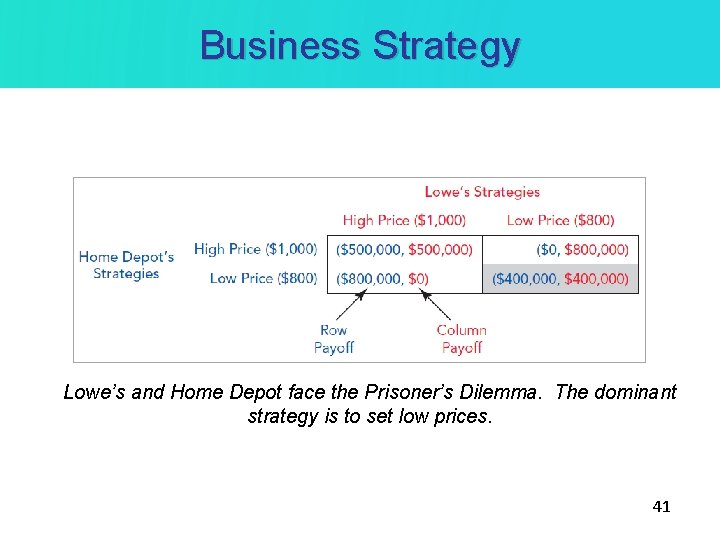
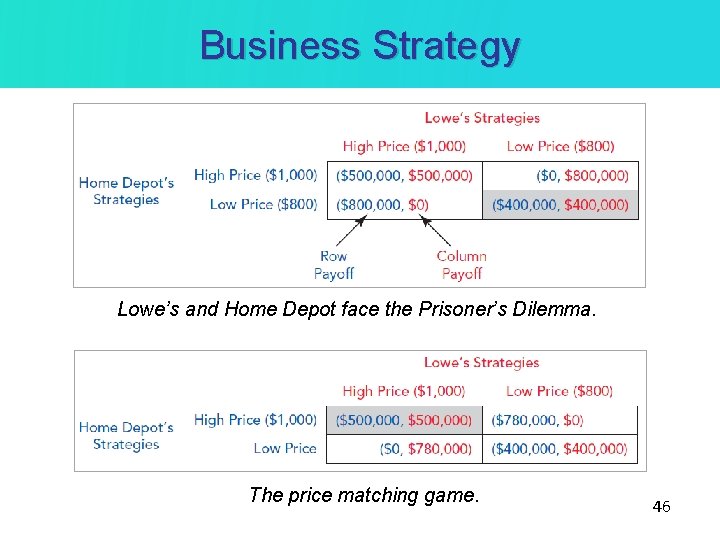
Business Strategy § Suppose that Lowe’s and Home Depot are locked into a price war over refrigerator sales. § Each firm could set a high price of $1, 000 or a low price of $800. § Assume that costs are zero and that there are 1, 000 consumers. § If both firms set a high price, each gets 500 consumers and makes a profit of $500, 000 ($1, 000 × 500). 39
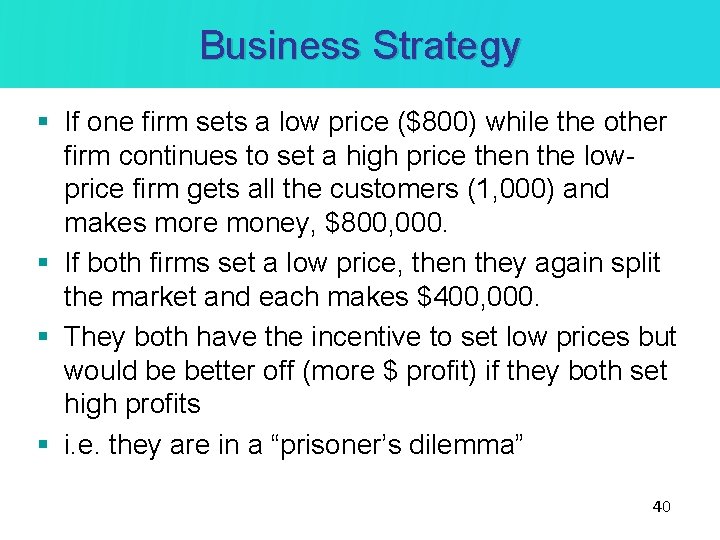
Business Strategy § If one firm sets a low price ($800) while the other firm continues to set a high price then the lowprice firm gets all the customers (1, 000) and makes more money, $800, 000. § If both firms set a low price, then they again split the market and each makes $400, 000. § They both have the incentive to set low prices but would be better off (more $ profit) if they both set high profits § i. e. they are in a “prisoner’s dilemma” 40
Business Strategy Lowe’s and Home Depot face the Prisoner’s Dilemma. The dominant strategy is to set low prices. 41
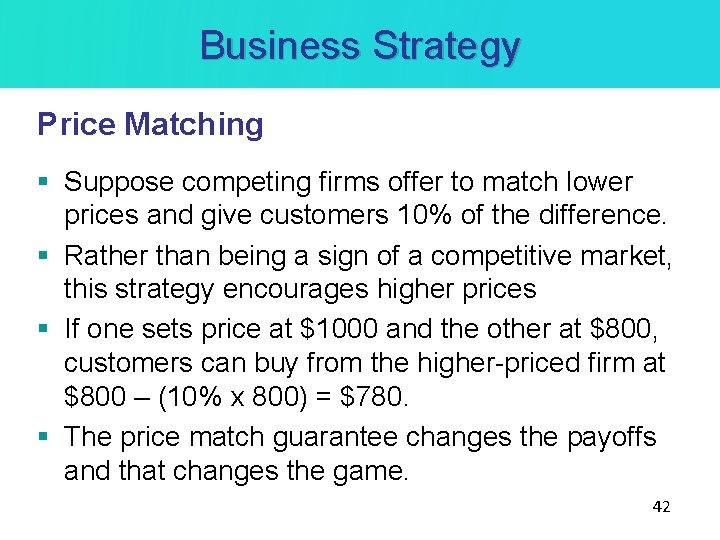
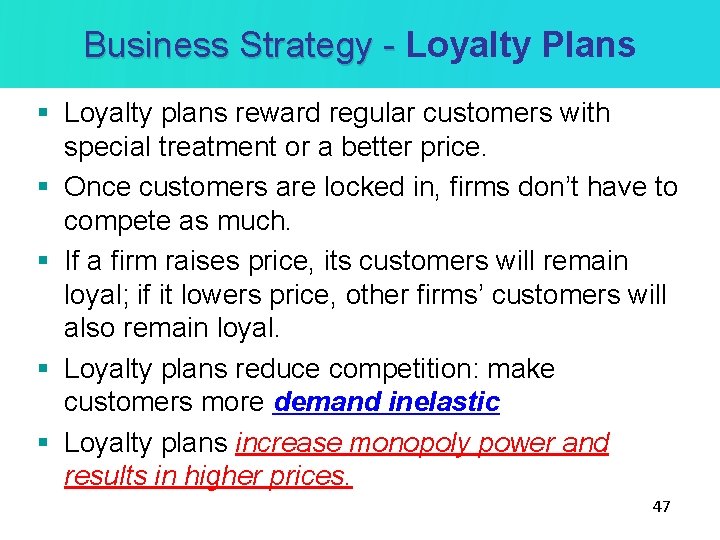
Business Strategy Price Matching § Suppose competing firms offer to match lower prices and give customers 10% of the difference. § Rather than being a sign of a competitive market, this strategy encourages higher prices § If one sets price at $1000 and the other at $800, customers can buy from the higher-priced firm at $800 – (10% x 800) = $780. § The price match guarantee changes the payoffs and that changes the game. 42
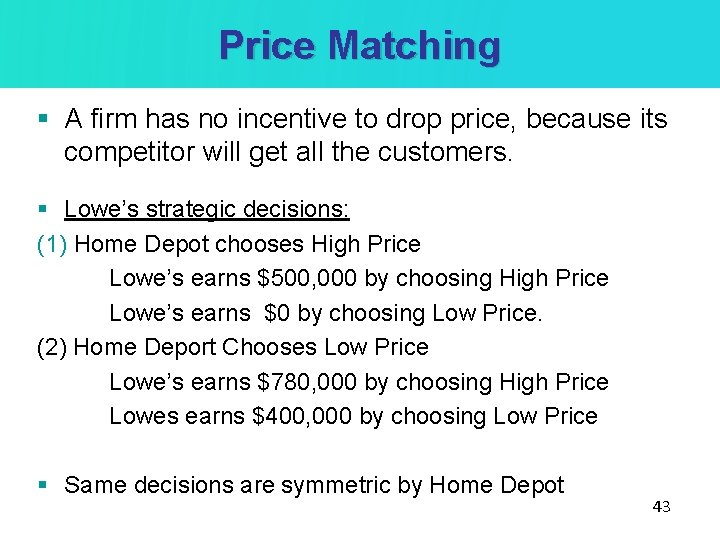
Price Matching § A firm has no incentive to drop price, because its competitor will get all the customers. § Lowe’s strategic decisions: (1) Home Depot chooses High Price Lowe’s earns $500, 000 by choosing High Price Lowe’s earns $0 by choosing Low Price. (2) Home Deport Chooses Low Price Lowe’s earns $780, 000 by choosing High Price Lowes earns $400, 000 by choosing Low Price § Same decisions are symmetric by Home Depot 43
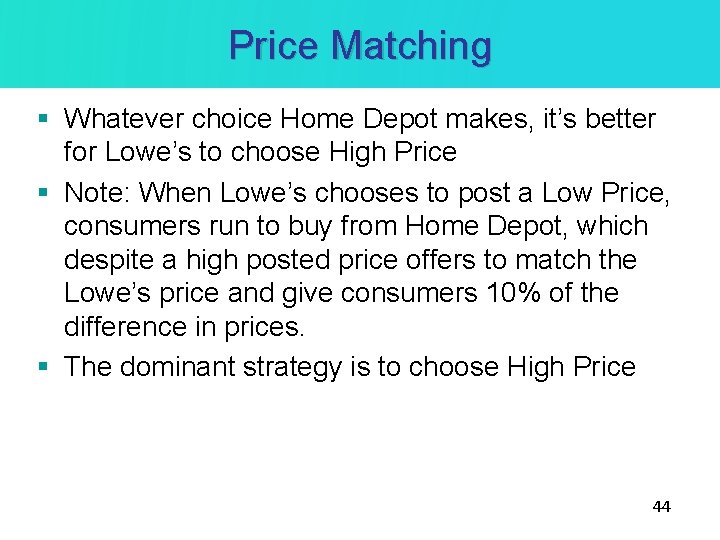
Price Matching § Whatever choice Home Depot makes, it’s better for Lowe’s to choose High Price § Note: When Lowe’s chooses to post a Low Price, consumers run to buy from Home Depot, which despite a high posted price offers to match the Lowe’s price and give consumers 10% of the difference in prices. § The dominant strategy is to choose High Price 44
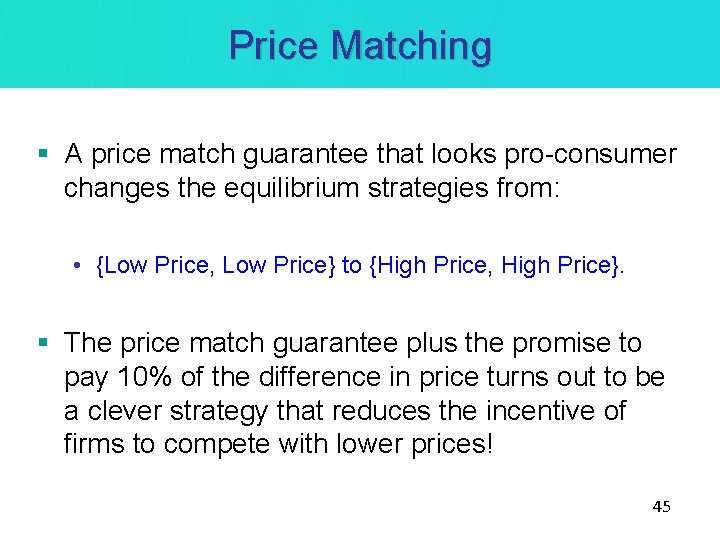
Price Matching § A price match guarantee that looks pro-consumer changes the equilibrium strategies from: • {Low Price, Low Price} to {High Price, High Price}. § The price match guarantee plus the promise to pay 10% of the difference in price turns out to be a clever strategy that reduces the incentive of firms to compete with lower prices! 45
Business Strategy Lowe’s and Home Depot face the Prisoner’s Dilemma. The price matching game. 46
Business Strategy - Loyalty Plans Business Strategy - § Loyalty plans reward regular customers with special treatment or a better price. § Once customers are locked in, firms don’t have to compete as much. § If a firm raises price, its customers will remain loyal; if it lowers price, other firms’ customers will also remain loyal. § Loyalty plans reduce competition: make customers more demand inelastic § Loyalty plans increase monopoly power and results in higher prices. 47
Self-Check Loyalty plans lead to: a. Higher prices. b. Lower prices. c. More competition. Answer: a – by encouraging lock-in, loyalty plans lead to monopoly power and thus higher prices. 48
Business Strategy Innovation § Pursuit of market power can lead to innovation and product differentiation. § One reason firms innovate is to produce a product with fewer substitutes. § Fewer substitutes mean more inelastic demand, leading to higher prices and profits. § Firms also compete by differentiating their products with different styles or features. 49
Innovation - Uber § Traditional taxi cab companies (TCC) – regulated by local governments § Local cartel – must have license (or medallion) issued by government § NYC medallions sold for over $1 million § Limit and control supply raised cab prices and profits § Who pays? § Problem: TCC’s very inefficient, high search costs • Why do cabs conglomerate around airports, hotels? 50
Innovation - Uber § Problem: TCC’s very inefficient, high search costs • Why do cabs conglomerate around airports, hotels? • TCCs have no way of gauging or responding to real time changes in demand • Lots of idle resources § Uber and other firms solved the “Search” & cost problems via technology • The TCC’s had every opportunity to do this many years ago but didn’t 51
Innovation - Uber § Uber has eradicated search costs: • Riders don’t have difficulty finding empty cabs • Cars dispatched on real time demand • No waiting around at highly probable locations § Helps consumers who don’t like long waits or uncertainty (more value) § Uber can dispatch more drivers during higher demand periods 52
Innovation - Uber § Uber’s social benefits: § Allows far more efficient use of capital § Enhances consumer welfare § Consumers may buy fewer cars leading to savings and reducing environmental harms § Less cars, more space for other things 53
Innovation - Uber § Does Uber have significant market power? § Uber is a technology company § Developed super efficient dispatch technology/software § Direct spillover from smartphone tech § What prevents entry/competition against Uber? • Drivers drive their own vehicle, self-driving cars? § Uber an idea that created immense value § Will Uber be around in 10 years? (“Myspace”) 54
Innovation - Uber § AEI article on Uber: § https: //www. aei. org/publication/the-beauty-of-uber-andwhy-it-represents-the-future-of-transportation-it-hasbasically-eradicated-search-costs/ § Uber and the Great Taxicab Collapse (7: 43) § https: //www. youtube. com/watch? v=n 0 y. Lhl. Q 6 k. CQ 55
Takeaway § An oligopoly is a market dominated by a small number of firm. § Oligopolies form when there are significant barriers to entry. § Prices in an oligopoly tend to be below monopoly prices but above competitive prices. § A cartel is an oligopoly that maximizes profits by limiting competition and producing the monopoly quantity. 56
Takeaway § Most cartels are not stable; either members cheat or new competitors enter the market. § Governments break up some cartels, but enforce many others. § Game theory is the study of strategic interaction. § The prisoner’s dilemma game explains why cheating is common in cartels. § Firms can reduce competitive pressures through price matching, loyalty programs, and innovation. 57