
Chapter 15 Nuclear Chemistry Radioactivity Nuclear Reactions Rates
- Slides: 49
Chapter 15 Nuclear Chemistry • • • Radioactivity Nuclear Reactions Rates of Radioactive Decay Medical Applications of Isotopes Biological Effects of Radiation Nuclear Energy 15 -1 Copyright © The Mc. Graw-Hill Companies, Inc. Permission required for reproduction or display.
Radiation • Radiation – Energy that comes from a source and travels through matter or space – Two types of radiation: • Electromagnetic – Includes light, gamma rays, and X-rays • Particulate – Mass given off from unstable atoms with the energy of motion – Ionizing radiation • Radiation of either type that can produce charged particles in matter 15 - 2
Radioactivity • Radioactive decay – The spontaneous emission of electromagnetic or other types of radiation • Radioactive atoms – Unstable atoms that give off excess matter, energy, or both as ionizing radiation 15 - 3
Nucleons • Nucleons – General term used to describe nuclear particles, protons, and neutrons – Remember: • Z signifies the atomic number, the number of protons in the nucleus of an atom • N signifies the neutron number, the number of neutrons in the nucleus of an atom • Sum of N and Z is A (N+Z = A), the mass number 15 - 4
Nuclides • Remember, isotopes are: – Atoms with the same atomic number Z, but different neutron numbers N and mass numbers A • Nuclides – Isotopes that exist for a measurable length of time and have a defined energy state – An atom of a particular atomic number, mass number and neutron number 15 - 5
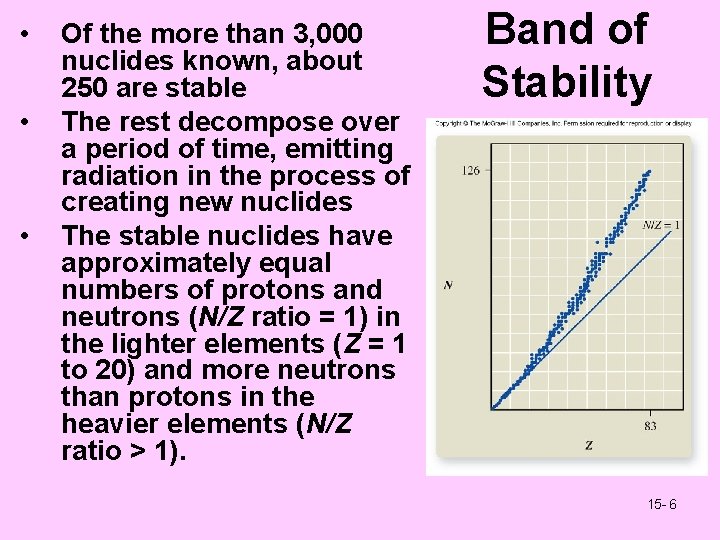
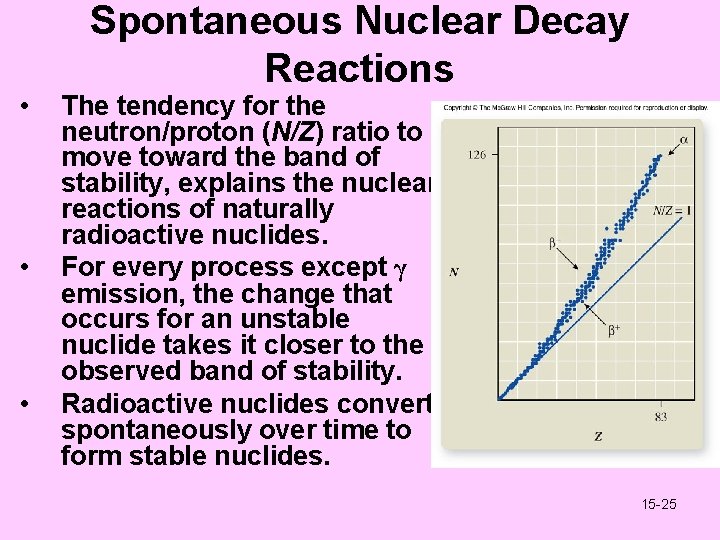
• • • Of the more than 3, 000 nuclides known, about 250 are stable The rest decompose over a period of time, emitting radiation in the process of creating new nuclides The stable nuclides have approximately equal numbers of protons and neutrons (N/Z ratio = 1) in the lighter elements (Z = 1 to 20) and more neutrons than protons in the heavier elements (N/Z ratio > 1). Band of Stability Figure 15. 4 15 - 6
Radiation • In a nuclear reaction, an emission of radiation usually accompanies changes in the composition of the nucleus. • Natural radiation associated with radioactive decay can be placed into three classes: – Alpha particles – Beta particles – Gamma rays 15 - 7
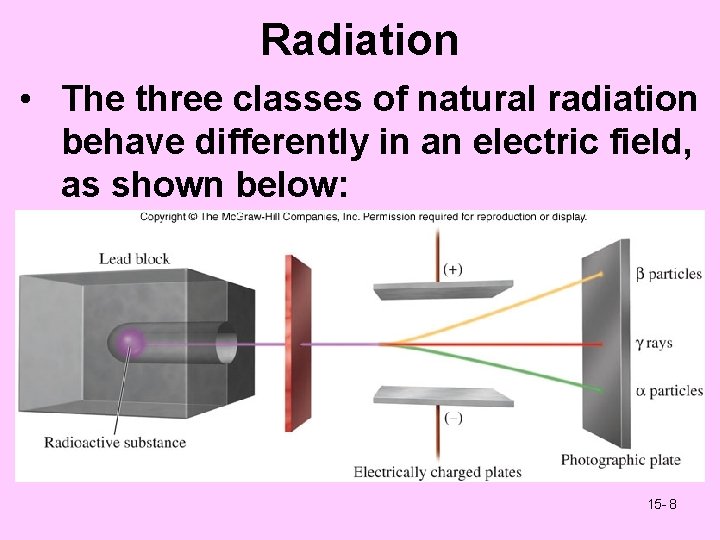
Radiation • The three classes of natural radiation behave differently in an electric field, as shown below: Figure 15. 5 15 - 8
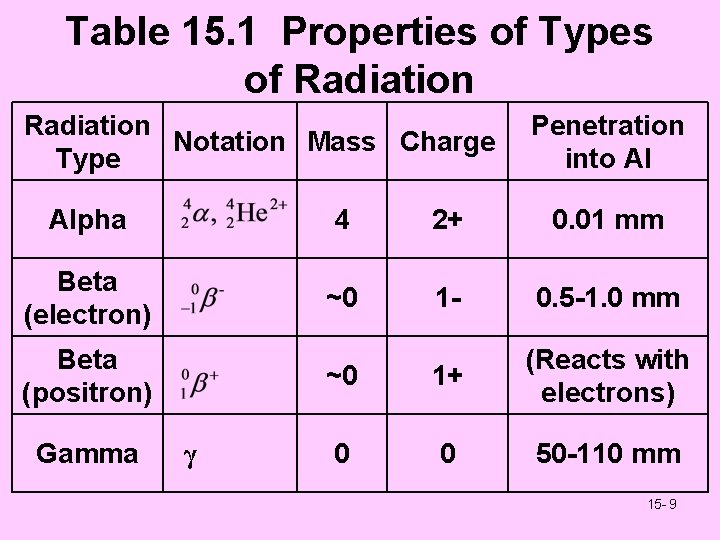
Table 15. 1 Properties of Types of Radiation Notation Mass Charge Type Penetration into Al Alpha 4 2+ 0. 01 mm Beta (electron) ~0 1 - 0. 5 -1. 0 mm ~0 1+ (Reacts with electrons) 0 0 50 -110 mm Beta (positron) Gamma γ 15 - 9
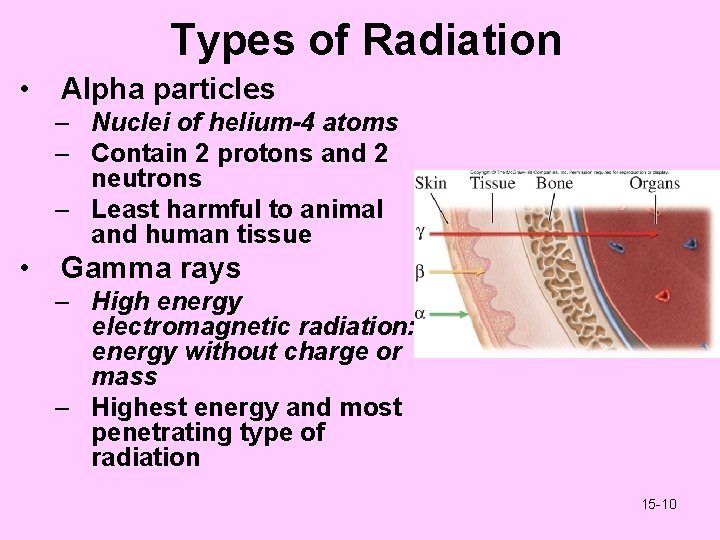
Types of Radiation • Alpha particles – Nuclei of helium-4 atoms – Contain 2 protons and 2 neutrons – Least harmful to animal and human tissue • Gamma rays – High energy electromagnetic radiation: energy without charge or mass – Highest energy and most penetrating type of radiation 15 - 10
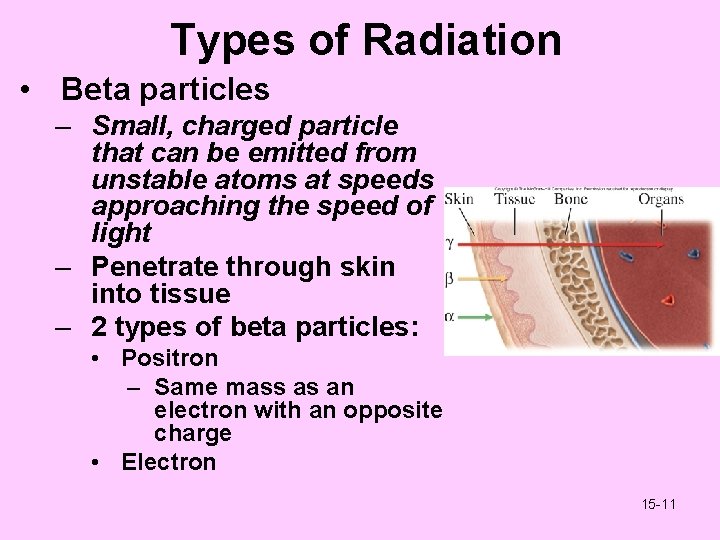
Types of Radiation • Beta particles – Small, charged particle that can be emitted from unstable atoms at speeds approaching the speed of light – Penetrate through skin into tissue – 2 types of beta particles: • Positron – Same mass as an electron with an opposite charge • Electron 15 - 11
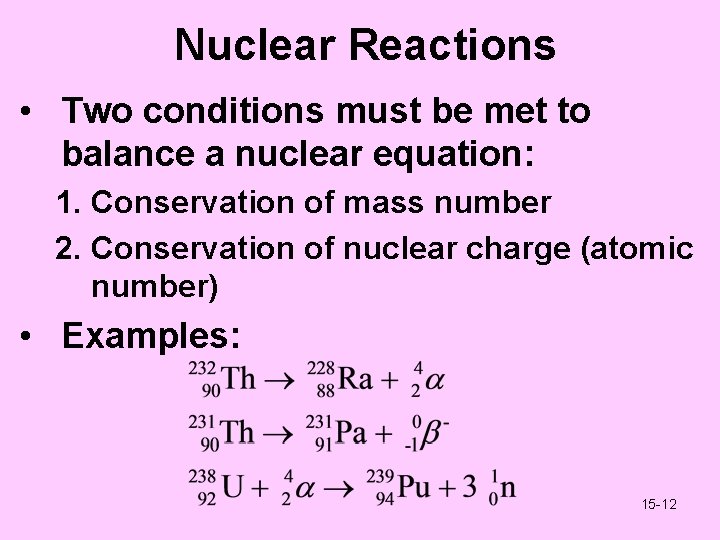
Nuclear Reactions • Two conditions must be met to balance a nuclear equation: 1. Conservation of mass number 2. Conservation of nuclear charge (atomic number) • Examples: 15 - 12
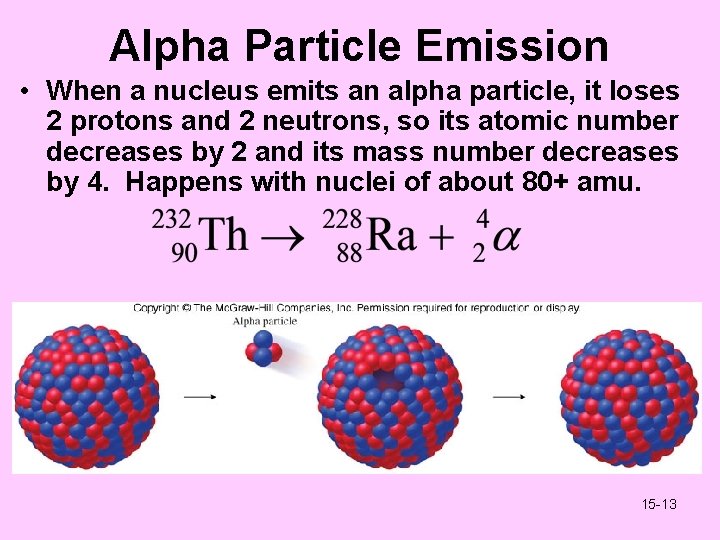
Alpha Particle Emission • When a nucleus emits an alpha particle, it loses 2 protons and 2 neutrons, so its atomic number decreases by 2 and its mass number decreases by 4. Happens with nuclei of about 80+ amu. Figure 15. 7 15 - 13
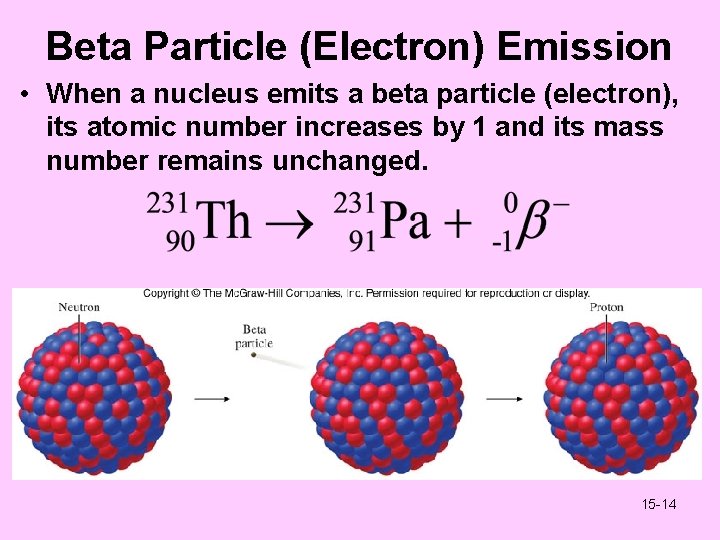
Beta Particle (Electron) Emission • When a nucleus emits a beta particle (electron), its atomic number increases by 1 and its mass number remains unchanged. Figure 15. 8 15 - 14
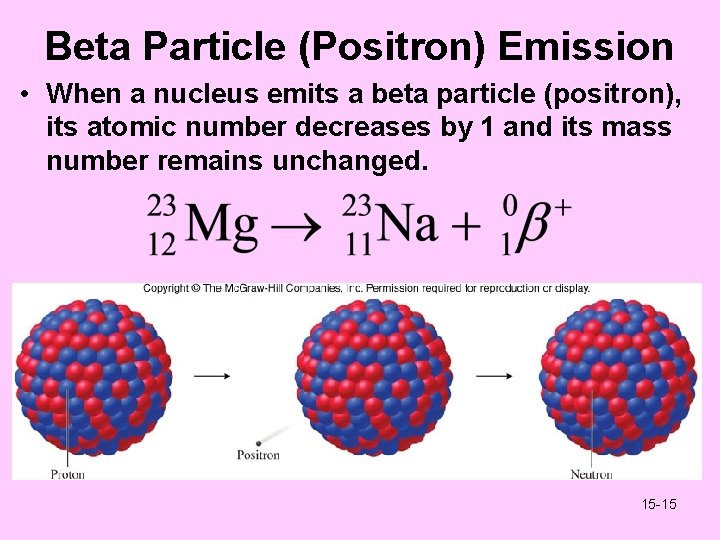
Beta Particle (Positron) Emission • When a nucleus emits a beta particle (positron), its atomic number decreases by 1 and its mass number remains unchanged. Figure 15. 9 15 - 15
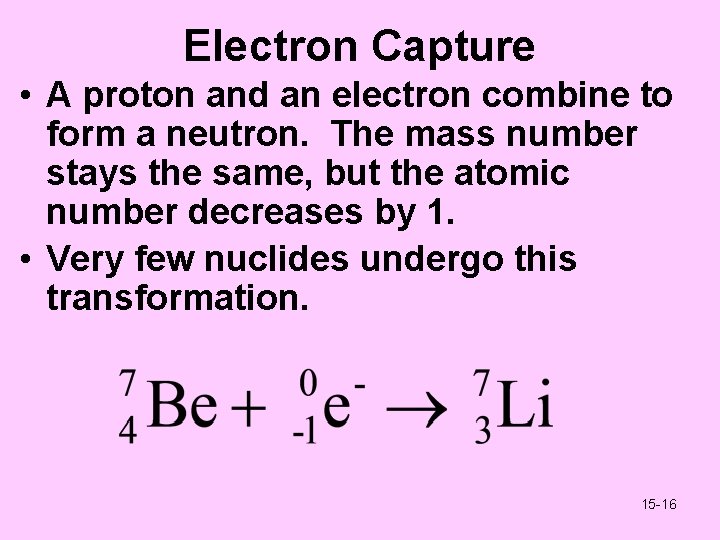
Electron Capture • A proton and an electron combine to form a neutron. The mass number stays the same, but the atomic number decreases by 1. • Very few nuclides undergo this transformation. 15 - 16
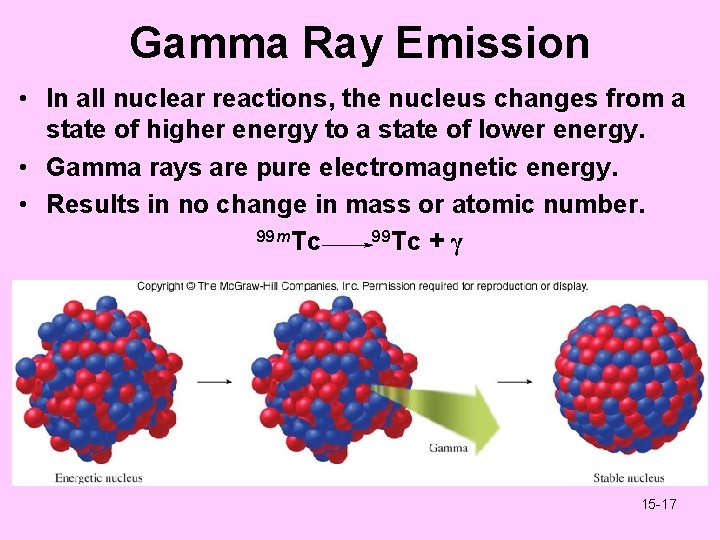
Gamma Ray Emission • In all nuclear reactions, the nucleus changes from a state of higher energy to a state of lower energy. • Gamma rays are pure electromagnetic energy. • Results in no change in mass or atomic number. 99 m. Tc 99 Tc + γ Figure 15. 10 15 - 17
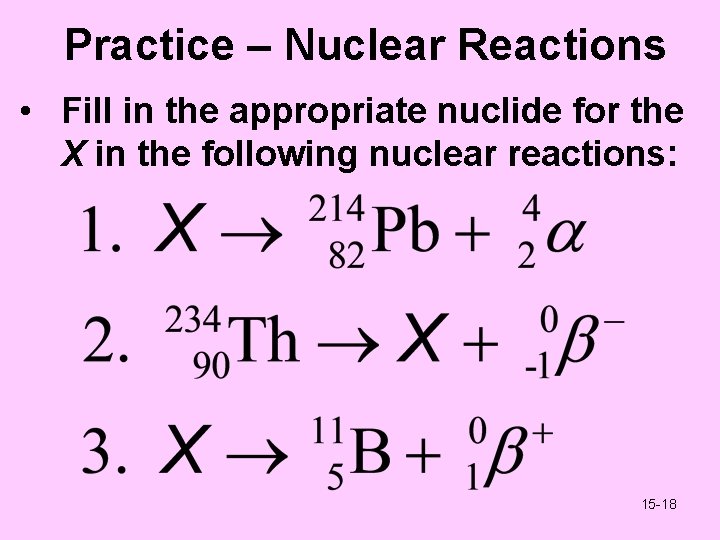
Practice – Nuclear Reactions • Fill in the appropriate nuclide for the X in the following nuclear reactions: 15 - 18
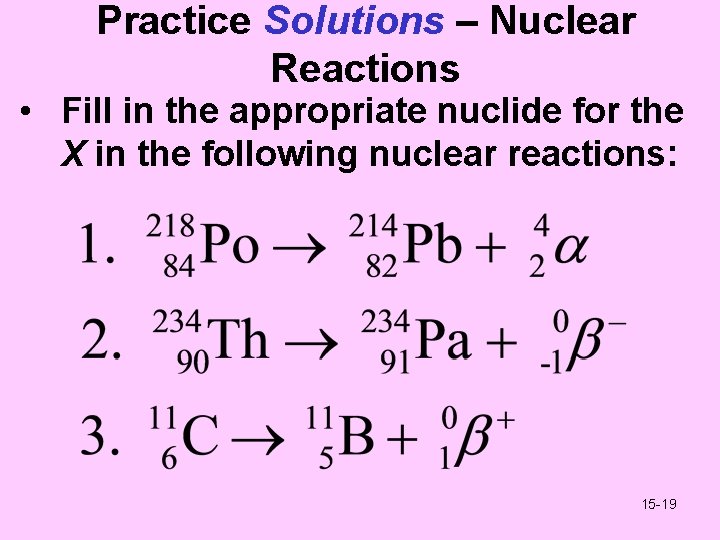
Practice Solutions – Nuclear Reactions • Fill in the appropriate nuclide for the X in the following nuclear reactions: 15 - 19
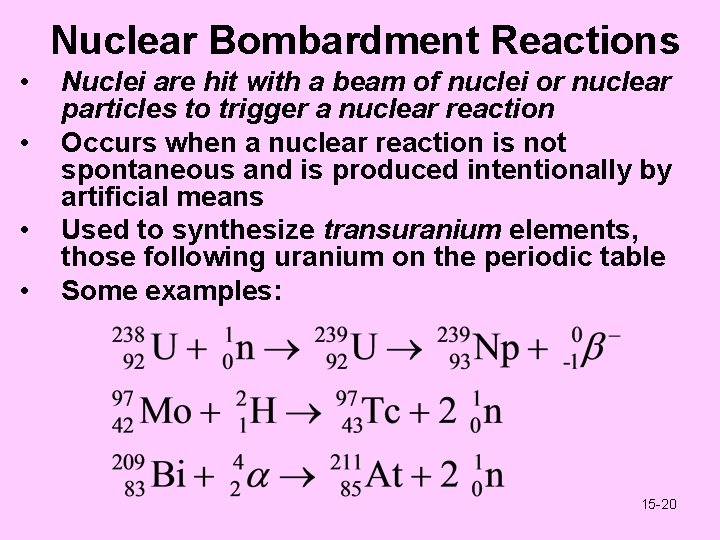
Nuclear Bombardment Reactions • • Nuclei are hit with a beam of nuclei or nuclear particles to trigger a nuclear reaction Occurs when a nuclear reaction is not spontaneous and is produced intentionally by artificial means Used to synthesize transuranium elements, those following uranium on the periodic table Some examples: 15 - 20
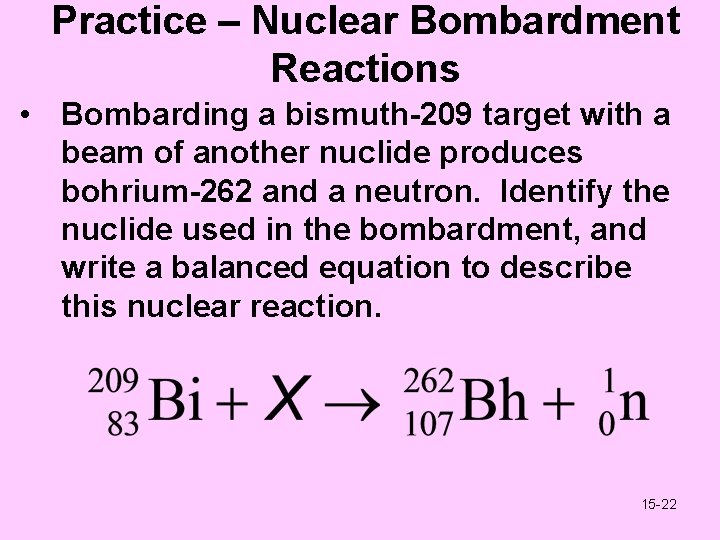
Practice – Nuclear Bombardment Reactions • Bombarding a bismuth-209 target with a beam of another nuclide produces bohrium-262 and a neutron. Identify the nuclide used in the bombardment, and write a balanced equation to describe this nuclear reaction. 15 - 21
Practice – Nuclear Bombardment Reactions • Bombarding a bismuth-209 target with a beam of another nuclide produces bohrium-262 and a neutron. Identify the nuclide used in the bombardment, and write a balanced equation to describe this nuclear reaction. 15 - 22
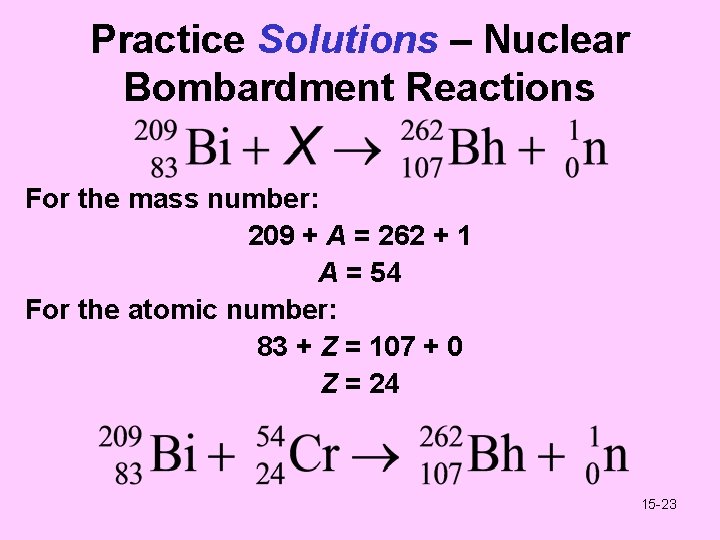
Practice Solutions – Nuclear Bombardment Reactions For the mass number: 209 + A = 262 + 1 A = 54 For the atomic number: 83 + Z = 107 + 0 Z = 24 15 - 23
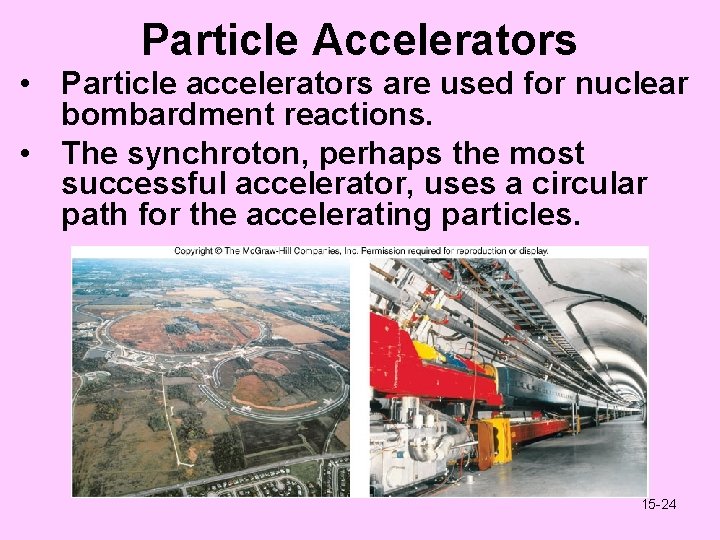
Particle Accelerators • Particle accelerators are used for nuclear bombardment reactions. • The synchroton, perhaps the most successful accelerator, uses a circular path for the accelerating particles. Figure 15. 13 15 - 24
• • • Spontaneous Nuclear Decay Reactions The tendency for the neutron/proton (N/Z) ratio to move toward the band of stability, explains the nuclear reactions of naturally radioactive nuclides. For every process except γ emission, the change that occurs for an unstable nuclide takes it closer to the observed band of stability. Radioactive nuclides convert spontaneously over time to form stable nuclides. Figure 15. 14 15 - 25
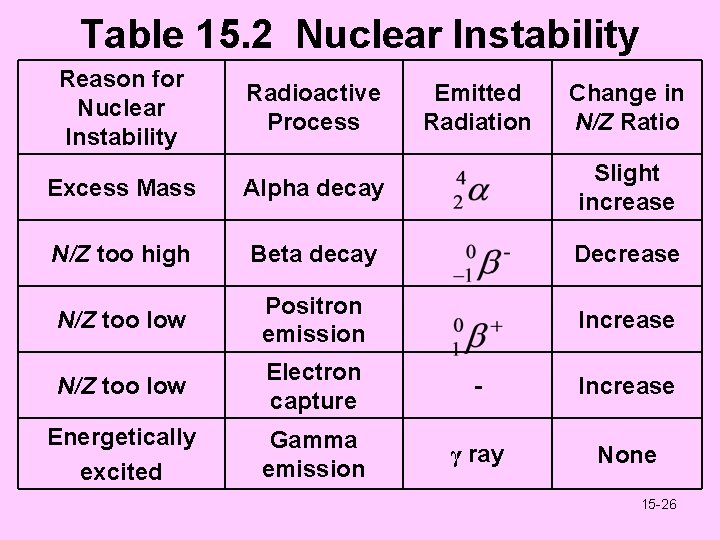
Table 15. 2 Nuclear Instability Reason for Nuclear Instability Radioactive Process Excess Mass Alpha decay Slight increase N/Z too high Beta decay Decrease N/Z too low Positron emission Increase N/Z too low Electron capture - Increase Energetically excited Gamma emission γ ray None Emitted Radiation Change in N/Z Ratio 15 - 26
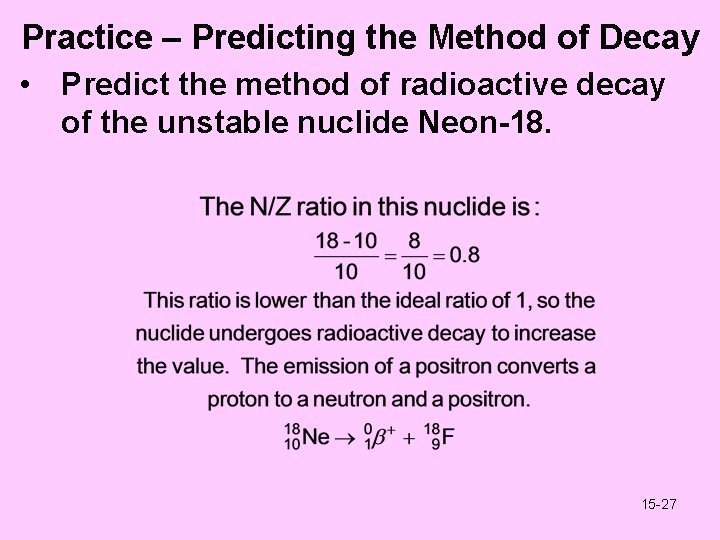
Practice – Predicting the Method of Decay • Predict the method of radioactive decay of the unstable nuclide Neon-18. 15 - 27
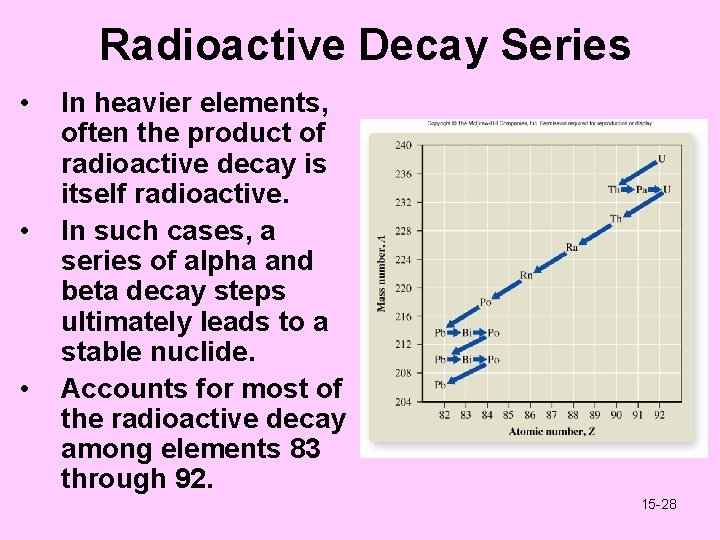
Radioactive Decay Series • • • In heavier elements, often the product of radioactive decay is itself radioactive. In such cases, a series of alpha and beta decay steps ultimately leads to a stable nuclide. Accounts for most of the radioactive decay among elements 83 through 92. Figure 15. 15 15 - 28
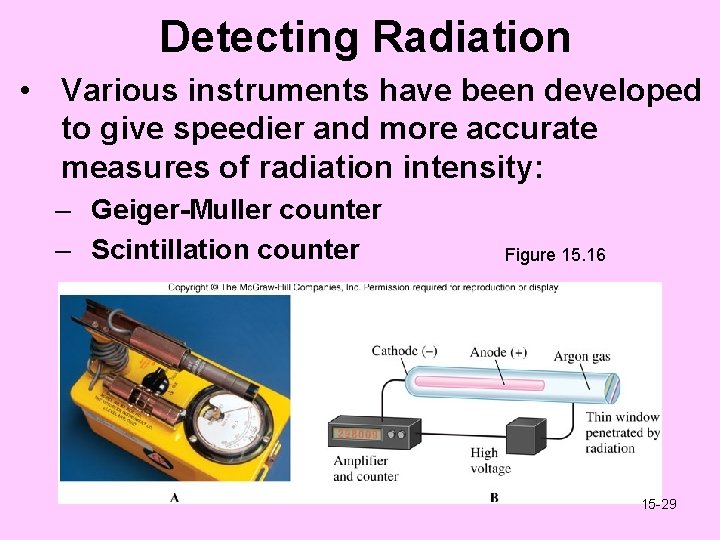
Detecting Radiation • Various instruments have been developed to give speedier and more accurate measures of radiation intensity: – Geiger-Muller counter – Scintillation counter Figure 15. 16 15 - 29
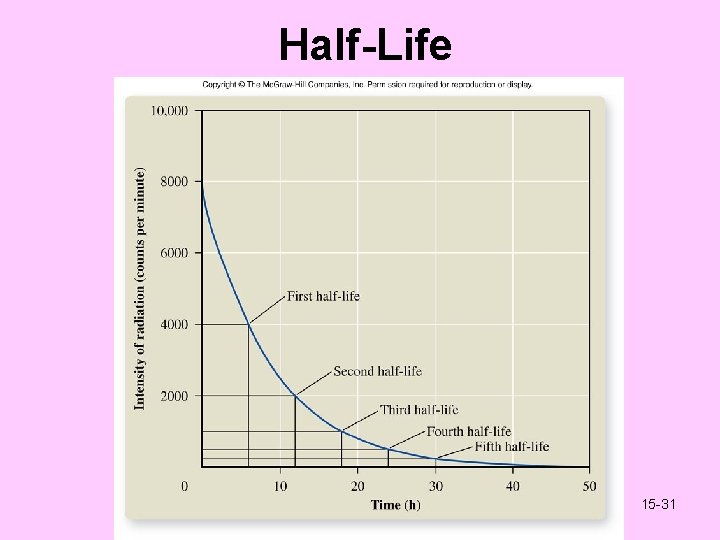
Half-Life • The time required for half of a sample of a nuclide to decay to a different nuclide • It takes the same time for a fresh sample to decay to one-half the original number of atoms of that nuclide as it does onehalf to decay to one-fourth and so on. • The shorter the half-life of a nuclide, the more intense the radiation that it emits. http: //www. eserc. stonybrook. edu/Project. Java/Radiation/ 15 - 30
Half-Life 15 - 31
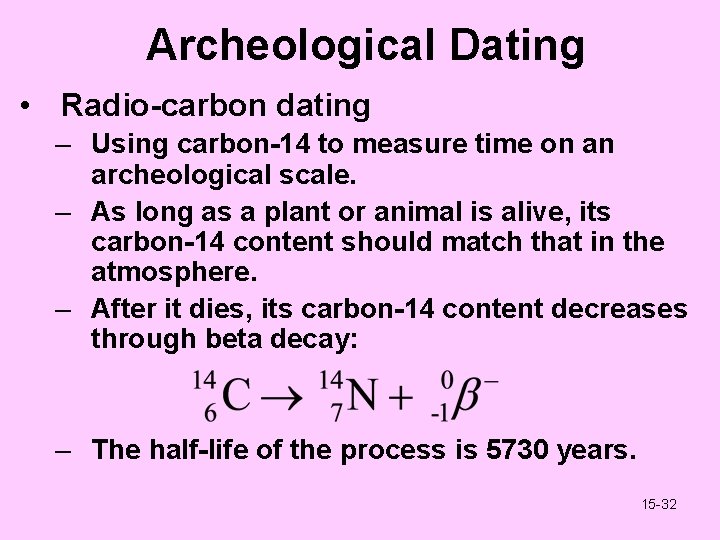
Archeological Dating • Radio-carbon dating – Using carbon-14 to measure time on an archeological scale. – As long as a plant or animal is alive, its carbon-14 content should match that in the atmosphere. – After it dies, its carbon-14 content decreases through beta decay: – The half-life of the process is 5730 years. 15 - 32
Medical Applications • Many medical applications exists that use radioactivity: – Power generators • Example: 238 Pu is used to power pacemakers – Medical diagnoses • Radioactive nuclides are used as tracers to track movements of substances in chemical or biological systems • Example: 99 m. Tc is used to help doctors locate tumors 15 - 33
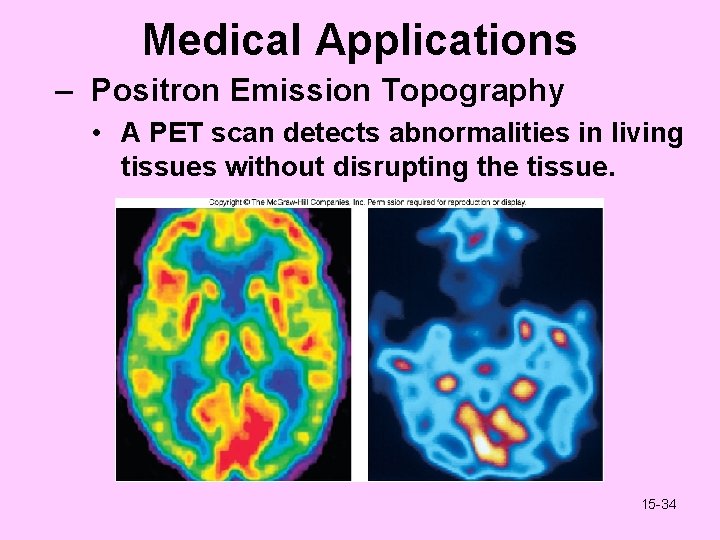
Medical Applications – Positron Emission Topography • A PET scan detects abnormalities in living tissues without disrupting the tissue. 15 - 34
Medical Applications – Cancer therapy • Radioactive nuclides, in much higher doses than those used for imaging, are used to treat cancerous tumors. • Cancer cells absorb nutrients containing gamma-emitting components, the gamma radiation becomes concentrated in the cancerous cells, destroying them in greater numbers than normal cells. • Examples: 131 I destroys thyroid tumors, 198 Au used to treat lung cancer, 32 P used for eye tumors. 15 - 35
Biological Effects of Radiation • Radiation can have one of four effects on the functioning of a cell: 1. The radiation can pass through the cell with no damage. 2. The cell can absorb the radiation and be damaged, but it can subsequently repair the damage and resume normal functioning. 3. The cell can be damaged so severely that it cannot repair itself. New cells formed from this cell will be abnormal. This mutant cell can ultimately cause cancer if it continues to proliferate. 4. The cell can be so severely damaged that it dies. 15 - 36
Biological Effects of Radiation • Radon – A rare noble gas which has also been implicated as a possible cause of lung cancer. – Accumulates in houses from particular kinds of soils or rock strata. 15 - 37
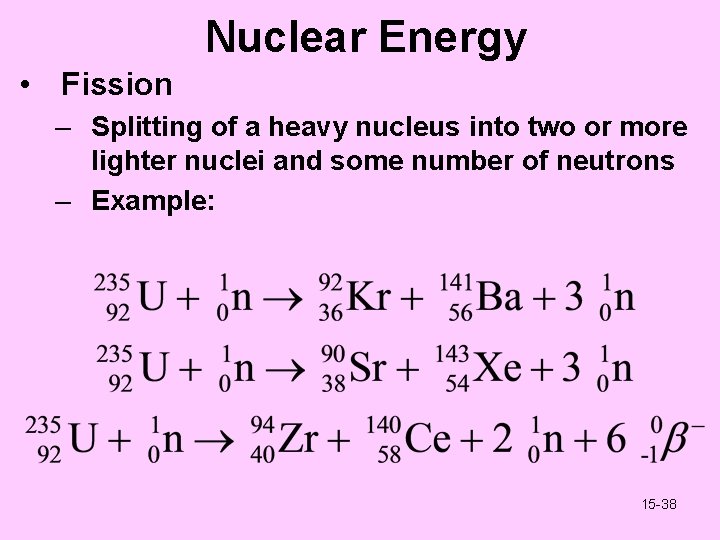
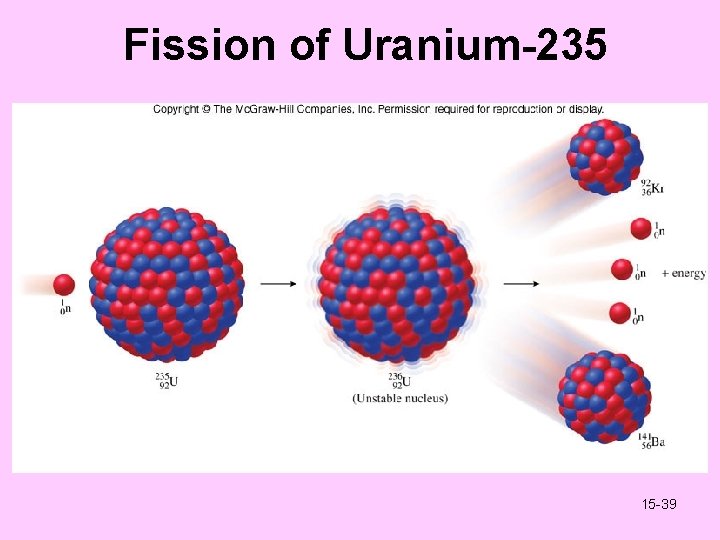
Nuclear Energy • Fission – Splitting of a heavy nucleus into two or more lighter nuclei and some number of neutrons – Example: 15 - 38
Fission of Uranium-235 Figure 15. 22 15 - 39
Chain Reactions • • A reaction in which the product of one step is the reactant in another step. In order for a chain reaction to sustain itself, the amount and shape of the sample of fissionable material must be such that the neutrons will not escape due to energy that is higher than optimum for inducing further fission. A chain reaction should maintain a constant rate. Critical mass – The smallest amount of fissionable material necessary to support a continuing chain reaction. 15 - 40
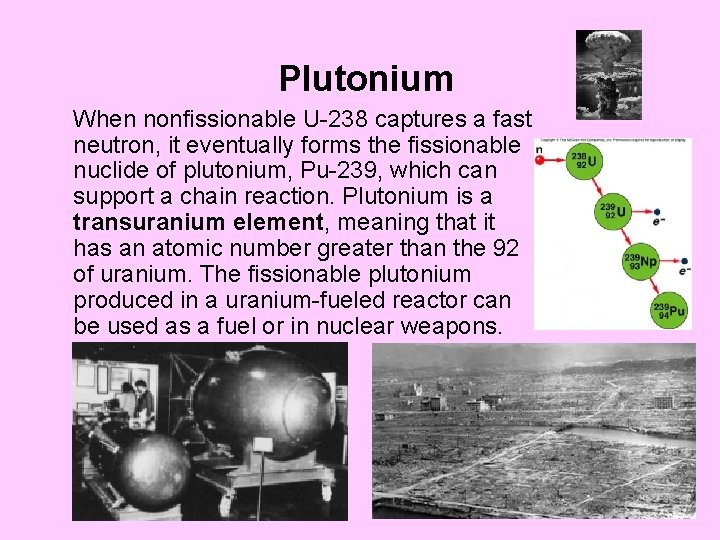
Plutonium When nonfissionable U-238 captures a fast neutron, it eventually forms the fissionable nuclide of plutonium, Pu-239, which can support a chain reaction. Plutonium is a transuranium element, meaning that it has an atomic number greater than the 92 of uranium. The fissionable plutonium produced in a uranium-fueled reactor can be used as a fuel or in nuclear weapons. 41
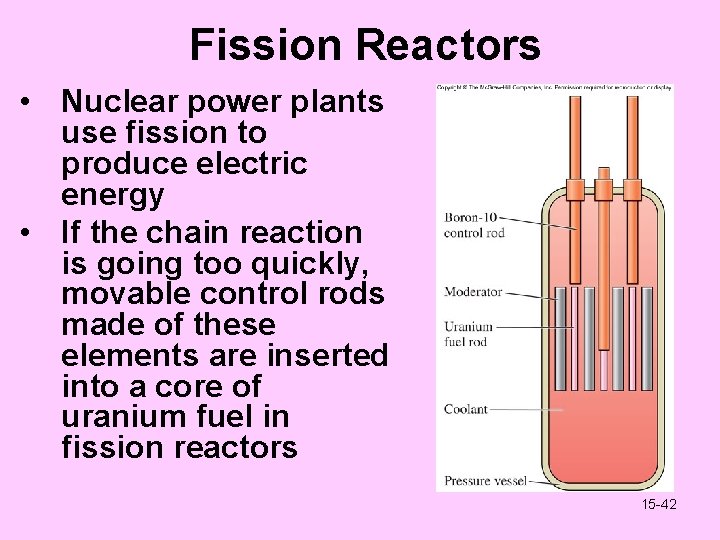
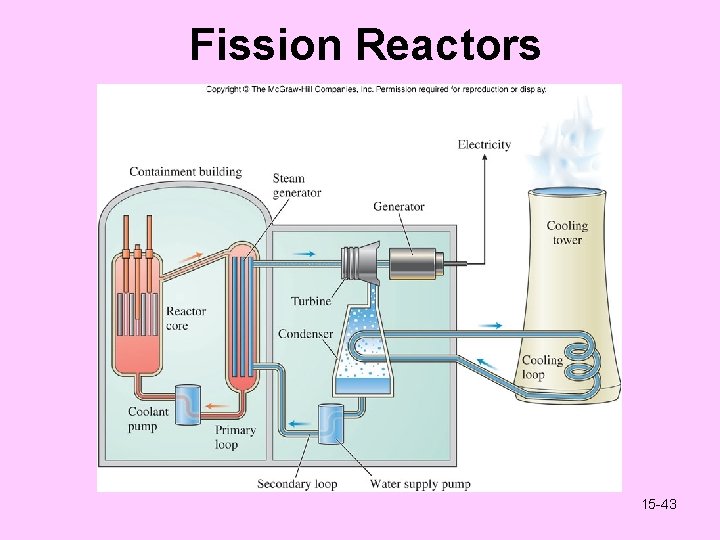
Fission Reactors • Nuclear power plants use fission to produce electric energy • If the chain reaction is going too quickly, movable control rods made of these elements are inserted into a core of uranium fuel in fission reactors Figure 15. 23 15 - 42
Fission Reactors 15 - 43
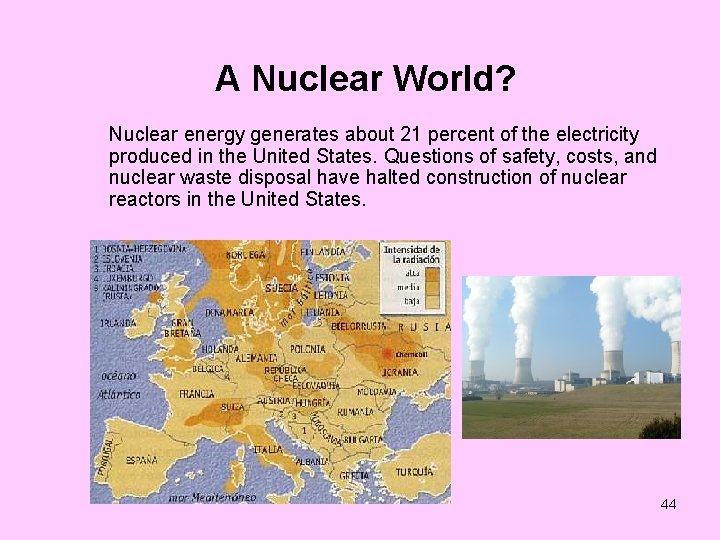
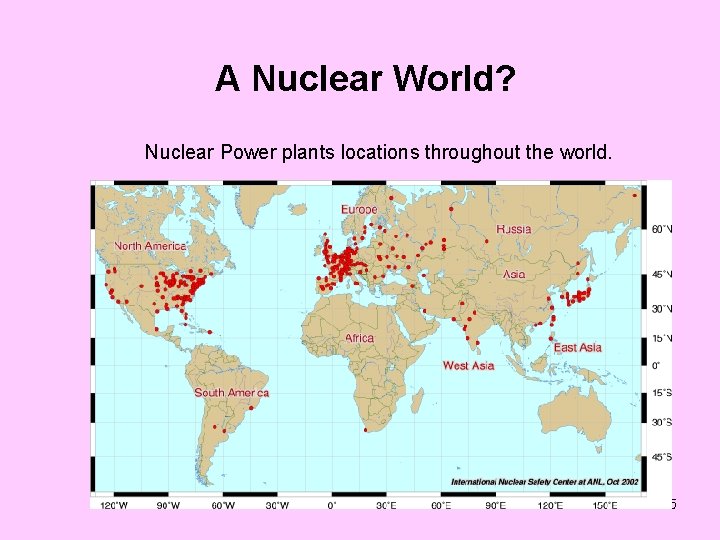
A Nuclear World? Nuclear energy generates about 21 percent of the electricity produced in the United States. Questions of safety, costs, and nuclear waste disposal have halted construction of nuclear reactors in the United States. 44
A Nuclear World? Nuclear Power plants locations throughout the world. 45
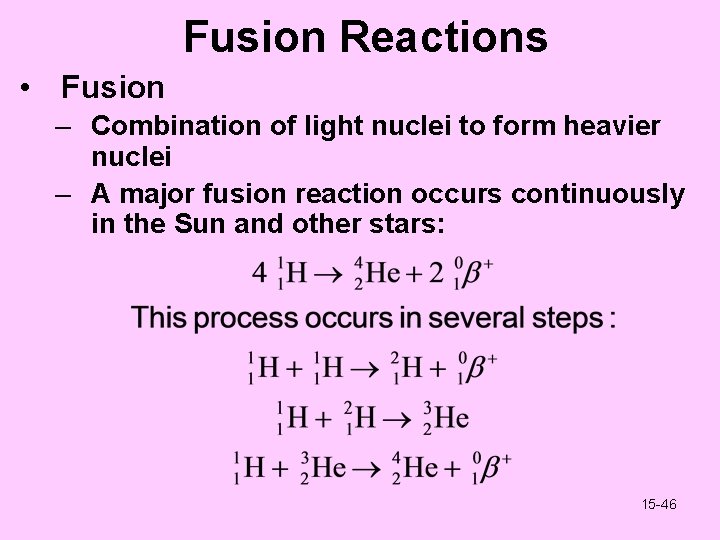
Fusion Reactions • Fusion – Combination of light nuclei to form heavier nuclei – A major fusion reaction occurs continuously in the Sun and other stars: 15 - 46
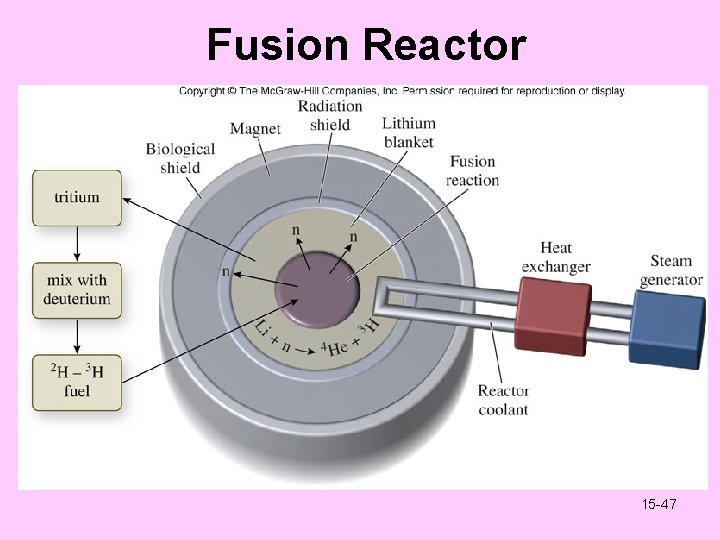
Fusion Reactor Figure 15. 26 15 - 47
• Fusion Reaction Terms Ignition temperature – Temperature required to initiate a fusion reaction • Breeder reactors – A reactor that produces fuel that can be used in other reactors • Plasma – An ionized gas that must created and controlled at temperatures of about 108 K – Melts most container material • • Until recently, fusion in reactors required more energy than was given off In order to achieve fusion, the gaseous reactants must be condensed to a small volume at high temperatures. 15 - 48
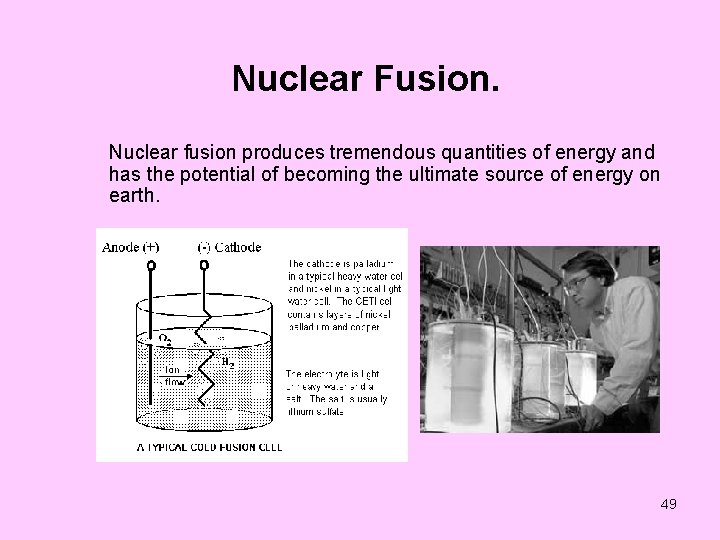
Nuclear Fusion. Nuclear fusion produces tremendous quantities of energy and has the potential of becoming the ultimate source of energy on earth. 49