
Chapter 15 Notes BIRDS AND MAMMALS Bird Characteristics
Chapter 15 Notes BIRDS AND MAMMALS
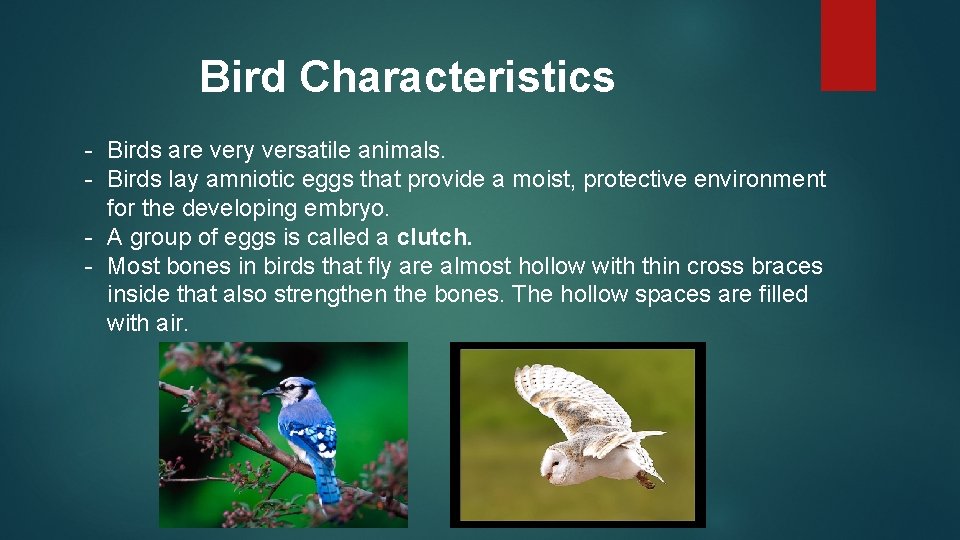
Bird Characteristics - Birds are very versatile animals. - Birds lay amniotic eggs that provide a moist, protective environment for the developing embryo. - A group of eggs is called a clutch. - Most bones in birds that fly are almost hollow with thin cross braces inside that also strengthen the bones. The hollow spaces are filled with air.
Bird Characteristics - Birds have two types of feathers, contour and down, and are the only animals with feathers. - Contour feathers- strong, lightweight feathers that give the bird coloring and smooth shape. The contour feathers on the wings and tail help the bird steer and help keep it in control. - Down feathers- soft, fluffy feathers that provide an insulating layer next to the skin. - Birds are endotherms. - Endotherms- birds maintain a constant body temperature.
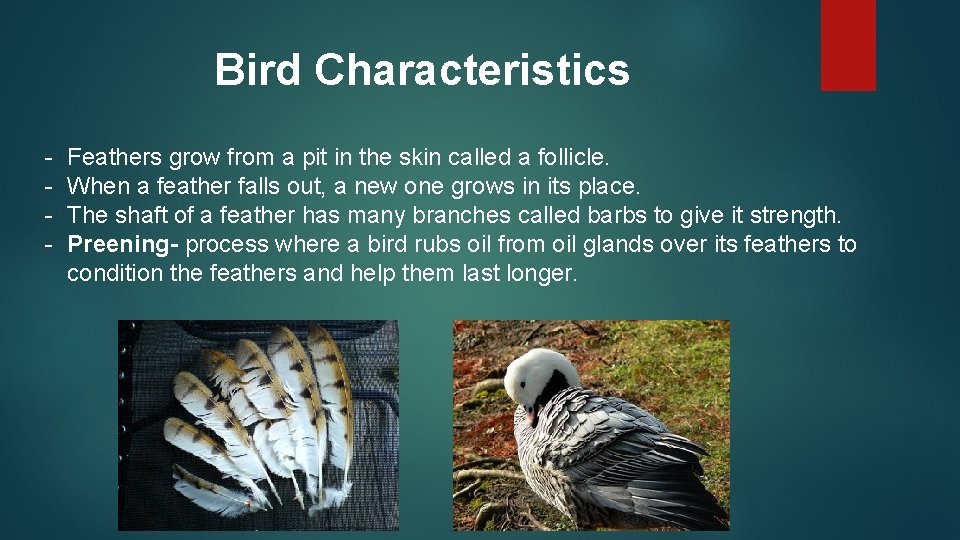
Bird Characteristics - Feathers grow from a pit in the skin called a follicle. When a feather falls out, a new one grows in its place. The shaft of a feather has many branches called barbs to give it strength. Preening- process where a bird rubs oil from oil glands over its feathers to condition the feathers and help them last longer.
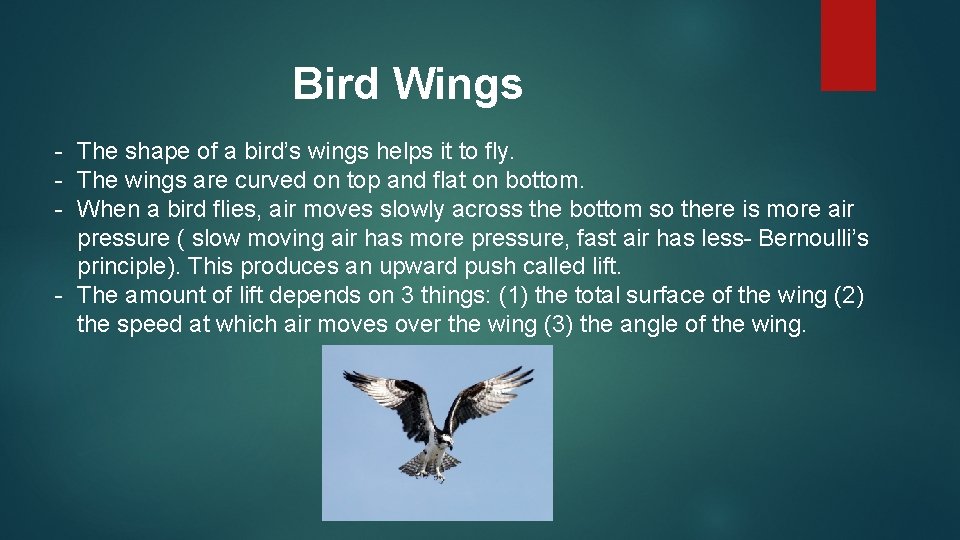
Bird Wings - The shape of a bird’s wings helps it to fly. - The wings are curved on top and flat on bottom. - When a bird flies, air moves slowly across the bottom so there is more air pressure ( slow moving air has more pressure, fast air has less- Bernoulli’s principle). This produces an upward push called lift. - The amount of lift depends on 3 things: (1) the total surface of the wing (2) the speed at which air moves over the wing (3) the angle of the wing.
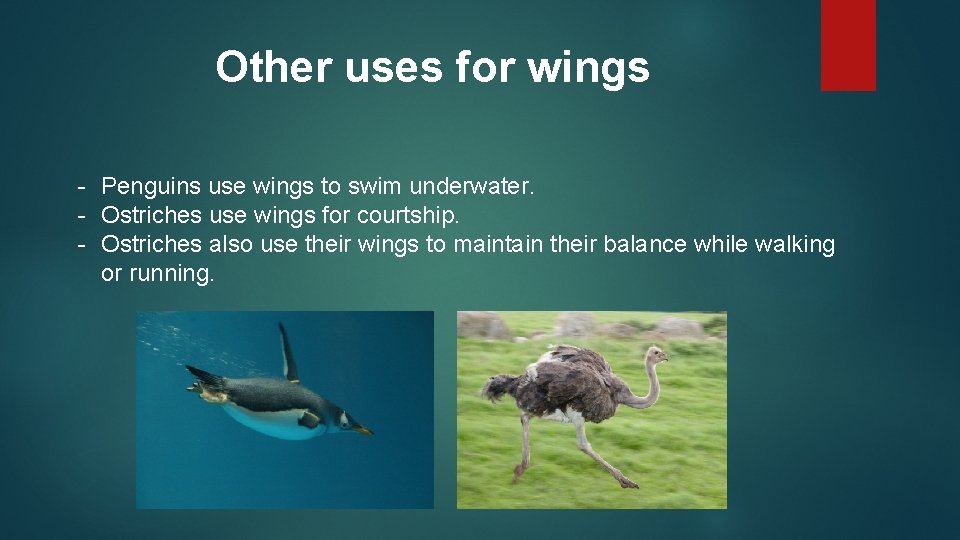
Other uses for wings - Penguins use wings to swim underwater. - Ostriches use wings for courtship. - Ostriches also use their wings to maintain their balance while walking or running.
Bird Characteristics - Because birds use so much energy flying, digestion takes place very quickly. - Birds digest food in less than an hour, humans in contrast take more than a day. - Birds have no teeth, but grind food in a gravel filled organ called a gizzard. - Birds take in oxygen while inhaling and exhaling, which provides more oxygen for flight. - Birds are important for food and raw material, control pests including insects, pollinating flowers, and seed eating birds help control weeds.
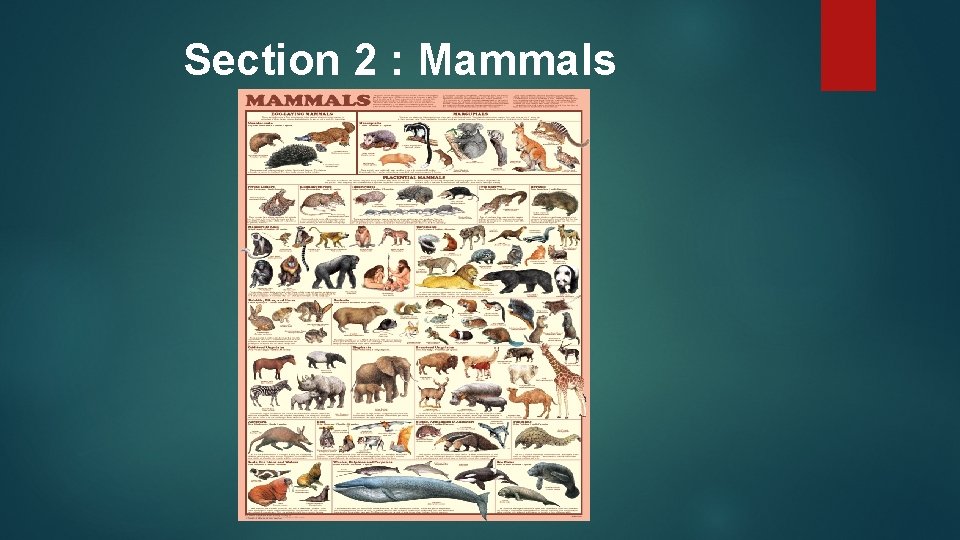
Section 2 : Mammals
Characteristics of Mammals - Mammals are endothermic vertebrates that have hair, produce milk to feed their young, and care for their young. - All mammals have mammary glands - Mammary glands- glands in the female that produce milk for feeding the young. - Almost all mammals have specialized teeth. - Incisors are the front teeth that bite and cut your food. - Canine teeth are used to grip and tear your food. - Premolars and molars are at the back of the mouth to shred, grind, and crush.
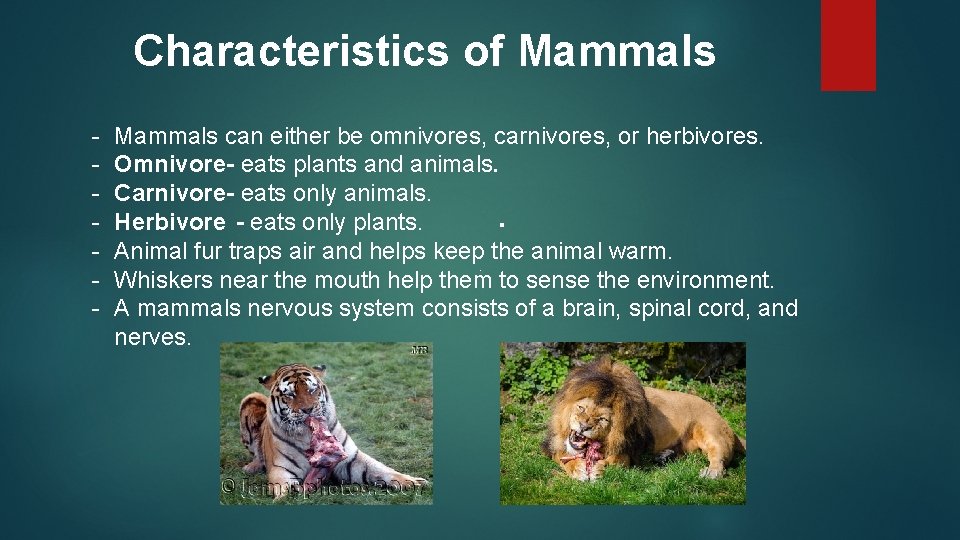
Characteristics of Mammals - Mammals can either be omnivores, carnivores, or herbivores. Omnivore- eats plants and animals. Carnivore- eats only animals. Herbivore - eats only plants. Animal fur traps air and helps keep the animal warm. Whiskers near the mouth help them to sense the environment. A mammals nervous system consists of a brain, spinal cord, and nerves.
Characteristics of Mammals - Digestive systems vary according to the kind of food the animal eats. - Herbivores have a long digestive tract because plants take longer to digest than meat. - All mammals reproduce sexually. Most mammals give birth to live young. - Mammals are classified into 3 groups based on how their young develop.
Characteristics of Mammals - The 3 mammal groups are monotremes, marsupials, and placentals. - Monotremes- are mammals that lay eggs (duck-billed platypus). - Marsupials- give birth to immature young that finishes developing inside the female’s pouch (opossum). - Placentals- embryos completely develop inside the female’s uterus. (humans) - Gestation period- time it takes for the embryo to develop (16 days in hamsters, 650 days in elephants). - Placenta- tissue around the embryo that provides it with oxygen and food. - Umbilical cord- connects embryo to placenta and transports food and oxygen and removes waste.

The End
- Slides: 13