
Chapter 15 Multiple Deposit Creation and the Money
- Slides: 22
Chapter 15 Multiple Deposit Creation and the Money Supply Process © 2005 Pearson Education Canada Inc.
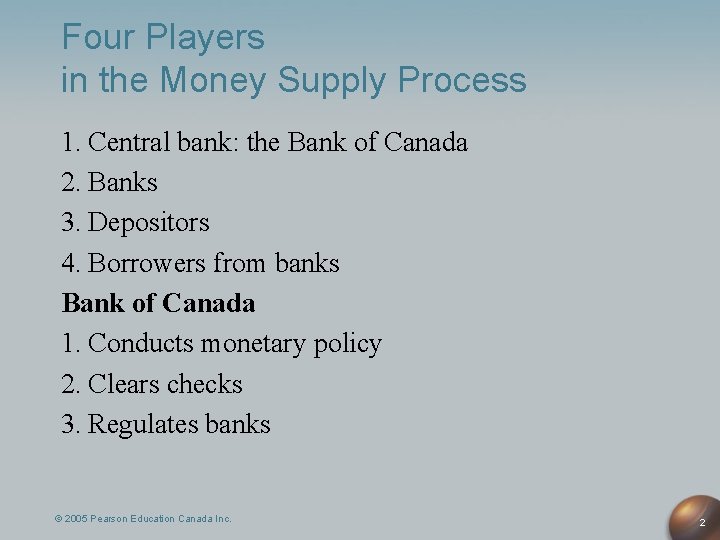
Four Players in the Money Supply Process 1. Central bank: the Bank of Canada 2. Banks 3. Depositors 4. Borrowers from banks Bank of Canada 1. Conducts monetary policy 2. Clears checks 3. Regulates banks © 2005 Pearson Education Canada Inc. 2
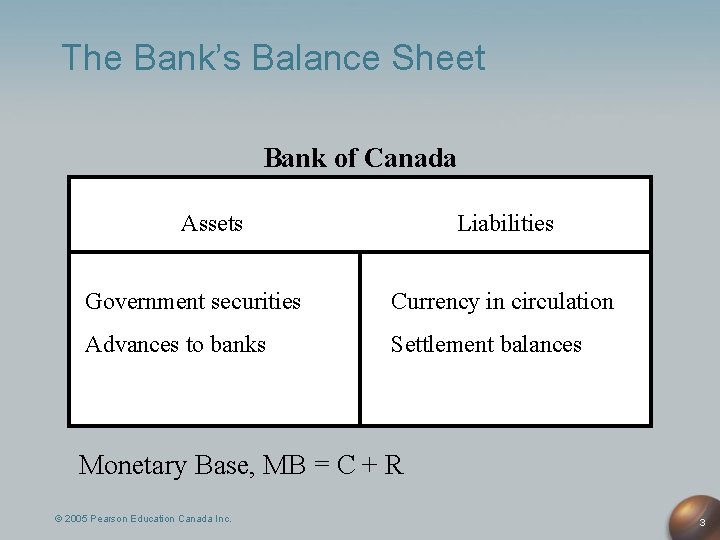
The Bank’s Balance Sheet Bank of Canada Assets Liabilities Government securities Currency in circulation Advances to banks Settlement balances Monetary Base, MB = C + R © 2005 Pearson Education Canada Inc. 3
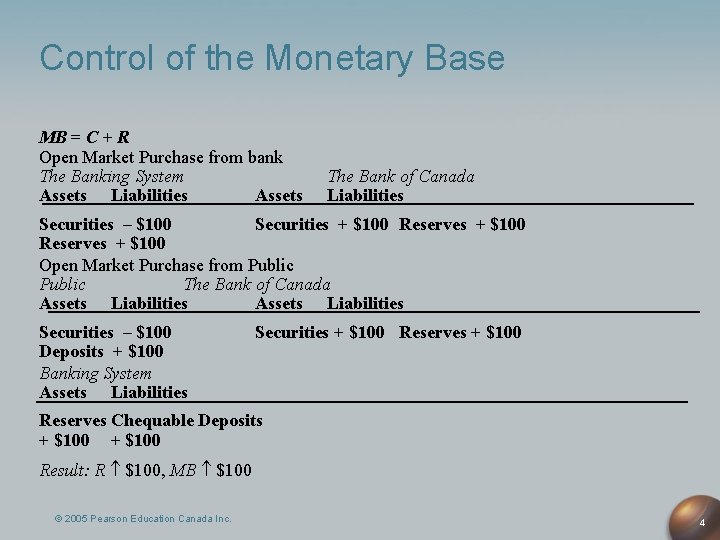
Control of the Monetary Base MB = C + R Open Market Purchase from bank The Banking System Assets Liabilities Assets The Bank of Canada Liabilities Securities – $100 Securities + $100 Reserves + $100 Open Market Purchase from Public The Bank of Canada Assets Liabilities Securities – $100 Deposits + $100 Banking System Assets Liabilities Securities + $100 Reserves Chequable Deposits + $100 Result: R $100, MB $100 © 2005 Pearson Education Canada Inc. 4
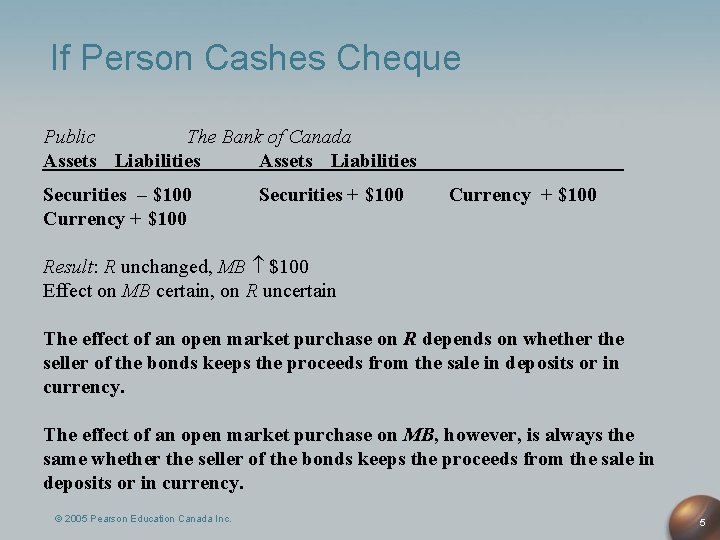
If Person Cashes Cheque Public The Bank of Canada Assets Liabilities Securities – $100 Currency + $100 Securities + $100 Currency + $100 Result: R unchanged, MB $100 Effect on MB certain, on R uncertain The effect of an open market purchase on R depends on whether the seller of the bonds keeps the proceeds from the sale in deposits or in currency. The effect of an open market purchase on MB, however, is always the same whether the seller of the bonds keeps the proceeds from the sale in deposits or in currency. © 2005 Pearson Education Canada Inc. 5
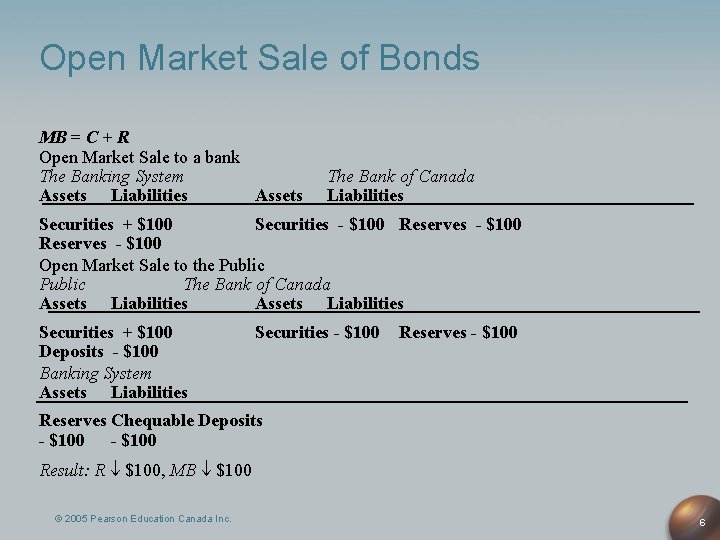
Open Market Sale of Bonds MB = C + R Open Market Sale to a bank The Banking System Assets Liabilities Assets The Bank of Canada Liabilities Securities + $100 Securities - $100 Reserves - $100 Open Market Sale to the Public The Bank of Canada Assets Liabilities Securities + $100 Deposits - $100 Banking System Assets Liabilities Securities - $100 Reserves Chequable Deposits - $100 Result: R $100, MB $100 © 2005 Pearson Education Canada Inc. 6
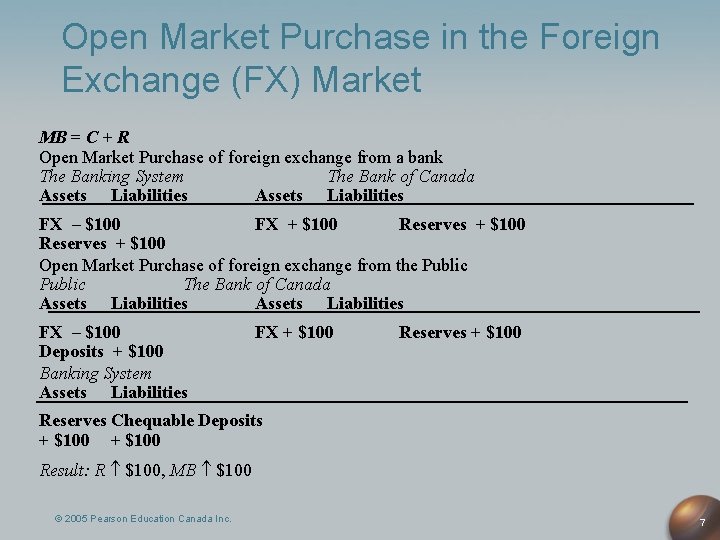
Open Market Purchase in the Foreign Exchange (FX) Market MB = C + R Open Market Purchase of foreign exchange from a bank The Banking System The Bank of Canada Assets Liabilities FX – $100 FX + $100 Reserves + $100 Open Market Purchase of foreign exchange from the Public The Bank of Canada Assets Liabilities FX – $100 Deposits + $100 Banking System Assets Liabilities FX + $100 Reserves Chequable Deposits + $100 Result: R $100, MB $100 © 2005 Pearson Education Canada Inc. 7
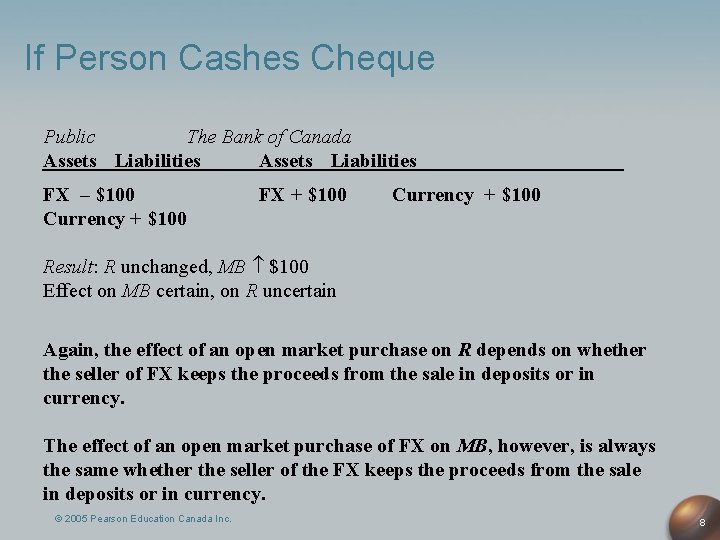
If Person Cashes Cheque Public The Bank of Canada Assets Liabilities FX – $100 Currency + $100 FX + $100 Currency + $100 Result: R unchanged, MB $100 Effect on MB certain, on R uncertain Again, the effect of an open market purchase on R depends on whether the seller of FX keeps the proceeds from the sale in deposits or in currency. The effect of an open market purchase of FX on MB, however, is always the same whether the seller of the FX keeps the proceeds from the sale in deposits or in currency. © 2005 Pearson Education Canada Inc. 8
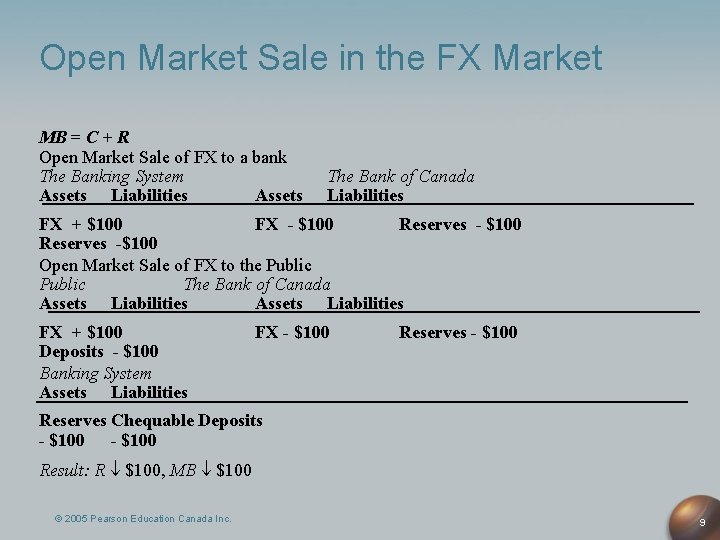
Open Market Sale in the FX Market MB = C + R Open Market Sale of FX to a bank The Banking System Assets Liabilities Assets The Bank of Canada Liabilities FX + $100 FX - $100 Reserves -$100 Open Market Sale of FX to the Public The Bank of Canada Assets Liabilities FX + $100 Deposits - $100 Banking System Assets Liabilities FX - $100 Reserves Chequable Deposits - $100 Result: R $100, MB $100 © 2005 Pearson Education Canada Inc. 9
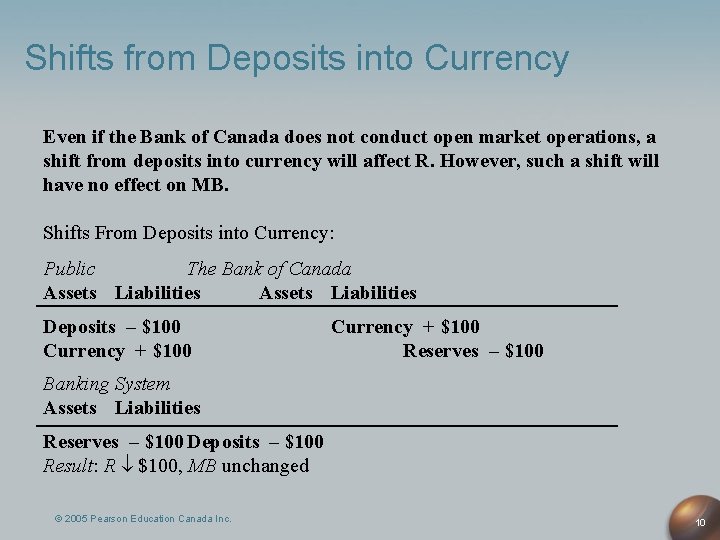
Shifts from Deposits into Currency Even if the Bank of Canada does not conduct open market operations, a shift from deposits into currency will affect R. However, such a shift will have no effect on MB. Shifts From Deposits into Currency: Public The Bank of Canada Assets Liabilities Deposits – $100 Currency + $100 Reserves – $100 Banking System Assets Liabilities Reserves – $100 Deposits – $100 Result: R $100, MB unchanged © 2005 Pearson Education Canada Inc. 10
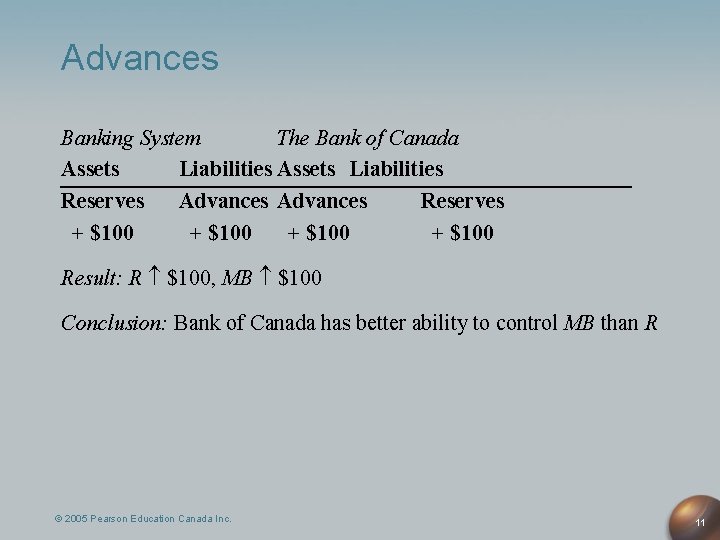
Advances Banking System The Bank of Canada Assets Liabilities Reserves Advances Reserves + $100 Result: R $100, MB $100 Conclusion: Bank of Canada has better ability to control MB than R © 2005 Pearson Education Canada Inc. 11
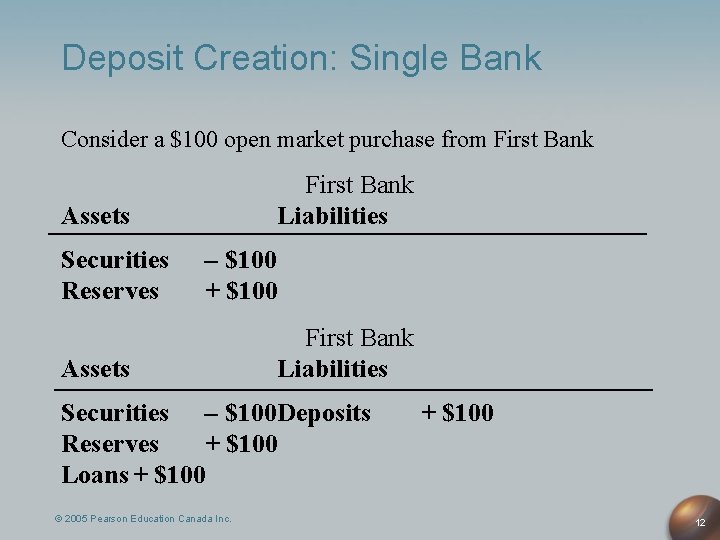
Deposit Creation: Single Bank Consider a $100 open market purchase from First Bank Liabilities Assets Securities Reserves – $100 + $100 Assets First Bank Liabilities Securities – $100 Deposits Reserves + $100 Loans + $100 © 2005 Pearson Education Canada Inc. + $100 12
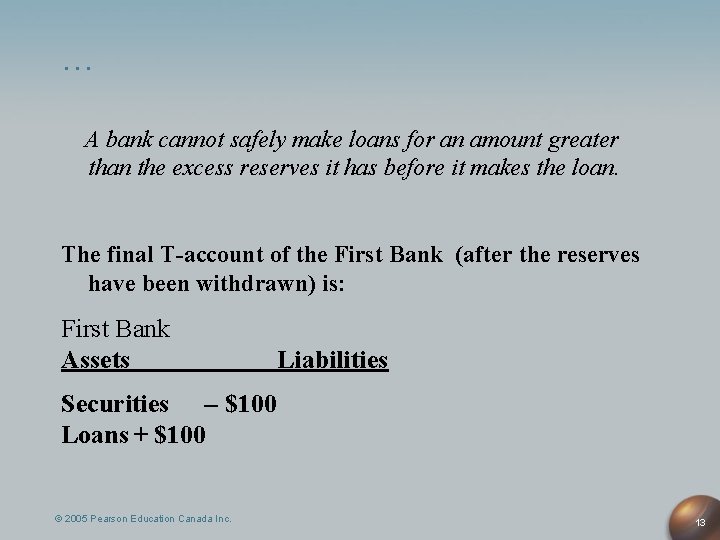
… A bank cannot safely make loans for an amount greater than the excess reserves it has before it makes the loan. The final T-account of the First Bank (after the reserves have been withdrawn) is: First Bank Assets Liabilities Securities – $100 Loans + $100 © 2005 Pearson Education Canada Inc. 13
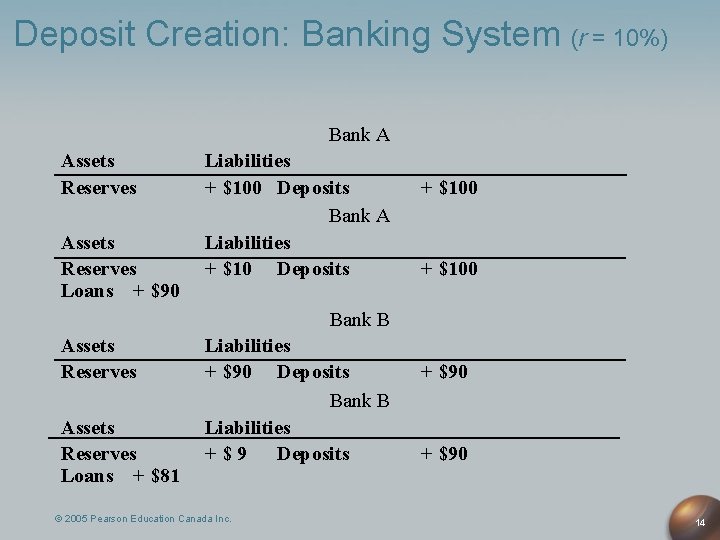
Deposit Creation: Banking System (r = 10%) Bank A Assets Reserves Loans + $90 Liabilities + $100 Deposits Bank A Liabilities + $10 Deposits + $100 Bank B Assets Reserves Loans + $81 Liabilities + $90 Deposits Bank B Liabilities +$9 Deposits © 2005 Pearson Education Canada Inc. + $90 14
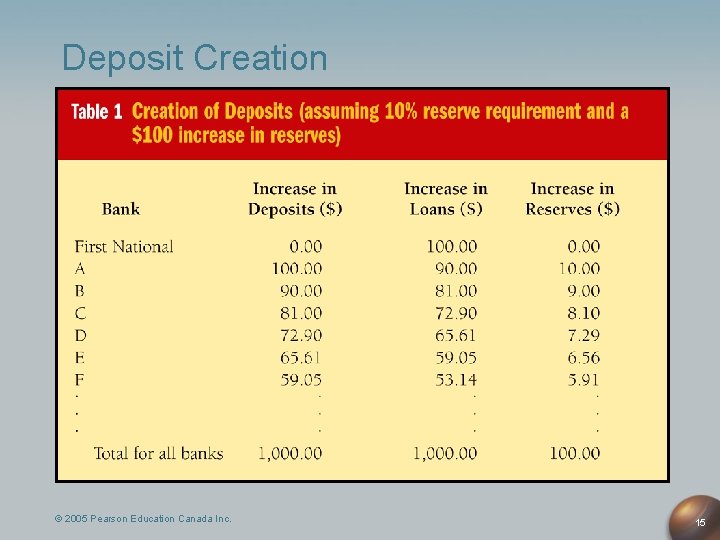
Deposit Creation © 2005 Pearson Education Canada Inc. 15
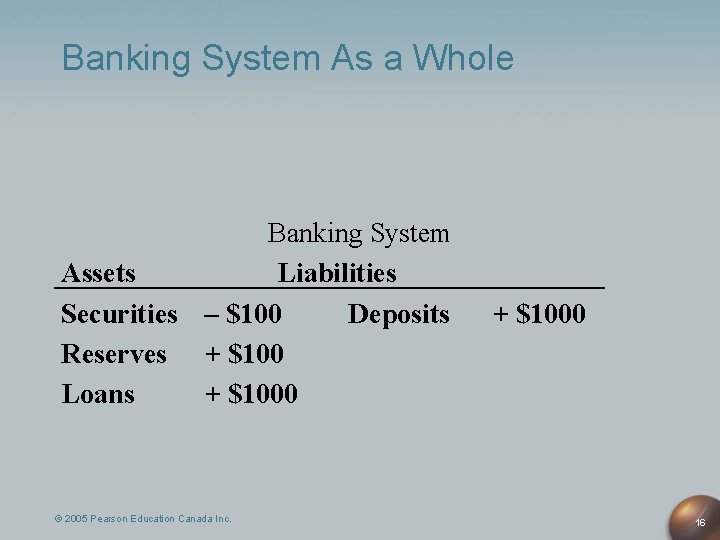
Banking System As a Whole Banking System Assets Liabilities Securities – $100 Deposits Reserves + $100 Loans + $1000 © 2005 Pearson Education Canada Inc. + $1000 16
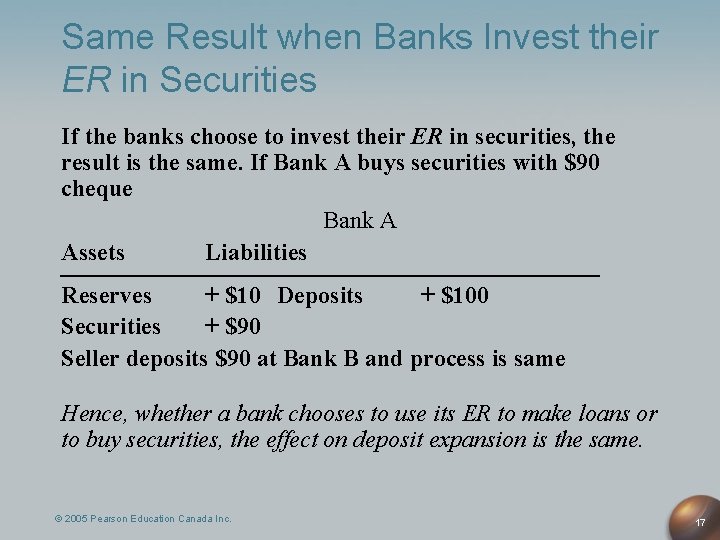
Same Result when Banks Invest their ER in Securities If the banks choose to invest their ER in securities, the result is the same. If Bank A buys securities with $90 cheque Bank A Assets Liabilities Reserves + $10 Deposits + $100 Securities + $90 Seller deposits $90 at Bank B and process is same Hence, whether a bank chooses to use its ER to make loans or to buy securities, the effect on deposit expansion is the same. © 2005 Pearson Education Canada Inc. 17
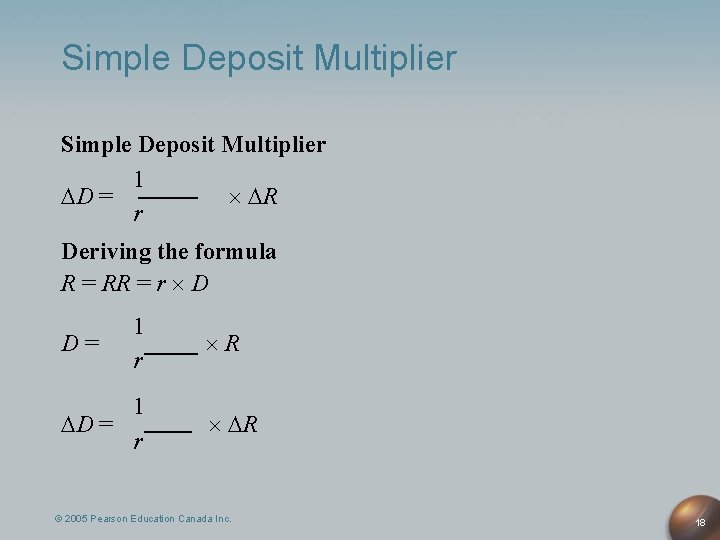
Simple Deposit Multiplier 1 D = R r Deriving the formula R = RR = r D D= 1 r 1 D = r R R © 2005 Pearson Education Canada Inc. 18
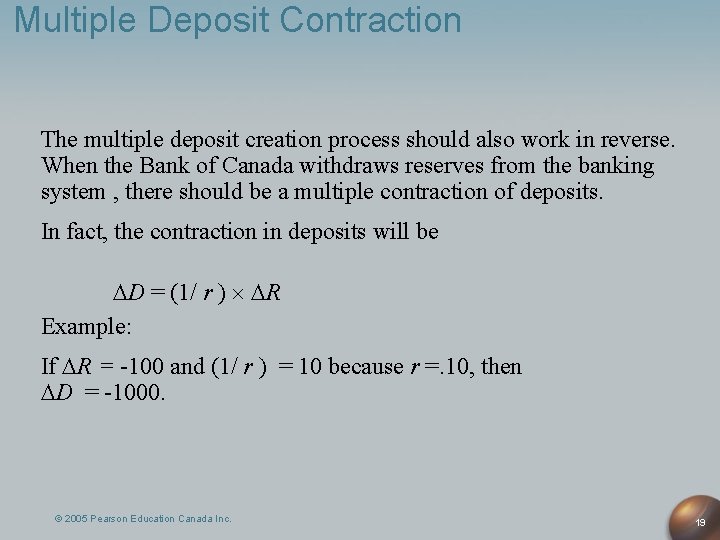
Multiple Deposit Contraction The multiple deposit creation process should also work in reverse. When the Bank of Canada withdraws reserves from the banking system , there should be a multiple contraction of deposits. In fact, the contraction in deposits will be D = (1/ r ) R Example: If R = -100 and (1/ r ) = 10 because r =. 10, then D = -1000. © 2005 Pearson Education Canada Inc. 19
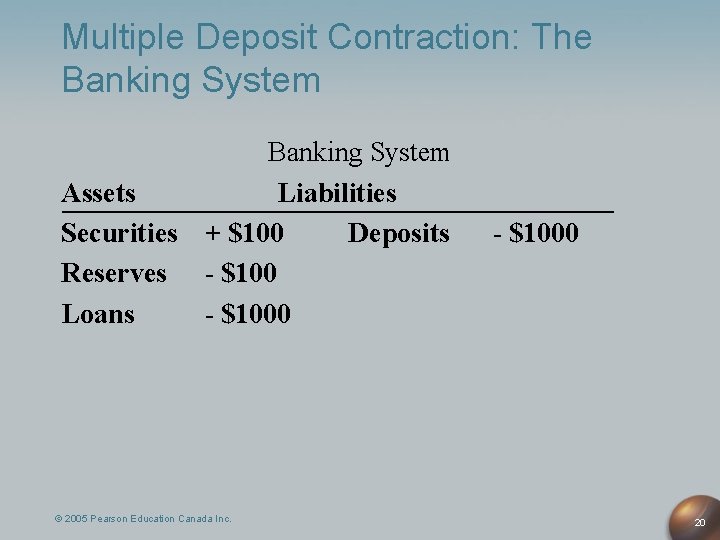
Multiple Deposit Contraction: The Banking System Assets Liabilities Securities + $100 Deposits Reserves - $100 Loans - $1000 © 2005 Pearson Education Canada Inc. - $1000 20
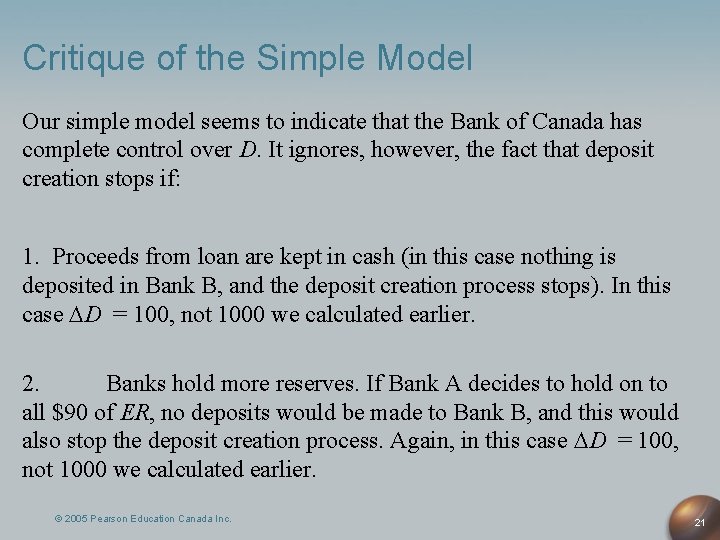
Critique of the Simple Model Our simple model seems to indicate that the Bank of Canada has complete control over D. It ignores, however, the fact that deposit creation stops if: 1. Proceeds from loan are kept in cash (in this case nothing is deposited in Bank B, and the deposit creation process stops). In this case D = 100, not 1000 we calculated earlier. 2. Banks hold more reserves. If Bank A decides to hold on to all $90 of ER, no deposits would be made to Bank B, and this would also stop the deposit creation process. Again, in this case D = 100, not 1000 we calculated earlier. © 2005 Pearson Education Canada Inc. 21
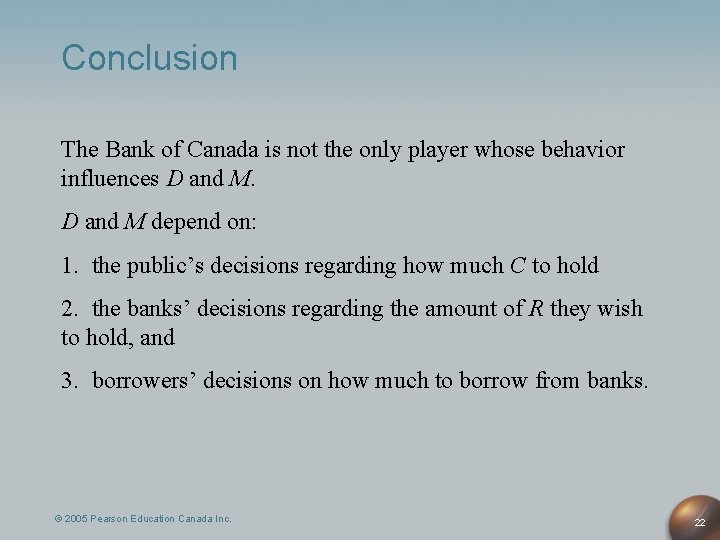
Conclusion The Bank of Canada is not the only player whose behavior influences D and M depend on: 1. the public’s decisions regarding how much C to hold 2. the banks’ decisions regarding the amount of R they wish to hold, and 3. borrowers’ decisions on how much to borrow from banks. © 2005 Pearson Education Canada Inc. 22