
CHAPTER 15 MARRIAGE AND FAMILY STRENGTHS AND NEEDS






- Slides: 30
CHAPTER 15 – MARRIAGE AND FAMILY STRENGTHS AND NEEDS Instructor: Wendy Crapo
Used by permission of THE ACADEMY OF NURSING 2355 E. 3900 S. S. L. C. , UT 84124 801 -506 -0064
RECURRING THEMES: • Families are dynamic: There will always be families and they will always continue to change.
RECURRING THEMES cont’d: • Families are diverse: Families are a composite of race, ethnicity, social class, gender, and lifestyle variety.
RECURRING THEMES cont’d: • Families satisfy important societal and personal needs: Societal health and stability depends in large part on strong and stable families.
RECURRING THEMES cont’d: Families need societal support: The family needs greater societal and institutional support to overcome problems and grasp opportunities.
MARITAL NEEDS • Desire for intimacy – • Needs to be balanced with maintaining a separate identity Interpersonal competence: The ability to share and develop an intimate, growing relationship with another.
MARITAL STRENGTHS VS FAMILY STRENGTHS Many of the traits of healthy marriages are also found in healthy families. • Childfree couples generally have more time for each other and substantially less psychological, economic and physical stress. • Many of our marital skills develop alongside our family skills. Do Families with children generally have more stability? Why?
DAVID MACE’S ESSENTIAL ASPECTS OF SUCCESSFUL MARRIAGE: • • • Commitment Communication Creative use of conflict
SUCCESSFUL MARRIAGES: • Numerous studies show correlation between communication patterns and marital satisfaction. • Commitment involves ongoing growth, willingness to work and ability to work. • Commitment to the sexual relationship within marriage is essential to marital strength. • Commitment involves give-and-take in order to be together and nurture the marriage. • Commitment to success is an essential component.
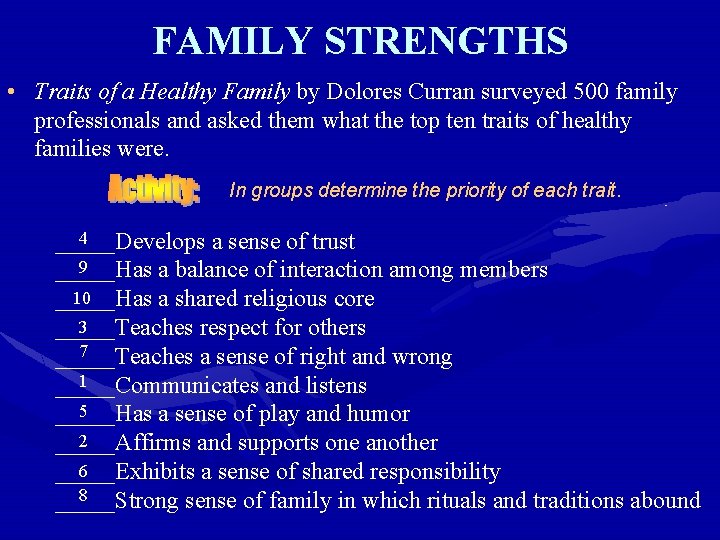
FAMILY STRENGTHS • Traits of a Healthy Family by Dolores Curran surveyed 500 family professionals and asked them what the top ten traits of healthy families were. In groups determine the priority of each trait. 4 _____Develops a sense of trust 9 _____Has a balance of interaction among members 10 _____Has a shared religious core 3 _____Teaches respect for others 7 _____Teaches a sense of right and wrong 1 _____Communicates and listens 5 _____Has a sense of play and humor 2 _____Affirms and supports one another 6 _____Exhibits a sense of shared responsibility 8 _____Strong sense of family in which rituals and traditions abound
FAMILY STRENGTHS • • • Commitment is a prevailing characteristic Identify family goals Positive family identity Work to promote growth of other family members Affirmation, respect for others and the world & trust Strong parental role models Communication is direct Responsibility Moral code and spiritual orientation give meaning, purpose & hope • Allow children to make mistakes and face the consequences • Make time for family • Traditions and sense of family history
FAMILY STRENGTHS cont’d What types of rituals, traditions, or holidays are practiced in your own family? How do these types of events strengthen families? Which is more important quality time or quantity time?
FAMILY QUALITY • Family quality can be seen as a continuum over the life cycle • Cohesiveness of the family is severely tested at times but can emerge stronger • May involve periods of distrust, disorder and unhappiness • Each family is different from each other
FAMILY CRISIS • Unite to face the challenges of a crisis • Cumulative effect of other family strengths enable strong families to deal with crisis • Able to accept changes from crisis and see possibilities for growth • Able to be open to resources available to them • Acknowledge their vulnerability • Recognizes interdependence within family and community • Adaptability essential
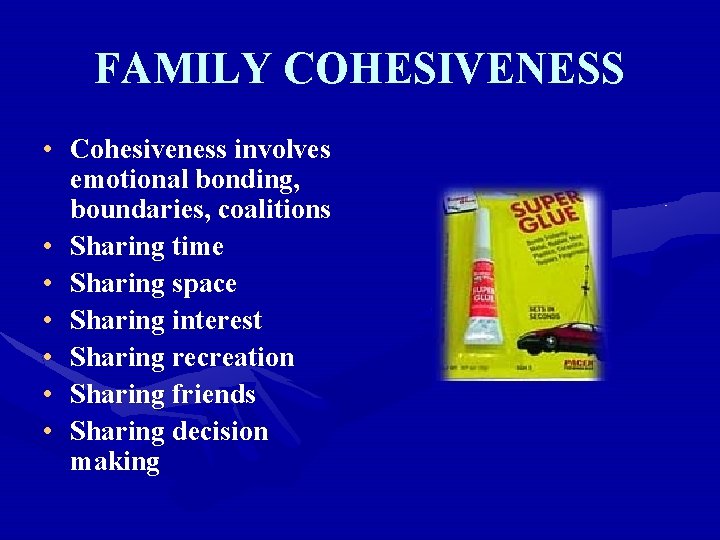
FAMILY COHESIVENESS • Cohesiveness involves emotional bonding, boundaries, coalitions • Sharing time • Sharing space • Sharing interest • Sharing recreation • Sharing friends • Sharing decision making
FAMILY ADAPTABILITY • • • Leadership Assertiveness Discipline Negotiation Roles Rules
STRENGTHS OF SINGLEPARENT FAMILIES • More efficient decision-making system • More direct communication • Greater sense of vitality is present in work and contributions made by children • More egalitarian view of roles of men & women
DIFFERENT FAMILIES, DIFFERENT STRENGTHS Family processes are common among families of all types. How are all ethnic group families similar?
ETHNICITY IS COMPLICATED AND EVER CHANGING Evaluate for each of the following ethnic groups in each area: – – Kinship ties Gender roles Priority of children, family, elderly Strengths
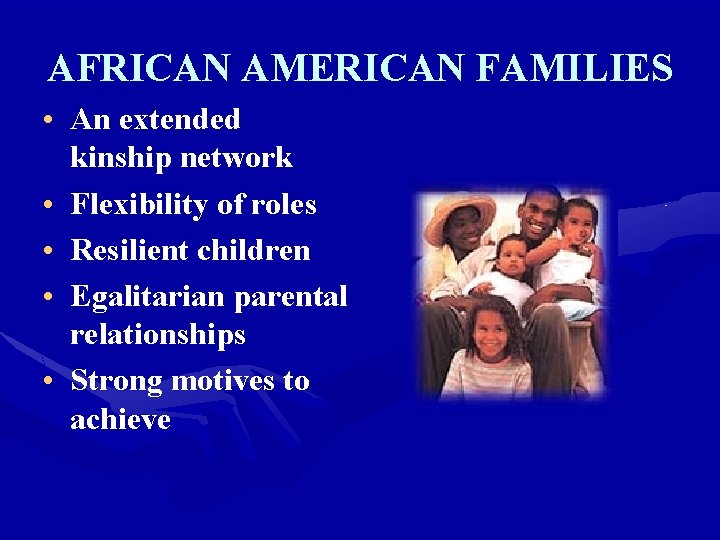
AFRICAN AMERICAN FAMILIES • An extended kinship network • Flexibility of roles • Resilient children • Egalitarian parental relationships • Strong motives to achieve
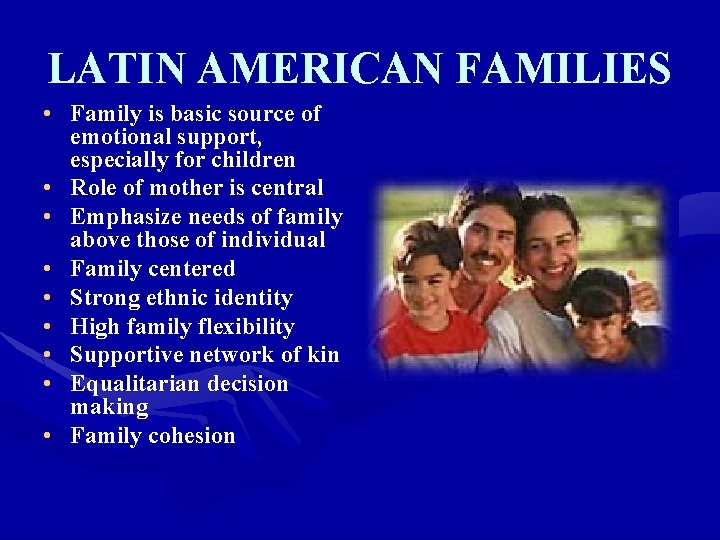
LATIN AMERICAN FAMILIES • Family is basic source of emotional support, especially for children • Role of mother is central • Emphasize needs of family above those of individual • Family centered • Strong ethnic identity • High family flexibility • Supportive network of kin • Equalitarian decision making • Family cohesion
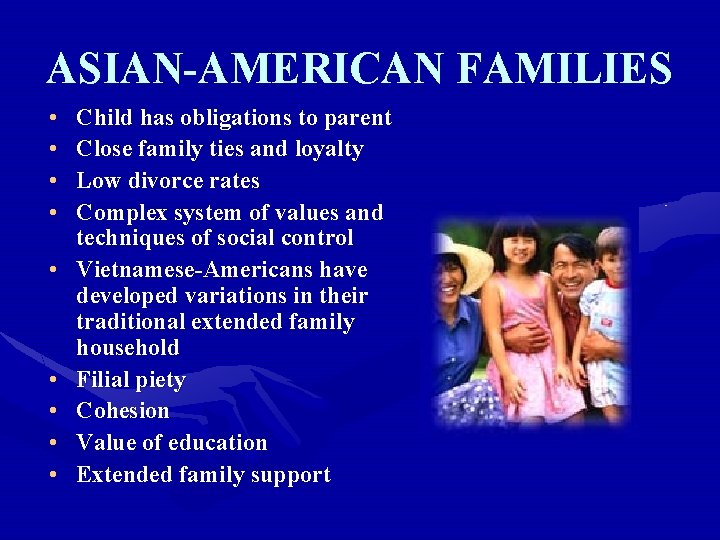
ASIAN-AMERICAN FAMILIES • • • Child has obligations to parent Close family ties and loyalty Low divorce rates Complex system of values and techniques of social control Vietnamese-Americans have developed variations in their traditional extended family household Filial piety Cohesion Value of education Extended family support
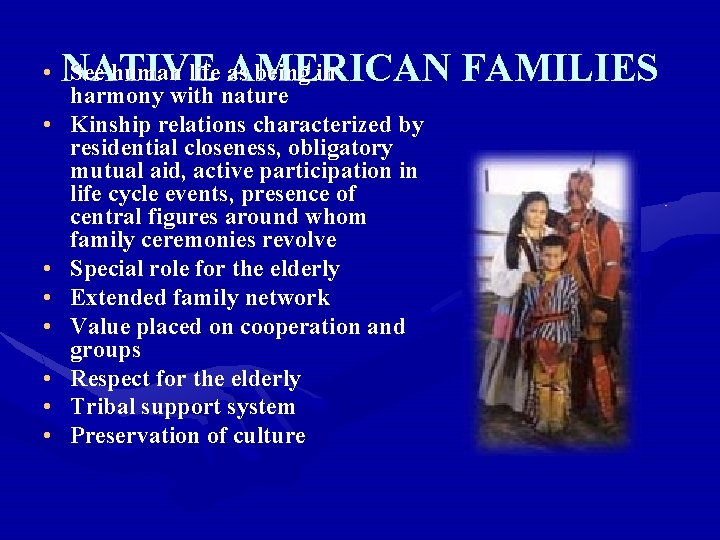
NATIVE AMERICAN FAMILIES • See human life as being in harmony with nature • Kinship relations characterized by residential closeness, obligatory mutual aid, active participation in life cycle events, presence of central figures around whom family ceremonies revolve • Special role for the elderly • Extended family network • Value placed on cooperation and groups • Respect for the elderly • Tribal support system • Preservation of culture
CAUCASIAN AMERICAN
KIN AND COMMUNITY Relationship needs • We need to nurture and care for others • We need intimacy from people who will listen to us and care about us • We need to be actively involved in some form of community • Knowledge that assistance from others is available keeps us from feeling anxious and vulnerable • We need reassurance as to our skills as persons, workers, parents, and partners to maintain selfesteem
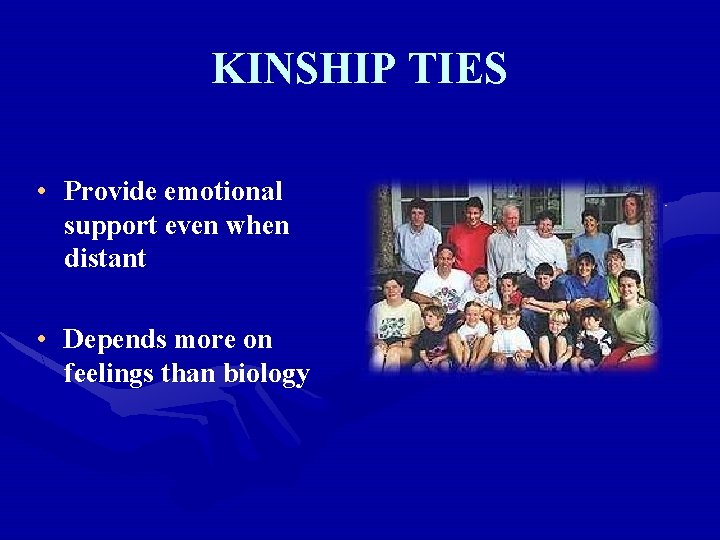
KINSHIP TIES • Provide emotional support even when distant • Depends more on feelings than biology
BRONFENBRENNER PROPOSES THAT WE LOOK AT FAMILY IN AN “ECOLOGICAL ENVIRONMENT” • Placing child in various systems such as home and school • Well-being of family depends on its own resources but also support from community • Families that love, shelter, and teach deserve to be nurtured, strengthened and protected
• What improvements need to be made in Family Policies? • Does honor and dignity to the parental role need to be restored? • If so, how?
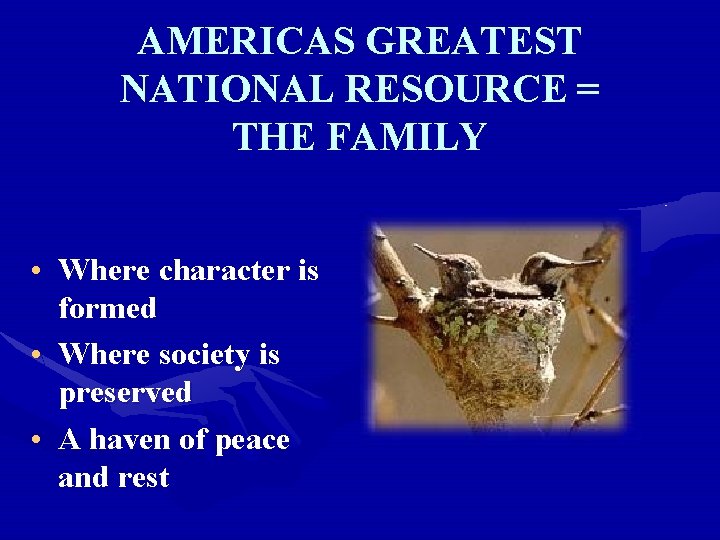
AMERICAS GREATEST NATIONAL RESOURCE = THE FAMILY • Where character is formed • Where society is preserved • A haven of peace and rest