
Chapter 15 Managing Incidents Fire Officer I Objectives
Chapter 15 Managing Incidents

Fire Officer I Objectives • Explain how the Incident Command System was created. • Describe the National Incident Management System. • Describe the postincident review process.

Fire Officer I Objectives • Describe the fire officer’s role in incident management. • Discuss strategic-level incident management.
Fire Officer II Objectives • Describe the National Incident Management System. • Develop and conduct a postincident analysis of a multiple-unit incident. • Describe the National Response Framework.
Fire Officer II Objectives • Describe the tactical level of incident management. • Describe the fire officer’s greater alarm responsibilities. • Describe the task level of incident management.
Introduction • The fire officer must: – Be prepared to perform the duties of the first-arriving officer – Be fully competent at working within the Incident Command System (ICS) as a unit, group, or division leader

The Origin of Incident Management • Fire service incident management was once a local activity. • Two programs provided the foundation for the National Incident Management System (NIMS): – FIRESCOPE – Fire-Ground Commander
FIRESCOPE • Created in the wake of massive southern California wildfires • Developed a standardized method of: – Setting up incident management structure – Coordinating strategy and tactics – Managing resources – Disseminating information

Fire-Ground Commander Program • Developed in Phoenix, Arizona, to meet the needs of an all-hazards metropolitan fire department • Focused on small and medium-sized urban emergencies
Developing One System • The first edition of NFPA 1561 was issued in 1990. • Its improved national preparedness includes: – National Response Framework – National Incident Management System
Incident Command System • The ICS is located within the NIMS Command Management component. • Local emergency response agencies were required to adopt it to remain eligible for federal disaster assistance. – Required training in the core NIMS curriculum
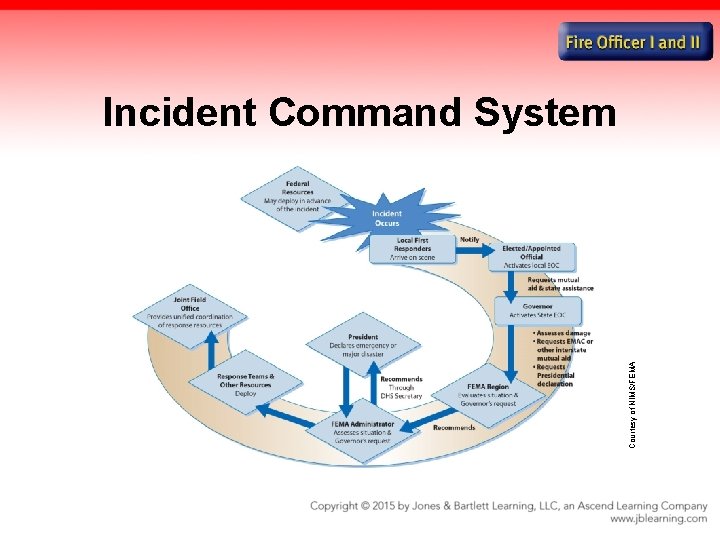
Courtesy of NIMS/FEMA Incident Command System
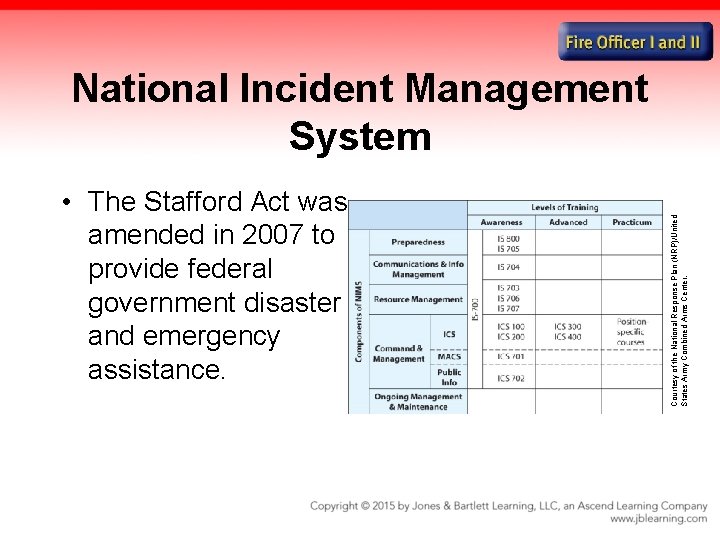
• The Stafford Act was amended in 2007 to provide federal government disaster and emergency assistance. Courtesy of the National Response Plan (NRP)/United States Army Combined Arms Center. National Incident Management System
National Incident Management System • NIMS makes it easier for organizations to work together. – Five components: • • • Preparedness Communications and information management Resource management Command management Ongoing management and maintenance
Postincident Review • A review should be conducted after emergency operations are performed. – Should be viewed as a potential learning experience – Format depends on the nature and magnitude of the incident
Preparing Information for an Incident Review • The incident commander conducts the multiple-company incident review. – Preparatory work is often done by one of the company officers. • Information about the situation leading up to the incident should be obtained.
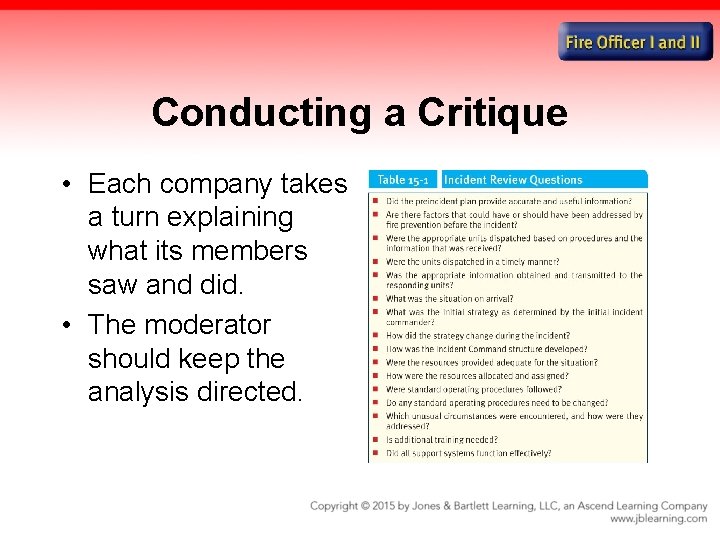
Conducting a Critique • Each company takes a turn explaining what its members saw and did. • The moderator should keep the analysis directed.
Conducting a Critique • The officer directing the critique should provide his or her assessment. – If the outcome was positive, praise should be distributed. – If there is room for improvement, note the valuable lessons learned.
Documentation and Follow-up • Written documentation is prepared for departmental records. • Appropriate follow-up should address training needs and policy changes.
The Fire Officer’s Role in Incident Management • Every fire officer is expected to be able to function as the initial incident commander, as well as a company-level supervisor, within ICS. – The first-arriving fire officer has the responsibility to establish command.
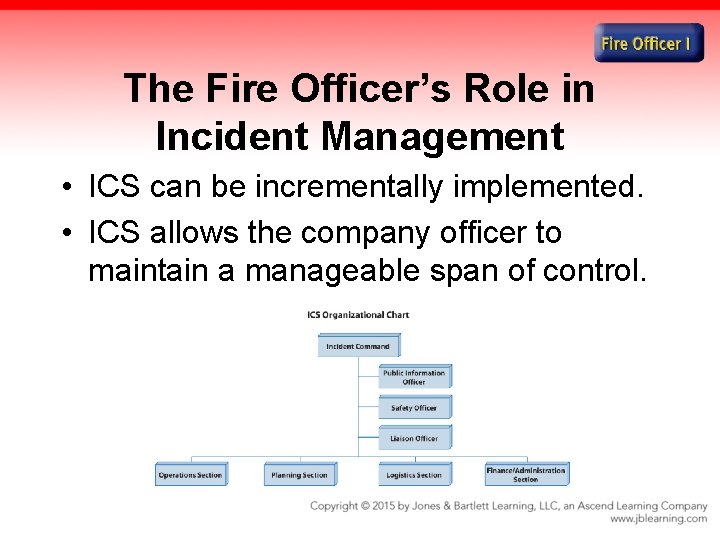
The Fire Officer’s Role in Incident Management • ICS can be incrementally implemented. • ICS allows the company officer to maintain a manageable span of control.
Levels of Command • Strategic level: sets overall direction and goals • Tactical level: acts to achieve strategic goals • Task level: acts to achieve tactical goals
Strategic-Level Incident Management • Three strategic priorities: 1. Life safety 2. Incident stabilization 3. Property conservation
Strategic-Level Incident Management • Also responsible for: – Building a command structure that matches the needs of the incident – Translating strategic priorities into tactical objectives – Assigning resources required
Establishing Command • The first fire officer to arrive assumes command. • The initial incident commander provides an initial radio report and announces that command has been established.
Command Options • Investigation mode – There may be nothing showing, or it may appear to be a minor situation. • Fast-attack mode – Immediate action is necessary to save life.
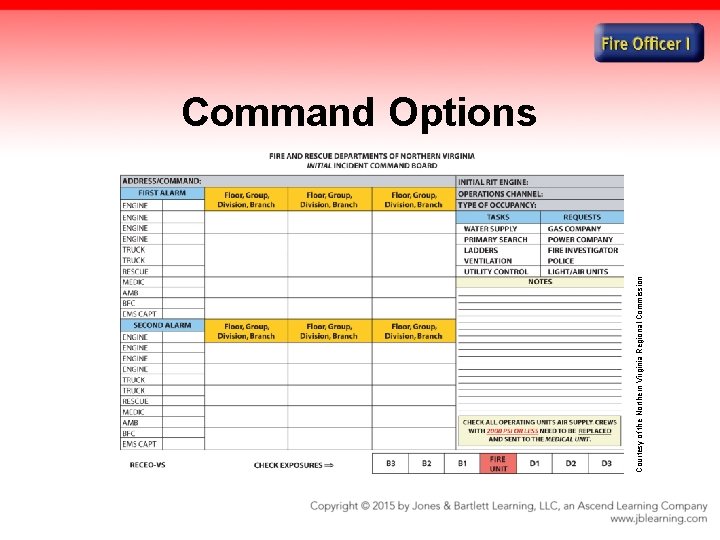
Command Options • Command mode – For large, complex, or dangerous events. – The company-level officer’s involvement in tactical operations is less important than command. – A tactical worksheet should be initiated.
Courtesy of the Northern Virginia Regional Commission Command Options
Functions of Command • Determining strategy • Selecting incident tactics • Setting action plan • Developing ICS organization • Managing resources • Coordinating resource activities • Providing for scene safety • Releasing incident information • Coordinating with outside agencies
Transfer of Command • The officer assuming command communicates with the initial incident commander. • The initial incident commander briefs the new incident commander. • Communicate the transfer of command to dispatch and all units.
Transfer of Command • After transfer, the new incident commander determines the assignment for the previous incident commander. – Group supervisor? – Remain at command post?
Fire Fighter Accountability • A minimum of two fire fighters must enter an IDLH area together. • Two more properly equipped and trained fire fighters must: – Be positioned outside the IDLH area – Account for interior teams – Remain capable of rescue
After the Transfer of Command • The Incident Management System can expand to handle larger and more complex incidents. – Fire officers may be given IMS assignments.
Command Staff • Safety officer – Ensures safety issues are managed effectively at the incident scene – Appointed early during an incident – Has the authority to stop or suspend operations when unsafe situations occur
Command Staff • Safety officer (cont’d) – Should be qualified and knowledgeable in: • • • Fire behavior Building construction and collapse potential Firefighting strategy and tactics Hazardous materials Technical rescue practices Departmental safety rules and regulations
Command Staff • Liaison officer – Point of contact for representatives from outside agencies – Exchanges information with those representatives
Command Staff • Public information officer – Gathers and releases incident information to the news media and other appropriate agencies
General Staff Functions • When an incident is too large for one person to manage, the incident commander may appoint officers to oversee four major components: 1. 2. 3. 4. Operations Planning Logistics Finance/administration
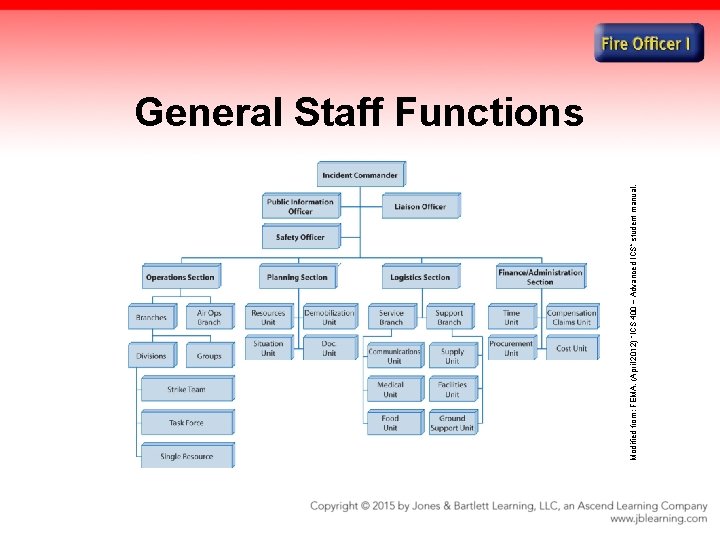
Modified from: FEMA. (April 2012) “ICS 400 – Advanced ICS” student manual. General Staff Functions
Operations Section • Manages all actions that are directly related to controlling the incident • A separate operations section chief is used at complex incidents.
Planning Section • Collects, evaluates, disseminates, and uses information relevant to the incident • Develops and updates the incident action plan • Functions may be delegated to subunits.
Planning Section • The incident action plan (IAP) is required for all incidents. – Outlines the strategic objectives – States how emergency operations will be conducted
Logistics Section • Provides supplies, services, facilities, and materials during the incident • May use subunits to provide support for large incidents
Finance/Administration Section • Responsible for administrative, accounting, and financial aspects • Responsible for legal issues • Usually established during larger-scale incidents: – Natural disaster – Hazardous materials incident
Location Designators • Exterior sides of building: A, B, C, and D • Exposures: areas adjacent to a burning building – Take the same letter as the adjacent side of the building • Divisions take the number of floor on which they are working.
National Response Framework • Established in March 2008 • Comprehensive national, all-hazards approach to domestic incident response • Describes specific authorities and best practices for managing incidents
National Response Framework • Department of Homeland Security built a comprehensive National Incident Management System to: – Respond to attacks and disasters – Consolidate emergency response plans – Ensure implementation of the NRF
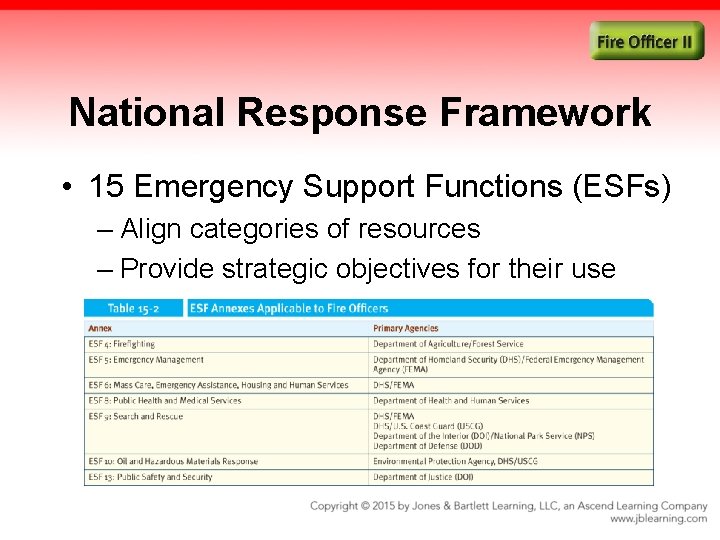
National Response Framework • 15 Emergency Support Functions (ESFs) – Align categories of resources – Provide strategic objectives for their use
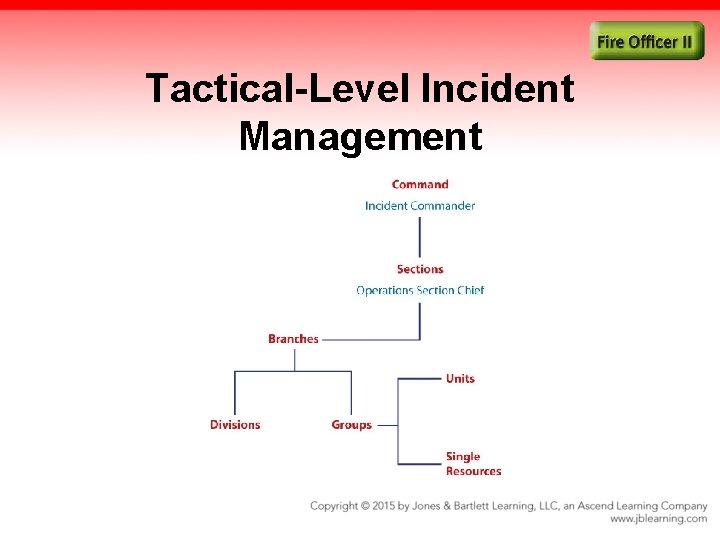
Tactical-Level Incident Management • Divisions, groups, and units – Assemble companies and resources for a common purpose • Divisions represent geographical operations. • Groups represent functional operations. • Units have functional or geographic responsibilities.
Tactical-Level Incident Management
Tactical-Level Incident Management • Division/group/unit supervisor responsibilities – Use an appropriate radio designation – Complete assigned objectives – Account for companies and personnel – Ensure operations are conducted safely – Monitor work progress
Tactical-Level Incident Management • Division/group/unit supervisor responsibilities (cont’d) – Redirect activities as necessary – Coordinate actions with related activities and adjacent supervisors – Monitor assigned personnel – Request additional resources
Tactical-Level Incident Management • Division/group/unit supervisor responsibilities (cont’d) – Provide the incident commander with progress reports – Reallocate or release resources
Tactical-Level Incident Management • Branches – Provide a span of control – May handle a number of divisions/groups/units at larger incidents – Branch director is in command
Fire Officer Greater Alarm Responsibilities • The incident commander calls for greater alarms when needed. • Company-level officer may be called to: • • • Reinforce the fire attack strategy Relieve an exhausted crew Perform support activities Maintain a ready reserve Perform additional related duties
Staging • Management of uncommitted resources at the scene of an incident • Level I staging: – Later-arriving units wait for instructions. • Level II staging: – Responding companies are directed to a standby location.
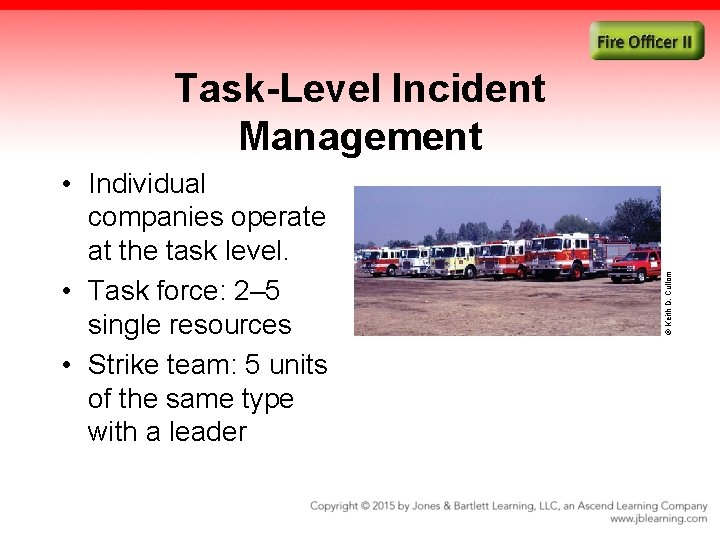
• Individual companies operate at the task level. • Task force: 2– 5 single resources • Strike team: 5 units of the same type with a leader © Keith D. Cullom Task-Level Incident Management
Greater Alarm Infrastructure • Small fire departments tend to have limited infrastructure. • Apparatus should carry enough water and food to support the fire company for a reasonable period of time.
Summary • A fire officer is expected to perform the duties of a first-arriving officer. • The incident management system evolved from the FIRESCOPE and Fire. Ground Commander programs. • The first-arriving fire officer has the responsibility to establish command manage the incident until relieved.
Summary • There are three levels of command in the ICS: strategic, tactical, and task. • The ICS must be used at every event. • The first-arriving company-level officer has three options: investigation, fast attack, or command mode. • There are nine functions of command.
Summary • The Incident Management System can expand as necessary. • The command staff report directly to the incident commander. • Everything that occurs at an emergency incident can be divided among operations, planning, logistics, and finance/administration.
Summary • The exterior sides of a building are labeled A, B, C, and D. • The areas adjacent to a burning building are called exposures. • Some form of review should be conducted after emergency operations. • The NRF is a comprehensive approach to domestic incident response.
Summary • Divisions, groups, and units assemble companies and resources for a common purpose. • A branch provides for an appropriate span of control. • Staging manages uncommitted resources at the scene of an incident.
Summary • Individual companies operate at the task level. • Task forces and strike teams are groups of single resources that have been assigned to work together. • Small fire departments have limited infrastructure support.
- Slides: 64