
Chapter 15 Lecture Earth Science Fourteenth Edition The
- Slides: 21
Chapter 15 Lecture Earth Science Fourteenth Edition The Dynamic Ocean Jennifer Mangan James Madison University © 2015 Pearson Education, Inc.
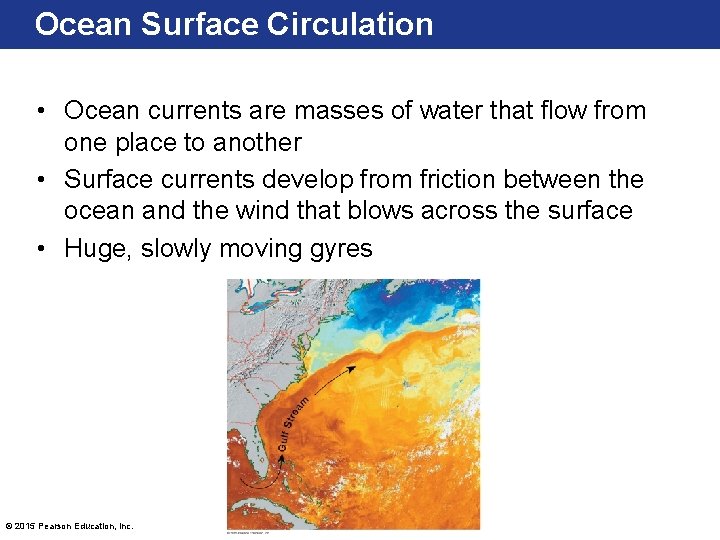
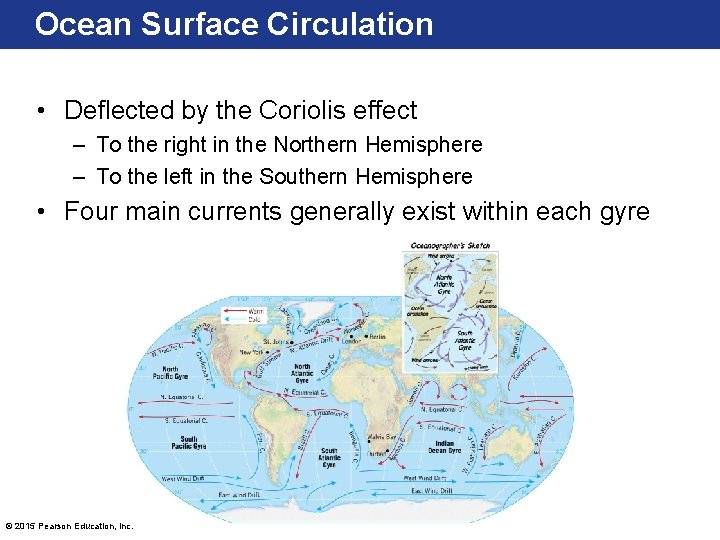
Ocean Surface Circulation • Ocean currents are masses of water that flow from one place to another • Surface currents develop from friction between the ocean and the wind that blows across the surface • Huge, slowly moving gyres © 2015 Pearson Education, Inc.
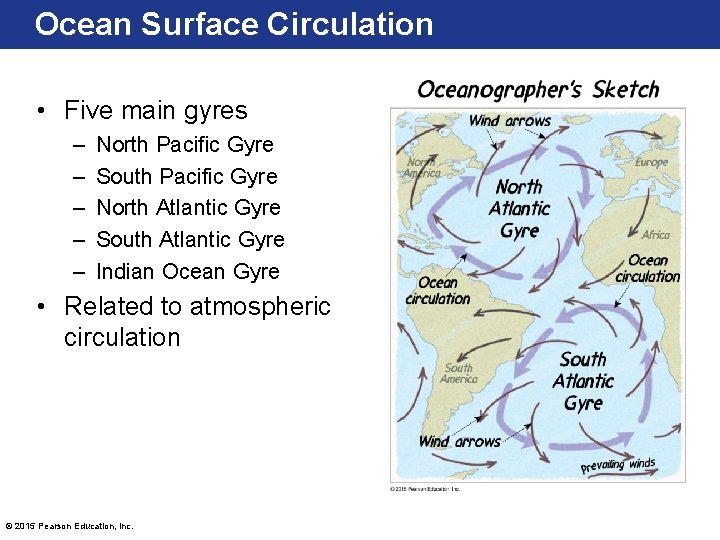
Ocean Surface Circulation • Five main gyres – – – North Pacific Gyre South Pacific Gyre North Atlantic Gyre South Atlantic Gyre Indian Ocean Gyre • Related to atmospheric circulation © 2015 Pearson Education, Inc.
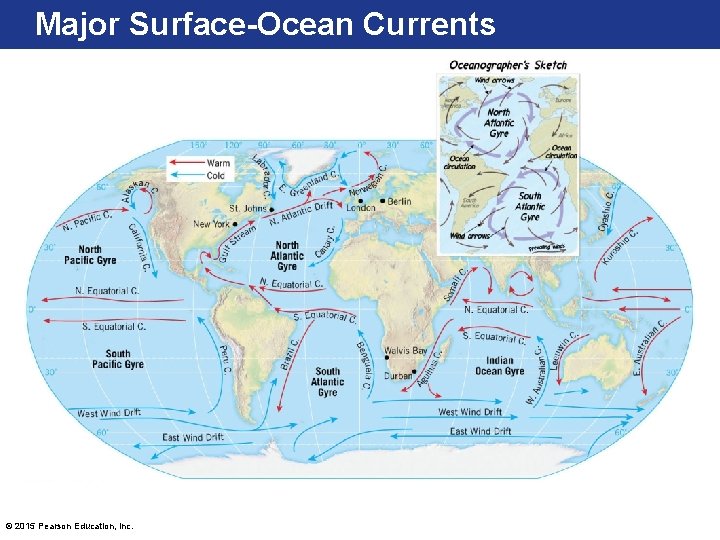
Major Surface-Ocean Currents © 2015 Pearson Education, Inc.
Ocean Surface Circulation • Deflected by the Coriolis effect – To the right in the Northern Hemisphere – To the left in the Southern Hemisphere • Four main currents generally exist within each gyre © 2015 Pearson Education, Inc.
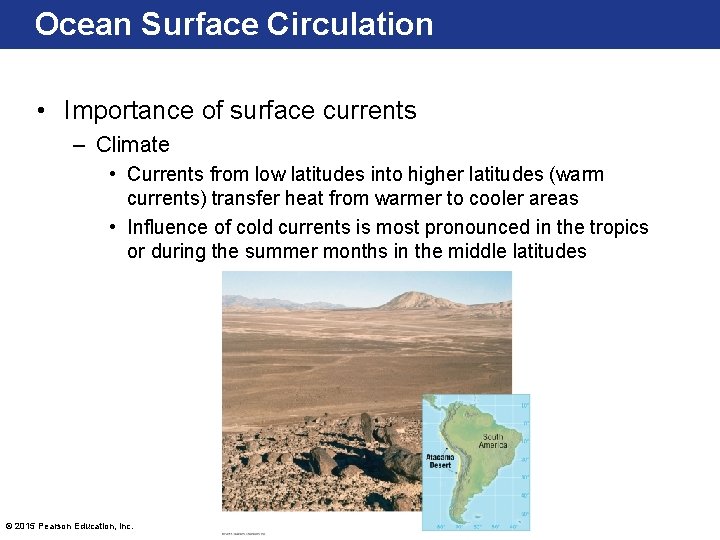
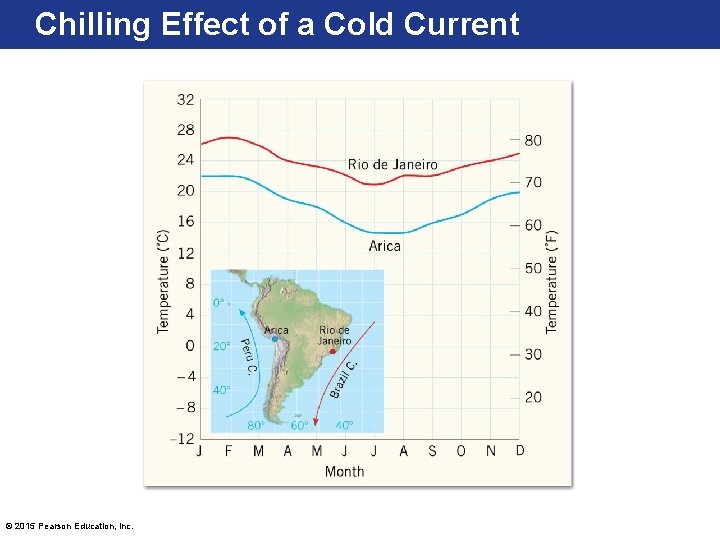
Ocean Surface Circulation • Importance of surface currents – Climate • Currents from low latitudes into higher latitudes (warm currents) transfer heat from warmer to cooler areas • Influence of cold currents is most pronounced in the tropics or during the summer months in the middle latitudes © 2015 Pearson Education, Inc.
Chilling Effect of a Cold Current © 2015 Pearson Education, Inc.
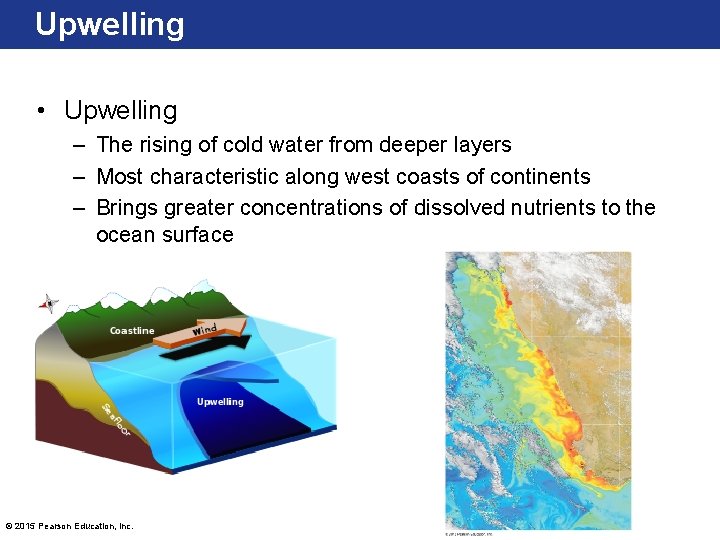
Upwelling • Upwelling – The rising of cold water from deeper layers – Most characteristic along west coasts of continents – Brings greater concentrations of dissolved nutrients to the ocean surface © 2015 Pearson Education, Inc.
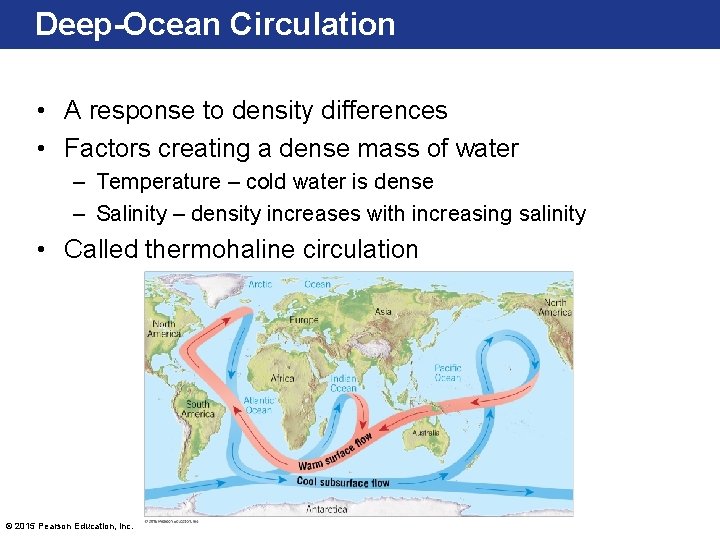
Deep-Ocean Circulation • A response to density differences • Factors creating a dense mass of water – Temperature – cold water is dense – Salinity – density increases with increasing salinity • Called thermohaline circulation © 2015 Pearson Education, Inc.
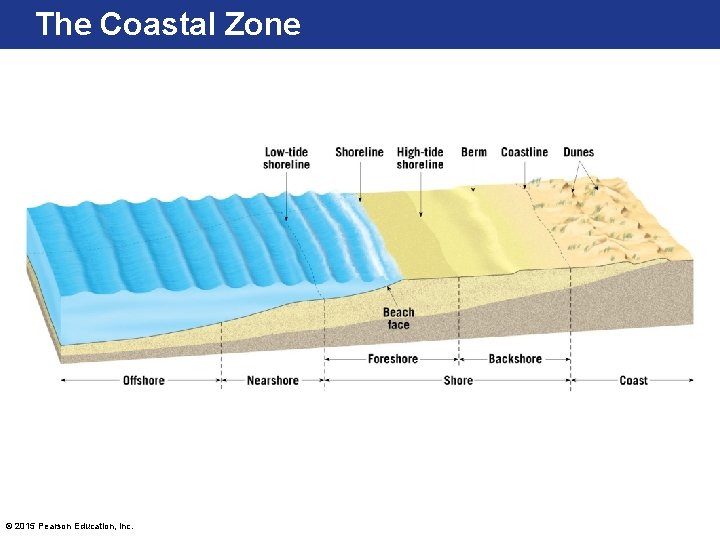
The Shoreline: A Dynamic Interface • The land-sea boundary – Shoreline – contact between land sea – Shore – area between lowest tidal level and highest areas affected by storm waves – Coastline – the seaward edge of the coast – Beach – accumulation of sediment along the landward margin of the ocean © 2015 Pearson Education, Inc.
The Coastal Zone © 2015 Pearson Education, Inc.
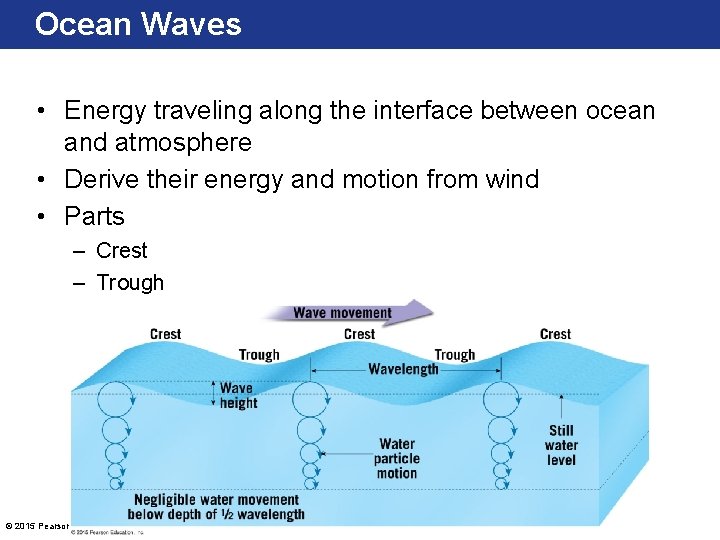
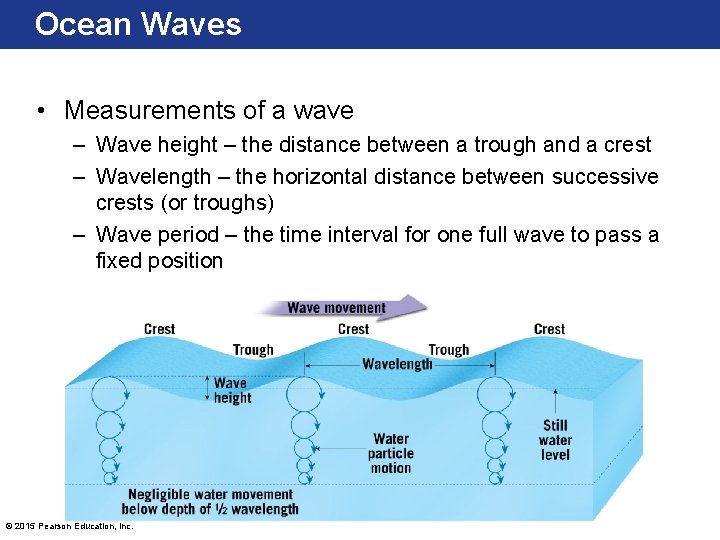
Ocean Waves • Energy traveling along the interface between ocean and atmosphere • Derive their energy and motion from wind • Parts – Crest – Trough © 2015 Pearson Education, Inc.
Ocean Waves • Measurements of a wave – Wave height – the distance between a trough and a crest – Wavelength – the horizontal distance between successive crests (or troughs) – Wave period – the time interval for one full wave to pass a fixed position © 2015 Pearson Education, Inc.
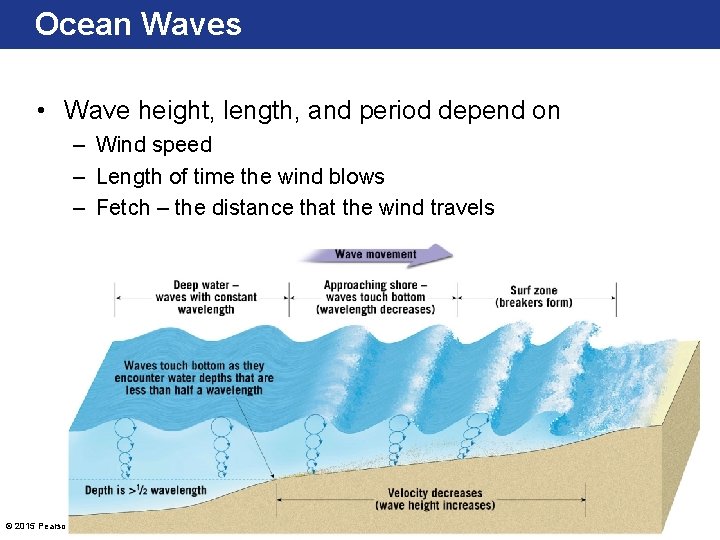
Ocean Waves • Wave height, length, and period depend on – Wind speed – Length of time the wind blows – Fetch – the distance that the wind travels © 2015 Pearson Education, Inc.
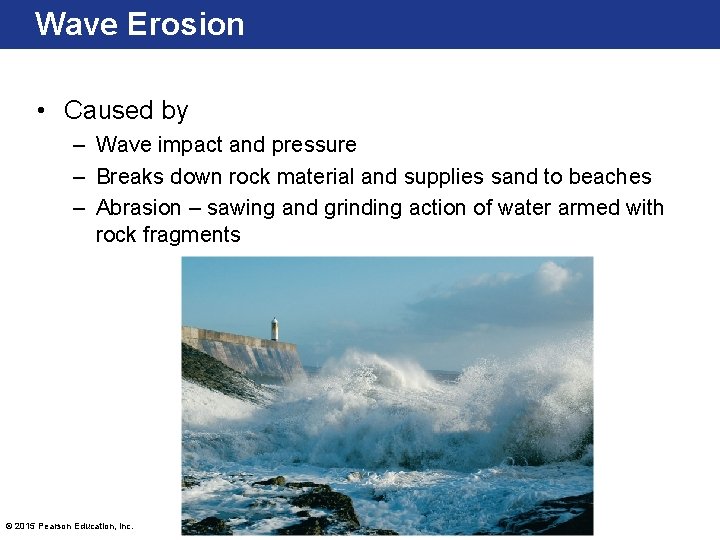
Wave Erosion • Caused by – Wave impact and pressure – Breaks down rock material and supplies sand to beaches – Abrasion – sawing and grinding action of water armed with rock fragments © 2015 Pearson Education, Inc.
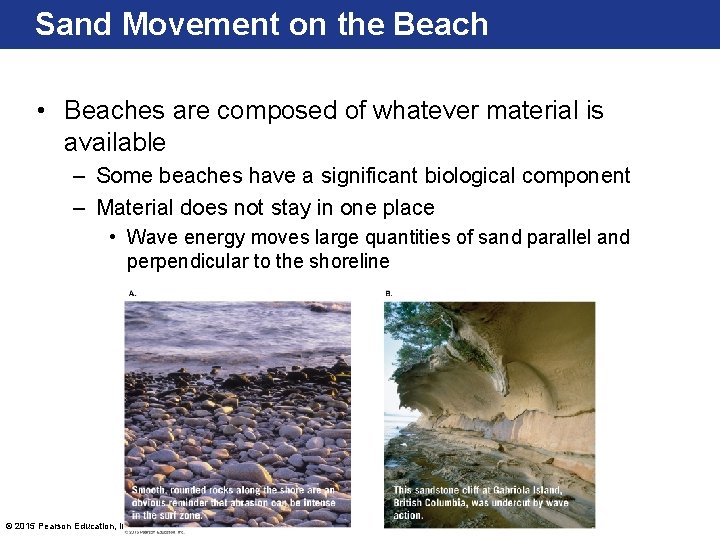
Sand Movement on the Beach • Beaches are composed of whatever material is available – Some beaches have a significant biological component – Material does not stay in one place • Wave energy moves large quantities of sand parallel and perpendicular to the shoreline © 2015 Pearson Education, Inc.
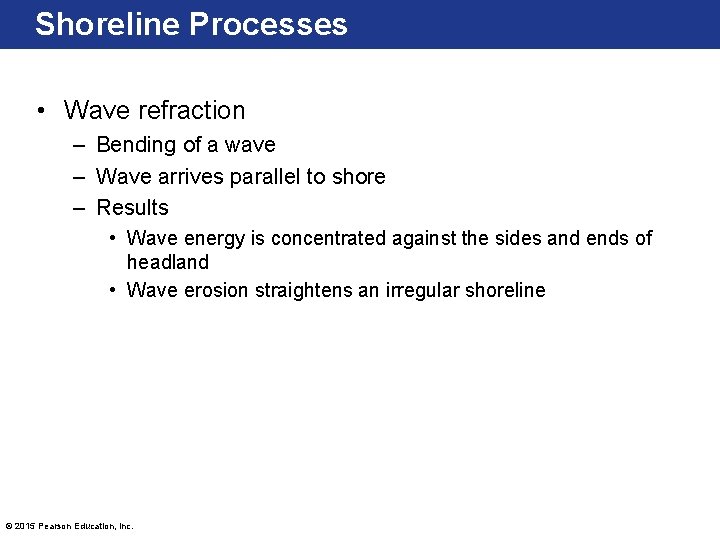
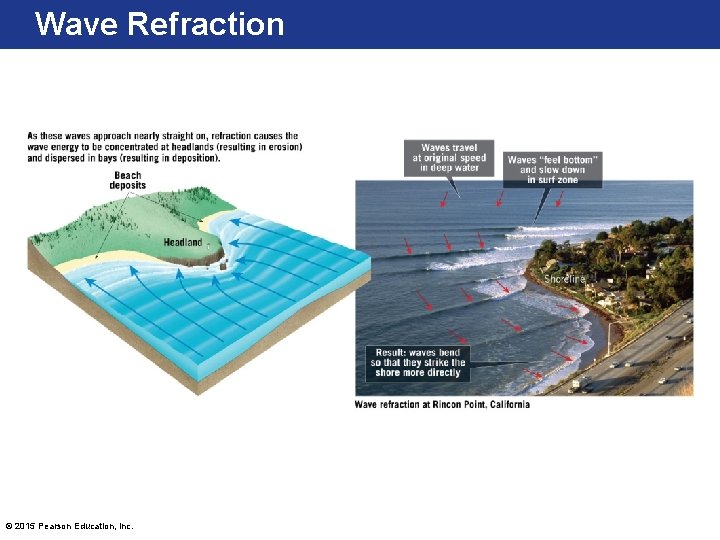
Shoreline Processes • Wave refraction – Bending of a wave – Wave arrives parallel to shore – Results • Wave energy is concentrated against the sides and ends of headland • Wave erosion straightens an irregular shoreline © 2015 Pearson Education, Inc.
Wave Refraction © 2015 Pearson Education, Inc.
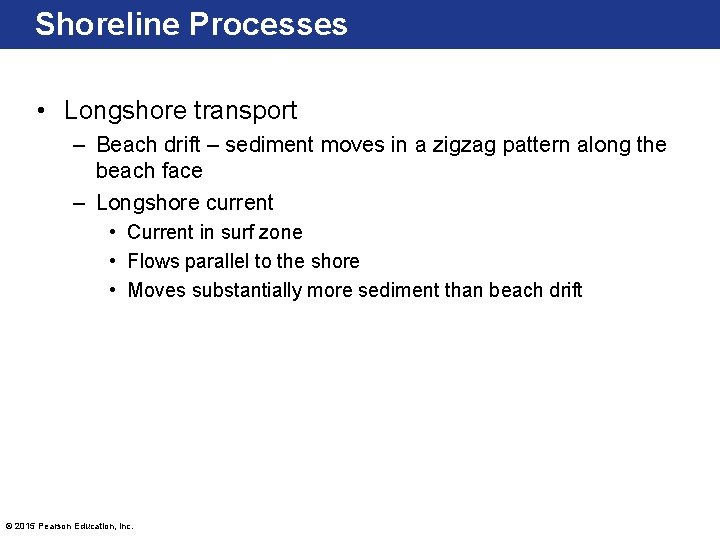
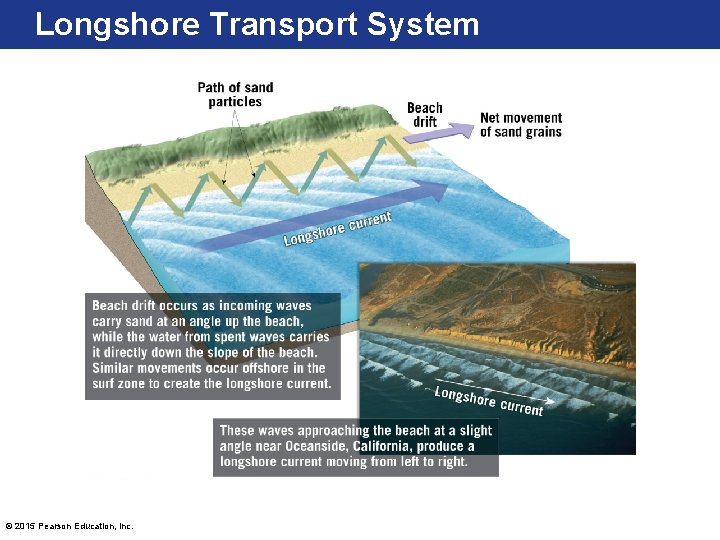
Shoreline Processes • Longshore transport – Beach drift – sediment moves in a zigzag pattern along the beach face – Longshore current • Current in surf zone • Flows parallel to the shore • Moves substantially more sediment than beach drift © 2015 Pearson Education, Inc.
Longshore Transport System © 2015 Pearson Education, Inc.
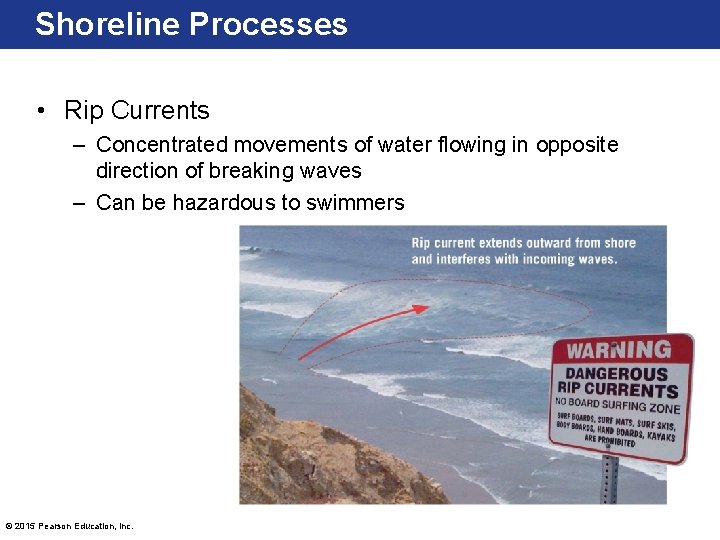
Shoreline Processes • Rip Currents – Concentrated movements of water flowing in opposite direction of breaking waves – Can be hazardous to swimmers © 2015 Pearson Education, Inc.