
Chapter 15 INTERVIEW TECHNIQUES Professionalism Skills for Workplace

- Slides: 30
Chapter 15 INTERVIEW TECHNIQUES Professionalism: Skills for Workplace Success, 2/e Lydia E. Anderson • Sandra B. Bolt Copyright © 2011 by Pearson Education, Inc. publishing as Pearson [imprint]
“All the world’s a stage. ” William Shakespeare (1564 -1616) Professionalism: Skills for Workplace Success, 2/e Lydia E. Anderson • Sandra B. Bolt Copyright © 2011 by Pearson Education, Inc. publishing as Pearson [imprint]
OBJECTIVES • Conduct company specific research for interview preparation • Prepare a personal commercial to sell skills and tie them to a target job • Identify pre-interview preparation activities including creating an interview portfolio and practice interview questions Professionalism: Skills for Workplace Success, 2/e Lydia E. Anderson • Sandra B. Bolt Copyright © 2011 by Pearson Education, Inc. publishing as Pearson [imprint]
OBJECTIVES (cont. ) • Describe specific statements and behaviors to exhibit at the close of an interview and job offer • Discuss salary negotiation strategies Professionalism: Skills for Workplace Success, 2/e Lydia E. Anderson • Sandra B. Bolt Copyright © 2011 by Pearson Education, Inc. publishing as Pearson [imprint]
COMPANY SPECIFIC RESEARCH • Conduct research prior to interview • Research better prepares you for interview, increases confidence, and provides greater advantage over other candidates • Sources include: – – Company web site, brochures, materials Internet search Industry journals Interviews with current employees and business leaders Professionalism: Skills for Workplace Success, 2/e Lydia E. Anderson • Sandra B. Bolt Copyright © 2011 by Pearson Education, Inc. publishing as Pearson [imprint]
COMPANY SPECIFIC RESEARCH • Identify as much as you can about – The target company – Its administrators – Department of the target job • Identify if the company is the right fit for you and your career goals • Share specific research information during the interview Professionalism: Skills for Workplace Success, 2/e Lydia E. Anderson • Sandra B. Bolt Copyright © 2011 by Pearson Education, Inc. publishing as Pearson [imprint]
THE PERSONAL COMMERCIAL • Personal Commercial: a brief career biography that conveys your career choice, knowledge, skills, strengths, abilities, and experiences that make you uniquely qualified • Sells skills and ties these skills to the target job in a brief two minute statement • Adapt statement to the requirements for each target job Professionalism: Skills for Workplace Success, 2/e Lydia E. Anderson • Sandra B. Bolt Copyright © 2011 by Pearson Education, Inc. publishing as Pearson [imprint]
THE PERSONAL COMMERCIAL • Do not include personal information such as marital status, hobbies, or other private information • Include career objective information • Use personal commercial at beginning of interview • Restate at end of interview • (Exercise 15 -1, page 240) Professionalism: Skills for Workplace Success, 2/e Lydia E. Anderson • Sandra B. Bolt Copyright © 2011 by Pearson Education, Inc. publishing as Pearson [imprint]
THE INVITATION TO INTERVIEW • Most invitations occur via phone or email • Regularly check and respond to phone and e-mail messages • Maintain a professional voice mail message and e-mail address Professionalism: Skills for Workplace Success, 2/e Lydia E. Anderson • Sandra B. Bolt Copyright © 2011 by Pearson Education, Inc. publishing as Pearson [imprint]
THE INVITATION TO INTERVIEW • Attempt to identify – With whom you will interview – How much time is scheduled for the interview – How many applicants are being called to interview • Be friendly, respectful, and professional • Try to arrange interview at time that puts you at advantage – First and last are most memorable – Morning is best Professionalism: Skills for Workplace Success, 2/e Lydia E. Anderson • Sandra B. Bolt Copyright © 2011 by Pearson Education, Inc. publishing as Pearson [imprint]
THE INTERVIEW PORTFOLIO • Interview Portfolio: small folder containing relevant documents that are taken to an interview • Use business portfolio or paper folder with pockets • Include: copies of résumé, cover letter, reference list, generic application, and personal commercial • Also include a calendar, note paper, a pen, and personal business cards Professionalism: Skills for Workplace Success, 2/e Lydia E. Anderson • Sandra B. Bolt Copyright © 2011 by Pearson Education, Inc. publishing as Pearson [imprint]
PRACTICE INTERVIEW QUESTIONS • Important pre-interview activity • Practice answering common interview questions in front of mirror or video camera (table 15 -1) • Analyze responses – Selling skills – Projecting professional image – Nervous gestures Professionalism: Skills for Workplace Success, 2/e Lydia E. Anderson • Sandra B. Bolt Copyright © 2011 by Pearson Education, Inc. publishing as Pearson [imprint]
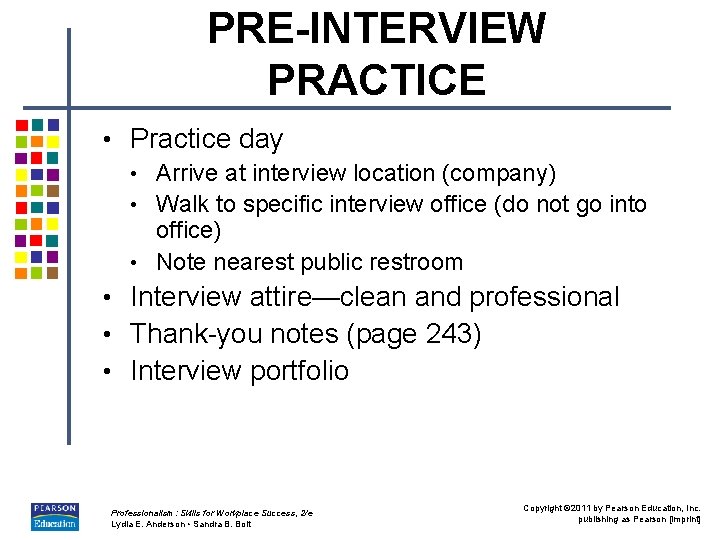
PRE-INTERVIEW PRACTICE • Practice day • Arrive at interview location (company) • Walk to specific interview office (do not go into office) • Note nearest public restroom • Interview attire—clean and professional • Thank-you notes (page 243) • Interview portfolio Professionalism: Skills for Workplace Success, 2/e Lydia E. Anderson • Sandra B. Bolt Copyright © 2011 by Pearson Education, Inc. publishing as Pearson [imprint]
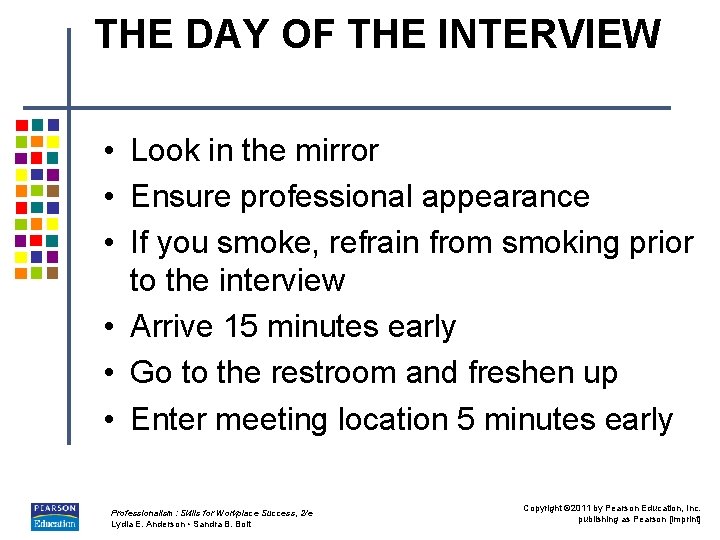
THE DAY OF THE INTERVIEW • Look in the mirror • Ensure professional appearance • If you smoke, refrain from smoking prior to the interview • Arrive 15 minutes early • Go to the restroom and freshen up • Enter meeting location 5 minutes early Professionalism: Skills for Workplace Success, 2/e Lydia E. Anderson • Sandra B. Bolt Copyright © 2011 by Pearson Education, Inc. publishing as Pearson [imprint]
THE DAY OF THE INTERVIEW • • • Make every interaction positive Introduce yourself to the receptionist Be sincere Take a seat and relax Use positive self-talk From the minute you enter the building, assume your interview has begun Professionalism: Skills for Workplace Success, 2/e Lydia E. Anderson • Sandra B. Bolt Copyright © 2011 by Pearson Education, Inc. publishing as Pearson [imprint]
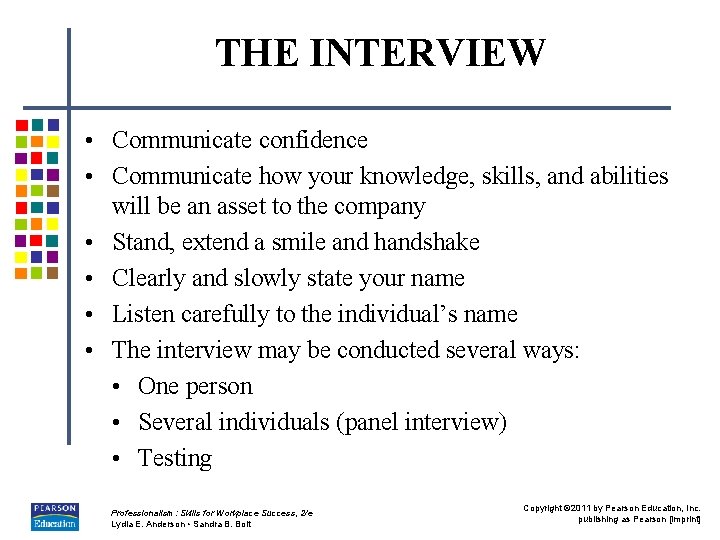
THE INTERVIEW • Communicate confidence • Communicate how your knowledge, skills, and abilities will be an asset to the company • Stand, extend a smile and handshake • Clearly and slowly state your name • Listen carefully to the individual’s name • The interview may be conducted several ways: • One person • Several individuals (panel interview) • Testing Professionalism: Skills for Workplace Success, 2/e Lydia E. Anderson • Sandra B. Bolt Copyright © 2011 by Pearson Education, Inc. publishing as Pearson [imprint]
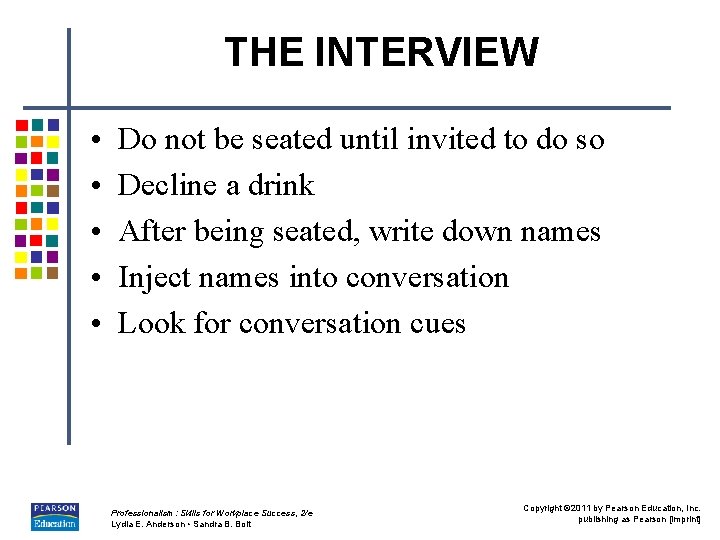
THE INTERVIEW • • • Do not be seated until invited to do so Decline a drink After being seated, write down names Inject names into conversation Look for conversation cues Professionalism: Skills for Workplace Success, 2/e Lydia E. Anderson • Sandra B. Bolt Copyright © 2011 by Pearson Education, Inc. publishing as Pearson [imprint]
THE INTERVIEW • Body language – Watch yours – Watch individuals conducting interview – Sit up straight, sit back in chair, and relax – Be calm but alert • Keep hands folded on lap or ready to take notes • Do not lean on furniture • Make eye contact, but don’t stare at the interviewer Professionalism: Skills for Workplace Success, 2/e Lydia E. Anderson • Sandra B. Bolt Copyright © 2011 by Pearson Education, Inc. publishing as Pearson [imprint]
THE INTERVIEW When Asked a Question • • Listen carefully Take a few seconds to think and digest question Formulate an answer Answers should relate back to the job qualifications and/or job duties The goal is to convey to interviewer how your skills will assist the company Keep answers brief, but complete Your job is to sell yourself When possible, inject company information Professionalism: Skills for Workplace Success, 2/e Lydia E. Anderson • Sandra B. Bolt Copyright © 2011 by Pearson Education, Inc. publishing as Pearson [imprint]
THE INTERVIEW When Asked a Question (cont. ) • “Talk about yourself” = personal commercial • When possible, share job samples • When possible, share company research findings • Do not provide personal information • Relate answers back to the target job Professionalism: Skills for Workplace Success, 2/e Lydia E. Anderson • Sandra B. Bolt Copyright © 2011 by Pearson Education, Inc. publishing as Pearson [imprint]
PHONE INTERVIEWS • First interview may take place over the phone • Consistently answer phone professionally, keeping interview portfolio within easy reach • During a phone interview: – Be professional and prepared – Be concise with communication – Be polite Professionalism: Skills for Workplace Success, 2/e Lydia E. Anderson • Sandra B. Bolt Copyright © 2011 by Pearson Education, Inc. publishing as Pearson [imprint]
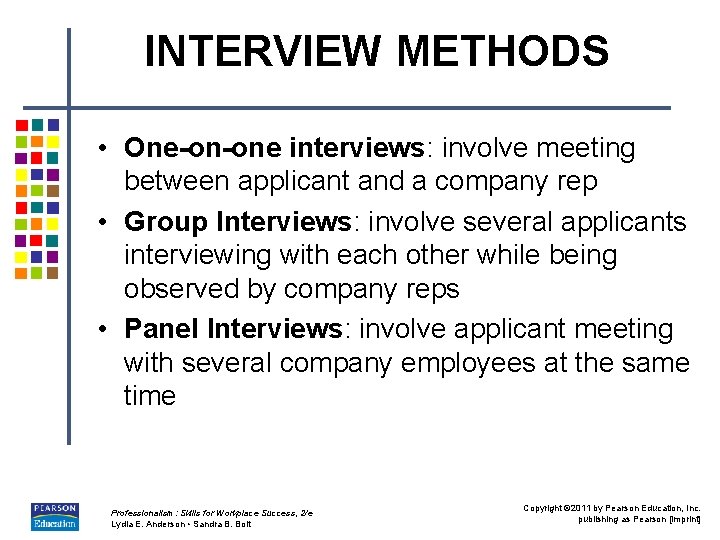
INTERVIEW METHODS • One-on-one interviews: involve meeting between applicant and a company rep • Group Interviews: involve several applicants interviewing with each other while being observed by company reps • Panel Interviews: involve applicant meeting with several company employees at the same time Professionalism: Skills for Workplace Success, 2/e Lydia E. Anderson • Sandra B. Bolt Copyright © 2011 by Pearson Education, Inc. publishing as Pearson [imprint]
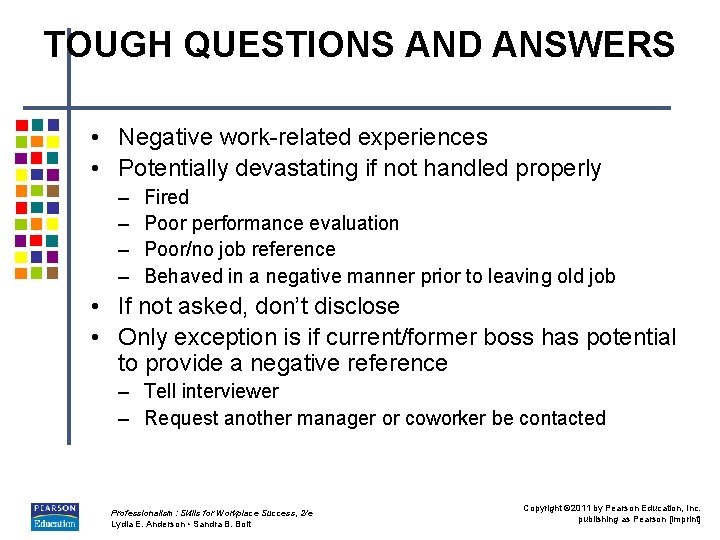
TOUGH QUESTIONS AND ANSWERS • Negative work-related experiences • Potentially devastating if not handled properly – – Fired Poor performance evaluation Poor/no job reference Behaved in a negative manner prior to leaving old job • If not asked, don’t disclose • Only exception is if current/former boss has potential to provide a negative reference – Tell interviewer – Request another manager or coworker be contacted Professionalism: Skills for Workplace Success, 2/e Lydia E. Anderson • Sandra B. Bolt Copyright © 2011 by Pearson Education, Inc. publishing as Pearson [imprint]
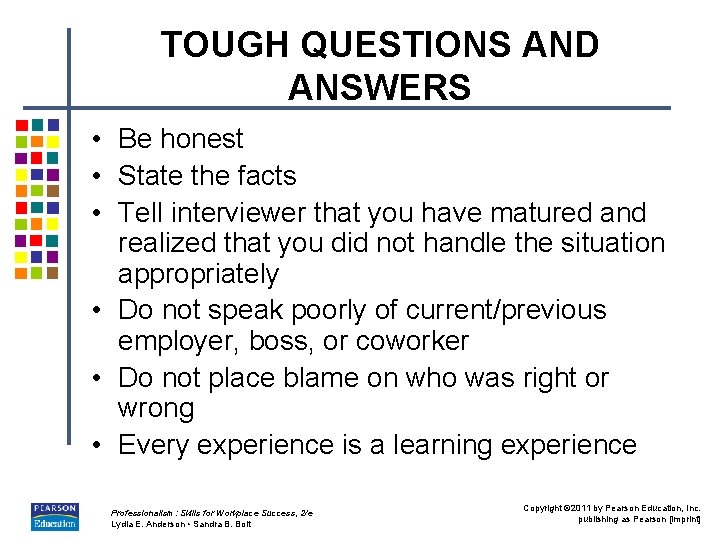
TOUGH QUESTIONS AND ANSWERS • Be honest • State the facts • Tell interviewer that you have matured and realized that you did not handle the situation appropriately • Do not speak poorly of current/previous employer, boss, or coworker • Do not place blame on who was right or wrong • Every experience is a learning experience Professionalism: Skills for Workplace Success, 2/e Lydia E. Anderson • Sandra B. Bolt Copyright © 2011 by Pearson Education, Inc. publishing as Pearson [imprint]
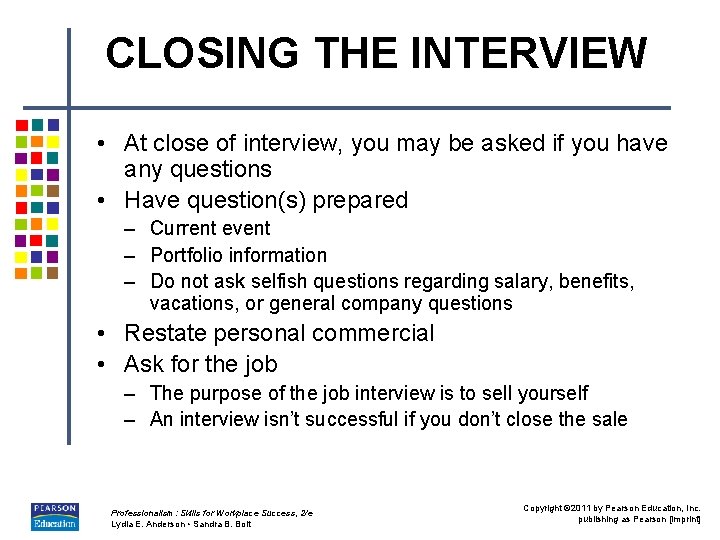
CLOSING THE INTERVIEW • At close of interview, you may be asked if you have any questions • Have question(s) prepared – Current event – Portfolio information – Do not ask selfish questions regarding salary, benefits, vacations, or general company questions • Restate personal commercial • Ask for the job – The purpose of the job interview is to sell yourself – An interview isn’t successful if you don’t close the sale Professionalism: Skills for Workplace Success, 2/e Lydia E. Anderson • Sandra B. Bolt Copyright © 2011 by Pearson Education, Inc. publishing as Pearson [imprint]
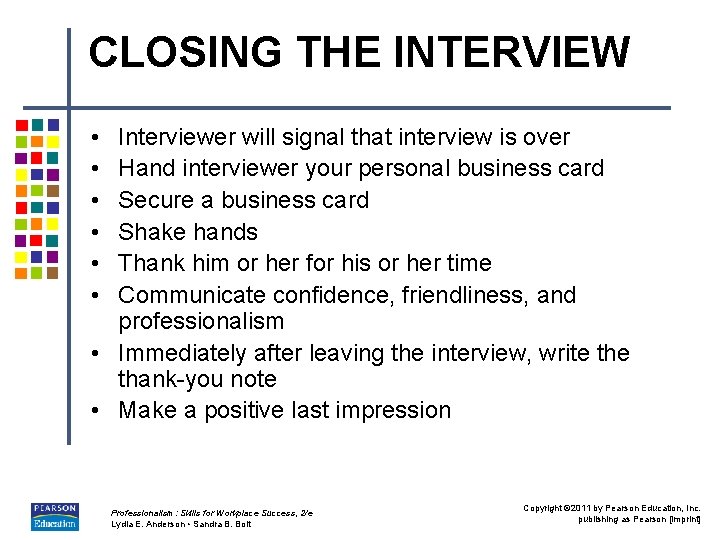
CLOSING THE INTERVIEW • • • Interviewer will signal that interview is over Hand interviewer your personal business card Secure a business card Shake hands Thank him or her for his or her time Communicate confidence, friendliness, and professionalism • Immediately after leaving the interview, write thank-you note • Make a positive last impression Professionalism: Skills for Workplace Success, 2/e Lydia E. Anderson • Sandra B. Bolt Copyright © 2011 by Pearson Education, Inc. publishing as Pearson [imprint]
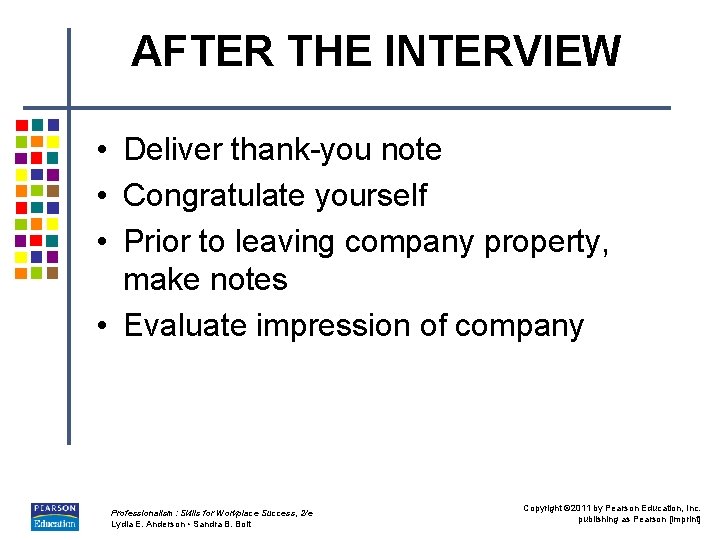
AFTER THE INTERVIEW • Deliver thank-you note • Congratulate yourself • Prior to leaving company property, make notes • Evaluate impression of company Professionalism: Skills for Workplace Success, 2/e Lydia E. Anderson • Sandra B. Bolt Copyright © 2011 by Pearson Education, Inc. publishing as Pearson [imprint]
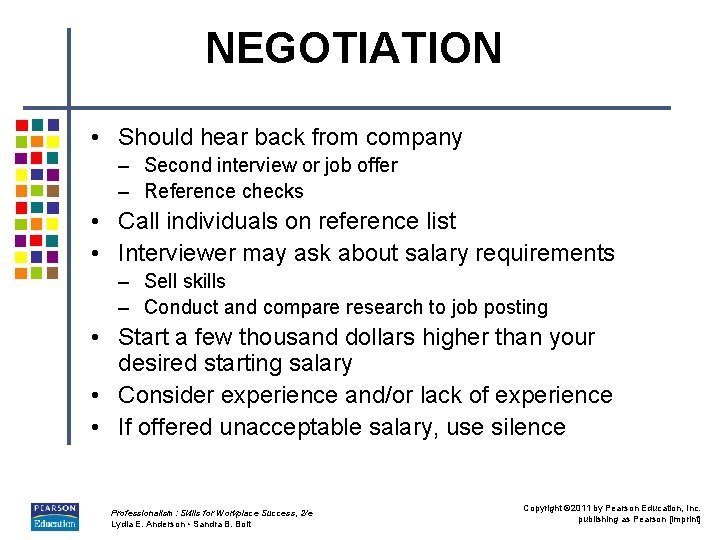
NEGOTIATION • Should hear back from company – Second interview or job offer – Reference checks • Call individuals on reference list • Interviewer may ask about salary requirements – Sell skills – Conduct and compare research to job posting • Start a few thousand dollars higher than your desired starting salary • Consider experience and/or lack of experience • If offered unacceptable salary, use silence Professionalism: Skills for Workplace Success, 2/e Lydia E. Anderson • Sandra B. Bolt Copyright © 2011 by Pearson Education, Inc. publishing as Pearson [imprint]
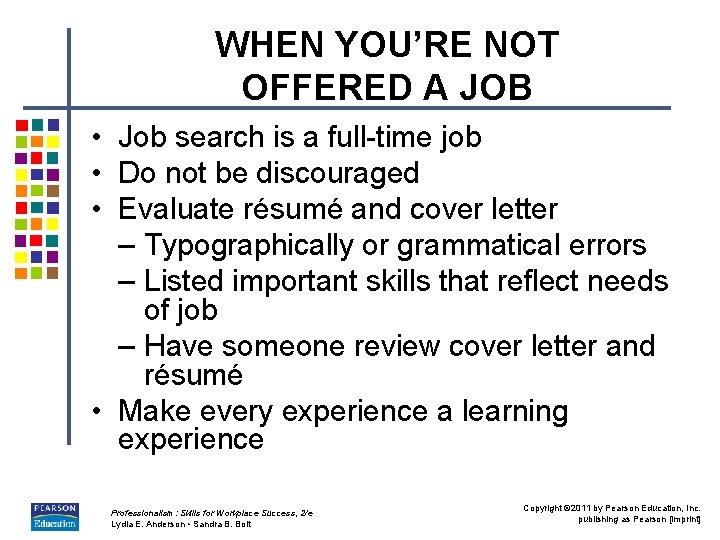
WHEN YOU’RE NOT OFFERED A JOB • Job search is a full-time job • Do not be discouraged • Evaluate résumé and cover letter – Typographically or grammatical errors – Listed important skills that reflect needs of job – Have someone review cover letter and résumé • Make every experience a learning experience Professionalism: Skills for Workplace Success, 2/e Lydia E. Anderson • Sandra B. Bolt Copyright © 2011 by Pearson Education, Inc. publishing as Pearson [imprint]
WHEN YOU’RE NOT OFFERED A JOB • Review each step in interview process – Grade yourself – Pre-interview preparation – Interview day appearance – Interview answers – Ability to interject company research into answers • Maintain a good attitude Professionalism: Skills for Workplace Success, 2/e Lydia E. Anderson • Sandra B. Bolt Copyright © 2011 by Pearson Education, Inc. publishing as Pearson [imprint]