
Chapter 15 Interference and Diffraction Table of Contents
Chapter 15 Interference and Diffraction Table of Contents Section 1 Interference Section 2 Diffraction Section 3 Lasers Chapter menu Resources Copyright © by Holt, Rinehart and Winston. All rights reserved.

Chapter 15 Section 1 Interference Objectives • Describe how light waves interfere with each other to produce bright and dark fringes. • Identify the conditions required for interference to occur. • Predict the location of interference fringes using the equation for double-slit interference. Chapter menu Resources Copyright © by Holt, Rinehart and Winston. All rights reserved.
Chapter 15 Section 1 Interference Combining Light Waves • Interference takes place only between waves with the same wavelength. A light source that has a single wavelength is called monochromatic. • In constructive interference, component waves combine to form a resultant wave with the same wavelength but with an amplitude that is greater than the either of the individual component waves. • In the case of destructive interference, the resultant amplitude is less than the amplitude of the larger component wave. Chapter menu Resources Copyright © by Holt, Rinehart and Winston. All rights reserved.
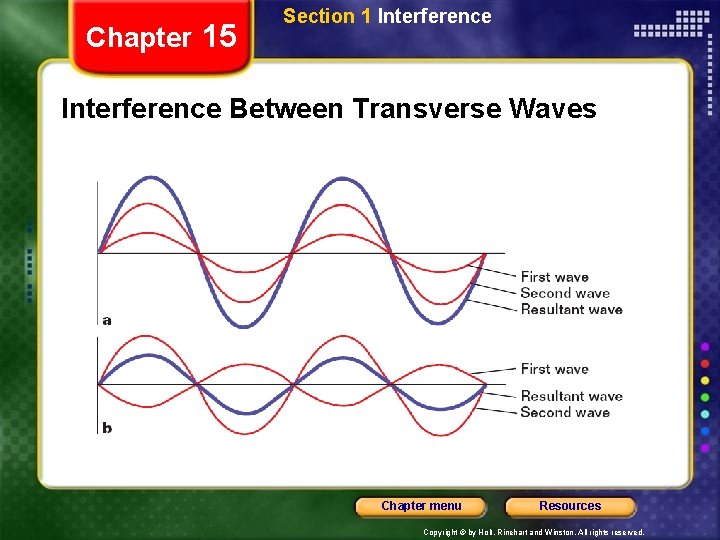
Chapter 15 Section 1 Interference Between Transverse Waves Chapter menu Resources Copyright © by Holt, Rinehart and Winston. All rights reserved.
Chapter 15 Section 1 Interference Combining Light Waves, continued • Waves must have a constant phase difference for interference to be observed. • Coherence is the correlation between the phases of two or more waves. – Sources of light for which the phase difference is constant are said to be coherent. – Sources of light for which the phase difference is not constant are said to be incoherent. Chapter menu Resources Copyright © by Holt, Rinehart and Winston. All rights reserved.

Chapter 15 Section 3 Lasers Incoherent and Coherent Light Chapter menu Resources Copyright © by Holt, Rinehart and Winston. All rights reserved.
Chapter 15 Section 1 Interference Demonstrating Interference • Interference can be demonstrated by passing light through two narrow parallel slits. • If monochromatic light is used, the light from the two slits produces a series of bright and dark parallel bands, or fringes, on a viewing screen. Chapter menu Resources Copyright © by Holt, Rinehart and Winston. All rights reserved.
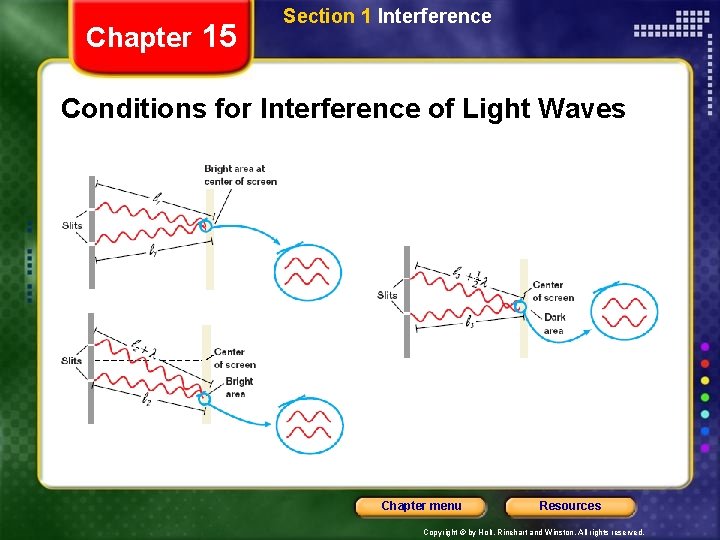
Chapter 15 Section 1 Interference Conditions for Interference of Light Waves Chapter menu Resources Copyright © by Holt, Rinehart and Winston. All rights reserved.

Chapter 15 Section 1 Interference Demonstrating Interference, continued • The location of interference fringes can be predicted. • The path difference is the difference in the distance traveled by two beams when they are scattered in the same direction from different points. • The path difference equals d sin . Chapter menu Resources Copyright © by Holt, Rinehart and Winston. All rights reserved.

Chapter 15 Section 1 Interference Demonstrating Interference, continued • The number assigned to interference fringes with respect to the central bright fringe is called the order number. The order number is represented by the symbol m. • The central bright fringe at = 0 (m = 0) is called the zeroth-order maximum, or the central maximum. • The first maximum on either side of the central maximum (m = 1) is called the first-order maximum. Chapter menu Resources Copyright © by Holt, Rinehart and Winston. All rights reserved.

Chapter 15 Section 1 Interference Demonstrating Interference, continued • Equation for constructive interference d sin = ±m m = 0, 1, 2, 3, … The path difference between two waves = an integer multiple of the wavelength • Equation for destructive interference d sin = ±(m + 1/2) m = 0, 1, 2, 3, … The path difference between two waves = an odd number of half wavelength Chapter menu Resources Copyright © by Holt, Rinehart and Winston. All rights reserved.
Chapter 15 Section 2 Diffraction Objectives • Describe how light waves bend around obstacles and produce bright and dark fringes. • Calculate the positions of fringes for a diffraction grating. • Describe how diffraction determines an optical instrument’s ability to resolve images. Chapter menu Resources Copyright © by Holt, Rinehart and Winston. All rights reserved.
Chapter 15 Section 2 Diffraction The Bending of Light Waves • Diffraction is a change in the direction of a wave when the wave encounters an obstacle, an opening, or an edge. • Light waves form a diffraction pattern by passing around an obstacle or bending through a slit and interfering with each other. • Wavelets (as in Huygens’ principle) in a wave front interfere with each other. Chapter menu Resources Copyright © by Holt, Rinehart and Winston. All rights reserved.

Chapter 15 Section 2 Diffraction Destructive Interference in Single-Slit Diffraction Chapter menu Resources Copyright © by Holt, Rinehart and Winston. All rights reserved.
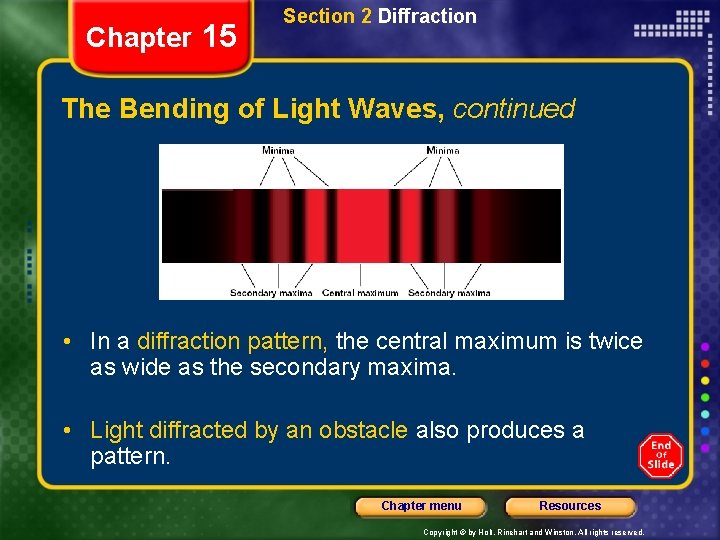
Chapter 15 Section 2 Diffraction The Bending of Light Waves, continued • In a diffraction pattern, the central maximum is twice as wide as the secondary maxima. • Light diffracted by an obstacle also produces a pattern. Chapter menu Resources Copyright © by Holt, Rinehart and Winston. All rights reserved.
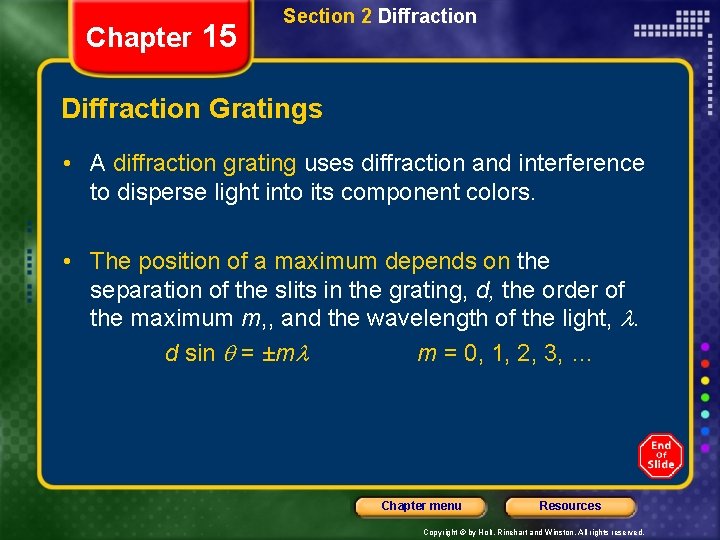
Chapter 15 Section 2 Diffraction Gratings • A diffraction grating uses diffraction and interference to disperse light into its component colors. • The position of a maximum depends on the separation of the slits in the grating, d, the order of the maximum m, , and the wavelength of the light, . d sin = ±m m = 0, 1, 2, 3, … Chapter menu Resources Copyright © by Holt, Rinehart and Winston. All rights reserved.
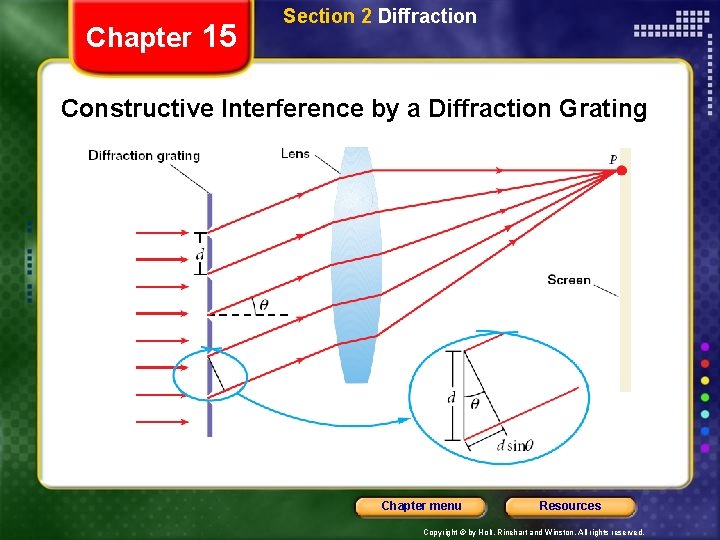
Chapter 15 Section 2 Diffraction Constructive Interference by a Diffraction Grating Chapter menu Resources Copyright © by Holt, Rinehart and Winston. All rights reserved.
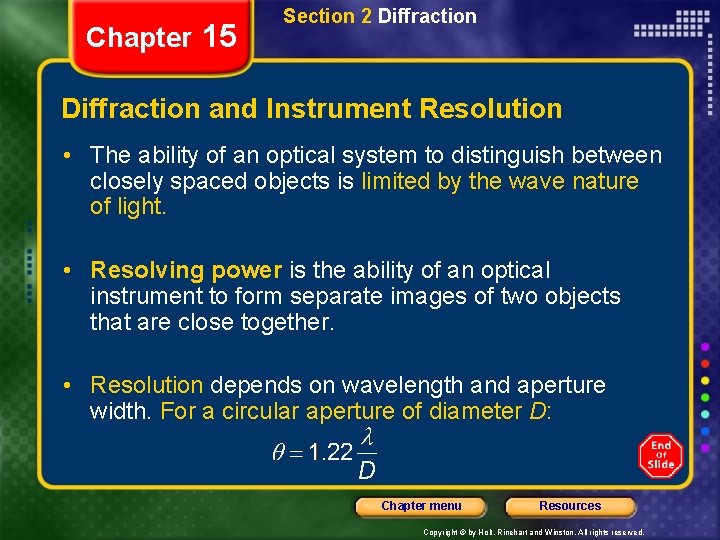
Chapter 15 Section 2 Diffraction and Instrument Resolution • The ability of an optical system to distinguish between closely spaced objects is limited by the wave nature of light. • Resolving power is the ability of an optical instrument to form separate images of two objects that are close together. • Resolution depends on wavelength and aperture width. For a circular aperture of diameter D: Chapter menu Resources Copyright © by Holt, Rinehart and Winston. All rights reserved.
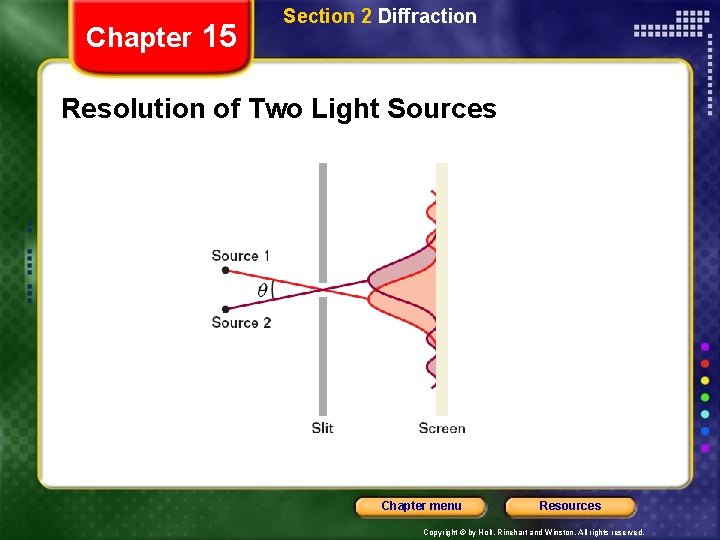
Chapter 15 Section 2 Diffraction Resolution of Two Light Sources Chapter menu Resources Copyright © by Holt, Rinehart and Winston. All rights reserved.
Chapter 15 Section 3 Lasers Objectives • Describe the properties of laser light. • Explain how laser light has particular advantages in certain applications. Chapter menu Resources Copyright © by Holt, Rinehart and Winston. All rights reserved.
Chapter 15 Section 3 Lasers and Coherence • A laser is a device that produces coherent light at a single wavelength. • The word laser is an acronym of “light amplification by stimulated emission of radiation. ” • Lasers transform other forms of energy into coherent light. Chapter menu Resources Copyright © by Holt, Rinehart and Winston. All rights reserved.
Chapter 15 Section 3 Lasers Applications of Lasers • Lasers are used to measure distances with great precision. • Compact disc and DVD players use lasers to read digital data on these discs. • Lasers have many applications in medicine. – Eye surgery – Tumor removal – Scar removal Chapter menu Resources Copyright © by Holt, Rinehart and Winston. All rights reserved.
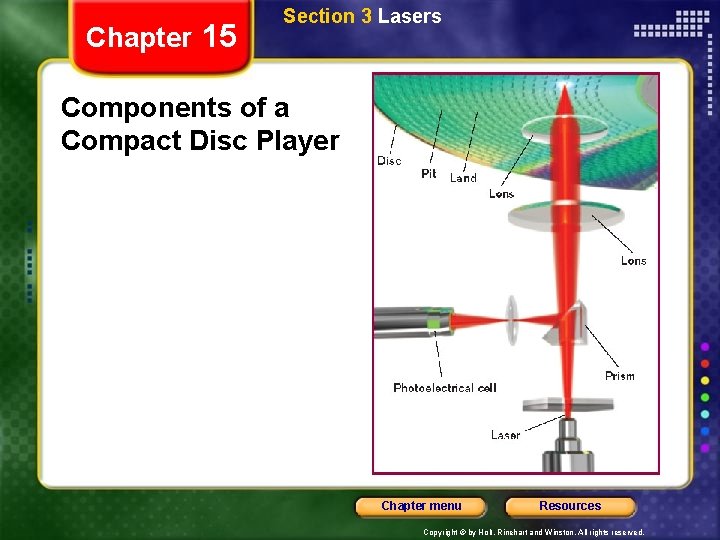
Chapter 15 Section 3 Lasers Components of a Compact Disc Player Chapter menu Resources Copyright © by Holt, Rinehart and Winston. All rights reserved.
- Slides: 23