
CHAPTER 15 IMPULSE AND MOMENTUM OBJECTIVES 1 To
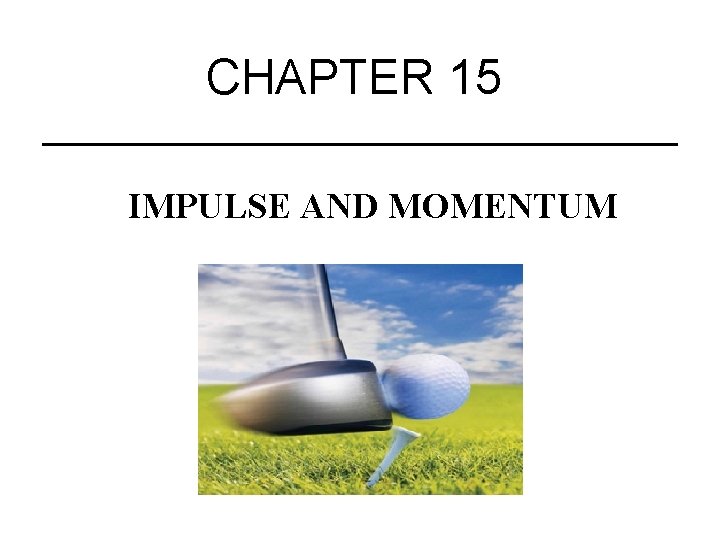
CHAPTER 15 IMPULSE AND MOMENTUM
OBJECTIVES 1. To develop the principle of linear impulse and momentum for a particle. 2. To study the conservation of linear momentum for a particle. 3. To analyze the mechanics of impact
CHAPTER OUTLINE: 1. Principle of Linear impulse and momentum 2. Conservation of Linear Momentum 3. Impact i. Central impact ii. Oblique impact
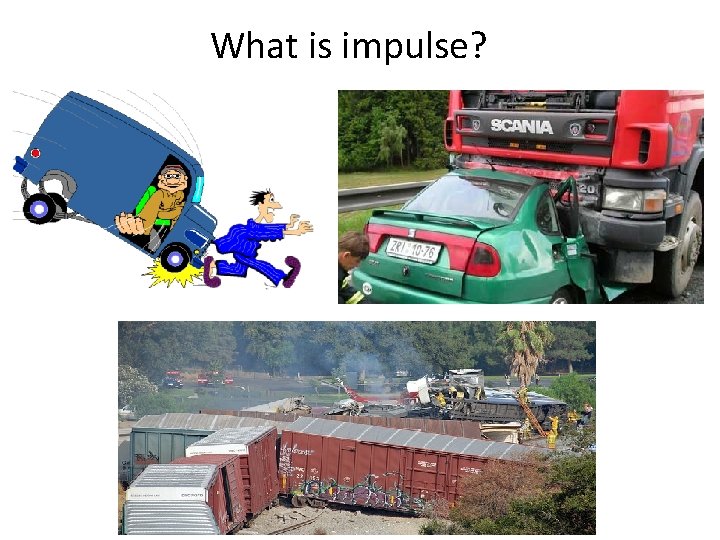
What is impulse?

What is impulse?

What is impulse? Impulse is defined as a force multiplied by the amount of time it acts over. In calculus terms, the impulse can be calculated as the integral of force with respect to time. Alternately, impulse can be calculated as the difference in momentum between two given instances. Impulse means change in momentum. I = Ft
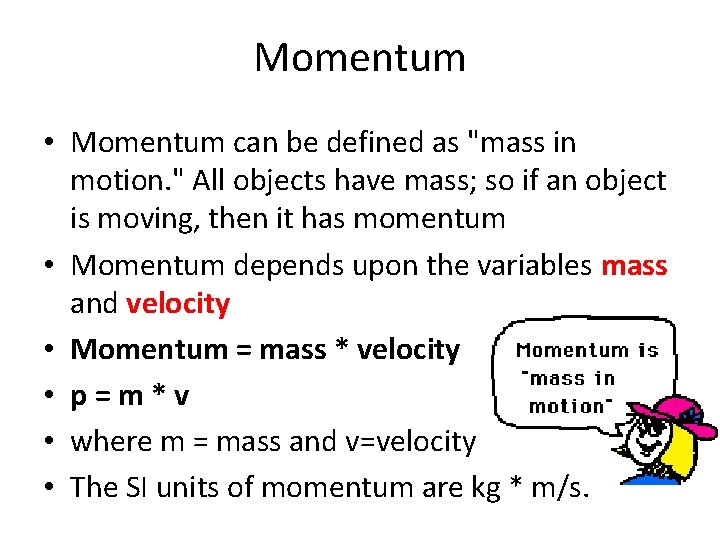
Momentum • Momentum can be defined as "mass in motion. " All objects have mass; so if an object is moving, then it has momentum • Momentum depends upon the variables mass and velocity • Momentum = mass * velocity • p = m * v • where m = mass and v=velocity • The SI units of momentum are kg * m/s.

Linear Impulse and momentum • Principle of impluse and momentum: the linear impulse applied to an object is equal to the change in its linear momentum • Momentum: mv
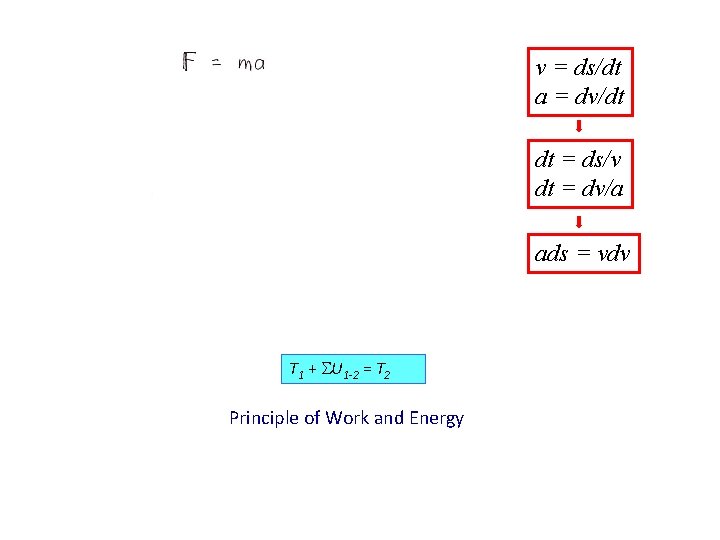
v = ds/dt a = dv/dt dt = ds/v dt = dv/a ads = vdv T 1 + SU 1 -2 = T 2 Principle of Work and Energy

ads = vdv Principle of Linear Impulse and Momentum a = dv/dt

Linear Impulse Variable Force Constant Force The impulse may be determined by direct integration. Graphically, it can be represented by the area under the force versus time curve. If F is constant, then I = F (t 2 – t 1).

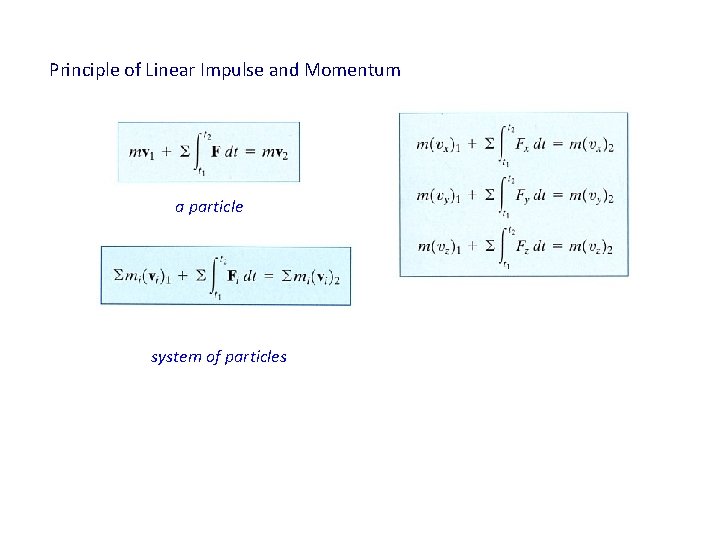
Principle of Linear Impulse and Momentum a particle system of particles
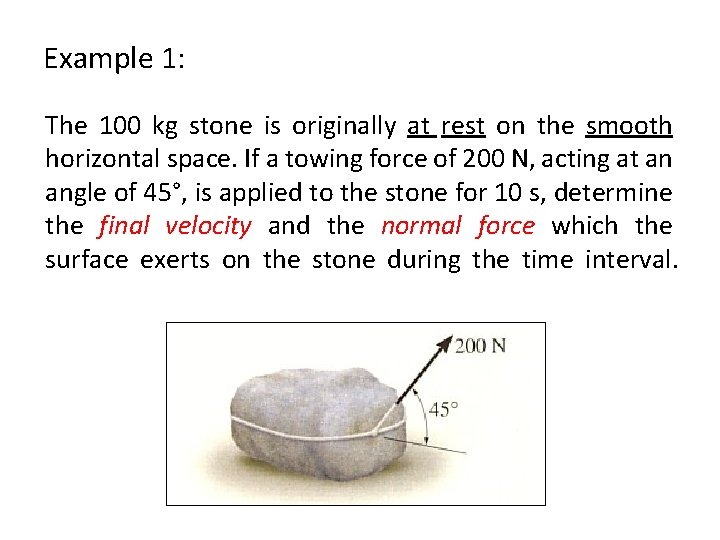
Example 1: The 100 kg stone is originally at rest on the smooth horizontal space. If a towing force of 200 N, acting at an angle of 45°, is applied to the stone for 10 s, determine the final velocity and the normal force which the surface exerts on the stone during the time interval.
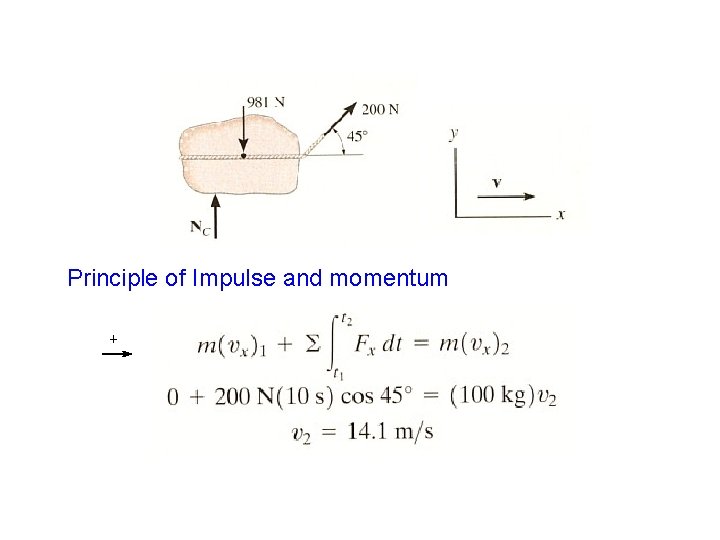
Principle of Impulse and momentum +

Principle of Impulse and momentum +

Conservation of Linear Momentum for a System of Particles When the sum of the external impulses acting on a system of a particle is zero, Nonimpulsive force - impulse that may be neglected - considered equal to zero Impulsive : - forces that are very large and act for a very short period of time - produce significant change in momentum
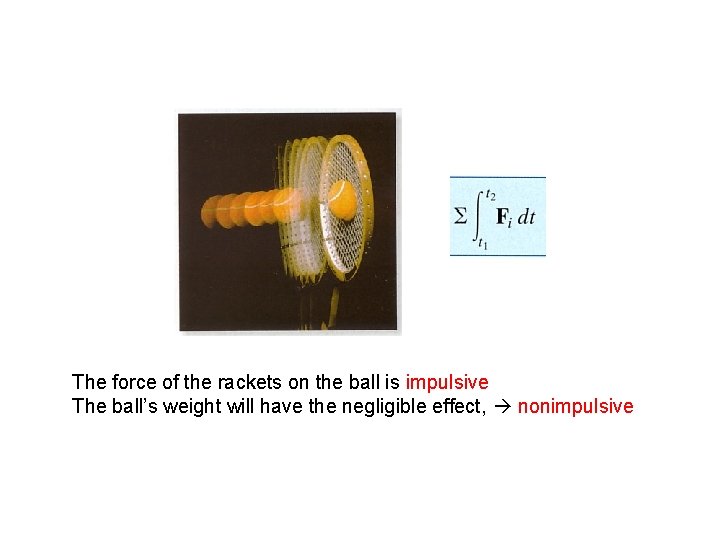
The force of the rackets on the ball is impulsive The ball’s weight will have the negligible effect, nonimpulsive
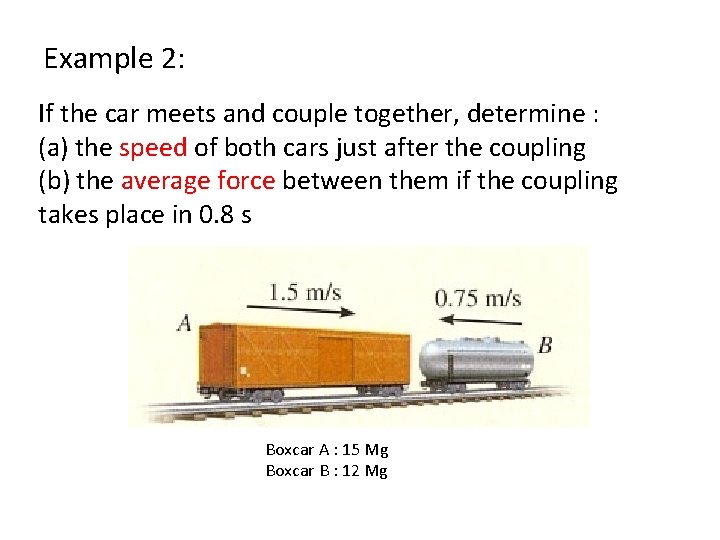
Example 2: If the car meets and couple together, determine : (a) the speed of both cars just after the coupling (b) the average force between them if the coupling takes place in 0. 8 s Boxcar A : 15 Mg Boxcar B : 12 Mg
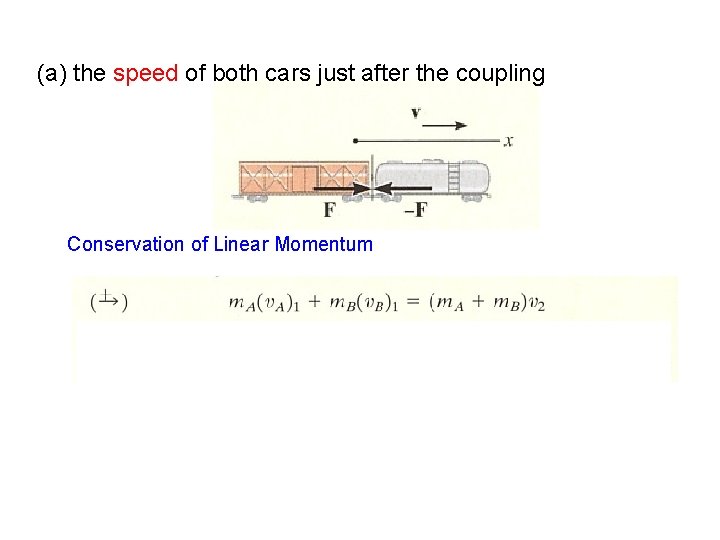
(a) the speed of both cars just after the coupling Conservation of Linear Momentum
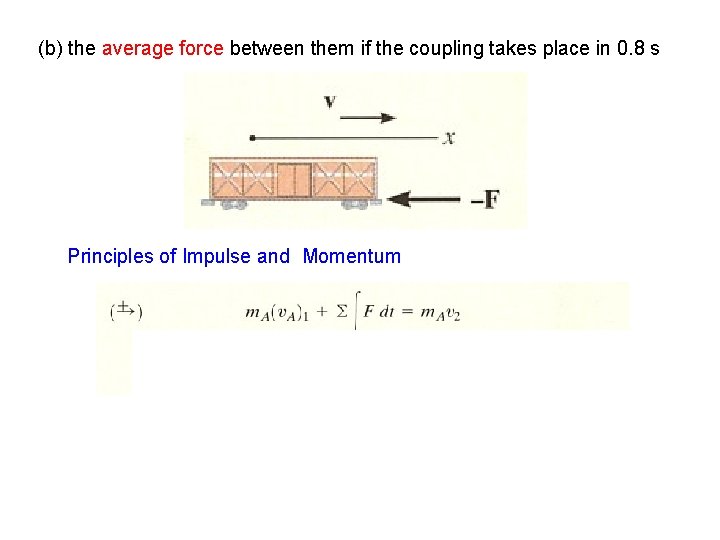
(b) the average force between them if the coupling takes place in 0. 8 s Principles of Impulse and Momentum

Example 3: The 600 kg cannon shown fires a 4 kg projectile with a muzzle velocity 450 m/s relative to the ground. If firing takes place in 0. 03 s, determine : (a) the recoil velocity of the cannon just after firing (b) the average impulsive force acting on the projectile The cannon support is fixed to the ground, and the horizontal recoil of the cannon is absorbed by two springs.

Mc = 600 [kg] Mp = 4 [kg] (Vp )1 = 450 [m/s] t = 0. 03 [s] Conservation of Linear Momentum
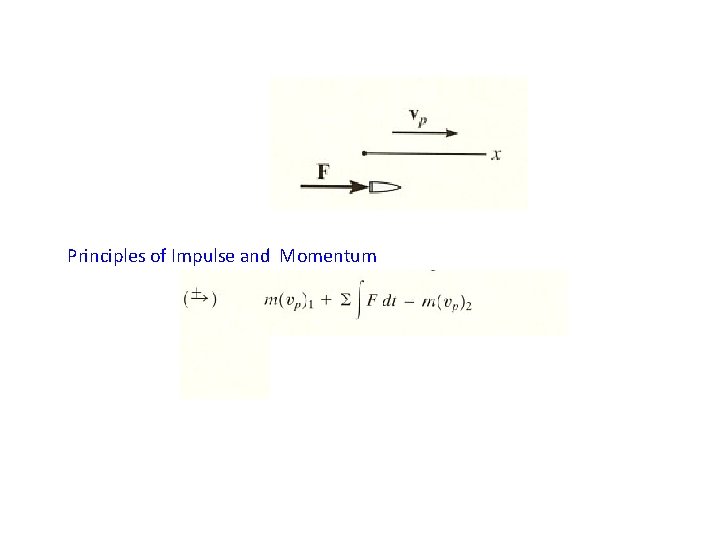
Principles of Impulse and Momentum
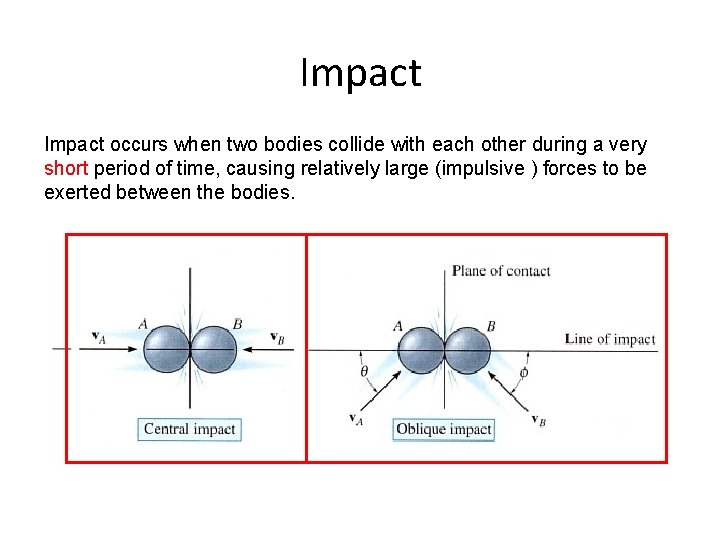
Impact occurs when two bodies collide with each other during a very short period of time, causing relatively large (impulsive ) forces to be exerted between the bodies.

Central Impact
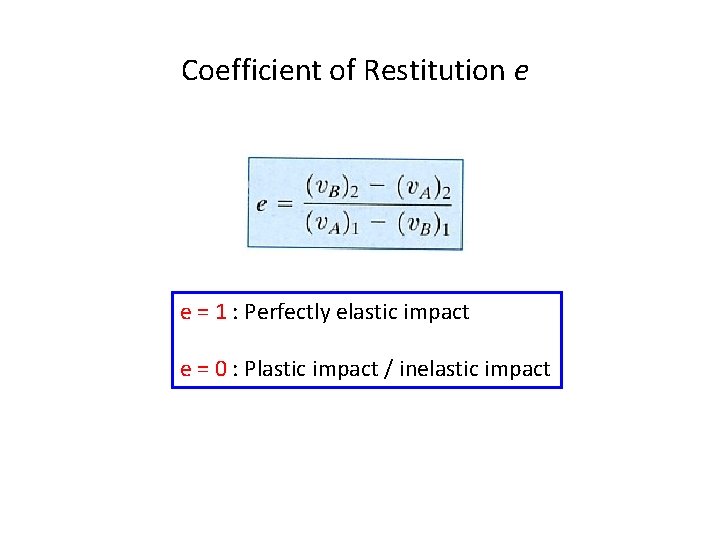
Coefficient of Restitution e e = 1 : Perfectly elastic impact e = 0 : Plastic impact / inelastic impact
Elastic and inelastic Collisions • When a Ball hits the ground and sticks, the collision would be totally inelastic • When a Ball hits the ground and bounces to the same height, the collision is elastic
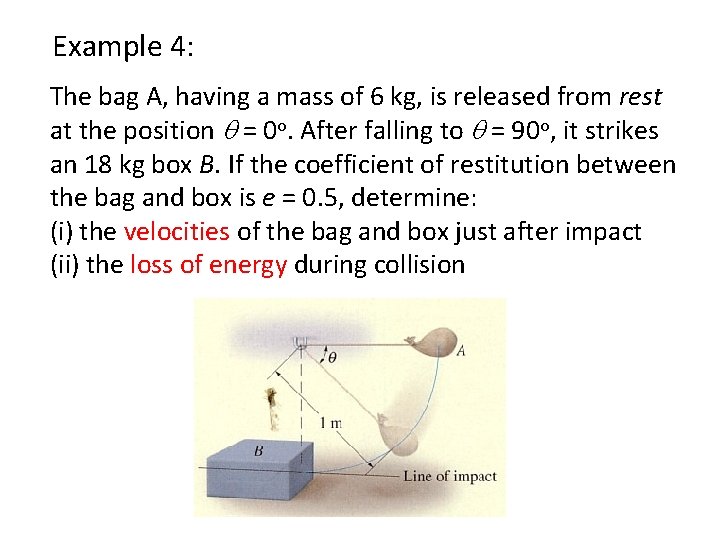
Example 4: The bag A, having a mass of 6 kg, is released from rest at the position q = 0 o. After falling to q = 90 o, it strikes an 18 kg box B. If the coefficient of restitution between the bag and box is e = 0. 5, determine: (i) the velocities of the bag and box just after impact (ii) the loss of energy during collision
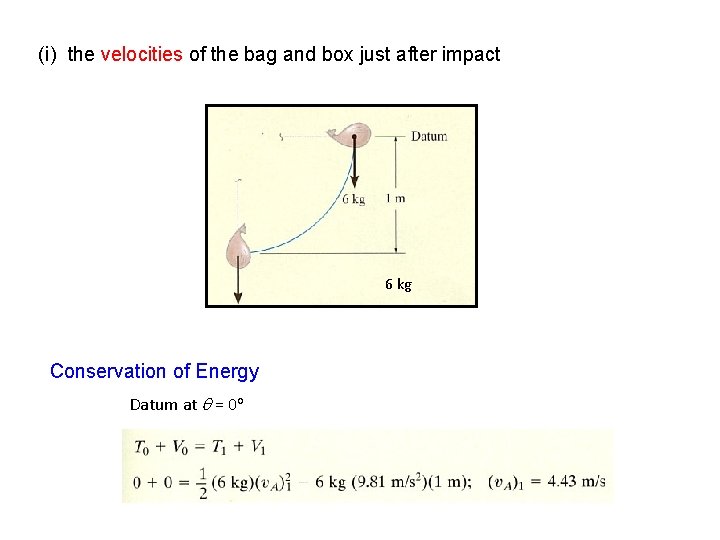
(i) the velocities of the bag and box just after impact 6 kg Conservation of Energy Datum at q = 0 o
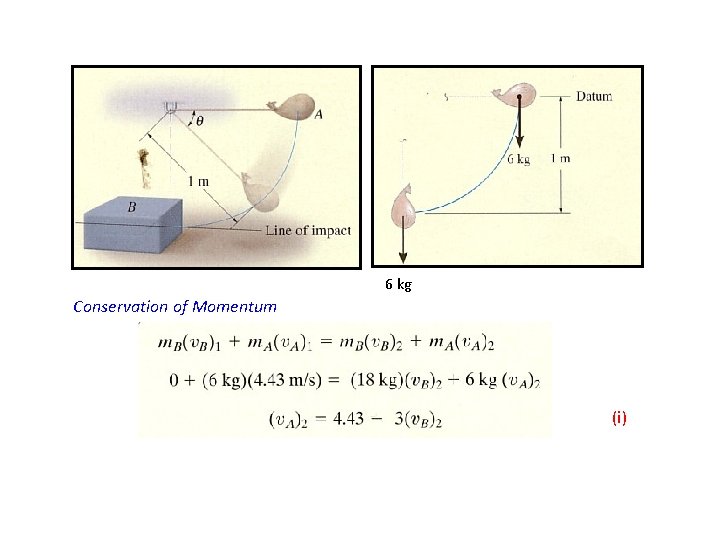
6 kg Conservation of Momentum (i)
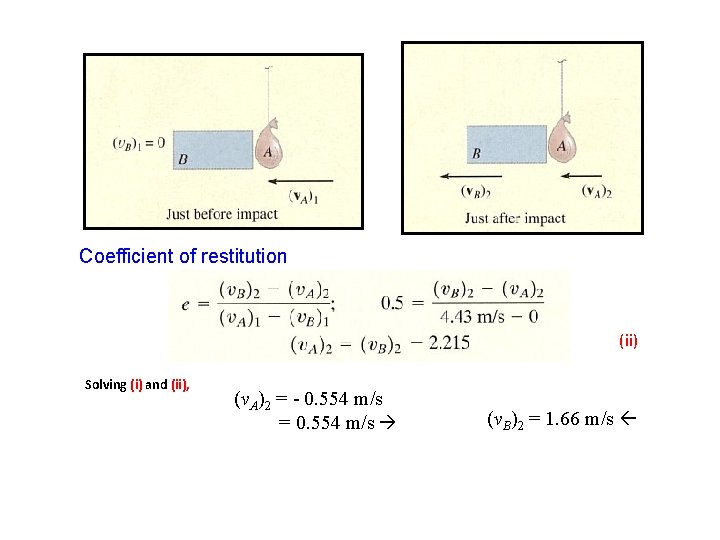
Coefficient of restitution (ii) Solving (i) and (ii), (v. A)2 = - 0. 554 m/s = 0. 554 m/s (v. B)2 = 1. 66 m/s
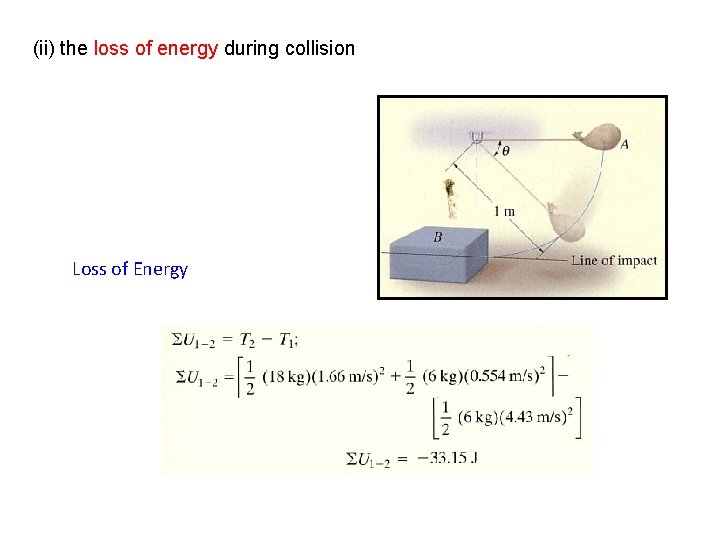
(ii) the loss of energy during collision Loss of Energy
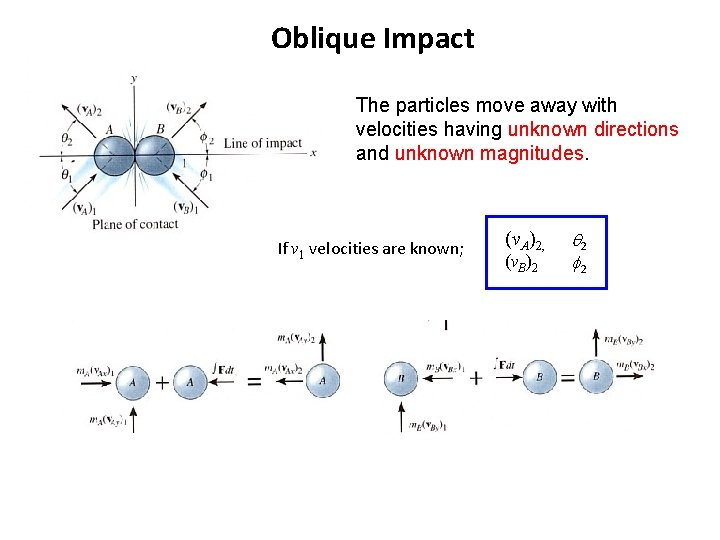
Oblique Impact The particles move away with velocities having unknown directions and unknown magnitudes. If v 1 velocities are known; (v. A)2, (v. B)2 q 2 f 2
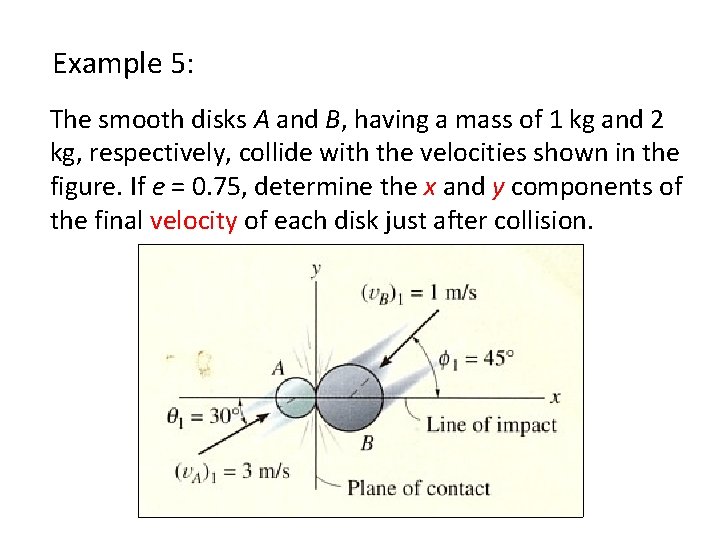
Example 5: The smooth disks A and B, having a mass of 1 kg and 2 kg, respectively, collide with the velocities shown in the figure. If e = 0. 75, determine the x and y components of the final velocity of each disk just after collision.
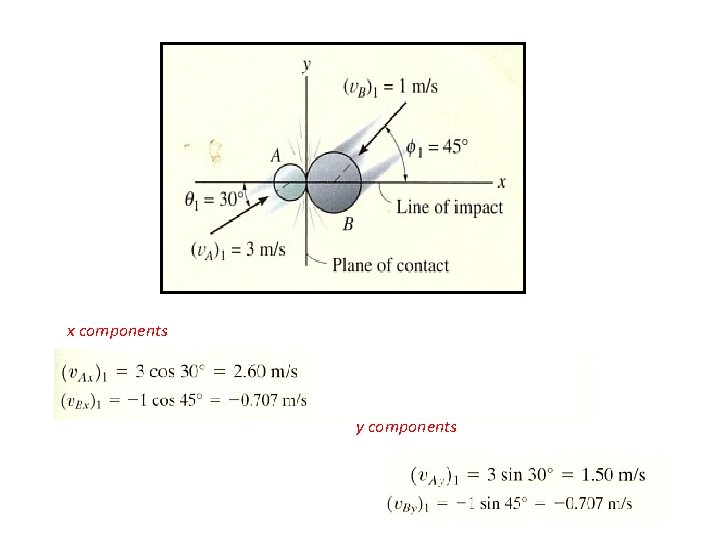
x components y components
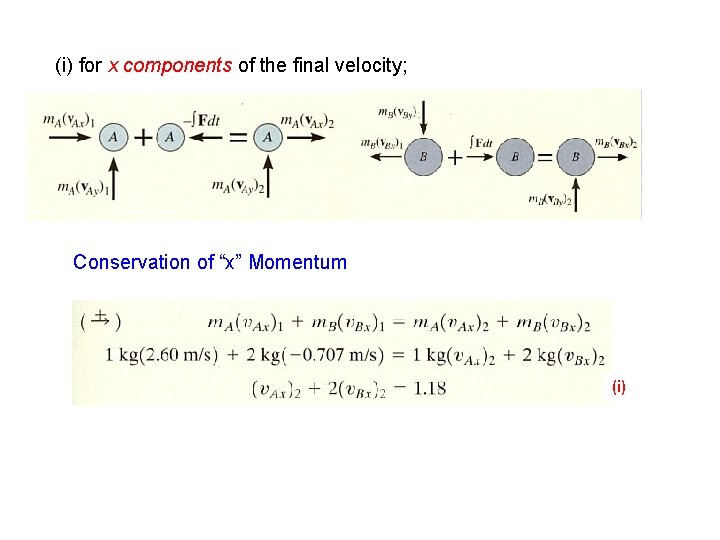
(i) for x components of the final velocity; Conservation of “x” Momentum (i)
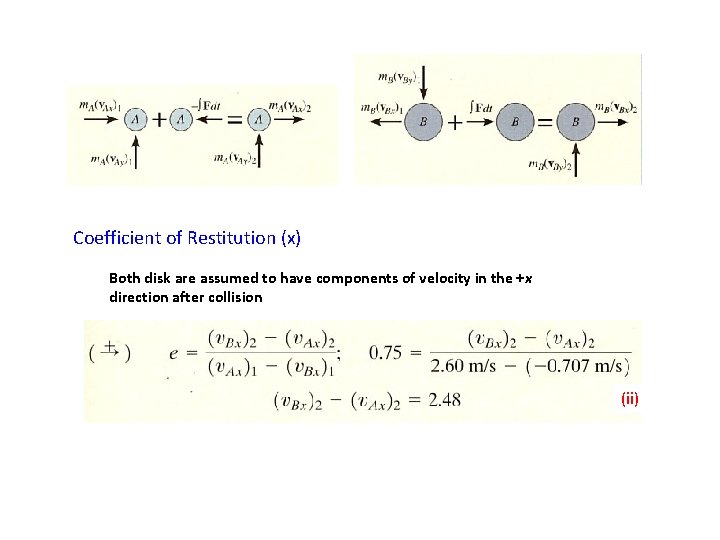
Coefficient of Restitution (x) Both disk are assumed to have components of velocity in the +x direction after collision (ii)
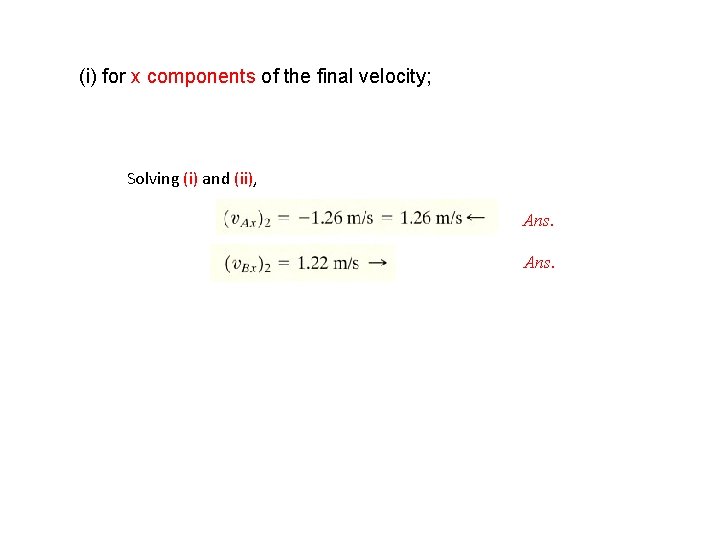
(i) for x components of the final velocity; Solving (i) and (ii), Ans.
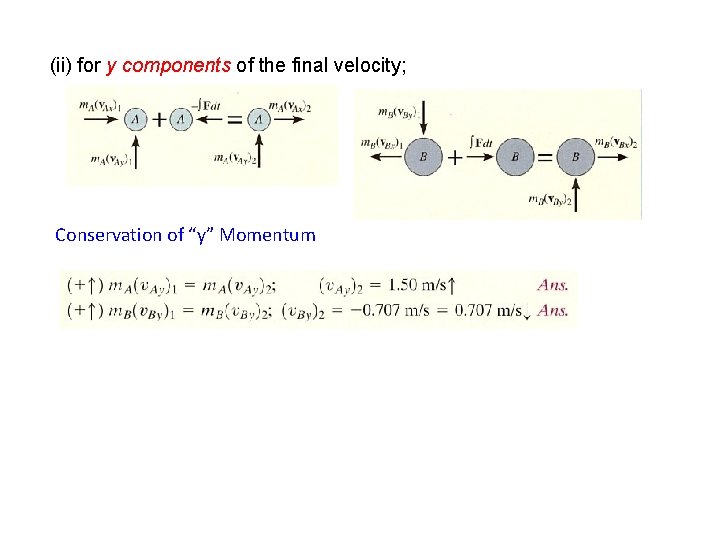
(ii) for y components of the final velocity; Conservation of “y” Momentum
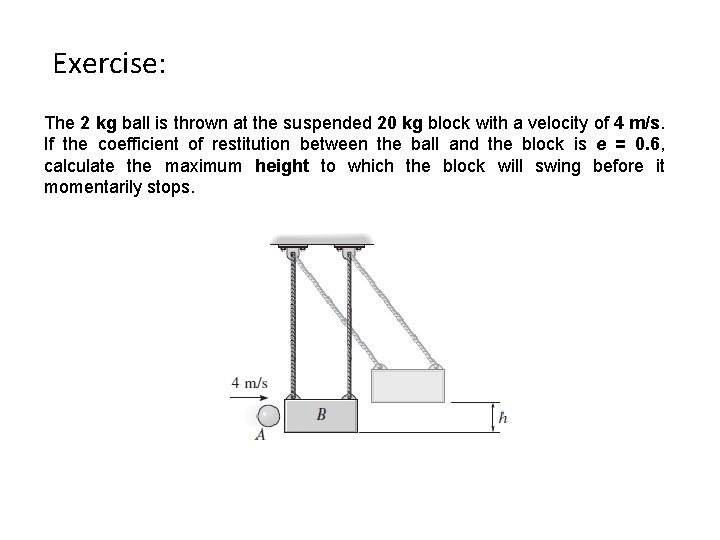
Exercise: The 2 kg ball is thrown at the suspended 20 kg block with a velocity of 4 m/s. If the coefficient of restitution between the ball and the block is e = 0. 6, calculate the maximum height to which the block will swing before it momentarily stops.
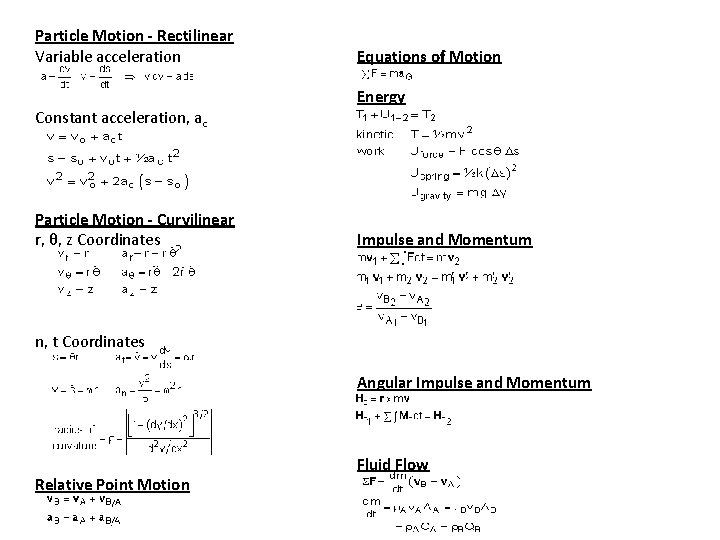
Particle Motion - Rectilinear Variable acceleration Equations of Motion Energy Constant acceleration, ac Particle Motion - Curvilinear r, θ, z Coordinates Impulse and Momentum n, t Coordinates Angular Impulse and Momentum Relative Point Motion Fluid Flow
- Slides: 42