
Chapter 15 HOW ATOMS BOND AND MOLECULES ATTRACT
. Chapter 15: HOW ATOMS BOND AND MOLECULES ATTRACT Copyright © 2008 Pearson Education, Inc. , publishing as Pearson Addison-Wesley
This lecture will help you understand: • • Electron-Dot Structures The Formation of Ions Ionic Bonds Metallic Bonds Covalent Bonds Polar Covalent Bonds Molecular Polarity Molecular Attractions Copyright © 2008 Pearson Education, Inc. , publishing as Pearson Addison-Wesley

Electron-Dot Structures • Atoms bond together through their electrons. To learn about bonding, therefore, we need to know something about how the electrons within an atom are organized. Copyright © 2008 Pearson Education, Inc. , publishing as Pearson Addison-Wesley
Electron-Dot Structures • Atoms bond together through their electrons. To learn about bonding, therefore, we need to know something about how the electrons within an atom are organized. • Electrons behave as though they are contained within a series of seven concentric shells. Copyright © 2008 Pearson Education, Inc. , publishing as Pearson Addison-Wesley
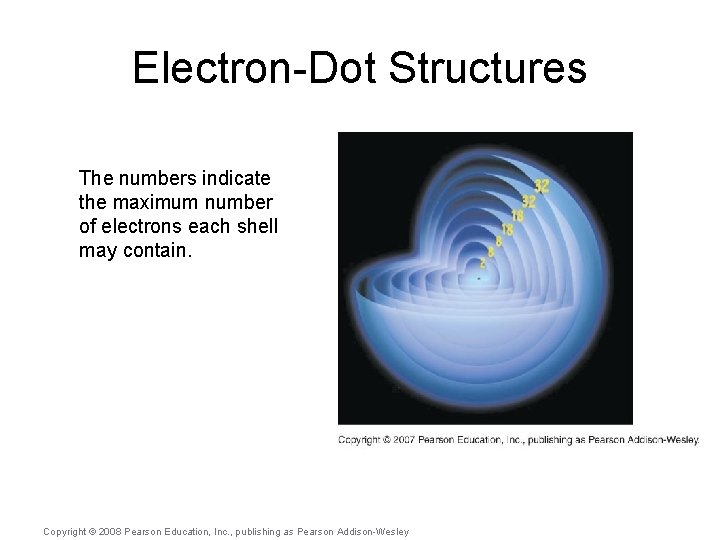
Electron-Dot Structures The numbers indicate the maximum number of electrons each shell may contain. Copyright © 2008 Pearson Education, Inc. , publishing as Pearson Addison-Wesley
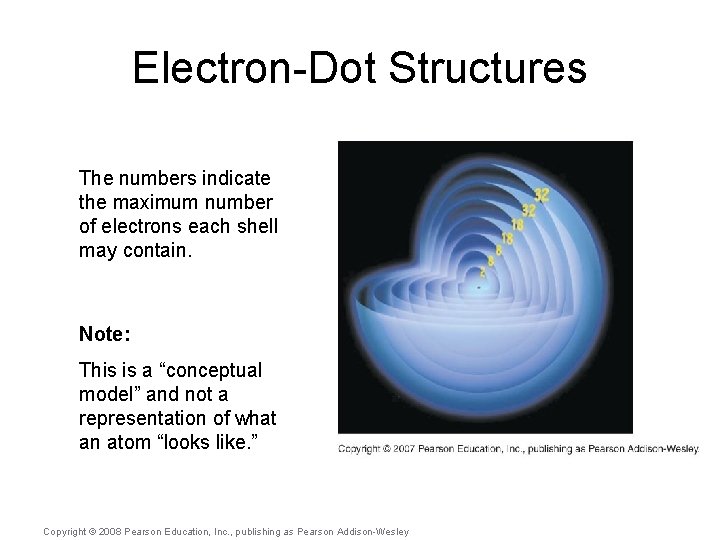
Electron-Dot Structures The numbers indicate the maximum number of electrons each shell may contain. Note: This is a “conceptual model” and not a representation of what an atom “looks like. ” Copyright © 2008 Pearson Education, Inc. , publishing as Pearson Addison-Wesley
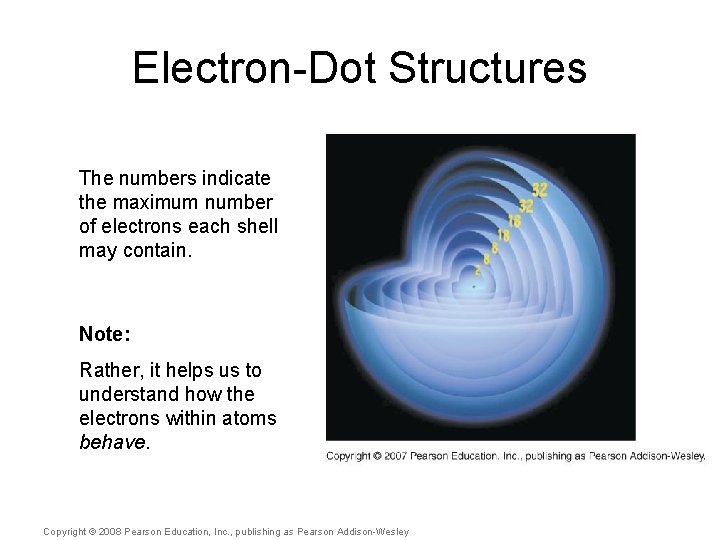
Electron-Dot Structures The numbers indicate the maximum number of electrons each shell may contain. Note: Rather, it helps us to understand how the electrons within atoms behave. Copyright © 2008 Pearson Education, Inc. , publishing as Pearson Addison-Wesley
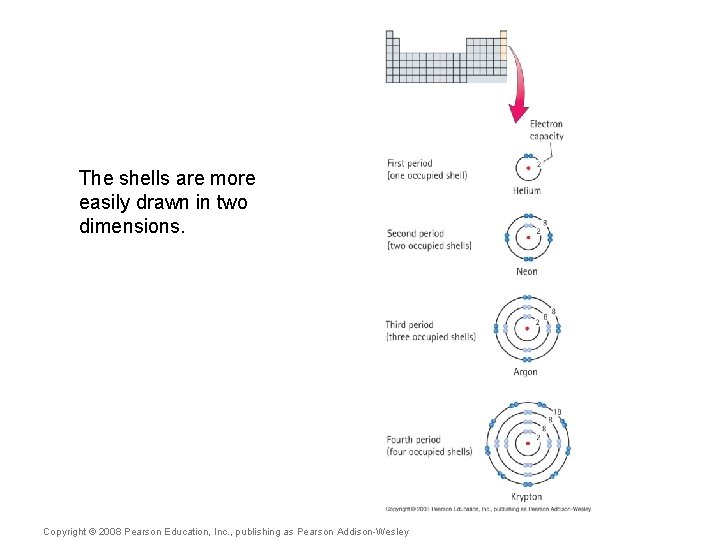
The shells are more easily drawn in two dimensions. Copyright © 2008 Pearson Education, Inc. , publishing as Pearson Addison-Wesley
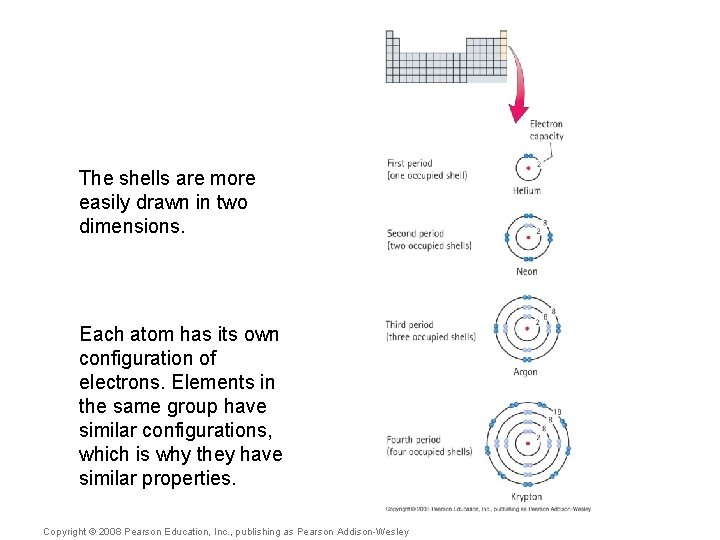
The shells are more easily drawn in two dimensions. Each atom has its own configuration of electrons. Elements in the same group have similar configurations, which is why they have similar properties. Copyright © 2008 Pearson Education, Inc. , publishing as Pearson Addison-Wesley
Electron-Dot Structures • Valence electrons: Electrons in the outermost shell of an atom. These are the ones that can participate in chemical bonding. Copyright © 2008 Pearson Education, Inc. , publishing as Pearson Addison-Wesley
Electron-Dot Structures • Valence electrons: Electrons in the outermost shell of an atom. These are the ones that can participate in chemical bonding. • Electron-dot structure: A notation showing the valence electrons surrounding the atomic symbol. Copyright © 2008 Pearson Education, Inc. , publishing as Pearson Addison-Wesley
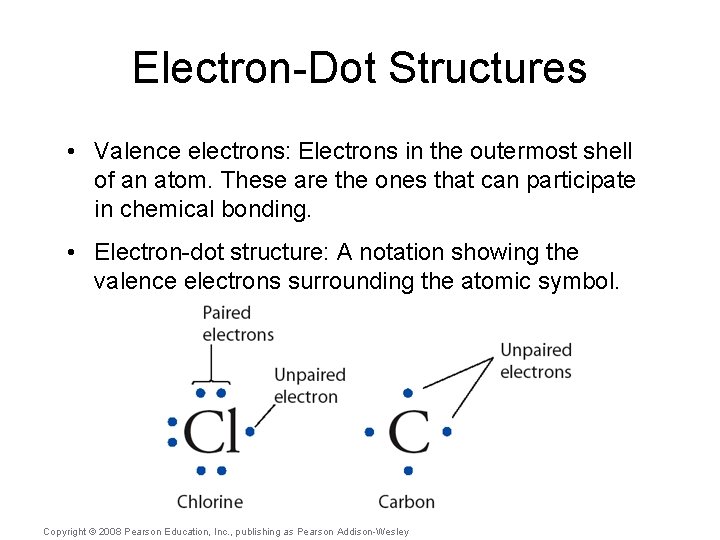
Electron-Dot Structures • Valence electrons: Electrons in the outermost shell of an atom. These are the ones that can participate in chemical bonding. • Electron-dot structure: A notation showing the valence electrons surrounding the atomic symbol. Copyright © 2008 Pearson Education, Inc. , publishing as Pearson Addison-Wesley
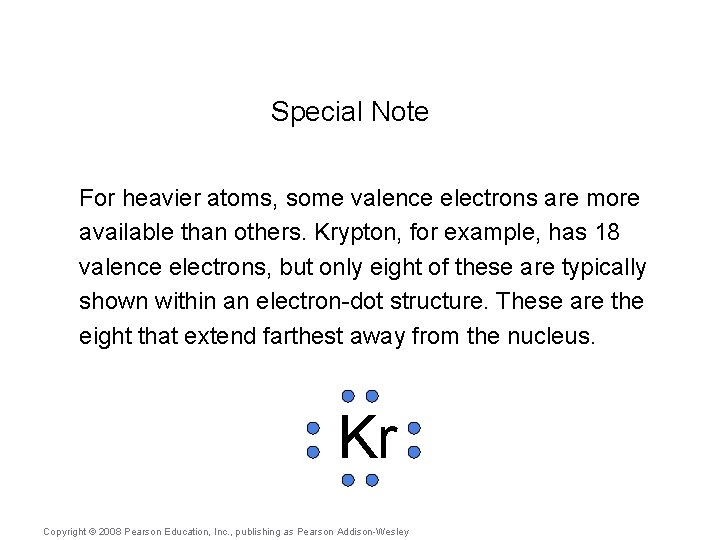
Special Note For heavier atoms, some valence electrons are more available than others. Krypton, for example, has 18 valence electrons, but only eight of these are typically shown within an electron-dot structure. These are the eight that extend farthest away from the nucleus. Kr Copyright © 2008 Pearson Education, Inc. , publishing as Pearson Addison-Wesley
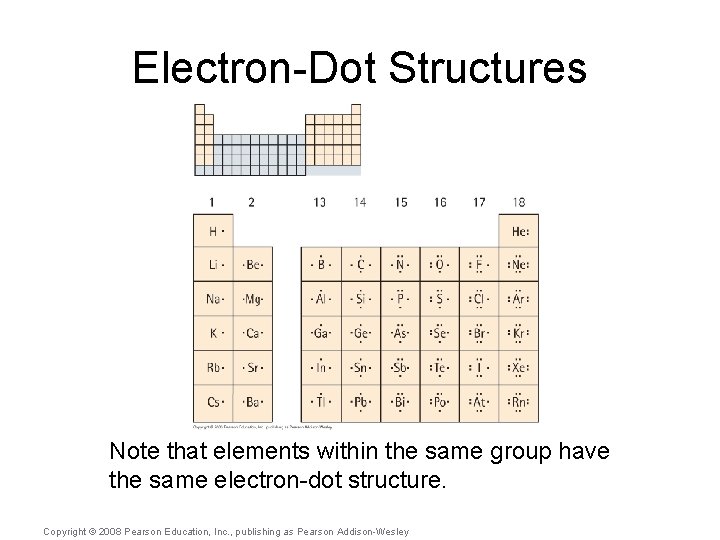
Electron-Dot Structures Note that elements within the same group have the same electron-dot structure. Copyright © 2008 Pearson Education, Inc. , publishing as Pearson Addison-Wesley
Electron-Dot Structures CHECK YOUR NEIGHBOR Sodium, Na, atomic number 11, has only one valence electron. Upon losing this electron, what other atom in the periodic table does the sodium thus resemble? A. B. C. D. Neon, Ne, atomic number 10 Magnesium, Mg, atomic number 12 Lithium, Li, atomic number 3 Sodium can only resemble sodium. Copyright © 2008 Pearson Education, Inc. , publishing as Pearson Addison-Wesley
Electron-Dot Structures CHECK YOUR ANSWER Sodium, Na, atomic number 11, has only one valence electron. Upon losing this electron, what other atom in the periodic table does the sodium thus resemble? A. B. C. D. Neon, Ne, atomic number 10 Magnesium, Mg, atomic number 12 Lithium, Li, atomic number 3 Sodium can only resemble sodium. Explanation: With 10 electrons, the sodium has enough electrons to fill the first and second shells, just like neon, Ne. Copyright © 2008 Pearson Education, Inc. , publishing as Pearson Addison-Wesley
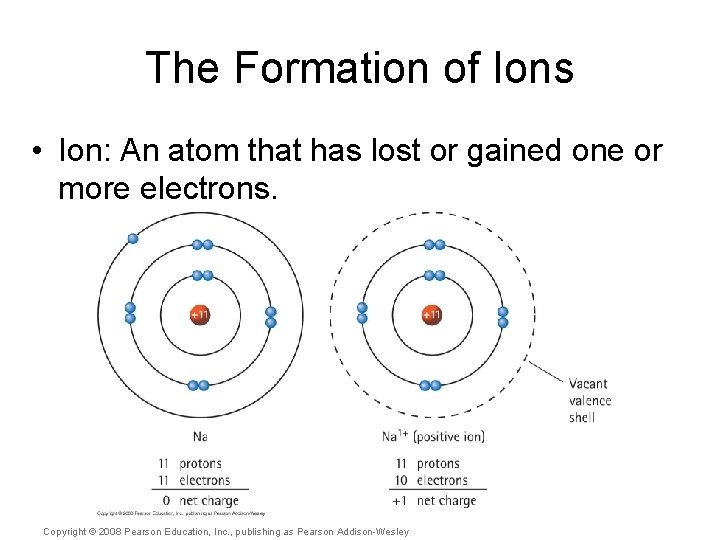
The Formation of Ions • Ion: An atom that has lost or gained one or more electrons. Copyright © 2008 Pearson Education, Inc. , publishing as Pearson Addison-Wesley
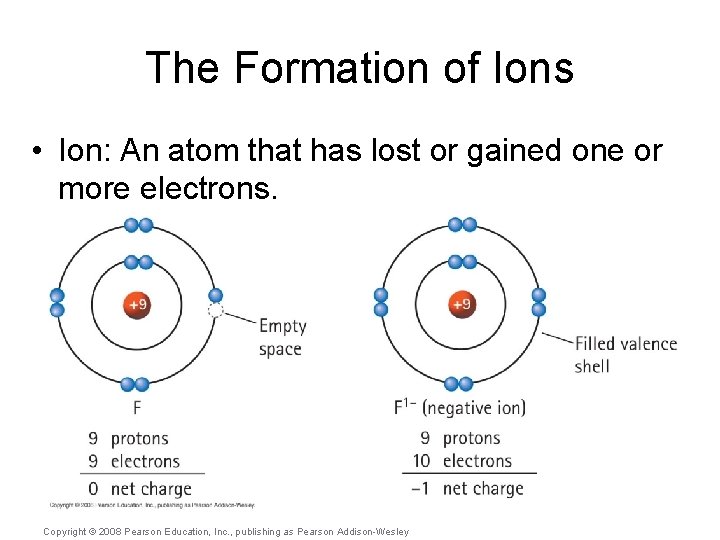
The Formation of Ions • Ion: An atom that has lost or gained one or more electrons. Copyright © 2008 Pearson Education, Inc. , publishing as Pearson Addison-Wesley
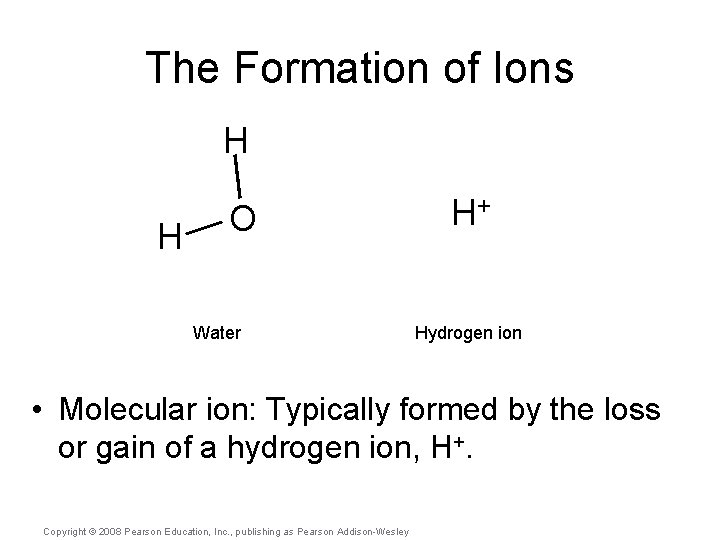
The Formation of Ions H H O Water H+ Hydrogen ion • Molecular ion: Typically formed by the loss or gain of a hydrogen ion, H+. Copyright © 2008 Pearson Education, Inc. , publishing as Pearson Addison-Wesley
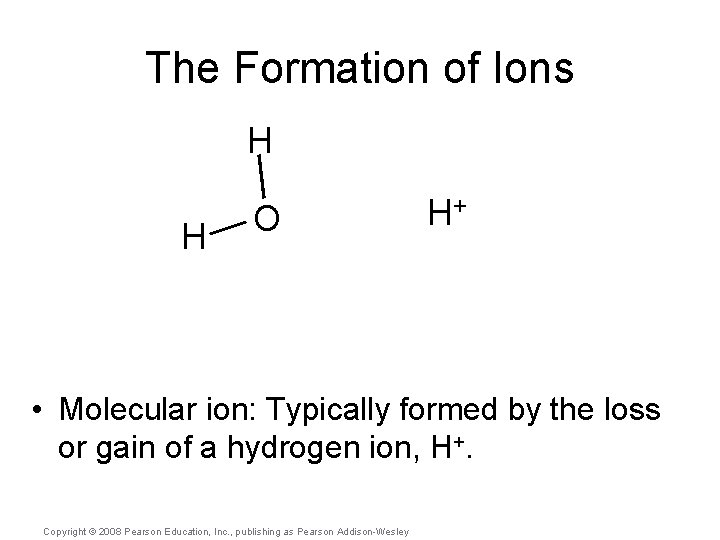
The Formation of Ions H H O H+ • Molecular ion: Typically formed by the loss or gain of a hydrogen ion, H+. Copyright © 2008 Pearson Education, Inc. , publishing as Pearson Addison-Wesley

The Formation of Ions H H O H+ • Molecular ion: Typically formed by the loss or gain of a hydrogen ion, H+. Copyright © 2008 Pearson Education, Inc. , publishing as Pearson Addison-Wesley
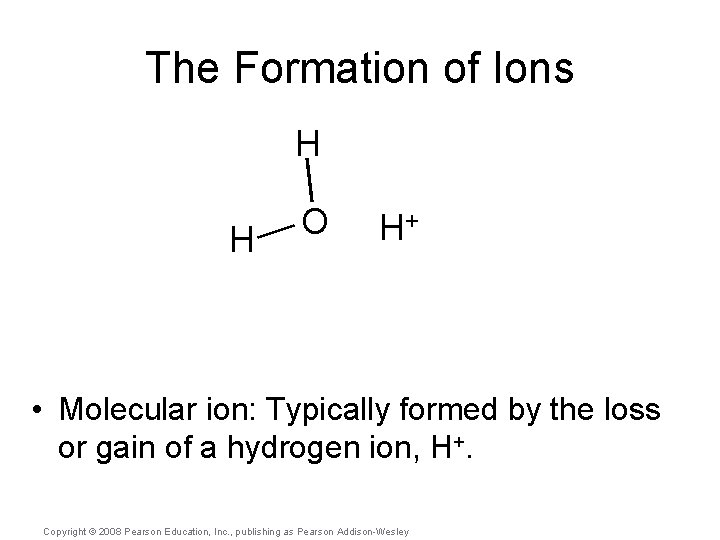
The Formation of Ions H H O H+ • Molecular ion: Typically formed by the loss or gain of a hydrogen ion, H+. Copyright © 2008 Pearson Education, Inc. , publishing as Pearson Addison-Wesley
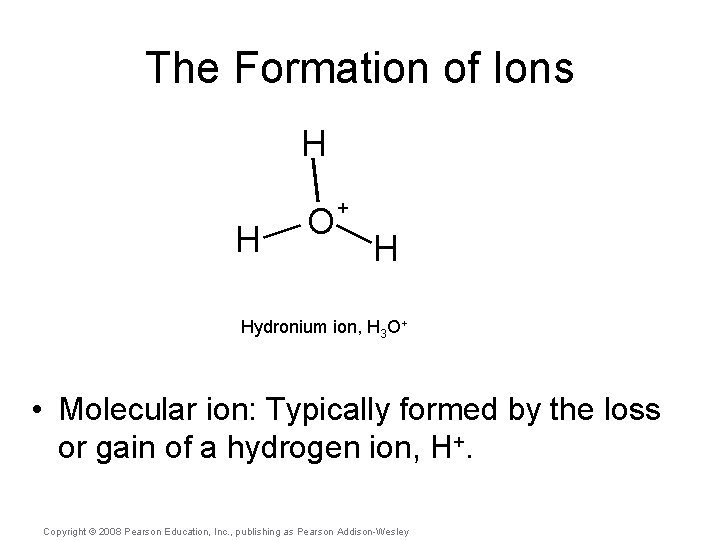
The Formation of Ions H H O + H Hydronium ion, H 3 O+ • Molecular ion: Typically formed by the loss or gain of a hydrogen ion, H+. Copyright © 2008 Pearson Education, Inc. , publishing as Pearson Addison-Wesley
Ionic Bonds • Ion: An atom that has lost or gained one or more electrons. • Ionic Bond: The electrical force of attraction between oppositely charged ions. Copyright © 2008 Pearson Education, Inc. , publishing as Pearson Addison-Wesley
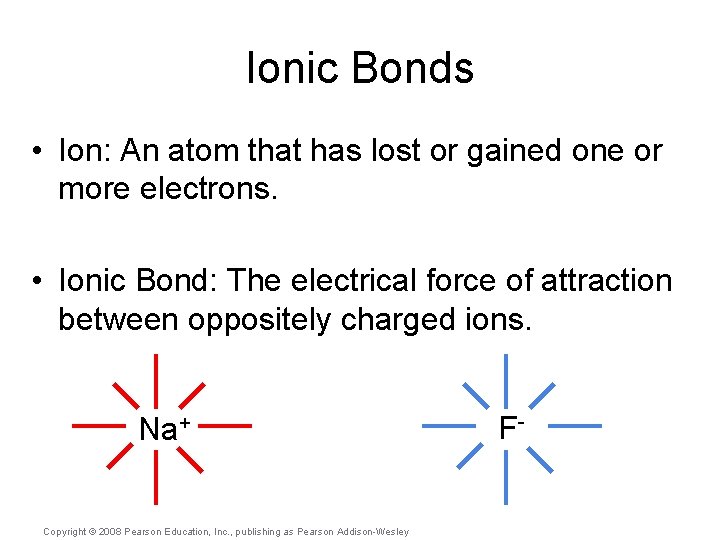
Ionic Bonds • Ion: An atom that has lost or gained one or more electrons. • Ionic Bond: The electrical force of attraction between oppositely charged ions. Na+ Copyright © 2008 Pearson Education, Inc. , publishing as Pearson Addison-Wesley F-
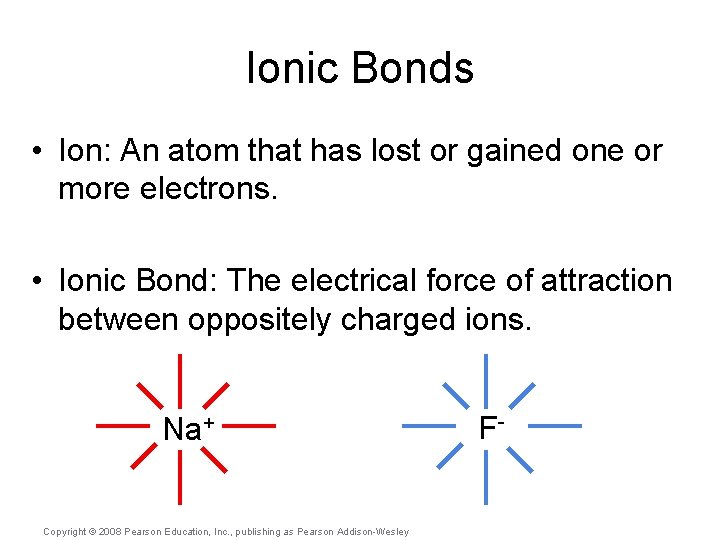
Ionic Bonds • Ion: An atom that has lost or gained one or more electrons. • Ionic Bond: The electrical force of attraction between oppositely charged ions. Na+ Copyright © 2008 Pearson Education, Inc. , publishing as Pearson Addison-Wesley F-
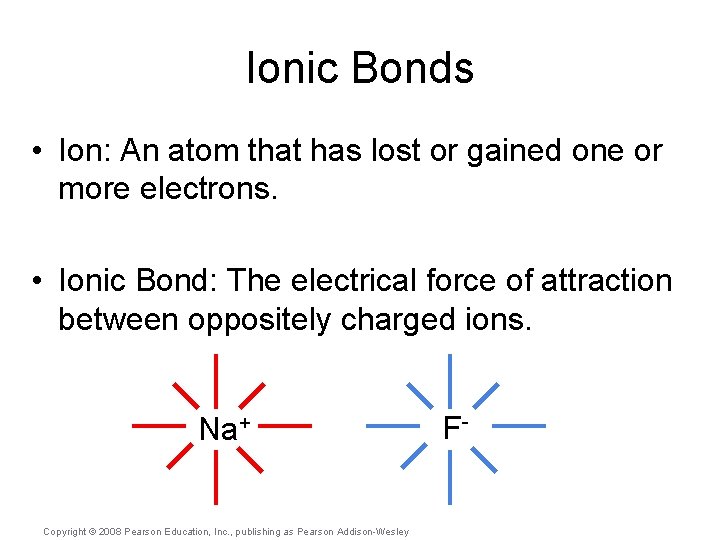
Ionic Bonds • Ion: An atom that has lost or gained one or more electrons. • Ionic Bond: The electrical force of attraction between oppositely charged ions. Na+ Copyright © 2008 Pearson Education, Inc. , publishing as Pearson Addison-Wesley F-
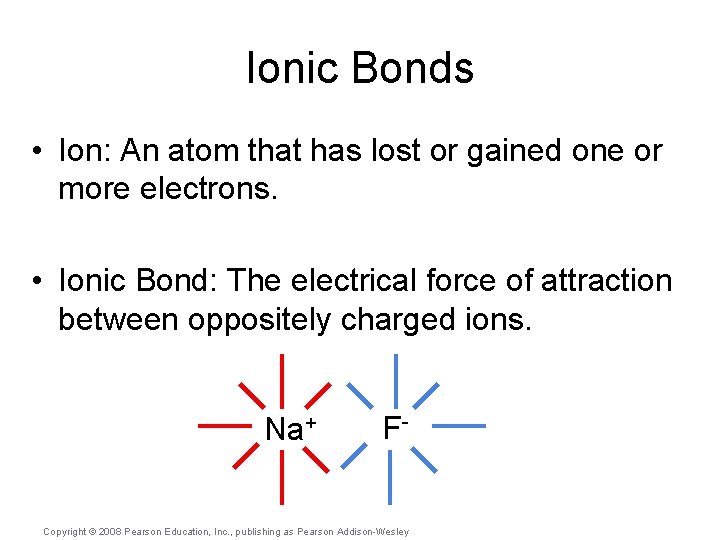
Ionic Bonds • Ion: An atom that has lost or gained one or more electrons. • Ionic Bond: The electrical force of attraction between oppositely charged ions. Na+ F- Copyright © 2008 Pearson Education, Inc. , publishing as Pearson Addison-Wesley
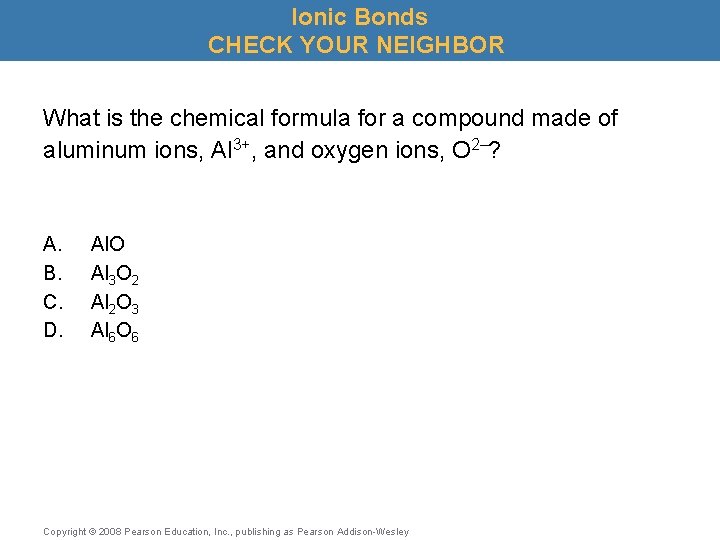
Ionic Bonds CHECK YOUR NEIGHBOR What is the chemical formula for a compound made of aluminum ions, Al 3+, and oxygen ions, O 2–? A. B. C. D. Al. O Al 3 O 2 Al 2 O 3 Al 6 O 6 Copyright © 2008 Pearson Education, Inc. , publishing as Pearson Addison-Wesley
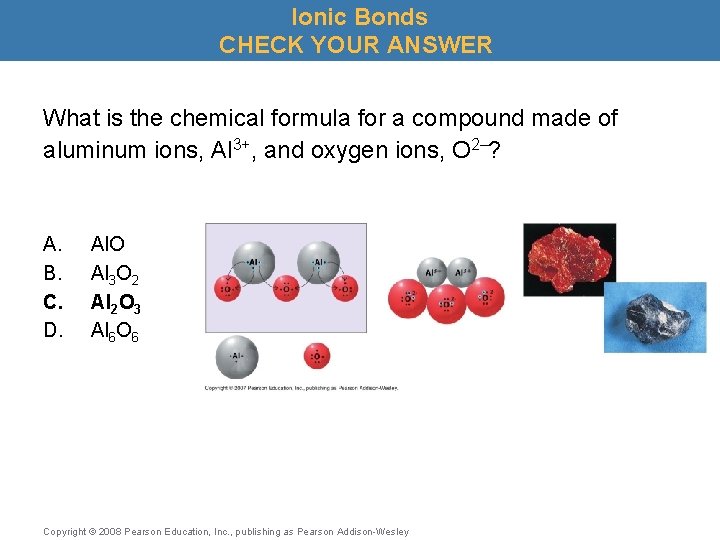
Ionic Bonds CHECK YOUR ANSWER What is the chemical formula for a compound made of aluminum ions, Al 3+, and oxygen ions, O 2–? A. B. C. D. Al. O Al 3 O 2 Al 2 O 3 Al 6 O 6 Copyright © 2008 Pearson Education, Inc. , publishing as Pearson Addison-Wesley
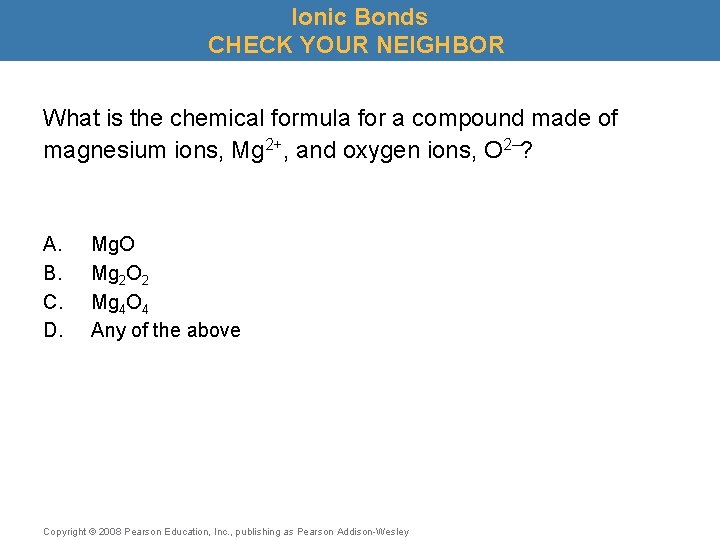
Ionic Bonds CHECK YOUR NEIGHBOR What is the chemical formula for a compound made of magnesium ions, Mg 2+, and oxygen ions, O 2–? A. B. C. D. Mg. O Mg 2 O 2 Mg 4 O 4 Any of the above Copyright © 2008 Pearson Education, Inc. , publishing as Pearson Addison-Wesley
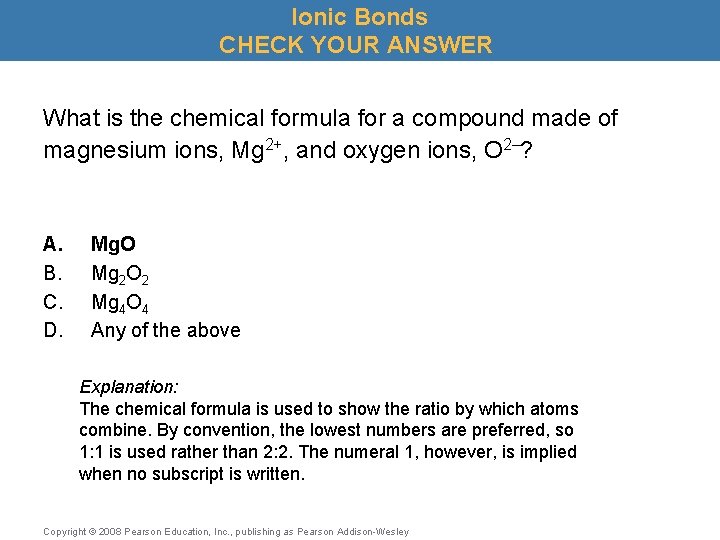
Ionic Bonds CHECK YOUR ANSWER What is the chemical formula for a compound made of magnesium ions, Mg 2+, and oxygen ions, O 2–? A. B. C. D. Mg. O Mg 2 O 2 Mg 4 O 4 Any of the above Explanation: The chemical formula is used to show the ratio by which atoms combine. By convention, the lowest numbers are preferred, so 1: 1 is used rather than 2: 2. The numeral 1, however, is implied when no subscript is written. Copyright © 2008 Pearson Education, Inc. , publishing as Pearson Addison-Wesley
Metallic Bonds • Outer electrons in metal atoms are held only weakly by the nucleus. Copyright © 2008 Pearson Education, Inc. , publishing as Pearson Addison-Wesley
Metallic Bonds • Outer electrons in metal atoms are held only weakly by the nucleus. • This weak attraction allows the electrons to move about quite freely. Copyright © 2008 Pearson Education, Inc. , publishing as Pearson Addison-Wesley
Metallic Bonds • Outer electrons in metal atoms are held only weakly by the nucleus. • This weak attraction allows the electrons to move about quite freely. • This mobility of electrons accounts for many metallic properties. Copyright © 2008 Pearson Education, Inc. , publishing as Pearson Addison-Wesley
Metallic Bonds • An alloy is a mixture of metallic elements. Copyright © 2008 Pearson Education, Inc. , publishing as Pearson Addison-Wesley
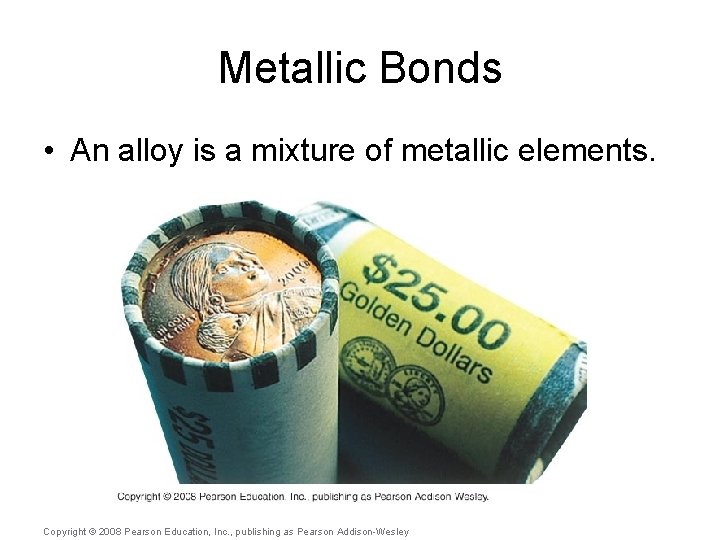
Metallic Bonds • An alloy is a mixture of metallic elements. Copyright © 2008 Pearson Education, Inc. , publishing as Pearson Addison-Wesley
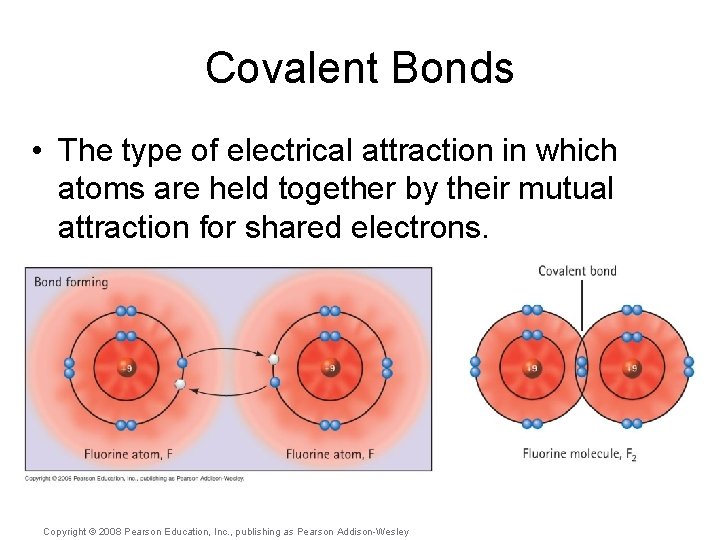
Covalent Bonds • The type of electrical attraction in which atoms are held together by their mutual attraction for shared electrons. Copyright © 2008 Pearson Education, Inc. , publishing as Pearson Addison-Wesley
Covalent Bonds • The type of electrical attraction in which atoms are held together by their mutual attraction for shared electrons. • There are two electrons within a single covalent bond. Copyright © 2008 Pearson Education, Inc. , publishing as Pearson Addison-Wesley
Covalent Bonds • The type of electrical attraction in which atoms are held together by their mutual attraction for shared electrons. • There are two electrons within a single covalent bond. • The covalent bond is represented using a straight line. Copyright © 2008 Pearson Education, Inc. , publishing as Pearson Addison-Wesley
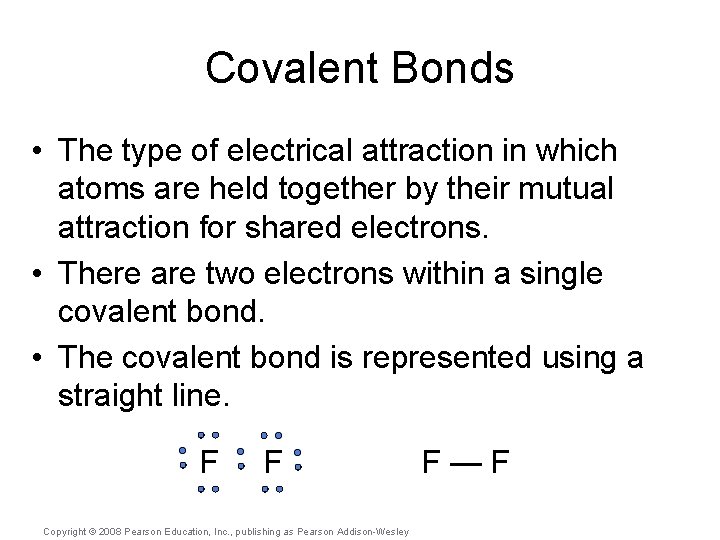
Covalent Bonds • The type of electrical attraction in which atoms are held together by their mutual attraction for shared electrons. • There are two electrons within a single covalent bond. • The covalent bond is represented using a straight line. F F Copyright © 2008 Pearson Education, Inc. , publishing as Pearson Addison-Wesley F—F
Covalent Bonds • The number of covalent bonds an atom can form equals its number of unpaired valence electrons. Copyright © 2008 Pearson Education, Inc. , publishing as Pearson Addison-Wesley
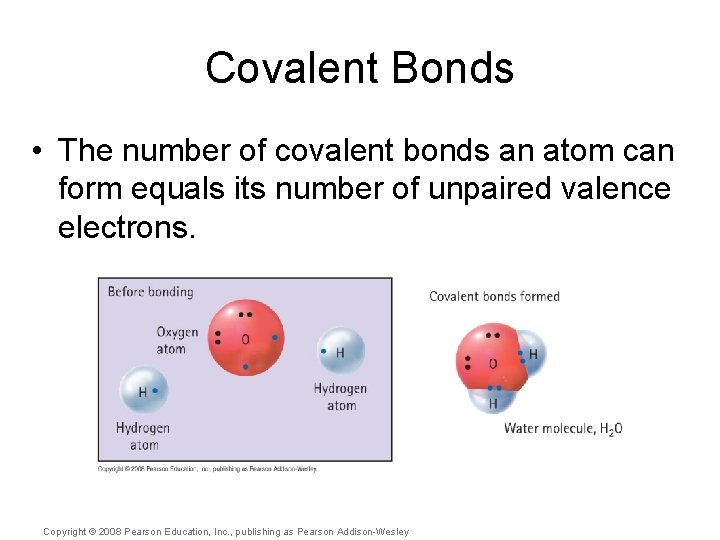
Covalent Bonds • The number of covalent bonds an atom can form equals its number of unpaired valence electrons. Copyright © 2008 Pearson Education, Inc. , publishing as Pearson Addison-Wesley
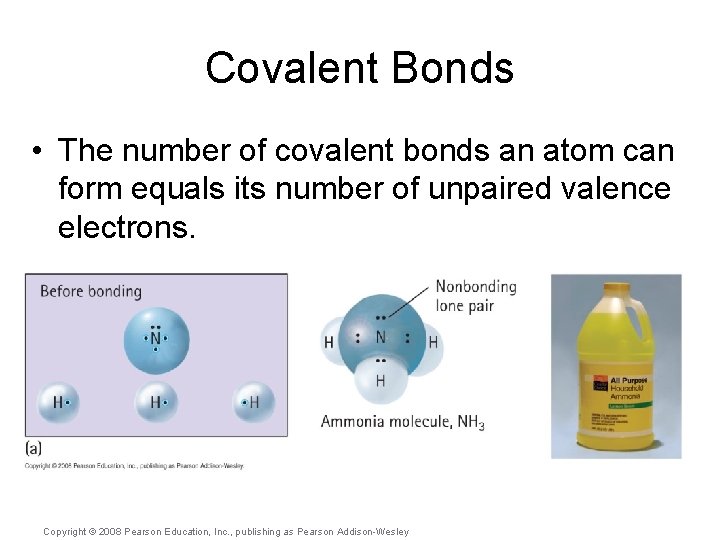
Covalent Bonds • The number of covalent bonds an atom can form equals its number of unpaired valence electrons. Copyright © 2008 Pearson Education, Inc. , publishing as Pearson Addison-Wesley
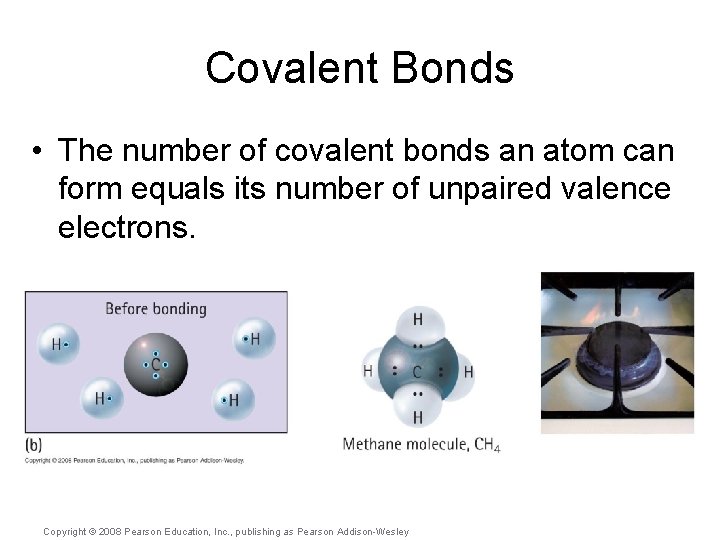
Covalent Bonds • The number of covalent bonds an atom can form equals its number of unpaired valence electrons. Copyright © 2008 Pearson Education, Inc. , publishing as Pearson Addison-Wesley
Covalent Bonds • The number of covalent bonds an atom can form equals its number of unpaired valence electrons. • Multiple covalent bonds are possible. Copyright © 2008 Pearson Education, Inc. , publishing as Pearson Addison-Wesley
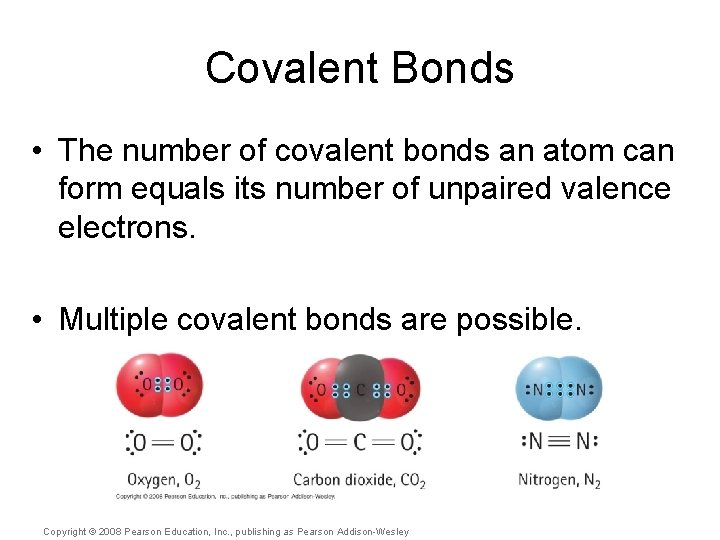
Covalent Bonds • The number of covalent bonds an atom can form equals its number of unpaired valence electrons. • Multiple covalent bonds are possible. Copyright © 2008 Pearson Education, Inc. , publishing as Pearson Addison-Wesley
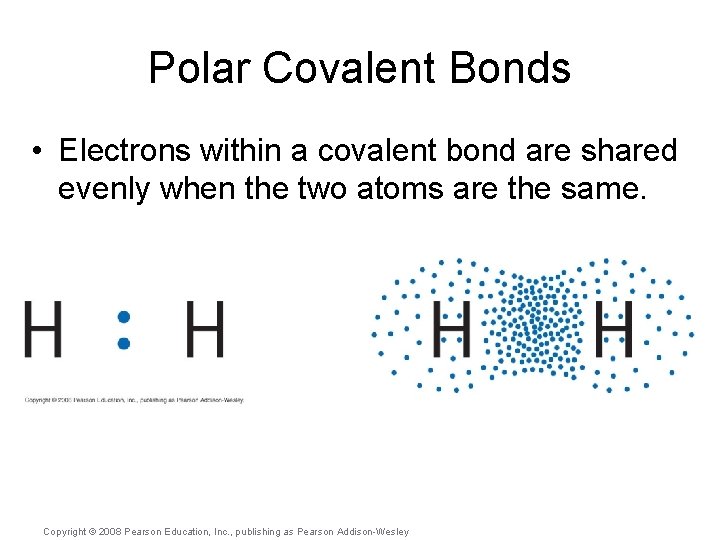
Polar Covalent Bonds • Electrons within a covalent bond are shared evenly when the two atoms are the same. Copyright © 2008 Pearson Education, Inc. , publishing as Pearson Addison-Wesley
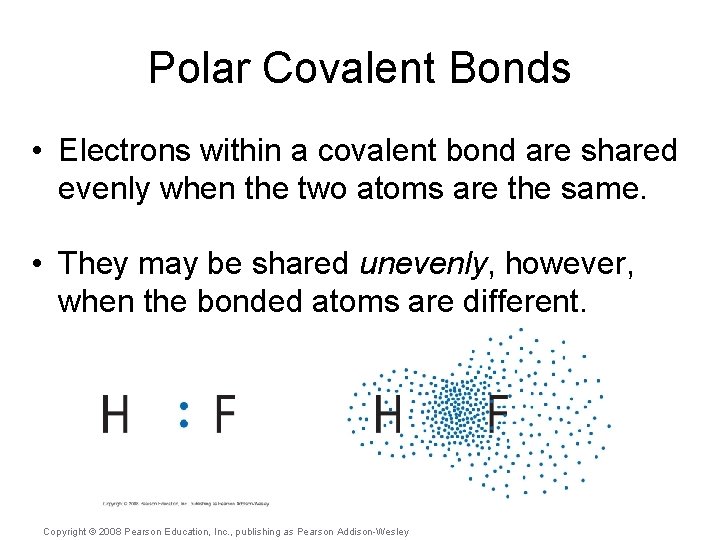
Polar Covalent Bonds • Electrons within a covalent bond are shared evenly when the two atoms are the same. • They may be shared unevenly, however, when the bonded atoms are different. Copyright © 2008 Pearson Education, Inc. , publishing as Pearson Addison-Wesley
Polar Covalent Bonds • Electrons within a covalent bond are shared evenly when the two atoms are the same. • They may be shared unevenly, however, when the bonded atoms are different. • Electronegativity: The ability of a bonded atom to pull on shared electrons. Greater electronegativity means greater “pulling power. ” Copyright © 2008 Pearson Education, Inc. , publishing as Pearson Addison-Wesley
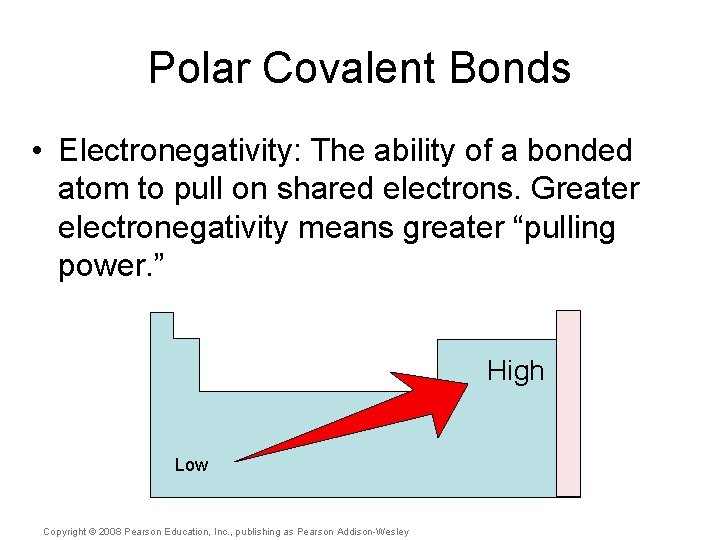
Polar Covalent Bonds • Electronegativity: The ability of a bonded atom to pull on shared electrons. Greater electronegativity means greater “pulling power. ” High Low Copyright © 2008 Pearson Education, Inc. , publishing as Pearson Addison-Wesley
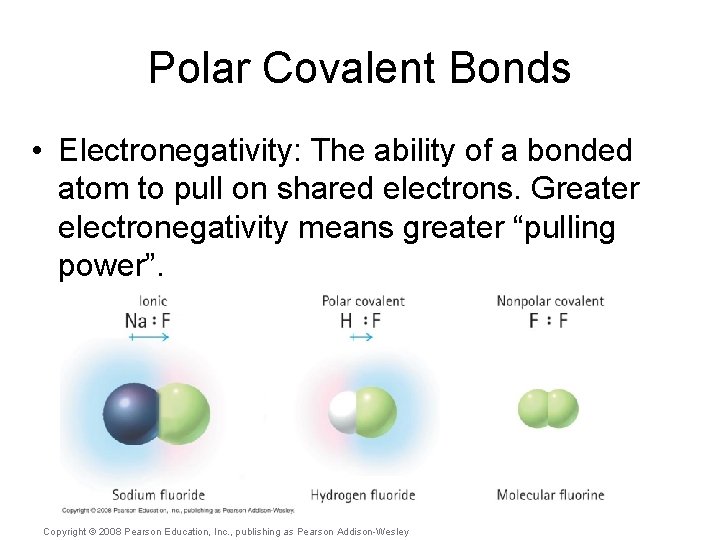
Polar Covalent Bonds • Electronegativity: The ability of a bonded atom to pull on shared electrons. Greater electronegativity means greater “pulling power”. Copyright © 2008 Pearson Education, Inc. , publishing as Pearson Addison-Wesley
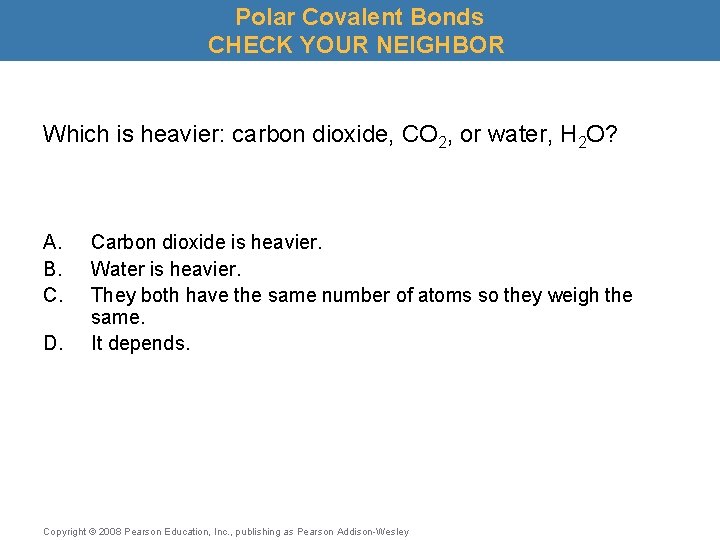
Polar Covalent Bonds CHECK YOUR NEIGHBOR Which is heavier: carbon dioxide, CO 2, or water, H 2 O? A. B. C. D. Carbon dioxide is heavier. Water is heavier. They both have the same number of atoms so they weigh the same. It depends. Copyright © 2008 Pearson Education, Inc. , publishing as Pearson Addison-Wesley
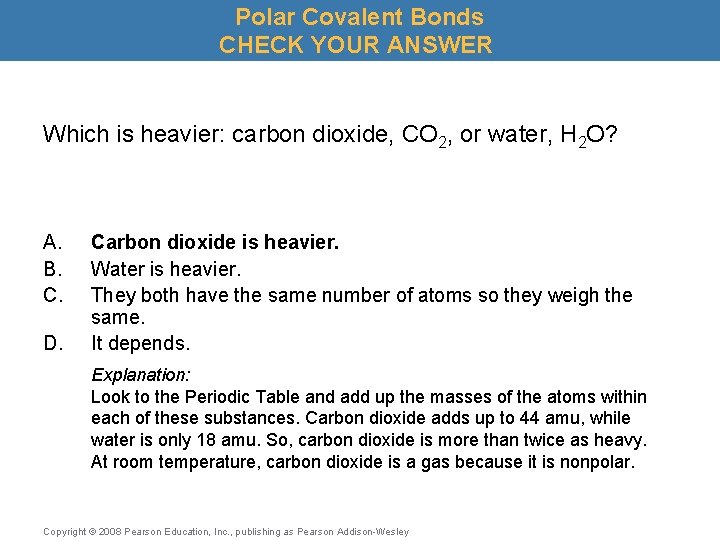
Polar Covalent Bonds CHECK YOUR ANSWER Which is heavier: carbon dioxide, CO 2, or water, H 2 O? A. B. C. D. Carbon dioxide is heavier. Water is heavier. They both have the same number of atoms so they weigh the same. It depends. Explanation: Look to the Periodic Table and add up the masses of the atoms within each of these substances. Carbon dioxide adds up to 44 amu, while water is only 18 amu. So, carbon dioxide is more than twice as heavy. At room temperature, carbon dioxide is a gas because it is nonpolar. Copyright © 2008 Pearson Education, Inc. , publishing as Pearson Addison-Wesley
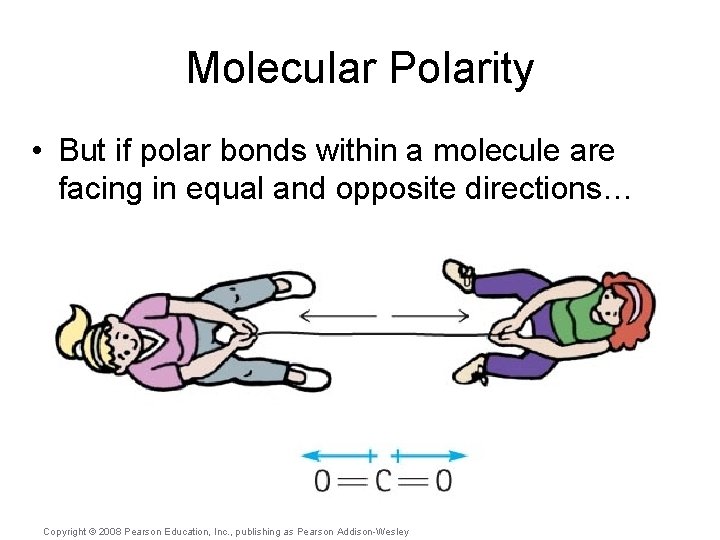
Molecular Polarity • But if polar bonds within a molecule are facing in equal and opposite directions… Copyright © 2008 Pearson Education, Inc. , publishing as Pearson Addison-Wesley
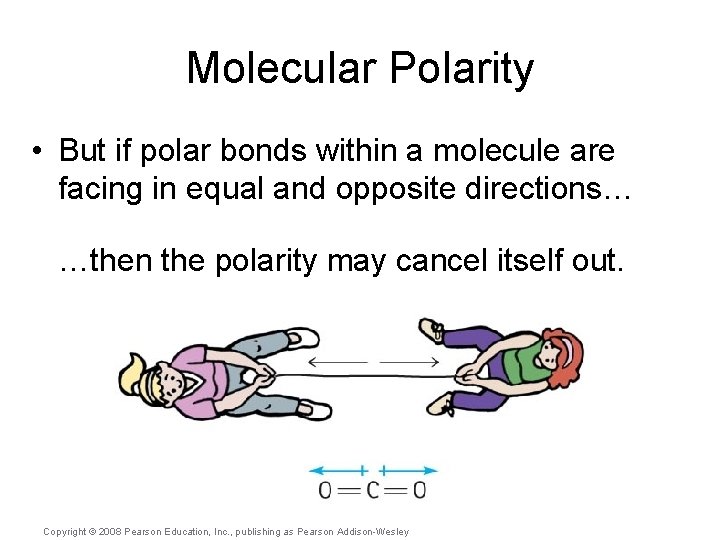
Molecular Polarity • But if polar bonds within a molecule are facing in equal and opposite directions… …then the polarity may cancel itself out. Copyright © 2008 Pearson Education, Inc. , publishing as Pearson Addison-Wesley
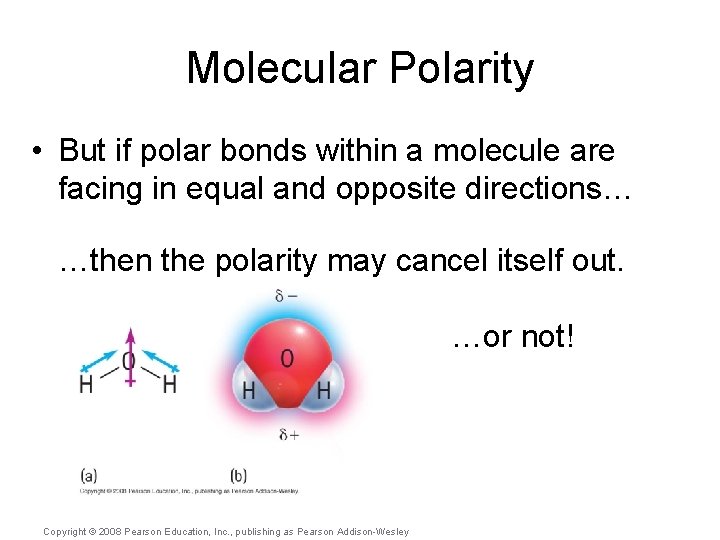
Molecular Polarity • But if polar bonds within a molecule are facing in equal and opposite directions… …then the polarity may cancel itself out. …or not! Copyright © 2008 Pearson Education, Inc. , publishing as Pearson Addison-Wesley
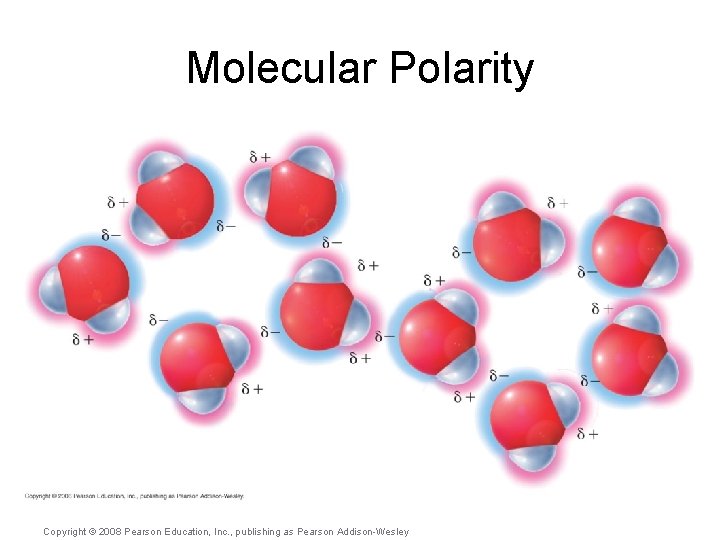
Molecular Polarity Copyright © 2008 Pearson Education, Inc. , publishing as Pearson Addison-Wesley
Molecular Polarity CHECK YOUR NEIGHBOR Water has such a relatively high boiling point because water A. B. C. D. is such a heavy substance. is transparent so that heat passes right through it. contains three atoms per molecules are so sticky. Copyright © 2008 Pearson Education, Inc. , publishing as Pearson Addison-Wesley
Molecular Polarity CHECK YOUR NEIGHBOR Water has such a relatively high boiling point because water A. B. C. D. is such a heavy substance. is transparent so that heat passes right through it. contains three atoms per molecules are so sticky. Explanation: The slightly negative end of one water molecule holds onto the slightly positive end of another water molecule. This force of attraction must be overcome before the liquid water can transform into the gaseous phase. Copyright © 2008 Pearson Education, Inc. , publishing as Pearson Addison-Wesley

Molecular Attractions • Ion–dipole The attraction between an ion and a dipole. Example: Na. Cl in water. Copyright © 2008 Pearson Education, Inc. , publishing as Pearson Addison-Wesley
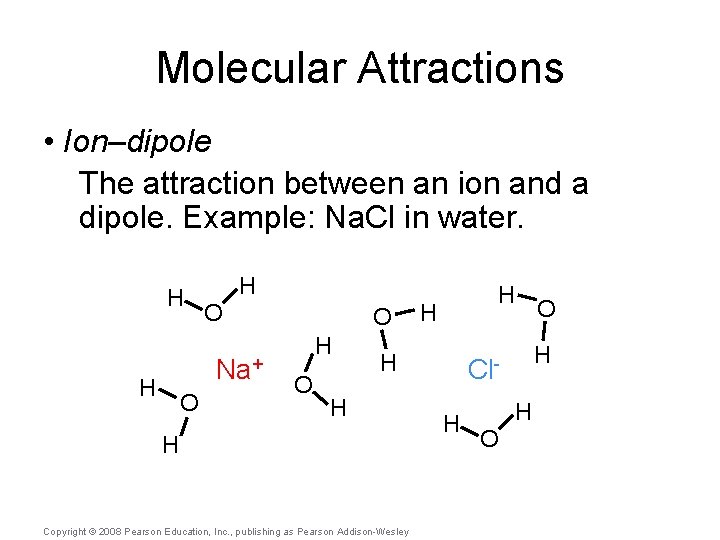
Molecular Attractions • Ion–dipole The attraction between an ion and a dipole. Example: Na. Cl in water. H H O Na+ H O O H H H Copyright © 2008 Pearson Education, Inc. , publishing as Pearson Addison-Wesley H Cl. H H O O
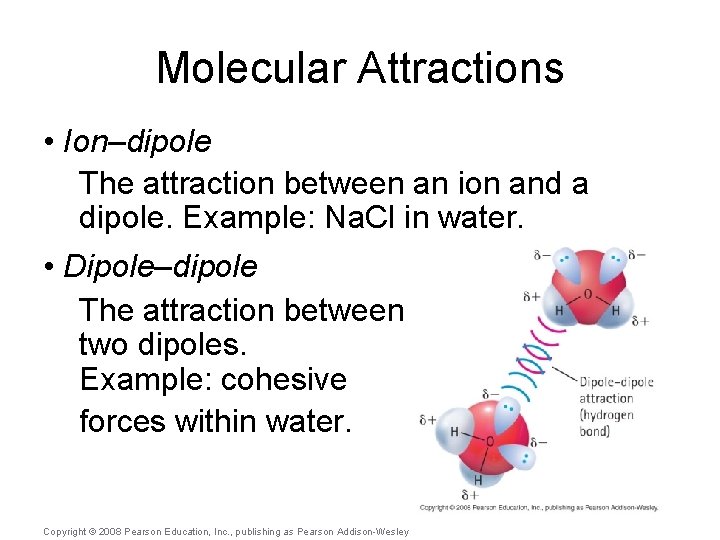
Molecular Attractions • Ion–dipole The attraction between an ion and a dipole. Example: Na. Cl in water. • Dipole–dipole The attraction between two dipoles. Example: cohesive forces within water. Copyright © 2008 Pearson Education, Inc. , publishing as Pearson Addison-Wesley
Molecular Attractions • Ion–dipole The attraction between an ion and a dipole. Example: Na. Cl in water. • Dipole–dipole The attraction between two dipoles. Example: cohesive forces within water. • Dipole–induced dipole The attraction between a dipole and an induced dipole. Copyright © 2008 Pearson Education, Inc. , publishing as Pearson Addison-Wesley
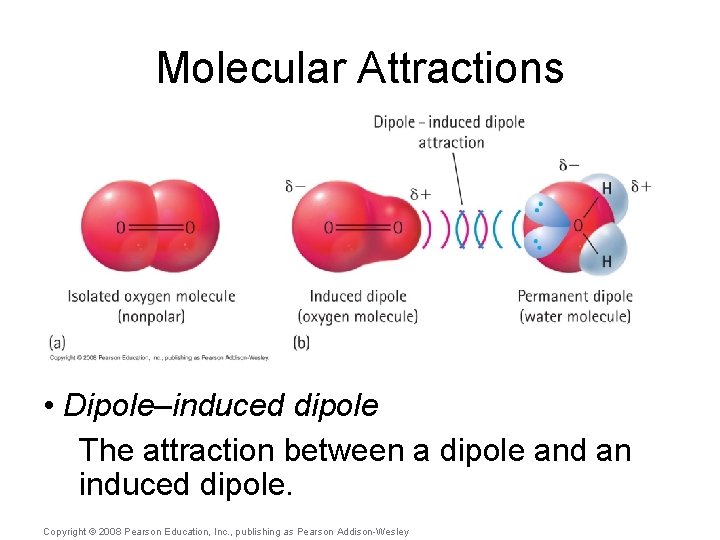
Molecular Attractions • Dipole–induced dipole The attraction between a dipole and an induced dipole. Copyright © 2008 Pearson Education, Inc. , publishing as Pearson Addison-Wesley
Molecular Attractions CHECK YOUR NEIGHBOR Is it possible for a fish to drown? A. B. C. D. No, because fish breathe water. Yes, when the water contains too little oxygen. No, because water is 88. 8% oxygen by mass. Yes, when the water is not moving. Copyright © 2008 Pearson Education, Inc. , publishing as Pearson Addison-Wesley
Molecular Attractions CHECK YOUR ANSWER Is it possible for a fish to drown? A. B. C. D. No, because fish breathe water. Yes, when the water contains too little oxygen. No, because water is 88. 8% oxygen by mass. Yes, when the water is not moving. Explanation: Fish don’t breathe water. Their gills extract the small amounts of dissolved oxygen, O 2, which can be found even in water that remains still. Copyright © 2008 Pearson Education, Inc. , publishing as Pearson Addison-Wesley
Molecular Attractions CHECK YOUR NEIGHBOR A nonpolar material, such as oxygen, O 2, is soluble in a polar material, such as water, H 2 O, by way of A. B. C. D. ion–dipole attractions. dipole–induced dipole attractions. All of the above. Copyright © 2008 Pearson Education, Inc. , publishing as Pearson Addison-Wesley
Molecular Attractions CHECK YOUR ANSWER A nonpolar material, such as oxygen, O 2, is soluble in a polar material, such as water, H 2 O, by way of A. B. C. D. ion–dipole attractions. dipole–induced dipole attractions. All of the above. Explanation: This is a relatively weak force of attraction, which explains why not much oxygen dissolves in the water. There is enough, however, to allow fish to live. Copyright © 2008 Pearson Education, Inc. , publishing as Pearson Addison-Wesley
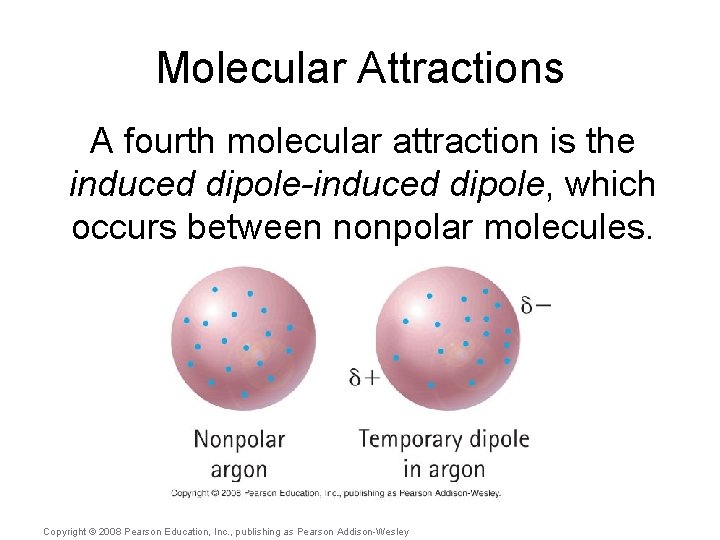
Molecular Attractions A fourth molecular attraction is the induced dipole-induced dipole, which occurs between nonpolar molecules. Copyright © 2008 Pearson Education, Inc. , publishing as Pearson Addison-Wesley
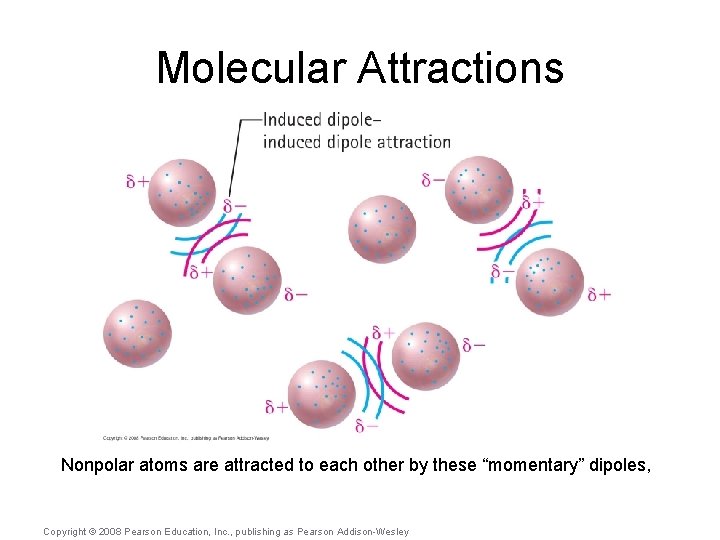
Molecular Attractions Nonpolar atoms are attracted to each other by these “momentary” dipoles, Copyright © 2008 Pearson Education, Inc. , publishing as Pearson Addison-Wesley
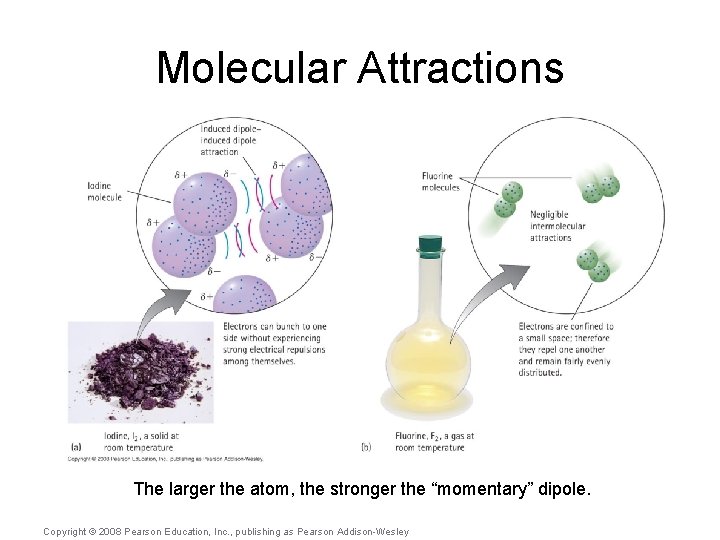
Molecular Attractions The larger the atom, the stronger the “momentary” dipole. Copyright © 2008 Pearson Education, Inc. , publishing as Pearson Addison-Wesley
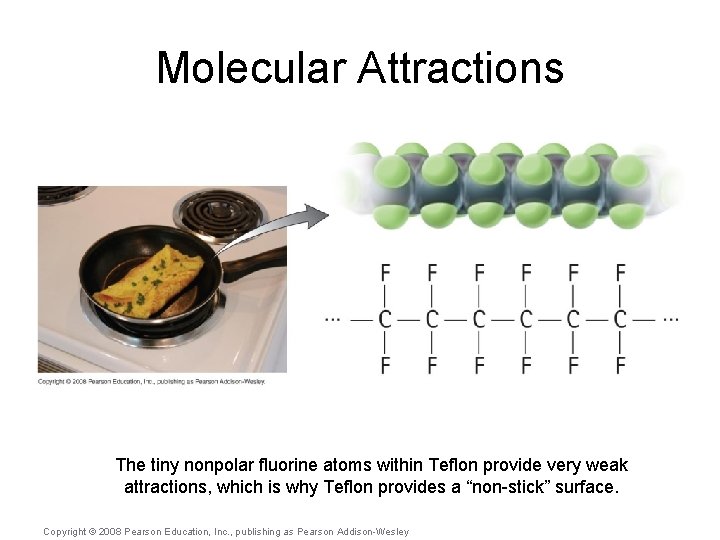
Molecular Attractions The tiny nonpolar fluorine atoms within Teflon provide very weak attractions, which is why Teflon provides a “non-stick” surface. Copyright © 2008 Pearson Education, Inc. , publishing as Pearson Addison-Wesley
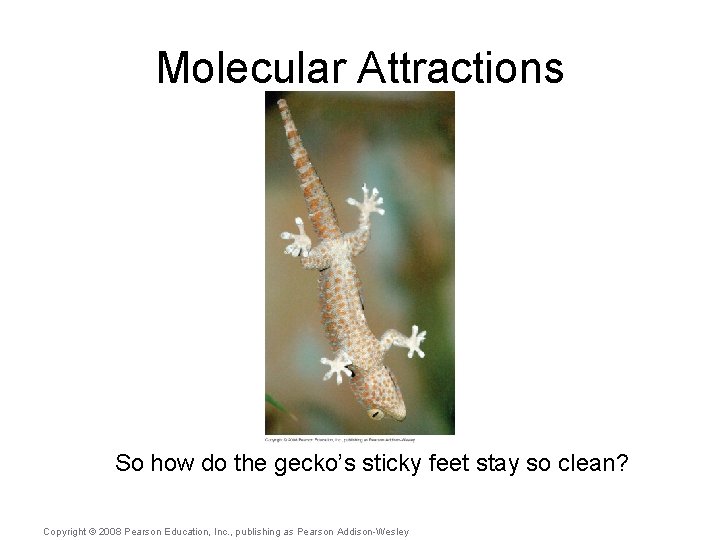
Molecular Attractions So how do the gecko’s sticky feet stay so clean? Copyright © 2008 Pearson Education, Inc. , publishing as Pearson Addison-Wesley
Molecular Attractions CHECK YOUR NEIGHBOR Which type of molecular attraction takes the least amount of energy to break apart? A. B. C. D. ion–dipole attractions. dipole–induced dipole attractions. induced dipole-induced dipole attractions. Copyright © 2008 Pearson Education, Inc. , publishing as Pearson Addison-Wesley
Molecular Attractions CHECK YOUR ANSWER Which type of molecular attraction takes the least amount of energy to break apart? A. B. C. D. ion–dipole attractions. dipole–induced dipole attractions. induced dipole-induced dipole attractions. Explanation: The induced dipole-induced dipole attraction is the weakest of these four, but only on a molecule-to-molecule basis. Remember, each hook on a strip of Velcro may be weak, but all the tiny hooks working together can provide for a significant holding power. Copyright © 2008 Pearson Education, Inc. , publishing as Pearson Addison-Wesley
- Slides: 76