
Chapter 15 HARVESTING Material from ENTREPRENEURIAL FINANCE STRATEGY

- Slides: 39
Chapter 15 HARVESTING Material from ENTREPRENEURIAL FINANCE: STRATEGY, VALUATION, AND DEAL STRUCTURE, by Janet Kiholm Smith, Richard L. Smith, and Richard T. Bliss, © by Stanford University, all rights reserved. Instructors may make copies of Power. Point Presentation contained herein for classroom distribution only. Any further reproduction, distribution, or use of this material, in any way or by any means, is strictly prohibited without the prior written permission of the publisher.
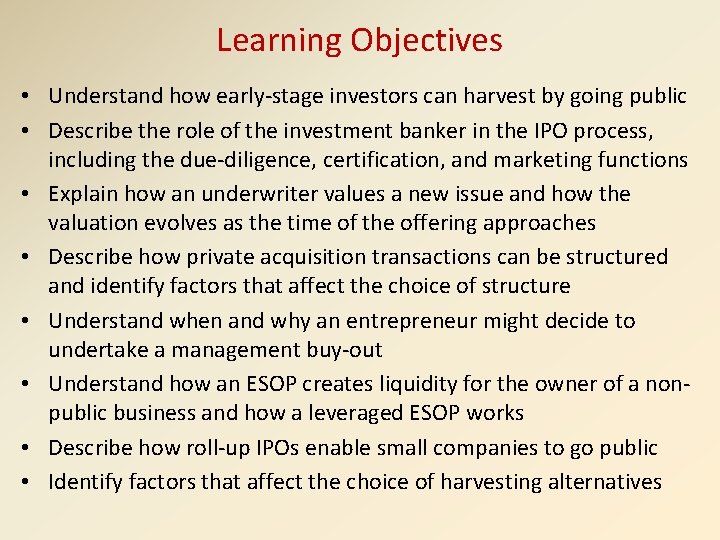
Learning Objectives • Understand how early-stage investors can harvest by going public • Describe the role of the investment banker in the IPO process, including the due-diligence, certification, and marketing functions • Explain how an underwriter values a new issue and how the valuation evolves as the time of the offering approaches • Describe how private acquisition transactions can be structured and identify factors that affect the choice of structure • Understand when and why an entrepreneur might decide to undertake a management buy-out • Understand how an ESOP creates liquidity for the owner of a nonpublic business and how a leveraged ESOP works • Describe how roll-up IPOs enable small companies to go public • Identify factors that affect the choice of harvesting alternatives
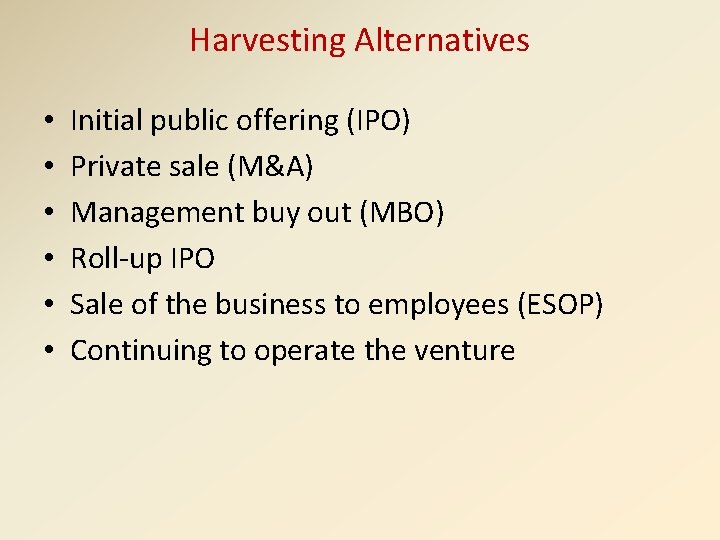
Harvesting Alternatives • • • Initial public offering (IPO) Private sale (M&A) Management buy out (MBO) Roll-up IPO Sale of the business to employees (ESOP) Continuing to operate the venture
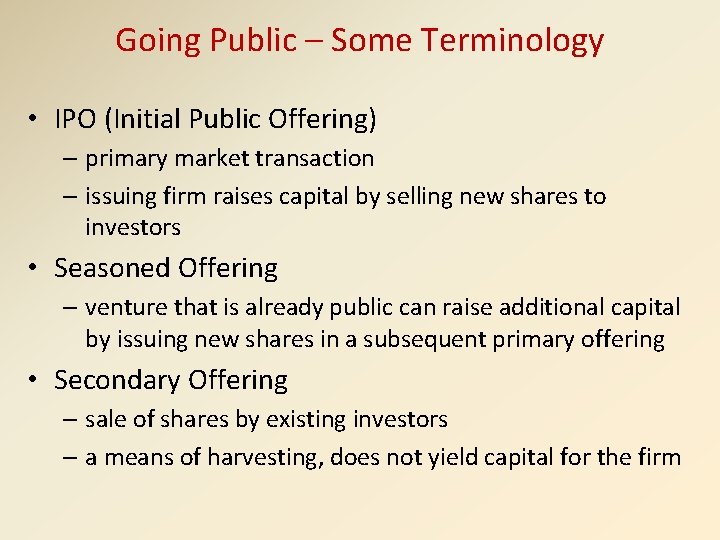
Going Public – Some Terminology • IPO (Initial Public Offering) – primary market transaction – issuing firm raises capital by selling new shares to investors • Seasoned Offering – venture that is already public can raise additional capital by issuing new shares in a subsequent primary offering • Secondary Offering – sale of shares by existing investors – a means of harvesting, does not yield capital for the firm
Approaches to Public Offering • Firm commitment – underwriter commits to buy all shares issued at the net offering price • Best-efforts basis – the investment banker acts more like an agent of the issuer and does not guarantee net proceeds • Rights offering – the issuer raises equity by issuing warrants to existing shareholders
The IPO Process: Selecting the Underwriter • The “bake-off” or “beauty contest” • Matching the underwriter’s capabilities with the issuer’s specific interests and objectives • Underwriter duties – due diligence – certification – issue pricing – syndication – distribution – market making
The IPO Process: Due Diligence and Issue Pricing • Underwriter as the intermediary between the informed issuer and uninformed investors • Due diligence and the prospectus can mitigate the information asymmetry • Establishing the offer price also addresses the information disparity • Investors can rely on the offer price as a conservative estimate of the value of the shares • The reputations of underwriters and VCs can act to “certify” the IPO
Figure 15. 1
The IPO Process: Cost • Going public is expensive – Underwriter fee: 5 -7 percent of proceeds – Direct issuing cost: 1 -5 percent of proceeds – Underpricing: 10 -15 percent of proceeds – Total: 16 -27 percent of gross proceeds 17 -31 percent of net proceeds
Why are IPOS are so expensive? • Significant fixed costs (prospectus) • Due diligence cost • Direct costs the underwriter incurs to market the issue • Underwriter’s exposure to risk after the IPO • Would auctioning be better? – Open. IPO
Green Shoe and Overallotment Options • A Green Shoe option, allows the underwriter to issue additional shares if demand turns out to be higher than anticipated • An overallotment option allows the underwriter to offer additional shares, anticipating that some investors may not honor their commitment to buy or may “flip” their shares to make a quick profit, which would depress the price
Cost of Harvesting by Going Public • IPO usually involves a small fraction of total shares • Selling shareholders normally harvest in the aftermarket • Existing shareholders implicitly bear the cost of the IPO • Percentage cost of IPO is less important than percentage cost of harvesting
Ways of Harvesting for Investors • Secondary sale as part of the IPO • Direct sales in the secondary market – timing and rate of sales are restricted in the US by Rule 144 – may also be restricted by lock-up provisions with underwriter • Seasoned offering of secondary shares • Private placement of secondary shares
Acquisition • Exchange modes – equity for cash – assets for cash – equity or assets for equity • Valuation • Choice of public or private sale
Acquisition – Equity for Cash • Buyer acquires assets and assumes liabilities • Due diligence and representations & warranties can reduce information asymmetry and bring valuations closer • Good for VCs/investors – immediate liquidity which is easily distributed – no adverse tax impact • May not be good for entrepreneurs/founders – potentially large tax impact – may sever entrepreneur’s involvement • Risky for buyer – trading a safe asset (cash) for the acquired risky assets – Increase in leverage if the cash is borrowed
Acquisition – Assets for Cash • Buyer can target only the desired assets for acquisition • Buyer avoids responsibility for liabilities and unattractive capital structure, e. g. , target company is in financial distress or bankruptcy • Cash price to seller will be higher without the buyer assuming the liabilities
Acquisition – Equity or Assets for Stock • Requires due diligence on both sides since the seller is getting a risky asset (the acquirer’s shares) as payment • Acquirer avoids time/cost of raising financing • May allow seller to postpone tax liability • Issues with a private acquirer – no “market value” for shares – non-traded shares may not provide liquidity
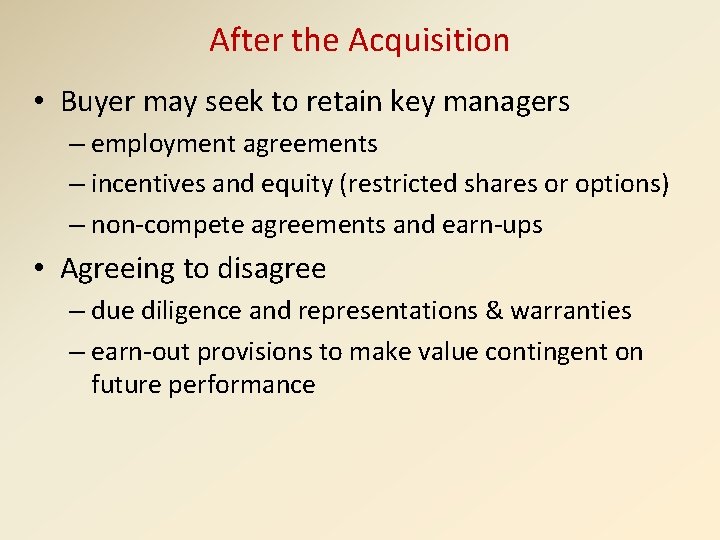
After the Acquisition • Buyer may seek to retain key managers – employment agreements – incentives and equity (restricted shares or options) – non-compete agreements and earn-ups • Agreeing to disagree – due diligence and representations & warranties – earn-out provisions to make value contingent on future performance
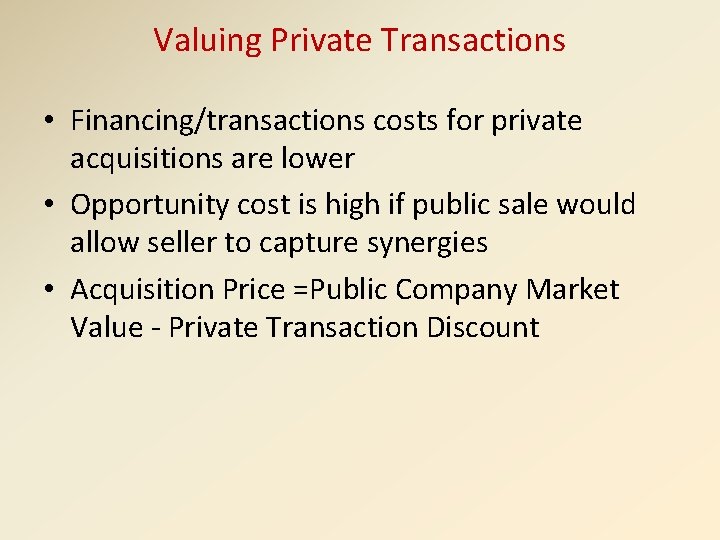
Valuing Private Transactions • Financing/transactions costs for private acquisitions are lower • Opportunity cost is high if public sale would allow seller to capture synergies • Acquisition Price =Public Company Market Value - Private Transaction Discount
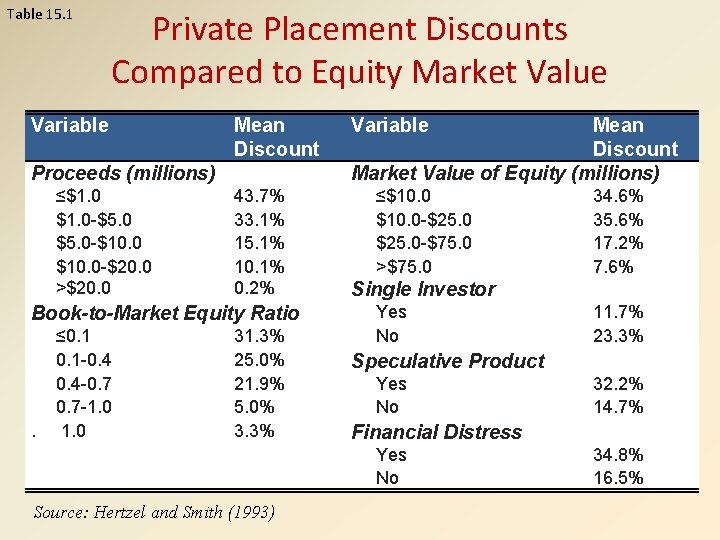
Table 15. 1 Private Placement Discounts Compared to Equity Market Value Variable Mean Discount Proceeds (millions) ≤$1. 0 -$5. 0 -$10. 0 -$20. 0 >$20. 0 43. 7% 33. 1% 15. 1% 10. 1% 0. 2% Book-to-Market Equity Ratio . ≤ 0. 1 -0. 4 -0. 7 -1. 0 31. 3% 25. 0% 21. 9% 5. 0% 3. 3% Variable Mean Discount Market Value of Equity (millions) ≤$10. 0 -$25. 0 -$75. 0 >$75. 0 Single Investor Yes No 11. 7% 23. 3% Speculative Product Yes No 32. 2% 14. 7% Financial Distress Yes No Source: Hertzel and Smith (1993) 34. 6% 35. 6% 17. 2% 7. 6% 34. 8% 16. 5%
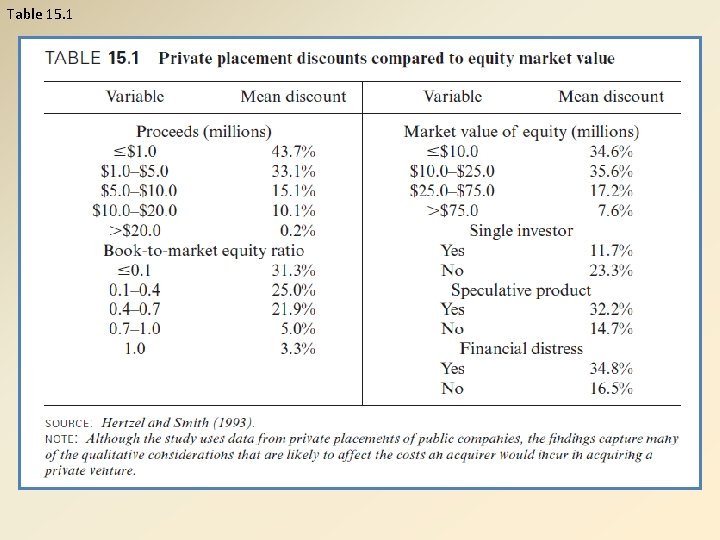
Table 15. 1
Going Public by Reverse Merger • Reverse merger - existing public company of negligible value acquires the shares of a private company that seeks a public market, and, possibly, then changes its name to that of the private company – does not require an underwriter – avoids the cost of an IPO – can be accomplished relatively quickly
Management Buy-out • A harvesting event is critical to VCs and other outside investors; it may be less important for the entrepreneur/founders • A management buy-out (MBO) might be a response to investor insistence on exercising demand registration rights or to an acquisition • MBOs are usually financed with debt venture cash flows must be sufficient to service the debt
Valuing Management Buy-out Transactions • Buyer (the management team) knows almost everything possible about the venture – due diligence can be completed quickly and at lower cost • Entrepreneur may place subjective value on continuing to run the business • These costs savings/benefits may be offset by the fact that the entrepreneur and management team continue to be underdiversified
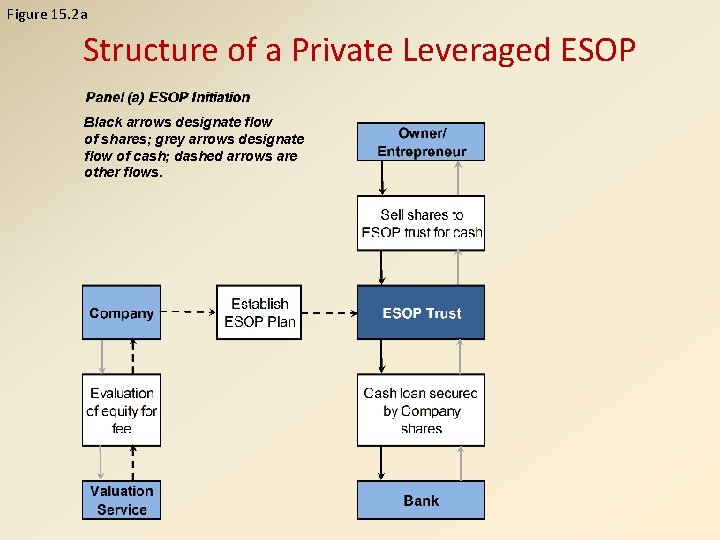
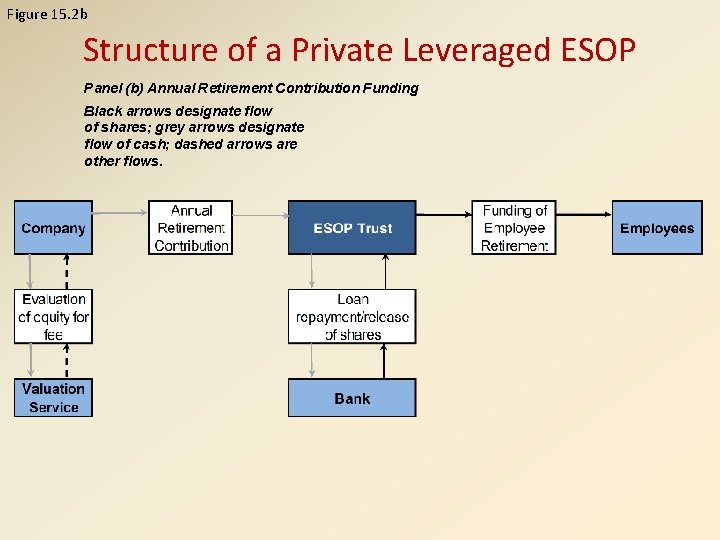
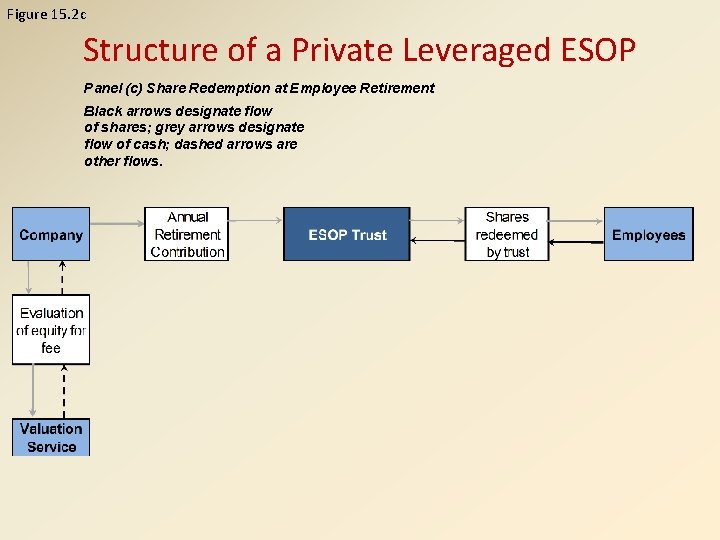
Employee Stock Ownership Plan (ESOP) • Entrepreneur may have little desire or need for a harvesting event • ESOP creates liquidity by establishing an internal market for a venture’s shares – cash flow to entrepreneur – estate/tax planning – employee compensation • Leveraged versus unleveraged ESOP
Figure 15. 2 a Structure of a Private Leveraged ESOP Black arrows designate flow of shares; grey arrows designate flow of cash; dashed arrows are other flows.
Figure 15. 2 b Structure of a Private Leveraged ESOP Panel (b) Annual Retirement Contribution Funding Black arrows designate flow of shares; grey arrows designate flow of cash; dashed arrows are other flows.
Figure 15. 2 c Structure of a Private Leveraged ESOP Panel (c) Share Redemption at Employee Retirement Black arrows designate flow of shares; grey arrows designate flow of cash; dashed arrows are other flows.
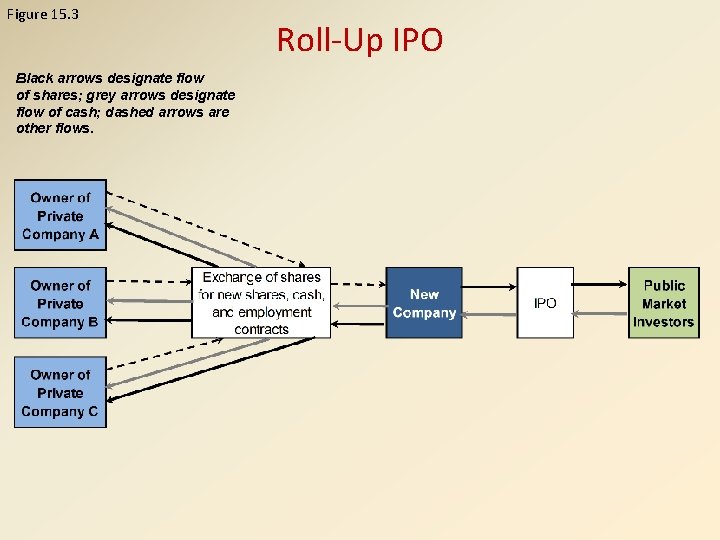
Roll-Up IPO • A company too small to go public alone combines with others to create an organization large enough to make efficient use of the public offering process – similar firms – usually profitable – IPO based on consolidated financial statements
Figure 15. 3 Black arrows designate flow of shares; grey arrows designate flow of cash; dashed arrows are other flows. Roll-Up IPO
The Harvesting Decision • Factors that bear on the exit decision – company size – the value of a public market for the shares – synergies with prospective acquirers – track record and ease of valuation – timing – ownership and control implications – taxes – transactions costs
The Harvesting Decision • Company size – IPO is more effective for large firms – small firms may achieve liquidity by acquisition • The value of a public market for the shares – disclosure and reporting requirements – as a currency for acquisitions and compensation – increased awareness of company’s products/image enhancement – provides flexibility over harvest timing
The Harvesting Decision • Synergies with prospective acquirers – being public may allow entrepreneur and investors to capture more value • Track record and ease of valuation – public investors may not provide the best valuation for new and volatile ventures • Timing – IPO volume is highly sensitive to market conditions
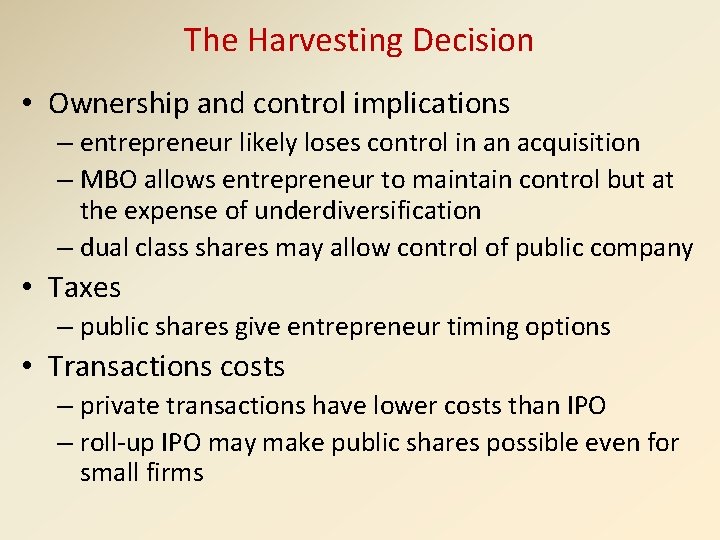
The Harvesting Decision • Ownership and control implications – entrepreneur likely loses control in an acquisition – MBO allows entrepreneur to maintain control but at the expense of underdiversification – dual class shares may allow control of public company • Taxes – public shares give entrepreneur timing options • Transactions costs – private transactions have lower costs than IPO – roll-up IPO may make public shares possible even for small firms
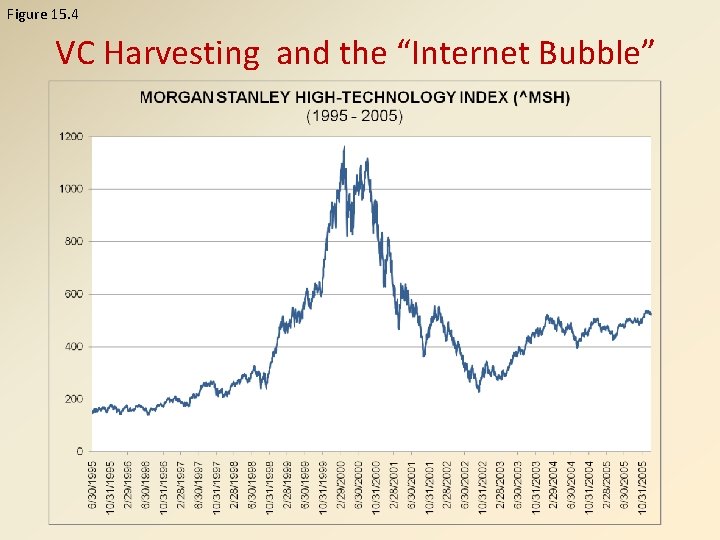
Figure 15. 4 VC Harvesting and the “Internet Bubble”
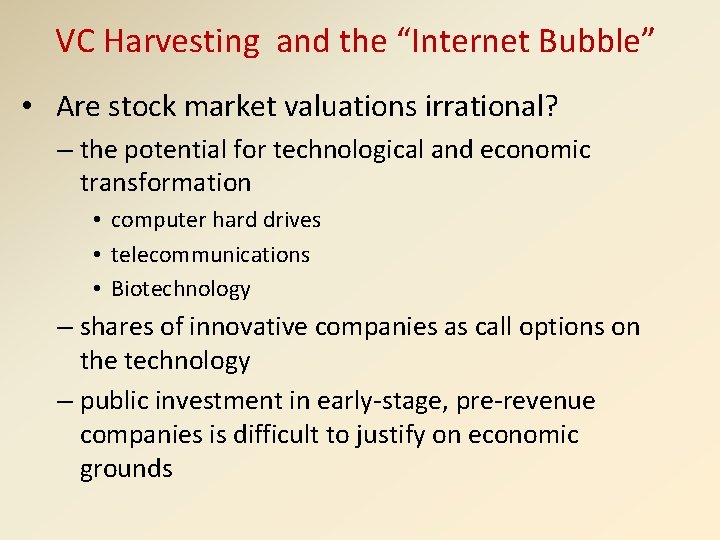
VC Harvesting and the “Internet Bubble” • Are stock market valuations irrational? – the potential for technological and economic transformation • computer hard drives • telecommunications • Biotechnology – shares of innovative companies as call options on the technology – public investment in early-stage, pre-revenue companies is difficult to justify on economic grounds
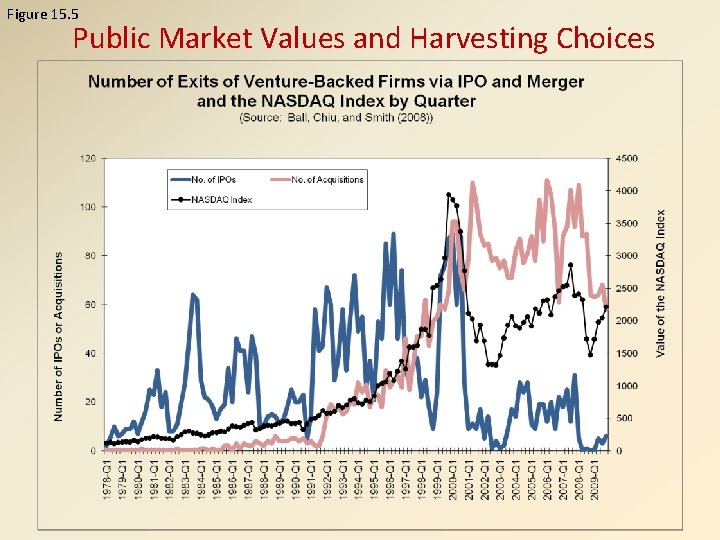
Figure 15. 5 Public Market Values and Harvesting Choices
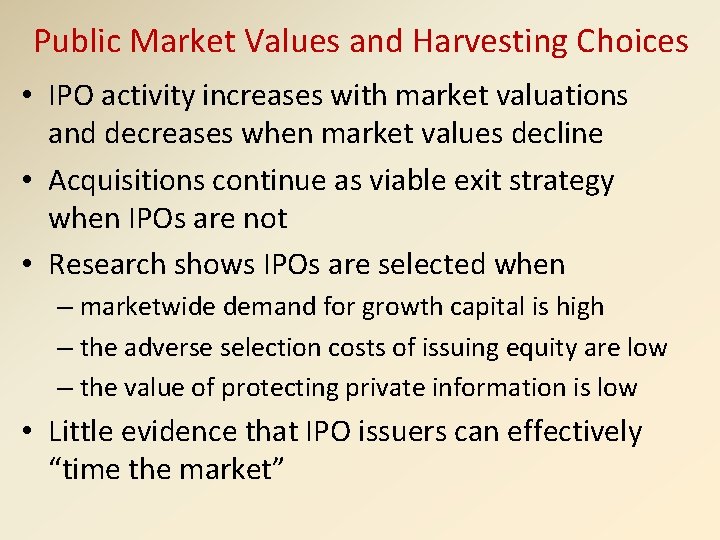
Public Market Values and Harvesting Choices • IPO activity increases with market valuations and decreases when market values decline • Acquisitions continue as viable exit strategy when IPOs are not • Research shows IPOs are selected when – marketwide demand for growth capital is high – the adverse selection costs of issuing equity are low – the value of protecting private information is low • Little evidence that IPO issuers can effectively “time the market”
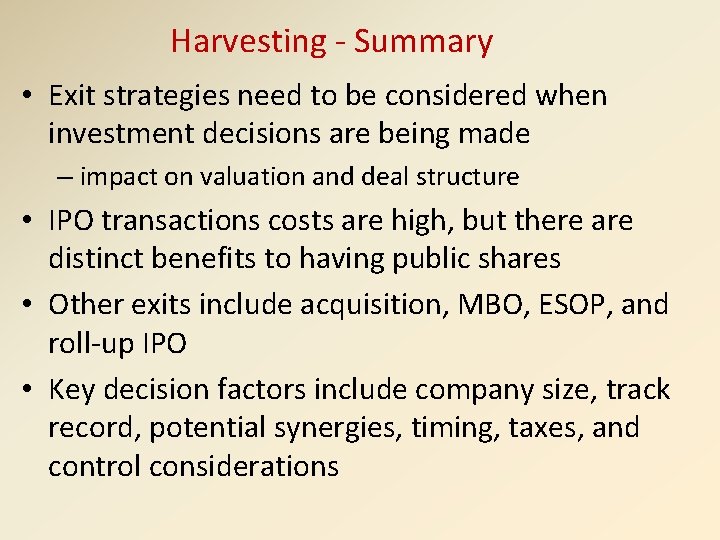
Harvesting - Summary • Exit strategies need to be considered when investment decisions are being made – impact on valuation and deal structure • IPO transactions costs are high, but there are distinct benefits to having public shares • Other exits include acquisition, MBO, ESOP, and roll-up IPO • Key decision factors include company size, track record, potential synergies, timing, taxes, and control considerations