
Chapter 15 Governmental Accounting General Fund and Account
- Slides: 62
Chapter 15 Governmental Accounting: General Fund and Account Groups C 15 1
Comparison of Government and Notfor-Profits (GNPs) with Business • Different mission - no profit motive • Budget - legal document – most significant financial document – entered into accounting system – budgets drive accounting • Level of services - expenditures drive revenues • Need to assure interperiod equity C 15 2
Types of GNPs • Governmental – cities, towns, counties, school districts, special tax districts, states, townships, etc. • Not-for-Profits – schools, universities, hospitals, social service organizations, civic organizations, cultural organizations, religious organizations, foundations, etc. C 15 3
Purposes of Financial Reporting • Assess financial condition • Compare actual results with the budget • Determine compliance with laws and regulations • Evaluate efficiency and effectiveness C 15 4
Users of Financial Reports • Main users identified by GASB: – citizens and taxpayers – investors and creditors – governing boards (legislators) • Other users – donors and grantors – regulatory and oversight agencies – employees and other constituents C 15 5
Objectives of Financial Reporting • GASB objectives for state & local governments – accountability (interperiod equity, budgetary and fiscal compliance, service efforts and accomplishments) – current standards - compliance reporting – new reporting model – GASB 34 C 15 6
GASB 34: New Reporting Model • Requires both fund statements and government-wide statements • Effective in – 2002 for large governments – 2003 for mid-size governments – 2004 for small governments C 15 7
New Reporting Model, continued • New requirements include infrastructure reporting and depreciation • Full accrual and modified accrual information will be reported • New model requirements explained throughout Chapters 15, 16, and 17 C 15 8
What is a Fund? • Fiscal and accounting entity with its own self-balancing set of accounts from which separate financial statements can be generated • Governments use funds to separate resources that have restrictions – many funds in each government – assets - liabilities = fund balance C 15 9
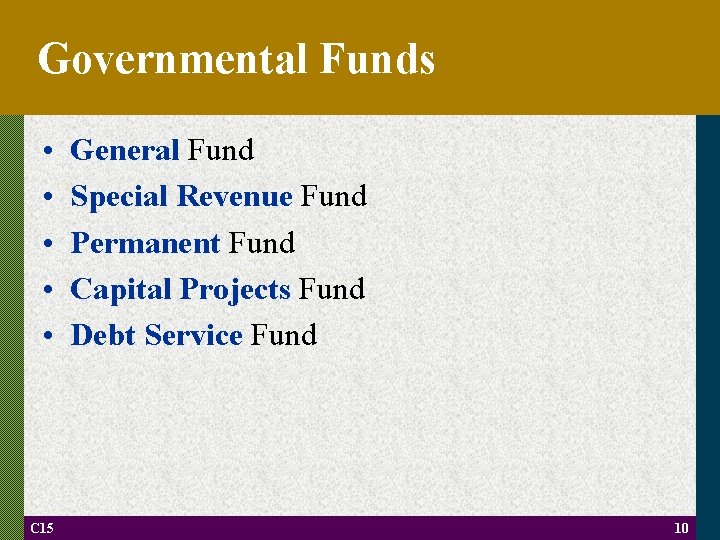
Governmental Funds • • • C 15 General Fund Special Revenue Fund Permanent Fund Capital Projects Fund Debt Service Fund 10
Governmental Funds, continued • Use modified accrual basis of accounting • Measurement focus is flow of financial resources • Therefore, just record inflows and outflows of financial resources • Use account groups to keep track of the long -term debt and fixed assets C 15 11
Proprietary Funds • Enterprise Funds • Internal Service Funds C 15 12
Proprietary Funds, continued • Use full accrual basis of accounting • Measurement focus is flow of economic resources • Therefore, record all transactions • All assets = all liabilities + fund equity • Used for all business-type activities C 15 13
Fiduciary Funds • Used to account for resources that are held by the government for others (individuals, organizations, corporations, other governments) – Private Purpose Trust Funds – Pension Trust Funds – Investment Trust Funds – Agency Funds C 15 14
Account Groups • No longer reported on the financial statements • May still be used to keep track of general capital assets and long-term debt • Two types: – General Fixed Asset Account Group (GFAAG) – General Long-Term Debt Account Group (GLTDAG) C 15 15
Overview of Governmental Fund Accounting • Recording – the budget • Accounting for – encumbrances – revenues – expenditures – other financing sources/uses C 15 16
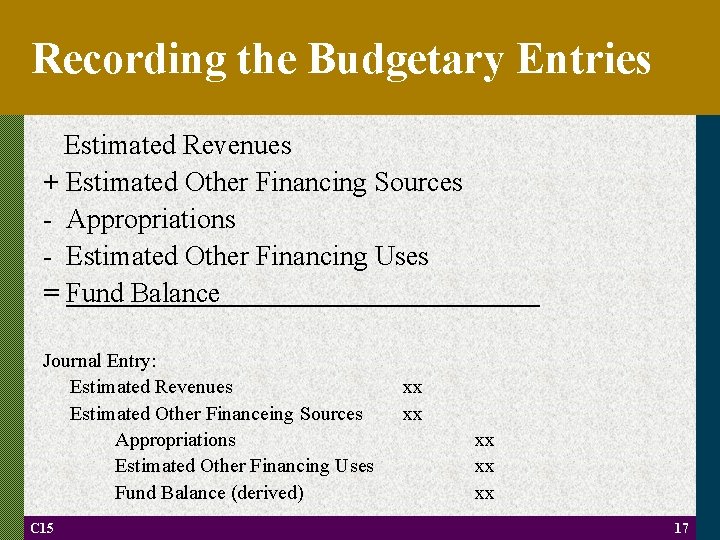
Recording the Budgetary Entries Estimated Revenues + Estimated Other Financing Sources - Appropriations - Estimated Other Financing Uses = Fund Balance Journal Entry: Estimated Revenues Estimated Other Financeing Sources Appropriations Estimated Other Financing Uses Fund Balance (derived) C 15 xx xx xx 17
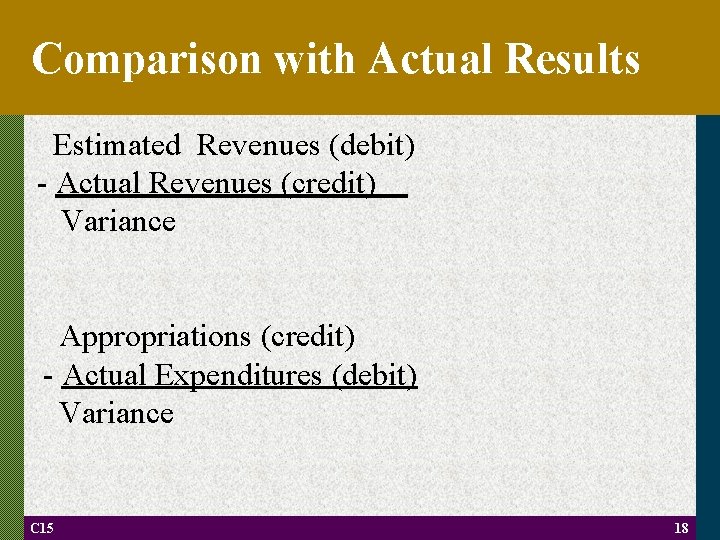
Comparison with Actual Results Estimated Revenues (debit) - Actual Revenues (credit) Variance Appropriations (credit) - Actual Expenditures (debit) Variance C 15 18
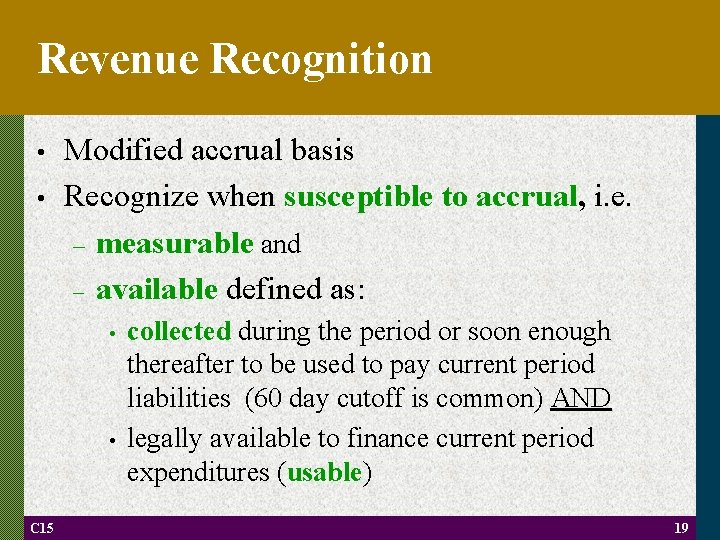
Revenue Recognition • • Modified accrual basis Recognize when susceptible to accrual, i. e. – measurable and – available defined as: • • C 15 collected during the period or soon enough thereafter to be used to pay current period liabilities (60 day cutoff is common) AND legally available to finance current period expenditures (usable) 19
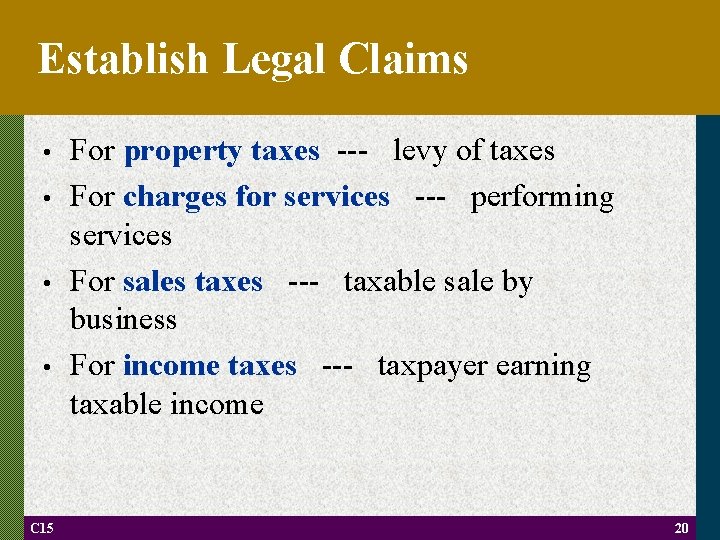
Establish Legal Claims • • C 15 For property taxes --- levy of taxes For charges for services --- performing services For sales taxes --- taxable sale by business For income taxes --- taxpayer earning taxable income 20
Deferred Revenues • • A liability Recorded if – – C 15 unearned or not legally available 21
Common Revenue Sources • • • Taxes Licenses and permits Intergovernmental revenues Charges for services Fines and forfeits Miscellaneous – – C 15 interest, rents, sales of fixed assets other financing sources (OFS) 22
Revenue: Property Taxes • • Local governments derive most of revenue from property taxes - based on value (ad valorem taxes) Recognize as revenue when levied – – – C 15 to be collected in the current period or soon enough thereafter… allowance for uncollectible deferred revenue if not “available” 23
Revenue: Sales Taxes • Recognize when merchant files sales tax return – – C 15 measurable available 24
Revenue: Licenses and Permits • • C 15 Difficult to predict accurate amounts Normally recognize revenue when cash is received 25
Grants & Other Intergovernmental Revenues • Restricted grants - expenditure driven – • • C 15 food stamps, pass-through grants (if administered), on-behalf payments Unrestricted grants - recognize upon award Entitlements - recognize upon award 26
Revenue: Charges for Services • C 15 Recognize revenue when billing for services rendered 27
Revenue: Fines • Options: – – – • C 15 when tickets are issued date fine is due actual payment date Common practice - when cash is received 28
Revenue: Investment Income • Record all investments at fair value – – • C 15 “mark-to-market” unrealized gains/losses are recognized as revenue in period Interest and dividends accrued as earned 29
Revenue: Donations • Treatment based on type of asset – – – C 15 Current assets: in funds at FMV Fixed assets that will be used: in account groups at FMV Fixed assets that will be sold: in funds as shortterm investments at FMV 30
Revenue: Tax Anticipation Notes • Recorded as a liability in the fund • Always short-term • Will not be converted into long-term so never in the account group C 15 31
Other Financing Sources • • C 15 Not a revenue Proceeds from issue of long-term debt Sale of a fixed asset up to original cost Transfer of resources from another fund 32
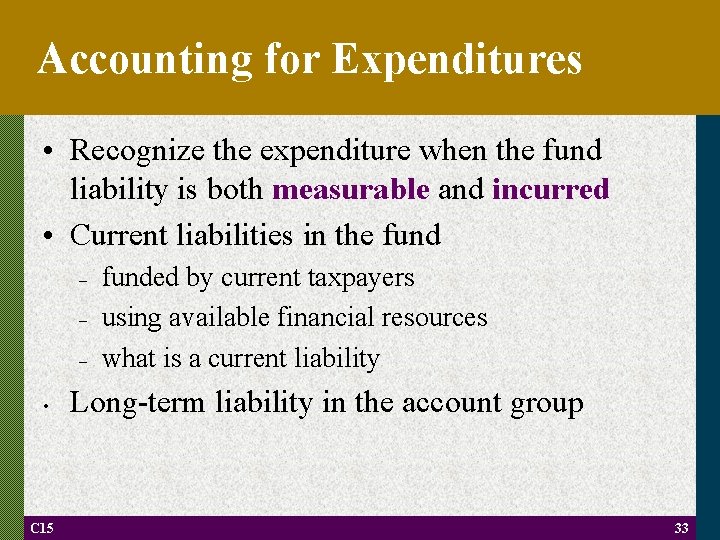
Accounting for Expenditures • Recognize the expenditure when the fund liability is both measurable and incurred • Current liabilities in the fund – – – • C 15 funded by current taxpayers using available financial resources what is a current liability Long-term liability in the account group 33
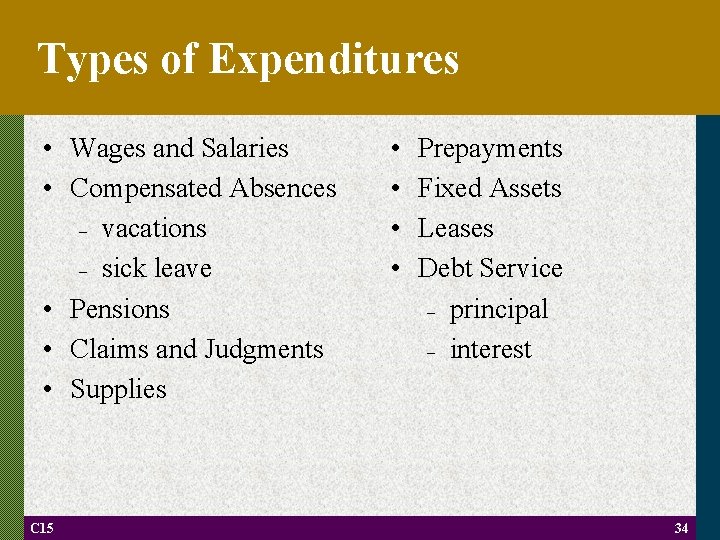
Types of Expenditures • Wages and Salaries • Compensated Absences – vacations – sick leave • Pensions • Claims and Judgments • Supplies C 15 • • Prepayments Fixed Assets Leases Debt Service – principal – interest 34
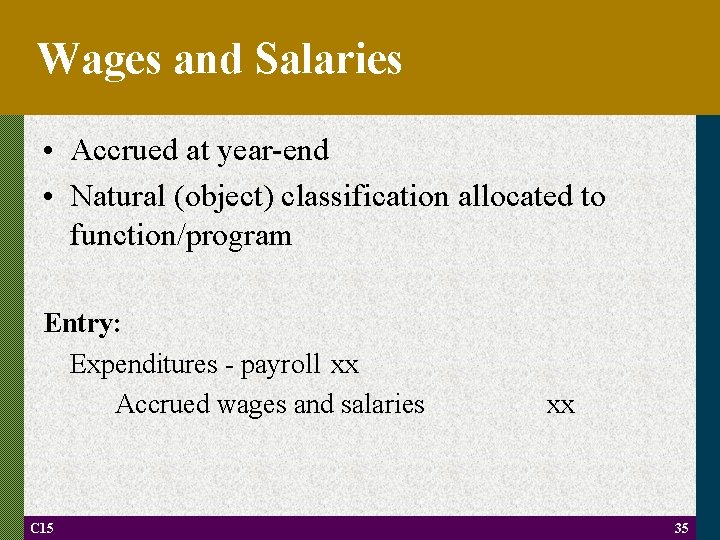
Wages and Salaries • Accrued at year-end • Natural (object) classification allocated to function/program Entry: Expenditures - payroll xx Accrued wages and salaries C 15 xx 35
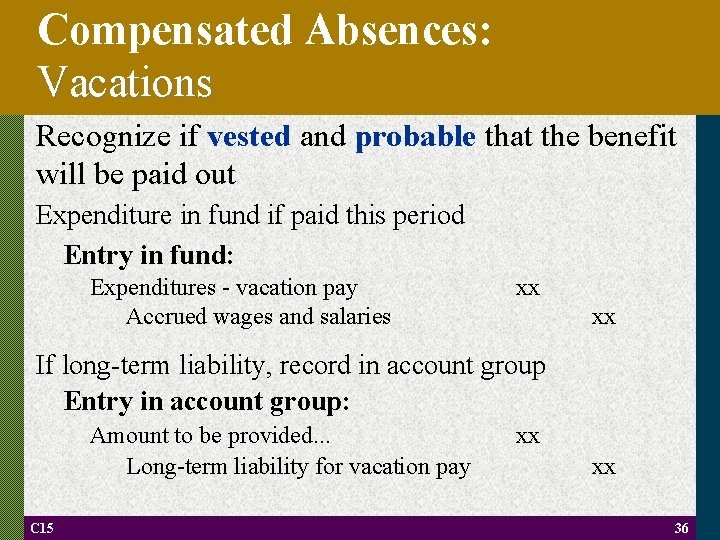
Compensated Absences: Vacations Recognize if vested and probable that the benefit will be paid out Expenditure in fund if paid this period Entry in fund: Expenditures - vacation pay Accrued wages and salaries xx xx If long-term liability, record in account group Entry in account group: Amount to be provided. . . Long-term liability for vacation pay C 15 xx xx 36
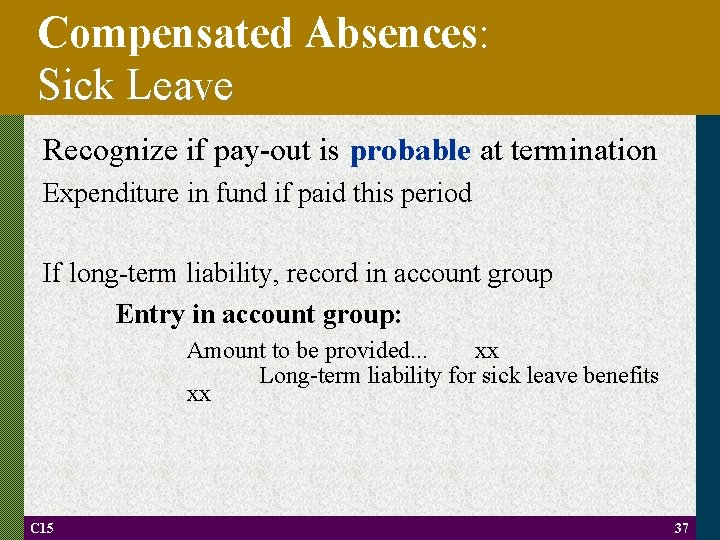
Compensated Absences: Sick Leave Recognize if pay-out is probable at termination Expenditure in fund if paid this period If long-term liability, record in account group Entry in account group: Amount to be provided. . . xx Long-term liability for sick leave benefits xx C 15 37
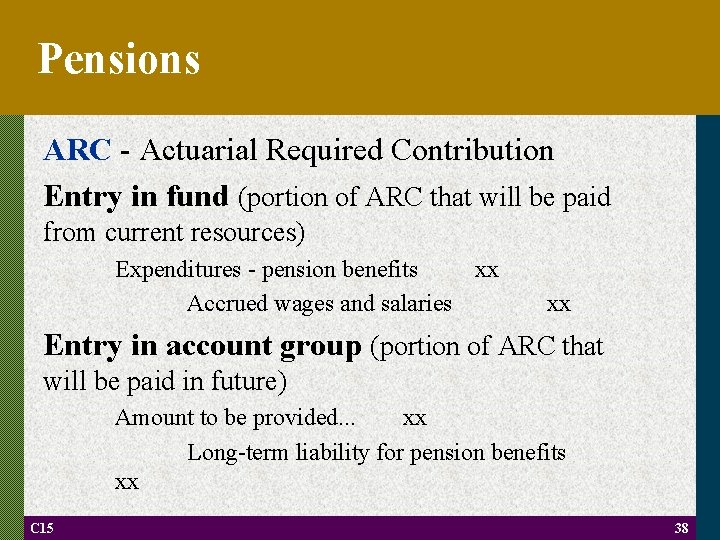
Pensions ARC - Actuarial Required Contribution Entry in fund (portion of ARC that will be paid from current resources) Expenditures - pension benefits xx Accrued wages and salaries xx Entry in account group (portion of ARC that will be paid in future) Amount to be provided. . . xx Long-term liability for pension benefits xx C 15 38
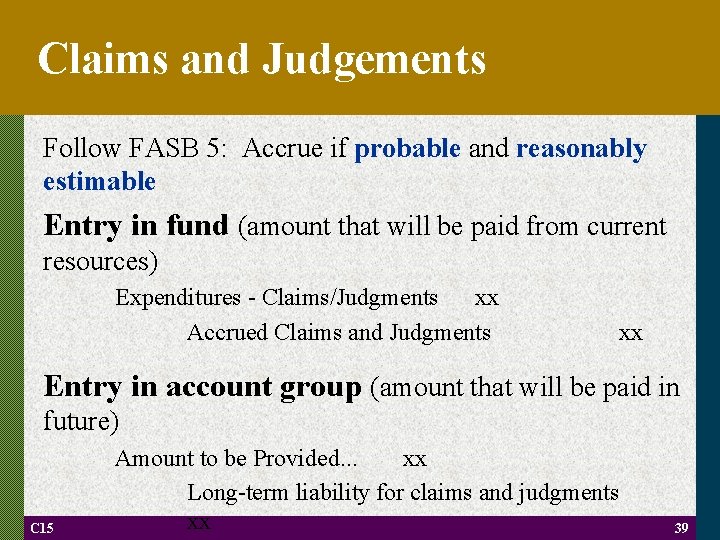
Claims and Judgements Follow FASB 5: Accrue if probable and reasonably estimable Entry in fund (amount that will be paid from current resources) Expenditures - Claims/Judgments xx Accrued Claims and Judgments xx Entry in account group (amount that will be paid in future) C 15 Amount to be Provided. . . xx Long-term liability for claims and judgments xx 39
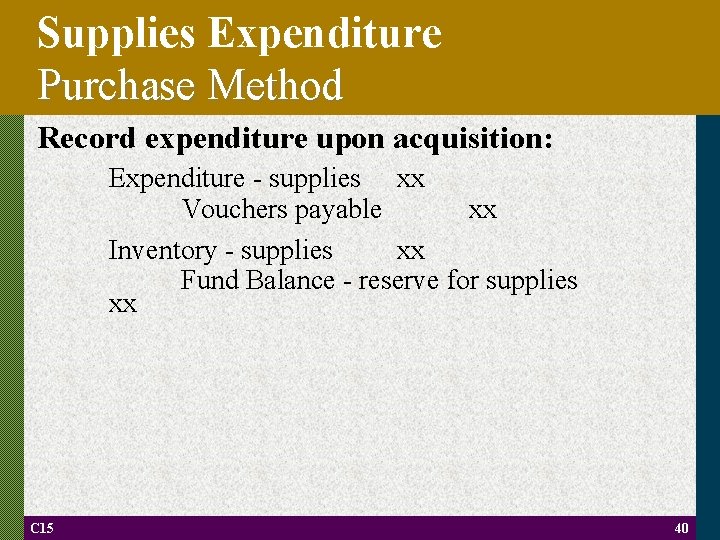
Supplies Expenditure Purchase Method Record expenditure upon acquisition: Expenditure - supplies xx Vouchers payable xx Inventory - supplies xx Fund Balance - reserve for supplies xx C 15 40
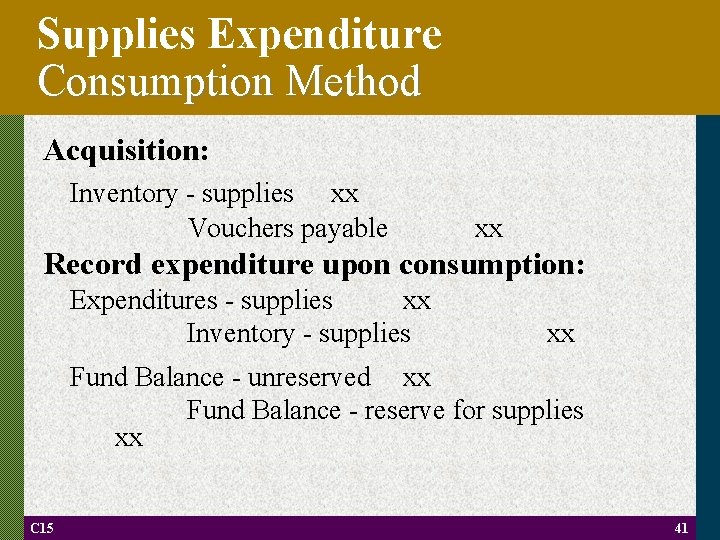
Supplies Expenditure Consumption Method Acquisition: Inventory - supplies xx Vouchers payable xx Record expenditure upon consumption: Expenditures - supplies xx Inventory - supplies xx Fund Balance - unreserved xx Fund Balance - reserve for supplies xx C 15 41
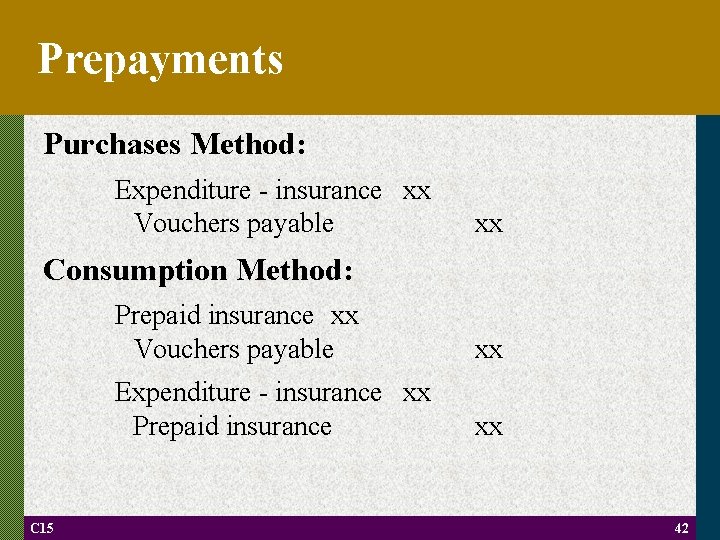
Prepayments Purchases Method: Expenditure - insurance xx Vouchers payable xx Consumption Method: C 15 Prepaid insurance xx Vouchers payable xx Expenditure - insurance xx Prepaid insurance xx 42
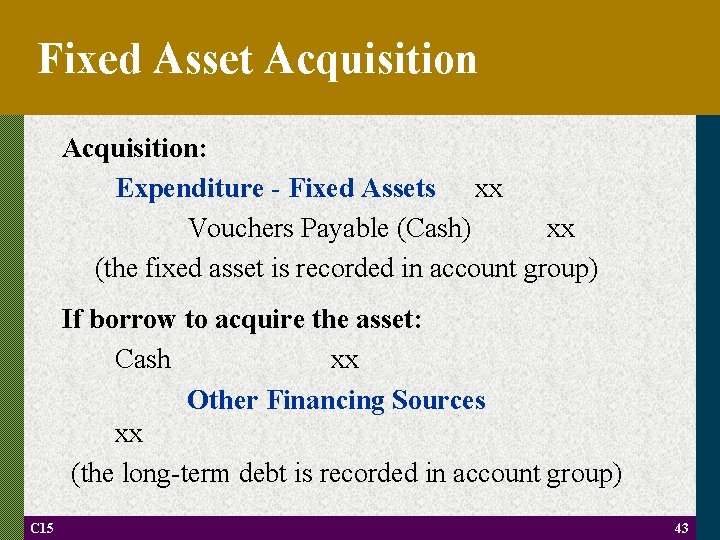
Fixed Asset Acquisition: Expenditure - Fixed Assets xx Vouchers Payable (Cash) xx (the fixed asset is recorded in account group) If borrow to acquire the asset: Cash xx Other Financing Sources xx (the long-term debt is recorded in account group) C 15 43
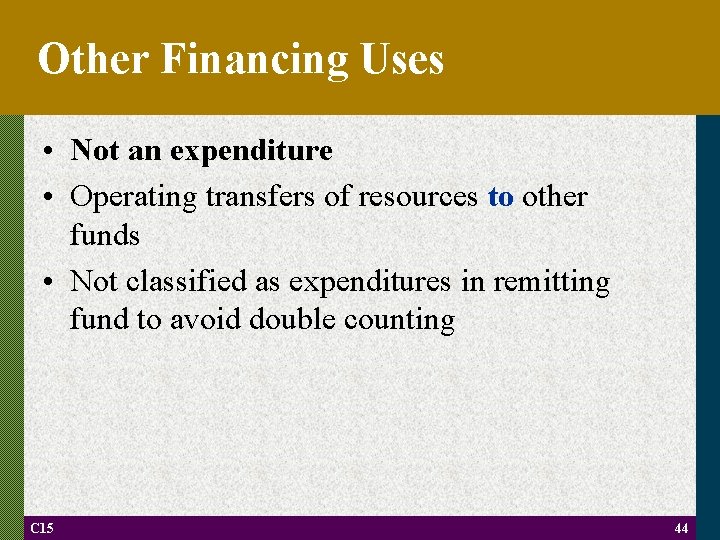
Other Financing Uses • Not an expenditure • Operating transfers of resources to other funds • Not classified as expenditures in remitting fund to avoid double counting C 15 44
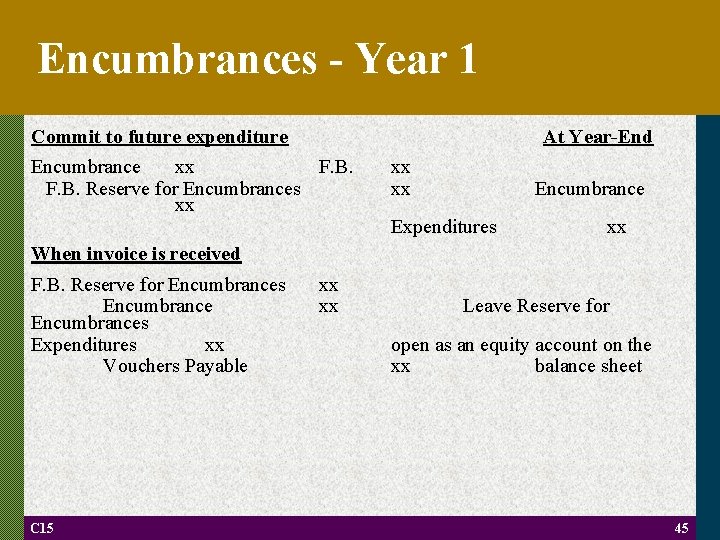
Encumbrances - Year 1 Commit to future expenditure At Year-End Encumbrance xx F. B. Reserve for Encumbrances xx xx xx Encumbrance Expenditures xx When invoice is received F. B. Reserve for Encumbrances Expenditures xx Vouchers Payable C 15 xx xx Leave Reserve for open as an equity account on the xx balance sheet 45
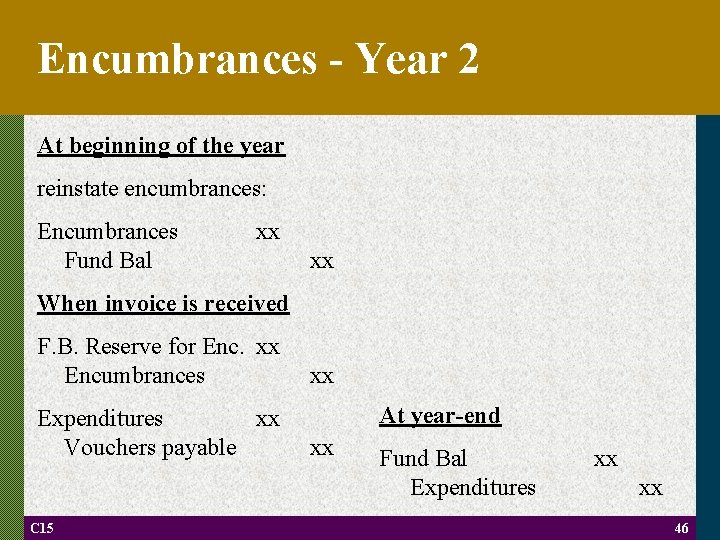
Encumbrances - Year 2 At beginning of the year reinstate encumbrances: Encumbrances Fund Bal xx xx When invoice is received F. B. Reserve for Enc. xx Encumbrances Expenditures xx Vouchers payable C 15 xx At year-end xx Fund Bal Expenditures xx xx 46
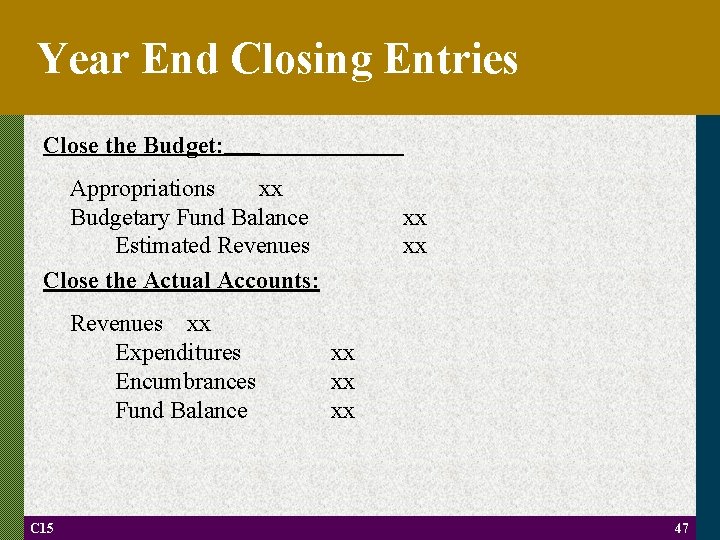
Year End Closing Entries Close the Budget: Appropriations xx Budgetary Fund Balance Estimated Revenues Close the Actual Accounts: Revenues xx Expenditures Encumbrances Fund Balance C 15 xx xx xx 47
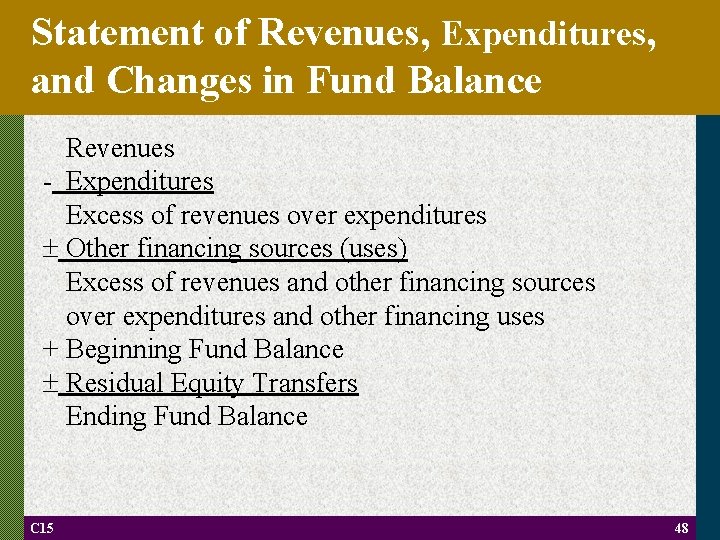
Statement of Revenues, Expenditures, and Changes in Fund Balance Revenues - Expenditures Excess of revenues over expenditures Other financing sources (uses) Excess of revenues and other financing sources over expenditures and other financing uses + Beginning Fund Balance Residual Equity Transfers Ending Fund Balance C 15 48
Accounting for Investments • Marketable Securities – stocks, bonds, notes, other financial instruments – recent controversies • Orange County, Texas, Ohio, Pennsylvania • more risky investment, more return • more sophisticated instruments C 15 49
Sophisticated Instruments • • Repurchase agreements Reverse repurchase agreements Securities lending transactions Derivatives (only value is some underlying asset, interest rate, or index) • Hedging on a changing economy C 15 50
GASB #3 (1986) • Requires extensive disclosure of risk – 3 categories • • • C 15 insured or collateralized with securities held by government collateralized with securities held by pledging financial institution uncollateralized 51
GASB Technical Bulletin 94 -1 (1994) • reaffirmed GASB #3 – plus, disclose any violation of legal, regulatory, or contractual provisions by investing in derivatives – explain nature of derivative transactions • C 15 reasons, exposure to credit risk, market risk legal risk 52
GASB #31 (1997) • All investments are to be shown on the balance sheet at fair value • Adjustments up or down to fair value are included on operating statement as adjustments to current-period revenue C 15 53
Account Groups General Fixed Assets - GFAAG General Long-Term Debt - GLTDAG Common Features of Account Groups: • Focus on general government as whole • Accounting procedures – list and offset accounting entries – primarily just add to/remove from “list” C 15 54
GFAAG • Definition – tracks all fixed assets other than those accounted for in proprietary or trust funds • Accounting equation for GFAAG Fixed Asset = Investment in GFA-source of funding C 15 55
GFAAG - continued Acquisition and initial valuation – cost – estimated cost – gifts: fair market value – foreclosure: lower of FMV or amount due for taxes – eminent domain: compensation to owner – escheat: FMV C 15 56
Classification of Fixed Assets • Land • Building (or Building and Improvements) • Infrastructure (or Improvements other than Buildings) • Machinery and Equipment • Construction in Progress (no capitalized interest) C 15 57
Classification of Investment in GFA by Financing Source • Capital Projects Funds – – long-term borrowing special assessments intergovernmental grants-in-aid interfund transfers • General Fund and Special Revenue Funds – – C 15 general revenues special revenues 58
GFA Options • Infrastructure – immovable in nature and of value only to state or local government – optional capitalization – disclosure policy • Capitalization Policy - legal/materiality • Recording of Depreciation - optional C 15 59
GLTDAG • Definition - all unmatured debt except that of proprietary funds –unmatured principal –secured (typically) by SLG full faith & credit –not a liability of any fund C 15 60
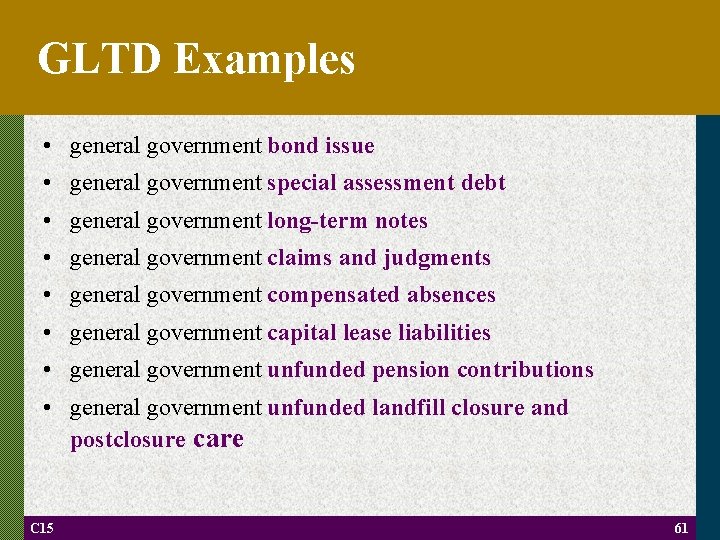
GLTD Examples • general government bond issue • general government special assessment debt • general government long-term notes • general government claims and judgments • general government compensated absences • general government capital lease liabilities • general government unfunded pension contributions • general government unfunded landfill closure and postclosure care C 15 61
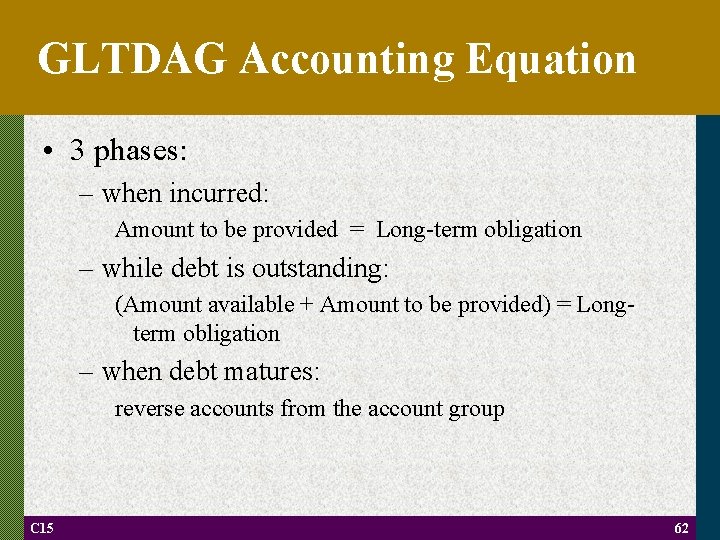
GLTDAG Accounting Equation • 3 phases: – when incurred: Amount to be provided = Long-term obligation – while debt is outstanding: (Amount available + Amount to be provided) = Longterm obligation – when debt matures: reverse accounts from the account group C 15 62