
Chapter 15 Government at Work The Bureaucracy Section
Chapter 15: Government at Work: The Bureaucracy Section 4
Objectives 1. Explain why Congress has created the independent agencies. 2. Identify the characteristics of independent executive agencies. 3. Describe the history and formation of NASA, the OPM, and Selective Service. 4. Explain the structure and function of the independent regulatory commissions and government corporations. Chapter 15, Section 4 Copyright Pearson Education Slide 2
Key Terms • independent agency: a federal agency that operates independently of the 15 executive departments • independent executive agency: the largest category of independent federal agencies, which include most of the non-Cabinet agencies • civil service: the collective name given to the majority of civilians who work directly for the federal government • patronage: the practice of handing out jobs, contracts, and other government favors to political supporters and friends Chapter 15, Section 4 Copyright Pearson Education Slide 3
Key Terms, cont. • spoils system: another name for the patronage system, dating back to the administration of Andrew Jackson • draft: compulsory, or required, military service; also called conscription • independent regulatory commission: one of 11 agencies that monitor and police key aspects of the national economy, with little direction from the President • government corporation: a government agency set up by Congress to carry out specific business activities Chapter 15, Section 4 Copyright Pearson Education Slide 4
Introduction • What are the roles and structures of the independent agencies? – Independent agencies are units created by Congress that operate outside of the executive departments. – There are more than 100 such agencies, carrying out many different tasks. – Independent agencies can be divided into three broad categories: • Independent executive agencies • Independent regulatory commissions • Government corporations Chapter 15, Section 4 Copyright Pearson Education Slide 5
Independent Agencies • Some perform work that does not fit easily into any existing executive department. • Some are independent to protect them from partisan politics or to satisfy the desires of various interest groups. Chapter 15, Section 4 Copyright Pearson Education Slide 6
Independent Agencies, cont. • Some are independent because they perform sensitive work, like financial regulation. • Several agencies perform tasks similar to those of executive departments. A few, like the Social Security Agency, are larger than several executive departments. • Most independent agencies remain under the authority of the President. Chapter 15, Section 4 Copyright Pearson Education Slide 7
Executive Agencies • Most independent agencies are executive agencies. – The largest of these agencies are organized like executive departments – The majority have small staffs and budgets and receive little public attention. Chapter 15, Section 4 Copyright Pearson Education Slide 8
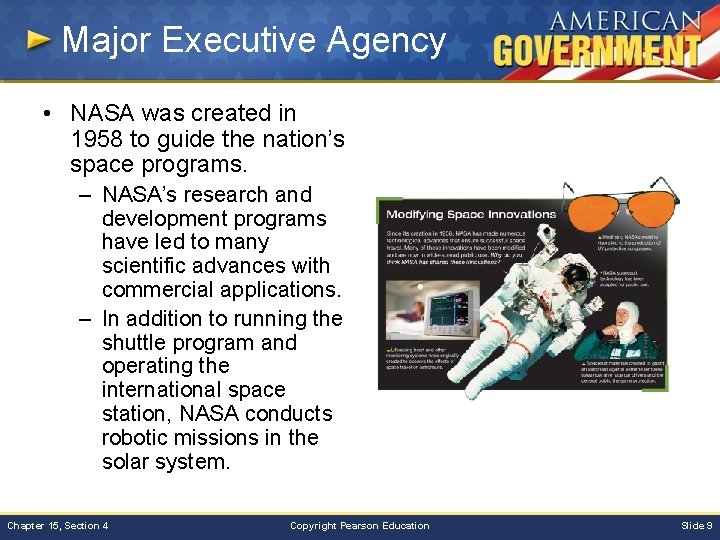
Major Executive Agency • NASA was created in 1958 to guide the nation’s space programs. – NASA’s research and development programs have led to many scientific advances with commercial applications. – In addition to running the shuttle program and operating the international space station, NASA conducts robotic missions in the solar system. Chapter 15, Section 4 Copyright Pearson Education Slide 9
The Civil Service • Checkpoint: Why was there a push to reform the civil service in the 1800 s? – The civil service system replaced the patronage system in the late 1800 s. – The patronage system rewarded political supporters with public offices. – Officeholders changed with each new administration and the system suffered from widespread corruption and inefficiency. – The Pendleton Civil Service Act of 1883 set up the foundation for the modern merit-based system of hiring and promotion. Chapter 15, Section 4 Copyright Pearson Education Slide 10
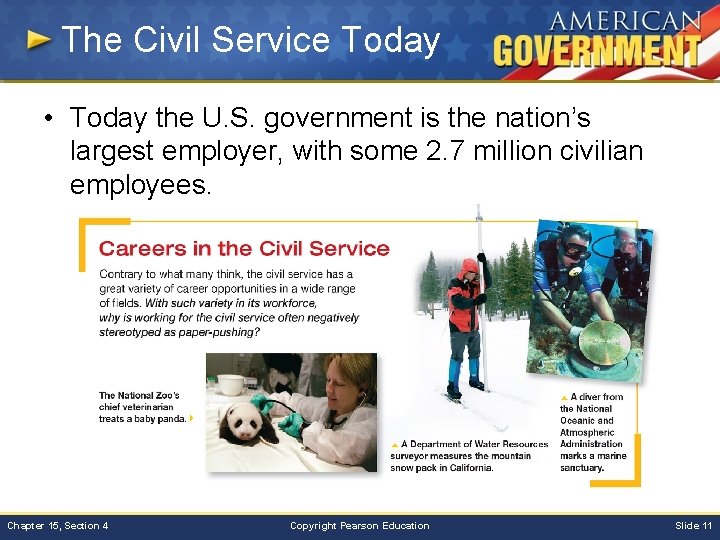
The Civil Service Today • Today the U. S. government is the nation’s largest employer, with some 2. 7 million civilian employees. Chapter 15, Section 4 Copyright Pearson Education Slide 11
The Civil Service Today, cont. • Nearly 90 percent of executive branch employees are now covered by the merit system. – Under this system, hiring and promotion are based on merit and scores on examinations. – The Merit Systems Protection Board ensures that the system is not abused, handling all complaints. – The Office of Personnel Management hires, pays, and promotes career civilian employees of the government who make up the civil service. Chapter 15, Section 4 Copyright Pearson Education Slide 12
Selective Service System • The national draft was introduced in 1917. – It was used for World War I and World War II, remaining in effect until it was suspended in 1973. – Some 2. 8 million soldiers were drafted in WW I, more than 10 million in WW II, and some 5 million up through 1973. Chapter 15, Section 4 Copyright Pearson Education Slide 13
Selective Service System, cont. • The draft law remains on the books. – All males between the ages of 18 and 26 must serve in the military if called. They must register with the Selective Service at age 18. – Congress must authorize a reactivation of the draft before troops can be conscripted. Chapter 15, Section 4 Copyright Pearson Education Slide 14
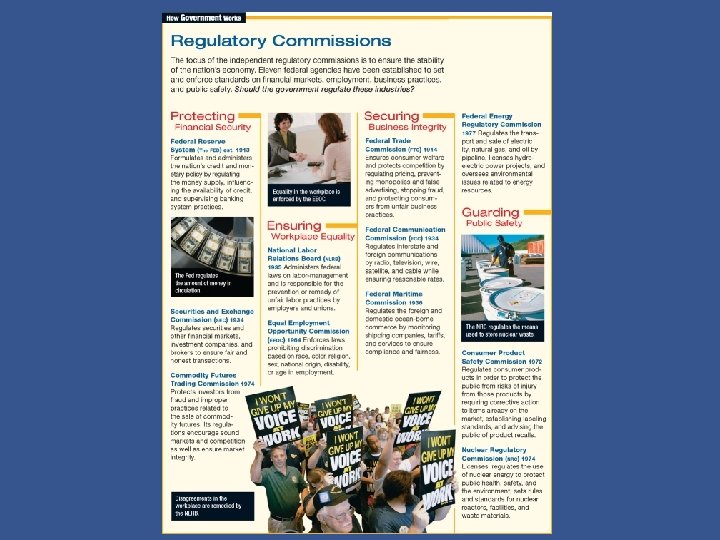
Regulatory Agencies • These agencies are largely independent of the executive branch. • Each is headed by a board or commission whose members are appointed by the President and approved by the Senate. – These members serve long, staggered terms so that only one term per board expires each year. – Members can only be removed for causes specified by Congress. – Only a bare majority of members can belong to the same political party. – These conditions help keep the independent regulatory agencies truly independent. Chapter 15, Section 4 Copyright Pearson Education Slide 15
Regulatory Agencies, cont. • Checkpoint: What makes the regulatory agencies different from other independent agencies? – Independent regulatory agencies have quasilegislative and judicial powers. • They can make rules and regulations with the force of law. • They can decide disputes in certain fields. – These agencies are an exception to the idea of separation of powers. – Some critics are concerned that these agencies have too much power or use it unfairly. Chapter 15, Section 4 Copyright Pearson Education Slide 16
Government Corporations • These agencies were set up by Congress to perform businesslike activities. – They were rarely used until World War I and the Great Depression. – There are now more than 50 government corporations, including: • • Chapter 15, Section 4 The U. S. Postal Service The Federal Deposit Insurance Corporation The National Railroad Passenger Corporation The Tennessee Valley Authority Copyright Pearson Education Slide 18
Government Corporations • Checkpoint: How do government and private corporations differ? – Government corporations are similar to private corporations, except that: • Congress decides their purpose and functions. • Their officers are public employees, typically chosen by the President and then approved by the Senate. • They are financed by public funds. – Government corporations are supposed to have more independence and flexibility than other executive agencies. Chapter 15, Section 4 Copyright Pearson Education Slide 19
Review • Now that you have learned about the role of structures of the independent agencies, go back and answer the Chapter Essential Question. – Is the bureaucracy essential to good government? Chapter 15, Section 4 Copyright Pearson Education Slide 20
- Slides: 20