
CHAPTER 15 FOOT AND ANKLE FOOT ANATOMY It

- Slides: 50
CHAPTER 15 – FOOT AND ANKLE
FOOT ANATOMY • It is complex! • 26 bones • 33 joints • Over 100 muscles, tendons and ligaments
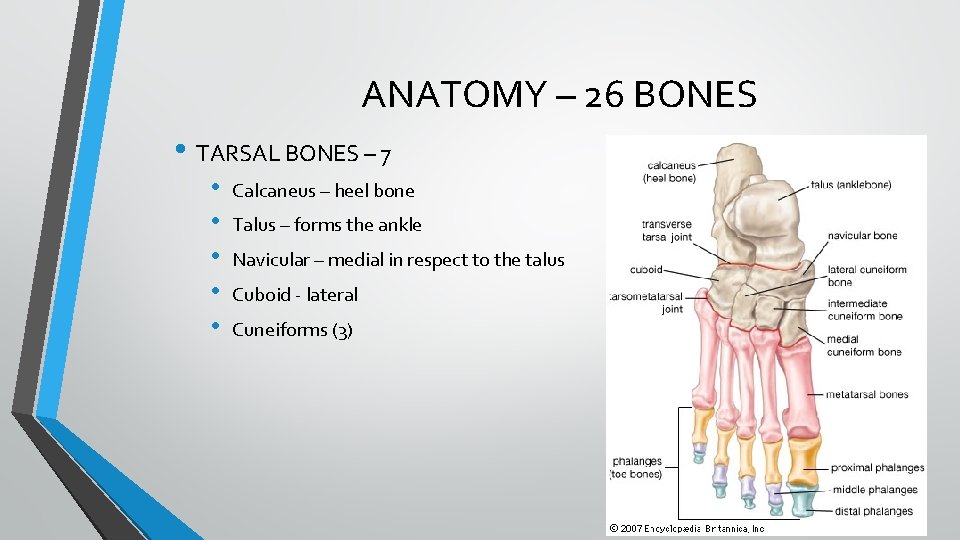
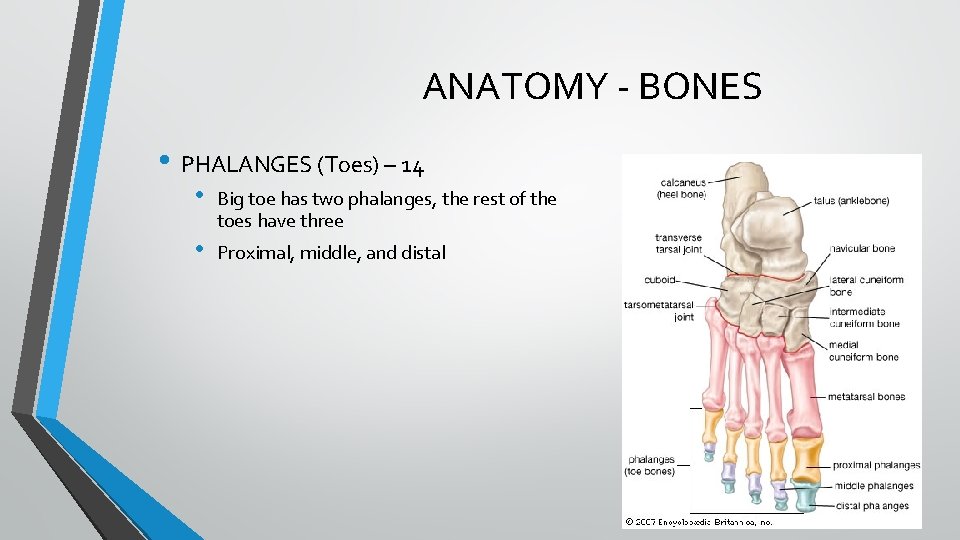
ANATOMY – 26 BONES • TARSAL BONES – 7 • • • Calcaneus – heel bone Talus – forms the ankle Navicular – medial in respect to the talus Cuboid - lateral Cuneiforms (3)
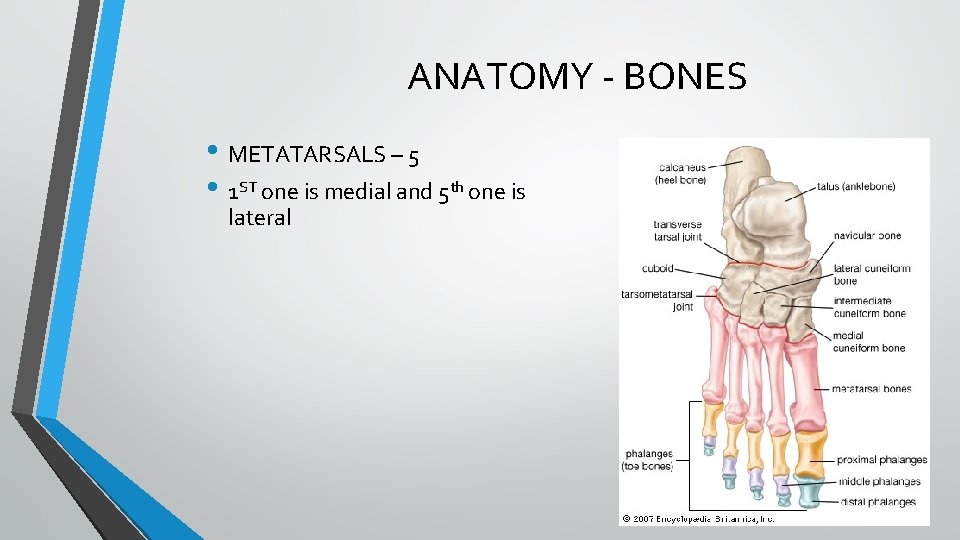
ANATOMY - BONES • METATARSALS – 5 • 1 ST one is medial and 5 th one is lateral
ANATOMY - BONES • PHALANGES (Toes) – 14 • Big toe has two phalanges, the rest of the toes have three • Proximal, middle, and distal
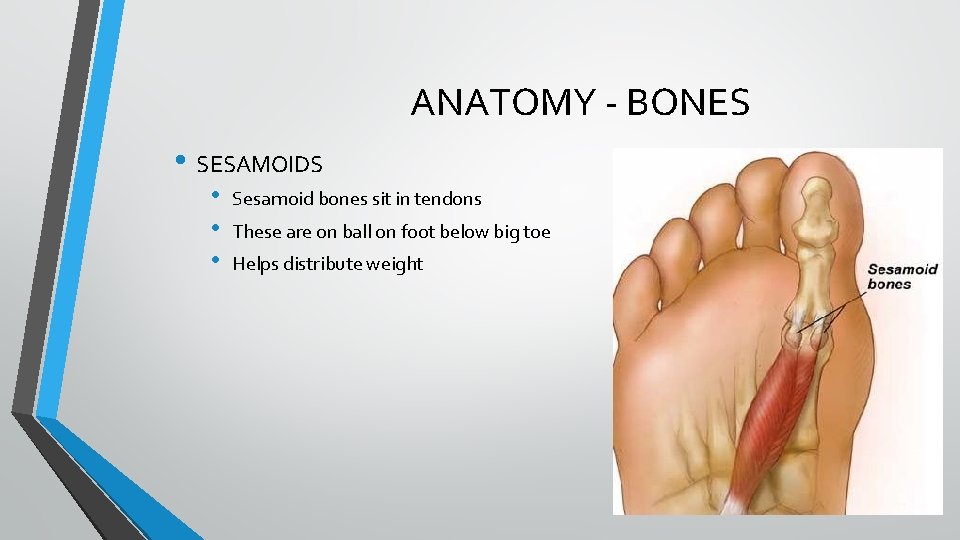
ANATOMY - BONES • SESAMOIDS • • • Sesamoid bones sit in tendons These are on ball on foot below big toe Helps distribute weight
ANATOMY - ARCHES • Support body weight and absorb shock • There are four arches: • • MEDIAL LONGITUDINAL ARCH LATERAL LONGITUDINAL ARCH METATARSAL ARCH TRANSVERSE ARCH
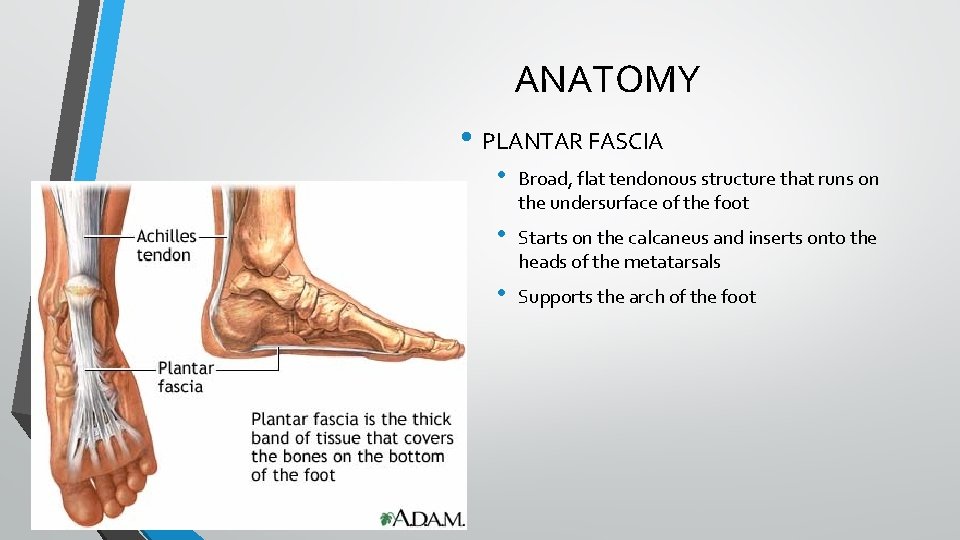
ANATOMY • PLANTAR FASCIA • Broad, flat tendonous structure that runs on the undersurface of the foot • Starts on the calcaneus and inserts onto the heads of the metatarsals • Supports the arch of the foot
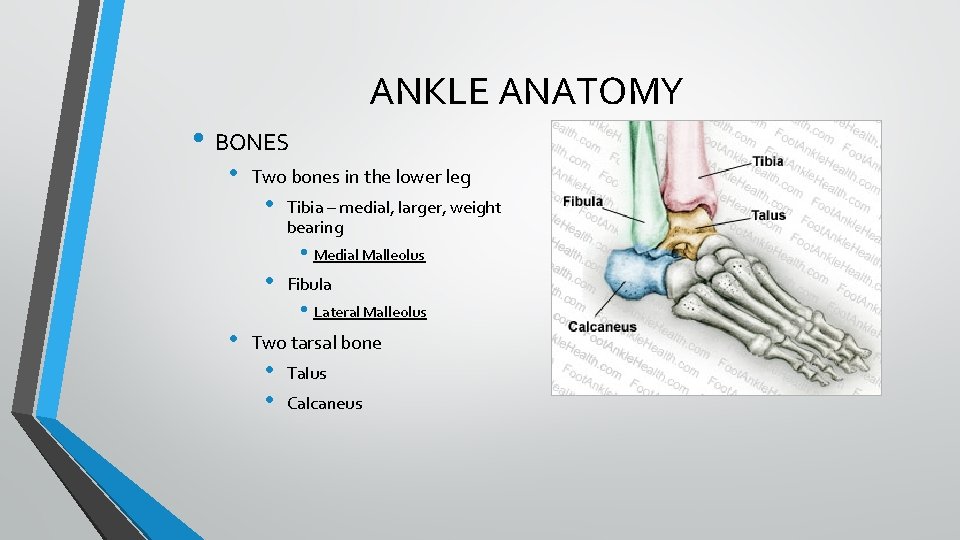
ANKLE ANATOMY • BONES • Two bones in the lower leg • Tibia – medial, larger, weight bearing • Medial Malleolus • • Fibula • Lateral Malleolus Two tarsal bone • • Talus Calcaneus
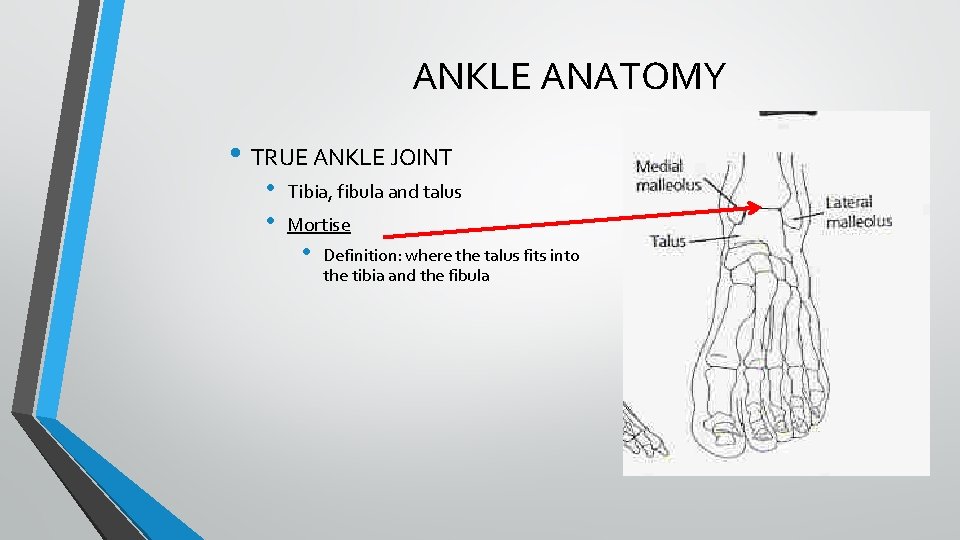
ANKLE ANATOMY • TRUE ANKLE JOINT • • Tibia, fibula and talus Mortise • Definition: where the talus fits into the tibia and the fibula
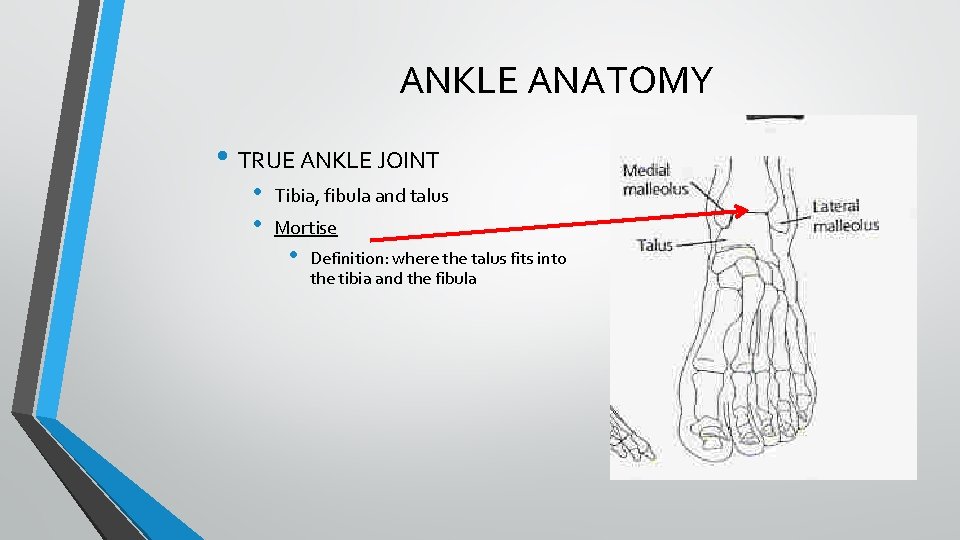
ANKLE ANATOMY • TRUE ANKLE JOINT • • Tibia, fibula and talus Mortise • Definition: where the talus fits into the tibia and the fibula
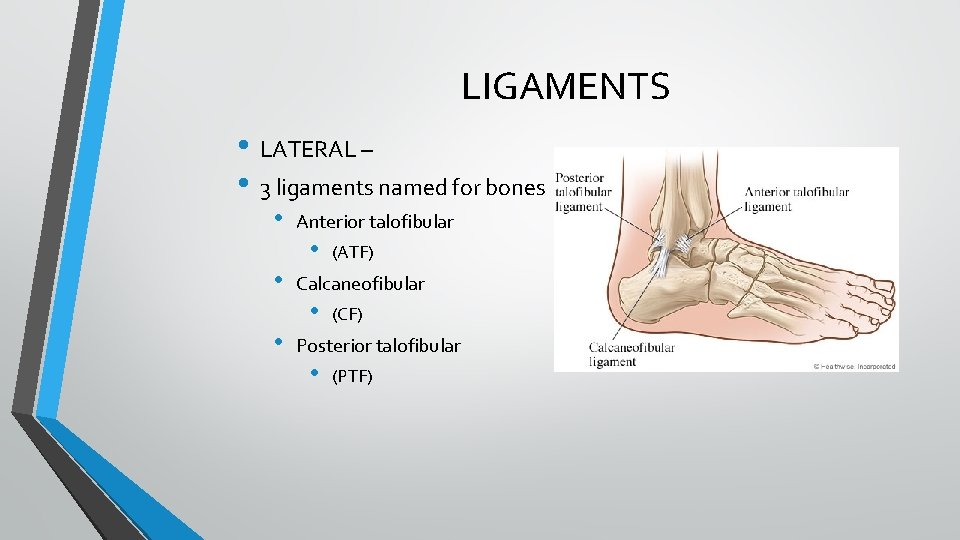
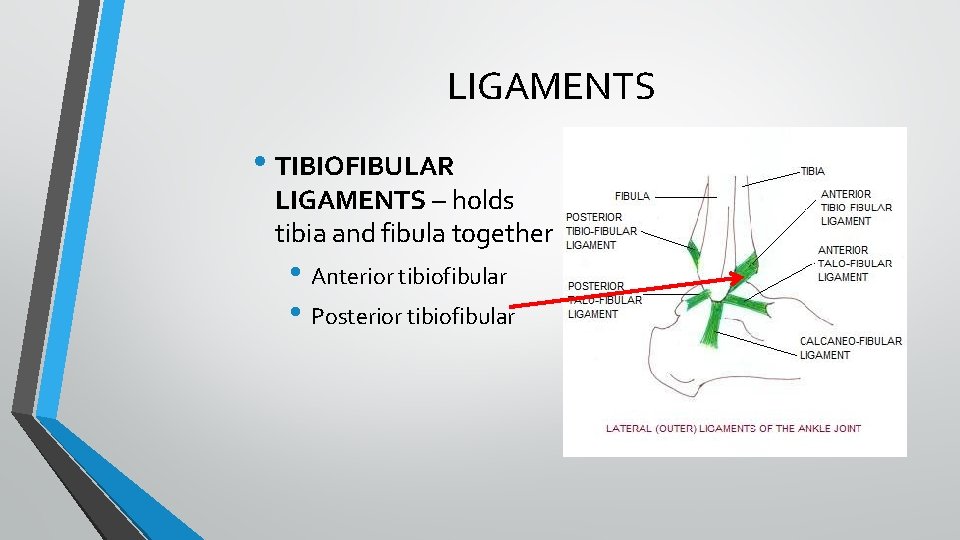
LIGAMENTS • LATERAL – • 3 ligaments named for bones • • • Anterior talofibular • (ATF) Calcaneofibular • (CF) Posterior talofibular • (PTF)
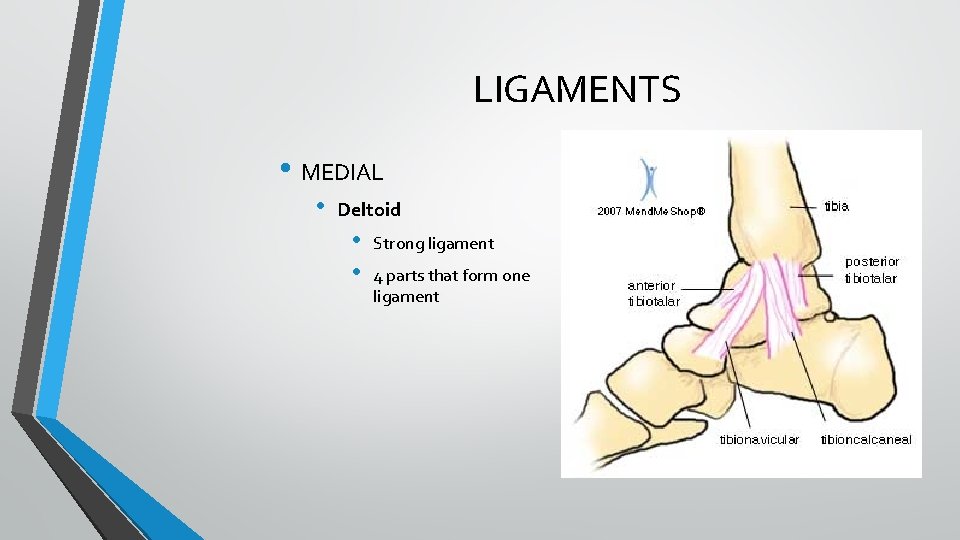
LIGAMENTS • MEDIAL • Deltoid • • Strong ligament 4 parts that form one ligament
LIGAMENTS • TIBIOFIBULAR LIGAMENTS – holds tibia and fibula together • Anterior tibiofibular • Posterior tibiofibular
FOOT INJURIES • PLANTAR FASCIITIS • Common with athletes who are on toes and/or have high arches • Causes: Not enough arch support in shoes, tight calf muscle • Signs/Symptoms: Pain occurs in the heel to mid-foot, especially with dorsiflexion • Hurts in the morning, feels better as they warm up • Treatment: Gentle stretches, roll on tennis ball or frozen can, arch taping or orthotics.
FOOT INJURIES • RETROCALCANEAL BURSITIS • ‘Pump bump’ • Cause: Pressure from back of shoe • Signs/Symptoms: Swelling where the Achilles attaches to the calcaneus • Treatment: RICE, stretching, shoes with wider heel cups, donut pad.
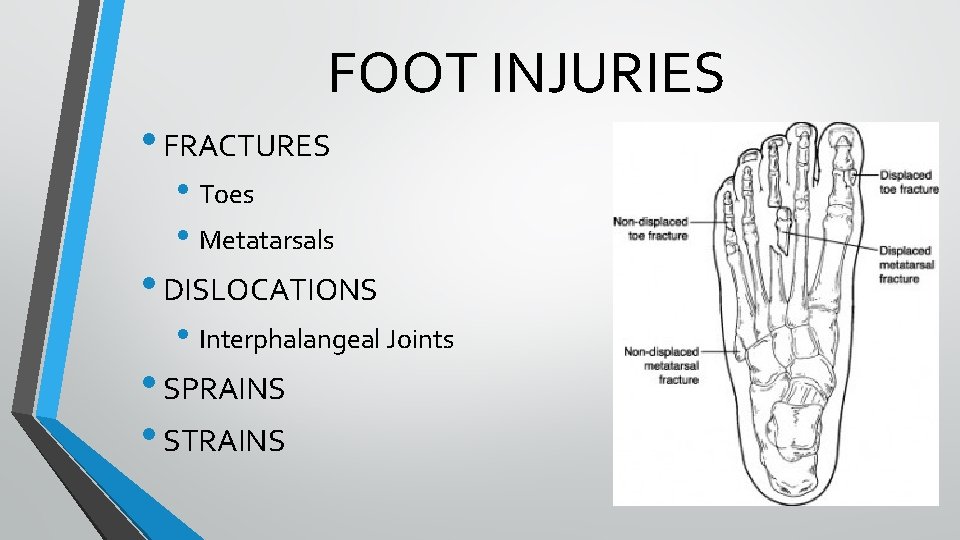
FOOT INJURIES • FRACTURES • Toes • Metatarsals • DISLOCATIONS • Interphalangeal Joints • SPRAINS • STRAINS
FOOT INJURIES • JONES FRACTURE • Fracture of the base of the 5 th metatarsal • Causes: overuse; inversion; rotational forces • S/S: Feels and hears a ‘pop’; pain in the lateral foot • Tx: immobilization (cast) 6 -8 weeks or longer, often requires surgery
FOOT INJURIES • BUNIONS (HALLUX VALGUS) • Deformity of the head of the 1 st metatarsal • Cause: extra bone is laid down on head of 1 st metatarsal • Great toe becomes malaligned • S/S: Pain, swelling and deformity of big toe joint • Treatment: Proper shoes; doughnut pad over the bunion; surgery?
• TURF TOE FOOT INJURIES • Great Toe sprain • Cause: Hyperextension of the big toe at the metatarsal phalangeal joint; kicking something • Common on artificial turf b/c turf shoes allow more motion • S/S: swelling and pain in the joint • Tx: RICE, rigid insoles or toe boxes, taping to prevent hyperextension of toe
FOOT INJURIES • INGROWN TOENAILS • Cause: leading side of toenail grows into skin, usually results in infection and pain • May trim nails too short or ill-fitting shoes • S/S: Inflammed nail bed, may have drainage/pus • Tx: May need to refer to doctor; soak in betadine bath; pack cotton under toenail
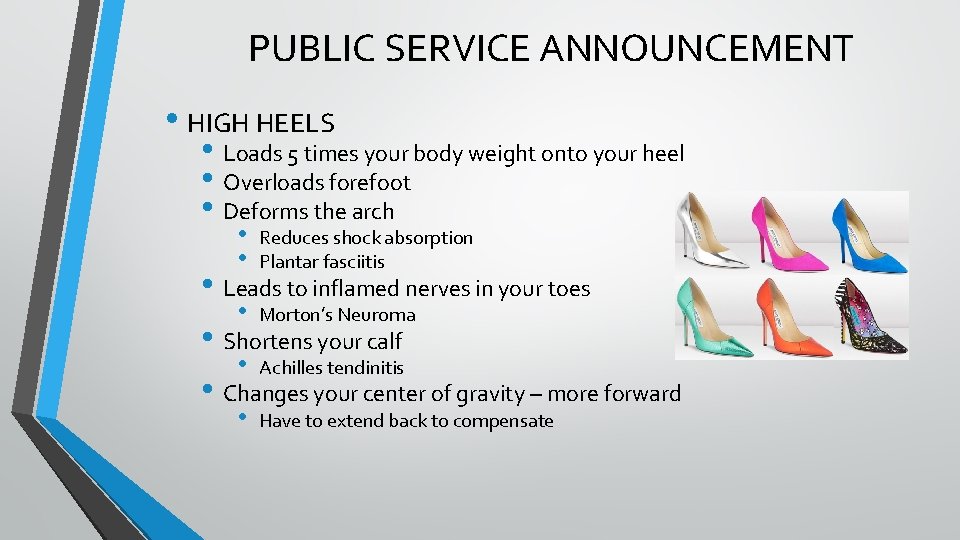
PUBLIC SERVICE ANNOUNCEMENT • HIGH HEELS • Loads 5 times your body weight onto your heel • Overloads forefoot • Deforms the arch • • Reduces shock absorption Plantar fasciitis • Have to extend back to compensate • Leads to inflamed nerves in your toes • Morton’s Neuroma • Shortens your calf • Achilles tendinitis • Changes your center of gravity – more forward
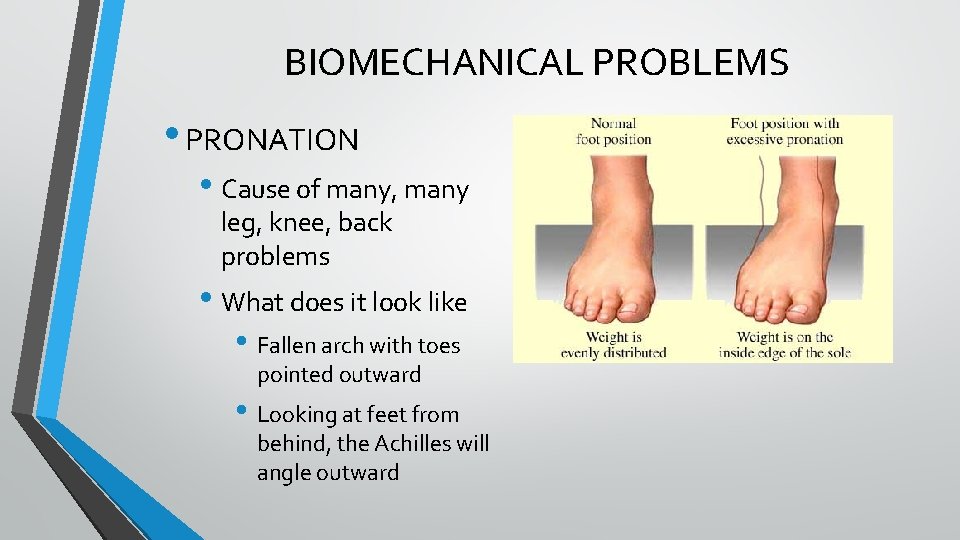
BIOMECHANICAL PROBLEMS • PRONATION • Cause of many, many leg, knee, back problems • What does it look like • Fallen arch with toes pointed outward • Looking at feet from behind, the Achilles will angle outward
ANKLE SPRAINS • Review: 3 Degrees of Sprains • Abnormal (too much) motion causes ankle injuries • Named for motions that cause them • What are those motions?
TYPES OF ANKLE SPRAINS • Inversion • Most common type of ankle sprain • Accounts for 80% of all sprains • AKA ‘a lateral ankle sprain’ • First degree sprain • Only involves the anterior talofibular ligament • Mild pain, tenderness, and swelling • No instability
TYPES OF ANKLE SPRAINS • Inversion • Second degree sprain • Anterior talofibular ligament is torn and calcaneofibular ligament is injured as well • Most painful • Moderate swelling • Mild Instability
TYPES OF ANKLE SPRAINS • Inversion • Third degree sprain • Complete tear of all three lateral ligaments • Uncommon • Lots of pain, but it can subside • Very unstable • Usually requires surgery
TESTING ATF STABILITY • Drawer Test • Stablize lower leg with one hand • Pull heel forward (like opening a drawer) • Should not move forward if ligament is intact
TYPES OF ANKLE SPRAINS • Eversion • Not as common • Can occur more on tartan surfaces and artificial turf • Everything is worse (pain, swelling, etc) when compared to an inversion injury • If the deltoid tears, the tibiofibular ligaments may tear also
High Ankle Sprain • Involves Anterior Inferior Tibiofibular (AITFL) Ligament • Injury allows tibia and fibula to separate
High Ankle Sprain • Cause: Inversion with rotation; rotation of foot • S/S: pain with external rotation of foot; tender over AITFL • Treatment: RICE, may need to be immobilized; possible surgery if severe enough
Treatment of Ankle Sprains • Prevention – once you sprain an ankle it is easy to do again – tape and rehab • Rest – No activity for 24 -48 hours • Ice – 20 minutes on, 40 minutes off • Compression – ace wrap with horseshoe • Elevation – ankle above the heart • Support – crutches and aircast if needed
Ankle Rehab • ABCs • Circles • Theraband exercises • Single Leg Balance • Balance Board • Calf Raises • And so much more….
Ankle Fractures • Always need to suspect a fracture when evaluating a potential sprained ankle • Cause: Too much motion • S/S: immediate swelling, point tender over the bone, does not want to weight bear • Treatment: splint, ice, x-ray Cast 6 -8 weeks
The Lower Leg
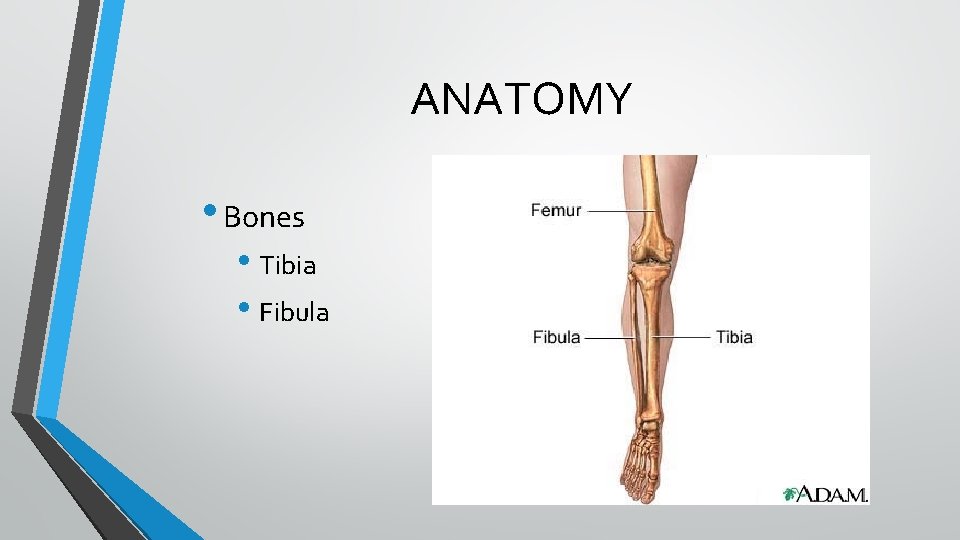
ANATOMY • Bones • Tibia • Fibula
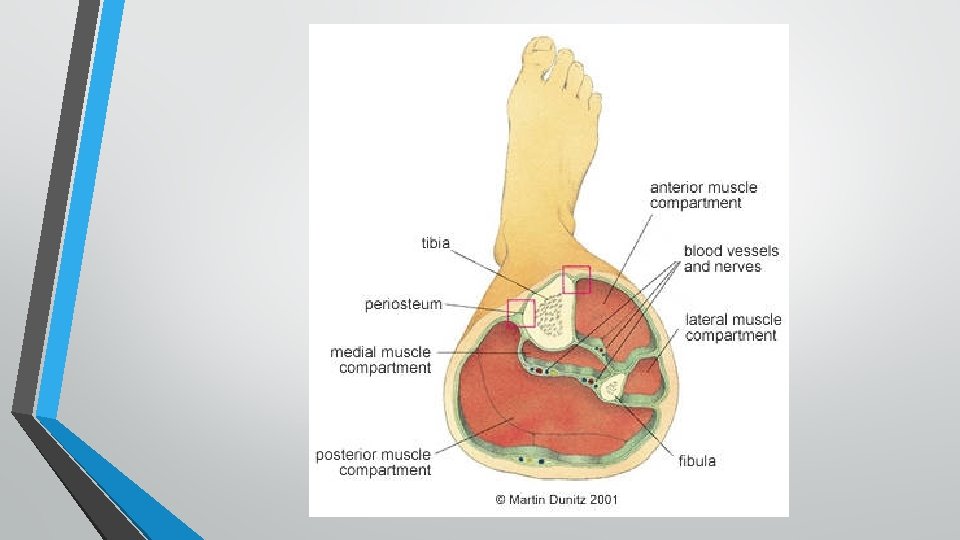
MUSCLES • The muscles are in four compartments with 2 -4 muscles in each compartment • Compartments are held together by fascia
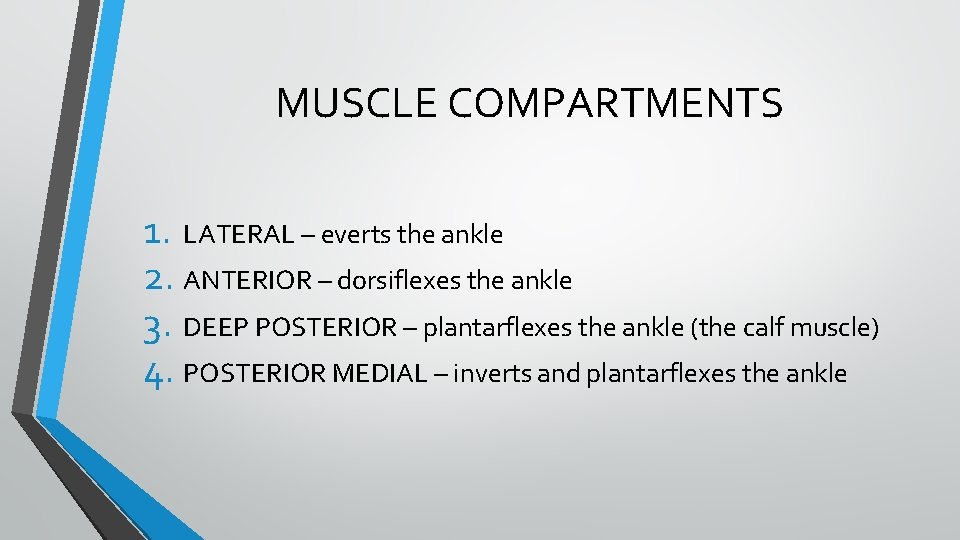
MUSCLE COMPARTMENTS 1. LATERAL – everts the ankle 2. ANTERIOR – dorsiflexes the ankle 3. DEEP POSTERIOR – plantarflexes the ankle (the calf muscle) 4. POSTERIOR MEDIAL – inverts and plantarflexes the ankle
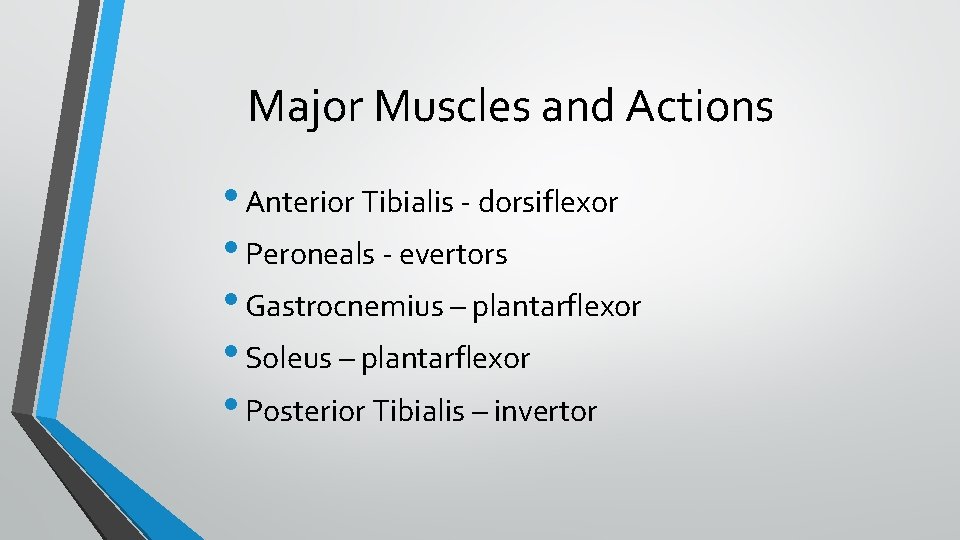
Major Muscles and Actions • Anterior Tibialis - dorsiflexor • Peroneals - evertors • Gastrocnemius – plantarflexor • Soleus – plantarflexor • Posterior Tibialis – invertor
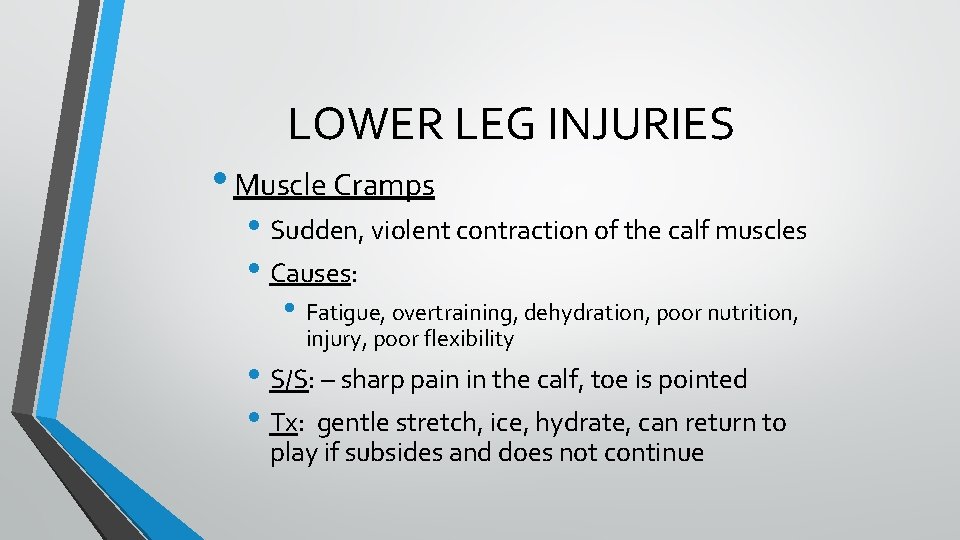
LOWER LEG INJURIES • Muscle Cramps • Sudden, violent contraction of the calf muscles • Causes: • Fatigue, overtraining, dehydration, poor nutrition, injury, poor flexibility • S/S: – sharp pain in the calf, toe is pointed • Tx: gentle stretch, ice, hydrate, can return to play if subsides and does not continue
LOWER LEG INJURIES • STRESS FRACTURE • Cause: Repetitive pounding with training • S/S: Hurts more with and after activity, pain on one spot on bone • Tx: Requires x-ray, possibly a bone scan • If positive, no weight bearing for at least 2 weeks, no running for 4 -6 weeks
LOWER LEG INJURIES • MEDIAL TIBIAL STRESS SYNDROME • ‘SHIN SPLINTS’ • Occurs in distal 2/3 of posterior/medial tibia • Causes: pronation, lack of flexibility in the lower legs, hard surfaces, hills, muscle weakness, poor shoes, increasing running distance too quickly
LOWER LEG INJURIES • MEDIAL TIBIAL STRESS SYNDROME • S/S: resisted plantar flexion and inversion should hurt, pain is just off the tibia • Treatment : prevention (shoes, arch support), strengthening, stretching, ice massage, contrast bath, tape arches • Refer to MD if no improvement to rule out stress fracture
LOWER LEG INJURIES • COMPARTMENT SYNDROME • Occurs when pressure increases in compartment and shuts off blood and nerve supply to the foot • Most often occurs in the anterior and deep posterior compartment • THREE TYPES • Acute Exertional • Chronic
LOWER LEG INJURIES • ACUTE COMPARTMENT SYNDROME • Medical emergency • Causes: direct blow to the lower leg • Usually in the anterior lower leg • Symptoms come about several hours later • S/S: compartment is tense, warm, red and shiny; complains of (c/o) deep aching pain; circulation and sensory problems in foot • Tx: ice, elevation – refer to ER immediately
LOWER LEG INJURIES • ACUTE EXERTIONAL/CHRONIC COMPARTMENT SYNDROME • Cause: running and jumping activities • S/S: With activity, foot goes to sleep, crampy pain, and tingling. When activity stops, it goes away. Consistent as to when it comes on with activity • Tx: ice, activity modification, stretching, massage, and referral to the doctor (possible surgery)
INJURIES • ACHILLES TENDINITIS • Chronic, overuse condition that comes about gradually • Causes: running and jumping, repetitive stress, running up hills, poor flexibility • S/S: achy type pain, Achilles is tender on palpation, pain with standing plantarflexion, may have crepitus, hurts to warm up and to cool down
INJURIES • ACHILLES TENDINITIS • TREATMENT • If there is crepitus, no running for 1 -2 weeks • Stretch! • Heel lift in both shoes • Orthotics • Heat and/or ice
INJURIES • ACHILLES TENDON RUPTURE • Achilles in largest tendon in body • For Gastrocnemius and Soleus muscles • Most common tearing spot is 1” above its insertion on the calcaneus • Causes: Sudden, forceful plantar flexion and extension of the knee, age, previous tendinitis • S/S: Feel and hear a snap, “kicked in the leg”, very weak plantarflexion, no Achilles observed • Tx: Immobilization to ER, surgery?