
Chapter 15 Fingerprinting Courtesy of C Fanning Crystal

- Slides: 29
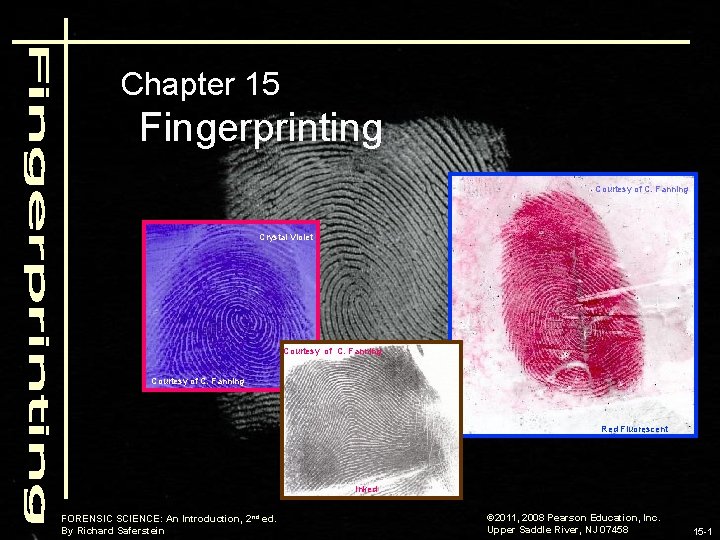
Chapter 15 Fingerprinting Courtesy of C. Fanning Crystal Violet Courtesy of C. Fanning Red Fluorescent Inked FORENSIC SCIENCE: An Introduction, 2 nd ed. By Richard Saferstein © 2011, 2008 Pearson Education, Inc. Upper Saddle River, NJ 07458 15 -1
History • The first systematic attempt at personal identification was devised by a French police expert, Alphonse Bertillion. • The Bertillion system relied on a detailed description of the subject, combined with full length and profile photographs and a system of precise body measurements called anthropometry. FORENSIC SCIENCE: An Introduction, 2 nd ed. By Richard Saferstein © 2011, 2008 Pearson Education, Inc. Upper Saddle River, NJ 07458 15 -2
Chapter 15 Fingerprinting • What was needed was the creation of classification systems capable of filing many thousands of prints in a logical and searchable sequence. • Sir Edward Henry devised a classification system used in most English-speaking countries. Cont. FORENSIC SCIENCE: An Introduction, 2 nd ed. By Richard Saferstein © 2011, 2008 Pearson Education, Inc. Upper Saddle River, NJ 07458 15 -3
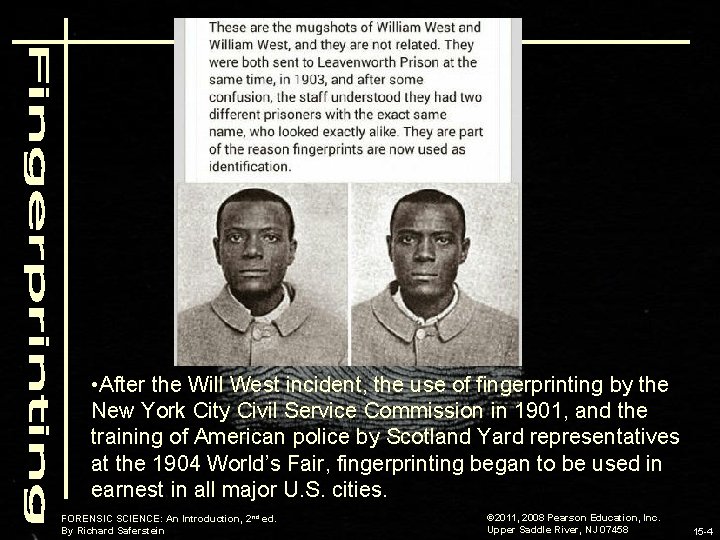
• After the Will West incident, the use of fingerprinting by the New York City Civil Service Commission in 1901, and the training of American police by Scotland Yard representatives at the 1904 World’s Fair, fingerprinting began to be used in earnest in all major U. S. cities. FORENSIC SCIENCE: An Introduction, 2 nd ed. By Richard Saferstein © 2011, 2008 Pearson Education, Inc. Upper Saddle River, NJ 07458 15 -4
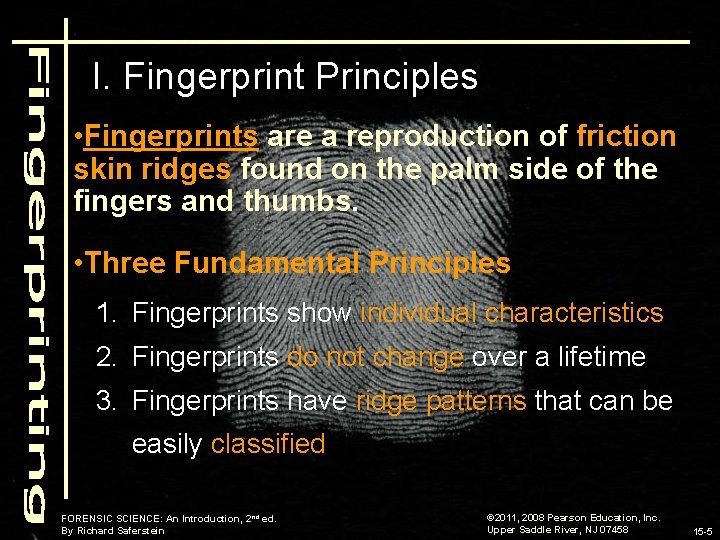
I. Fingerprint Principles • Fingerprints are a reproduction of friction skin ridges found on the palm side of the fingers and thumbs. • Three Fundamental Principles 1. Fingerprints show individual characteristics 2. Fingerprints do not change over a lifetime 3. Fingerprints have ridge patterns that can be easily classified FORENSIC SCIENCE: An Introduction, 2 nd ed. By Richard Saferstein © 2011, 2008 Pearson Education, Inc. Upper Saddle River, NJ 07458 15 -5
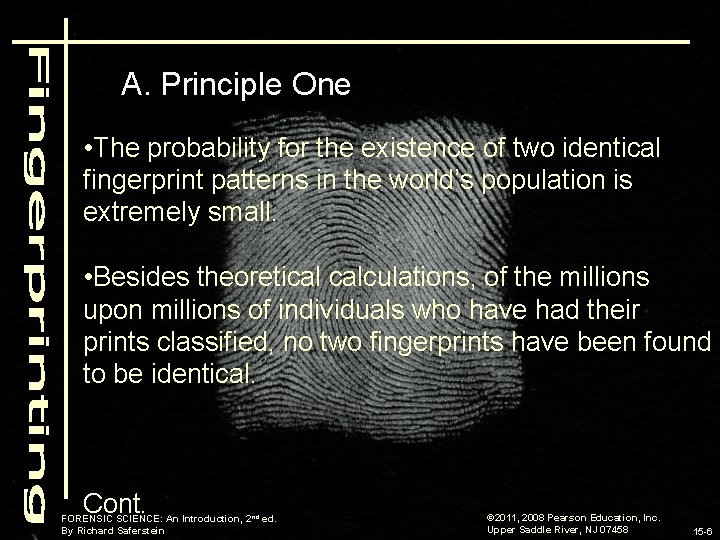
A. Principle One • The probability for the existence of two identical fingerprint patterns in the world’s population is extremely small. • Besides theoretical calculations, of the millions upon millions of individuals who have had their prints classified, no two fingerprints have been found to be identical. Cont. FORENSIC SCIENCE: An Introduction, 2 nd ed. By Richard Saferstein © 2011, 2008 Pearson Education, Inc. Upper Saddle River, NJ 07458 15 -6
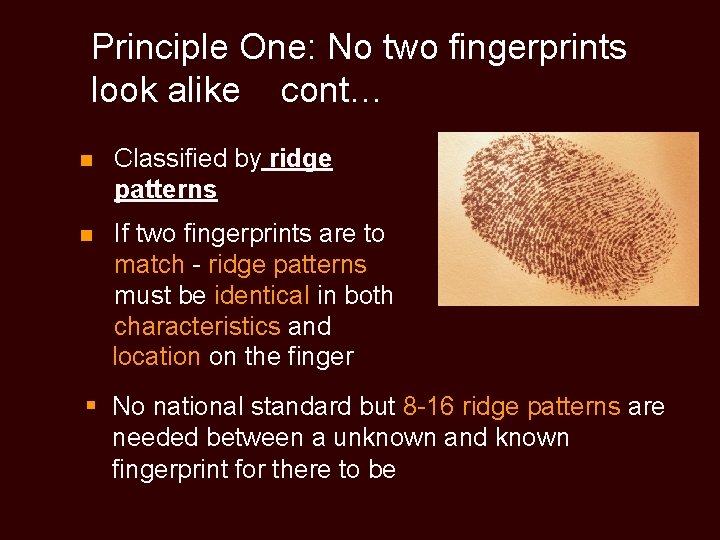
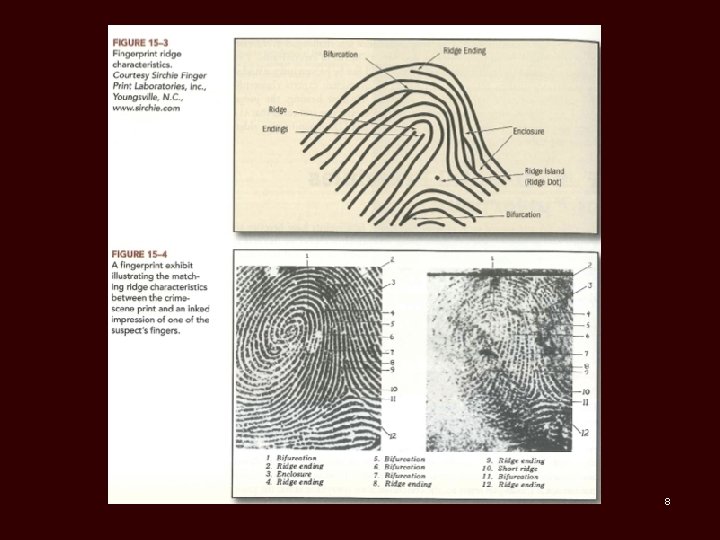
Principle One: No two fingerprints look alike cont… n Classified by ridge patterns n If two fingerprints are to match - ridge patterns must be identical in both characteristics and location on the finger § No national standard but 8 -16 ridge patterns are needed between a unknown and known fingerprint for there to be
8
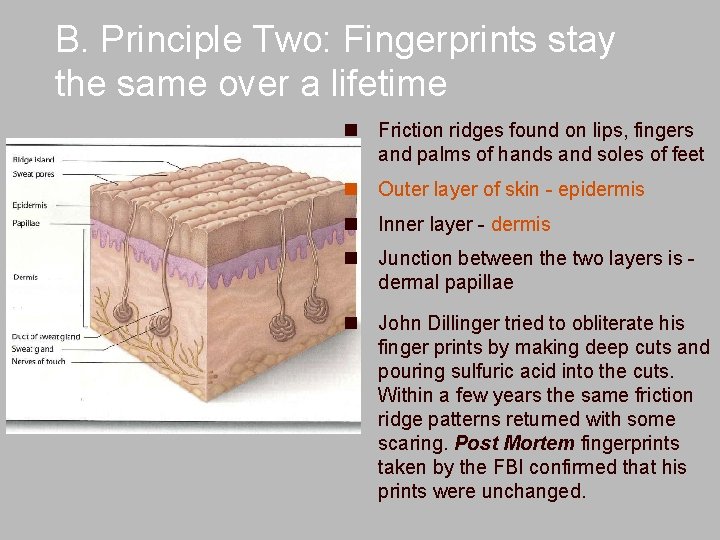
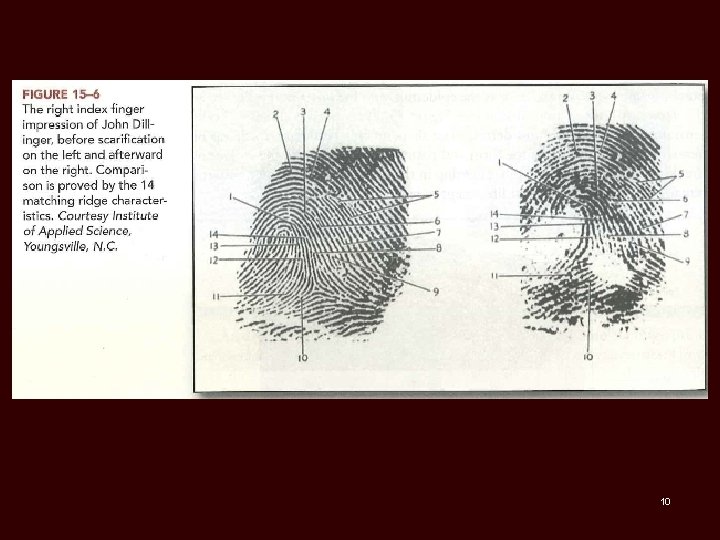
B. Principle Two: Fingerprints stay the same over a lifetime n Friction ridges found on lips, fingers and palms of hands and soles of feet n Outer layer of skin - epidermis n Inner layer - dermis n Junction between the two layers is dermal papillae n John Dillinger tried to obliterate his finger prints by making deep cuts and pouring sulfuric acid into the cuts. Within a few years the same friction ridge patterns returned with some scaring. Post Mortem fingerprints taken by the FBI confirmed that his prints were unchanged.
10
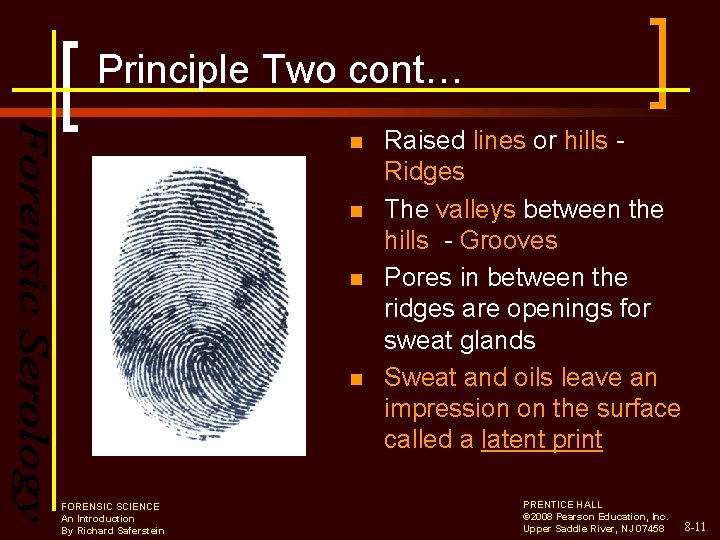
Principle Two cont… n n FORENSIC SCIENCE An Introduction By Richard Saferstein Raised lines or hills Ridges The valleys between the hills - Grooves Pores in between the ridges are openings for sweat glands Sweat and oils leave an impression on the surface called a latent print PRENTICE HALL © 2008 Pearson Education, Inc. Upper Saddle River, NJ 07458 8 -11
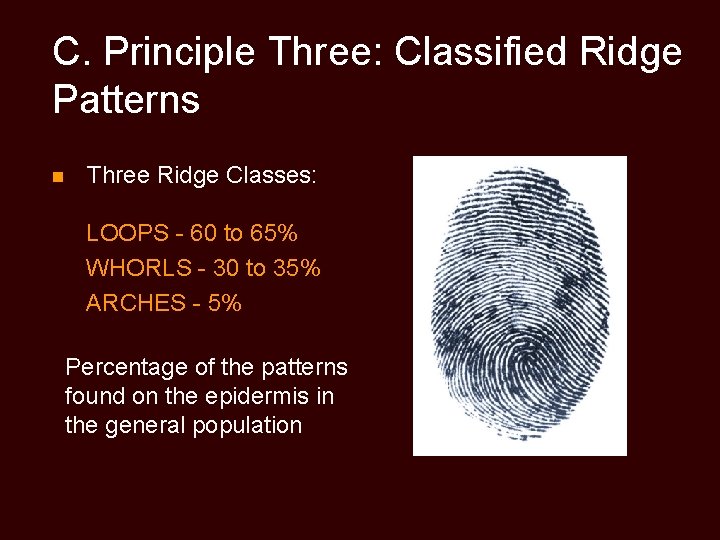
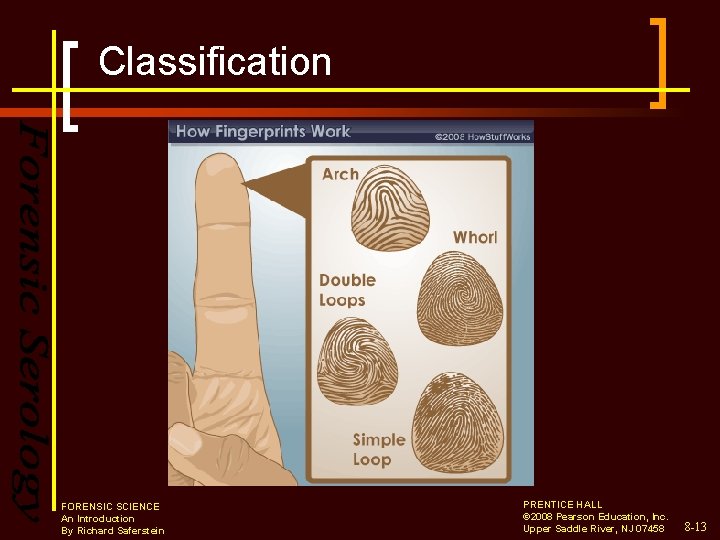
C. Principle Three: Classified Ridge Patterns n Three Ridge Classes: LOOPS - 60 to 65% WHORLS - 30 to 35% ARCHES - 5% Percentage of the patterns found on the epidermis in the general population
Classification FORENSIC SCIENCE An Introduction By Richard Saferstein PRENTICE HALL © 2008 Pearson Education, Inc. Upper Saddle River, NJ 07458 8 -13
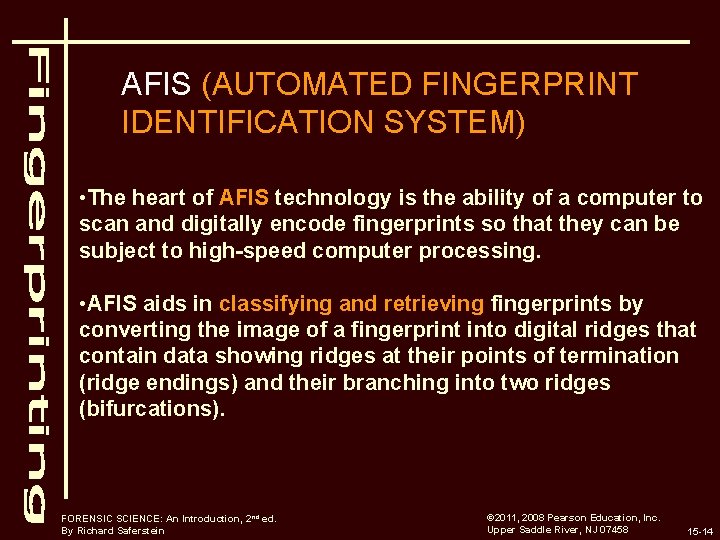
AFIS (AUTOMATED FINGERPRINT IDENTIFICATION SYSTEM) • The heart of AFIS technology is the ability of a computer to scan and digitally encode fingerprints so that they can be subject to high-speed computer processing. • AFIS aids in classifying and retrieving fingerprints by converting the image of a fingerprint into digital ridges that contain data showing ridges at their points of termination (ridge endings) and their branching into two ridges (bifurcations). FORENSIC SCIENCE: An Introduction, 2 nd ed. By Richard Saferstein © 2011, 2008 Pearson Education, Inc. Upper Saddle River, NJ 07458 15 -14
II. DETECTING FINGERPRINTS A. Types of Prints Three kinds of crime scene prints: n o o o § Visible – can be seen without technology Latent – not visible without some technology Plastic – impressions made in soft materials such as soap, wax or putty Visible and plastic are easy to find but latent is more difficult
DETECTING FINGERPRINTS B. Locating fingerprints n Different surfaces require different visualizing methods 1. Hard non-porous surfaces (glass, tile, painted wood) require visualizing powders or Super glue 2. Soft and porous surfaces (cloth, paper, cardboard) require chemical treatment
C. DEVELOPING LATENT PRINTS 1. POWDERS: o Adhere to perspiration and body oils Almost any color – grey and black being most common o Grey – aluminum dust o Black –carbon or charcoal o Fluorescent – glow under UV light o Video – Developing Fingerprints with Powder
2. Super Glue • Super Glue fuming develops latent prints on nonporous surfaces, such as metals, electrical tape, leather, and plastic bags. • Development occurs when fumes from the glue adhere to the print, usually producing a white latent print. FORENSIC SCIENCE: An Introduction, 2 nd ed. By Richard Saferstein © 2011, 2008 Pearson Education, Inc. Upper Saddle River, NJ 07458 15 -18
3. Chemical treatments • Prints on porous surfaces (e. g. , papers, cardboard, and cloth) generally require treatment with a chemical. • Examiners use various chemical methods to visualize latent prints on porous surfaces, such as: q iodine fuming q ninhydrin q Physical Developer FORENSIC SCIENCE: An Introduction, 2 nd ed. By Richard Saferstein © 2011, 2008 Pearson Education, Inc. Upper Saddle River, NJ 07458 15 -19
Chemical Treatment § Iodine fuming involves heating iodine crystals that cause vapors which combine with latent prints to make them visible. o Iodine prints are not permanent and will fade, making it necessary to photograph the prints immediately. § Ninhydrin reacts chemically with trace amounts of amino acids present in latent prints to produce a purple-blue color. § Physical Developer is a silver nitrate-based reagent used to develop prints when other chemical methods are ineffective. FORENSIC SCIENCE: An Introduction, 2 nd ed. By Richard Saferstein © 2011, 2008 Pearson Education, Inc. Upper Saddle River, NJ 07458 15 -20
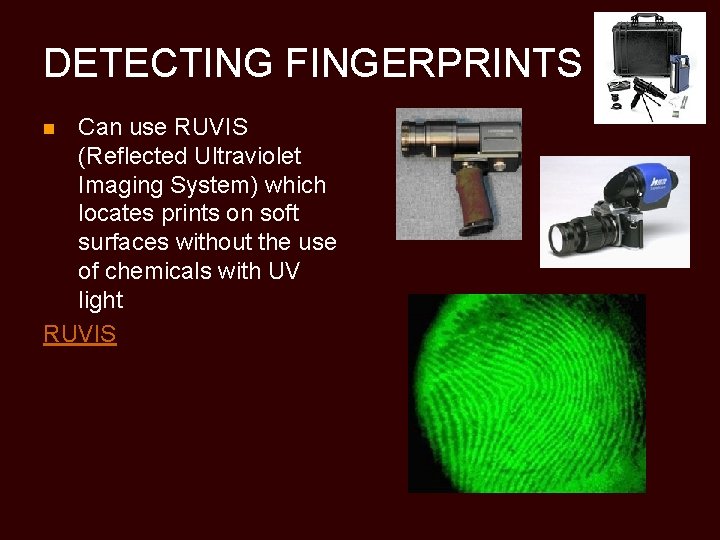
DETECTING FINGERPRINTS Can use RUVIS (Reflected Ultraviolet Imaging System) which locates prints on soft surfaces without the use of chemicals with UV light RUVIS n
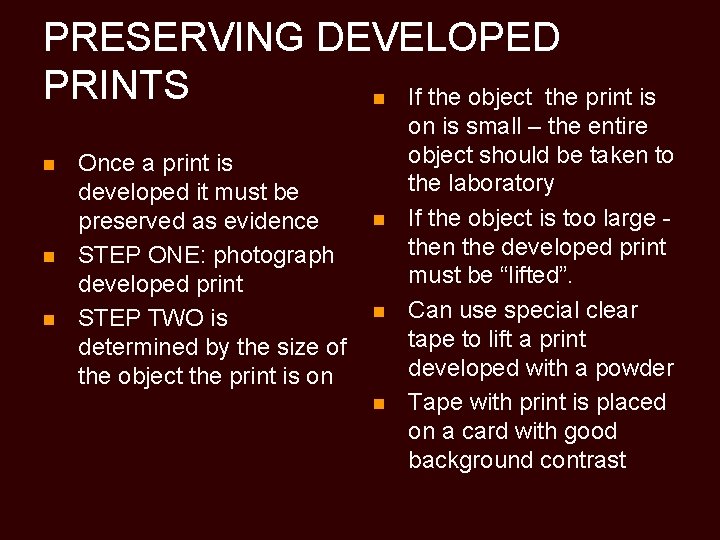
PRESERVING DEVELOPED PRINTS n If the object the print is n n n Once a print is developed it must be preserved as evidence STEP ONE: photograph developed print STEP TWO is determined by the size of the object the print is on n on is small – the entire object should be taken to the laboratory If the object is too large then the developed print must be “lifted”. Can use special clear tape to lift a print developed with a powder Tape with print is placed on a card with good background contrast
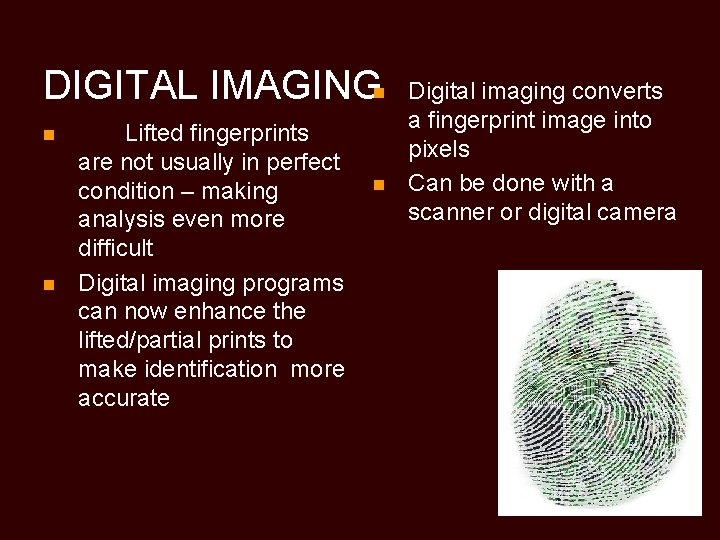
DIGITAL IMAGINGn n n Lifted fingerprints are not usually in perfect condition – making analysis even more difficult Digital imaging programs can now enhance the lifted/partial prints to make identification more accurate n Digital imaging converts a fingerprint image into pixels Can be done with a scanner or digital camera
END 24
Integrated Automated Fingerprint Identifcation System (IAFIS) n n n Ability of the computer to scan and digitally encode fingerprints The encoding allows ridges to be rapidly scanned Can screen a set of 10 prints against a file of 500, 000 sets of 10 prints in. 08 seconds n n Ridge endings (terminations) Branching of ridges (bifurcations) Screen out imperfections in latent prints Can send prints immediately to FBI database
DEVELOPING LATENT PRINTS POWDERS: n o Adhere to perspiration and body oils Almost any color – grey and black being most common o Grey – aluminum dust o Black –carbon or charcoal o Magnetic – charged o Fluorescent – glow under UV light o
DEVELOPING LATENT PRINTS FUMING: n Iodine o v iodine sublimates when heated giving off fumes. v The iodine fumes adhere to the latent print v Old technology – does not last long print visible fades in minutes FUMING: n Super glue (Crazy glue) o v can visualize a print on non-porous surfaces as well as metals, tape, leather and plastic bags v Heating the Super glue releases cyanoacrylate ester fumes v Fumes produce a white fluffy print
DEVELOPING PRINTS FUMING: n NINHYDRIN o v The chemical reacts with amino acids to produce a purple-blue color v Usually used as an 0. 6 % solution sprayed as an aerosol on porous surfaces v Takes 1 to 48 hours can increase developing by heating in an oven v Effective on paper that was 15 years old
DEVELOPING PRINTS n n PHYSICAL DEVELOPER Chemical mixture – silver nitrate based Works even if item was wet –then dried. Used as the “last resort” because washes away all traces of proteins n NEWEST TECHNOLOGY Laser light can detect latent prints that fluoresce with certain components of sweat. Alternate light sources: High-intensity quartz halogen Xenon-arc LED’s (light emitting diodes) DFO (1, 8 -diazafluoren 9 -one) Chemical works with alternate light sources