
CHAPTER 15 Financial Planning Forecasting and Cash Budgets
CHAPTER 15 Financial Planning, Forecasting, and Cash Budgets Financial Planning Process Long-Term Strategic Goals Short-Term Operating Plans Sales Forecast Estimating Sales Using the Historical Average Growth Rate (cont. )
2 Chapter 15: Financial Planning, Forecasting, and Cash Budgets Estimating Sales Using Regression Analysis Estimating Sales Using Management Opinions Forecasting with the Percentage of Sales Method Additional Funds Needed: Tabular Approach Additional Funds Needed: Using the Equation Approach Projecting the Maximum Rate of Growth Maximum Internal Growth Rate Maximum Sustainable Growth Rate How to Influence the Growth Rate Cash Budget Compilation of the Cash Budget Uncertainty and the Cash Budget Copyright © 1999 Addison Wesley Longman
3 Chapter 15: Financial Planning, Forecasting, and Cash Budgets Objectives u u u Make sales forecasts Prepare cash budgets Prepare pro forma statements Estimate external funds needed Estimate maximum sustainable growth rate Copyright © 1999 Addison Wesley Longman
4 Chapter 15: Financial Planning, Forecasting, and Cash Budgets Financial Planning is Difficult Because. . . Information must be gathered from a variety of sources, both internal and external u Estimates must be made about the unforeseeable future u Copyright © 1999 Addison Wesley Longman
5 Chapter 15: Financial Planning, Forecasting, and Cash Budgets u The future of the firm often depends on the accuracy of the projections Copyright © 1999 Addison Wesley Longman

6 Chapter 15: Financial Planning, Forecasting, and Cash Budgets The First Step: u Develop long-term strategic goals – Use capital budgeting methods to evaluate investment objective Copyright © 1999 Addison Wesley Longman
7 Chapter 15: Financial Planning, Forecasting, and Cash Budgets – – Develop an investment strategy that lets the firm utilize its advantages over other firms Then convert long-term goals into short-term operating plans Copyright © 1999 Addison Wesley Longman
8 Chapter 15: Financial Planning, Forecasting, and Cash Budgets Financial Planning u The allocation of a firm’s resources to achieve its investment plans Copyright © 1999 Addison Wesley Longman
9 Chapter 15: Financial Planning, Forecasting, and Cash Budgets The Sales Forecast Is u The beginning point for financial planning, where sales depend on: – The economy and business cycles – The condition of industry – The behavior of competitors Copyright © 1999 Addison Wesley Longman
10 Chapter 15: Financial Planning, Forecasting, and Cash Budgets Estimating Sales u Using the Historical Average Growth Rate – Compute historical compounded average growth rate. Copyright © 1999 Addison Wesley Longman
11 Chapter 15: Financial Planning, Forecasting, and Cash Budgets – Apply this growth rate to the most recent year’s sales to estimate future period sales. Copyright © 1999 Addison Wesley Longman
12 Chapter 15: Financial Planning, Forecasting, and Cash Budgets Example u Compute the average compounded growth rate for the following sales: 1993 $100 1994 $110 1995 $120 1996 $140 Copyright © 1999 Addison Wesley Longman
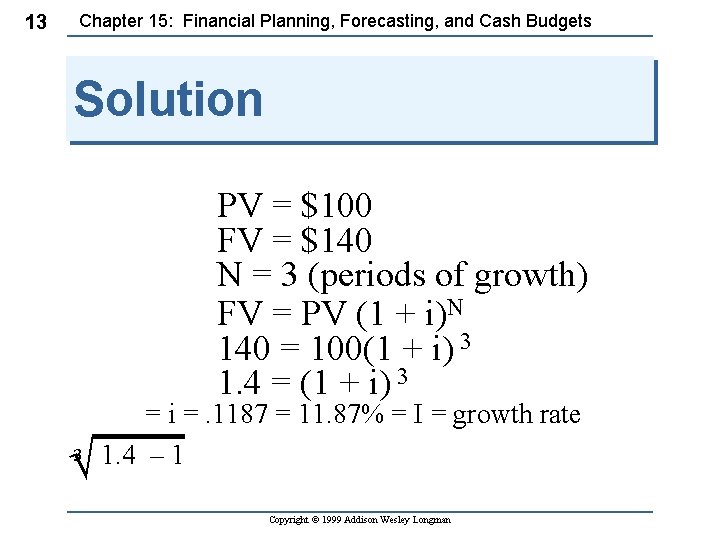
13 Chapter 15: Financial Planning, Forecasting, and Cash Budgets Solution PV = $100 FV = $140 N = 3 (periods of growth) FV = PV (1 + i)N 140 = 100(1 + i) 3 1. 4 = (1 + i) 3 = i =. 1187 = 11. 87% = I = growth rate 3 1. 4 – 1 Copyright © 1999 Addison Wesley Longman
14 Chapter 15: Financial Planning, Forecasting, and Cash Budgets Choosing Which Periods to Use u A critical choice to the accuracy of this method. In the following figure picking periods 2 and 4 results in a much different projection than picking periods 1 and 3. Copyright © 1999 Addison Wesley Longman
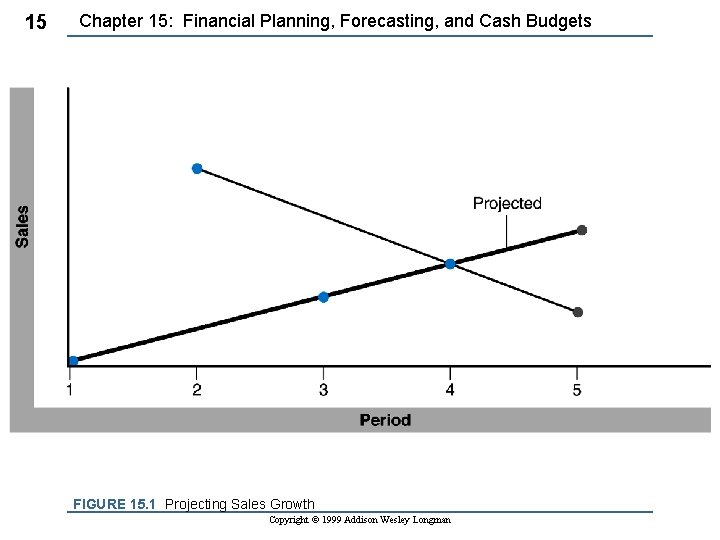
15 Chapter 15: Financial Planning, Forecasting, and Cash Budgets FIGURE 15. 1 Projecting Sales Growth Copyright © 1999 Addison Wesley Longman
16 Chapter 15: Financial Planning, Forecasting, and Cash Budgets Estimating Sales with Regression Analysis Every observation is used to compute a best fitting line, u Which can be then projected into the future. u Copyright © 1999 Addison Wesley Longman

17 Chapter 15: Financial Planning, Forecasting, and Cash Budgets Example 1995 $77 1996 $97 1997 $132 1998 $140. 30 1999 $148. 80 Copyright © 1999 Addison Wesley Longman

18 Chapter 15: Financial Planning, Forecasting, and Cash Budgets Solution 150 100 50 1989 90 91 92 93 94 Copyright © 1999 Addison Wesley Longman

19 Chapter 15: Financial Planning, Forecasting, and Cash Budgets Future Sales Can also be estimated using management opinions u This is often the only way to estimate sales for new products where no historical information is available u Copyright © 1999 Addison Wesley Longman
20 Chapter 15: Financial Planning, Forecasting, and Cash Budgets Percentage of Sales Forecasting Method Estimate future sales using one of the methods discussed earlier. u Divide each balance sheet item that varies with sales by current sales to get percent of current sales. u Copyright © 1999 Addison Wesley Longman
21 Chapter 15: Financial Planning, Forecasting, and Cash Budgets Percentage of Sales (continued) Multiply percent of current sales by estimated future sales. u Compute additions to equity due to current year income. u Use additional funds as a plug figure to balance. u Copyright © 1999 Addison Wesley Longman
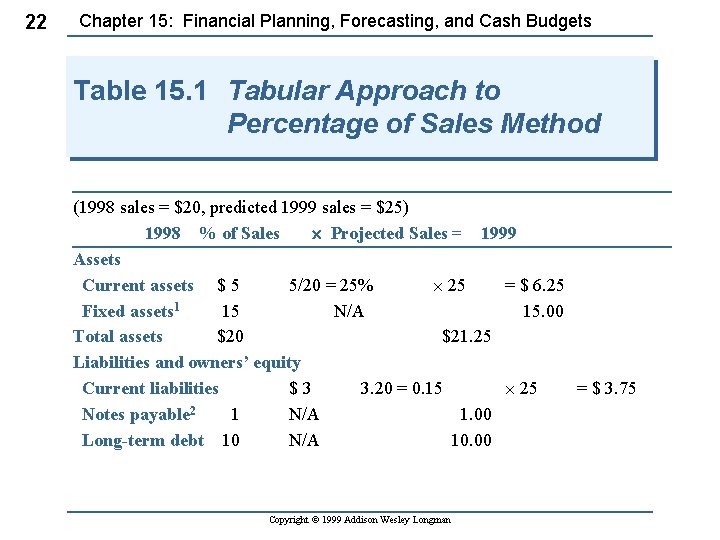
22 Chapter 15: Financial Planning, Forecasting, and Cash Budgets Table 15. 1 Tabular Approach to Percentage of Sales Method (1998 sales = $20, predicted 1999 sales = $25) 1998 % of Sales Projected Sales = 1999 Assets Current assets $ 5 5/20 = 25% 25 = $ 6. 25 Fixed assets 1 15 N/A 15. 00 Total assets $20 $21. 25 Liabilities and owners’ equity Current liabilities $ 3 3. 20 = 0. 15 25 = $ 3. 75 Notes payable 2 1 N/A 1. 00 Long-term debt 10 N/A 10. 00 Copyright © 1999 Addison Wesley Longman

23 Chapter 15: Financial Planning, Forecasting, and Cash Budgets 1998 % of Sales ¥ Projected Sales = 1999 Total liabilities $14. 75 Common stock $ 4 N/A $ 4. 00 Retained earnings 3 2 2+ [0. 06 25 (1 -0. 7)] Total equity $ 6 $6. 45 Financing provided $21. 20 Additional funds needed $ 0. 054 Total $20 $21. 25 = 2. 45 1 If fixed assets are expected to increase as a result of the sales increase, they should be adjusted along with current assets. 2 Notes payable are not usually spontaneous in the sense that they increase automatically with sales. It usually requires a request from management to increase them. Notes payable may be a source of additional funds needed. 3 The net profit margin is 6% and the dividend payout ratio is 70%. This means that 6% of every sales dollar is available for shareholders but only 30% is retained to sue to finance growth. In this example net income will be $1. 50, found as ($25 0. 06) and $0. 45 will be retained ($1. 50 0. 3). 4 If the increase in liabilities and owners’ equity was greater than the increase in sales, a surplus would result. A surplus is entered as a negative number. Copyright © 1999 Addison Wesley Longman
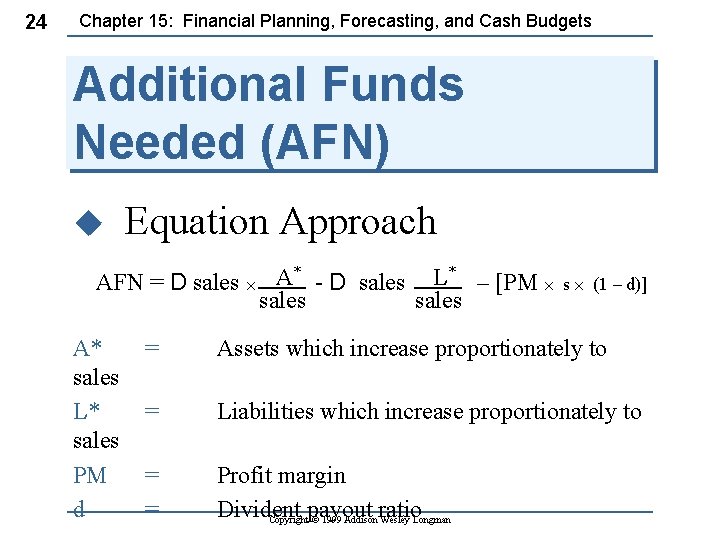
24 Chapter 15: Financial Planning, Forecasting, and Cash Budgets Additional Funds Needed (AFN) u Equation Approach A* L* AFN = D sales - D sales – [PM s (1 – d)] sales A* sales L* sales PM d = Assets which increase proportionately to = Liabilities which increase proportionately to = = Profit margin Divident payout ratio Copyright © 1999 Addison Wesley Longman

25 Chapter 15: Financial Planning, Forecasting, and Cash Budgets Example u Using the data from the previous example: AFN = $5($5 / 20) – $5($3 / 20) – [$25 –. 06(1 –. 7)] = $. 05 Copyright © 1999 Addison Wesley Longman
26 Chapter 15: Financial Planning, Forecasting, and Cash Budgets Solution u AFN calculations show that because firms must acquire assets to support their growth, it is possible to grow so fast that they outgrow their ability to raise funds. Copyright © 1999 Addison Wesley Longman
27 Chapter 15: Financial Planning, Forecasting, and Cash Budgets u In the following figure no additional funds are required as long as sales are below $24. Copyright © 1999 Addison Wesley Longman
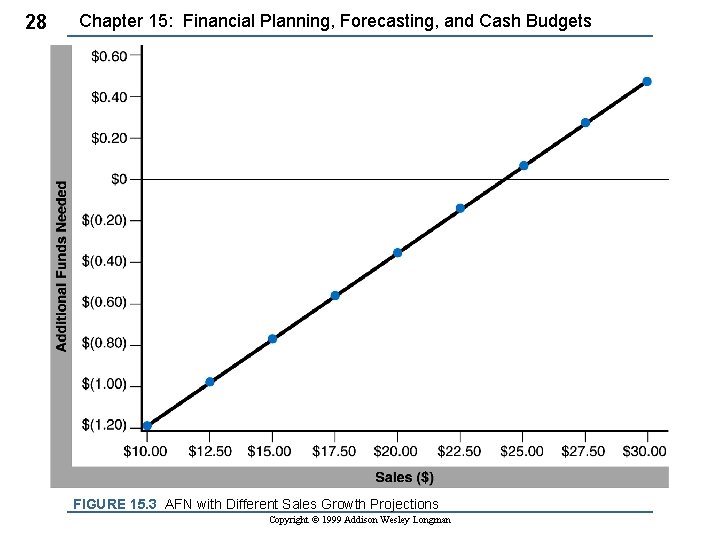
28 Chapter 15: Financial Planning, Forecasting, and Cash Budgets FIGURE 15. 3 AFN with Different Sales Growth Projections Copyright © 1999 Addison Wesley Longman
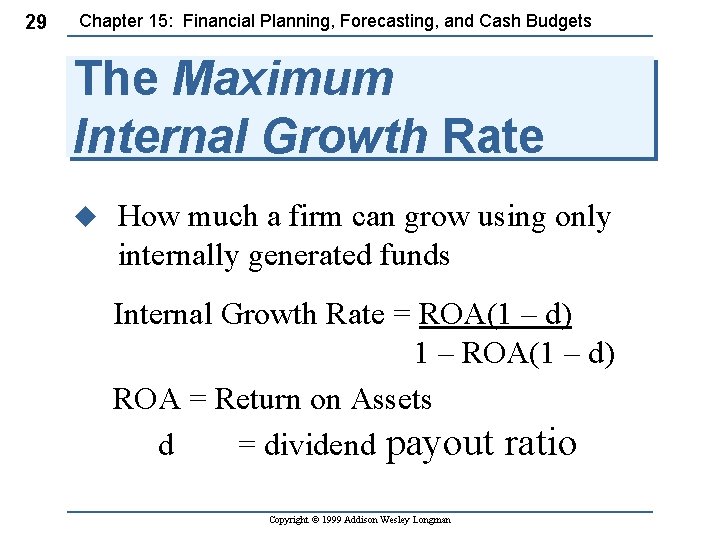
29 Chapter 15: Financial Planning, Forecasting, and Cash Budgets The Maximum Internal Growth Rate u How much a firm can grow using only internally generated funds Internal Growth Rate = ROA(1 – d) 1 – ROA(1 – d) ROA = Return on Assets d = dividend payout ratio Copyright © 1999 Addison Wesley Longman

30 Chapter 15: Financial Planning, Forecasting, and Cash Budgets Example u ROA = 16. 43% and the firm pays out 20. 91% of its income as dividends. What is its maximum internal growth rate? Copyright © 1999 Addison Wesley Longman
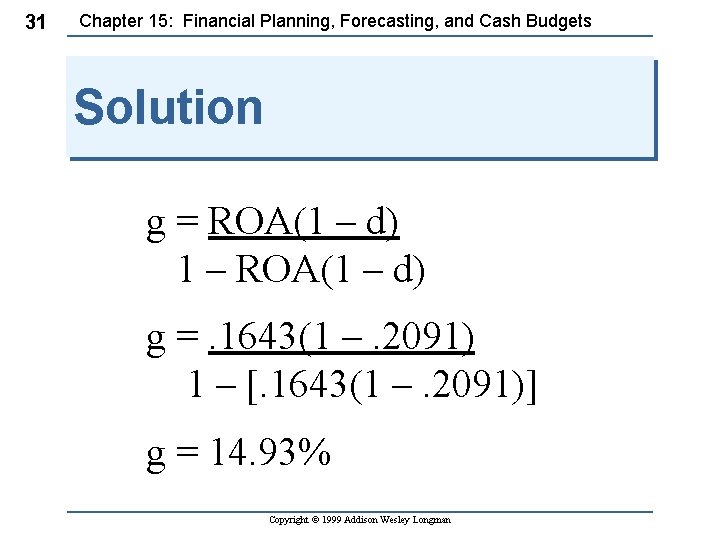
31 Chapter 15: Financial Planning, Forecasting, and Cash Budgets Solution g = ROA(1 – d) 1 – ROA(1 – d) g =. 1643(1 –. 2091) 1 – [. 1643(1 –. 2091)] g = 14. 93% Copyright © 1999 Addison Wesley Longman
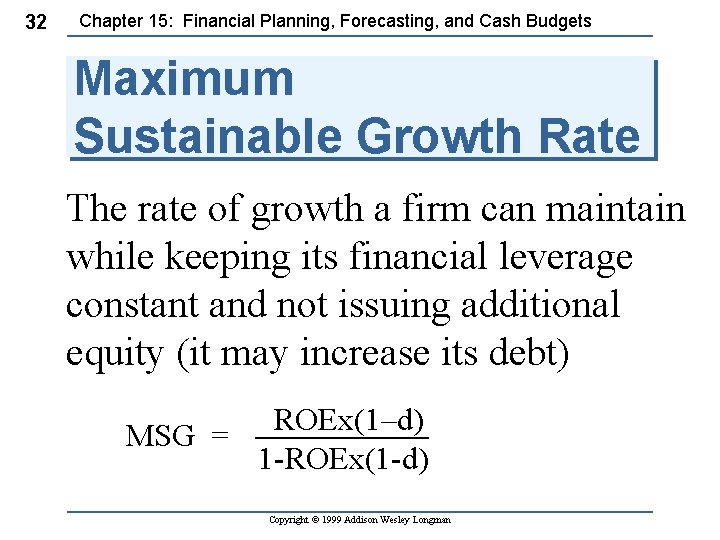
32 Chapter 15: Financial Planning, Forecasting, and Cash Budgets Maximum Sustainable Growth Rate The rate of growth a firm can maintain while keeping its financial leverage constant and not issuing additional equity (it may increase its debt) ROEx(1–d) MSG = 1 -ROEx(1 -d) Copyright © 1999 Addison Wesley Longman
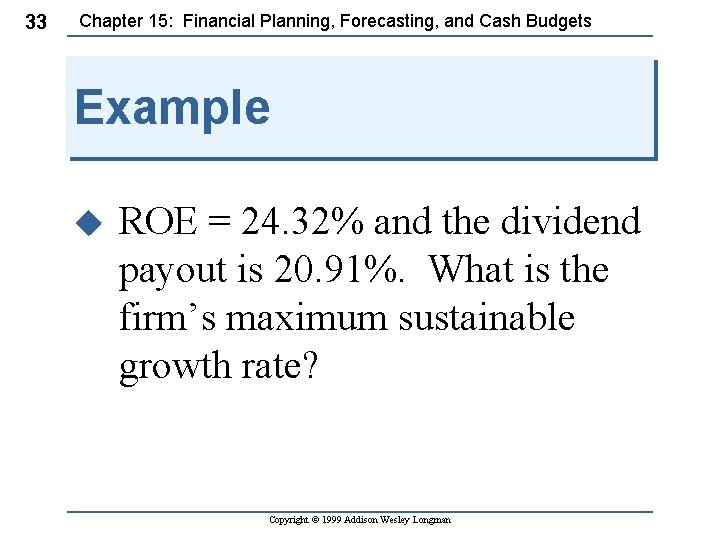
33 Chapter 15: Financial Planning, Forecasting, and Cash Budgets Example u ROE = 24. 32% and the dividend payout is 20. 91%. What is the firm’s maximum sustainable growth rate? Copyright © 1999 Addison Wesley Longman

34 Chapter 15: Financial Planning, Forecasting, and Cash Budgets Solution MSG =. 2432(1 –. 2091) 1 – [. 2432(1 –. 2091)] MSG = 23. 81% Copyright © 1999 Addison Wesley Longman

35 Chapter 15: Financial Planning, Forecasting, and Cash Budgets What if. . . u You determine your projected growth rate to be greater than your maximum sustainable growth rate? Copyright © 1999 Addison Wesley Longman
36 Chapter 15: Financial Planning, Forecasting, and Cash Budgets – – Profit Margin: increasing margin will provide more cash. Total Asset Turnover: increasing turnover will reduce the need for new assets. Copyright © 1999 Addison Wesley Longman
37 Chapter 15: Financial Planning, Forecasting, and Cash Budgets If PGR is determined to be greater than MSG. . . Financial Leverage: More debt in optimal capital structure reduces the need for equity. u Dividend Payout Ratio: Reducing payout provides additional funds for growth. u Copyright © 1999 Addison Wesley Longman
38 Chapter 15: Financial Planning, Forecasting, and Cash Budgets Cash Budget A detailed statement of cash inflows and outflows u Can be daily, weekly, or monthly u Used to ensure that funds will be available when needed u Copyright © 1999 Addison Wesley Longman
39 Chapter 15: Financial Planning, Forecasting, and Cash Budgets Cash Budget u General Format: Cash Receipts – Cash Disbursements Net Cash Flow + Beginning Cash Balance – Required Cash Balance Required External Funds Needed/Excess Cash Balance Copyright © 1999 Addison Wesley Longman
40 Chapter 15: Financial Planning, Forecasting, and Cash Budgets Example Sales Increase = 10% per month u November and December sales are $9, 500 and $10, 000 u COGS = 60% of sales and is paid the following month u Copyright © 1999 Addison Wesley Longman
41 Chapter 15: Financial Planning, Forecasting, and Cash Budgets Example, (cont. ) u All sales for credit, 80% collected the following month and 20% collected during the second month Copyright © 1999 Addison Wesley Longman
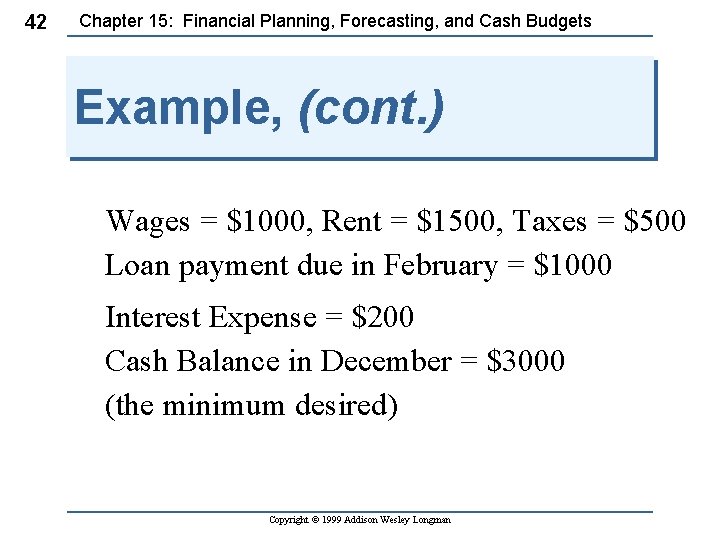
42 Chapter 15: Financial Planning, Forecasting, and Cash Budgets Example, (cont. ) Wages = $1000, Rent = $1500, Taxes = $500 Loan payment due in February = $1000 Interest Expense = $200 Cash Balance in December = $3000 (the minimum desired) Copyright © 1999 Addison Wesley Longman
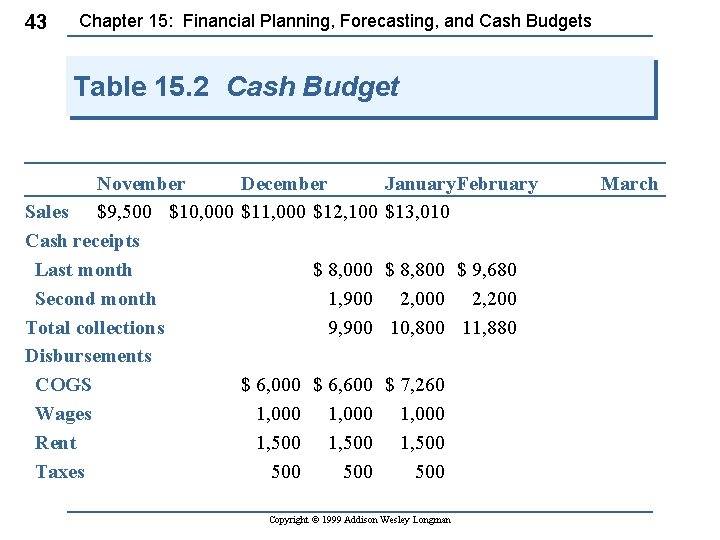
43 Chapter 15: Financial Planning, Forecasting, and Cash Budgets Table 15. 2 Cash Budget November Sales $9, 500 $10, 000 Cash receipts Last month Second month Total collections Disbursements COGS Wages Rent Taxes December January. February $11, 000 $12, 100 $13, 010 $ 8, 000 $ 8, 800 $ 9, 680 1, 900 2, 000 2, 200 9, 900 10, 800 11, 880 $ 6, 000 1, 500 $ 6, 600 1, 000 1, 500 $ 7, 260 1, 000 1, 500 Copyright © 1999 Addison Wesley Longman March

44 Chapter 15: Financial Planning, Forecasting, and Cash Budgets Nov. Dec. Loan pmt Total disbursements Net cash flow Plus beginning cash flow Total cash Less minimum balance AFN/Surplus Jan. Feb. Mar. 200 1, 200 $ 9, 200 $ 700 $ 0 3, 000 $ 3, 700 3, 000 $ 700 Copyright © 1999 Addison Wesley Longman 200 $10, 800 $10, 460 $ 1, 420 3, 700 $ 5, 120 3, 000 $ 2, 200
45 Chapter 15: Financial Planning, Forecasting, and Cash Budgets Multiple Spreadsheets Can be prepared for different sales growth estimates. u The resulting projection of external funds needed can be summarized graphically. u Copyright © 1999 Addison Wesley Longman
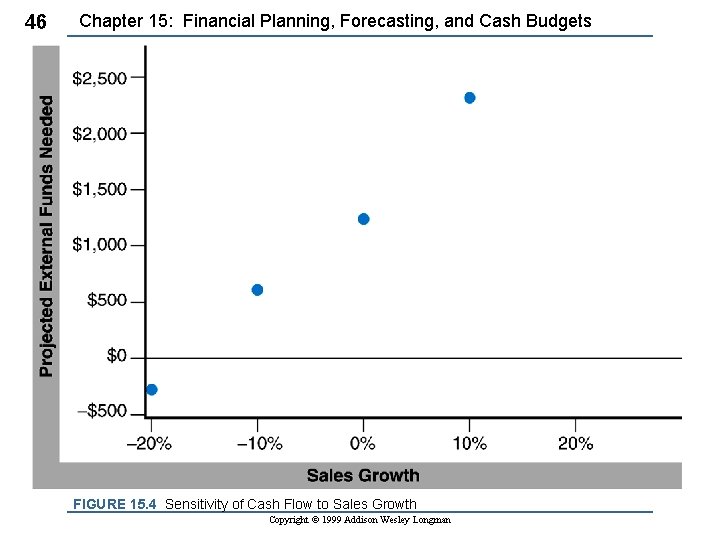
46 Chapter 15: Financial Planning, Forecasting, and Cash Budgets FIGURE 15. 4 Sensitivity of Cash Flow to Sales Growth Copyright © 1999 Addison Wesley Longman
47 Chapter 15: Financial Planning, Forecasting, and Cash Budgets Pro-Forma Financial Statements Project 1, 2 or more years into the future u A valuable management tool for assessing the effects of various management decisions u Copyright © 1999 Addison Wesley Longman

48 Chapter 15: Financial Planning, Forecasting, and Cash Budgets u Virtually all firms prepare these statements as a part of their strategic planning process. Copyright © 1999 Addison Wesley Longman
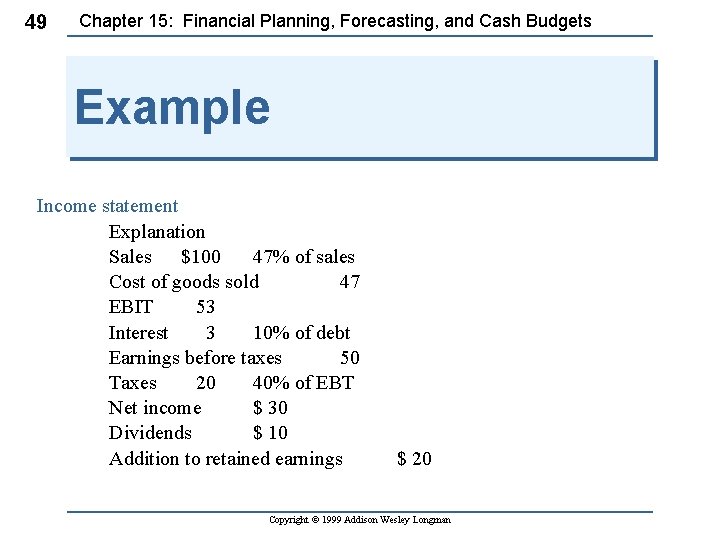
49 Chapter 15: Financial Planning, Forecasting, and Cash Budgets Example Income statement Explanation Sales $100 47% of sales Cost of goods sold 47 EBIT 53 Interest 3 10% of debt Earnings before taxes 50 Taxes 20 40% of EBT Net income $ 30 Dividends $ 10 Addition to retained earnings $ 20 Copyright © 1999 Addison Wesley Longman
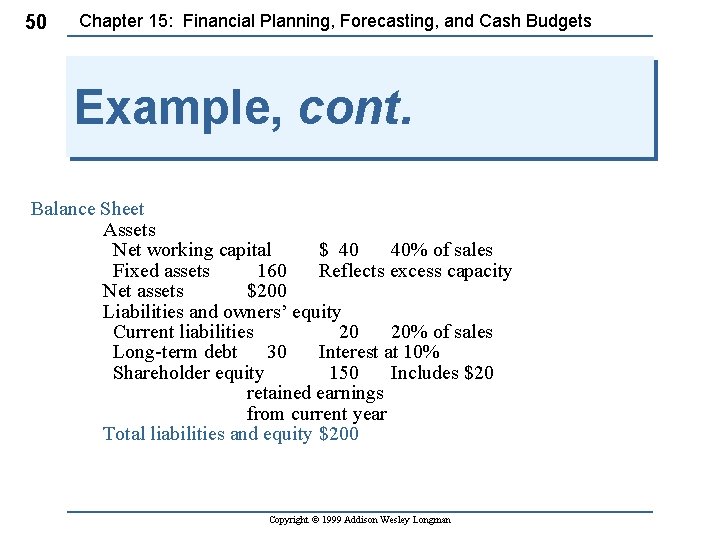
50 Chapter 15: Financial Planning, Forecasting, and Cash Budgets Example, cont. Balance Sheet Assets Net working capital $ 40 40% of sales Fixed assets 160 Reflects excess capacity Net assets $200 Liabilities and owners’ equity Current liabilities 20 20% of sales Long-term debt 30 Interest at 10% Shareholder equity 150 Includes $20 retained earnings from current year Total liabilities and equity $200 Copyright © 1999 Addison Wesley Longman
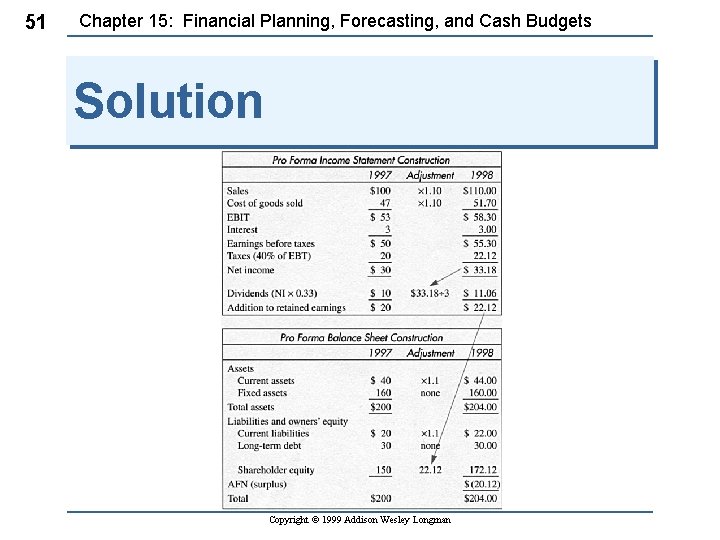
51 Chapter 15: Financial Planning, Forecasting, and Cash Budgets Solution Copyright © 1999 Addison Wesley Longman
- Slides: 51