
Chapter 15 External Growth Strategies Mergers Acquisitions Alliances
- Slides: 6
Chapter 15 External Growth Strategies: Mergers, Acquisitions & Alliances © 2013 Robert M. Grant www. contemporarystrategyanalysis. com 1
External Growth Strategies: Mergers, Acquisitions & Alliances OUTLINE • Mergers and Acquisitions: Causes and Consequences • Strategic Alliances— Motives © 2013 Robert M. Grant www. contemporarystrategyanalysis. com 2
The Motives for Mergers & Acquisitions • Acquiring Resources or Capabilities o Some resources and capabilities not transferable or replicable: to obtain them may require acquiring the entire company (e. g. Disney and Pixar) o Acquisitions are especially important for established companies seeking to acquire emerging technologies (during 2005 -11, Google acquired 95 firms and Microsoft 71) • Cost Economies and Market Power o Horizontal mergers (especially between competitors) offer clearest benefits from mergers in terms of scale economies and market power (e. g. United and Continental airlines; Exxon and Mobil) • Geographical Extension o Acquisition is the most popular means of entry into foreign markets by companies. Allows acquiring firm to gain critical mass and overcome “liabilities of foreignness” • Diversification o Acquisition is the predominant mode of diversification by firms © 2013 Robert M. Grant www. contemporarystrategyanalysis. com 3
Consequences of Mergers & Acquisitions • Financial Outcomes o Many studies, inconsistent results o In terms of returns to shareholders, main finding is that shareholders of acquiring firms lose; shareholders of acquired firms gain; combined impact a v. small gain • If acquisitions destroy value for the acquirer, why do they happen? o o o Motivated by managerial goals (e. g. growth) Imitation (e. g. internationalization by banks, merger wave among petroleum firms) Acquiring firms overestimate the benefits, underestimate the costs • Learning effects o Some firms more successful acquirers than others. Acquisition capability the result of (a) learning through experience (b) systematizing the approach to acquisition management © 2013 Robert M. Grant www. contemporarystrategyanalysis. com 4
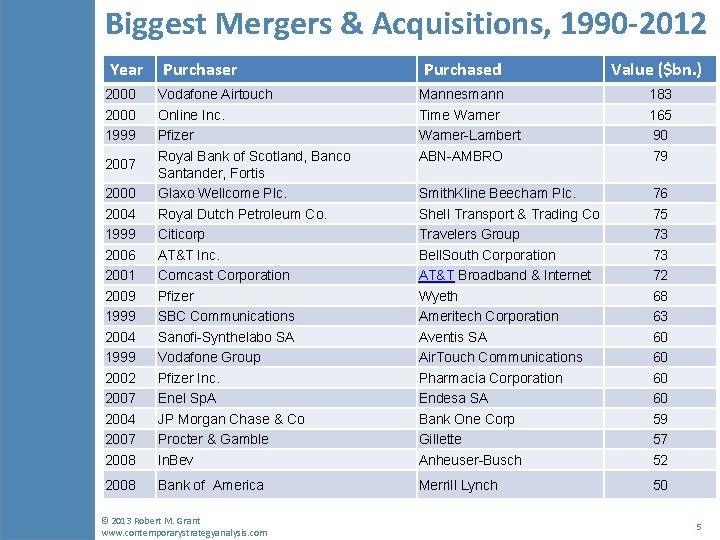
Biggest Mergers & Acquisitions, 1990 -2012 Year 2000 1999 Purchaser Purchased Value ($bn. ) Mannesmann Time Warner-Lambert ABN-AMBRO 183 165 90 79 2000 2004 1999 2006 2001 2009 1999 2004 1999 2002 2007 2004 2007 2008 Vodafone Airtouch Online Inc. Pfizer Royal Bank of Scotland, Banco Santander, Fortis Glaxo Wellcome Plc. Royal Dutch Petroleum Co. Citicorp AT&T Inc. Comcast Corporation Pfizer SBC Communications Sanofi-Synthelabo SA Vodafone Group Pfizer Inc. Enel Sp. A JP Morgan Chase & Co Procter & Gamble In. Bev Smith. Kline Beecham Plc. Shell Transport & Trading Co Travelers Group Bell. South Corporation AT&T Broadband & Internet Wyeth Ameritech Corporation Aventis SA Air. Touch Communications Pharmacia Corporation Endesa SA Bank One Corp Gillette Anheuser-Busch 76 75 73 73 72 68 63 60 60 59 57 52 2008 Bank of America Merrill Lynch 50 2007 © 2013 Robert M. Grant www. contemporarystrategyanalysis. com 5
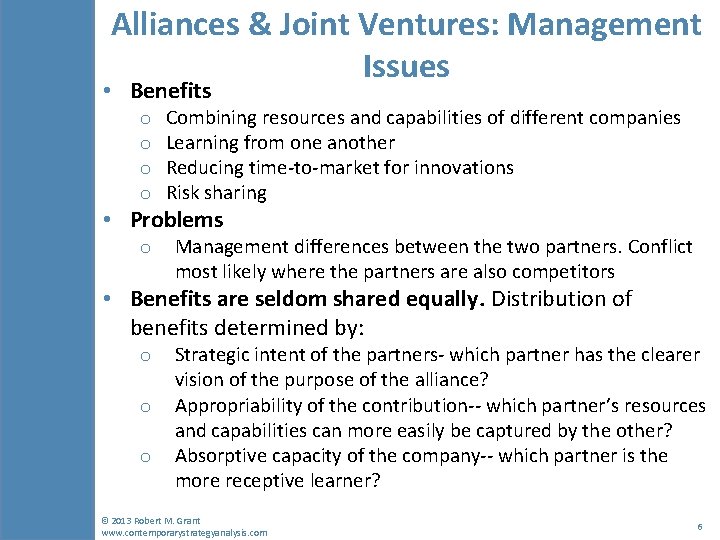
Alliances & Joint Ventures: Management Issues • Benefits o o Combining resources and capabilities of different companies Learning from one another Reducing time-to-market for innovations Risk sharing • Problems o Management differences between the two partners. Conflict most likely where the partners are also competitors • Benefits are seldom shared equally. Distribution of benefits determined by: o o o Strategic intent of the partners- which partner has the clearer vision of the purpose of the alliance? Appropriability of the contribution-- which partner’s resources and capabilities can more easily be captured by the other? Absorptive capacity of the company-- which partner is the more receptive learner? © 2013 Robert M. Grant www. contemporarystrategyanalysis. com 6