
Chapter 15 Exporting and Logistics Special Issues for
- Slides: 27
Chapter 15 Exporting and Logistics: Special Issues for Business Modular: Afjal Hossain Assistant Professor, Department of Marketing Mc. Graw-Hill/Irwin International Marketing, 13/e PSTU
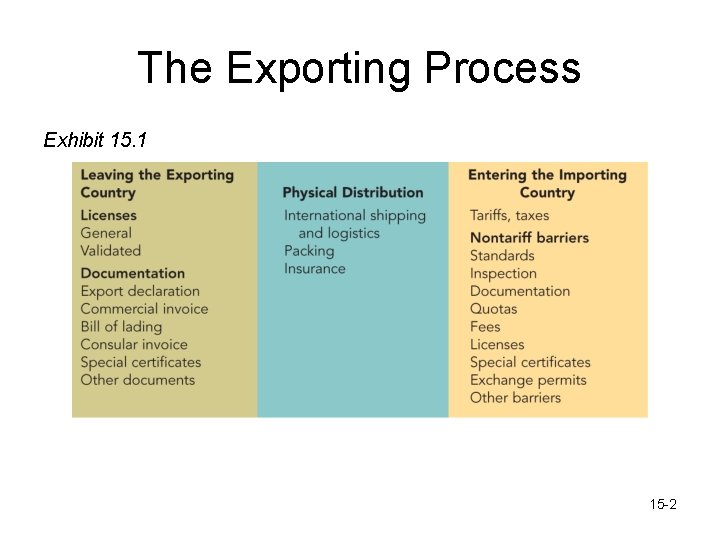
The Exporting Process Exhibit 15. 1 15 -2
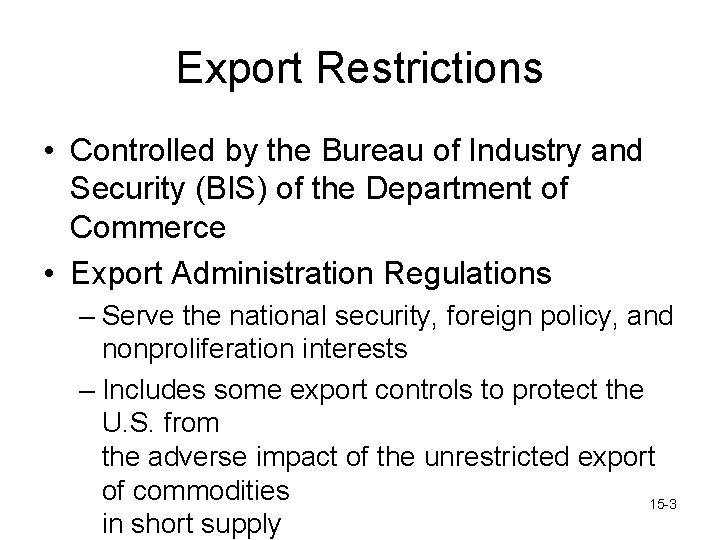
Export Restrictions • Controlled by the Bureau of Industry and Security (BIS) of the Department of Commerce • Export Administration Regulations – Serve the national security, foreign policy, and nonproliferation interests – Includes some export controls to protect the U. S. from the adverse impact of the unrestricted export of commodities 15 -3 in short supply
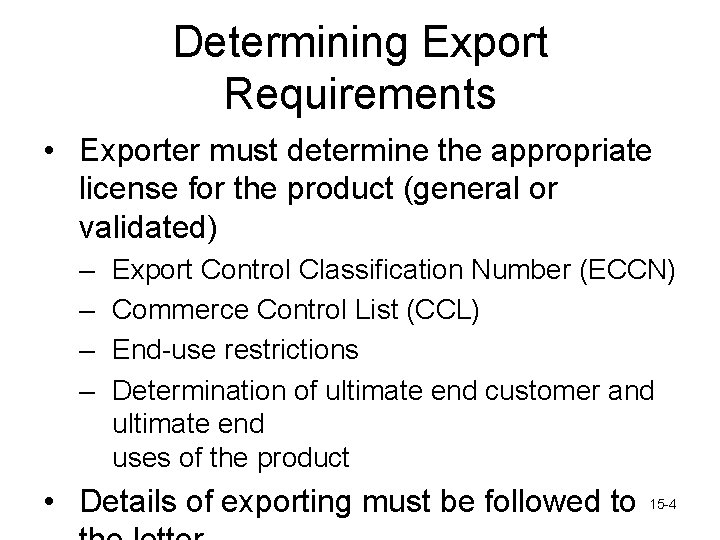
Determining Export Requirements • Exporter must determine the appropriate license for the product (general or validated) – – Export Control Classification Number (ECCN) Commerce Control List (CCL) End-use restrictions Determination of ultimate end customer and ultimate end uses of the product • Details of exporting must be followed to 15 -4
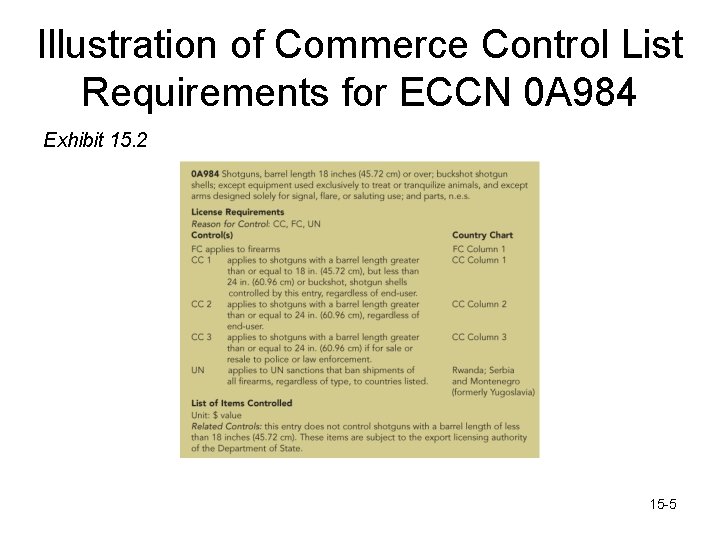
Illustration of Commerce Control List Requirements for ECCN 0 A 984 Exhibit 15. 2 15 -5
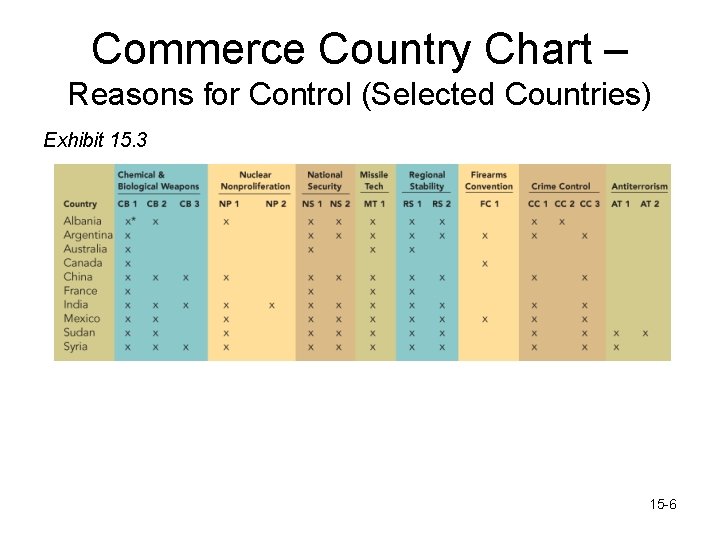
Commerce Country Chart – Reasons for Control (Selected Countries) Exhibit 15. 3 15 -6
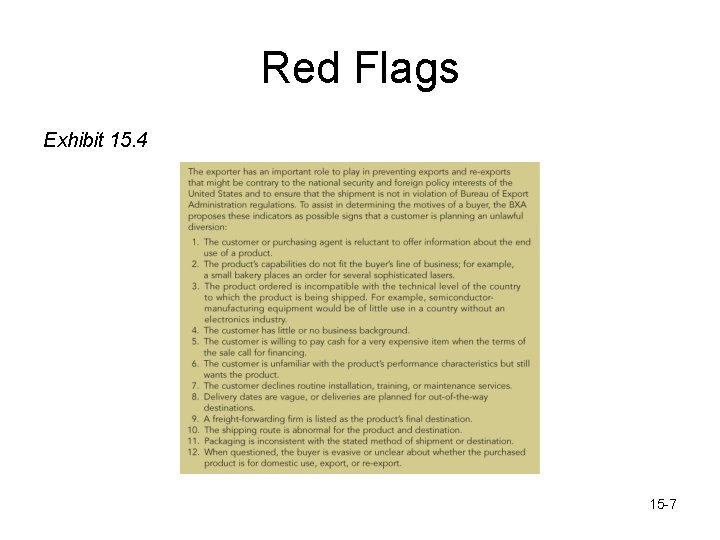
Red Flags Exhibit 15. 4 15 -7
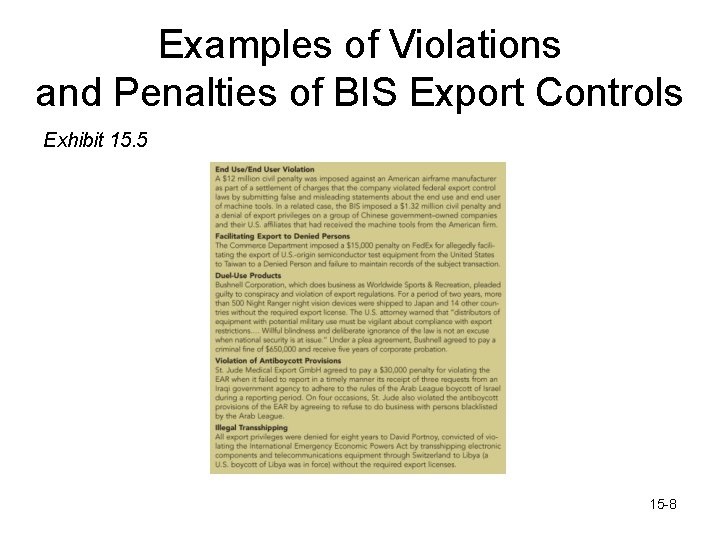
Examples of Violations and Penalties of BIS Export Controls Exhibit 15. 5 15 -8
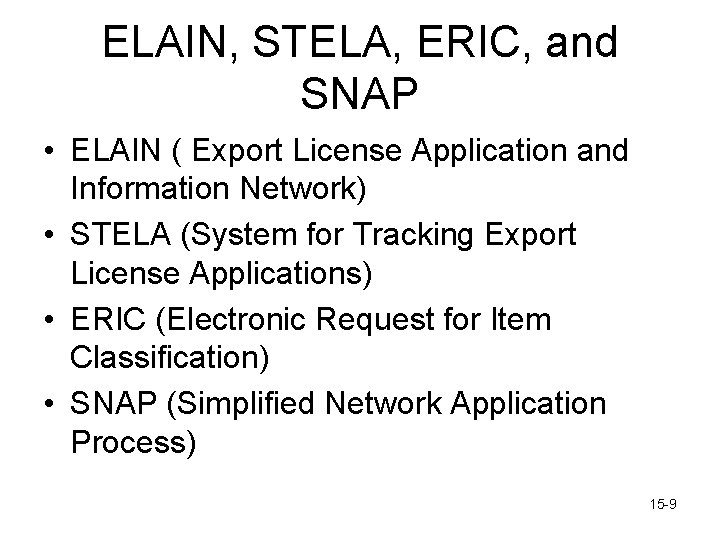
ELAIN, STELA, ERIC, and SNAP • ELAIN ( Export License Application and Information Network) • STELA (System for Tracking Export License Applications) • ERIC (Electronic Request for Item Classification) • SNAP (Simplified Network Application Process) 15 -9
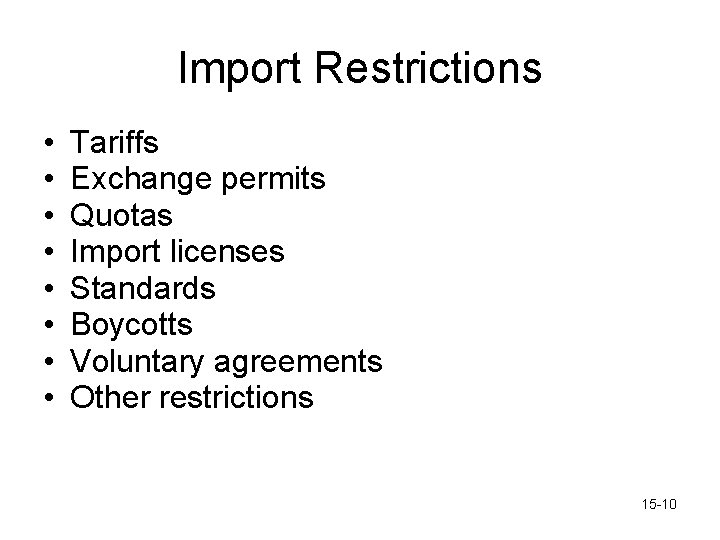
Import Restrictions • • Tariffs Exchange permits Quotas Import licenses Standards Boycotts Voluntary agreements Other restrictions 15 -10
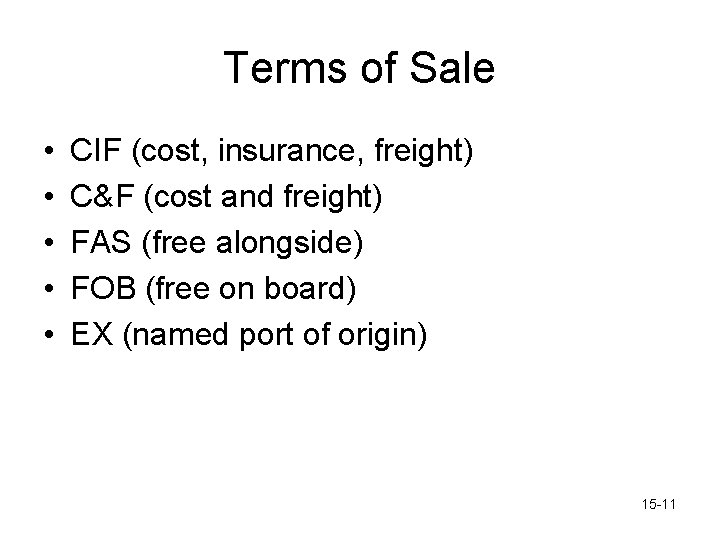
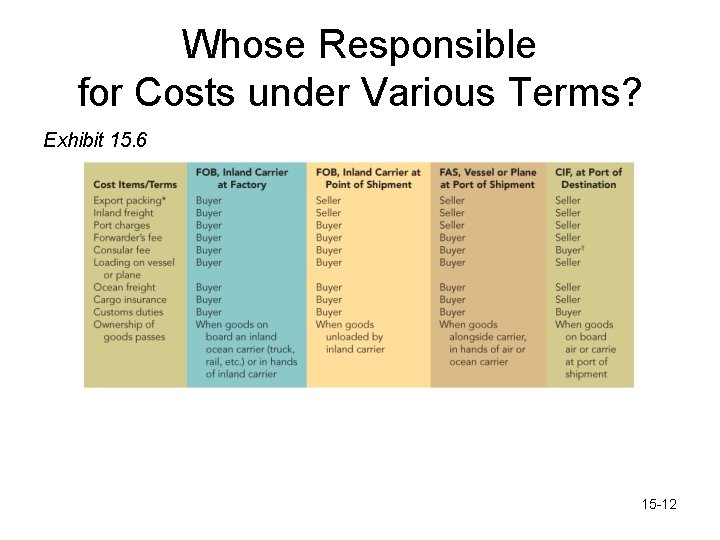
Terms of Sale • • • CIF (cost, insurance, freight) C&F (cost and freight) FAS (free alongside) FOB (free on board) EX (named port of origin) 15 -11
Whose Responsible for Costs under Various Terms? Exhibit 15. 6 15 -12
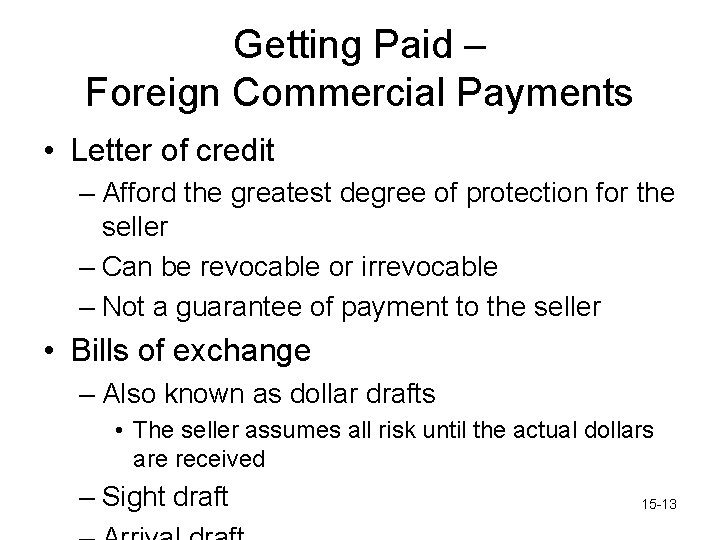
Getting Paid – Foreign Commercial Payments • Letter of credit – Afford the greatest degree of protection for the seller – Can be revocable or irrevocable – Not a guarantee of payment to the seller • Bills of exchange – Also known as dollar drafts • The seller assumes all risk until the actual dollars are received – Sight draft 15 -13
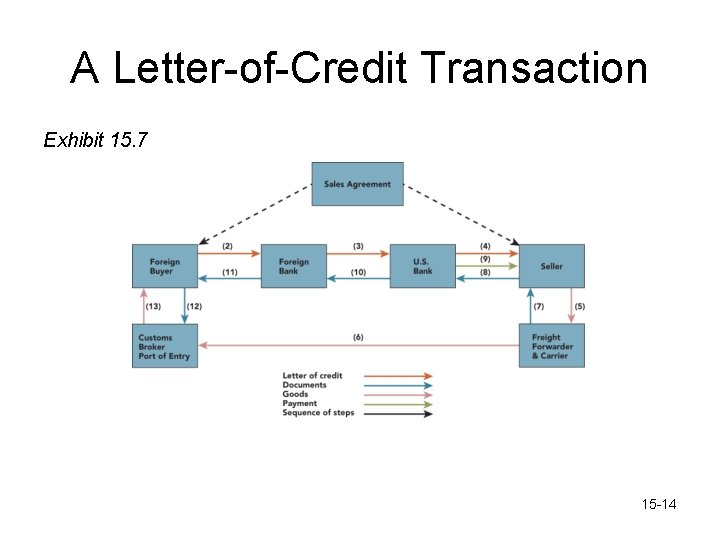
A Letter-of-Credit Transaction Exhibit 15. 7 15 -14
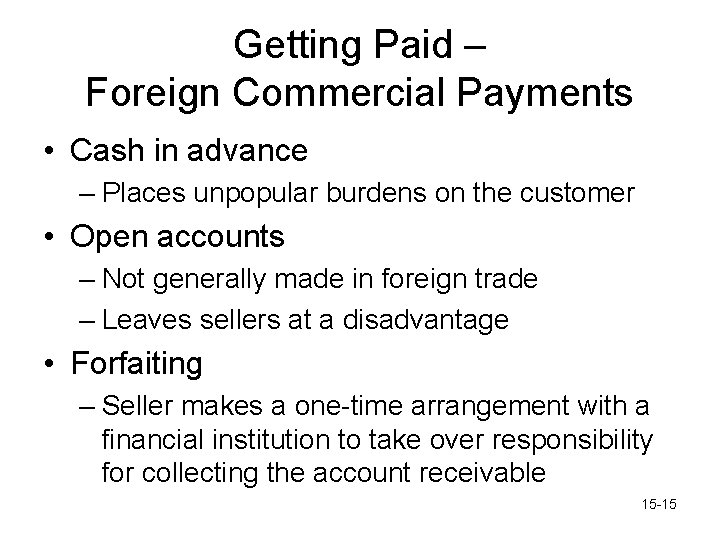
Getting Paid – Foreign Commercial Payments • Cash in advance – Places unpopular burdens on the customer • Open accounts – Not generally made in foreign trade – Leaves sellers at a disadvantage • Forfaiting – Seller makes a one-time arrangement with a financial institution to take over responsibility for collecting the account receivable 15 -15
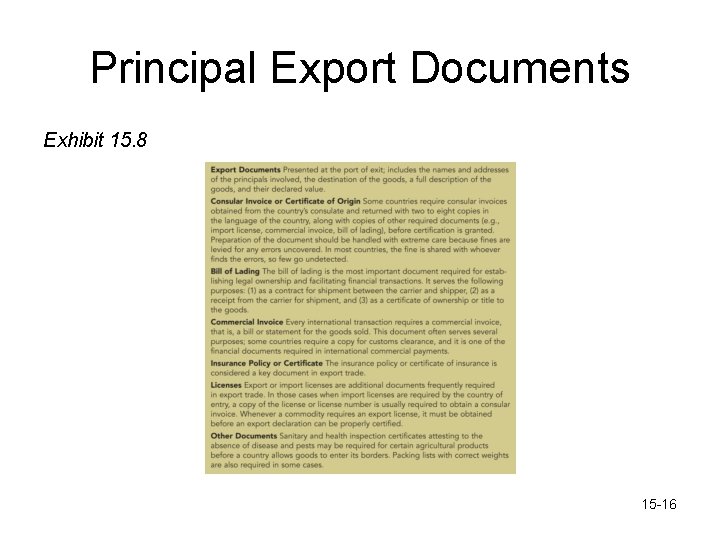
Principal Export Documents Exhibit 15. 8 15 -16
Packing and Marking • Export packaging must consider: – Protection against rough handling, climate, pilferage – Effect of gross weight on import fees • All countries regulate the marking of imported goods and containers – All markings must conform exactly to the data on the export documents • Preparing shipment to (Country) details: 15 -17
Customs-Privileged Facilities • Customs-privileged facilities – Areas where goods can be imported for storage and/or processing with tariffs and quota limits postponed until the products leave the designated areas • Foreign trade zones (FTZs) – Drawback • Offshore assembly (Maquiladoras) – Originated in Mexico in the early 1970’s – NAFTA 15 -18
Logistics • Logistics management – Total systems approach to management of the distribution process • Physically moving raw material • In-process inventory • Finished goods inventory from the point of origin to the point of use or consumption 15 -19
Interdependence of Physical Distribution Activities • Physical distribution system – Physical movement of goods – Location of plants and warehousing (storage) – Transportation mode – Inventory quantities – Packing • Interdependence of the costs of each activity – A decision involving one activity affects the cost and efficiency of one or all others 15 -20
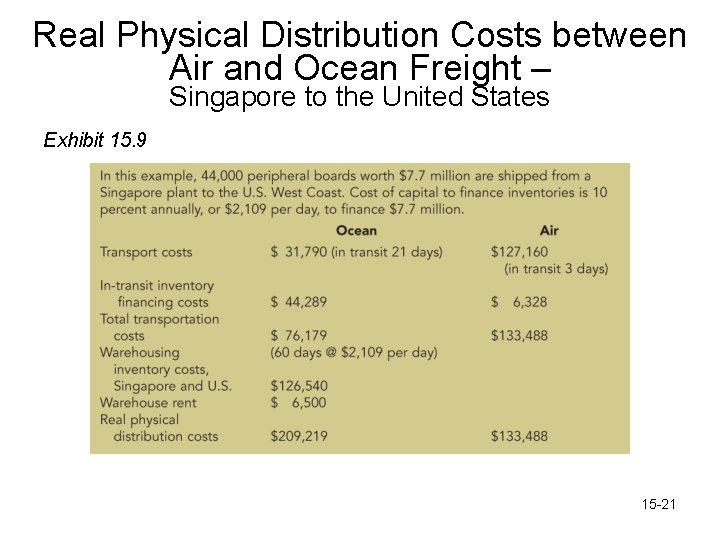
Real Physical Distribution Costs between Air and Ocean Freight – Singapore to the United States Exhibit 15. 9 15 -21
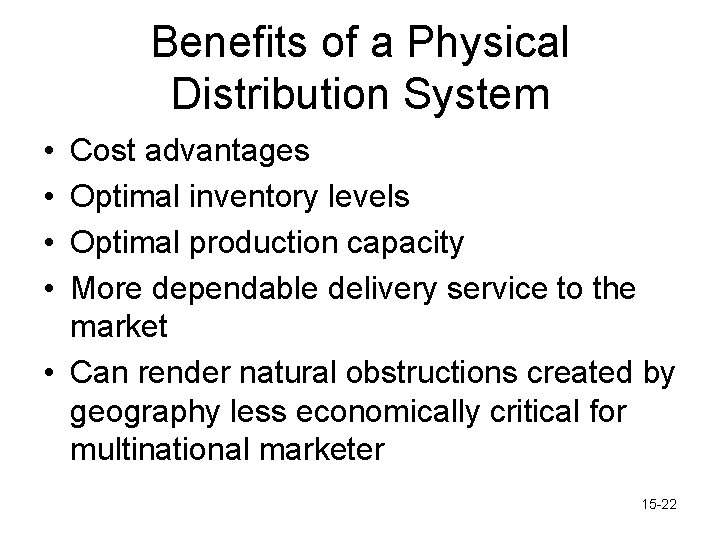
Benefits of a Physical Distribution System • • Cost advantages Optimal inventory levels Optimal production capacity More dependable delivery service to the market • Can render natural obstructions created by geography less economically critical for multinational marketer 15 -22
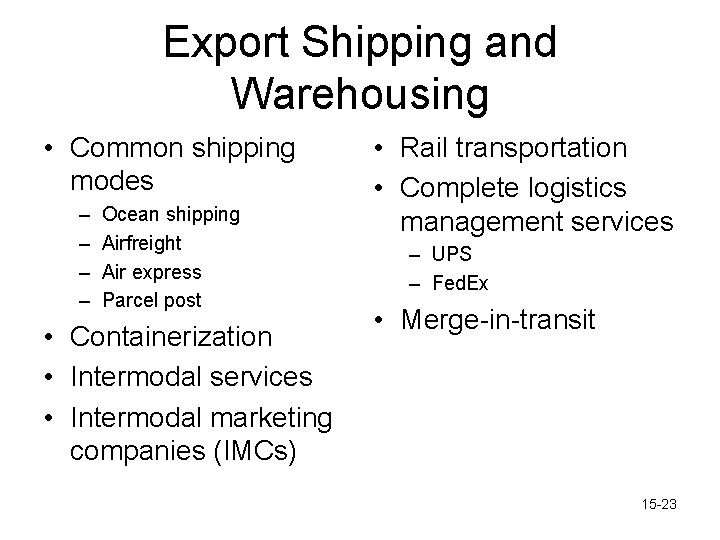
Export Shipping and Warehousing • Common shipping modes – – Ocean shipping Airfreight Air express Parcel post • Containerization • Intermodal services • Intermodal marketing companies (IMCs) • Rail transportation • Complete logistics management services – UPS – Fed. Ex • Merge-in-transit 15 -23
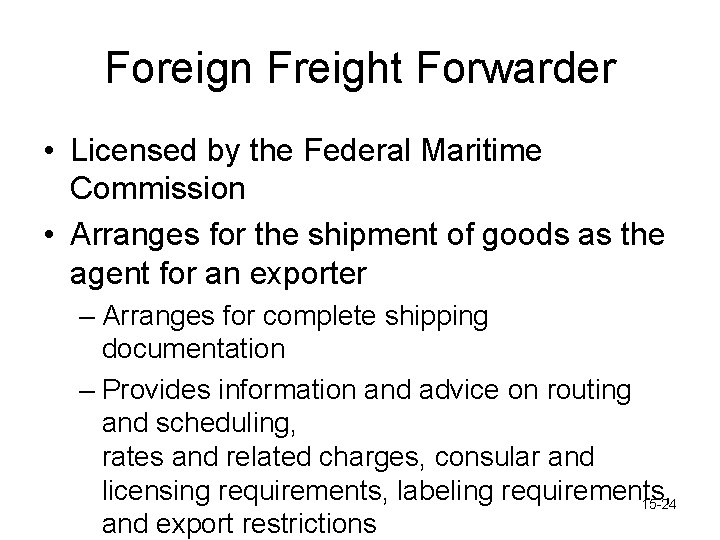
Foreign Freight Forwarder • Licensed by the Federal Maritime Commission • Arranges for the shipment of goods as the agent for an exporter – Arranges for complete shipping documentation – Provides information and advice on routing and scheduling, rates and related charges, consular and licensing requirements, labeling requirements, 15 -24 and export restrictions
International Logistics and Supply Chain Management • Information technology now allows communication with participants in real time via a single connection point • Net. Linx • Descartes • 3 PL providers or integrators – UPS Logistics Group 15 -25
Terrorism and Logistics • Cargo and Container Security Initiative (CSI) – 24 -hour rule • Customs-Trade Partnership against Terrorism (C-TPAT) – Augments the 24 -hour rule by extending security procedures throughout the supply chain – Only applies to U. S. importers • Electronic tracking (C-TPAT-Plus) – – – – RFID GPS Cellular Satellite Ultra-wide-band Bluetooth Bar codes Optical character recognition 15 -26
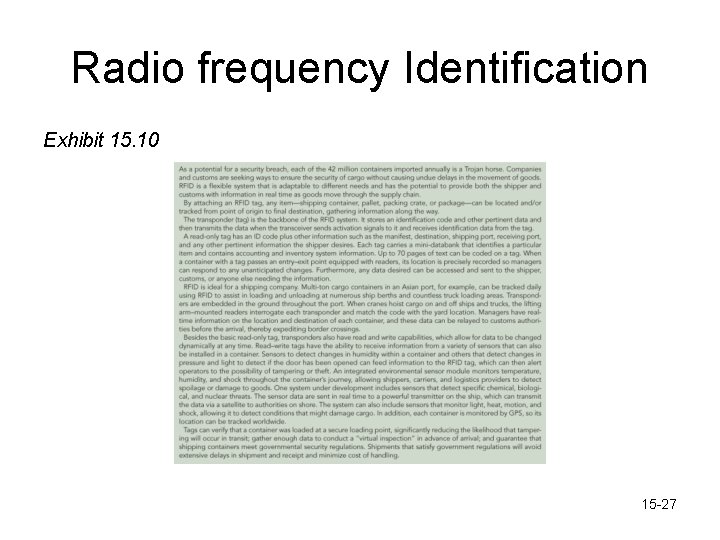
Radio frequency Identification Exhibit 15. 10 15 -27