
Chapter 15 Evolution and Diversity of Microbial Life
Chapter 15 Evolution and Diversity of Microbial Life Algae: © NPS photo by William S. Keller (RF) Copyright © The Mc. Graw-Hill Companies, Inc. Permission required for reproduction or display.
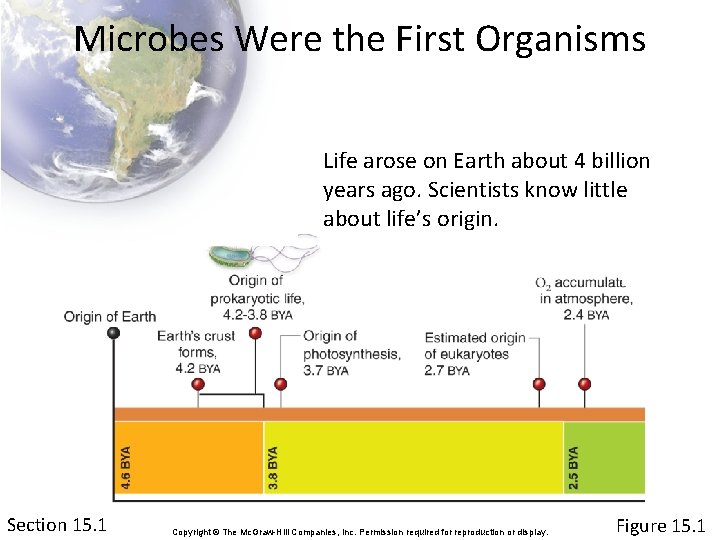
Microbes Were the First Organisms Life arose on Earth about 4 billion years ago. Scientists know little about life’s origin. Section 15. 1 Copyright © The Mc. Graw-Hill Companies, Inc. Permission required for reproduction or display. Figure 15. 1

Microbes Were the First Organisms Section 15. 1 Copyright © The Mc. Graw-Hill Companies, Inc. Permission required for reproduction or display. Figure 15. 2

Microbes Were the First Organisms The Miller experiment simulated early Earth’s atmosphere. Simple molecules combined into organic compounds, such as amino acids. Section 15. 1 Copyright © The Mc. Graw-Hill Companies, Inc. Permission required for reproduction or display. Figure 15. 3
Clicker Question #1 Why was the Miller experiment important? A. It showed life could be created in a test tube. B. It demonstrated how the first cells arose on Earth. C. It showed that RNA was the first selfreplicating molecule. D. It demonstrated Earth’s early atmosphere could have given rise to organic molecules. E. All of the choices are correct. © 1996 Photo. Disc, Inc. /Getty Images/RF Copyright © The Mc. Graw-Hill Companies, Inc. Permission required for reproduction or display.
Clicker Question #1 Why was the Miller experiment important? A. It showed life could be created in a test tube. B. It demonstrated how the first cells arose on Earth. C. It showed that RNA was the first selfreplicating molecule. D. It demonstrated Earth’s early atmosphere could have given rise to organic molecules. E. All of the choices are correct. © 1996 Photo. Disc, Inc. /Getty Images/RF Copyright © The Mc. Graw-Hill Companies, Inc. Permission required for reproduction or display.
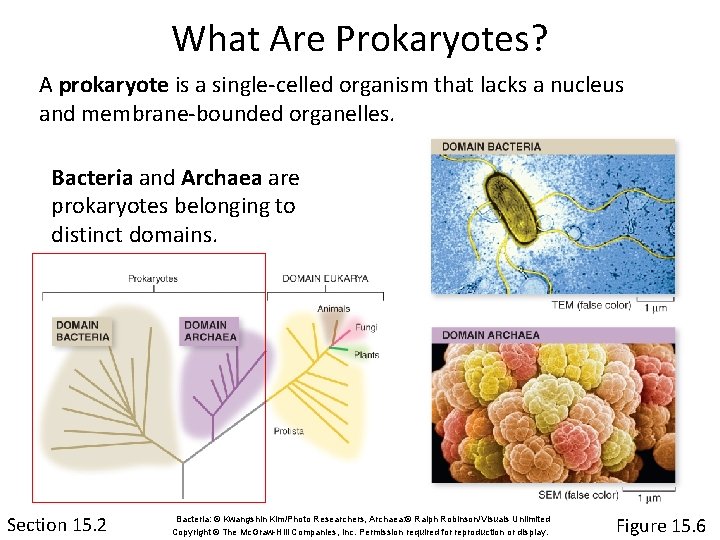
What Are Prokaryotes? A prokaryote is a single-celled organism that lacks a nucleus and membrane-bounded organelles. Bacteria and Archaea are prokaryotes belonging to distinct domains. Section 15. 1 15. 2 Bacteria: © Kwangshin Kim/Photo Researchers, Archaea: © Ralph Robinson/Visuals Unlimited Copyright © The Mc. Graw-Hill Companies, Inc. Permission required for reproduction or display. Figure 15. 6
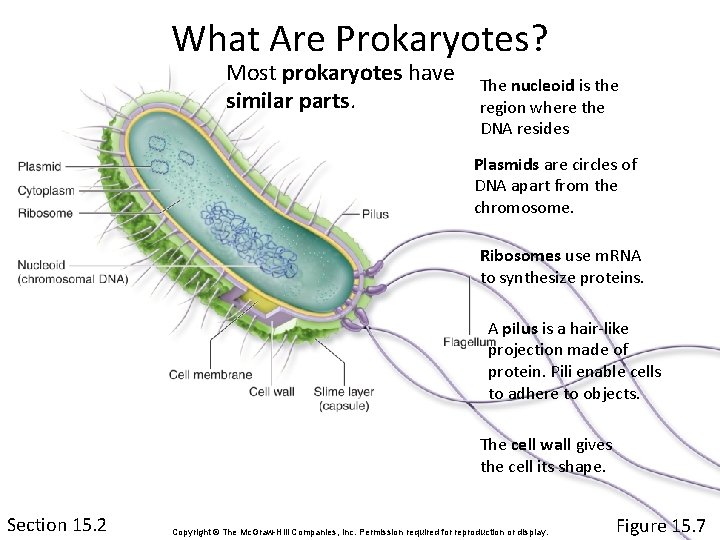
What Are Prokaryotes? Most prokaryotes have similar parts. The nucleoid is the region where the DNA resides Plasmids are circles of DNA apart from the chromosome. Ribosomes use m. RNA to synthesize proteins. A pilus is a hair-like projection made of protein. Pili enable cells to adhere to objects. The cell wall gives the cell its shape. Section 15. 1 15. 2 Copyright © The Mc. Graw-Hill Companies, Inc. Permission required for reproduction or display. Figure 15. 7
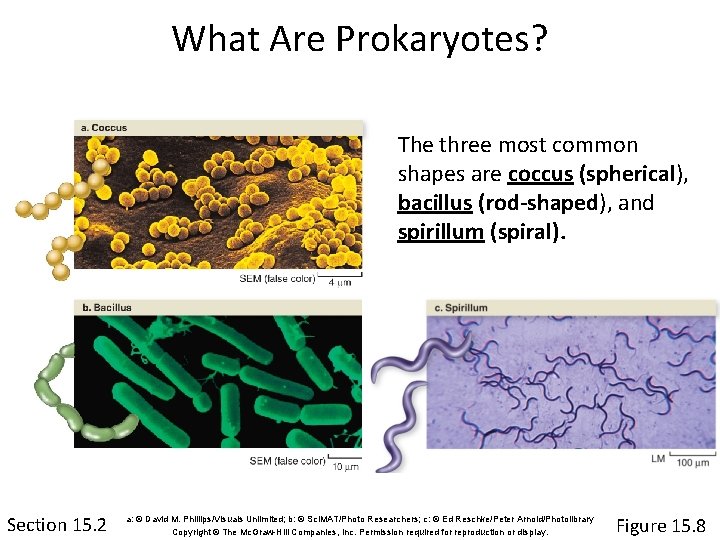
What Are Prokaryotes? The three most common shapes are coccus (spherical), bacillus (rod-shaped), and spirillum (spiral). Section 15. 1 15. 2 a: © David M. Phillips/Visuals Unlimited; b: © Sci. MAT/Photo Researchers; c: © Ed Reschke/Peter Arnold/Photolibrary Copyright © The Mc. Graw-Hill Companies, Inc. Permission required for reproduction or display. Figure 15. 8
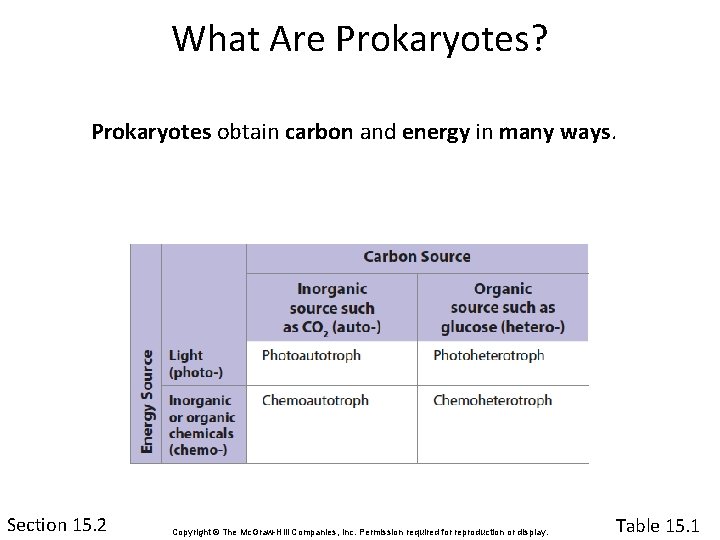
What Are Prokaryotes? Prokaryotes obtain carbon and energy in many ways. Section 15. 1 15. 2 Copyright © The Mc. Graw-Hill Companies, Inc. Permission required for reproduction or display. Table 15. 1
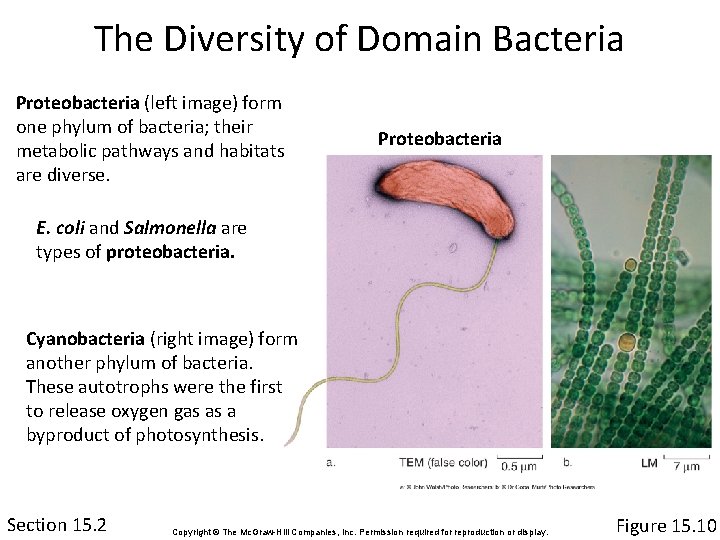
The Diversity of Domain Bacteria Proteobacteria (left image) form one phylum of bacteria; their metabolic pathways and habitats are diverse. Proteobacteria E. coli and Salmonella are types of proteobacteria. Cyanobacteria (right image) form another phylum of bacteria. These autotrophs were the first to release oxygen gas as a byproduct of photosynthesis. Section 15. 1 15. 2 Copyright © The Mc. Graw-Hill Companies, Inc. Permission required for reproduction or display. Figure 15. 10
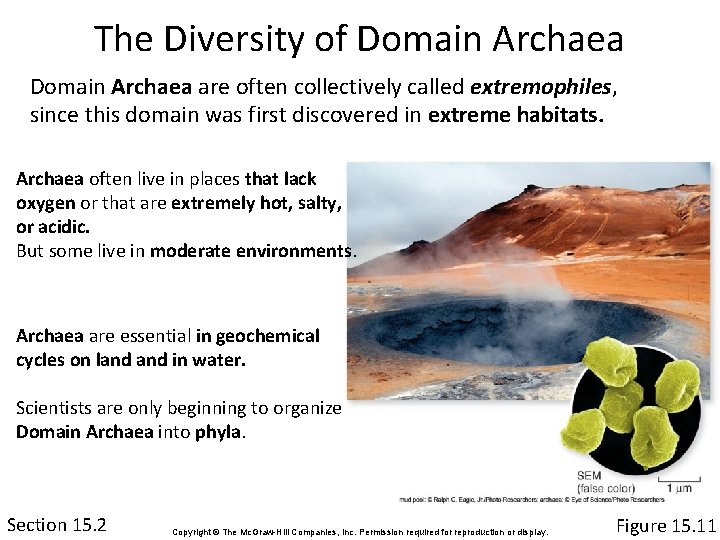
The Diversity of Domain Archaea are often collectively called extremophiles, since this domain was first discovered in extreme habitats. Archaea often live in places that lack oxygen or that are extremely hot, salty, or acidic. But some live in moderate environments. Archaea are essential in geochemical cycles on land in water. Scientists are only beginning to organize Domain Archaea into phyla. Section 15. 1 15. 2 Copyright © The Mc. Graw-Hill Companies, Inc. Permission required for reproduction or display. Figure 15. 11
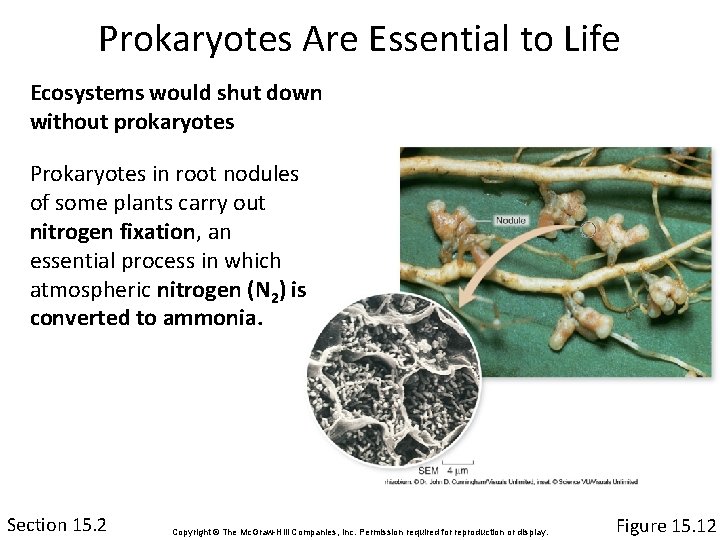
Prokaryotes Are Essential to Life Ecosystems would shut down without prokaryotes Prokaryotes in root nodules of some plants carry out nitrogen fixation, an essential process in which atmospheric nitrogen (N 2) is converted to ammonia. Section 15. 1 15. 2 Copyright © The Mc. Graw-Hill Companies, Inc. Permission required for reproduction or display. Figure 15. 12
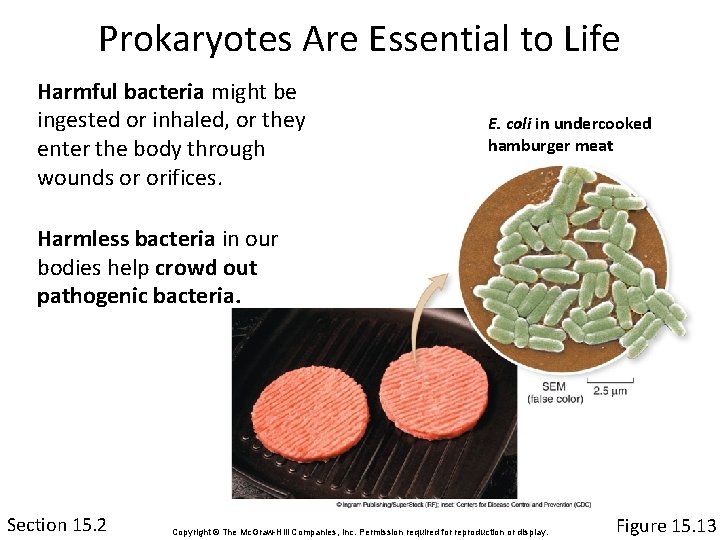
Prokaryotes Are Essential to Life Harmful bacteria might be ingested or inhaled, or they enter the body through wounds or orifices. E. coli in undercooked hamburger meat Harmless bacteria in our bodies help crowd out pathogenic bacteria. Section 15. 1 15. 2 Copyright © The Mc. Graw-Hill Companies, Inc. Permission required for reproduction or display. Figure 15. 13

Prokaryotes Are Essential to Life When we take antibiotics, some of our resident microbes die, sometimes leading to secondary infections. Microbes help make food and drugs. In wastewater treatment plants, microbes help break down organic matter. Section 15. 1 15. 2 Copyright © The Mc. Graw-Hill Companies, Inc. Permission required for reproduction or display.
Clicker Question #2 Bacteria, archaea, and eukaryotes all have ribosomes, but ribosome structure slightly varies between these groups. What is the best explanation for this observation? A. The common ancestor of these three domains had ribosomes; slight changes have accumulated since the lineages split. B. Ribosomes arose independently in all three groups. © 1996 Photo. Disc, Inc. /Getty Images/RF Copyright © The Mc. Graw-Hill Companies, Inc. Permission required for reproduction or display.
Clicker Question #2 Bacteria, archaea, and eukaryotes all have ribosomes, but ribosome structure slightly varies between these groups. What is the best explanation for this observation? A. The common ancestor of these three domains had ribosomes; slight changes have accumulated since the lineages split. B. Ribosomes arose independently in all three groups. © 1996 Photo. Disc, Inc. /Getty Images/RF Copyright © The Mc. Graw-Hill Companies, Inc. Permission required for reproduction or display.
- Slides: 17