
Chapter 15 Coulombs Law Electrical Force Superposition Last
Chapter 15 Coulomb’s Law Electrical Force Superposition
Last time: two types of charge Positive and Negative Quantized in units of +/- 1, +/- 2, etc. The mks unit for charge is the Coulomb, named after Charles Coulomb in honor of his many contributions in the field of electricity. 1 e = 1. 6 X 10 -19 C
Joseph Priestly and Charles Coulomb set out to quantify the electrical force in the late 1700’s. Let’s see if we can figure it out an expression for the electric force ourselves. . .
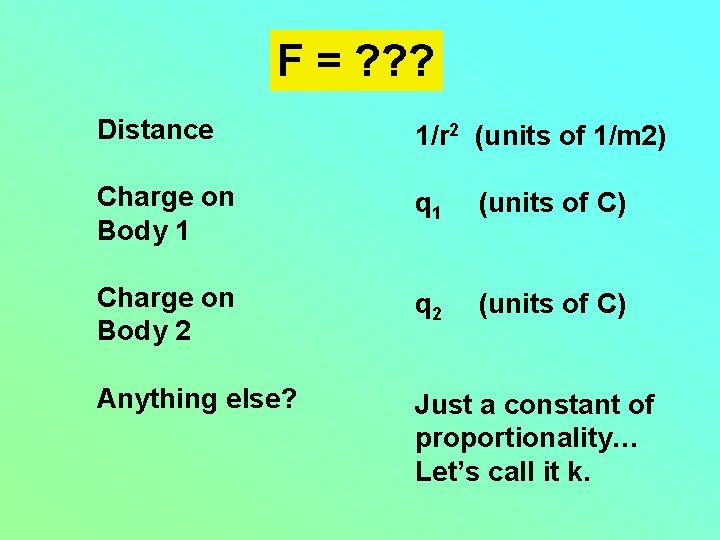
F = ? ? ? Distance 1/r 2 (units of 1/m 2) Charge on Body 1 q 1 (units of C) Charge on Body 2 q 2 (units of C) Anything else? Just a constant of proportionality… Let’s call it k.
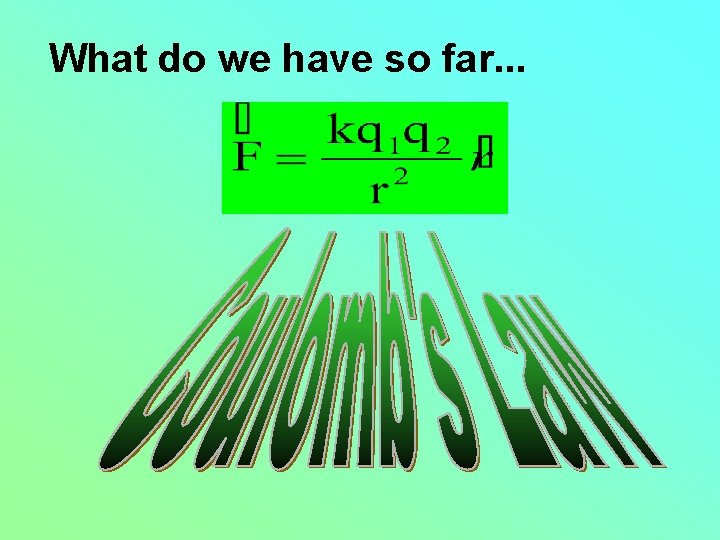
What do we have so far. . .
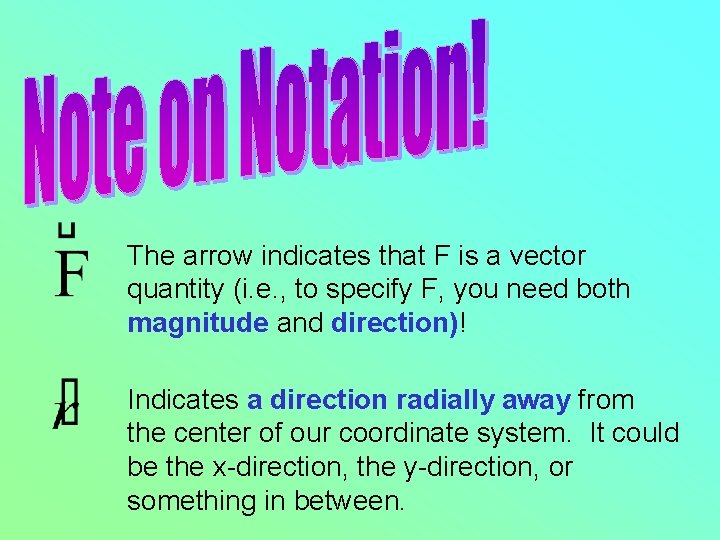
The arrow indicates that F is a vector quantity (i. e. , to specify F, you need both magnitude and direction)! Indicates a direction radially away from the center of our coordinate system. It could be the x-direction, the y-direction, or something in between.
![[F] = [k] [q 1] [q 2] / [r]2 N = [k] C 2/m](http://slidetodoc.com/presentation_image_h2/214655f5e30638f8d63c963b55df7c86/image-7.jpg "[F] = [k] [q 1] [q 2] / [r]2 N = [k] C 2/m")
[F] = [k] [q 1] [q 2] / [r]2 N = [k] C 2/m 2 [k] = N m 2/C 2!
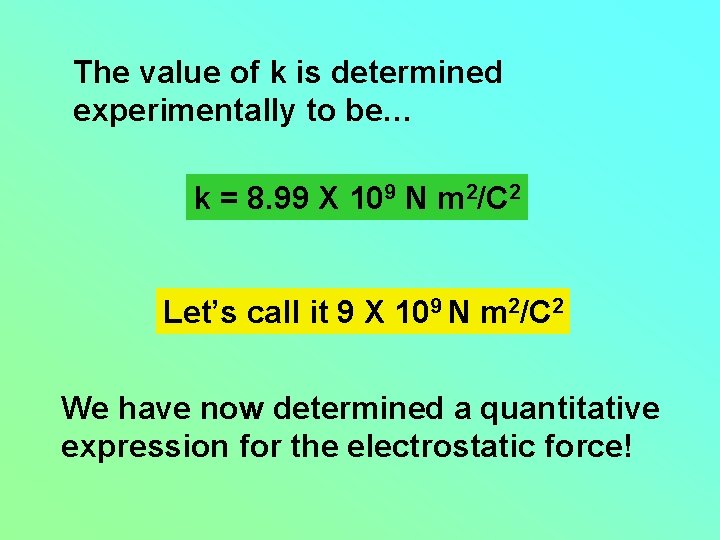
The value of k is determined experimentally to be… k = 8. 99 X 109 N m 2/C 2 Let’s call it 9 X 10⁹ N m 2/C 2 We have now determined a quantitative expression for the electrostatic force!
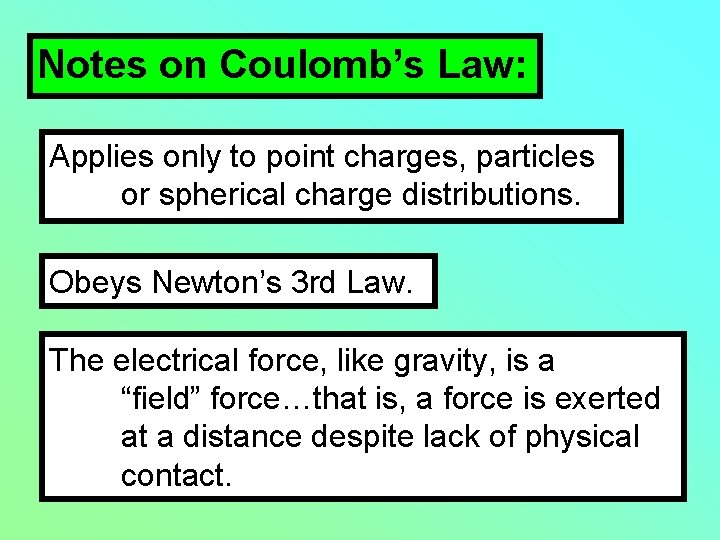
Notes on Coulomb’s Law: Applies only to point charges, particles or spherical charge distributions. Obeys Newton’s 3 rd Law. The electrical force, like gravity, is a “field” force…that is, a force is exerted at a distance despite lack of physical contact.
The electrostatic force obeys the Superposition Principle This implies that to solve problems with multiple charges, we may consider each two charge system separately and combine the results at the end. Remember, force is a vector quantity, so you must use vector addition!
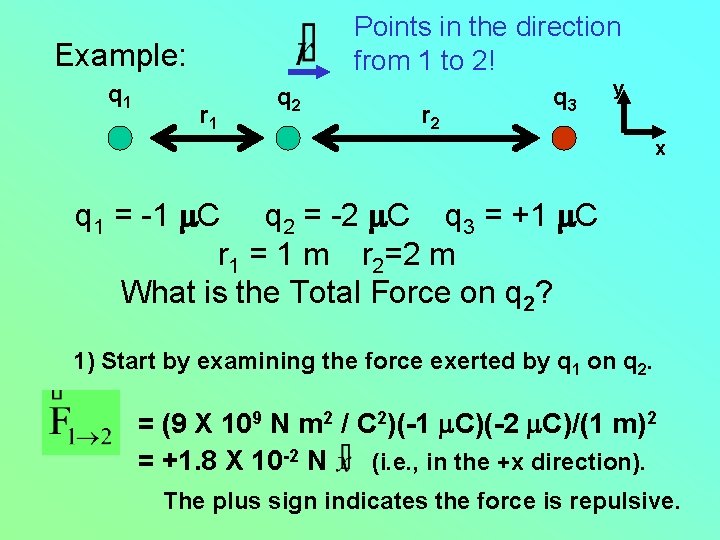
Points in the direction from 1 to 2! Example: q 1 r 1 q 2 r 2 q 3 y x q 1 = -1 m. C q 2 = -2 m. C q 3 = +1 m. C r 1 = 1 m r 2=2 m What is the Total Force on q 2? 1) Start by examining the force exerted by q 1 on q 2. = (9 X 10⁹ N m 2 / C 2)(-1 m. C)(-2 m. C)/(1 m)2 = +1. 8 X 10 -2 N (i. e. , in the +x direction). The plus sign indicates the force is repulsive.
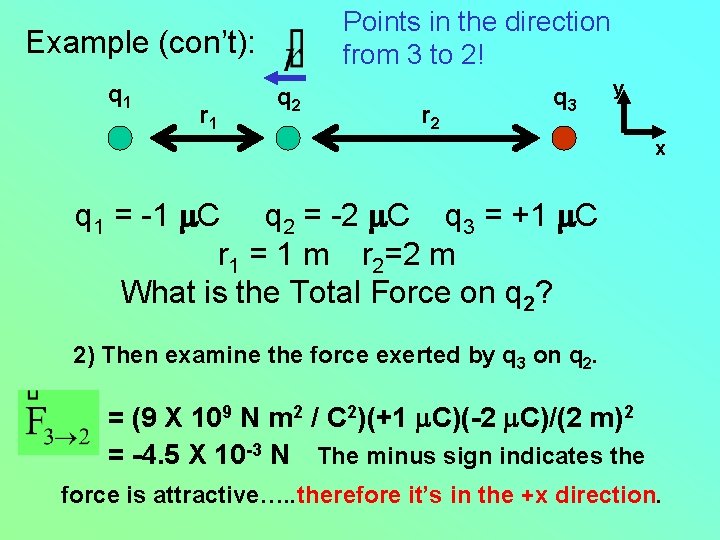
Points in the direction from 3 to 2! Example (con’t): q 1 r 1 q 2 r 2 q 3 y x q 1 = -1 m. C q 2 = -2 m. C q 3 = +1 m. C r 1 = 1 m r 2=2 m What is the Total Force on q 2? 2) Then examine the force exerted by q 3 on q 2. = (9 X 10⁹ N m 2 / C 2)(+1 m. C)(-2 m. C)/(2 m)2 = -4. 5 X 10 -3 N The minus sign indicates the force is attractive…. . therefore it’s in the +x direction.
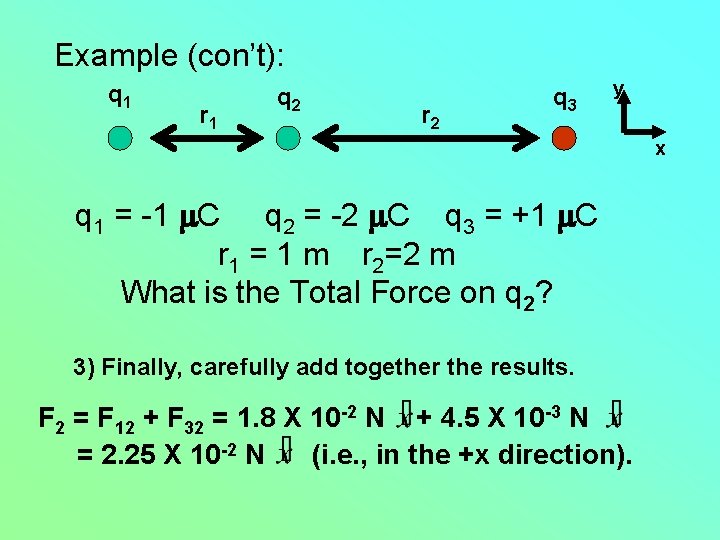
Example (con’t): q 1 r 1 q 2 r 2 q 3 y x q 1 = -1 m. C q 2 = -2 m. C q 3 = +1 m. C r 1 = 1 m r 2=2 m What is the Total Force on q 2? 3) Finally, carefully add together the results. F 2 = F 12 + F 32 = 1. 8 X 10 -2 N + 4. 5 X 10 -3 N = 2. 25 X 10 -2 N (i. e. , in the +x direction).
- Slides: 14