
Chapter 15 COMPANY ANALYSIS AND STOCK VALUATION Chapter




- Slides: 41
Chapter 15 COMPANY ANALYSIS AND STOCK VALUATION
Chapter 15 Questions • Why is it important to differentiate between company analysis and stock analysis? • What is the difference between a growth company and a growth stock? • What are the two primary approaches to the valuation of common stock? • How do we apply the discounted cash flow valuation approach? • What are the major discounted cash flow valuation techniques?
Chapter 15 Questions • How do we apply the relative valuation approach? • What are the major relative valuation techniques (ratios)? • What are some economic, industry, and structural links that should be considered in company analysis? • What insights regarding a firm can be derived from analyzing its competitive strategy and from a SWOT analysis?
Chapter 15 Questions • How do we apply the two valuation approaches and several valuation techniques? • What techniques can be used to estimate the inputs to alternative valuation models? • What techniques aid estimating company sales? • How do we estimate the profit margins and earnings per share for a company?
Chapter 15 Questions • What factors do we consider when estimating the earnings multiplier for a firm? • What two specific competitive strategies can a firm use to cope with the competitive environment in its industry? • When should we consider selling a stock?
Company Analysis and Stock Selection • Good companies are not necessarily good investments • In the end, we want to compare the intrinsic value of a stock to its market value – Stock of a great company may be overpriced – Stock of a lesser company may be a superior investment since it is undervalued
Growth Companies and Growth Stocks • Companies that consistently experience above-average increases in sales and earnings have traditionally been thought of as growth companies – Limitations to this definition • Financial theorists define a growth company as one with management and opportunities that yield rates of return greater than the firm’s required rate of return
Growth Companies and Growth Stocks • Growth stocks are not necessarily shares in growth companies – A growth stock has a higher rate of return than other stocks with similar risk – Superior risk-adjusted rate of return occurs because of market under-valuation compared to other stocks • Studies indicate that growth companies have generally not been growth stocks
Defensive Companies and Stocks • Defensive companies’ future earnings are more likely to withstand an economic downturn – Low business risk – Not excessive financial risk • Defensive stocks’ returns are not as susceptible to changes in the market – Stocks with low systematic risk
Cyclical Companies and Stocks • Sales and earnings heavily influenced by aggregate business activity – High business risk – Sometimes high financial risk as well • Cyclical stocks experience high returns is up markets, low returns in down markets – Stocks with high betas
Speculative Companies and Stocks • Speculative companies invest in sssets involving great risk, but with the possibility of great gain – Very high business risk • Speculative stocks have the potential for great percentage gains and losses – May be firms whose current price-earnings ratios are very high
Value versus Growth Investing • Growth stocks will have positive earnings surprises and above-average risk adjusted rates of return because the stocks are undervalued • Value stocks appear to be undervalued for reasons besides earnings growth potential – Value stocks usually have low P/E ratio or low ratios of price to book value
The Search for True Growth Stocks • To find undervalued stocks, we must understand theory of valuation itself
Theory of Valuation • The value of a financial asset is the present value of its expected future cash flows • Required inputs: – The stream of expected future returns, or cash flows – The required rate of return on the investment
Stream of Expected Returns (Cash Flows) From of returns • Depending on the investment, returns can be in the form of: – – Earnings Dividends Interest payments Capital gains Time period and growth rate of returns • When will the cash flows be received from the investment?
Required Rate of Return • • Determined by the risk of an investment and available returns in the market Determined by: 1. The real risk-free rate of return, plus 2. The expected rate of inflation, plus 3. A risk premium to compensate for the uncertainty of returns • Sources of uncertainty, and therefore risk premiums, vary by the type of investment
Investment Decision Process • Once expected (intrinsic) value is calculated, the investment decision is rather straightforward and intuitive: – If Estimated Value > Market Price, buy – If Estimated Value < Market Price, do not buy
Economic, Industry, and Structural Links to Company Analysis • Company analysis is the final step in the topdown approach to investing • Macroeconomic analysis identifies industries expected to offer attractive returns in the expected future environment • Analysis of firms in selected industries concentrates on a stock’s intrinsic value based on growth and risk
Economic and Industry Influences • If trends are favorable for an industry, the company analysis should focus on firms in that industry that are positioned to benefit from the economic trends • Firms with sales or earnings particularly sensitive to macroeconomic variables should also be considered • Research analysts need to be familiar with the cash flow and risk of the firms
Structural Influences • Social trends, technology, political, and regulatory influences can have significant influence on firms • Early stages in an industry’s life cycle see changes in technology which followers may imitate and benefit from • Politics and regulatory events can create opportunities even when economic influences are weak
Company Analysis • Competitive forces necessitate competitive strategies. – Competitive Forces: l l l • Current rivalry Threat of new entrants Potential substitutes Bargaining power of suppliers Bargaining power of buyers SWOT analysis is another useful tool
Firm Competitive Strategies • Defensive or offensive • Defensive strategy deflects competitive forces in the industry • Offensive competitive strategy affects competitive force in the industry to improve the firm’s relative position • Porter suggests two major strategies: low-cost leadership and differentiation
Low-Cost Strategy • Seeks to be the low cost leader in its industry • Must still command prices near industry average, so still must differentiate • Discounting too much erodes superior rates of return
Differentiation Strategy • Seeks to be identified as unique in its industry in an area that is important to buyers • Above average rate of return only comes if the price premium exceeds the extra cost of being unique
Focusing a Strategy • Firms with focused strategies: – Select segments in the industry – Tailor the strategy to serve those specific groups – Determine which strategy a firm is pursuing and its success – Evaluate the firm’s competitive strategy over time
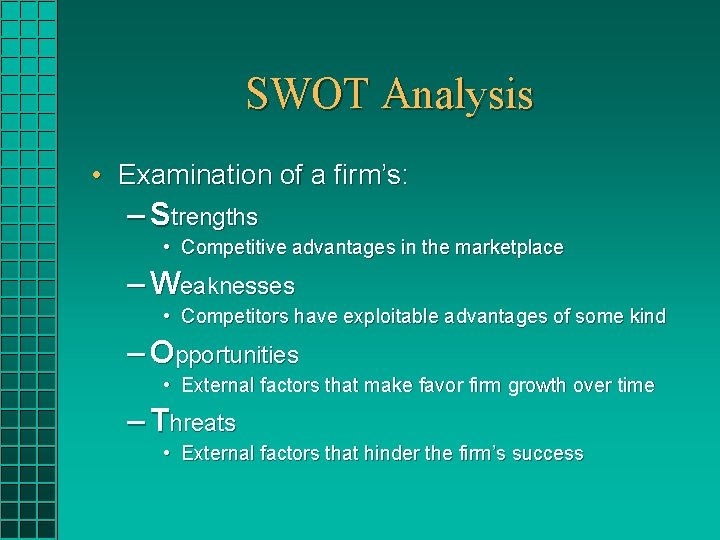
SWOT Analysis • Examination of a firm’s: – Strengths • Competitive advantages in the marketplace – Weaknesses • Competitors have exploitable advantages of some kind – Opportunities • External factors that make favor firm growth over time – Threats • External factors that hinder the firm’s success
Favorable Attributes of Firms • Peter Lynch’s list of favorable attributes: l l l Firm’s product is not faddish Company has competitive advantage over rivals Industry or product has potential for market stability l Firm can benefit from cost reductions l Firm is buying back its own shares or managers (insiders) are buying
Applying the Valuation Models (From Chapter 11) • Discounted Cash Flow Techniques – Based on the basic valuation model: the value of a financial asset is the present value of its expected future cash flows Vj = SCFt/(1+k)t – The different discounted cash flow techniques consider different cash flows and also different appropriate discount rates
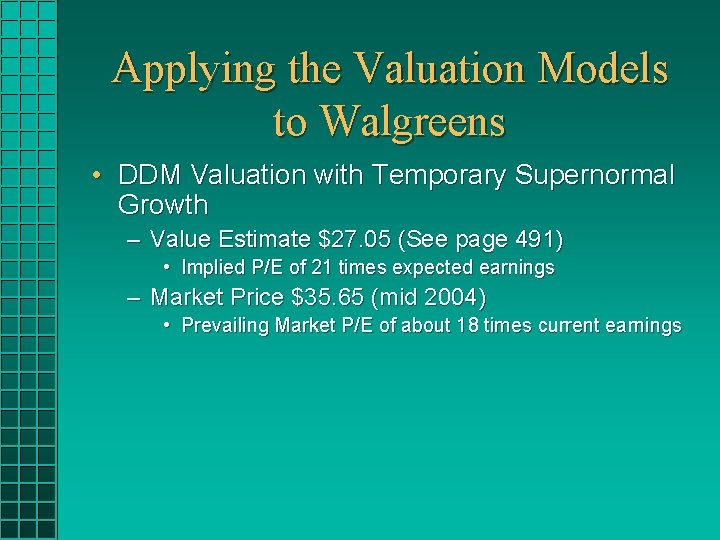
Applying the Valuation Models to Walgreens • DDM Valuation with Temporary Supernormal Growth – Value Estimate $27. 05 (See page 491) • Implied P/E of 21 times expected earnings – Market Price $35. 65 (mid 2004) • Prevailing Market P/E of about 18 times current earnings
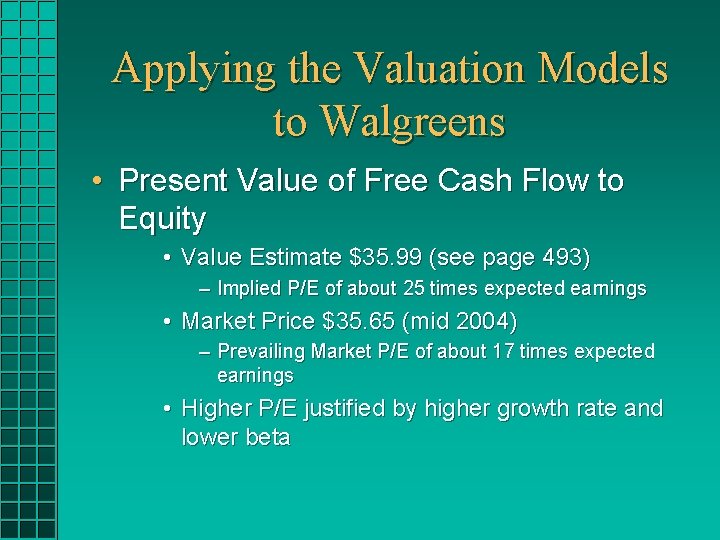
Applying the Valuation Models to Walgreens • Present Value of Free Cash Flow to Equity • Value Estimate $35. 99 (see page 493) – Implied P/E of about 25 times expected earnings • Market Price $35. 65 (mid 2004) – Prevailing Market P/E of about 17 times expected earnings • Higher P/E justified by higher growth rate and lower beta
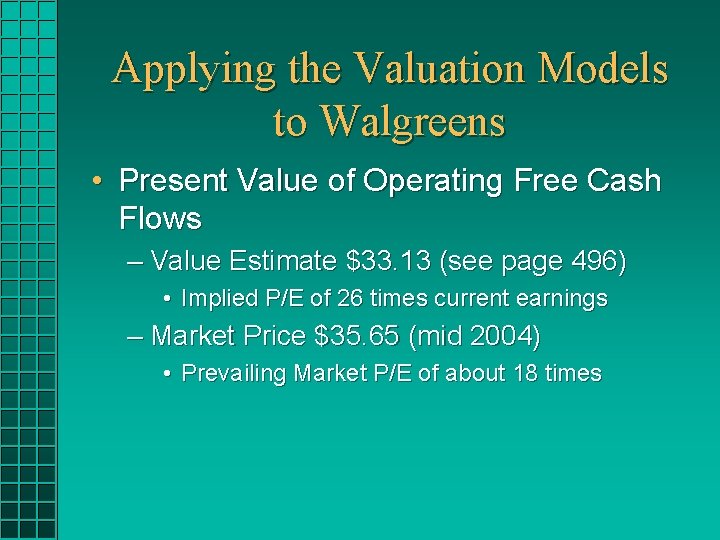
Applying the Valuation Models to Walgreens • Present Value of Operating Free Cash Flows – Value Estimate $33. 13 (see page 496) • Implied P/E of 26 times current earnings – Market Price $35. 65 (mid 2004) • Prevailing Market P/E of about 18 times
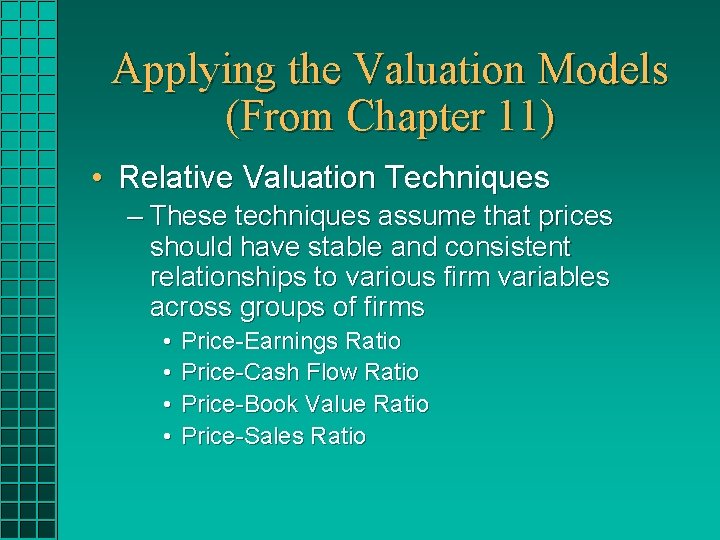
Applying the Valuation Models (From Chapter 11) • Relative Valuation Techniques – These techniques assume that prices should have stable and consistent relationships to various firm variables across groups of firms • • Price-Earnings Ratio Price-Cash Flow Ratio Price-Book Value Ratio Price-Sales Ratio
Applying the Valuation Models to Walgreens • All four relative valuation ratios increasing over time for Walgreens, its industry, and the market – Suggests that changes are caused by aggregate economic variables • Walgreens experienced a larger increase than its industry in all ratios, while lagging the market in terms of the P/E ratio in several years
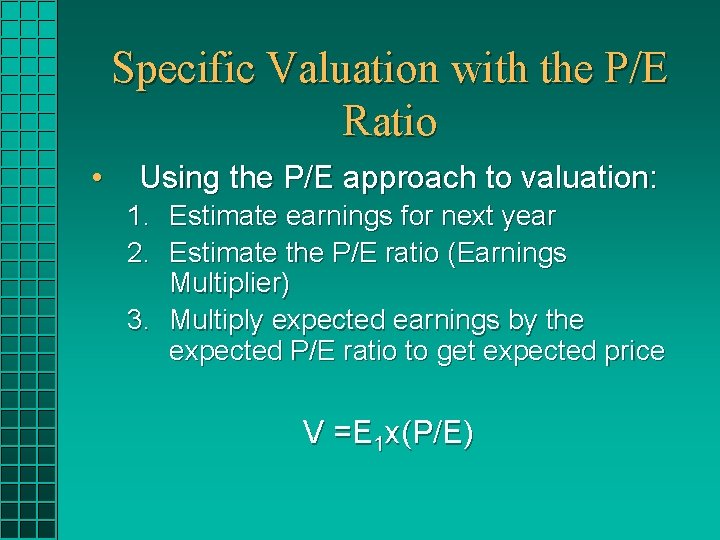
Specific Valuation with the P/E Ratio • Using the P/E approach to valuation: 1. Estimate earnings for next year 2. Estimate the P/E ratio (Earnings Multiplier) 3. Multiply expected earnings by the expected P/E ratio to get expected price V =E 1 x(P/E)
Specific Valuation with the P/E Ratio • Earnings per share estimates – Time series – use statistical analysis – Sales - profit margin approach • EPS = (Sales Forecast x Profit Margin)/ Number of Shares Outstanding – Judgmental approaches to estimating earnings • Last year’s income plus judgmental evaluations • Using the consensus of analysts’ earnings estimates – Once annual estimates are obtained, do quarterly estimates and interpret announcements accordingly
Site Visits, Interviews, and Fair Disclosure • Fair Disclosure (FD) requires that all disclosure of material information be made public to all interested parties at the same time – Many firms will not allow interviews with individuals, only provide information during large public presentations • Analysts now talk to people other than top managers – Customers, suppliers
Making the Investment Decision • If the estimate of the stock’s intrinsic value is greater than or equal to the current market price, buy the stock • If your estimate of the stock’s future intrinsic value would yield a return greater than your required rate of return (based on current investment price), then buy the stock • If the value is less than its current price, or its return would be less than your required rate of return, do not buy the stock
Ranking Undervalued Stocks • How do we rank if we have a budget constraint? • Best to rank on the basis of the excess return ratio – Intrinsic Value/Market Price
When to Sell • Hold on or move on? • If stocks decline right after purchase, is that a further buying opportunity or a signal of a mistaken investment? • Continuously monitor key assumptions that led to the purchase of the investment – Know why you bought, and see if conditions have changed • Evaluate when market value approaches estimated intrinsic value
Influences on Analysts Several factors make it difficult for analysts to outperform the market • Efficient Markets – Markets tend to price securities correctly, so opportunities are rare – Most opportunities are likely in small, less followed companies • Paralysis of Analysis – Must see the forest (the appropriate recommendation) despite all of the trees (data) that complicate the decision
Influences on Analysts • Investment bankers may push for favorable evaluations of securities when the same firm does (or wants to do) underwriting business with the firm in question – Are analysts independent and unbiased in their recommendations? – Ideally, analysts will remain independent and show confidence in their analyses