
Chapter 15 Chemical Equilibrium 15 1 The Concept
Chapter 15 Chemical Equilibrium

15. 1 The Concept of Equilibrium
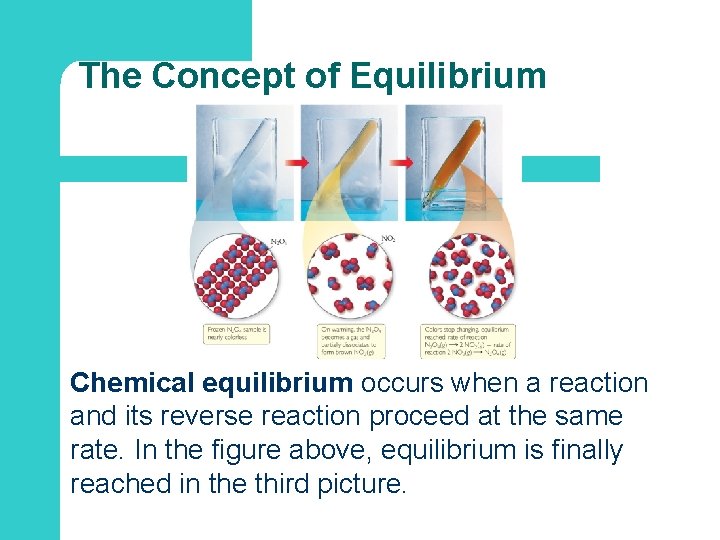
The Concept of Equilibrium Chemical equilibrium occurs when a reaction and its reverse reaction proceed at the same rate. In the figure above, equilibrium is finally reached in the third picture.
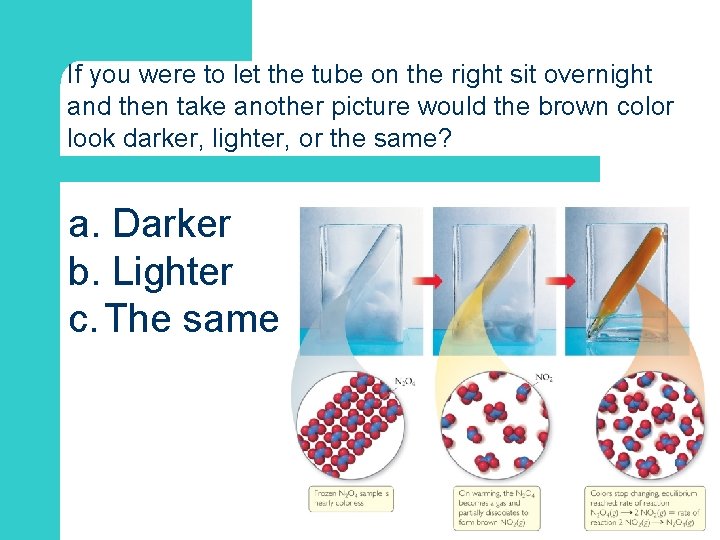
If you were to let the tube on the right sit overnight and then take another picture would the brown color look darker, lighter, or the same? a. Darker b. Lighter c. The same
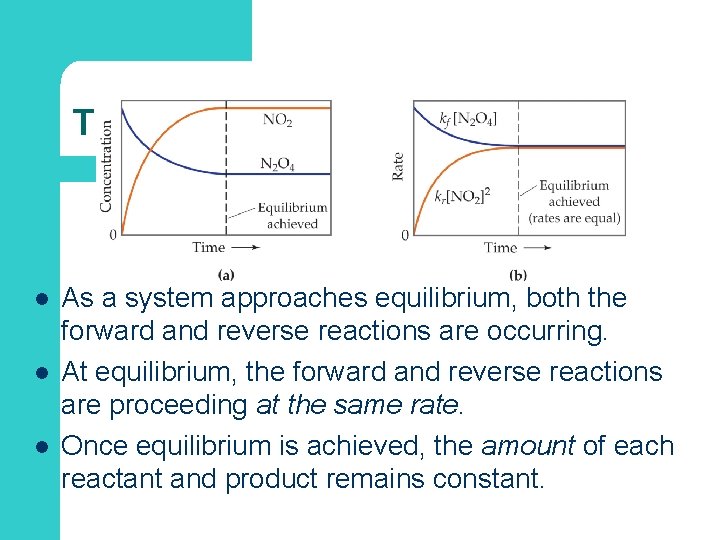
The Concept of Equilibrium l l l As a system approaches equilibrium, both the forward and reverse reactions are occurring. At equilibrium, the forward and reverse reactions are proceeding at the same rate. Once equilibrium is achieved, the amount of each reactant and product remains constant.
![At equilibrium, is the ratio [NO 2] / [N 2 O 4] less than,](http://slidetodoc.com/presentation_image_h/9b8ef621cf58986164ba247f5e5684d2/image-6.jpg "At equilibrium, is the ratio [NO 2] / [N 2 O 4] less than,")
At equilibrium, is the ratio [NO 2] / [N 2 O 4] less than, greater to, or equal to 1? a. Less than 1 b. Greater than 1 c. Equal to 1 d. Cannot tell from the graph
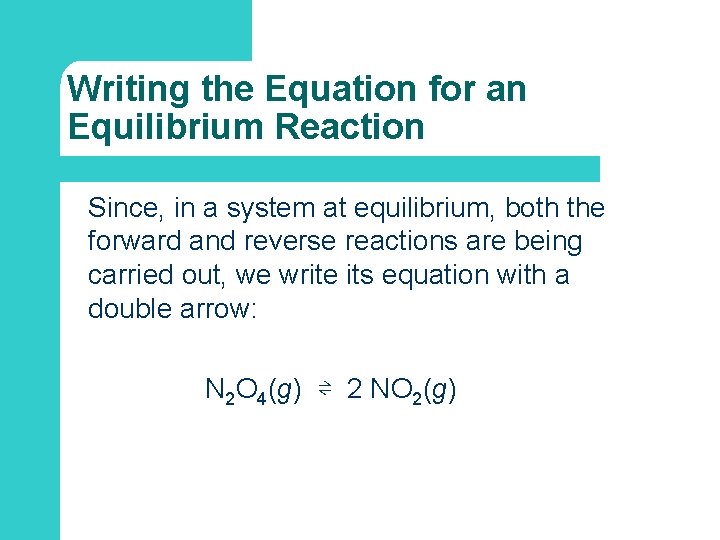
Writing the Equation for an Equilibrium Reaction Since, in a system at equilibrium, both the forward and reverse reactions are being carried out, we write its equation with a double arrow: N 2 O 4(g) ⇌ 2 NO 2(g)
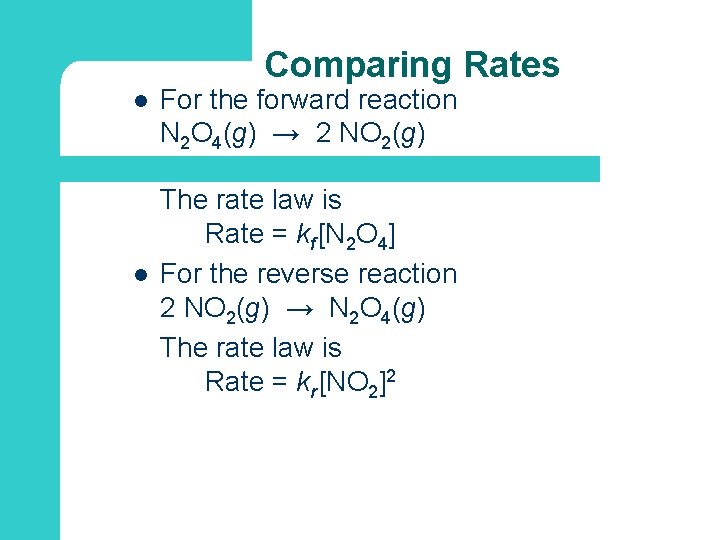
Comparing Rates l l For the forward reaction N 2 O 4(g) → 2 NO 2(g) The rate law is Rate = kf [N 2 O 4] For the reverse reaction 2 NO 2(g) → N 2 O 4(g) The rate law is Rate = kr [NO 2]2
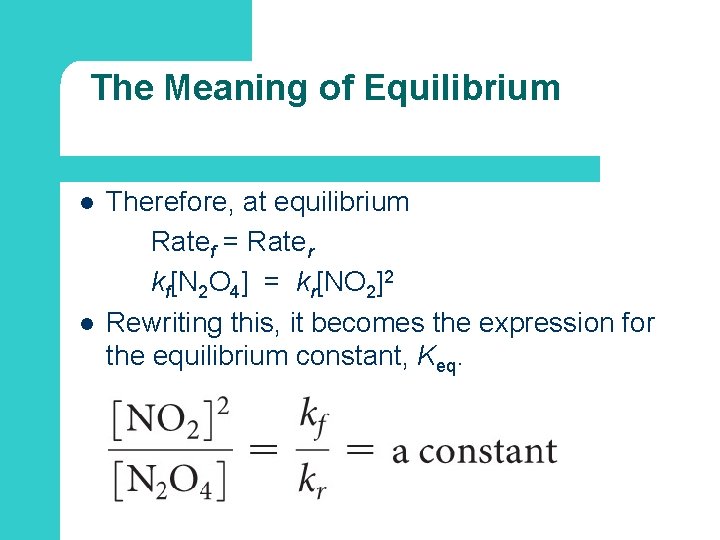
The Meaning of Equilibrium l l Therefore, at equilibrium Ratef = Rater kf[N 2 O 4] = kr[NO 2]2 Rewriting this, it becomes the expression for the equilibrium constant, Keq.
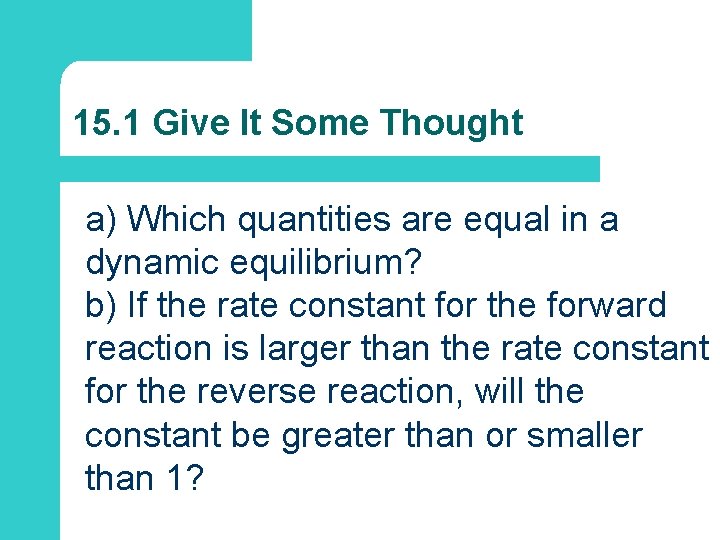
15. 1 Give It Some Thought a) Which quantities are equal in a dynamic equilibrium? b) If the rate constant for the forward reaction is larger than the rate constant for the reverse reaction, will the constant be greater than or smaller than 1?
15. 2 The Equilibrium Constant
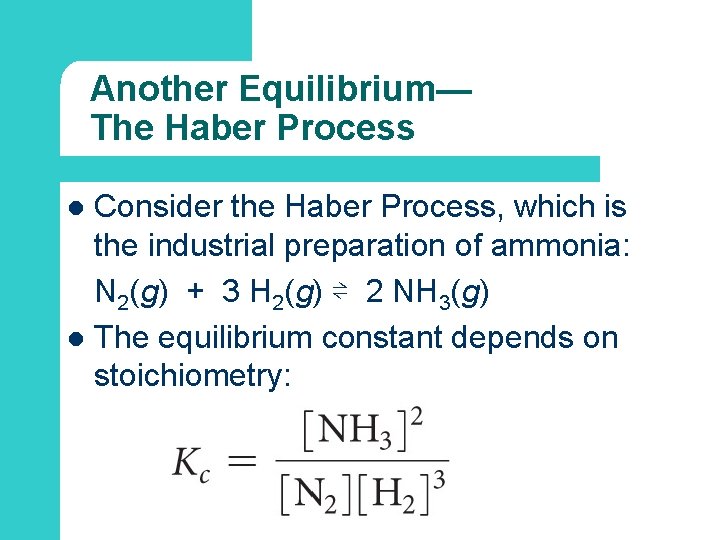
Another Equilibrium— The Haber Process Consider the Haber Process, which is the industrial preparation of ammonia: N 2(g) + 3 H 2(g) ⇌ 2 NH 3(g) l The equilibrium constant depends on stoichiometry: l
15. 2 Give It Some Thought l How do we know when equilibrium has been reached in a chemical reaction?
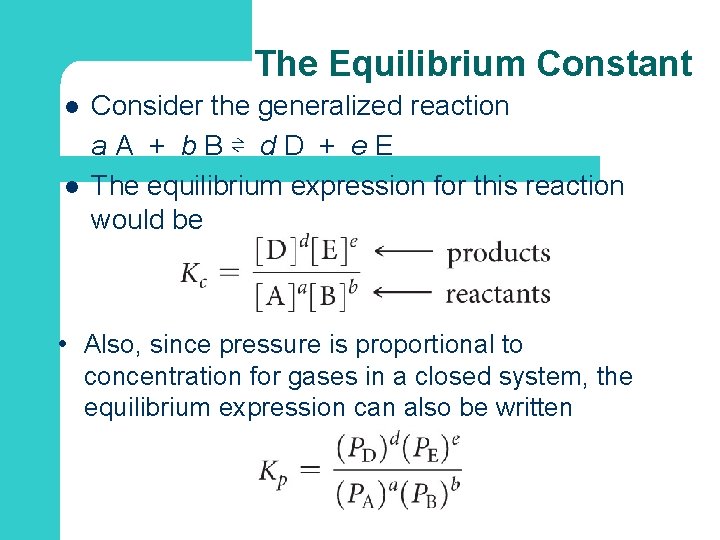
The Equilibrium Constant l l Consider the generalized reaction a A + b B ⇌ d D + e E The equilibrium expression for this reaction would be • Also, since pressure is proportional to concentration for gases in a closed system, the equilibrium expression can also be written
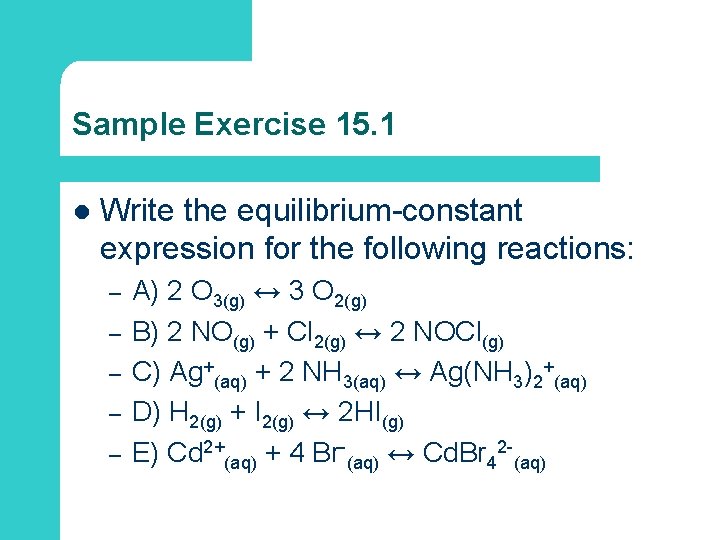
Sample Exercise 15. 1 l Write the equilibrium-constant expression for the following reactions: – – – A) 2 O 3(g) ↔ 3 O 2(g) B) 2 NO(g) + Cl 2(g) ↔ 2 NOCl(g) C) Ag+(aq) + 2 NH 3(aq) ↔ Ag(NH 3)2+(aq) D) H 2(g) + I 2(g) ↔ 2 HI(g) E) Cd 2+(aq) + 4 Br-(aq) ↔ Cd. Br 42 -(aq)
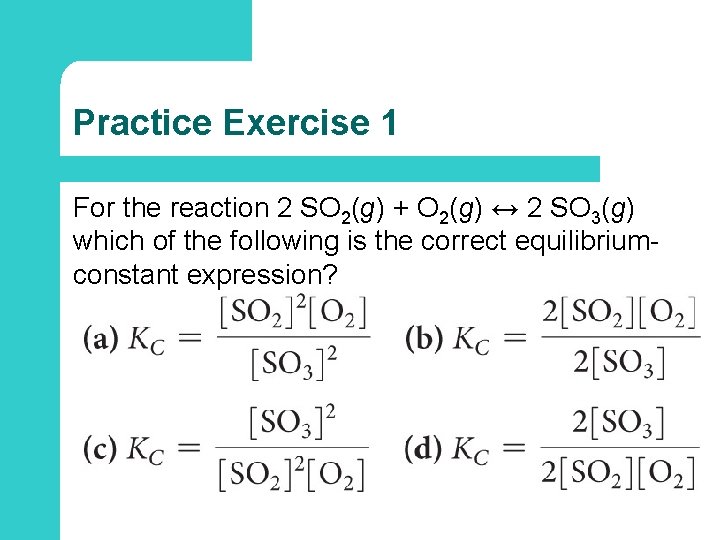
Practice Exercise 1 For the reaction 2 SO 2(g) + O 2(g) ↔ 2 SO 3(g) which of the following is the correct equilibriumconstant expression?
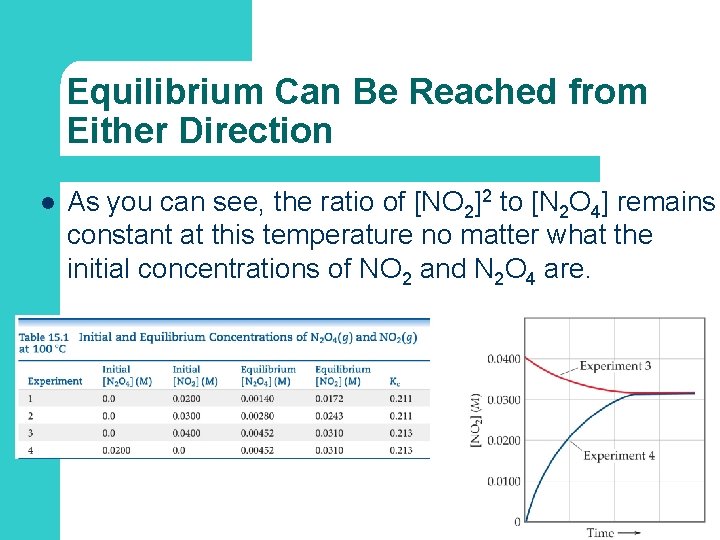
Equilibrium Can Be Reached from Either Direction l As you can see, the ratio of [NO 2]2 to [N 2 O 4] remains constant at this temperature no matter what the initial concentrations of NO 2 and N 2 O 4 are.
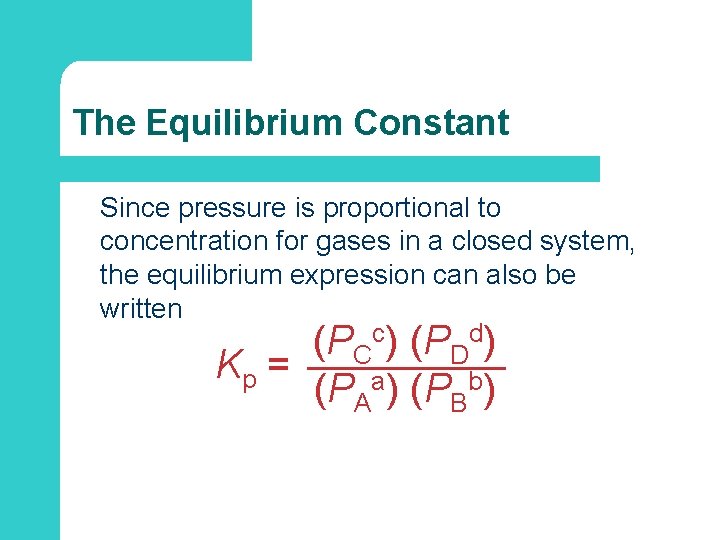
The Equilibrium Constant Since pressure is proportional to concentration for gases in a closed system, the equilibrium expression can also be written (PCc) (PDd) Kp = (PAa) (PBb)
15. 2 Give It Some Thought l How does the value of Kc in the equation depend on the starting concentrations of NO 2 and N 2 O 4? – l Kc = [NO 2]2/[N 2 O 4] What is the difference between the equilibrium constant Kc and the equilibrium constant Kp?
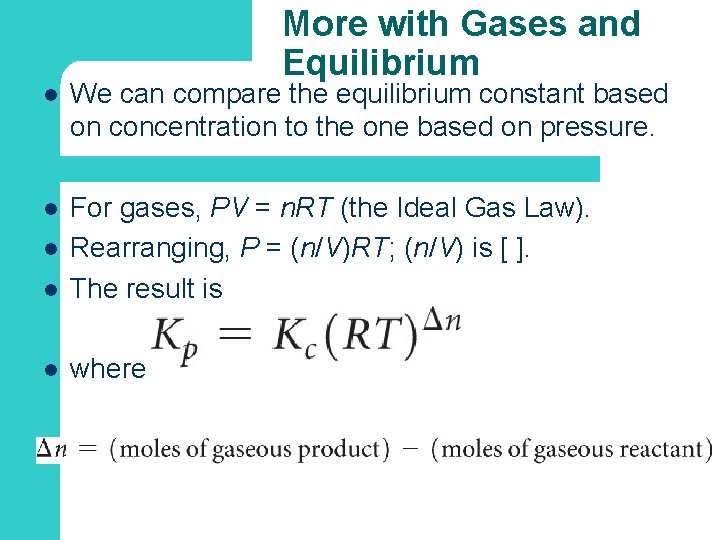
More with Gases and Equilibrium l We can compare the equilibrium constant based on concentration to the one based on pressure. l l For gases, PV = n. RT (the Ideal Gas Law). Rearranging, P = (n/V)RT; (n/V) is [ ]. The result is l where l
15. 2 Give It Some Thought l Is it possible to have a reaction where Kc = Kp? If so, under what conditions would this relationship hold?
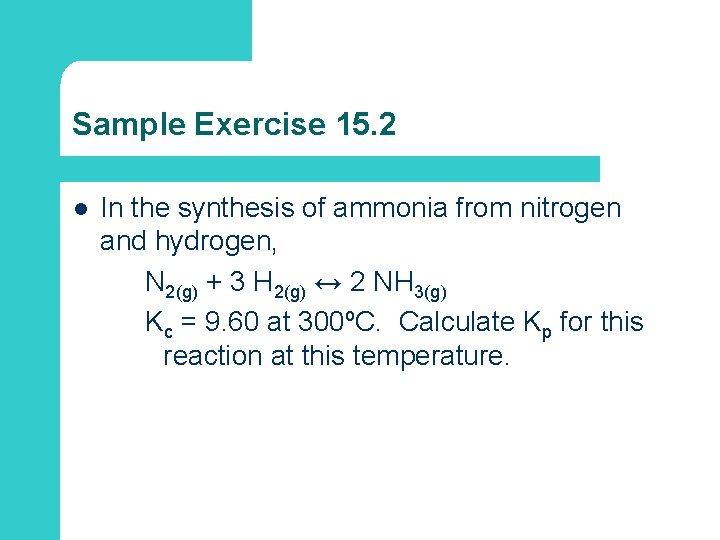
Sample Exercise 15. 2 l In the synthesis of ammonia from nitrogen and hydrogen, N 2(g) + 3 H 2(g) ↔ 2 NH 3(g) Kc = 9. 60 at 300ºC. Calculate Kp for this reaction at this temperature.
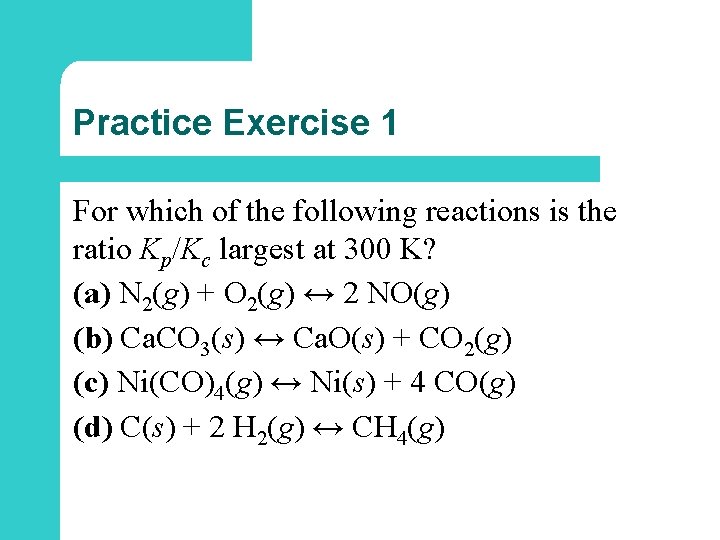
Practice Exercise 1 For which of the following reactions is the ratio Kp/Kc largest at 300 K? (a) N 2(g) + O 2(g) ↔ 2 NO(g) (b) Ca. CO 3(s) ↔ Ca. O(s) + CO 2(g) (c) Ni(CO)4(g) ↔ Ni(s) + 4 CO(g) (d) C(s) + 2 H 2(g) ↔ CH 4(g)
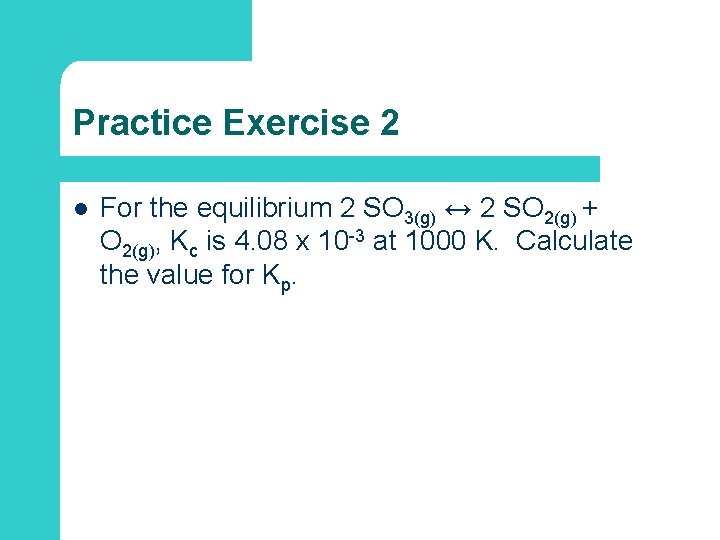
Practice Exercise 2 l For the equilibrium 2 SO 3(g) ↔ 2 SO 2(g) + O 2(g), Kc is 4. 08 x 10 -3 at 1000 K. Calculate the value for Kp.
15. 3 Understanding and Working with Equilibrium Constants
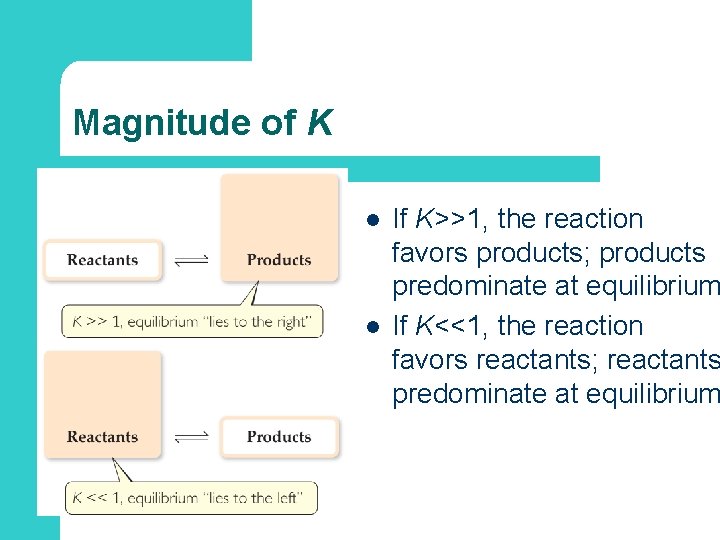
Magnitude of K l l If K>>1, the reaction favors products; products predominate at equilibrium If K<<1, the reaction favors reactants; reactants predominate at equilibrium
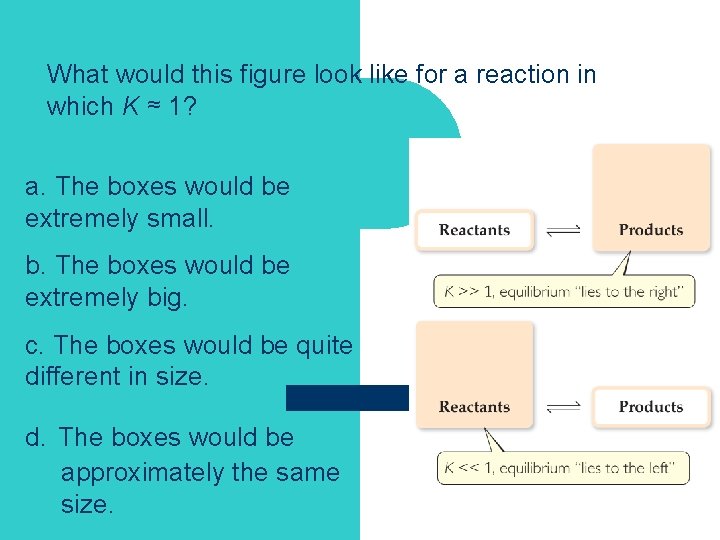
What would this figure look like for a reaction in which K ≈ 1? a. The boxes would be extremely small. b. The boxes would be extremely big. c. The boxes would be quite different in size. d. The boxes would be approximately the same size.
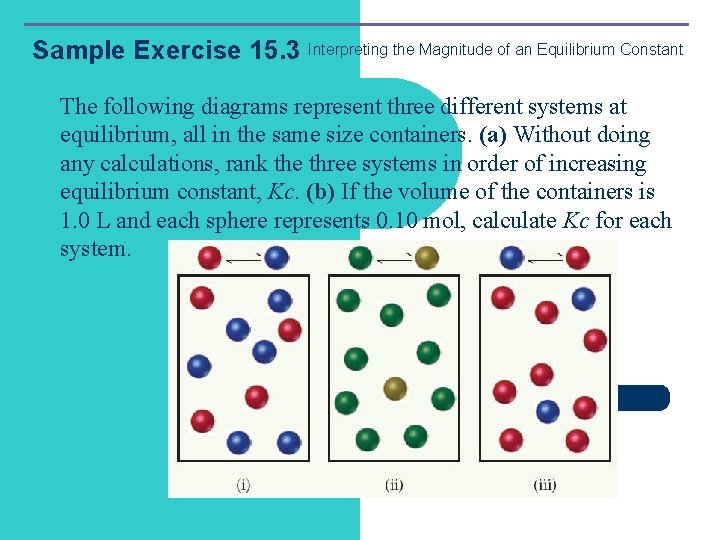
Sample Exercise 15. 3 Interpreting the Magnitude of an Equilibrium Constant The following diagrams represent three different systems at equilibrium, all in the same size containers. (a) Without doing any calculations, rank the three systems in order of increasing equilibrium constant, Kc. (b) If the volume of the containers is 1. 0 L and each sphere represents 0. 10 mol, calculate Kc for each system.
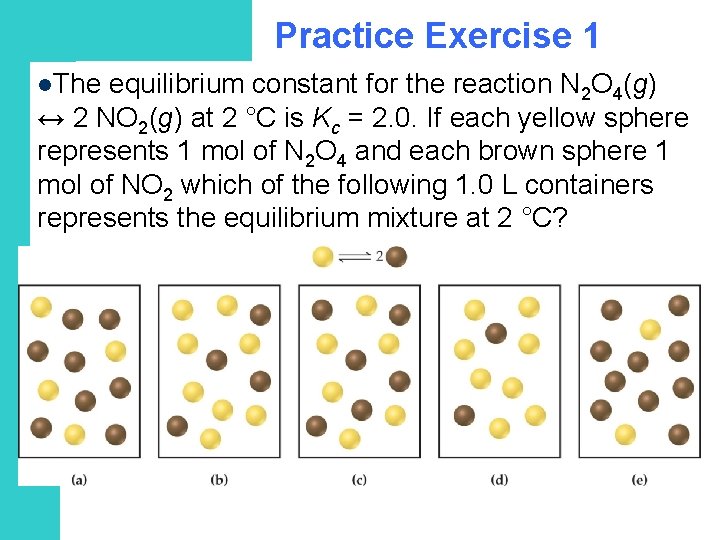
Practice Exercise 1 l. The equilibrium constant for the reaction N 2 O 4(g) ↔ 2 NO 2(g) at 2 °C is Kc = 2. 0. If each yellow sphere represents 1 mol of N 2 O 4 and each brown sphere 1 mol of NO 2 which of the following 1. 0 L containers represents the equilibrium mixture at 2 °C?
Practice Exercise 2 For the reaction H 2(g) + I 2(g) ↔ 2 HI(g), Kp = 794 at 298 K and Kp = 55 at 700 K. Is the formation of HI favored more at the higher or lower temperature?
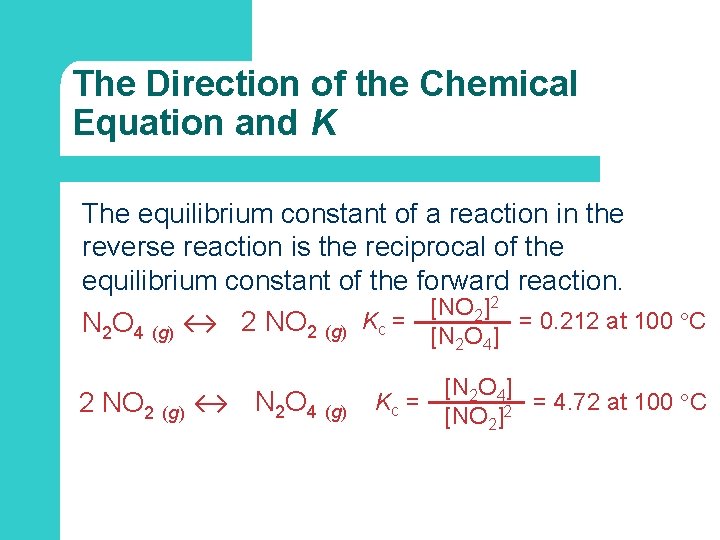
The Direction of the Chemical Equation and K The equilibrium constant of a reaction in the reverse reaction is the reciprocal of the equilibrium constant of the forward reaction. [NO 2]2 N 2 O 4 (g) ↔ 2 NO 2 (g) Kc = [N O ] = 0. 212 at 100 C 2 2 NO 2 (g) ↔ N 2 O 4 (g) 4 [N 2 O 4] Kc = = 4. 72 at 100 C [NO 2]2
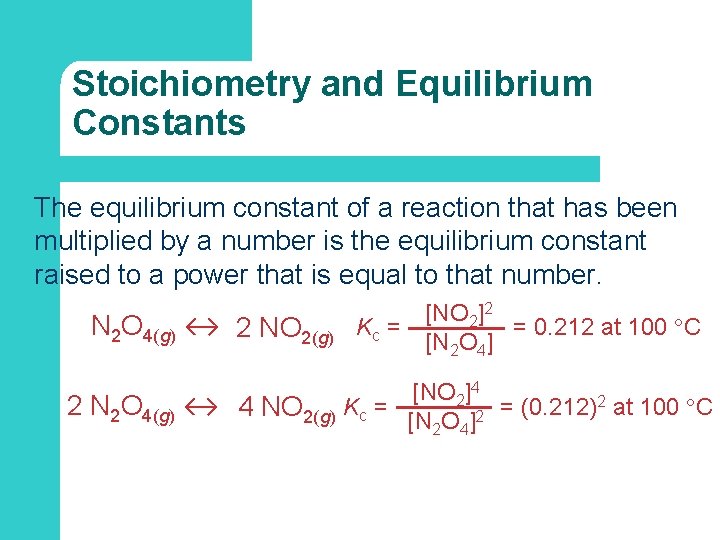
Stoichiometry and Equilibrium Constants The equilibrium constant of a reaction that has been multiplied by a number is the equilibrium constant raised to a power that is equal to that number. N 2 O 4(g) ↔ 2 NO 2(g) [NO 2]2 Kc = = 0. 212 at 100 C [N 2 O 4] [NO 2]4 2 N 2 O 4(g) ↔ 4 NO 2(g) Kc = [N O ]2 = (0. 212)2 at 100 C 2 4
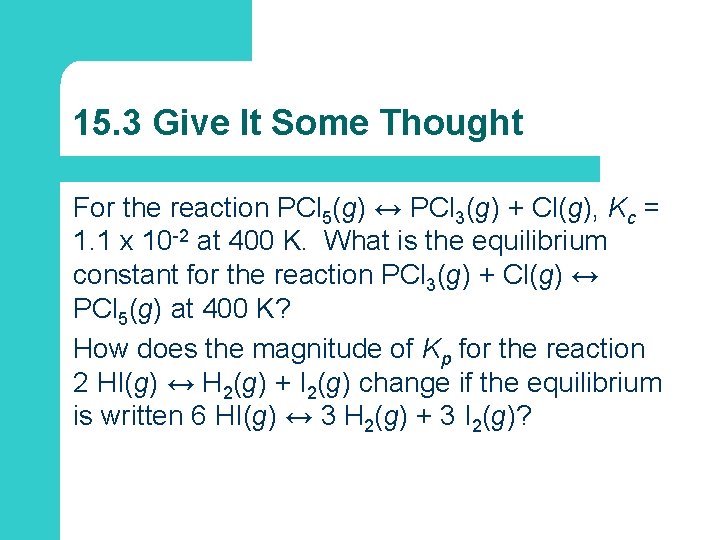
15. 3 Give It Some Thought For the reaction PCl 5(g) ↔ PCl 3(g) + Cl(g), Kc = 1. 1 x 10 -2 at 400 K. What is the equilibrium constant for the reaction PCl 3(g) + Cl(g) ↔ PCl 5(g) at 400 K? How does the magnitude of Kp for the reaction 2 HI(g) ↔ H 2(g) + I 2(g) change if the equilibrium is written 6 HI(g) ↔ 3 H 2(g) + 3 I 2(g)?
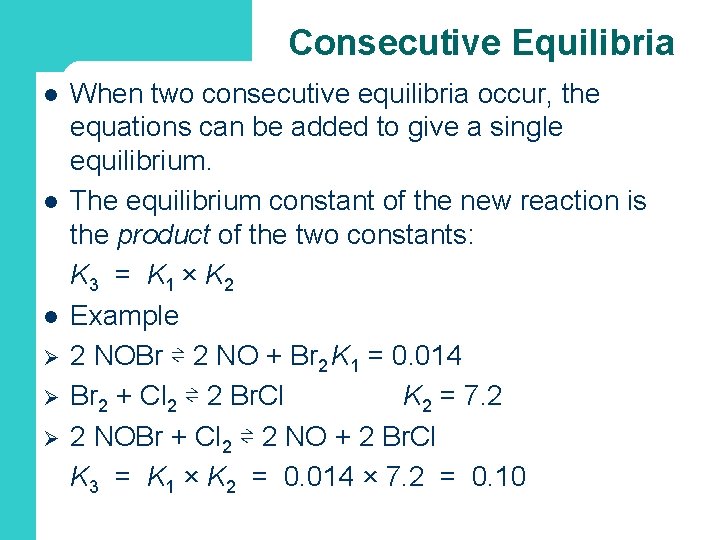
Consecutive Equilibria l l l Ø Ø Ø When two consecutive equilibria occur, the equations can be added to give a single equilibrium. The equilibrium constant of the new reaction is the product of the two constants: K 3 = K 1 × K 2 Example 2 NOBr ⇌ 2 NO + Br 2 K 1 = 0. 014 Br 2 + Cl 2 ⇌ 2 Br. Cl K 2 = 7. 2 2 NOBr + Cl 2 ⇌ 2 NO + 2 Br. Cl K 3 = K 1 × K 2 = 0. 014 × 7. 2 = 0. 10
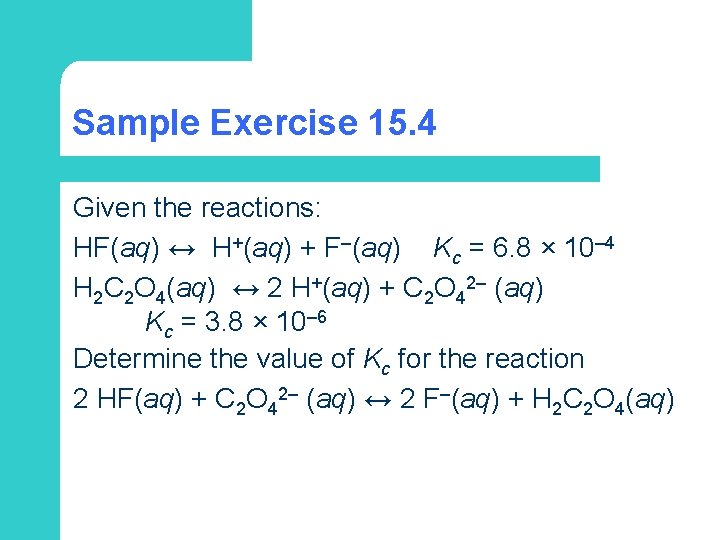
Sample Exercise 15. 4 Given the reactions: HF(aq) ↔ H+(aq) + F–(aq) Kc = 6. 8 × 10– 4 H 2 C 2 O 4(aq) ↔ 2 H+(aq) + C 2 O 42– (aq) Kc = 3. 8 × 10– 6 Determine the value of Kc for the reaction 2 HF(aq) + C 2 O 42– (aq) ↔ 2 F–(aq) + H 2 C 2 O 4(aq)
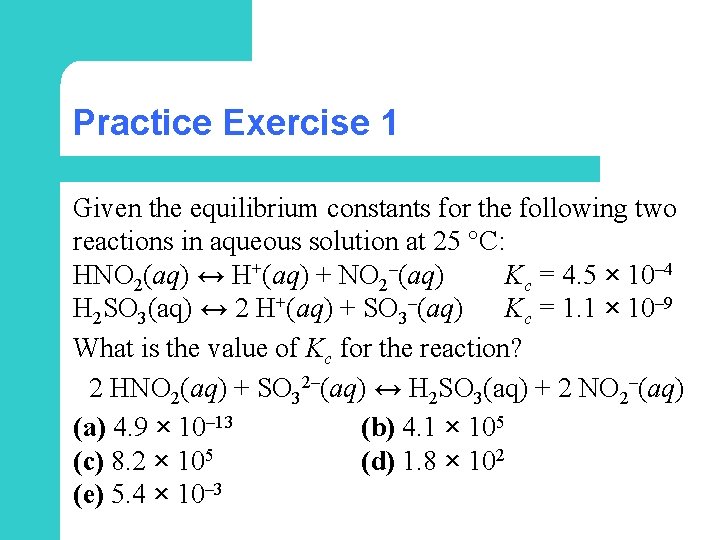
Practice Exercise 1 Given the equilibrium constants for the following two reactions in aqueous solution at 25 °C: HNO 2(aq) ↔ H+(aq) + NO 2–(aq) Kc = 4. 5 × 10– 4 H 2 SO 3(aq) ↔ 2 H+(aq) + SO 3–(aq) Kc = 1. 1 × 10– 9 What is the value of Kc for the reaction? 2 HNO 2(aq) + SO 32–(aq) ↔ H 2 SO 3(aq) + 2 NO 2–(aq) (a) 4. 9 × 10– 13 (b) 4. 1 × 10⁵ (c) 8. 2 × 10⁵ (d) 1. 8 × 10² (e) 5. 4 × 10– 3
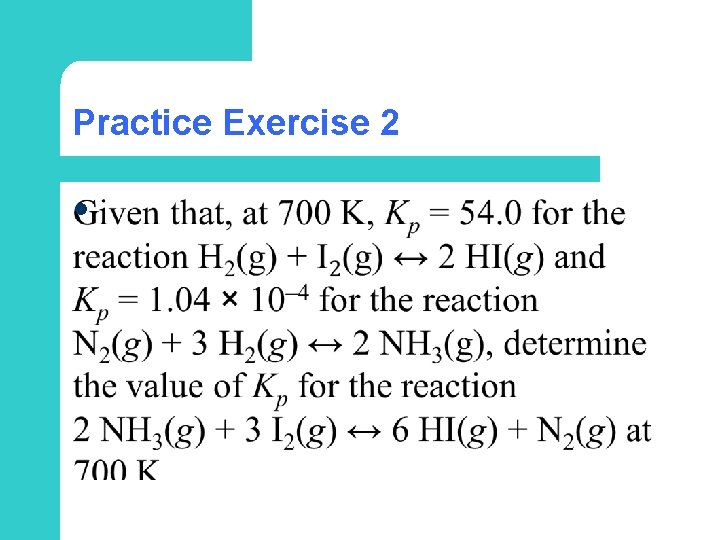
Practice Exercise 2 l
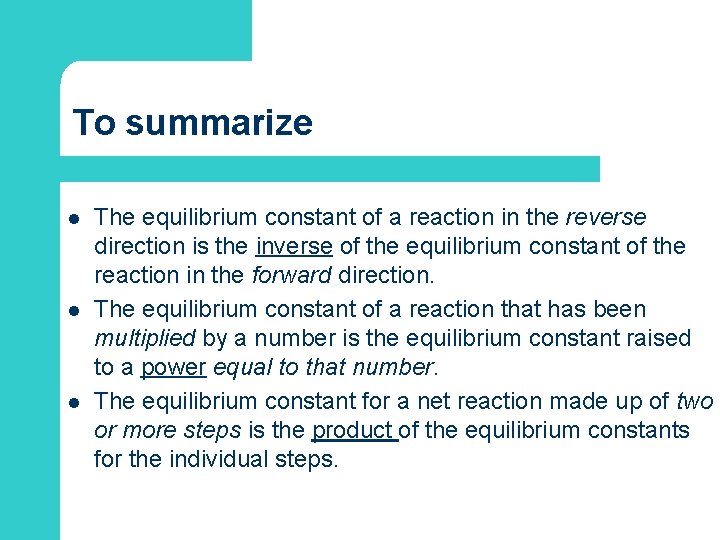
To summarize l l l The equilibrium constant of a reaction in the reverse direction is the inverse of the equilibrium constant of the reaction in the forward direction. The equilibrium constant of a reaction that has been multiplied by a number is the equilibrium constant raised to a power equal to that number. The equilibrium constant for a net reaction made up of two or more steps is the product of the equilibrium constants for the individual steps.
15. 4 Heterogeneous Equilibria
Homogeneous vs. Heterogeneous l l l Homogeneous equilibria occur when all reactants and products are in the same phase. Heterogeneous equilibria occur when something in the equilibrium is in a different phase. The value used for the concentration of a pure substance is always 1. – Concentrations of liquids and solids are constant
15. 4 Give It Some Thought l Write the equilibrium constant expression for the evaporation of water, H 2 O(l) ↔ H 2 O(g), in terms of partial pressures.
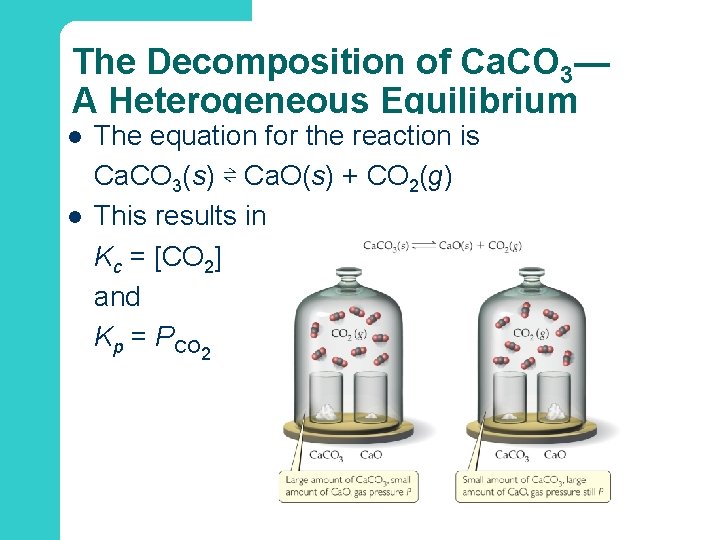
The Decomposition of Ca. CO 3— A Heterogeneous Equilibrium l l The equation for the reaction is Ca. CO 3(s) ⇌ Ca. O(s) + CO 2(g) This results in Kc = [CO 2] and Kp = PCO 2
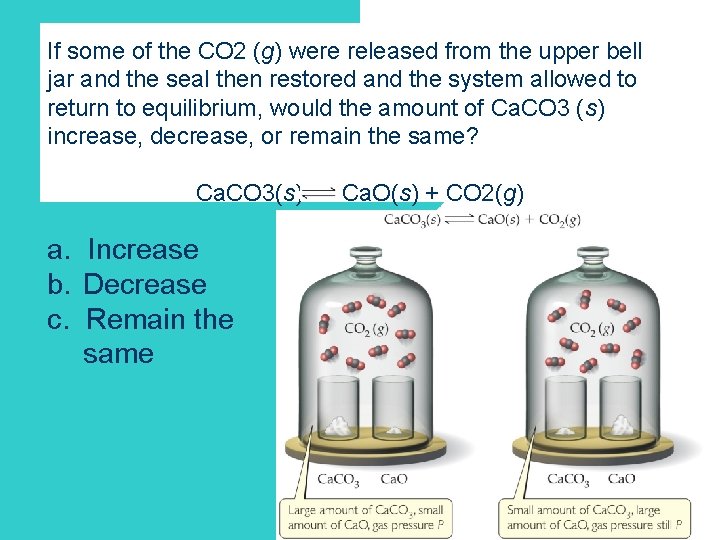
If some of the CO 2 (g) were released from the upper bell jar and the seal then restored and the system allowed to return to equilibrium, would the amount of Ca. CO 3 (s) increase, decrease, or remain the same? Ca. CO 3(s) Ca. O(s) + CO 2(g) a. Increase b. Decrease c. Remain the same
Sample Exercise 15. 5 l Write the equilibrium constant expression for Kc for each of the following reactions: – A) CO 2(g) + H 2(g) ↔ CO(g) + H 2 O(l) – B) Sn. O 2(s) + 2 CO(g) ↔ Sn(s) + 2 CO 2(g)
Practice Exercise 1 Consider the equilibrium that is established in a saturated solution of silver chloride, Ag+(aq) + Cl–(aq) ↔ Ag. Cl(s). If solid Ag. Cl is added to this solution, what will happen to the concentration of Ag+ and Cl– ions in solution? (a) [Ag+] and [Cl–] will both increase (b) [Ag+] and [Cl–] will both decrease (c) [Ag+] will increase and [Cl–] will decrease (d) [Ag+] will decrease and [Cl–] will increase (e) neither [Ag+] nor [Cl–] will change
Practice Exercise 2 l Write the following equilibrium-constant expressions: – A) Kc for Cr(s) + 3 Ag+(aq) ↔ Cr 3+(aq) + 3 Ag(s) – B) Kp for 3 Fe(s) + 4 H 2 O(g) ↔ Fe 3 O 4(s) + 4 H 2(g)
Sample Exercise 15. 6 l Each of the following mixtures was placed in a closed container and allowed to stand. Which is capable of attaining the equilibrium Ca. CO 3(s) ↔ Ca. O(s) + CO 2(g): – – A) Ca. CO 3(s) B) Ca. O(s) and CO 2(g) at a pressure greater than the value of Kp C) Ca. CO 3(s) and CO 2(g) at a pressure greater than the value of Kp D) Ca. CO 3(s) and Ca. O(s)
Practice Exercise 1 If 8. 0 g of NH 4 HS(s) is placed in a sealed vessel with a volume of 1. 0 L and heated to 200 °C the reaction NH 4 HS(s) ↔ NH 3(g) + H 2 S(g) will occur. When the system comes to equilibrium, some NH 4 HS(s) is still present. Which of the following changes will lead to a reduction in the amount of NH 4 HS(s) that is present? (a) Adding more NH 3(g) to the vessel (b) Adding more H 2 S(g) to the vessel (c) Adding more NH 4 HS(s) to the vessel (d) Increasing the volume of the vessel (e) decreasing the volume of the vessel
Practice Exercise 2 l When added to Fe 3 O 4(s) in a closed container, which one of the following substances – H 2(g), H 2 O(g), O 2(g) – will allow equilibrium to be established in the reaction 3 Fe(s) + 4 H 2 O(g) ↔ Fe 3 O 4(s) + 4 H 2(g)?
15. 4 Give It Some Thought Write the equilibrium constant expression for the reaction: NH 3(aq) + H 2 O(l) ↔ NH 4+(aq) + OH-(aq)
15. 5 Calculating Equilibrium Constants
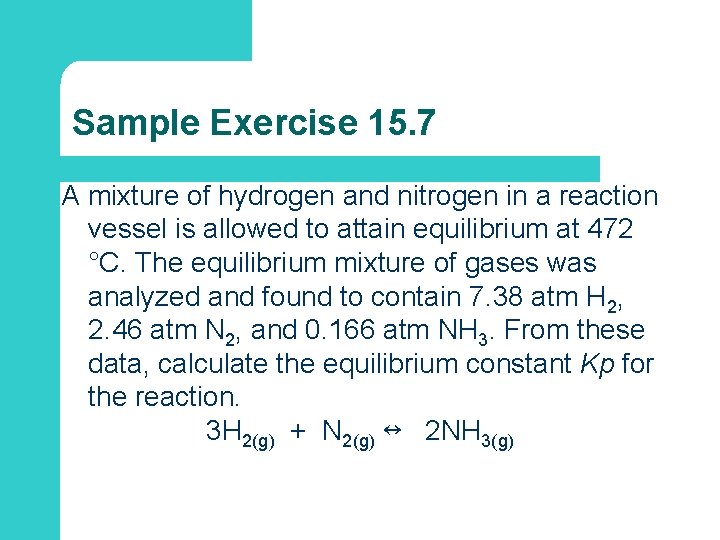
Sample Exercise 15. 7 A mixture of hydrogen and nitrogen in a reaction vessel is allowed to attain equilibrium at 472 °C. The equilibrium mixture of gases was analyzed and found to contain 7. 38 atm H 2, 2. 46 atm N 2, and 0. 166 atm NH 3. From these data, calculate the equilibrium constant Kp for the reaction. 3 H 2(g) + N 2(g) ↔ 2 NH 3(g)
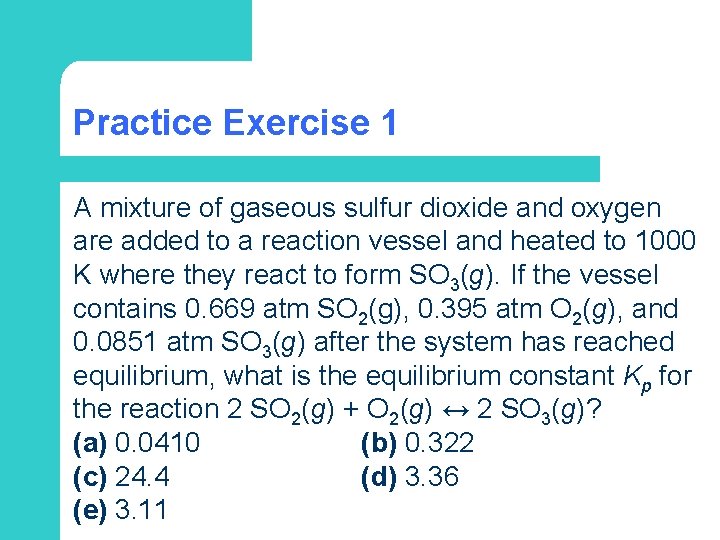
Practice Exercise 1 A mixture of gaseous sulfur dioxide and oxygen are added to a reaction vessel and heated to 1000 K where they react to form SO 3(g). If the vessel contains 0. 669 atm SO 2(g), 0. 395 atm O 2(g), and 0. 0851 atm SO 3(g) after the system has reached equilibrium, what is the equilibrium constant Kp for the reaction 2 SO 2(g) + O 2(g) ↔ 2 SO 3(g)? (a) 0. 0410 (b) 0. 322 (c) 24. 4 (d) 3. 36 (e) 3. 11
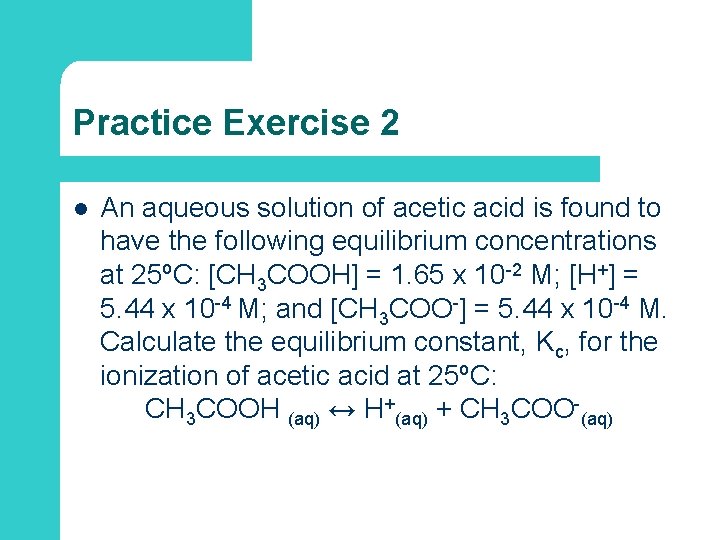
Practice Exercise 2 l An aqueous solution of acetic acid is found to have the following equilibrium concentrations at 25ºC: [CH 3 COOH] = 1. 65 x 10 -2 M; [H+] = 5. 44 x 10 -4 M; and [CH 3 COO-] = 5. 44 x 10 -4 M. Calculate the equilibrium constant, Kc, for the ionization of acetic acid at 25ºC: CH 3 COOH (aq) ↔ H+(aq) + CH 3 COO-(aq)
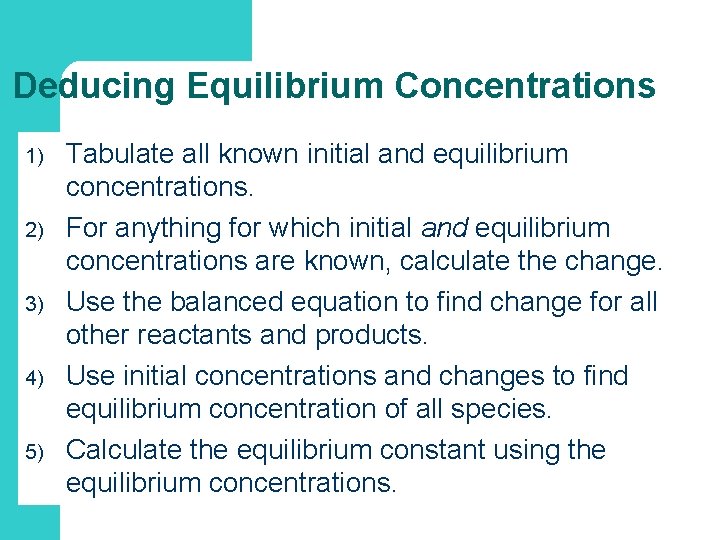
Deducing Equilibrium Concentrations 1) 2) 3) 4) 5) Tabulate all known initial and equilibrium concentrations. For anything for which initial and equilibrium concentrations are known, calculate the change. Use the balanced equation to find change for all other reactants and products. Use initial concentrations and changes to find equilibrium concentration of all species. Calculate the equilibrium constant using the equilibrium concentrations.
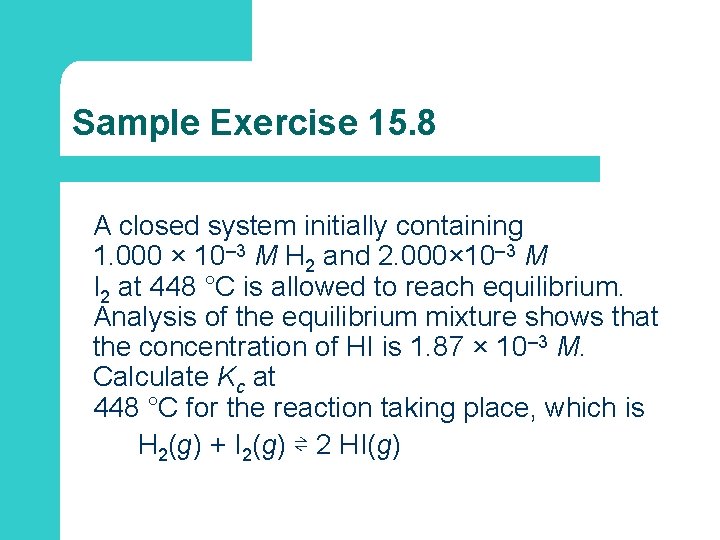
Sample Exercise 15. 8 A closed system initially containing 1. 000 × 10– 3 M H 2 and 2. 000× 10– 3 M I 2 at 448 °C is allowed to reach equilibrium. Analysis of the equilibrium mixture shows that the concentration of HI is 1. 87 × 10– 3 M. Calculate Kc at 448 °C for the reaction taking place, which is H 2(g) + I 2(g) ⇌ 2 HI(g)
![What Do We Know? Initially [H 2], M [I 2], M [HI], M 1.](http://slidetodoc.com/presentation_image_h/9b8ef621cf58986164ba247f5e5684d2/image-57.jpg "What Do We Know? Initially [H 2], M [I 2], M [HI], M 1.")
What Do We Know? Initially [H 2], M [I 2], M [HI], M 1. 000 × 10– 3 2. 000 × 10– 3 0 Change At equilibrium 1. 87 × 10– 3
![[HI] Increases by 1. 87 × 10− 3 M Initially Change At equilibrium [H](http://slidetodoc.com/presentation_image_h/9b8ef621cf58986164ba247f5e5684d2/image-58.jpg "[HI] Increases by 1. 87 × 10− 3 M Initially Change At equilibrium [H")
[HI] Increases by 1. 87 × 10− 3 M Initially Change At equilibrium [H 2], M [I 2], M [HI], M 1. 000 × 10– 3 2. 000 × 10– 3 0 +1. 87 × 10− 3 1. 87 × 10– 3
![Stoichiometry tells us [H 2] and [I 2] decrease by half as much. [H](http://slidetodoc.com/presentation_image_h/9b8ef621cf58986164ba247f5e5684d2/image-59.jpg "Stoichiometry tells us [H 2] and [I 2] decrease by half as much. [H")
Stoichiometry tells us [H 2] and [I 2] decrease by half as much. [H 2], M [I 2], M [HI], M Initially 1. 000 × 10– 3 2. 000 × 10– 3 0 Change − 9. 35 × 10− 4 +1. 87 × 10– 3 At equilibrium 1. 87 × 10– 3
![We can now calculate the equilibrium concentrations of all three compounds. [H 2], M](http://slidetodoc.com/presentation_image_h/9b8ef621cf58986164ba247f5e5684d2/image-60.jpg "We can now calculate the equilibrium concentrations of all three compounds. [H 2], M")
We can now calculate the equilibrium concentrations of all three compounds. [H 2], M [I 2], M [HI], M Initially 1. 000 × 10– 3 2. 000 × 10– 3 0 Change – 9. 35 × 10– 4 +1. 87 × 10– 3 6. 5 × 10− 5 1. 065 × 10− 3 1. 87 × 10– 3 At equilibrium
![And, therefore, the equilibrium constant… 2 Kc = = = 51 [HI] [H 2]](http://slidetodoc.com/presentation_image_h/9b8ef621cf58986164ba247f5e5684d2/image-61.jpg "And, therefore, the equilibrium constant… 2 Kc = = = 51 [HI] [H 2]")
And, therefore, the equilibrium constant… 2 Kc = = = 51 [HI] [H 2] [I 2] – 3 2 (1. 87 × 10 ) – 5 – 3 (6. 5 × 10 )(1. 065 × 10 )
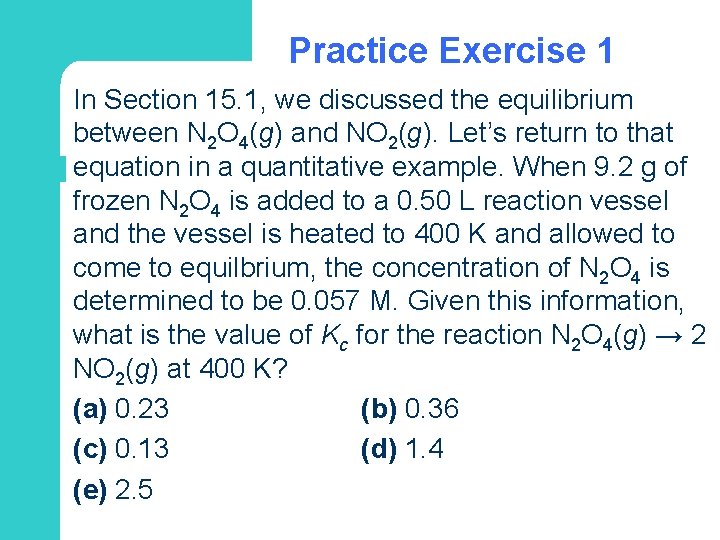
Practice Exercise 1 In Section 15. 1, we discussed the equilibrium between N 2 O 4(g) and NO 2(g). Let’s return to that equation in a quantitative example. When 9. 2 g of frozen N 2 O 4 is added to a 0. 50 L reaction vessel and the vessel is heated to 400 K and allowed to come to equilbrium, the concentration of N 2 O 4 is determined to be 0. 057 M. Given this information, what is the value of Kc for the reaction N 2 O 4(g) → 2 NO 2(g) at 400 K? (a) 0. 23 (b) 0. 36 (c) 0. 13 (d) 1. 4 (e) 2. 5
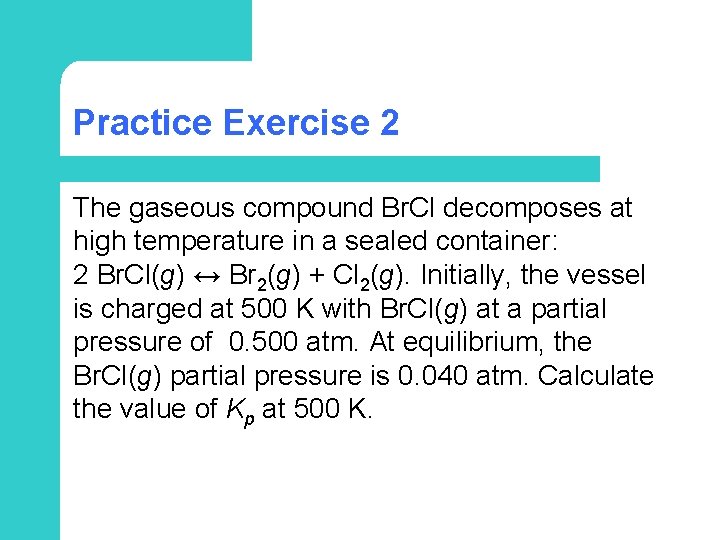
Practice Exercise 2 The gaseous compound Br. Cl decomposes at high temperature in a sealed container: 2 Br. Cl(g) ↔ Br 2(g) + Cl 2(g). Initially, the vessel is charged at 500 K with Br. Cl(g) at a partial pressure of 0. 500 atm. At equilibrium, the Br. Cl(g) partial pressure is 0. 040 atm. Calculate the value of Kp at 500 K.
15. 6 Applications of Equilibrium Constants
Is a Mixture in Equilibrium? Which Way Does the Reaction Go? l l l To answer these questions, we calculate the reaction quotient, Q. Q looks like the equilibrium constant, K, but the values used to calculate it are the current conditions, not necessarily those for equilibrium. To calculate Q, one substitutes the initial concentrations of reactants and products into the equilibrium expression.
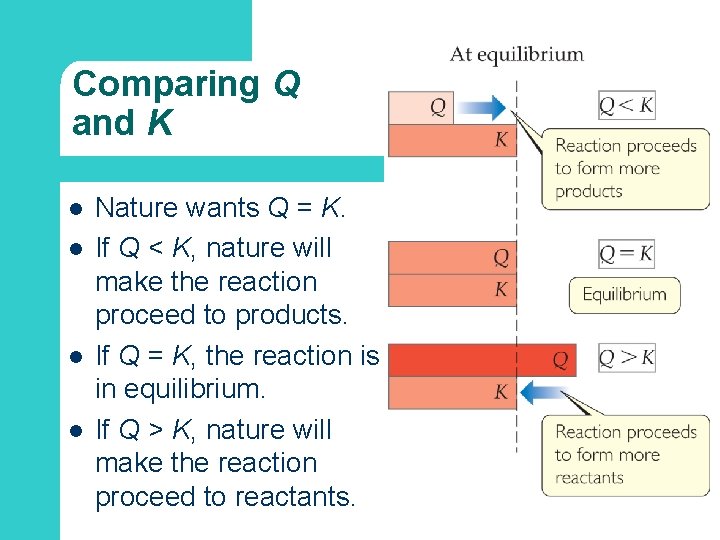
Comparing Q and K l l Nature wants Q = K. If Q < K, nature will make the reaction proceed to products. If Q = K, the reaction is in equilibrium. If Q > K, nature will make the reaction proceed to reactants.
Sample Exercise 15. 9 l At 448ºC the equilibrium constant Kc for the reaction H 2(g) + I 2(g) ↔ 2 HI(g) is 50. 5. Predict in which direction the reaction will proceed to reach equilibrium at 448ºC if we start with 2. 0 x 10 -2 mol of HI, 1. 0 x 10 -2 mol H 2, and 3. 0 x 10 -2 mol of I 2 in a 2. 00 -L container.
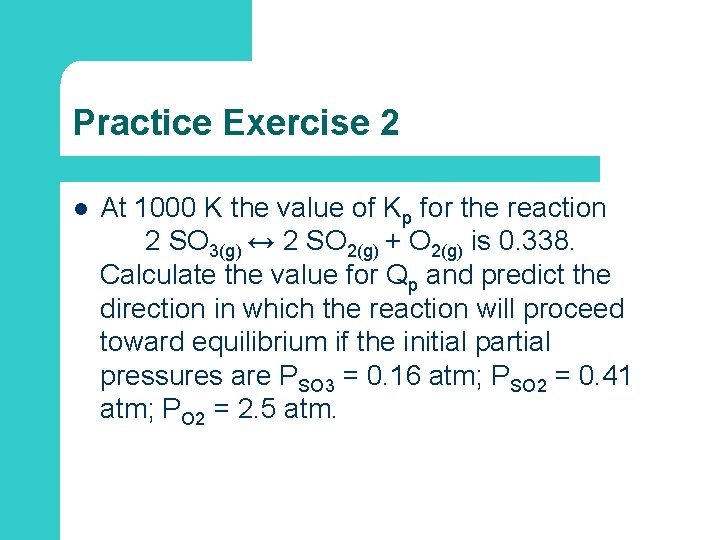
Practice Exercise 2 l At 1000 K the value of Kp for the reaction 2 SO 3(g) ↔ 2 SO 2(g) + O 2(g) is 0. 338. Calculate the value for Qp and predict the direction in which the reaction will proceed toward equilibrium if the initial partial pressures are PSO 3 = 0. 16 atm; PSO 2 = 0. 41 atm; PO 2 = 2. 5 atm.
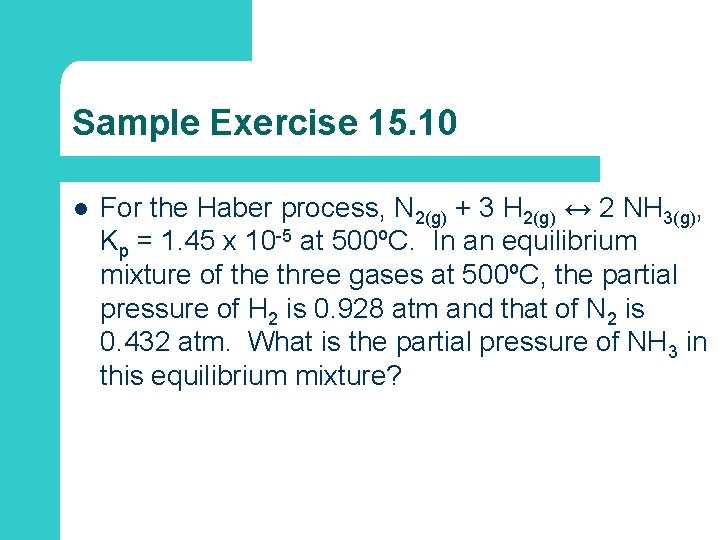
Sample Exercise 15. 10 l For the Haber process, N 2(g) + 3 H 2(g) ↔ 2 NH 3(g), Kp = 1. 45 x 10 -5 at 500ºC. In an equilibrium mixture of the three gases at 500ºC, the partial pressure of H 2 is 0. 928 atm and that of N 2 is 0. 432 atm. What is the partial pressure of NH 3 in this equilibrium mixture?
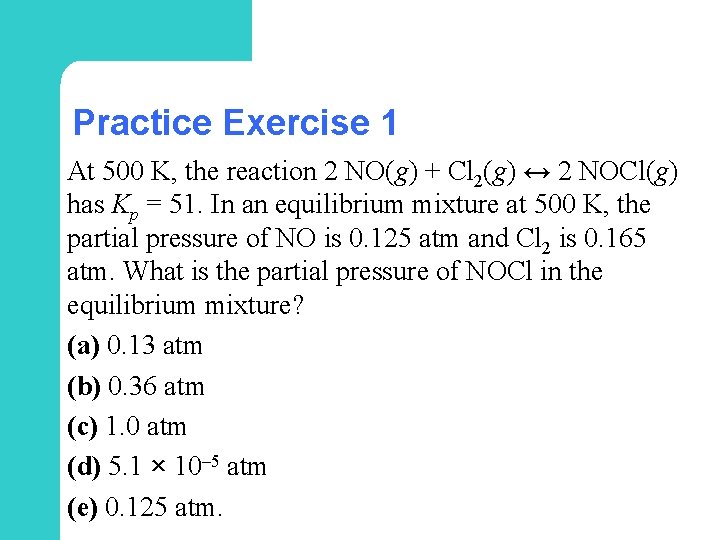
Practice Exercise 1 At 500 K, the reaction 2 NO(g) + Cl 2(g) ↔ 2 NOCl(g) has Kp = 51. In an equilibrium mixture at 500 K, the partial pressure of NO is 0. 125 atm and Cl 2 is 0. 165 atm. What is the partial pressure of NOCl in the equilibrium mixture? (a) 0. 13 atm (b) 0. 36 atm (c) 1. 0 atm (d) 5. 1 × 10– 5 atm (e) 0. 125 atm.
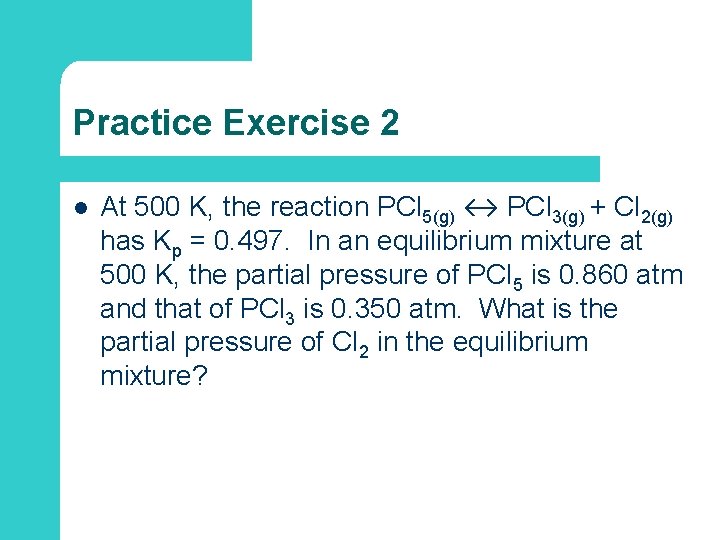
Practice Exercise 2 l At 500 K, the reaction PCl 5(g) ↔ PCl 3(g) + Cl 2(g) has Kp = 0. 497. In an equilibrium mixture at 500 K, the partial pressure of PCl 5 is 0. 860 atm and that of PCl 3 is 0. 350 atm. What is the partial pressure of Cl 2 in the equilibrium mixture?
Calculating Equilibrium Concentrations l l If you know the equilibrium constant, you can find equilibrium concentrations from initial concentrations and changes (based on stoichiometry). You will set up a table similar to the ones used to find the equilibrium concentration, but the “change in concentration” row will simple be a factor of “x” based on the stoichiometry.
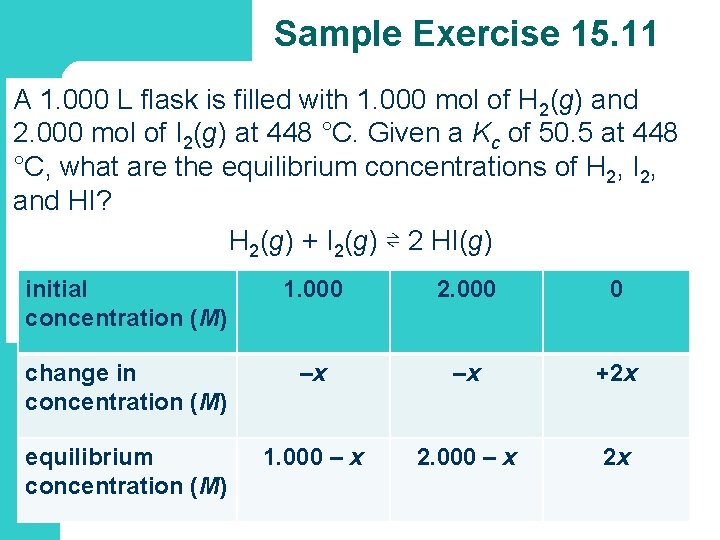
Sample Exercise 15. 11 A 1. 000 L flask is filled with 1. 000 mol of H 2(g) and 2. 000 mol of I 2(g) at 448 °C. Given a Kc of 50. 5 at 448 °C, what are the equilibrium concentrations of H 2, I 2, and HI? H 2(g) + I 2(g) ⇌ 2 HI(g) initial concentration (M) 1. 000 2. 000 0 change in concentration (M) –x –x +2 x equilibrium concentration (M) 1. 000 – x 2 x
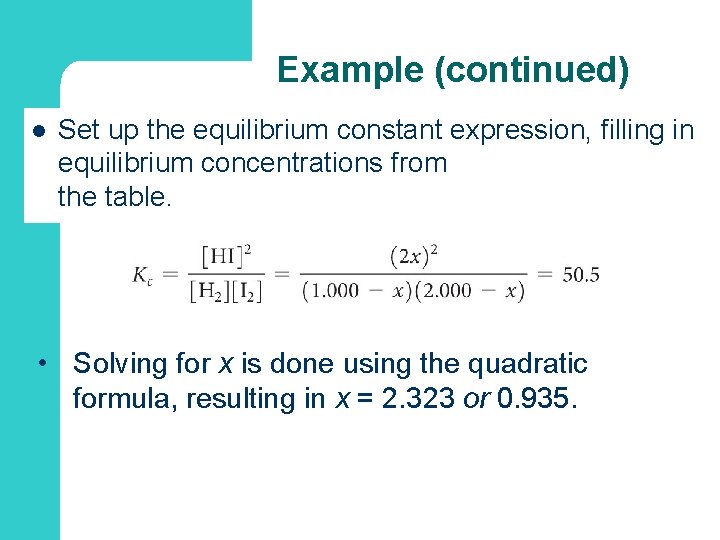
Example (continued) l Set up the equilibrium constant expression, filling in equilibrium concentrations from the table. • Solving for x is done using the quadratic formula, resulting in x = 2. 323 or 0. 935.
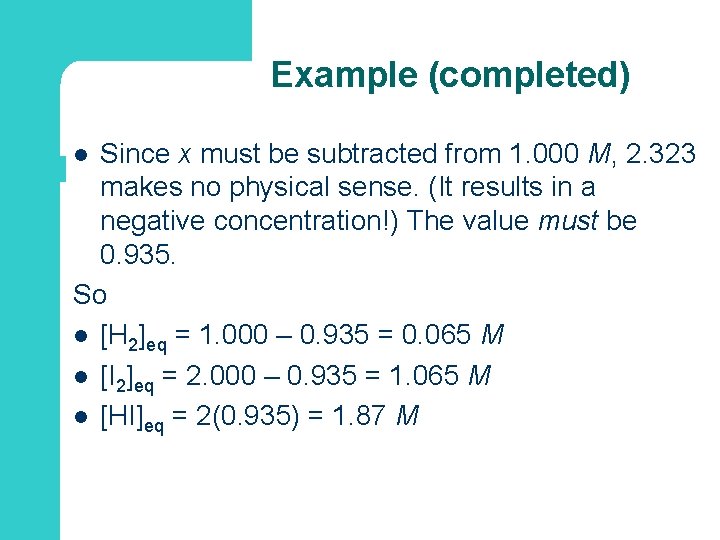
Example (completed) Since x must be subtracted from 1. 000 M, 2. 323 makes no physical sense. (It results in a negative concentration!) The value must be 0. 935. So l [H 2]eq = 1. 000 – 0. 935 = 0. 065 M l [I 2]eq = 2. 000 – 0. 935 = 1. 065 M l [HI]eq = 2(0. 935) = 1. 87 M l
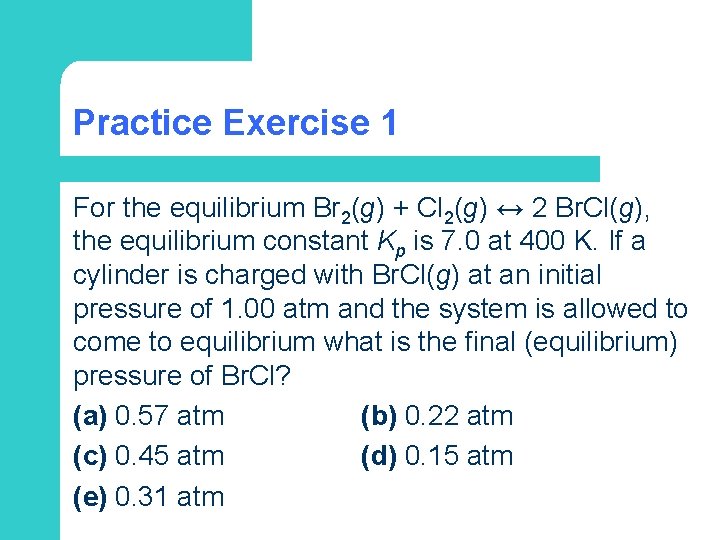
Practice Exercise 1 For the equilibrium Br 2(g) + Cl 2(g) ↔ 2 Br. Cl(g), the equilibrium constant Kp is 7. 0 at 400 K. If a cylinder is charged with Br. Cl(g) at an initial pressure of 1. 00 atm and the system is allowed to come to equilibrium what is the final (equilibrium) pressure of Br. Cl? (a) 0. 57 atm (b) 0. 22 atm (c) 0. 45 atm (d) 0. 15 atm (e) 0. 31 atm
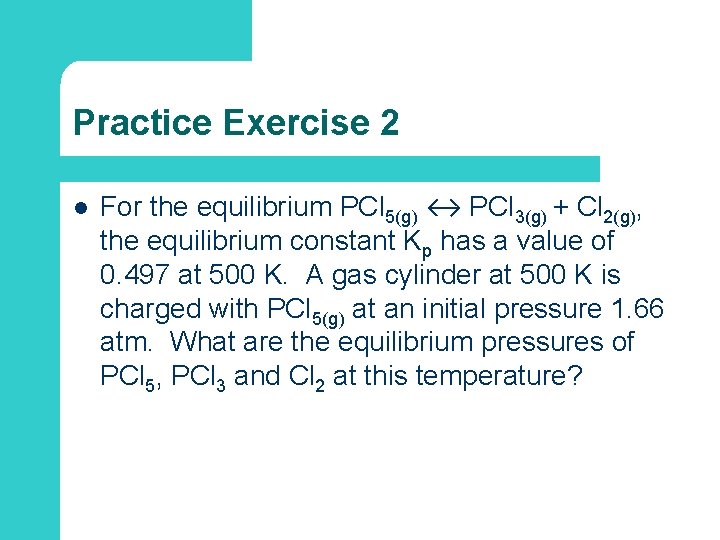
Practice Exercise 2 l For the equilibrium PCl 5(g) ↔ PCl 3(g) + Cl 2(g), the equilibrium constant Kp has a value of 0. 497 at 500 K. A gas cylinder at 500 K is charged with PCl 5(g) at an initial pressure 1. 66 atm. What are the equilibrium pressures of PCl 5, PCl 3 and Cl 2 at this temperature?
15. 7 Le Châtelier’s Principle
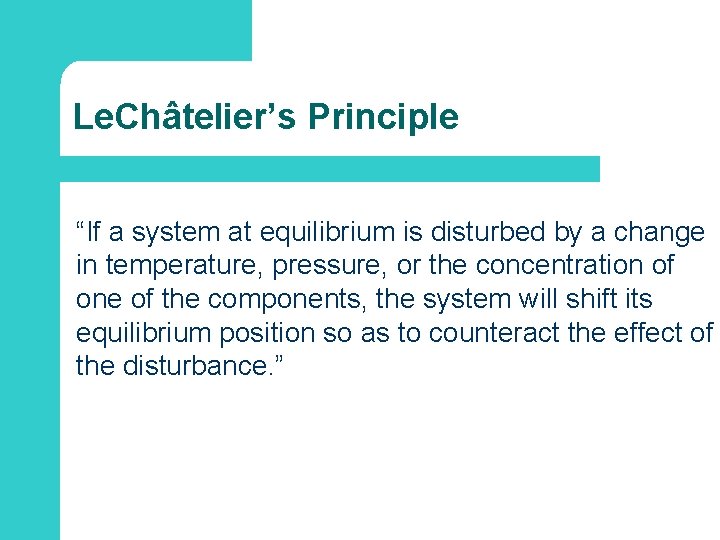
Le. Châtelier’s Principle “If a system at equilibrium is disturbed by a change in temperature, pressure, or the concentration of one of the components, the system will shift its equilibrium position so as to counteract the effect of the disturbance. ”
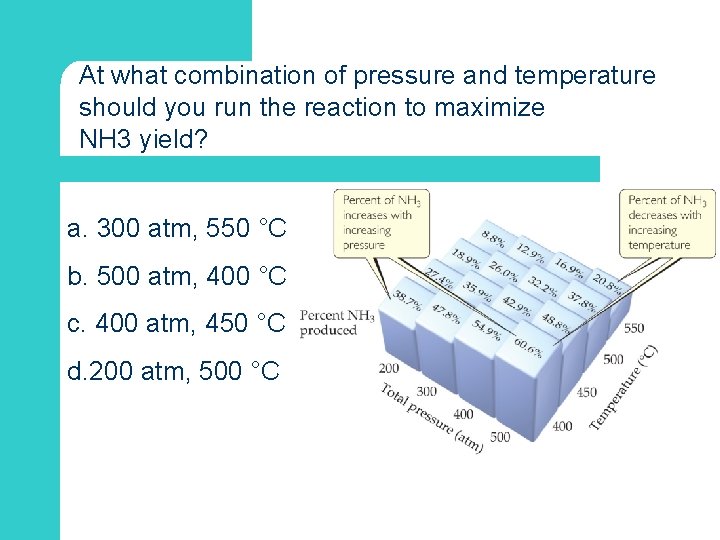
At what combination of pressure and temperature should you run the reaction to maximize NH 3 yield? a. 300 atm, 550 °C b. 500 atm, 400 °C c. 400 atm, 450 °C d. 200 atm, 500 °C
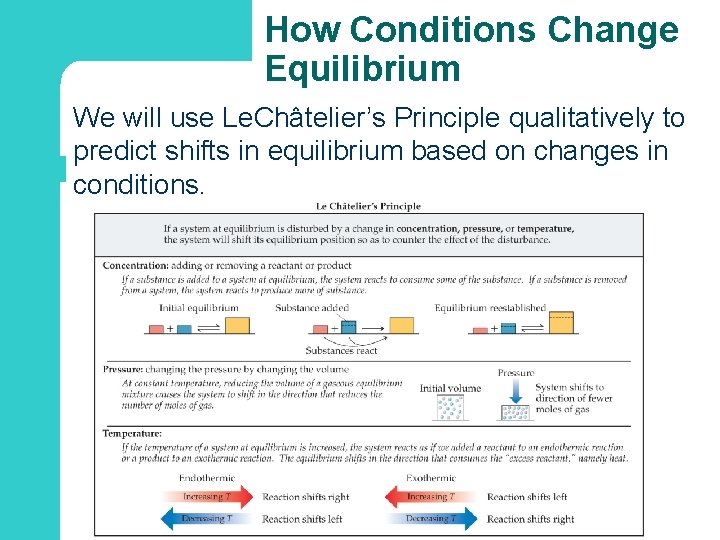
How Conditions Change Equilibrium We will use Le. Châtelier’s Principle qualitatively to predict shifts in equilibrium based on changes in conditions.
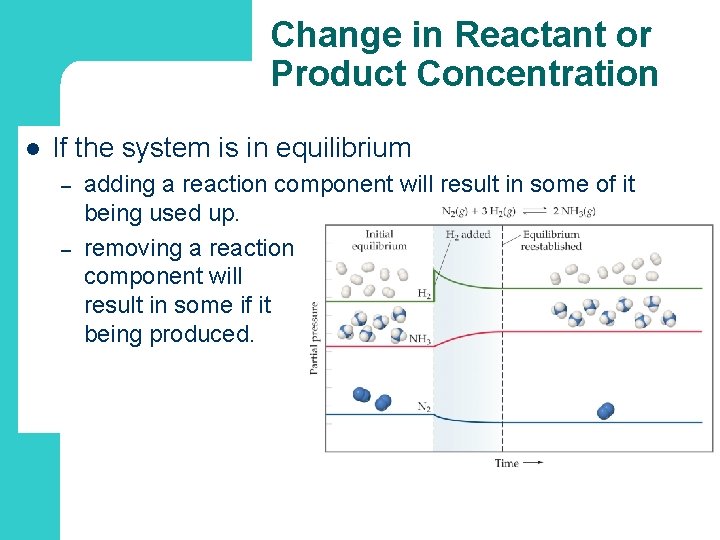
Change in Reactant or Product Concentration l If the system is in equilibrium – – adding a reaction component will result in some of it being used up. removing a reaction component will result in some if it being produced.
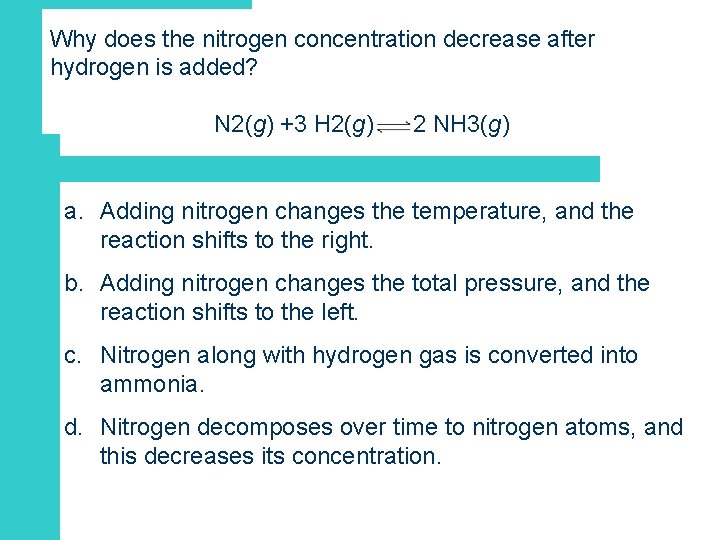
Why does the nitrogen concentration decrease after hydrogen is added? N 2(g) +3 H 2(g) 2 NH 3(g) a. Adding nitrogen changes the temperature, and the reaction shifts to the right. b. Adding nitrogen changes the total pressure, and the reaction shifts to the left. c. Nitrogen along with hydrogen gas is converted into ammonia. d. Nitrogen decomposes over time to nitrogen atoms, and this decreases its concentration.
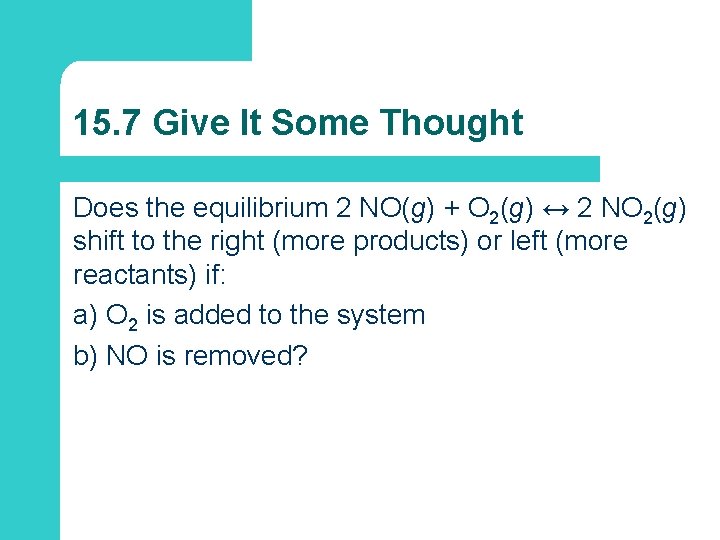
15. 7 Give It Some Thought Does the equilibrium 2 NO(g) + O 2(g) ↔ 2 NO 2(g) shift to the right (more products) or left (more reactants) if: a) O 2 is added to the system b) NO is removed?
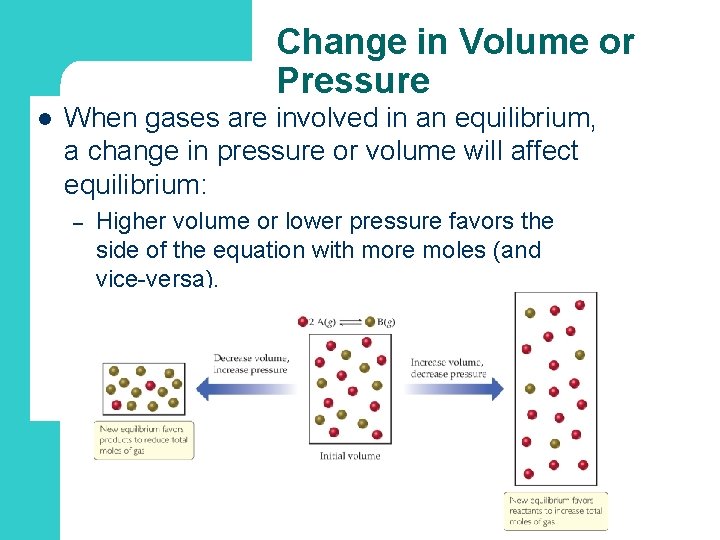
Change in Volume or Pressure l When gases are involved in an equilibrium, a change in pressure or volume will affect equilibrium: – Higher volume or lower pressure favors the side of the equation with more moles (and vice-versa).
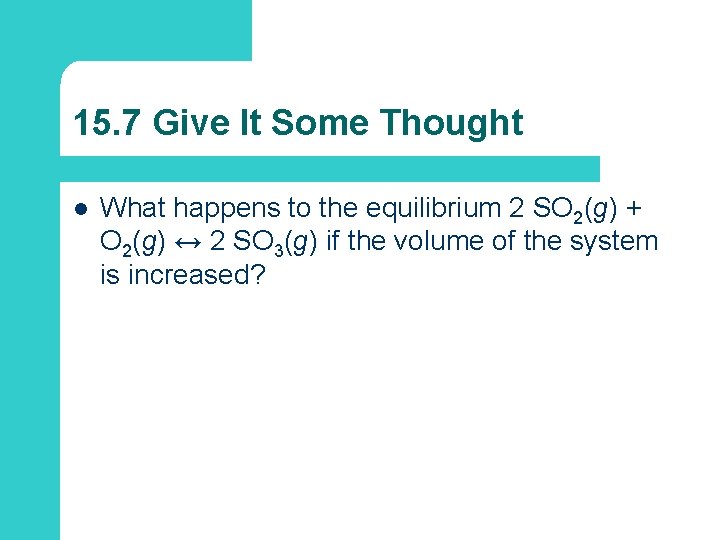
15. 7 Give It Some Thought l What happens to the equilibrium 2 SO 2(g) + O 2(g) ↔ 2 SO 3(g) if the volume of the system is increased?
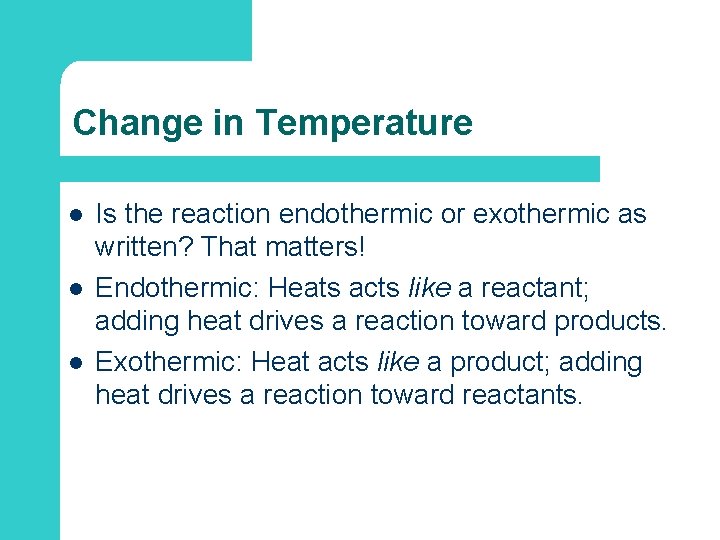
Change in Temperature l l l Is the reaction endothermic or exothermic as written? That matters! Endothermic: Heats acts like a reactant; adding heat drives a reaction toward products. Exothermic: Heat acts like a product; adding heat drives a reaction toward reactants.
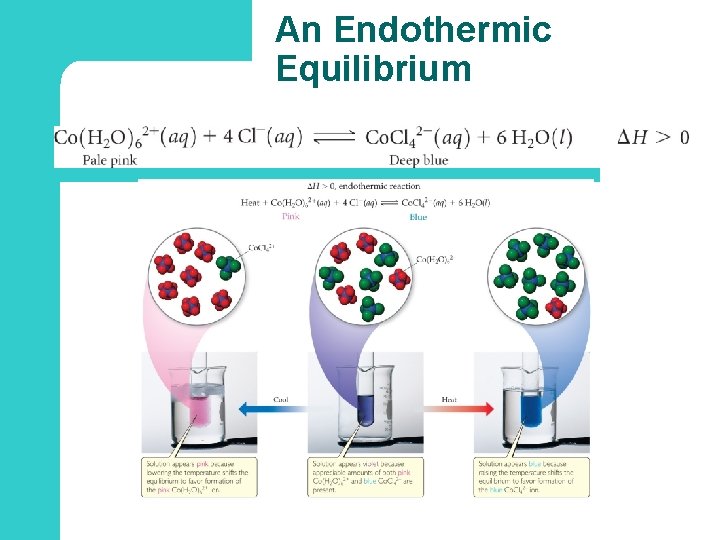
An Endothermic Equilibrium
An Exothermic Equilibrium l l The Haber Process for producing ammonia from the elements is exothermic. One would think that cooling down the reactants would result in more product. However, the activation energy for this reaction is high! This is the one instance where a system in equilibrium can be affected by a catalyst!
15. 7 Give It Some Thought l Use Le Chatelier’s Principle to explain why the equilibrium vapor pressure of a liquid increases with increasing themperature.
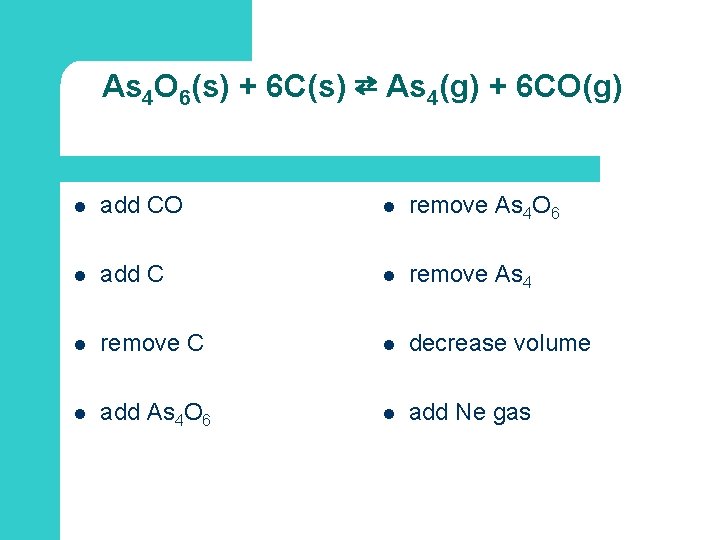
As 4 O 6(s) + 6 C(s) ⇄ As 4(g) + 6 CO(g) l add CO l remove As 4 O 6 l add C l remove As 4 l remove C l decrease volume l add As 4 O 6 l add Ne gas
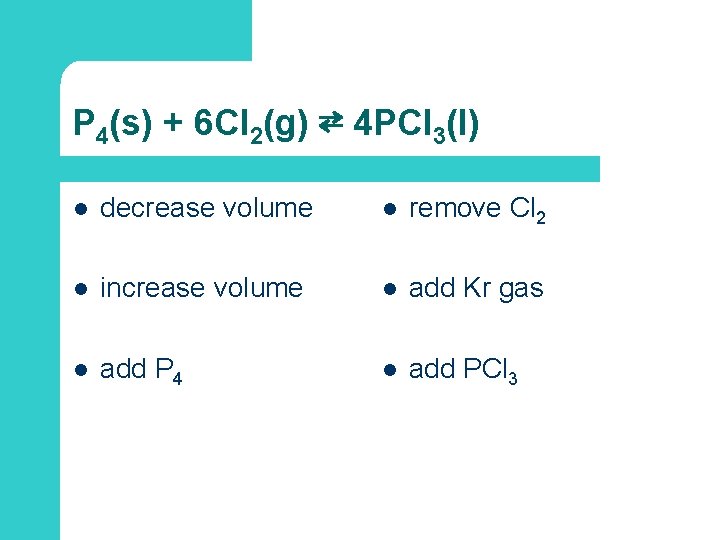
P 4(s) + 6 Cl 2(g) ⇄ 4 PCl 3(l) l decrease volume l remove Cl 2 l increase volume l add Kr gas l add P 4 l add PCl 3
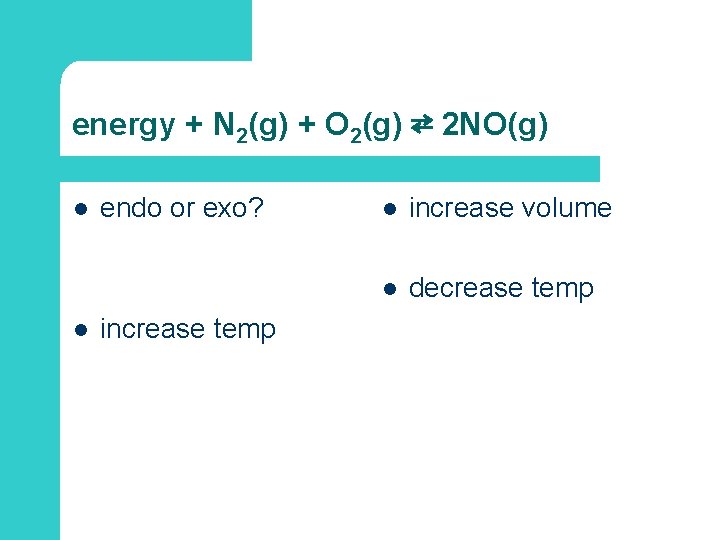
energy + N 2(g) + O 2(g) ⇄ 2 NO(g) l l endo or exo? increase temp l increase volume l decrease temp
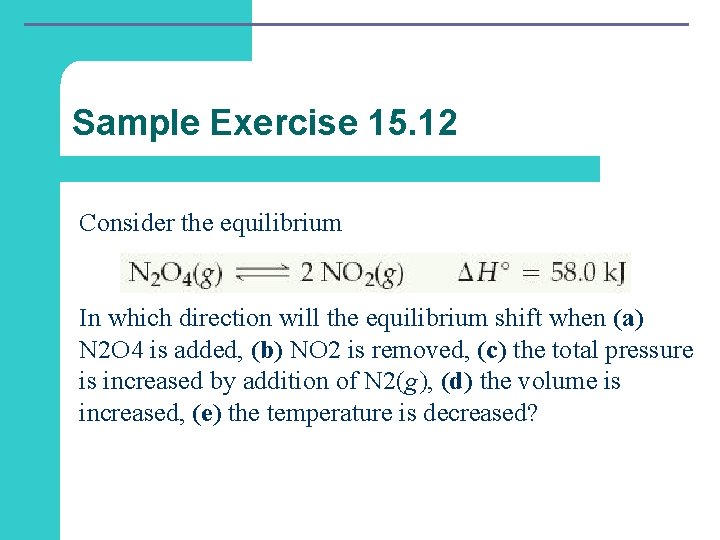
Sample Exercise 15. 12 Consider the equilibrium In which direction will the equilibrium shift when (a) N 2 O 4 is added, (b) NO 2 is removed, (c) the total pressure is increased by addition of N 2(g), (d) the volume is increased, (e) the temperature is decreased?
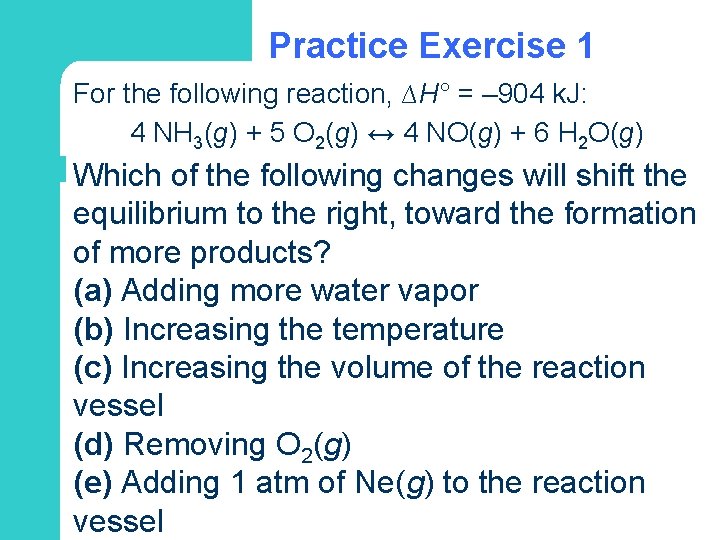
Practice Exercise 1 For the following reaction, ∆H° = – 904 k. J: 4 NH 3(g) + 5 O 2(g) ↔ 4 NO(g) + 6 H 2 O(g) Which of the following changes will shift the equilibrium to the right, toward the formation of more products? (a) Adding more water vapor (b) Increasing the temperature (c) Increasing the volume of the reaction vessel (d) Removing O 2(g) (e) Adding 1 atm of Ne(g) to the reaction vessel
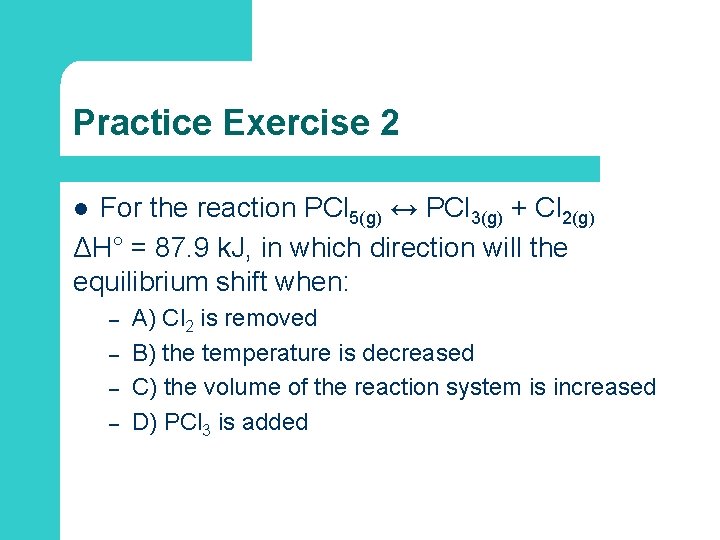
Practice Exercise 2 For the reaction PCl 5(g) ↔ PCl 3(g) + Cl 2(g) ΔH° = 87. 9 k. J, in which direction will the equilibrium shift when: l – – A) Cl 2 is removed B) the temperature is decreased C) the volume of the reaction system is increased D) PCl 3 is added
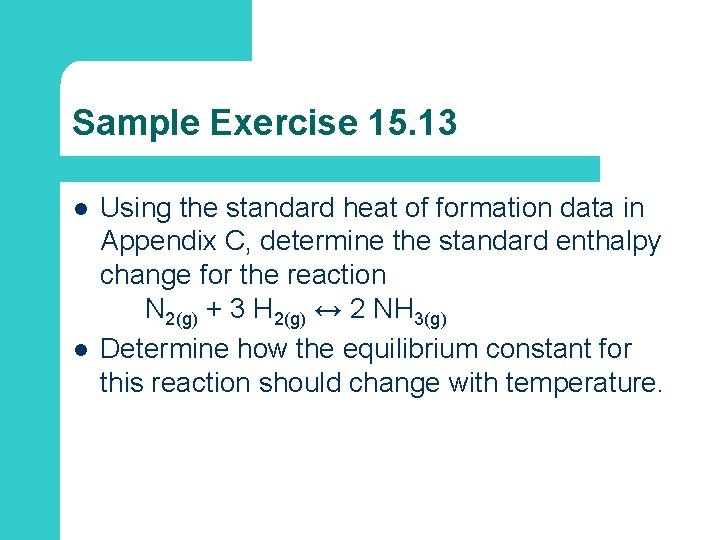
Sample Exercise 15. 13 l l Using the standard heat of formation data in Appendix C, determine the standard enthalpy change for the reaction N 2(g) + 3 H 2(g) ↔ 2 NH 3(g) Determine how the equilibrium constant for this reaction should change with temperature.
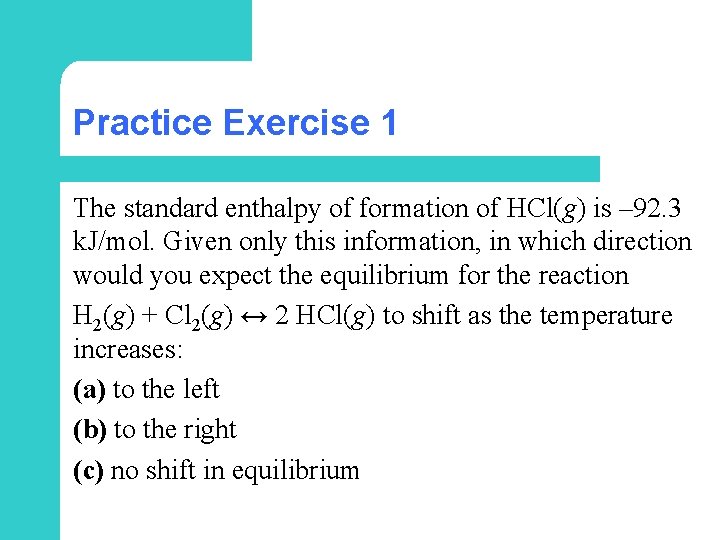
Practice Exercise 1 The standard enthalpy of formation of HCl(g) is – 92. 3 k. J/mol. Given only this information, in which direction would you expect the equilibrium for the reaction H 2(g) + Cl 2(g) ↔ 2 HCl(g) to shift as the temperature increases: (a) to the left (b) to the right (c) no shift in equilibrium
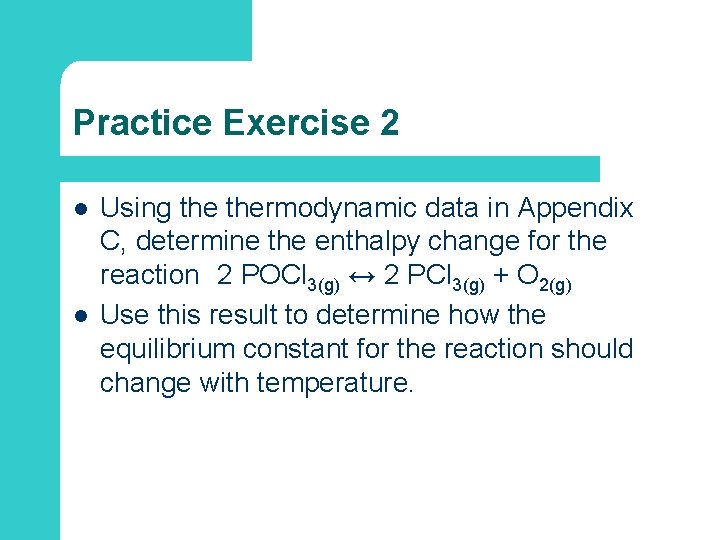
Practice Exercise 2 l l Using thermodynamic data in Appendix C, determine the enthalpy change for the reaction 2 POCl 3(g) ↔ 2 PCl 3(g) + O 2(g) Use this result to determine how the equilibrium constant for the reaction should change with temperature.
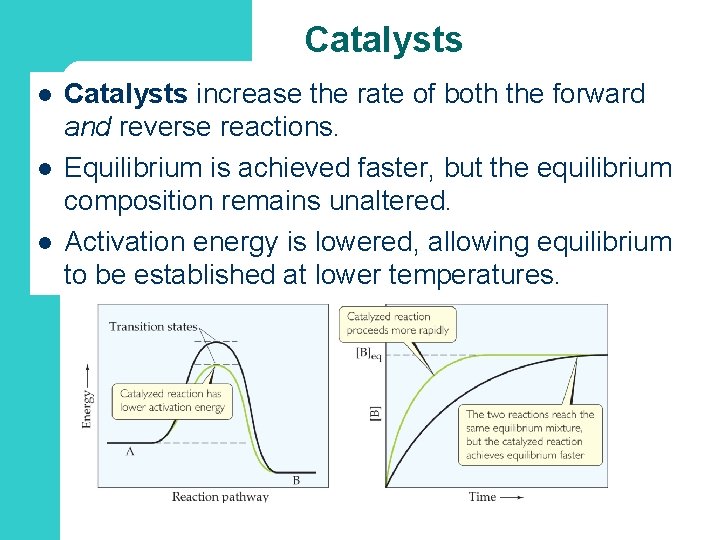
Catalysts l l l Catalysts increase the rate of both the forward and reverse reactions. Equilibrium is achieved faster, but the equilibrium composition remains unaltered. Activation energy is lowered, allowing equilibrium to be established at lower temperatures.
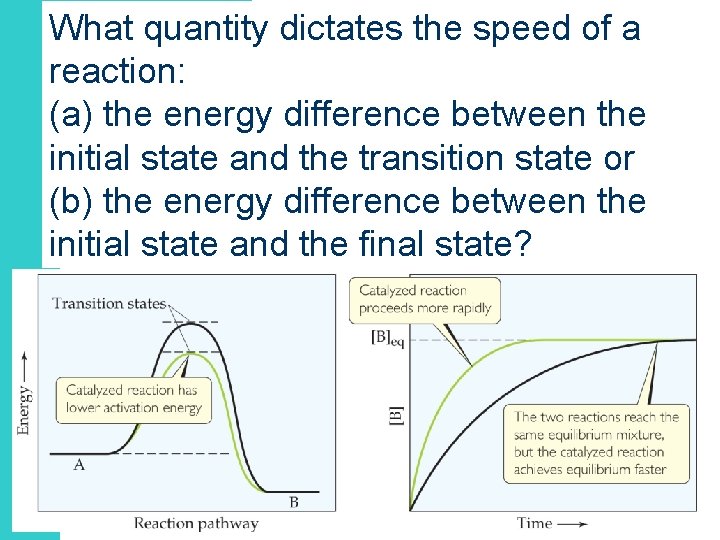
What quantity dictates the speed of a reaction: (a) the energy difference between the initial state and the transition state or (b) the energy difference between the initial state and the final state?
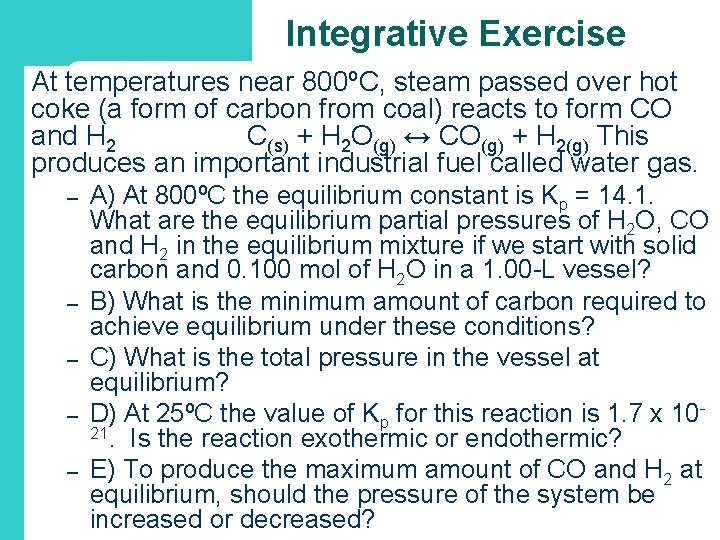
Integrative Exercise At temperatures near 800ºC, steam passed over hot coke (a form of carbon from coal) reacts to form CO and H 2 C(s) + H 2 O(g) ↔ CO(g) + H 2(g) This produces an important industrial fuel called water gas. – – – A) At 800ºC the equilibrium constant is Kp = 14. 1. What are the equilibrium partial pressures of H 2 O, CO and H 2 in the equilibrium mixture if we start with solid carbon and 0. 100 mol of H 2 O in a 1. 00 -L vessel? B) What is the minimum amount of carbon required to achieve equilibrium under these conditions? C) What is the total pressure in the vessel at equilibrium? D) At 25ºC the value of Kp for this reaction is 1. 7 x 10²¹. Is the reaction exothermic or endothermic? E) To produce the maximum amount of CO and H 2 at equilibrium, should the pressure of the system be increased or decreased?
19. 7 Free Energy and the Equilibrium Constant
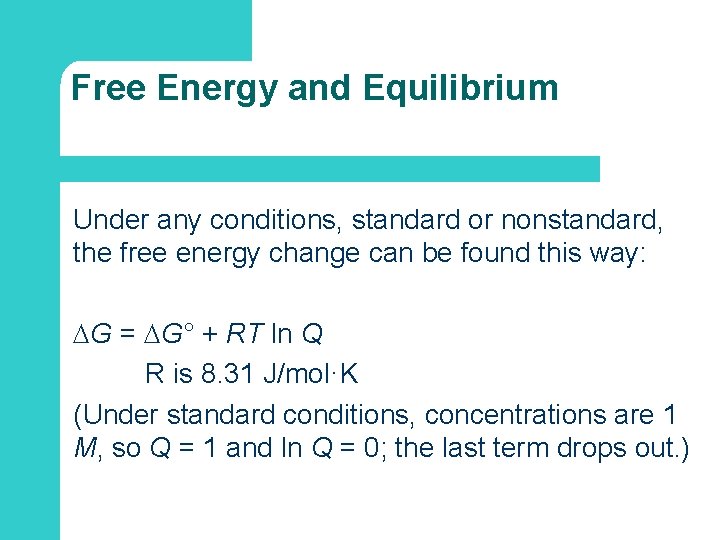
Free Energy and Equilibrium Under any conditions, standard or nonstandard, the free energy change can be found this way: G = G° + RT ln Q R is 8. 31 J/mol·K (Under standard conditions, concentrations are 1 M, so Q = 1 and ln Q = 0; the last term drops out. )
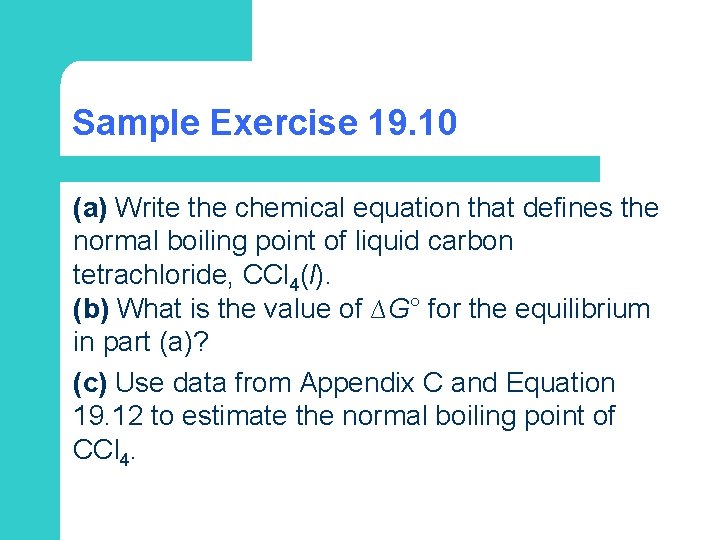
Sample Exercise 19. 10 (a) Write the chemical equation that defines the normal boiling point of liquid carbon tetrachloride, CCl 4(l). (b) What is the value of ∆G° for the equilibrium in part (a)? (c) Use data from Appendix C and Equation 19. 12 to estimate the normal boiling point of CCl 4.
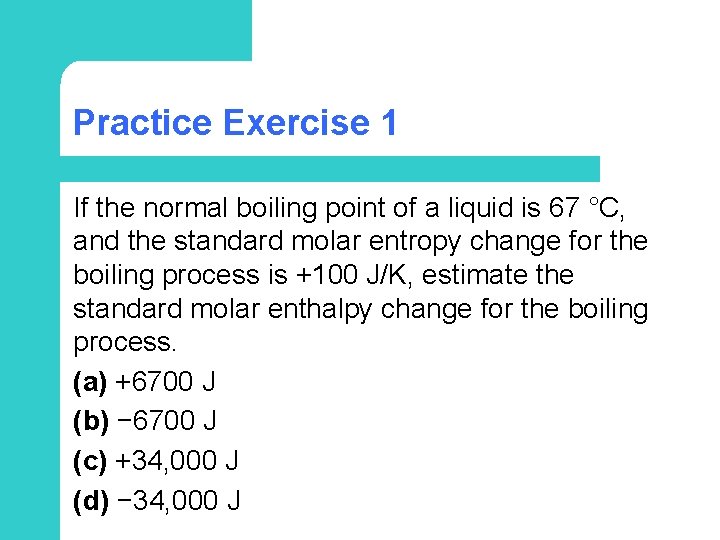
Practice Exercise 1 If the normal boiling point of a liquid is 67 °C, and the standard molar entropy change for the boiling process is +100 J/K, estimate the standard molar enthalpy change for the boiling process. (a) +6700 J (b) − 6700 J (c) +34, 000 J (d) − 34, 000 J
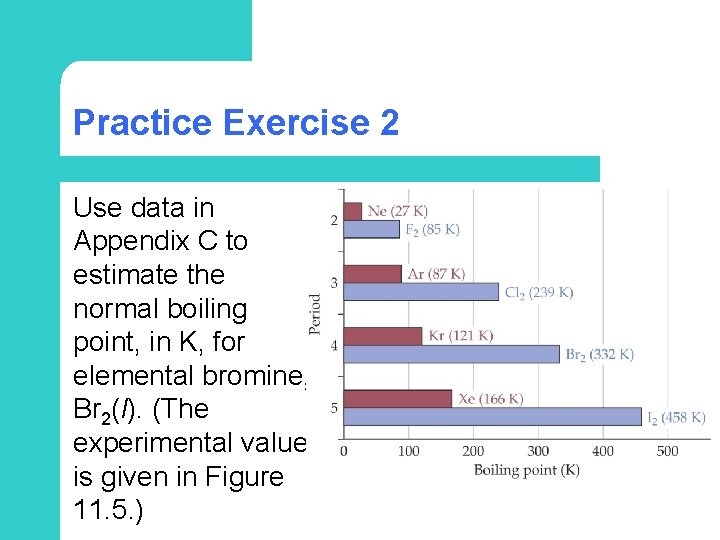
Practice Exercise 2 Use data in Appendix C to estimate the normal boiling point, in K, for elemental bromine, Br 2(l). (The experimental value is given in Figure 11. 5. )
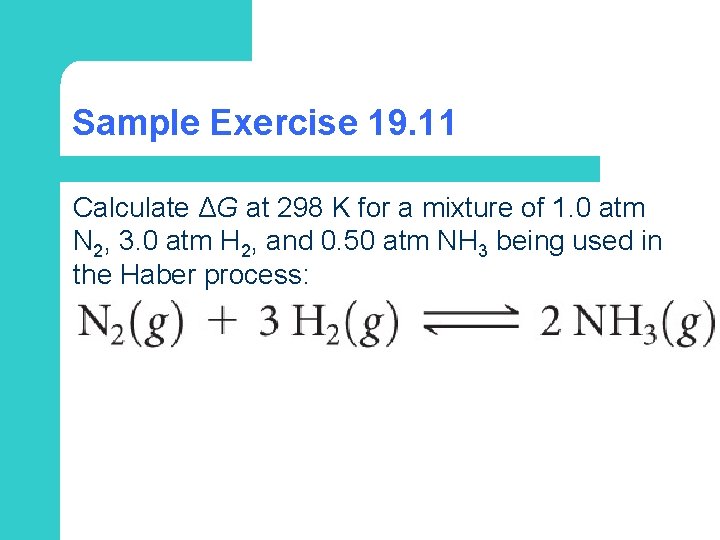
Sample Exercise 19. 11 Calculate ΔG at 298 K for a mixture of 1. 0 atm N 2, 3. 0 atm H 2, and 0. 50 atm NH 3 being used in the Haber process:
Practice Exercise 2 Calculate ΔG at 298 K for the Haber reaction if the reaction mixture consists of 0. 50 atm N 2, 0. 75 atm H 2, and 2. 0 atm NH 3.
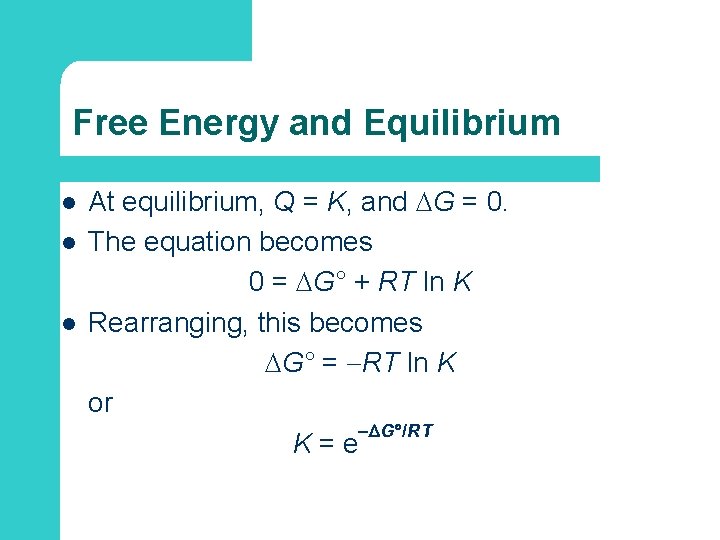
Free Energy and Equilibrium l l l At equilibrium, Q = K, and G = 0. The equation becomes 0 = G° + RT ln K Rearranging, this becomes G° = RT ln K or G /RT K = e
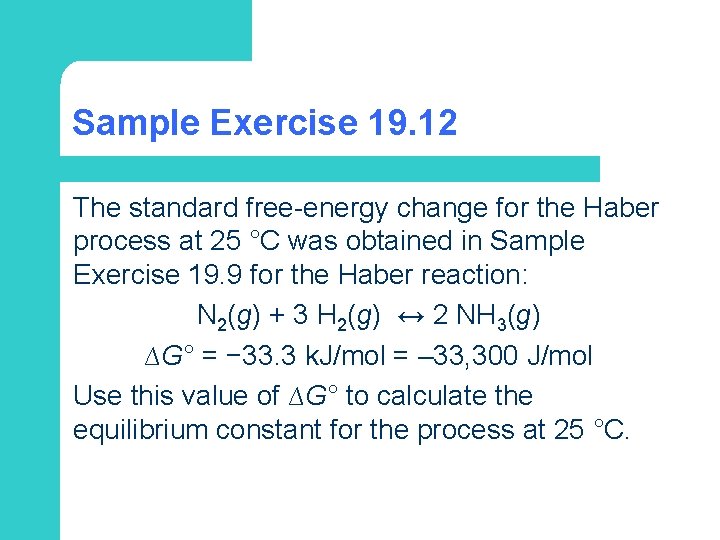
Sample Exercise 19. 12 The standard free-energy change for the Haber process at 25 °C was obtained in Sample Exercise 19. 9 for the Haber reaction: N 2(g) + 3 H 2(g) ↔ 2 NH 3(g) ∆G° = − 33. 3 k. J/mol = – 33, 300 J/mol Use this value of ∆G° to calculate the equilibrium constant for the process at 25 °C.
Practice Exercise 1 The Ksp for a very insoluble salt is 4. 2 × 10− 47 at 298 K. What is ΔG° for the dissolution of the salt in water? (a) − 265 k. J/mol (b) − 115 k. J/mol (c) − 2. 61 k. J/mol (d) +115 k. J/mol (e) +265 k. J/mol
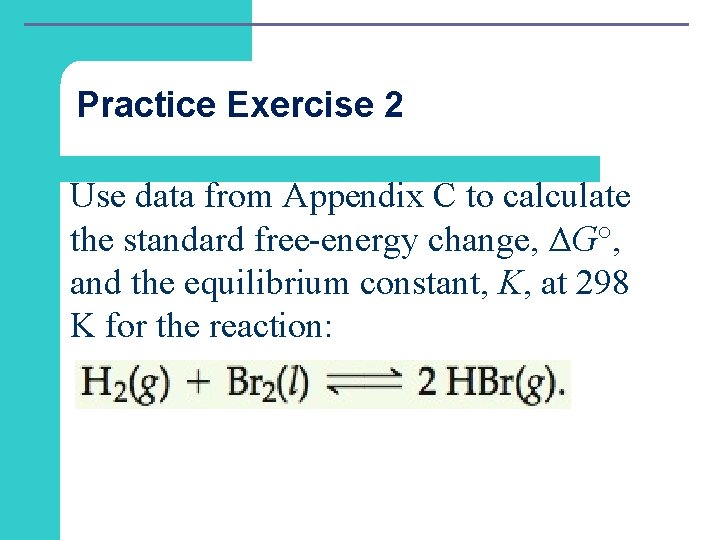
Practice Exercise 2 Use data from Appendix C to calculate the standard free-energy change, ΔG°, and the equilibrium constant, K, at 298 K for the reaction:
Sample Integrative Exercise Consider the simple salts Na. Cl(s) and Ag. Cl(s): Na. Cl(s) ↔ Na+(aq) + Cl–(aq) Ag. Cl(s) ↔a Ag+(aq) + Cl–(aq) (a) Calculate the value of ΔG° at 298 K for each of the preceding reactions. (b) The two values from part (a) are very different. Is this difference primarily due to the enthalpy term or the entropy term of the standard free-energy change? (c) Use the values of ΔG° to calculate the Ksp values for the two salts at 298 K. (d) Sodium chloride is considered a soluble salt, whereas silver chloride is considered insoluble. Are these descriptions consistent with the answers to part (c)? (e) How will ΔG° for the solution process of these salts change with increasing T? What effect should this change have on the solubility of the salts?
- Slides: 114