
Chapter 15 Blood Elsevier items and derived items

Chapter 15 Blood Elsevier items and derived items © 2007, 2003, 2000 by Saunders, an imprint of Elsevier Inc. Slide 1
Introduction • Blood has three main functions: it delivers oxygen to all cells; it helps regulate body functions, such as body temperature; and it protects the body from infection. Slide 2
Composition and Characteristics of Blood • Blood is composed of plasma and blood cells. • The blood cells originate in the bone marrow and lymphoid tissue. Slide 3
Blood Cells • Red Blood Cells (RBCs) or Erythrocytes – RBCs are filled with hemoglobin. – Oxyhemoglobin transports oxygen, and carbaminohemoglobin transports carbon dioxide. – RBC production is regulated by erythropoietin (senses oxygen). Slide 4
Blood Cells - cont’d • White Blood Cells (WBCs) – WBCs are classified as granulocytes and agranulocytes. – The granulocytes are neutrophils, basophils, and eosinophils. – The agranulocytes are the lymphocytes and monocytes. Slide 5
Blood Cells - cont’d • Platelets – Platelets are thrombocytes. – Platelets are involved in hemostasis. Slide 6
Hemostasis • Stages of Hemostasis – The three stages of hemostasis are blood vessel spasm, formation of a platelet plug, and blood coagulation. – The three stages of blood coagulation are summarized in Figure 15 -11. • Dissolving Clots and Preventing Clot Formation – Eventually the clot dissolves by a process called fibrinolysis; clot dissolution is achieved primarily by plasmin. – Natural anticoagulant mechanisms include a smooth endothelial lining and heparin. Slide 7
Blood Types • ABO Blood Types – There are 4 types of blood: type A, B, AB, and O. – The A and B antigens are on the membrane of the RBC. – Blood plasma contains anti-A and anti-B antibodies. – Blood antigen and antibodies are summarized in Table 15 -3. Slide 8
Blood Types - cont’d • Rh Factor – An Rh-positive person has the Rh antigen on the RBC membrane; an Rh-positive person does not have anti-Rh antibodies in the plasma. – The Rh factor must be considered when blood is transfused; an Rh ( ) person cannot receive Rh (+) blood. – An Rh-negative mother carrying an Rh-positive baby may give birth to a baby with erythroblastosis fetalis. Slide 9
Introduction • The endocrine system and the nervous system are the two major communicating and coordinating systems in the body. The endocrine system communicates through chemical signals called hormones. Slide 10
Hormones • Classification of Hormones – Hormones are secreted by endocrine glands directly into the blood. – Hormones are classified as proteins (protein-related substances) and steroids. • Hormone Receptors – Hormones are aimed at receptors of target organs. – Receptors are located on the outer surface of the membrane or inside the cell. – Hormone secretion is controlled by three mechanisms: negative feedback control, biorhythms, and control by the central nervous system. Slide 11
Pituitary Gland • Hypothalamic-Hypophyseal Portal System – The portal system is a system of capillaries that connects the hypothalamus and the anterior pituitary. – The portal system transports releasing hormones from the hypothalamus to the anterior pituitary gland. Slide 12
Pituitary Gland - cont’d • Hormones of the Anterior Pituitary Gland – Growth hormone stimulates growth and maintains blood glucose during periods of fasting. – Prolactin (lactogenic hormone) stimulates milk production by the breasts. – Tropic hormones stimulate other glands to secrete hormones. These include thyrotropin, adrenocorticotropic hormone, and the gonadotropins. Slide 13
Pituitary Gland - cont’d • Hormones of the Anterior Pituitary Gland— cont’d – Thyroid-stimulating hormone stimulates the thyroid gland. – Adrenocorticotropic hormone (ACTH) stimulates the adrenal cortex. – The gonadotropic hormones stimulate the gonads (ovaries and testes). Slide 14
Pituitary Gland - cont’d • Hormones of the Posterior Pituitary Gland – Antidiuretic hormone (ADH) stimulates the kidney to reabsorb water. – Oxytocin stimulates the uterine muscle to contract for labor and stimulates the breast to release milk during suckling (milk let-down reflex). • A tiny, third lobe secretes melanocytestimulating hormones. Slide 15
Other Endocrine Glands • Thyroid Gland – The follicular cells synthesize triiodothyronine (T 3) and tetraiodothyronine, or thyroxine (T 4). T 3 and T 4 regulate metabolic rate. – The parafollicular cells secrete calcitonin. Calcitonin lowers blood calcium. • Parathyroid Glands – The parathyroid glands secrete parathyroid hormone (PTH). – PTH stimulates the bones, kidneys, and intestines to increase blood calcium levels. Slide 16
Other Endocrine Glands - cont’d • Adrenal Gland – The adrenal medulla secretes the catecholamines epinephrine and norepinephrine and causes the “fight or flight” response. – The adrenal cortex secretes the steroids: glucocorticoids, mineralocorticoid, and sex hormones. • Pancreas – The pancreas secretes insulin and glucagon. – Insulin lowers blood glucose while glucagon increases blood glucose. Slide 17
Other Endocrine Glands - cont’d • Gonads – The ovaries are stimulated by the gonadotropins and secrete estrogens and progesterone. – The testes are stimulated by the gonadotropins and secrete testosterone. • Thymus Gland: plays an important role in the immune response • Pineal Gland: houses the “biological clock” and secretes melatonin • Other hormones include organ-specific hormones (cholecystokinin), prostaglandins, and hormones of adipose tissue Slide 18
Introduction • The sensory system allows us to experience the world through a variety of sensations: touch, pressure, pain, proprioception, temperature, taste, smell, vision, hearing, and equilibrium. Slide 19
Receptors and Sensation • Receptor – A receptor is a specialized area of a sensory neuron that detects a specific stimulus. – The five types of receptors are chemoreceptors, pain receptors (nociceptors), thermoreceptors, mechanoreceptors, and photoreceptors. Slide 20
Receptors and Sensation - cont’d • Sensation – A sensation is a conscious awareness of incoming sensory information. – There are four components of a sensation. – The two characteristics of sensation are projection and adaptation. Slide 21
General Senses • Pain – Pain receptors (nociceptors) are free nerve endings. – The stimuli for pain are tissue damage, lack of oxygen, and stretching or distortion of tissue. Slide 22
General Senses - cont’d • Touch and Pressure – Receptors are mechanoreceptors and respond to forces that press, move, or deform tissue. – The receptors for pressure are located in the skin, subcutaneous tissue, and the deep tissue. Slide 23
General Senses - cont’d • Temperature – There are thermoreceptors for heat and cold. – Thermoreceptors are found in free nerve endings and in other specialized sensory cells beneath the skin. Slide 24
General Senses - cont’d • Proprioception – Proprioreceptors are located primarily in the muscles, tendons, and joints. – Proprioreceptors sense orientation or position. Slide 25
Special Senses • Sense of Smell: The Nose – Olfactory receptors are chemoreceptors. – Sensory information travels along the olfactory nerve to the temporal lobe. Slide 26
Special Senses - cont’d • Sense of Taste: The Tongue – Taste buds contain chemoreceptors for taste. – There are four basic taste sensations: sweet, salty, sour, and bitter. – Sensory information travels along the facial and glossopharyngeal nerves to the gustatory cortex in the parietal lobe. Slide 27
Special Senses - cont’d • Sense of Sight: The Eye – The visual accessory organs include the eyebrows, eyelids, eyelashes, lacrimal apparatus, and extrinsic eye muscles. – The eyeball has three layers: the sclera, choroids, and retina (contains the photoreceptors, rods, and cones). – The eyeball has two cavities. One is a posterior cavity filled with vitreous humor, the other is an anterior cavity filled with aqueous humor. Slide 28 – There are two sets of eye muscles: extrinsic and
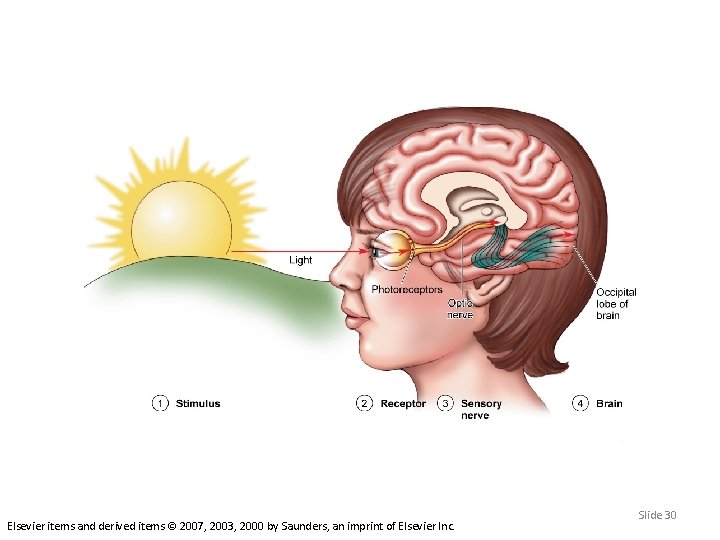
Special Senses - cont’d • Sense of Sight: The Eye—cont’d – The extrinsic eye muscles move the eyeball. – The intrinsic eye muscles control the size of the pupil and shape of the lens for refraction. – Light stimulates the photoreceptors. – The electrical signal is carried to the occipital lobe via the visual pathway. – Steps in seeing are summarized in Figure 13 -1. Slide 29
Elsevier items and derived items © 2007, 2003, 2000 by Saunders, an imprint of Elsevier Inc. Slide 30
Special Senses - cont’d • Sense of Hearing: The Ear – There are three parts of the ear: the external ear, middle ear, and inner ear. – The middle ear contains the ossicles. – The inner ear structure concerned with hearing is the cochlea. It contains the hearing receptors and organ of Corti. – Hearing information is carried by the cochlear nerve to the temporal lobe. – Steps in hearing are summarized in Figure 13 -16. Slide 31
Special Senses - cont’d • Sense of Balance: The Ear – The receptors are mechanoreceptors located in the vestibule and the semicircular canals of the inner ear. – The receptors are activated when the head changes position. – Balance information travels along the vestibular nerve to many areas of the brain (cerebellum, midbrain, and temporal lobe). Slide 32
Autonomic or Visceral Reflexes • What They Do: Autonomic reflexes regulate organ function • Pathway: The sequence is receptor activation, sensory input ( CNS), motor neuron response, and effector response Slide 33
Organization and Function of the Autonomic Nervous System • Divisions of the ANS: There are two divisions. – Sympathetic nervous system, called “Fight or Flight. ” – Parasympathetic Nervous System, called “Feed and Breed. ” • Autonomic Terminology and Autonomic Pharmacology – Drugs that affect the sympathetic nervous system are called sympathomimetic and sympatholytic. – Drugs that affect the parasympathetic nervous system are called parasympathomimetic and parasympatholytic. Slide 34
Organization and Function of the Autonomic Nervous System - cont’d • Autonomic Tone and Vasomotor Tone – Background firing of the ANS causes autonomic tone. – Background sympathetic stimulation of the blood vessels causes vasomotor tone. Slide 35
ANS: Neurons • Numbers and Ganglia – Preganglionic fibers are fibers that extend from the CNS to the ganglia. – Postganglionic fibers are fibers that extend from the ganglia to the effector organ. Slide 36
ANS: Neurons - cont’d • Neurons of the Sympathetic Nervous System – The SNS is called the thoracolumbar outflow. – The sympathetic ganglia are located in a chain close to the spinal cord; the chain is called paravertebral ganglia. – The adrenal medulla secretes hormones that mimic the SNS. Slide 37
ANS: Neurons - cont’d • Neurons of the Parasympathetic Nervous System – The parasympathetic nervous system is called the craniosacral outflow. – Parasympathetic fibers travel with cranial nerves; most parasympathetics run with the vagus nerve CN X. • Naming Fibers and Neurotransmitters – Cholinergic fibers secrete acetylcholine (ACh). – Adrenergic fibers secrete norepinephrine (NE). Slide 38
ANS: Neurons - cont’d • Neurotransmitters: Termination of Activity – ACh is degraded immediately by acetylcholinesterase. – NE activity is ended primarily by reuptake of the NE into the nerve terminal and by MAO activity within the nerve terminal. Slide 39
Receptors of the Autonomic Nervous System • Cholinergic Receptors – These are activated by ACh. – There are two types: muscarinic and nicotinic (with subtypes). • Adrenergic Receptors – Activated by NE – There are two types: alpha and beta (with subtypes). Slide 40
Receptors of the Autonomic Nervous System - cont’d • Receptor activation and blockade can be determined by examining Tables 12 -1, 12 -3, and 12 -4. • Autonomic Receptors: “Doing Autonomic Pharmacology” – Clinical examples where drugs target autonomic receptors Slide 41
Introduction • The brain, spinal cord, and peripheral nervous system act as a vast communication system. The spinal cord transmits information to and from the brain. The peripheral nervous system brings information to the CNS (its sensory role) and delivers information from the CNS to the periphery (its motor role). Slide 42
What the Spinal Cord Is • The spinal cord is a tubelike structure located in the spinal cavity, extending from the foramen magnum (occipital bone) to L 1 • Arrangement of Nervous Tissue – The gray matter is a centrally located, butterflyshaped area. – The white matter is composed of myelinated fibers arranged in tracts. Ascending tracts are sensory tracts. Descending tracts are motor tracts. Slide 43
What the Spinal Cord Is - cont’d • Arrangement of Nervous Tissue—cont’d – Spinal nerves are attached to the spinal cord. All spinal nerves are mixed (they contain sensory and motor fibers). – Sensory nerve fibers travel to the cord through the dorsal root. Motor nerve fibers travel in the ventral root. Slide 44
What the Spinal Cord Does: Functions • The spinal cord relays both sensory and motor information. • The spinal cord acts as a major reflex center. Slide 45
Reflexes • A reflex is an involuntary response to a stimulus. • The four components to a reflex are a sensory receptor; an afferent (sensory) neuron; an efferent (motor) neuron; and an effector organ. Slide 46
Peripheral Nervous System • Nerve – A nerve is a group of neurons, blood vessels, and connective tissue. – There are sensory nerves, motor nerves, and mixed nerves. Slide 47
Peripheral Nervous System - cont’d • Structural Classification of Nerves – A classification of nerves on the basis of structure divides nerves into cranial nerves and spinal nerves. There are 12 pairs of cranial nerves (Table 11 -3) and 31 pairs of spinal nerves (Table 11 -5). – Spinal nerves are sorted out at nerve plexuses. The three major plexuses are the cervical plexus, the brachial plexus, and the lumbosacral plexus. – A dermatome is the area of skin innervated by each spinal nerve. Slide 48
Peripheral Nervous System - cont’d • Functional Classification of Nerves – Somatic afferent nerves carry sensory information to the CNS. – Somatic efferent nerves carry motor information to skeletal muscles. – Autonomic nerves carry motor information to the organs (viscera). Slide 49
Introduction • The purpose of the nervous system is to bring information to the central nervous system, interpret the information, and enable the body to respond to the information. Slide 50
The Nervous System: Overview • Divisions of the Nervous System – The central nervous system (CNS) includes the brain and the spinal cord. – The peripheral nervous system includes the nerves that connect the CNS with the rest of the body. Slide 51
The Nervous System: Overview - cont’d • Cells That Make Up the Nervous System – Neuroglia (glia) support, protect, and nourish the neurons. – Neurons conduct the nerve impulse. – The three parts of a neuron are the dendrites, cell body, and axon. Slide 52
The Nervous System: Overview - cont’d • Types of Neurons – Sensory, or afferent, neurons carry information toward the CNS. – Interneurons are located in the CNS (make connections). – Motor, or efferent, neurons carry information away from the CNS toward the periphery. Slide 53
The Nervous System: Overview - cont’d • White Matter and Gray Matter – White matter is due to myelinated fibers. – Gray matter is composed primarily of cell bodies, interneurons, and unmyelinated fibers. – Clusters of cell bodies (gray matter) are called nuclei and ganglia. Slide 54
The Neuron Carrying Information • Nerve Impulse – The electrical signal is called the action potential or nerve impulse. – The nerve impulse is due to the following changes in the neuron: polarization, depolarization, and repolarization. – The nerve impulse is due to flow of ions: polarization (outward flux of K+), depolarization (influx of Na+), and repolarization (outward flux of K+). Slide 55
The Neuron Carrying Information - cont’d • Nerve Impulse—cont’d – The refractory period is the unresponsive period of the neuron. – The nerve impulse jumps from node to node as it travels along a myelinated fiber. Myelination increases the speed of the nerve impulse. – The nerve impulse causes the release of a neurotransmitter. Slide 56
The Neuron Carrying Information - cont’d • Synapse – The synapse is a space between two neurons. – The nerve impulse of the first (presynaptic) neuron causes the release of neurotransmitter into the synaptic cleft. The neurotransmitter diffuses across the synaptic cleft and binds to the receptors on the second (postsynaptic) membrane. The activation of the receptors stimulates a nerve impulse in the second neuron. Slide 57
Brain: Structure and Function • Cerebrum – The right and left hemispheres are joined by the corpus callosum. – The four main cerebral lobes are the frontal, parietal, temporal, and occipital lobes. Functions of each lobe are summarized in Table 10 -2. – Large areas of the cerebrum, called association areas, are concerned with interpreting, integrating, and analyzing information. Slide 58
Brain: Structure and Function - cont’d • Diencephalon – The thalamus is a relay station for most sensory tracts traveling to the cerebrum. – The hypothalamus controls many body functions such as water balance, temperature, and the secretion of hormones from the pituitary gland; it exerts an effect on the autonomic nervous system. Slide 59
Brain: Structure and Function - cont’d • Brain Stem – Brain stem: midbrain, pons, and medulla oblongata. – The medulla oblongata is called the vital center because it controls the heart rate, blood pressure, and respirations (the vital functions). – The vomiting center is located in the medulla oblongata; it receives input directly and indirectly from activation of the chemoreceptor trigger zone (CTZ). Slide 60
Brain: Structure and Function - cont’d • Cerebellum – The cerebellum is sometimes called the little brain. – The cerebellum is concerned primarily with the coordination of voluntary muscle activity. Slide 61
Brain: Structure and Function - cont’d • Structures Involving More than One Lobe – The limbic system is sometimes called the emotional brain. – The reticular formation is concerned with the sleep/wake cycle. It keeps us conscious and prevents us from slipping into a coma state. – The “memory areas” handle short-term and long-term memory. Slide 62
Protection of the CNS • Bone: cranium and vertebral column • Meninges: pia mater, arachnoid, and dura mater • Cerebrospinal fluid (CSF) that circulates within the subarachnoid space • Blood-brain barrier Slide 63
Introduction • The purpose of muscle is to contract and to cause movement. Slide 64
Muscle Function: Overview • Types and Functions of Muscles – Skeletal muscle is striated and voluntary; its primary function is to produce movement. – Smooth (visceral) muscle is nonstriated and involuntary; it helps the organs perform their functions. – Cardiac muscle is striated and involuntary; it is found only in the heart and allows the heart to function as a pump. Slide 65
Muscle Function: Overview - cont’d • Structure of the Whole Muscle – A large muscle consists of thousands of single muscle fibers (muscle cells). – Connective tissue binds the muscle fibers (cells) together (forming compartments in the limbs) and attaches muscle to bone and other tissue (by tendons and aponeuroses). Slide 66
Muscle Function: Overview - cont’d • Structure and Function of a Single Muscle Fiber – The muscle fiber (cell) is surrounded by a cell membrane (sarcolemma). The cell membrane penetrates to the interior of the muscle as the transverse tubule (T tubule). – An extensive sarcoplasmic reticulum (SR) stores calcium. – Each muscle fiber consists of a series of sarcomeres. Each sarcomere contains the contractile proteins actin and myosin. Slide 67
Muscle Function: Overview - cont’d • How Muscles Contract – Muscles shorten or contract as the actin and myosin (in the presence of calcium and ATP) interact through crossbridge formation, according to the sliding filament theory. – For skeletal muscle to contract, it must be stimulated by a motor nerve. The nerve impulse releases acetycholine (ACh) from the nerve terminal. ACh diffuses across the neuromuscular junction (NMJ), binds to the muscle membrane and causes an electrical signal to form in the muscle membrane. Slide 68
Muscle Function: Overview - cont’d • How Muscles Contract—cont’d – The electrical signal enters the T-tubular system and stimulates the SR to release calcium. – Actin, myosin, and ATP interact to form crossbridges, which cause sliding or shortening. – Calcium is pumped back into the SR and the muscles relax. Slide 69
Muscle Function: Overview - cont’d • Responses of a Whole Muscle – A single muscle fiber contracts in an all-or-nothing response; a whole muscle can contract partially (i. e. , not all-or-nothing). – A whole muscle increases its force of contraction by recruitment of additional muscle fibers. – Two terms describe the contractile activity of a whole muscle: twitch and tetanus. Tetanus refers to a sustained muscle contraction. – Energy for muscle contraction can be obtained from three sources: burning fuel aerobically, burning fuel anaerobically, and metabolizing creatine phosphate. Slide 70
Muscle Function: Overview - cont’d • Terms That Describe Muscle Movement – Origin and Insertion: The attachments of the muscles. – Prime mover: The muscle most responsible for the movement achieved by the muscle group – Synergist and Antagonist: Works with, or has an opposing action. Slide 71
Muscles from Head to Toe • Skeletal muscles are named according to size, shape, direction of fibers, location, number of origins, place of origin and insertion, and muscle action. • See Table 9 -1 for a list of the body’s muscles. Slide 72
Introduction • The skeletal system supports the weight of the body, supports and protects body organs, enables the body to move, acts as storage site for minerals, and produces blood cells. Slide 73
Bones: An Overview • Sizes and Shapes – Bones are classified as long, short, flat, and irregular. – Bone markings function as sites of muscle attachments and passages for nerves and blood vessels. – A long bone has a diaphysis (shaft) and two epiphyses (ends). Articular cartilage is found on the outer surface of the epiphyses. – The diaphysis is composed of compact or hard bone. The epiphysis consists of spongy or soft bone; red marrow is found in the holes of spongy bone. Slide 74
Bones: An Overview - cont’d • Bone Formation and Growth – Bones ossify in two ways. In the skull, osteoblasts replace thin connective tissue membrane, forming flat bones. Other bones form on hyaline cartilage models as osteoblasts replace cartilage with bone. – Bones grow longitudinally at the epiphyseal disc, to determine height; bones also grow thicker and wider to support the weight of the body. – Bone growth and reshaping occur throughout life and depend on many factors, including diet, exercise, and hormones. Slide 75
Divisions of the Skeletal System • The names of the 206 bones of the skeleton are listed in Table 8 -2. Slide 76
Divisions of the Skeletal System - cont’d • Axial Skeleton – The axial skeleton includes the bones of the skull (cranium and face), hyoid bone, bones of the middle ear, bones of the vertebral column, and the thoracic cage. – The skull of a newborn contains fontanels, which are membranous areas that allow brain growth. – The skull contains air-filled cavities called sinuses. Slide 77
Divisions of the Skeletal System - cont’d • Axial Skeleton—cont’d – The vertebral column is formed from 26 vertebrae, one sacrum, and one coccyx. The vertebrae are separated by cartilaginous discs. The vertebral column of the adult has four curvatures: cervical, thoracic, lumbar, and sacral. – The thoracic cage is a bony, cone-shaped cage formed by the sternum, 12 pairs of ribs, and thoracic vertebrae. Slide 78
Divisions of the Skeletal System - cont’d • Appendicular Skeleton – The appendicular skeleton includes the bones of the extremities (arms and legs), and the bones of the hip and shoulder girdles. – The shoulder girdle consists of the scapula and the clavicle. – The pelvic girdle is formed by the two coxal bones and is secured to the axial skeleton at the sacrum. Slide 79
Joints • A joint or articulation is the site where two bones meet. Slide 80
Joints - cont’d • Types of Joints (based on the degree of movement) – Immovable joints. – Slightly movable joints. – Freely movable joints or synovial joints. Structures within a synovial joint (knee): articular cartilage, the joint capsule, synovial membrane, synovial fluid, bursae, and supporting ligaments. – The types of freely movable joints include hinge, ball and socket, pivot, gliding, saddle, and condyloid. Slide 81
Joints - cont’d • Joint Movement – Freely movable joints are capable of different types of movement. – Types of movements at freely movable joints include flexion and extension, abduction and adduction, inversion and eversion, supination and pronation, and circumduction. Slide 82
Introduction • The integumentary system includes the skin, which covers the body, protects the internal organs, and plays an important role in the regulation of body temperature. Slide 83
Structures: Organs of the Integumentary System • The integumentary system includes the skin, accessory structures, and subcutaneous tissue beneath the skin. Slide 84
Structures: Organs of the Integumentary System - cont’d • Skin – The skin is called the cutaneous membrane. – The skin has two layers, an outer layer called the epidermis and an inner layer called the dermis. – The epidermis has five layers. The stratum germinativum is the layer in which cell division takes place. The new cells produce keratin (waterproofing) and die as they are pushed toward the surface. The outer layer is the stratum corneum and consists of flattened, dead, keratinized cells. Slide 85
Structures: Organs of the Integumentary System - cont’d • Skin—cont’d – The dermis lies on the subcutaneous tissue. – Skin color is determined by many factors: some genetic, some physiologic, and some due to disease. Melanin causes skin to darken. Carotene causes skin to appear yellow. The amount of blood in the skin affects skin color (e. g. , flushing) as does the appearance of abnormal substances such as bilirubin (jaundice) and a low blood oxygen content (cyanosis). Slide 86
Structures: Organs of the Integumentary System - cont’d • Accessory Structures of the Skin – Hair is unevenly distributed over the skin. The location of the hair determines its function. Eyebrows and eyelashes protect the eyes from dust and perspiration. – The main parts of a hair are the shaft and root. – Hair color is determined by the amount and type of melanin. – Nails are thin plates of stratified squamous epithelial cells that contain a hard form of keratin. – There are two major exocrine glands in the skin: sebaceous glands and sweat glands. Slide 87
Structures: Organs of the Integumentary System - cont’d • Accessory Structures of the Skin—cont’d – The sebaceous glands (oil glands) secrete sebum. The sebum lubricates hair and skin. In the fetus, these glands secrete vernix caseosa, a cheeselike substance that coats the skin of a newborn. – The two types of sweat glands (sudoriferous glands) are the apocrine glands and the eccrine glands. The eccrine sweat glands play a crucial role in temperature regulation. – The mammary glands (which secrete milk) and the ceruminous glands (which secrete ear wax) are modified sweat glands. Slide 88
Structures: Organs of the Integumentary System - cont’d • Subcutaneous Tissue – Subcutaneous tissue anchors the dermis to underlying structures. – Subcutaneous tissue acts as an insulator; it prevents heat loss. Slide 89
Regulation of Body Temperature • Heat Production – Heat produced by metabolizing cells constitutes the body temperature. – Most of the heat is produced by the muscles and the liver. • Heat Loss – Most of the heat (80%) is lost through the skin. – Heat loss occurs through radiation, conduction, convection, and evaporation. Slide 90
Regulation of Body Temperature - cont’d • Heat Loss—cont’d – Normal body temperature is set by the body’s thermostat in the hypothalamus. – Heat is lost through sweating and vasodilation. Heat is conserved by vasoconstriction and produced by shivering. Slide 91
When Skin Is Burned • Physiological Effects – Short-term effects: fluid and electrolyte losses, shock, inability to regulate body temperature, infection – Long-term effects: scarring, loss of function, and cosmetic and emotional problems • Classification of Burns – Classified according to the thickness of the burn (partial, full); also first, second, and third degree. – The rule of nines is a way to evaluate burns. Slide 92
Introduction • Tissues are groups of cells similar to each other in structure and function. • Membranes are thin sheets of tissue that cover surfaces, line body cavities, and surround organs. Slide 93
Types of Tissue • Epithelial Tissue Types – Epithelial tissue covers surfaces, lines cavities, and engages in secretion/absorption and protective functions. – Epithelial tissue is classified according to cell shape (squamous, cuboidal, and columnar) and layers (simple and stratified). – The types and functions are summarized in Table 61. Slide 94
Types of Tissue - cont’d • Connective Tissue – The primary function of connective tissue is to bind together the parts of the body. Other functions include support, protection, fat storage, and transport of substances. – Connective tissue has an abundant intercellular matrix that fills spaces between cells. The intercellular matrix may be liquid, gel-like, or hard. The matrix often contains protein fibers that are secreted by the cells. – There are three types of loose connective tissue: areolar, adipose, and reticular. Slide 95
Types of Tissue - cont’d • Connective Tissue—cont’d – Dense fibrous connective tissue forms tendons, ligaments, capsules, and fascia, and is found in the skin (dermis). – Types of cartilage include: hyaline, elastic, and fibrocartilage. – Bone (osseous tissue) is connective tissue formed by osteocytes. Bone cells have a hard intercellular matrix that includes collagen, calcium salts, and other minerals. – Blood and lymph are types of connective tissue that have a watery intercellular matrix. Slide 96
Types of Tissue - cont’d • Nervous Tissue – Nervous tissue is found in the peripheral nerves, brain, and spinal cord. – The two types of nervous tissue are neurons, which transmit electrical signals, and neuroglia, which support and take care of the neurons. • Muscle Tissue – Muscle cells contract, thereby causing movement. – The three kinds of muscle are skeletal, smooth, and cardiac. Slide 97
Tissue Repair • Tissue Repair by Regeneration – Replacement of tissue by cells that undergo mitosis • Tissue Repair by Fibrosis – Formation of scar tissue Slide 98
Membranes • Epithelial Membranes – The cutaneous membrane is the skin. – Mucous membranes are epithelial membranes that line all body cavities that open to the exterior of the body. – Serous membranes are epithelial membranes that line the ventral body cavities, which are not open to the exterior of the body. – Serous membranes form two layers: a parietal layer that lines the wall of the cavity and a visceral layer that covers the outside of an organ. – The three serous membranes are the pleura, the pericardium, and the peritoneum. Slide 99
Membranes - cont’d • Connective Tissue Membranes – Synovial membranes are connective tissue membranes. – Other connective tissue membranes are listed in Table 6 -3. Slide 100
- Slides: 100